London Explained – Royal residences…

There are numerous royal palaces in London but which are royal residences?
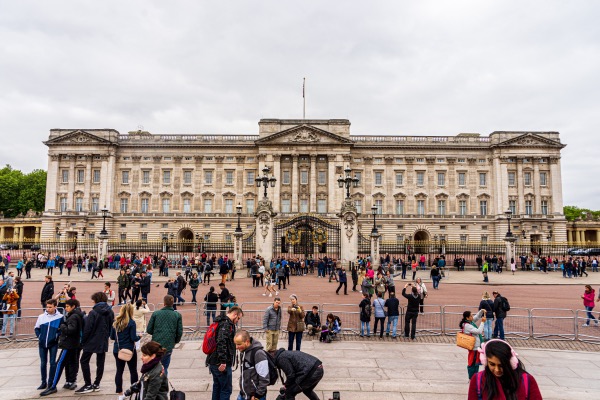
Buckingham Palace. PICTURE: Sung Shin/Unsplash

Foremost is Buckingham Palace, the official residence and office of the monarch – Queen Elizabeth II – in London. The palace – acquired for the Crown by King George III in 1761, converted to a palace by King George IV and first lived in by Queen Victoria – is also used for State ceremonies and for official entertaining.
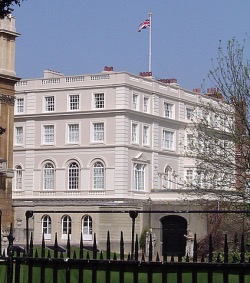
Clarence House. PICTURE: ChrisO (licensed under CC BY-SA 3.0)

Other royal residences include Clarence House which is the official London residence of Prince Charles and Camilla, Duchess of Cornwall.

The property was built between 1825 and 1827 to the designs of John Nash for Prince William Henry, Duke of Clarence (hence the name).

It was the home of Queen Elizabeth, the Queen Mother, between 1953 and her death in 2002, and was also temporarily the home of the then-Princess Elizabeth and Prince Philip following their marriage in 1947.
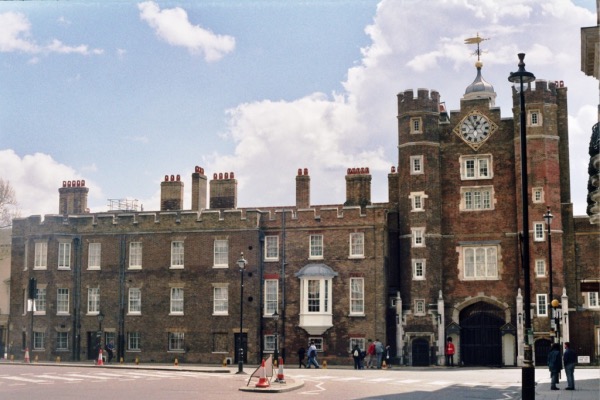
St James’s Palace. PALACE: Elisa.rolle (licensed under CC BY-SA 3.0)

St James’s Palace, which was largely built by King Henry VIII and served as the residence of numerous monarchs until King William IV, also remains the home of several members of the Royal Family – including Princess Anne and Princess Alexandra – and their household offices.

The State Apartments are sometimes used for entertaining during in-coming State Visits, as well as for other ceremonial and formal occasions. Its history means diplomats are still accredited to the Court of St James.
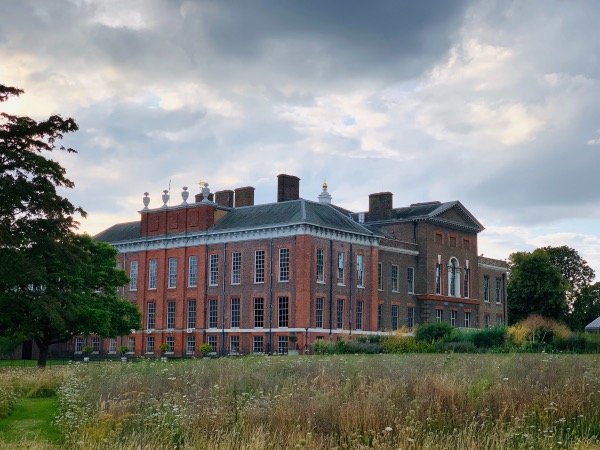
Kensington Palace. PICTURE: Pranav Thombare/Unsplash.

Kensington Palace – childhood home of Queen Victoria and favoured residence of monarchs from King William III to King George II – is these days the official London residence of Prince William and Katherine, the Duchess of Cambridge.

It also contains the London residences and offices of the Duke and Duchess of Gloucester, the Duke and Duchess of Kent and Prince and Princess Michael of Kent.

While Hampton Court Palace, the Tower of London, Kew Palace and the remnant of the Palace of Whitehall known as the Banqueting House are all royal palaces, they ceased being used regularly for royal court purposes in the 18th century and are now in the care of Historic Royal Palaces (along with parts of Kensington Palace).
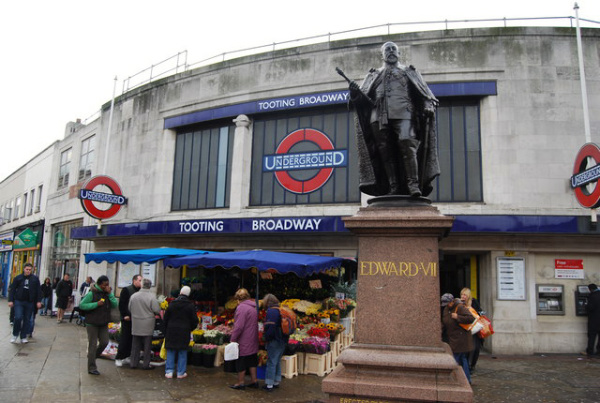
10 (lesser known) statues of English monarchs in London…4. King Edward VII…

PICTURE: Nigel Chadwick (licensed under CC BY-SA 2.0)
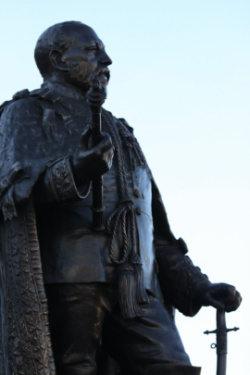
PICTURE: Singh (licensed under CC BY-NC-ND 2.0)

It’s a rather incongruous place for a king. Standing outside the entrance to Tooting Broadway Underground Station is a large-than-life statue of King Edward VII, who ruled from 1901-1910.

Erected in 1911 after the King’s death, the statue is the work of Louis Fritz Roselieb (later Roslyn) and was funded through a public subscription.

The statue depicts the King in royal regalia holding a sceptre in his right hand with his left hand resting on his sword hilt. The plinth features bronze reliefs on either side depicting representations of ‘peace’ and ‘charity’.

Given Tooting Broadway Underground Station didn’t open until 1926, the statue wasn’t initially located in relation to it.

In fact, it was originally located on a traffic island a short distance from its current siting but was moved after the area was remodelled in 1994.

It isn’t, of course the only statue of King Edward VII in London – the more well known one can be found in Waterloo Place. It was unveiled by his son, King George V, in 1921.

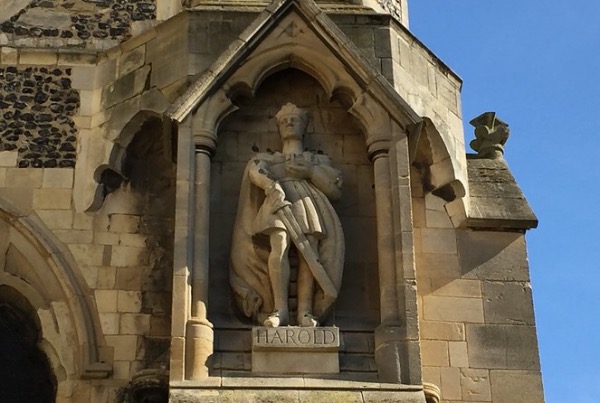
10 (lesser known) statues of English monarchs in London…3. King Harold Godwinson…

PICTURE: Matt Brown (licensed under CC BY 2.0)

Depicting the last crowned Anglo-Saxon king who famously died at the Battle of Hastings, this statue is located in a niche on the exterior of Waltham Abbey Church on the north-eastern outskirts of Greater London.

The life-sized statue was the work of Canadian-born, Dorset-based, sculptor Elizabeth Muntz and was erected in the 1960s.

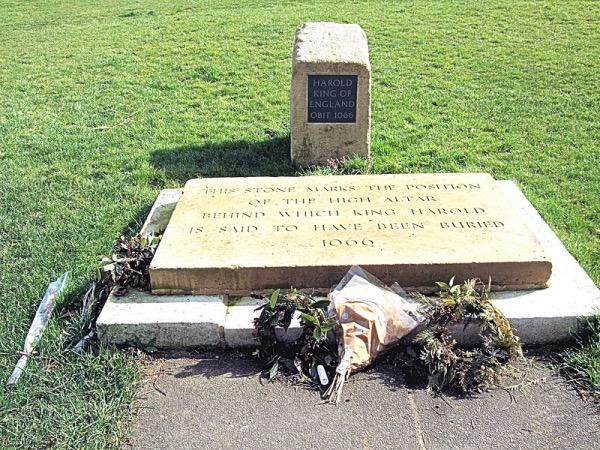
King Harold, also known as King Harold II, not only rebuilt the abbey church (apparently after he was healed of paralysis on a pilgrimage to Waltham), the abbey is also a possible site for his grave.

The grave is marked by a memorial stone now located in the churchyard which was erected in 1960. The inscription says the stone marks the position of the former church’s high altar. King Harold is said to have been buried behind this in 1066 after he was killed, according to tradition, by a well-aimed arrow to the eye at the Battle of Hastings (the church was rebuilt in the 12th century which explains why the altar is now located outside).

There are alternate theories for his burial place including in Bosham, West Sussex.

PICTURE: Jim Linwood (licensed under CC BY 2.0)

This Week in London – Tulips at Hampton Court; new Falklands-related displays at the IWM; and, a new garden for The Regent’s Park…

Hoping you have a wonderful Easter break.

PICTURE: © Historic Royal Palaces

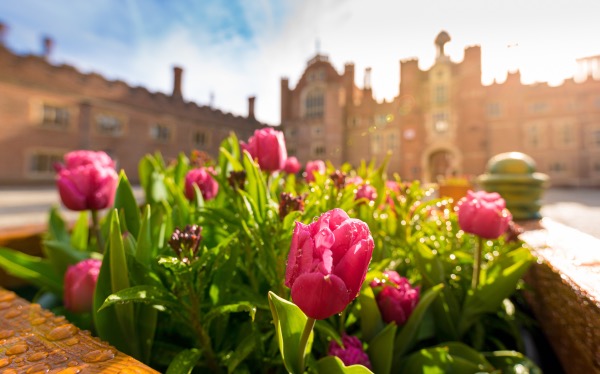
Hampton Court Palace’s Tulip Festival – the largest of its kind in the UK – is returning following its successful inaugural year in 2021. From Friday until 2nd May (depending on flowering periods), the palace’s 60 acres of formal gardens are expected to be filled with rare, historic and specialist tulip varieties inspired by Queen Mary II’s famous 17th century collection which was once housed at the palace. Some 120,000 tulip bulbs of 60 different varieties have been planted, including breath-taking floating tulip vases located in the palace’s famous fountains, and floral displays which will fill the cobbled courtyards of Base Court and Clock Court. Visitors will be able to find out all about the links between the flower and the palace’s history with a dedicated Tulip Festival Guide. Included with admission. For more, head here.

New exhibits marking the 40th anniversary of the Falklands Conflict have gone on show at the Imperial War Museum in Lambeth. Among the new items on display are drawings by Linda Kitson, the first female artist commissioned by IWM to accompany troops into conflict, and images of the conflict – many of which have never been seen before – taken by photographer Paul RG Haley who covered it for Soldier Magazine. The museum is also exploring the story and legacy of the conflict through a digital programme of events including a series of short films and a new episode of the Conflict of Interest podcast featuring actor Katherine Parkinson. For more, see www.iwm.org.uk.

The Regent’s Park will soon boast a new 1.5 acre garden at its centre in honour of Queen Elizabeth II’s Platinum Jubilee. The new garden, to be created on the site of a former plant nursery near the Inner Circle, will include design features that reflect the Queen’s “love of trees and nature”. The Royal Parks will be committing £1 million to the project and will seek external funding and public donations. Designs for the new park will be shared as they are developed. Meanwhile, The Royal Parks have also announced they will be creating a new wood in Richmond Park as part of the Queen’s Green Canopy Initiative. The new woodland, which will be located adjacent to Ham Cross, will be planted with 70 large trees, each one to mark a year of Her Majesty’s reign.

Send all items to exploringlondon@gmail.com.

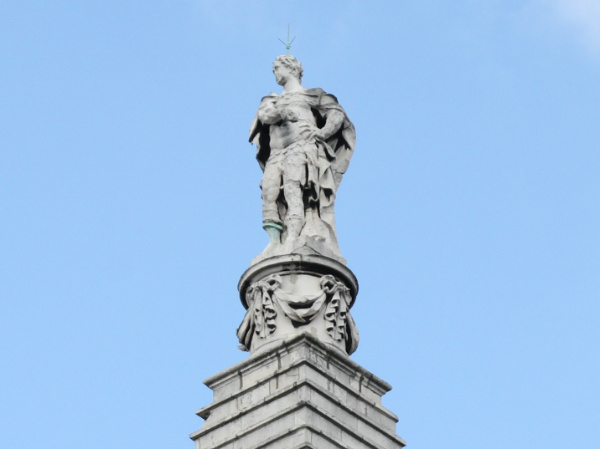
10 (lesser known) statues of English monarchs in London…2. King George I above St George’s…

The weathered statue of King George I. PICTURE: Wongleism (licensed under CC BY-NC-ND 2.0)

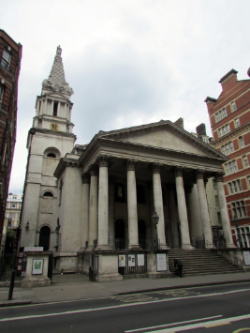
Perched atop the stepped pyramid steeple of St George’s Church in Bloomsbury is a statue of King George I – the only statue of the king in London.

St George’s Bloomsbury with its stepped pyramid spire. PICTURE: Reading Tom (licensed under CC BY 2.0)

The larger-than-life-sized Portland stone statue is the work of Edward Strong who was master mason on the building of the church. It depicts the king in Roman costume standing atop a Roman altar.

The steeple, described as the “most eccentric” in London, also features statues of two unicorns and two lions at its base – both symbols of the Royal Coat of Arms of the UK – the lions representing England and the unicorns Scotland – and included apparently as a comment on Hanoverian succession. These were also originally the work of Strong but the originals disappeared in the 1870s and those now present are replicas which themselves recently underwent a restoration.

The stepped pyramid spire is said to have been influenced by Pliny the Elder’s description of Mausoleum at Halicarnassus.

Horace Walpole famously referred to the statue of King George in verse:

When Henry VIII left the Pope in the lurch,
The Protestants made him the head of the church,
But George’s good subjects, the Bloomsbury people
Instead of the church, made him head of the steeple. 

A Moment in London’s History – The martyrdom of St Alphege…

This month marks the 1010th anniversary of the murder of Alphege, the Archbishop of Canterbury, by Vikings in Greenwich.

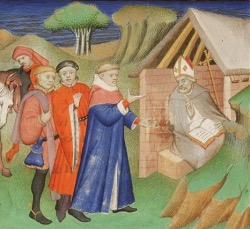
St Alphege, Archbishop of Canterbury, is asked for advice in this early 15th century manuscript from Paris.

Alphege, also known as Ælfheah and Alfege, had been kidnapped from Canterbury during a Viking raid in September, 1011. Alphege’s captors were said to have been seeking a huge sum for his ransom – some 3,000 gold marks, reports the monk Osbern – but that, knowing such a sum would bring starvation upon the people under his care, he refused to allow himself to be ransomed – for money or anything else – and this drew the anger of his captors.

According to the Anglo-Saxon Chronicle, one day, seven months after his kidnapping – on 19th April, 1012, the Vikings were drunk and, had the elderly archbishop brought before their assembly. Then, in an act of execution, they began throwing ox bones and heads at the unfortunate archbishop before one of them struck him on the back of the head with the butt of an axe, killing him.

According to tradition, the murder took place on the site of St Alfege’s Church in Greenwich. A contemporary account also tells that a Viking lord named Thorkell the Tall, a Christian convert, had tried to save the archbishop’s life – offering everything he owned except his ship in exchange for the cleric’s life – but failed (interestingly, so appalled was Thorkell at the murder that he switched sides and fought for the English king Ethelred the Unready following Alphege’s death). There is also an account that the fatal blow was actually delivered by a Christian converted named Thrum as an act of mercy.

Alphege’s body was recovered and he was buried in St Paul’s Cathedral in London. In 1023, the body was moved by King Cnut to Canterbury in a gesture of goodwill to the English. The first Archbishop of Canterbury to meet such a violent end, he was canonised in 1078.

There is a memorial stone to the saint set in the floor in front of the altar in the Greenwich church.

This Week in London – Japanese works at the Queen’s Gallery; Raphael at The National Gallery; Food Season at the British Library; and, Enid Marx’s Blue Plaque…

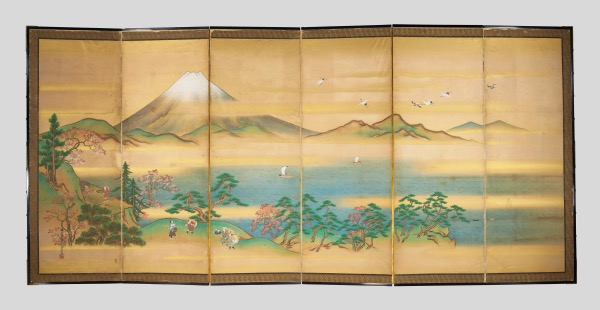
Itaya Hiroharu, folding screen paintings, 1860. Sent to Queen Victoria by Shōgun Tokugawa Iemochi, 1860.

A first-of-its-kind exhibition featuring the Royal Collection’s Japanese works of art opens at the Queen’s Gallery, Buckingham Palace, tomorrow. Japan: Courts and Culture, features more than 150 works including rare porcelain, samurai armour, woodcut prints, embroidered screens and a range of diplomatic gifts sent during the reigns of monarchs ranging from King James I to Queen Elizabeth II. Among the highlights are a pair of folding screens sent to Queen Victoria in 1860 from the Japanese Shōgun Tokugawa Iemochi which will go on public display for the first time since they arrived at the British court 162 years ago. The screen paintings, which depict the changing seasons, were not thought to have survived but in recent years research has revealed the two screens were the work of Itaya Hiroharu, one of the artists likely to have worked on Queen Victoria’s gifts. Also included in gift was a set of lacquer furniture, spears inlaid with glittering mother of pearl, and swords made by leading court swordsmiths – all of which will also be on display. Admission charge applies. Runs until 26 February, 2023. For more, see www.rct.uk.

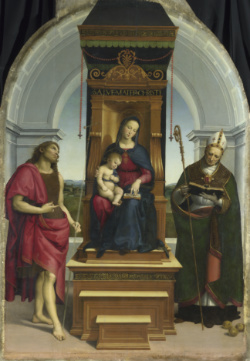
Raphael, The Madonna and Child with Saint John the Baptist and Saint Nicholas of Bari (‘The Ansidei Madonna’) (1505), © The National Gallery, London

• Marking the 500th anniversary of the death of Raphael, one of the first-ever exhibitions to explore the complete career of this giant of the Italian Renaissance opens at The National Gallery on Saturday. The Credit Suisse Exhibition: Raphael, which was supposed to be held in 2020 and was delayed due to the coronavirus pandemic, features more than 90 exhibits. They include a rare gathering of Raphael’s paintings of the Virgin and Child including Ansidei Madonna (The Virgin and Child with Saint John the Baptist and Saint Nicholas of Bari) (1505), two bronze roundels – The Incredulity of Saint Thomas and The Descent into Limbo – from Santa Maria della Pace which have never previously exhibited outside Italy and which are attributed to Cesarino Rossetti after designs by Raphael, and a room devoted to Raphael’s frescoes for Pope Julius II’s private apartments. There are also several of his original print designs, an survey of ancient Rome he undertook for Pope Leo X, tapestry designs including Saint Paul Preaching at Athens (workshop of, or on behalf of, Pieter van Aelst, active about 1490–1533, after design by Raphael, about 1517–19), and portraiture from his final years including Portrait of Lorenzo de’ Medici (1518) and Portrait of Baldassare Castiglione (1519). Admission charge applies. Runs until 31st July. For more, see www.nationalgallery.org.uk/exhibitions/the-credit-suisse-exhibition-raphael.

• The British Library’s Food Season kicks off today with almost two months of online and in-person events inspired by the cookbooks, recipes and culinary stories in the collection. Highlights include chef Ainsley Harriott talking about his life and career with food-writer Melissa Thompson, food-writer Maunika Gowardan celebrating India’s breadth of food cultures with chefs and food-writers including Ravinder Bhogal, Romy Gill, Kavi Thakrar and Farokh Talati, chef and broadcaster Andi Oliver discussing Jessica B Harris’ 50- year career examining the history and meaning of food for the African diaspora, and psychologist Kimberley Wilson chairing a discussion about the food prisoners are fed inside British correctional institutions and if it impacts rehabilitation. Now in its fifth year, the 2022 Food Season is supported by KitchenAid. For the full programme of events, head to www.bl.uk/events/food-season.

Textile designer Enid Marx – famous for her seat fabric designs on the London Underground – has been honoured with an English Heritage Blue Plaque. The plaque was unveiled this week at her former home at 39 Thornhill Road where she lived and worked for more than 30 years. Marx, who shared the house with her partner, Margaret Lambert, and friends Eleanor Breuning and Grace Lambert (Breuning continues to live at the house today), had a purpose-built studio in the back garden which remains in similar condition to when she left it almost 25 years ago. Alongside her work for the London Underground, Marx also is known for her design of postage stamps marking the start of Queen Elizabeth II’s reign in 1953. For more, see www.english-heritage.org.uk/visit/blue-plaques/.

10 (lesser known) statues of English monarchs in London…1. King Edward VI at St Thomas’…

In honour of Queen Elizabeth II’s Platinum Jubilee, we have a new series looking at 10 lesser known statues of previous monarchs in London.

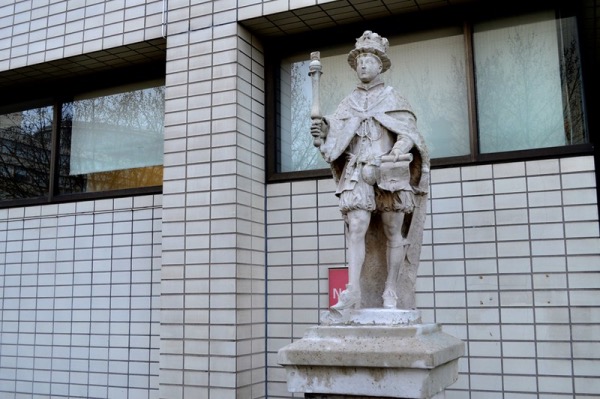
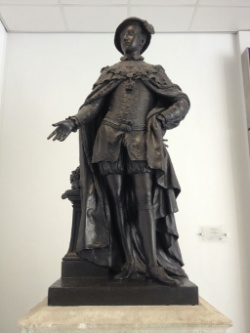
We kick off with not one, but actually two, statues of King Edward VI, the son of King Henry VIII and his third queen, Jane Seymour, can be found at St Thomas Hospital in Southwark.

Both of the statues were commissioned to commemorate the king’s re-founding of the hospital – which had been first founded in the 12th century and had been closed in 1540 as part of the Dissolution – in 1551 and which saw the complete rebuilding of the hospital under the stewardship of the hospital’s President, Sir Robert Clayton.

The 1682 statue. PICTURE: Matt Brown (licensed under CC BY 2.0)

The oldest of the statues, now located outside the north entrance to the hospital’s North Wing on Lambeth Palace Road, was designed by Nathaniel Hanwell and carved from Purbeck limestone by Thomas Cartwright in 1682.

Peter Scheemakers’ bronze of King Edward VI. PICTURE: Secretlondon (licensed under CC BY-SA 3.0)

It originally was part of a group – the King standing at the centre holding his raised sceptre surrounded by four figures which were innovative in that they depicted patients of the time – which adorned the gateway to the hospital on Borough High Street.

It was moved when the gate was widened in around 1720 and subsequently occupied several different positions – including spending some time in storage – before eventually, without the surrounding figures, being moved to its current position in 1976. It was designated a Grade II* monument in 1979.

The second of the two statues is a bronze figure in period dress which was created by sculptor Peter Scheemakers in 1737.

It can now be found inside the hospital’s North Wing, having been moved there last century, and like its counterpart, was designated a Grade II* monument in 1979.

The inscription on the front of the plinth describes the King as “a most excellent prince of exemplary piety and wisdom above his years, the glory and ornament of his age and most munificent founder of this hospital” and adds that the statue was erected at the expense of Charles Joye, Treasurer of the hospital.

This Week in London – Anne Boleyn’s heraldic badge at Hampton Court; and, St Patrick’s Day parade returns…

Queen Anne Boleyn’s carved heraldic badge. PICTURE: Courtesy of Historic Royal Palaces.

Five hundred years after Queen Anne Boleyn is recorded as first appearing before her future husband, King Henry VIII, her carved heraldic badge has gone on show at Hampton Court Palace. The blackened oak carving, which features a crowned falcon atop a tree stump flowering with Tudor roses, was discovered by antiques expert Paul Fitzsimmons. While it had been covered in centuries of soot, grime and wax, conservation saw the removal of a layer of black paint to reveal the original colouring of white, gold and red. Subsequent research revealed the carving’s similarity to the 43 surviving falcon badges with the ‘frieze’ above the windows and hammer beams in the palace’s Great Hall, leading researchers to believe that the carving is an element of the room’s original Tudor scheme. Records show one Michael Joyner was paid to create carvings of the King’s and Queen’s badges. Following Boleyn’s downfall and Henry VIII’s subsequent marriage to Jane Seymour, craftsmen were paid to overpaint the former Queen’s white falcons in black, severing their association with her. Boleyn, who first appeared before Henry playing the role of Perseverance in a court masque, first started using the white falcon as her device around the time she was created Marquess of Pembroke, shortly before her public marriage to Henry in 1533. After her marriage and coronation, new imperial falcon badge was created, featuring the crown and sceptre. The badge can be seen in the Great Hall (included in general admission). For more, see www.hrp.org.uk/hampton-court-palace/.

St Patricks’ Day will be marked in London this weekend for the first time in three years with a parade through central London and festivities in Trafalgar Square. The annual parade of Irish marching bands and dancers will start at Green Park at noon on Sunday and wind its way through the streets to Whitehall. Trafalgar Square, meanwhile, will play host to a line-up of Irish talent from noon to 6pm on Sunday with family-friendly concerts, storytelling, children’s films and youth performances, as well community choirs, schools, dance troupes and children’s workshops featuring camogie games, medal-making and face painting as well as a food and drinks stalls. For the full programme, head to www.london.gov.uk/st-patricks.

Send all items to exploringlondon@gmail.com

10 historic stairways in London – 9. ‘Two Princes Staircase’, Tower of London… 

The White Tower with external staircase – they’re not the stairs we’re talking about, a remnant of them is located in the niche you can see about half way up the external staircase. PICTURE: Amy-Leigh Barnard/Unsplash.

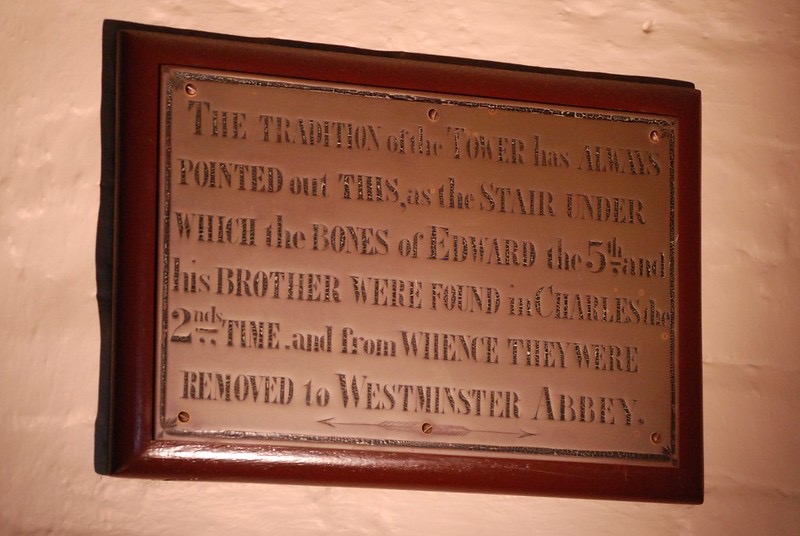
A truncated staircase – really just a few steps – located near the entrance to the White Tower is famous – or perhaps infamous is a better word – for its connection with the so-called ‘Princes in the Tower’ – the 12-year-old King Edward V and his nine-year-old brother, Richard, Duke of York, who disappeared after entering the Tower of London in the late 15th century.

While the princes are believed to have been held in the Bloody Tower, their connection with the staircase, which is located in a doorway niche halfway up the main outer stairway into the White Tower, dates to 1674.

King Charles II had ordered the demolition of what was left of the royal palace to the south of the White Tower and during those works a wooden chest containing two skeletons was discovered beneath the foundations of a staircase which had led up to St John’s Chapel.

Many have subsequently believed the skeletons to be those of the two princes.

A plaque located near the staircase remnant at the Tower of London. PICTURE: Ian McKellar (licensed under CC BY-SA 2.0)

The princes had been taken to the tower in April, 1483, following the death of their father, King Edward IV, on the 9th of that month. Their uncle, Richard, Duke of Gloucester (and the Lord Protector of his nephews), had done so, ostensibly for their protection, while Edward’s coronation was initially scheduled for June.

The last recorded reference to them being in the tower dates from 16th June when they were seen “shooting [arrows] and playing in the garden of the Tower sundry times”.

There has since been much debate over their fate with many believing Richard, who in July of that year was crowned King Richard III, had them murdered to ensure his own ascension to the throne.

The two skeletons found almost 200 years later were put on display for several years following their discovery before King Charles II ordered that they be placed in an urn and reburied in the Henry VII Chapel in Westminster Abbey. In 1933, they were disinterred and forensically examined by LE Tannery and W Wright who concluded they were the skeletons of two boys, aged 10 and 13. They were subsequently reinterred and have remained buried since. They have never been tested for DNA.

Historic Royal Palaces Chief Curator Lucy Worsley and special guests will look at the question of whether the urn should be opened and the bones tested using modern forensic methods in an online event on 16th March at 7pm. Follow this link to register for this event.

WHERE: Tower of London (nearest Tube station Tower Hill); WHEN: 9am to 4.30pm (last admission), Tuesday to Saturday, 10am to 4.30pm (last admission) Sunday to Monday; COST: £29.90 adults; £14.90 children 5 to 15; £24 concessions (family tickets available; discounts for online purchases/memberships); WEBSITE: www.hrp.org.uk/toweroflondon/.

10 historic stairways in London – 8. The King’s Staircase, Kensington Palace… 

PICTURE: Tuomo Lindfors (licensed under CC-BY-NC-SA 2.0)

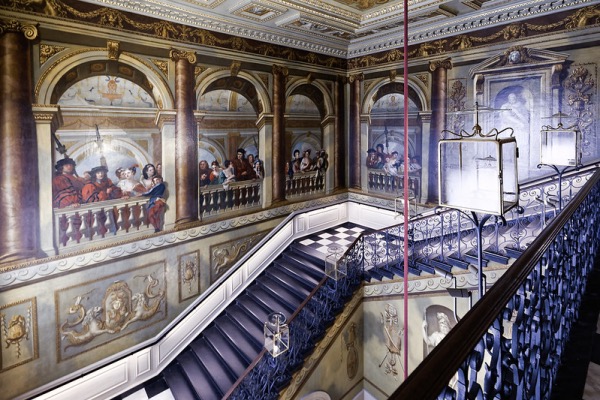
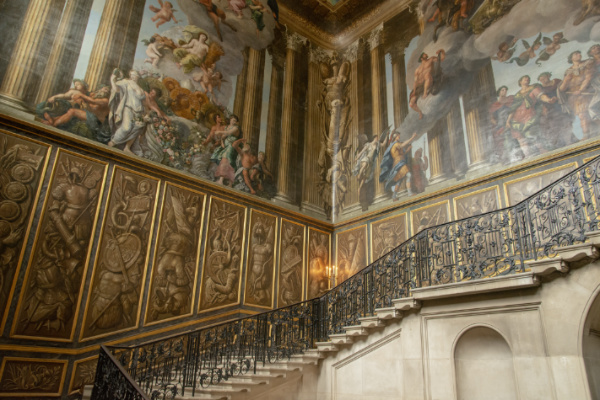
This staircase, a grand entrance to the King’s State Apartments at Kensington Palace, are famous for the paintings on the walls and ceiling which depict an 18th century court looking down on those who ascend.

The work of William Kent, the staircase paintings were complete in 1724 and replaced earlier wooden panelling.

The stairs were originally constructed as part of Sir Christopher Wren’s remodelling Nottingham House into Kensington Palace for King William III and Queen Mary II. Following a fire in 1691, they were rebuilt in marble.

There are 45 people in Kent’s painting and only about a dozen have been identified. As well as members of the Yeomen of the Guard, the images depict King George I’s Polish page Ulric, his Turkish servants Mahomet and Mustapha, Peter the ‘wild boy’, a child found in the woods in Germany, and Dr John Arbuthnot, a medical doctor and satirist who tried to teach Peter to speak.

Interestingly, Kent included a selfie on the ceiling – a depiction of himself, wearing a brown turban and carrying an artist’s palette, standing with his mistress by his side.

The trompe l’oeil (a technique which creates the optical illusion of 3D) work features architecture inspired by Rome where Kent had trained while there’s also a painted figure of Diana on the top landing which is based on an antique statue at Holkham Hall in Norfolk.

In 1734, Queen Caroline commissioned Kent to rework the stairs to the Queen’s State Apartments. His work there features a Roman-inspired scene again created as a trompe l’oeil. There is also a homage to Queen who is compared to Britannia. The staircase’s balustrade was another by Huguenot ironworker Jean Tijou.

WHERE: The Broad Walk, Kensington Gardens, Kensington (nearest tube stations are High Street Kensington or Queensway); WHEN: Daily 10am to 6pm (last admission 5pm); COST: £16 adult/£12.80 concession/£8 child (Historic Royal Palaces members free); WEBSITE: www.hrp.org.uk/KensingtonPalace.

Where’s London’s oldest…embassy?

Another ‘oldest’ question that’s not as simple as it might seem.

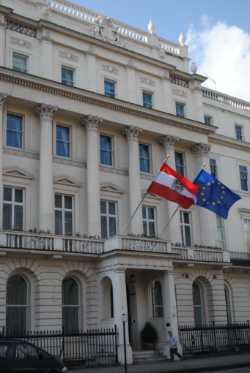
Austrian Embassy, Belgrave Square. PICTURE: David Adams

Austria has occupied a building at 18 Belgrave Square in Belgravia since it moved there from Chandos House in Queen Anne Street in 1866.

But the embassy was vacated with the outbreak of World War I and the building entrusted, firstly to the protection of the ambassador of the United States, and following the severing of their relations in 1917, to the Royal Swedish Legation.

The Austrians returned in 1920 but following Hitler’s incorporation of Austria into the German Reich in 1938, it was used as a department of the German Embassy.

Following the outbreak of World War II, the Swiss legation room over protection of the building and following the end of the war the damaged building fell under the care of Britain’s Ministry of Works.

The Austrians returned in September, 1948, with the new ambassador arriving in 1952. It continues today to serve as the residence of the Austrian Ambassador.

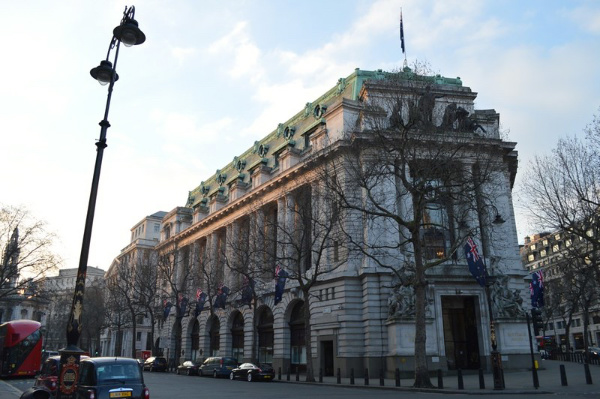
Australia House. PICTURE: Matt Brown (licensed under CC BY 2.0)

Not to be confused with the Austrians, the Australian High Commission resides in ‘Australia House’ which claims to be “the longest continuously occupied foreign mission in London”.

In 1912, the Australian Government bought the freehold of a site on the corner bounded by Strand, Aldwych and Melbourne Place. Following a design competition, Scottish architects A Marshal Mackenzie and Son were selected as the designers of the new Australia House with Commonwealth of Australia’s chief architect, Mr JS Murdoch, arriving in London to assist them.

Work began in 1913 – King George V laid the foundation stone – but was interrupted by World War I and in 1916, former Australian PM and now High Commissioner Andrew Fisher moved into temporary offices on the site even as the work continued around him. King George V officially opened Australia House on 3rd August, 1918, with then Australian Prime Minister, WM “Billy” Hughes, in attendance.

A Moment in London’s History – The execution of Catherine Howard…

It’s 480 years this month since Catherine Howard, fifth wife of Henry VIII of England, was executed for treason inside the Tower of London.

Unknown woman, formerly known as Catherine Howard after Hans Holbein the Younger (oil on panel, late 17th century/NPG 1119 © National Portrait Gallery, London

Catherine, who it has been suggested may have been just 17-years-old when she died, was beheaded on the morning of 13th February, 1542, less than two years after her hastily arranged marriage to the King, just three weeks after his prior marriage to Anne of Cleves was annulled.

Catherine, also spelt as Katherine, was condemned to death after a young noble named Francis Dereham admitted, under torture, to having a sexual relationship with her prior to her marrying the king, and, more importantly, Thomas Culpeper, a Gentleman of the King’s Privy Chamber, who admitted to having an affair with her after her marriage.

Both men were executed at Tyburn following their admissions and their heads were displayed on London Bridge. Catherine sailed under it aboard a barge as she was taken to the Tower on 10th February, 1542.

She is said to have spent the night before her execution practising placing her head on the block – which was brought to her at her request.

Catherine was beheaded with the single stroke of a headsman’s axe on Tower Green – King Henry did not attend but some of her cousins, including the Earl of Surrey, were among the witnesses.

She was said to have been composed, although she needed help mounting the scaffold. It’s often said that her last words were “I die a Queen, but I would rather have died the wife of Culpeper” but there’s no eyewitness report which suggests this and instead she is believed to have stuck to a more traditional script, saying her punishment was just for her crimes and asking forgiveness.

Her maid – Jane Boleyn, Lady Rochford – followed her to the block for her role in facilitating the affair while Henry was away from court. Catherine had apparently spent the night before practising how to lay her head upon the block.

Catherine was buried in an unmarked grave at in the Chapel of St Peter ad Vincula next to Tower Green – there’s a memorial to her in the church. The Queen’s ghost is famously said to be present in what’s known as the ‘Haunted Gallery’ at Hampton Court Palace – it is here that, when she was arrested, she apparently broke free from her guards and ran to the doors of the Chapel Royal where she believed the king was at prayer. Needless to say, her cries for mercy went unanswered.

Memorial stone set in the floor of the Chapel of St Peter ad Vincula. PICTURE: VCR Giulio19/Wikipedia (licensed under CC BY-SA 4.0)

Treasures of London – The Solebay Tapestry…

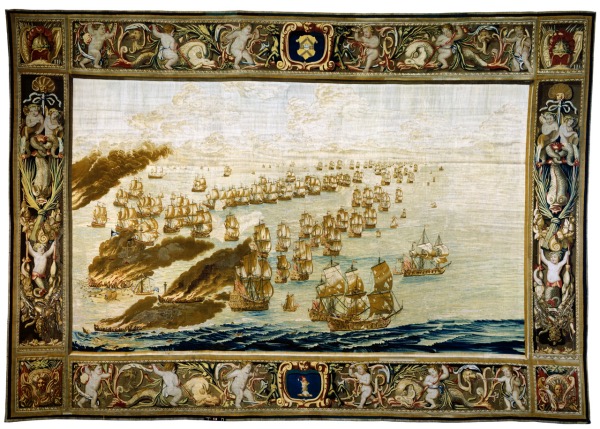
The Burning of the Royal James at the Battle of Solebay, 28 May 1672 © National Maritime Museum, London

A monumental tapestry – and the only surviving one of its era depicting an English naval scene, the Solebay Tapestry was actually one a series of six designed by father and son team, Willem Van de Velde the Elder and Younger.

Commissioned by King Charles II and his brother, James, Duke of York (later King James II), the tapestry known as The Burning of the Royal James at the Battle of Solebay, 28 May 1672 – commemorates the Battle of Solebay, a naval battle fought in Southwold Bay off the coast of Suffolk on 28th May, 1672. The first battle of the Third Anglo-Dutch War, it ended with both sides claiming victory and was the final naval battle in which James was engaged.

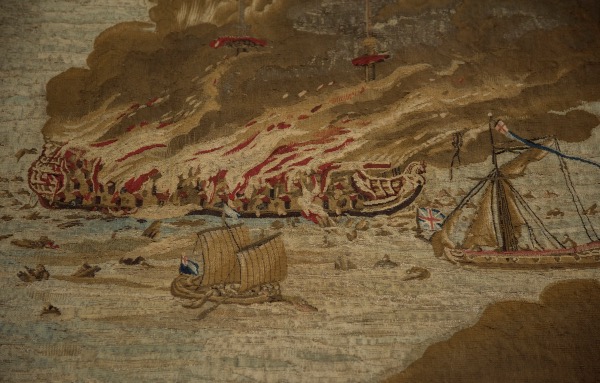
It depicts the dramatic climax of the battle and shows the Royal James engulfed in flames after it was set alight by Dutch fireships. Edward Montagu, the first Earl of Sandwich whose was aboard the Royal James, died in the attack.

Detail from the Solebay Tapestry, showing the burning of the ‘Royal James’, before conservation. © National Maritime Museum, London

William Van de Veldes the Elder, who was a contemporary of Rembrandt and, along with his son, is considered the founder of English maritime painting, was present at the battle and made a series of sketches from a boat at the scene (he was actually there for the Dutch, not the English).

Subsequently commissioned to reimagine the battle from the English point-of-view, it was the studios of the Van de Velds in the Queen’s House in Greenwich that a series of ‘cartoons’ – large-scale paper designs – were produced using the sketches.

These were then presented to weavers who, once thought to have been based in Mortlake but now believed to have been based in either at Clerkenwell or Hatton Garden, used them to create the tapestries.

The tapestry in the collection of Royal Museums Greenwich was displayed behind King George VI during his speech at the opening of the National Maritime Museum in 1937 but hasn’t been able to be displayed for the past 22 years due to its fragile condition.

In urgent need of repair, the first phase of a conservation project was completed last year. Royal Museums Greenwich has now launched an urgent crowdfunding campaign through ‘Art Happens with Art Fund’ to raise £15,000 for the completion of the project. This will mean the tapestry can be included in an exhibition at the Queen’s House next February marking 350 years since the Van de Veldes’ arrival in England.

The crowdfunding campaign runs until 17th March. To contribute, head to www.artfund.org/save-solebay.

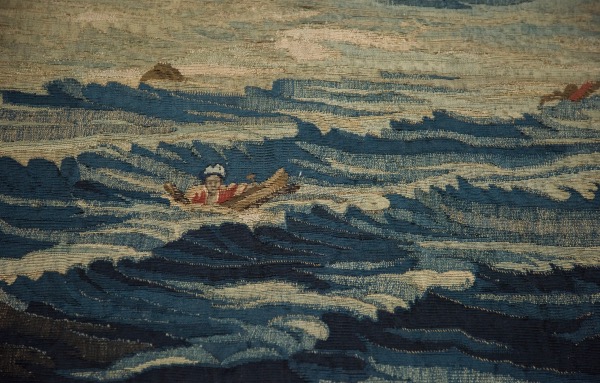
Detail from the Solebay Tapestry of sailor washed out to sea, taken in March 2019 before conservation. © National Maritime Museum, London

10 historic stairways in London – 5. The King’s Staircase, Hampton Court Palace…

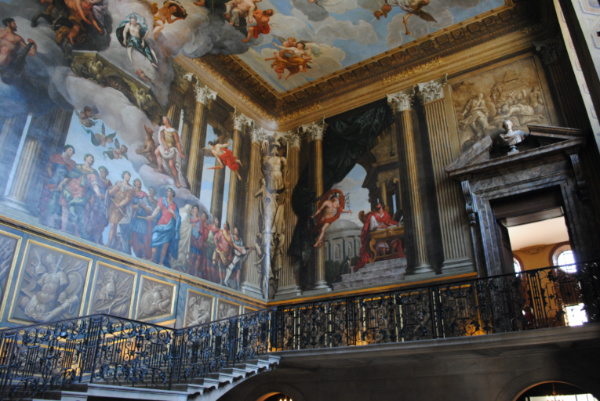
The King’s Staircase at Hampton Court Palace. PICTURE: Peter K Burian (licensed under CC BY-SA 4.0)

This grand staircase was installed in Hampton Court Palace during the reign of King William III and Queen Mary II as a grand entrance to the King’s Apartments.

The staircase, which features shallow steps, was designed Sir Christopher Wren and features a wrought iron balustrade designed by French ironsmith Jean Tijou.

Another view of the staircase and accompanying art. PICTURE: David Adams

It was decorated in about 1700 by Italian painter Antonio Verrio to resemble a Roman courtyard which is open to the sky. The main image depicts ‘Victory of Alexander over the Caesars’ which features King William III as Alexander the Great and is painted as an allegory of William’s triumph over the Stuart King, James II, in the Glorious Revolution of 1688 (with the Stuarts represented by the 12 Caesars).

The stairs lead up to the Guard Chamber, an anteroom which had to be passed through to reach the Presence Chamber.

Famous Londoners – John Flamsteed…

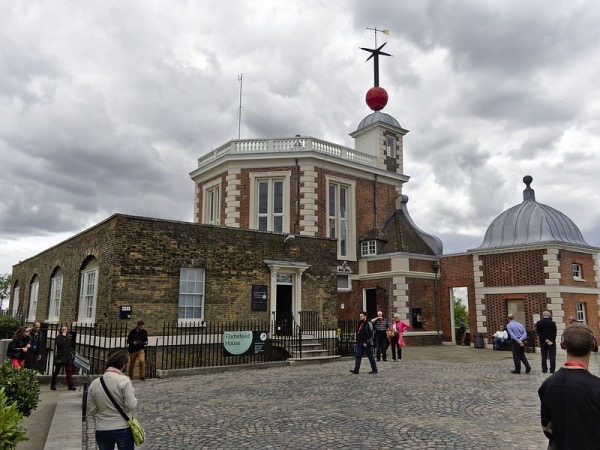
Memorialised in the name of the house where he once lived at the Royal Observatory in Greenwich, John Flamsteed was the first Astronomer Royal.

Flamsteed was born in Denby, Derbyshire, on 16th August, 1646, and was the only child of Stephen Flamsteed, who among other things was involved in the brewing industry, and his first wife Mary (who died when John Flamsteed was still quite young).

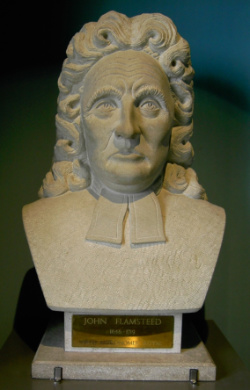
A bust of John Flamsteed at the Royal Observatory Greenwich.

He was educated at local schools but left off his studies at the age of 15 due to his own ill health and his father’s need for his assistance in the household and with his business.

His poor health meant he pursued some more sedentary activities and it was during this period that he established interest in astronomy, writing his first paper in 1665. Flamsteed did briefly attend Jesus College in Cambridge in the early 1670s, although it’s not thought he ever took up full residence.

Flamsteed was ordained a deacon and was preparing to take up a living in Derbyshire in 1675 – having by then obtained an MA from Cambridge – when his patron Jonas Moore, whom he’d met in the summer of 1670 during a visit to London and then visited again in mid-1674, invited him to return to the city, ostensibly to establish an observatory which Moore, who was Surveyor-General of the Ordnance, had offered to pay for.

Flamsteed arrived in February, 1675, stayed with Moore in the Tower before, after meeting King Charles II, was made an official assistant to a Royal Commission which the king had established charged with examining the merits of a proposal – put forward by a “le Sieur de St Pierre” to find longitude by the position of the Moon.

The commission decided the proposal wasn’t worth taking further but did recommend the establishment of an observatory from which the movement of the stars and Moon could be mapped in the hope of developing a method of finding longitude. Flamsteed was subsequently appointed “The King’s Astronomical Observator” – the first Astronomer Royal – on 4th March, 1675, by royal warrant, and in June that same year, another royal warrant provided for the founding of the Royal Greenwich Observatory. Flamsteed laid the foundation stone on 10th August.

He was admitted as a fellow of the Royal Society in February the following year and in July he moved into the observatory, now known as Flamsteed House (it contains famed Octagonal Room with large windows from which celestial events could be watched), which was designed by Sir Christopher Wren. It was to serve as Flamsteed’s home for next decade or so.

Flamsteed House, Royal Greenwich Observatory, its named after John Flamsteed. PICTURE: Dmitry Djouce.

Flamsteed’s achievements as an astronomer included the accurate calculation of the solar eclipses of 1666 and 1668 and recording some of the earliest sightings of Uranus which he mistakenly thought was a star. He was also in regular contact with many other scientific luminaries of the day and famously fell out with both Sir Edmond Halley (his one-time assistant and future successor as Astronomer Royal) and Sir Isaac Newton.

Flamsteed’s own catalogue of almost 3,000 stars wasn’t published until after death in 1725 thanks to the effort’s of his wife Margaret – whom he had married on 23rd October, 1692 (they were to have no children although Flamsteed’s niece, Ann Heming, did live with them). Margaret also published his star atlas, Atlas Coelestis, posthumously in 1729.

In 1684, Flamsteed was elevated to the priesthood and made rector of the village of Burstow, near Crawley in Surrey – a post, which, along with that of Astronomer Royal, he held until his death on 31st December, 1719.

He was buried in Burstow and there is a plaque on the wall of the church there marking his grave (which was added long after his death). Aside from his earthly honours – which includes the name of Flamsteed House at the Royal Observatory, a crater on the Moon is named after him as is an asteroid.

Treasures of London – Wren’s Great Model of St Paul’s Cathedral…

PICTURE: Andrea Vail (licensed under CC BY-ND 2.0)

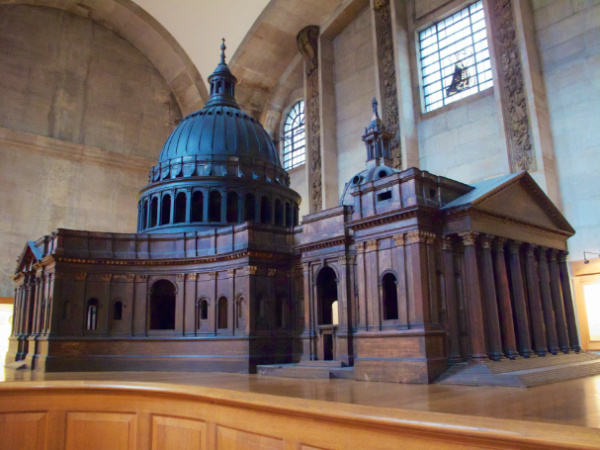
Housed now in the building it depicts, the Great Model of St Paul’s Cathedral was created by architect Sir Christopher Wren to show King Charles II what his proposed grand new English Baroque cathedral would look like (following the destruction of the medieval cathedral in the Great Fire of 1666).

Made of oak, plaster and lime wood, the model was made by William Cleere to Wren’s design in between September, 1673, and October, 1674, at a scale of 1:25. It measures 6.27 metres long, 3.68 metres wide and more than four metres tall, making it one of the largest in the UK.

The model, which cost about £600 to make – an extraordinary sum which could apparently buy a good London house, was designed to be “walked through” at eye level and, as well as being a useful way to show the King what the proposed building would look like, was also something of an insurance policy in case something happened to Wren.

It was based on drawings made by Wren and his assistant Edward Woodroofe on a large table in the cathedral’s convocation or chapter house (later demolished in the early 1690s) and was originally painted white to represent Portland stone with a blue-grey dome and gilded details.

There are some differences between the model and the finished cathedral – among them was a substantial extension of the quire, double-height portico on the west front, and, of course, the bell towers on the west front which were made in place of the cupola which was located halfway down the nave on the model.

Part of an earlier wooden model from 1671 also survives – it was apparently lost for many years and rediscovered in 1935.

The Great Model can be seen on tours of the Triforium.

WHERE: St Paul’s Cathedral (nearest Tube stations are St Paul’s, Mansion House and Blackfriars); WHEN: 8.30am to 4.30pm Monday to Saturday; COST: £21 adults/£18.50 concessions/£9 children/£36 family (these are walk-up rates – online advanced and group rates are discounted); WEBSITE: www.stpauls.co.uk (for tours, head to www.stpauls.co.uk/visits/visits/guided-tours)

10 historic stairways in London – 2. Queen Mary’s Steps, Whitehall…

PICTURE: Paul Farmer (licensed under CC BY-SA 2.0).

This small stone stairway which now sits in the midst of a grassy expanse at the back of the Ministry of Defence was once part of the Palace of Whitehall.

Named for Queen Mary II, wife of King William III, for whom they were designed, the stairs were part of a terrace built in 1691 abutting the Thames in front of an old river wall constructed for King Henry VIII.

Designed by Sir Christopher Wren, the stairs were one of a pair located at either end of the terrace which gave direct access to the river – and state barges – from the Royal Apartments.

Excavations in 1939 during construction of the MoD revealed the Tudor river wall, the terrace and the northern-most of the two flights of steps. The upper part of the steps have been repaired and the terrace and wall reconstructed.

The steps and palace fragments are now a Grade I listed monument.

LondonLife – A Christmas menagerie at the Tower…

ALL PICTURES: © Historic Royal Palaces.

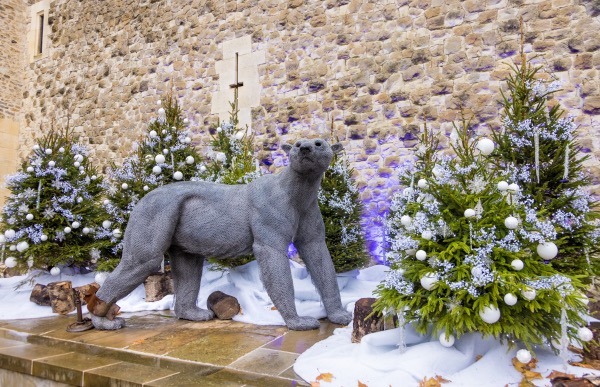
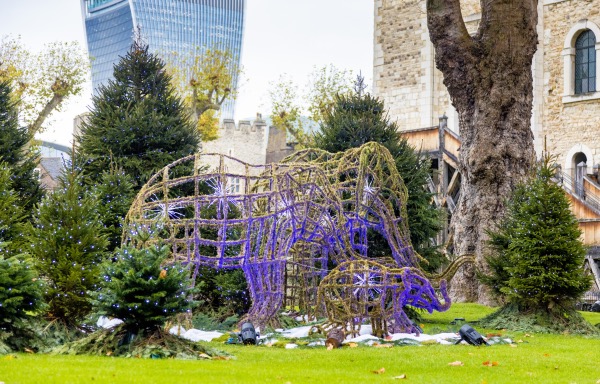
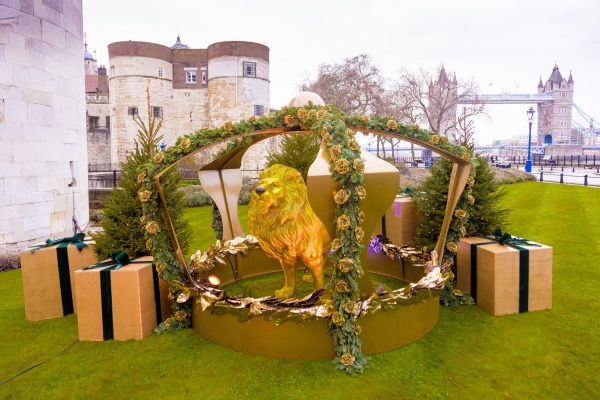
The Royal Menagerie at the Tower of London has been decked out for Christmas with an array of glittering decorations. Animals including a polar bear, elephants and lions were kept at various times in the Tower’s menagerie which started thanks to a royal penchant to giving exotic animals as gifts to fellow monarchs. King Edward I created the first permanent home for the menagerie which, after hundreds of years, closed for good in 1835. The Christmas display the Tower, which centres on the Tower Green Christmas tree, can be seen until 3rd January. Admission charges apply. For more, see www.hrp.org.uk.

This Week in London – Borealis at Guildhall Yard; princess panto costumes; and ancient Greeks at the Science Museum…

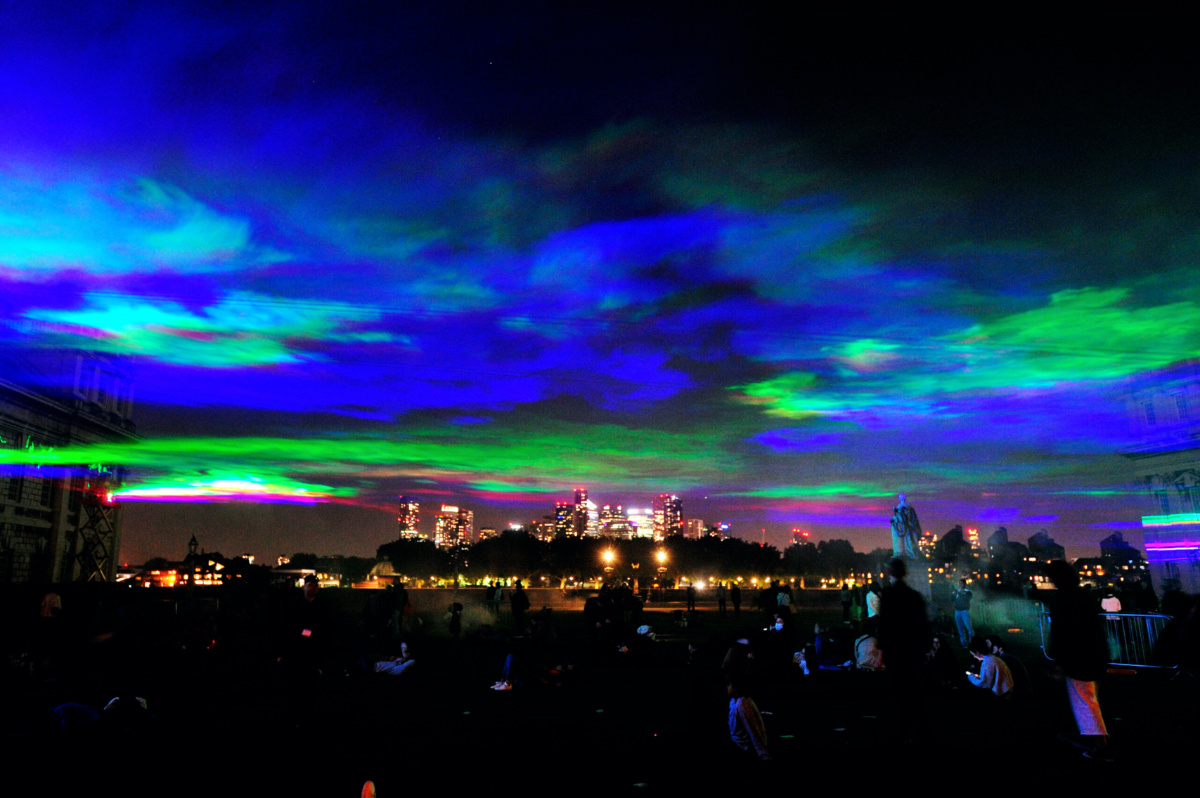
Borealis. PICTURE: Doug Southall

A dazzling light show inspired by the Northern Lights – one of the seven natural wonders of the world – can be seen in the Guildhall Yard this December. Borealis – which can be seen between 11th and 22nd December – is the work of artist Dan Acher and is one of a number of light displays which is illuminating London this winter as part of Mayor Sadiq Khan’s ‘Winter Lights’ campaign. Others include an animal-themed display bringing to life the beasts that once lived at the Tower of London, an outdoor programme of installations and video art projections illuminating the Southbank Centre’s site, the ‘Illuminated River’ display lighting up nine of London’s bridges in what is be the longest public art project in the world, and a free Canary Wharf ‘Winter Lights Spectacular’ in January which will feature 20 new light commissions by some of the most innovative artists across the globe. In Grosvenor Square, Mayfair, thousands of illuminated white roses will form an ‘Ever After Garden’ designed by fashion designer Anya Hindmarch while traditional favourites like the Hyde Park Winter Wonderland as well as winter markets and ice rinks at locations like the Natural History Museum and Somerset House are also once again returning to the city. London’s red buses are an easy way to see the Christmas lights this year with routes 12, 94, 98, 139 and 390 all travelling through Oxford Circus. Free tickets to Borealis can be booked at www.visitlondon.com/Borealis while, for more on the best bus routes, see https://londonblog.tfl.gov.uk/festive-bus-routes/. For more information on all the light shows and events (some of which are already underway), see visitlondon.com    .

Costumes worn by then Princess Elizabeth and her sister Princess Margaret in wartime-era pantomimes are at the heart of a new display at Windsor Castle this Christmas. The princesses spent much of their time at Windsor during World War II – away from the Blitz in London – and, between 1941 and 1944, they performed in and helped to stage a series of pantomimes to raise money for the Royal Household Wool Fund which supplied knitting wool to make comforters for soldiers fighting at the front. Six of the costumes they wore have been brought together for the first time and are being displayed in the castle’s Waterloo Chamber where the pantos were originally performed. The costumes on show were worn in the last two pantos – Aladdin, which was performed in 1943, and Old Mother Red Riding Boots which was performed in 1944. Also on show are 16 large scale pictures of fairy-tale characters that were pasted around the walls to create the space for the performances. Visitors to Windsor this Christmas will also see State Apartments decorated for the festive season and a 20 foot high Christmas tree in St George’s Hall. The Semi-State Rooms, created for King George IV and now used for official entertaining, are also now open to visitors. The costumes can be seen until 31st January. Admission charges apply. For more on the Christmas activities at Windsor, including a ‘Mary, Queen of Scots at Christmas Family Activity Day’ on 18th December, see www.rct.uk/whatson/. Meanwhile, Buckingham Palace is offering guided tours of the State Rooms over winter with special family guided tours available for the first time. The tours run until 30th January. Admission charge applies. For more on the guided tours, head here and for more on the family tours, head here.

• The ancient Greeks’ pursuit of knowledge is the subject of a new exhibition which has opened at the Science Museum in South Kensington. Ancient Greeks: Science and Wisdom takes visitors on a journey in which they will sail the perilous seas with a statue of Hermes that was discovered on a shipwreck off the island of Antikythera, experience the lost music of the aulos instrument through interactive displays and an exclusive video that reimagines its ancient sounds, and gaze at the starry cosmos through ancient Greek eyes via a beautiful and rare silver globe depicting the known constellations and a Byzantine sundial-calendar – the second oldest known geared mechanism in the world. The free display can be seen until 5th June. Tickets are required – to book head to sciencemuseum.org.uk/ancient-greeks.

Send all items for inclusion to exploringlondon@gmail.com.