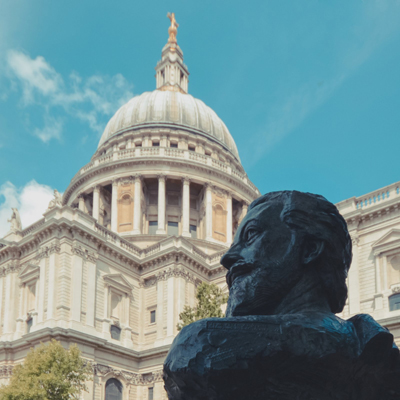
 A new bust of priest and poet John Donne was unveiled outside St Paul’s Cathedral earlier this year. Donne was made Dean of St Paul’s in 1621, a position he held until his death 10 years later. He was subsequently buried in Old St Paul’s Cathedral and a memorial to him – a likeness apparently based on a drawing of him in his shroud – was the only monument to survive the Great Fire of London in 1666. It’s still inside the cathedral. The new bronze bust, located in the garden to the south of the cathedral, was the work of artist Nigel Boonham and has Donne looking east towards his birth place in nearby Bread Street. The text “Hence is’t, that I am carried towards the West/This day, when my Soul’s form bends to the East” – taken from the poem Good-Friday, 1613, Riding Westward – is inscribed underneath the bust. Commissioned by the City of London, the sculpture was unveiled in June by the artist and Professor Peter McCullough, one of the cathedral’s Lay Canons. For more on St Paul’s, see www.stpauls.co.uk. PICTURE: Graham Lacdao / The Chapter of St Paul’s Cathedral.
LondonLife
LondonLife – A giant shot put hits Greenwich…
 Another reminder of the Olympic and Paralympic Games in London can be found at the Old Royal Naval College in Greenwich. The sculpture, a three metre wide shot put embedded in the ground, is one of a series of three different Gifts from the Gods sculptures which have appeared around the city. As well as shot puts, the other sculptures – all of which look as though they’ve been dropped from a great height – depict a 10 metre high javelin and a seven metre long bow with arrows. The sculptures, which will remain in place until 10th September, are part of Wonder, a series of interactive installations put in place as part of the Mayor of London Presents program. For more, see www.molpresents.com/wonder. For more on the Old Royal Naval College, see www.ornc.org. PICTURE: Steve Bradbury/Courtesy of ORNC.
LondonLife – Gold, gold, gold…
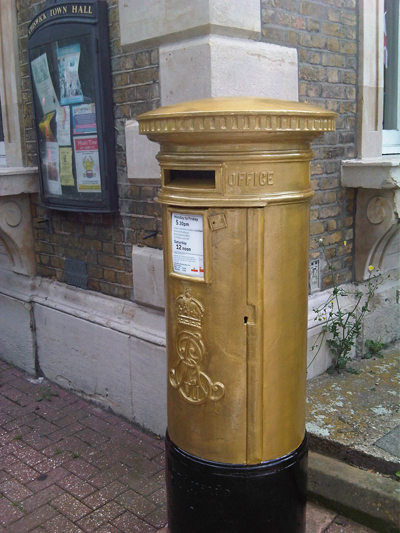 The Olympics might be over but there are still plenty of reminders of the Games around town. Not the least of which are the gold postboxes, painted that color in celebration of London’s gold medallists (the postboxes are located in the home towns of the gold medallists where possible). Pictured is the gold postbox in Heathfield Terrace, Chiswick, west London, painted gold in honor of the victory of Pete Reed in the men’s four rowing. It’s one of a number of gold postboxes in London – others include one in with others in Carshalton Road, Sutton, for Joanna Rowsell’s gold medal win in the women’s team pursuit; one in Church Road in Wimbledon for Andy Murray’s gold medal in the men’s tennis singles, and one in Broad Street, Teddington for Mo Farah’s gold medal in the men’s 5000 metres. Royal Mail has a website where you can see the location of all the gold postboxes in London and elsewhere around the nation – www.goldpostboxes.com. Not sure how long the gold is going to last – Royal Mail has said they will repaint them red – the color they have been, with a few exceptions, since 1874 – in “due course” but there is a push for them to remain gold as a reminder of the Games.
PICTURE: Courtesy of Royal Mail.
LondonLife – The 2012 Serpentine Gallery Pavilion…
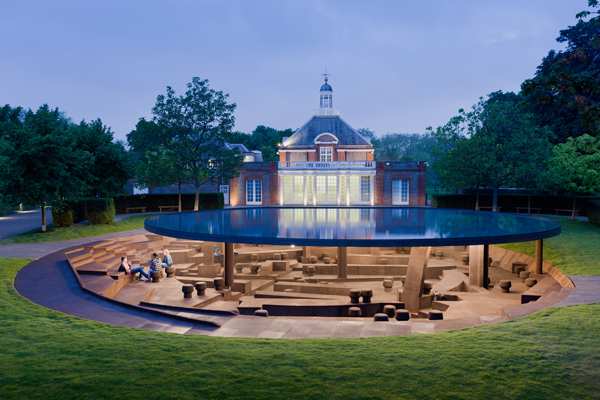
The 12th in the Serpentine Gallery’s annual architecture series, this year’s Serpentine Gallery Pavilion in Kensington Gardens has been designed by Herzog & de Meuron and Ai Weiwei, the design team behind for the Beijing National Stadium, star of the 2008 Olympic Games and commonly known as the “bird’s nest”. Twelve columns – each of which represents one of the 12 annual pavilions created so far (including this one) – support a floating platform roof standing 1.5 metres off the ground. The interior is clad in cork and the pavilion designed to “inspire visitors to look beneath the surface of the park as well as back in time across the ghosts of the earlier structures”. Open until 14th October. For more information, see www.serpentinegallery.org. PICTURE: Serpentine Gallery Pavilion 2012. Designed by Herzog & de Meuron and Ai Weiwei © Herzog & de Meuron and Ai Weiwei. IMAGE – © 2012 Iwan Baan.
LondonLife – Hats…err, on to London’s statues…
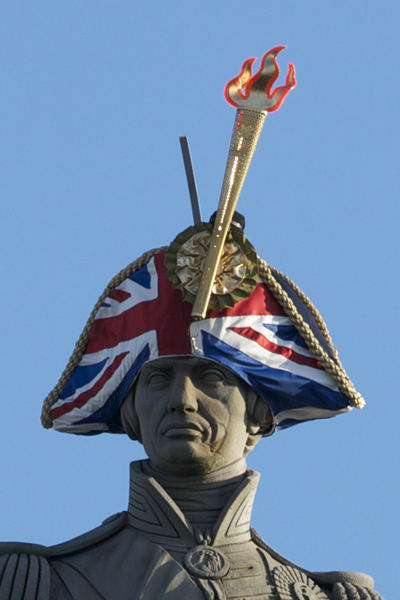
One of the stranger sights in London during this week of Olympic celebration are the many statues around the city adorned with hats – including Trafalgar Square’s iconic statue of Admiral Lord Nelson which now wears a Union Jack hat featuring a replica of the Olympic flame. Designed by Sylvia Fletcher and made by London’s oldest hatters Lock & Co, makers of Nelson’s original bicorn hat, the hat is one of 20 which has been placed upon London statues. It’s all part of Hatwalk, an initiative which aims to take visitors on a tour of the city by bringing some of its most well-known statues to life. Other statues wearing hats include those of former US President Franklin D Roosevelt and former British PM Winston Churchill in Bond Street, the Duke of Wellington near Wellington Arch, and William Shakespeare in Leicester Square. Hatwalk, which features hats designed by some of the UK’s top milliners, was commissioned by the Mayor of London, in partnership with BT, Grazia magazine, the British Fashion Council and the London 2012 Festival. The hats, which appeared on the statues yesterday, will remain on the statues for only four days before they are auctioned for charity. For more on Hatwalk and a map of where the hats are, see www.molpresents.com/hatwalk
LondonLife – BBC World Service bids adieu to Bush House…

Seventy-one years of broadcasting from Bush House in Aldwych came to an end last week when the BBC World Service formally left the building. The building has been used by the BBC for foreign language broadcasting since 1941 (the service’s previous home, Broadcasting House in Portland Place having been bombed out), initially for the European Service and, since 1958, for the rest of what was then called the Overseas Service. Designed by American architect Harvey Corbett, the building at the end of Kingsway in west London was constructed in 1923 and opened in 1925 (additions were made in 1928 and 1935). Built for an Anglo-American trading company at the enormous cost of around £2 million (a price tag which led to it being declared the most expensive building in the world), it was named for American businessman, Irving T. Bush. Noted for its distinctive portico featuring two male statues depicting Anglo-American friendship, the premises has been the site of important events including General Charles De Gaulle’s wartime broadcasts to the Free French while among those who worked in the building were George Orwell, who worked for the Eastern Service during World War II. The BBC, who have returned the World Service to Broadcasting House following a major extension, have never actually owned the building – owners during its residency there have included the Church of Wales and its current Japanese owners. For more on Bush House and its BBC connections, see www.bbc.co.uk/historyofthebbc/collections/buildings/bush_house.shtml. For the final broadcast, see www.bbc.co.uk/news/entertainment-arts-18805063. PICTURE: Bush House, 1951 – Courtesy BBC.
LondonLife – Olympic flower power at Kew Gardens…
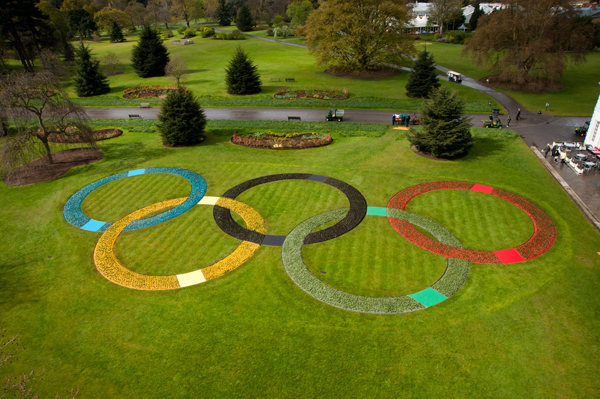
There’s less than a month to go to the Opening Ceremony of the Olympic Games so we thought it only appropriate to take a look at Kew Gardens’ floral Olympic Rings. Located next to The Orangery, the rings are 50 metres long and made of 20,000 plants including Viola ‘Light Blue’, Viola ‘Clear Yellow’, Viola ‘Black Delight’, apple mint (Mentha suaveolens) and Viola ‘Red Blotch’ plants. Able to be seen from planes on the Heathrow flight path, they were unveiled in April and will be at the gardens until September. For more information on visiting Kew Gardens, see www.kew.org. PICTURE: Courtesy Kew Gardens
LondonLife – Unveiling the Bomber Command Memorial…
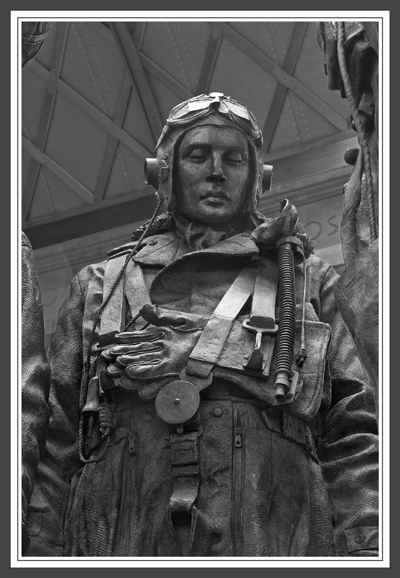 A new memorial honoring the 55,573 airmen who died while serving in Bomber Command during World War II was formally dedicated by Queen Elizabeth II in Green Park last week. At the centre of a new Portland stone pavilion, designed by architect Liam O’Connor (the architect behind the Commonwealth Memorial Gates near Buckingham Palace), is a nine foot high sculpture – the work of Philip Jackson – depicting seven aircrew from a Lancaster bomber having just returned from an operation (detail of which is pictured). The roof of the pavilion, the design of which was inspired by construction techniques used in the Vickers Wellington bomber, incorporates aluminium which was recovered from a Handley Page Halifax III bomber shot down over Belgium on the night of 12th May, 1944. The eight crew were killed during the incident and three of them were found still at their stations when the aircraft was excavated from a swamp in 1997 (they were subsequently buried with full military honors alongside the other five members of the crew). Hundreds of RAF veterans and Commonwealth airmen turned out to see the £6 million publicly funded memorial officially unveiled. The event was also marked with a flyover by five RAF Tornado bombers followed by the RAF’s last Lancaster Bomber which dropped thousands of poppies over Green Park in a message of remembrance. About 125,000 men served in Bomber Command from 1939-1945. The memorial, created following a five year campaign, commemorates people of all nations who lost their lives in the bombing campaigns of that period. For more on the memorial, see www.bombercommand.com.
PICTURE: Courtesy of Mike Legend at Flickr.
LondonLife – Marking Wimbledon that was…
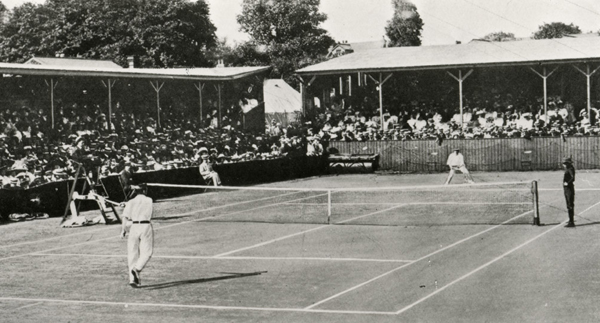 Wimbledon kicked off this week, so it’s only fitting that we mention the recent unveiling of a plaque commemorating the first ever Wimbledon Championships, held in 1877.
The plaque was unveiled last Monday on the former site of the All England Lawn Tennis and Croquet Club just off Worple Road in Wimbledon. As well as the first championships, it also commemorates use of the site for the 1908 Olympics tennis event.
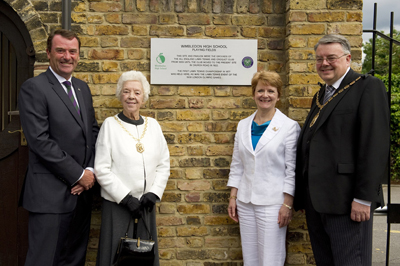 The location of the former club, which it occupied until 1922, is now used as playing field by Wimbledon High School. The club is now based in Church Road opposite Wimbledon Park.
For more on the history of Wimbledon, see our entry from last year’s event here. For more on this year’s event, see www.wimbledon.com.
PICTURES: Top – The Championships being played at the former location in Worple Road (© Wimbledon Lawn Tennis Museum); and, at the plaque’s unveiling featuring the chairman of the All England Lawn Tennis and Croquet Club, Philip Brook, Wimbledon High School headmistress, Heather Hanbury, and the Mayor of Merton, Cr David Williams (© AELTC/Thomas Lovelock).
LondonLife – The Cromwell Trial Plate…
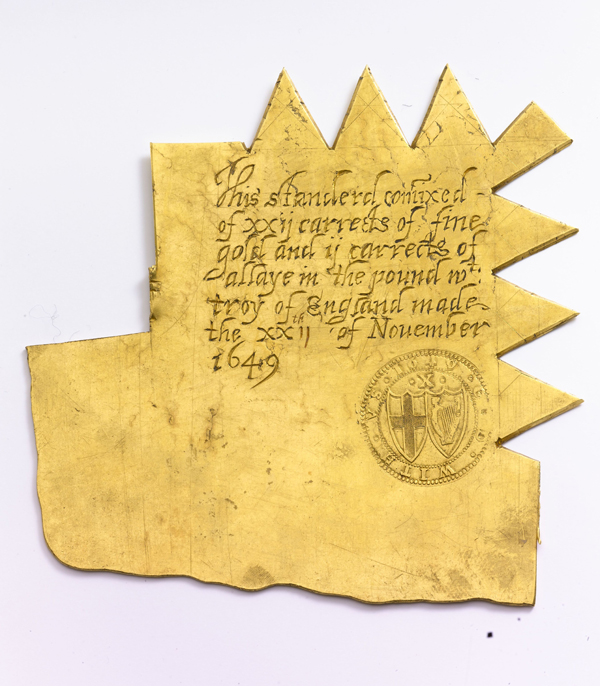
This is a section of the Cromwell Trial Plate used in the Trial of the Pyx in 1649. The Trial of the Pyx, still held every year in February, dates back to the 12th century; its purpose was to ensure, in a public demonstration, that coins produced at the Royal Mint were within set parameters surrounding weight, size and metallic composition. It is named after the box in which coins were transported, known as a pyx (from the Latin pyxis for box or chest – these were historically kept in the Chamber of the Pyx at Westminster Abbey), and involves melting down samples of coins and measuring the gold and silver content against a benchmark piece of metal known as a Trial Plate. This Trial Plate, created by the Goldsmith’s Company during the first year of the Commonwealth, is among 400 treasures on show as part of Gold: Power and Allure, a landmark exhibition celebrating the story of gold and Britain being held at the Goldsmiths’ Hall in association with the World Gold Council. Runs until 28th July. Admission is free. For more, head to www.thegoldsmiths.co.uk. PICTURE: © Royal Mint.
LondonLife – Sunset over The Shard…

Says the photographer, Ed Walker: “The picture was taken from my girlfriend’s roof garden in New Cross using a 50mm prime lens. I’ve been experimenting with increasing clarity in my pictures to bring out the textures and sharpness especially in landscapes. With the reds, yellows and purples in the sky the cityscape contrasts perfectly.” For more of Ed’s work, follow this link www.flickr.com/photos/spooke/7191263460/in/set-72157629741433536.
Taken an interesting photograph of somewhere in London? We’re always looking for interesting images of the city so if you’ve got one you reckon captures a snippet of life in London, please contact us at exploringlondon@gmail.com or via our new Flickr group at www.flickr.com/groups/exploringlondon/
LondonLife – An upsized Royal Family…

Like your Royal Family large? The largest ever photograph of Queen Elizabeth II, her husband, the Duke of Edinburgh, and their four children has been displayed on South Bank building, Sea Containers, in celebration of the Queen’s Diamond Jubilee. The iconic picture of the family – which also includes Earl Mountbatten, uncle to Prince Philip, and Princess Anne’s then husband Mark Phillips – was taken during 1977’s Silver Jubilee by an unknown photographer. The 100 by 70 metre image, which weighs nearly two tons, took eight people more than 45 hours to put into place on the building’s facade overlooking the Thames. It was erected by the owner of Sea Containers as a tribute to be seen during this weekend’s Jubilee Flotilla (and also to hide development work taking place behind as the building is transformed into a Mondrian hotel – Europe’s first – and office space.
LondonLife – The RHS Chelsea Flower Show…

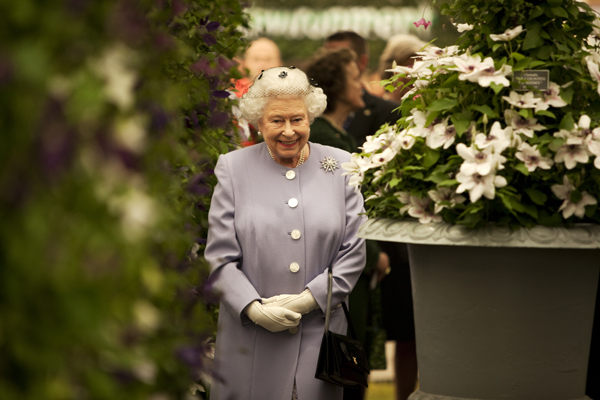
Yes, it’s that time of the year again when Chelsea is all abloom! This year the flower show is marking the Queen’s Diamond Jubilee with a specially designed flower bed designed by the Parish of St Helier in Jersey, the centrepiece of which is a rotating Jersey Accession Issue Postal stamp (pictured above). During a visit to the Flower Show on Monday (pictured below, this took place prior to the public opening today), Queen Elizabeth II, patron of the show, awarded the first ever Diamond Jubilee Award for the Best Exhibit in the Great Pavilion to HM Hyde & Son for their display of lilies. Among the other ways in which the show is marking the Diamond Jubilee is the opening of an exhibition of photographs of the Queen’s past visits to the show. The flower show runs until Saturday (while tickets are sold out, you can check in person daily at the ticket office for returned tickets). For more, see www.rhs.org.uk/Shows-Events/RHS-Chelsea-Flower-Show/2012. PICTURES: Andy Paradise (courtesy of RHS).
LondonLife – Wellington Arch reopens…
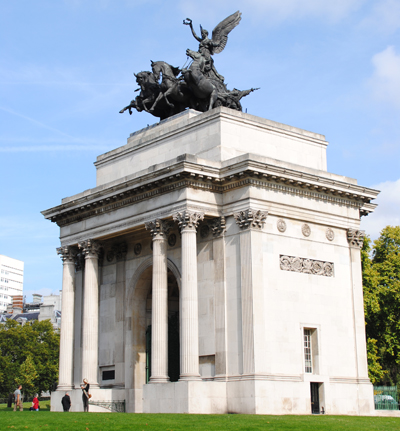 A newly refurbished Wellington Arch reopened last week with a new exhibition dedicated to Stonehenge. Stonehenge: Monumental Journey, which runs until 24th June in the arch’s Quadriga Gallery, show how visitors to the monument have interacted with it over time and look at how it new works will see it reconnected with the landscape around it. Other exhibitions in the Quadriga Gallery later this year include Blackpool: The Wonderland of the World, The Ladies of Kenwood, and Egypt in England. The refurbished arch also now contains a bookshop dedicated to English Heritage publications. For more on the history of Wellington Arch, see our previous entry here.
WHERE: Aspley Way, Hyde Park Corner (nearest Tube station is Hyde Park Corner); WHEN: 10am to 5pm, Wednesday to Sunday (until 28th March, 2013); COST: £4 an adult/£2.40 a child/£3.60 concession/£21.30 family (English Heritage members free); WEBSITE: www.english-heritage.org.uk/daysout/properties/wellington-arch/
LondonLife – Florence Nightingale remembered…
 The life of Florence Nightingale, ‘The Lady with the Lamp’, depicted here on the Crimean War Memorial at Waterloo Place, is to be commemorated at the annual service in Westminster Abbey tomorrow. The Florence Nightingale commemoration service is held “to celebrate nursing and midwifery and all staff, both qualified and unqualified working in these services”. During the service a lamp, carried this year by Claire Gibbs, will be taken from the Abbey’s Florence Nightingale Chapel (formerly known as the Nurses’ chapel but rededicated in May 2010 – the centenary of Nightingale’s death) and escorted by a procession of nurses – this year it’s students from Liverpool John Moores University – to Reverend Professor Vernon White who will place it upon the High Altar. The address will be given by the former Archbishop of Canterbury, Lord Carey. Nightingale (1820-1910) rose to fame for her pioneering nursing work during the Crimean War and established the first secular nursing school in the world at St Thomas’ Hospital in London. The upcoming International Nurses Day is celebrated each year on her birthday – 12th May. Tickets for this year’s commemoration service are already allocated – to apply for tickets to next year’s, keep an eye on www.florence-nightingale-foundation.org.uk for details.
LondonLife – The ‘Royal River’ celebrated at the National Maritime Museum
 Canaletto’s image of Greenwich Hospital from the north bank of the Thames (1750-52) is among almost 400 paintings, manuscripts and objects selected to be part of the National Maritime Museum’s new exhibition, Royal River: Power, Pageantry & The Thames.
Curated by historian David Starkey, the exhibition, part of the Diamond Jubilee celebrations, focuses on the use of the river across five centuries covering events including Anne Boleyn’s coronation procession and Admiral Lord Nelson’s stately funeral through to the evolving Lord Mayor’s pageant and the ‘Great Stink’ of the mid-1800s.
Highlights include the oldest known copy of Handel’s Water Music, the sixteenth century Pearl Sword (which the monarch must touch on entering the City of London), a stuffed swan, treasures from the City’s livery companies, and another Canaletto work – this time his famous view of the river filled with boats getting ready for the Lord Mayor’s Day, seen as an inspiration for this year’s Diamond Jubilee Pageant and on show in the UK for the first time since its completion.
As well as celebrating the Diamond Jubilee, the exhibition also marks the 75th anniversary of the opening of the National Maritime Museum by King George VI on 27th April, 1937. The king’s speech from that day and his Admiral of the Fleet uniform also feature in the exhibition.
WHERE: National Maritime Museum Greenwich (nearest DLR station is Cutty Sark); WHEN: Daily 10am to 5pm (opening times may vary during the Paralympic and Olympic Games) until 9th September; COST: £11 adult/£9 concession/family ticket £24.50; WEBSITE: www.rmg.co.uk.
PICTURE: © National Maritime Museum, London
LondonLife – Flight
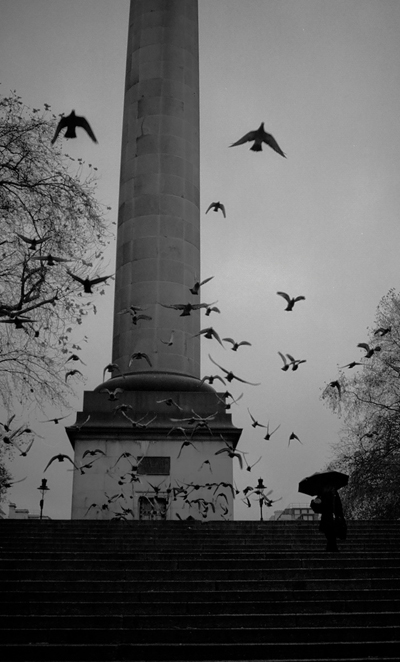
Says the photographer, Aaron Reiff-Zall: “It’s the Duke of York column, there are some steps down from Waterloo Place to The Mall. I live in London, so have done a lot of street photography here. As well as being very interested in its history and culture much like yourselves. I stood out in the rain for maybe an hour-and-a-half to craft that shot, I thought the column would make a nice back-drop, and there are always lots of birds milling about at the top. So I knew if I waited, the right person will come along and disturb them to produce the shot I wanted. After a few false alarms, and times when the birds didn’t go the way I wanted, I saw this lady with the umbrella happen by, framed the shot, hoping it would be right, and at the right moment when the birds took to flight, they luckily flew towards me as I wanted, I captured a burst of maybe five frames of film. Developed that and voila!” For more of Aaron Reiff-Zall’s work, see www.flickr.com/photos/aaronrz/.
Taken an interesting photograph of somewhere in London? We’re always looking for interesting images of the city so if you’ve got one you reckon captures a snippet of life in London, please contact us at exploringlondon@gmail.com or via our new Flickr group at www.flickr.com/groups/exploringlondon/
LondonLife – All is revealed at Hampton Court Palace
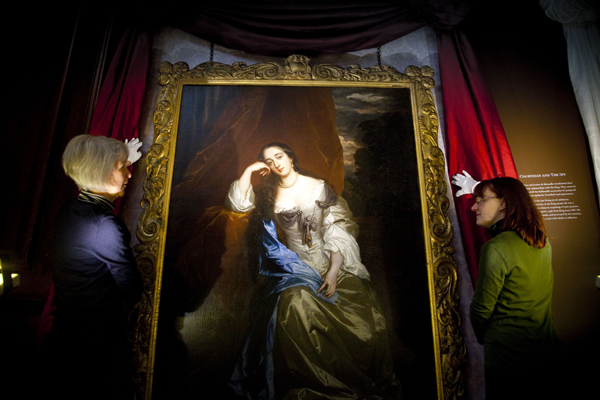
A portrait of King Charles II’s mistress, Barbara Villiers, is put into place ahead of The Wild, The Beautiful and the Damned exhibition which opened at Hampton Court Palace earlier this month. The portrait, which dates from about 1662, was painted by Sir Peter Lely – he also painted a picture King Charles II’s other principal mistress, Nell Gwyn, which is being shown together with the Villiers portrait for the first time. The exhibition, which focuses on the beauty, mistresses and debauchery of the Stuart Court, spans the reigns of the Stuarts from Charles II to Queen Anne and looks at how kings, queens and courtesans “swept away the Puritanical solemnity of the mid-17th century, and attempted to rewrite the moral code of social behaviour”. Runs until 30th September (admission is included in entry ticket; free to Historic Royal Palaces members). There are late openings on the first Monday of each month and note that the exhibition includes adult content. For more, see http://bit.ly/HvyiOE.
PICTURE: Richard Lea-Hair/newsteam.
LondonLife – The Old Bailey and the notorious case of Dr Crippen…
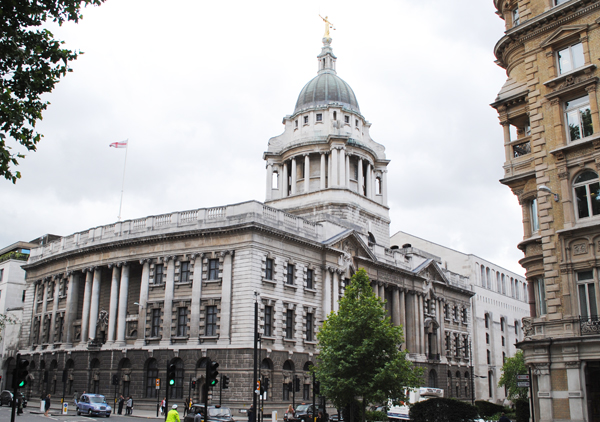
As well as being relevant to our recent focus on author Charles Dickens (as well as featuring in his works, some suggest he worked here as a court reporter), the Old Bailey (home of the Central Criminal Court) has been in the news recently for its role in the conviction of the infamous murderer Dr Hawley Crippen. An American, Dr Crippen was tried and found guilty at the court of poisoning his first wife Cora and then of cutting her up (he was found to have hidden the body parts in the cellar of their home in Hilldrop Crescent, Holloway). He was hanged in 1910, having been arrested while fleeing on a ship to Canada with his mistress Ethel Le Neve. Now reportedly come plans to hold a posthumous retrial of the case in front of a judge at the Islington Museum. The event, which will be held later this year, is being organised by Archway-based human rights solicitor Greg Foxsmith and will see John Cooper, QC, defending Dr Crippen. The move comes follows an earlier investigation by US scientists who concluded from DNA evidence that the victim may have in fact been male. For a great read on the case of Dr Crippen – and the important role the new invention of the wireless telegraph played in his capture – have a look at Erik Larsen’s Thunderstruck
LondonLife – The Queen visits the newly transformed Kensington Palace…
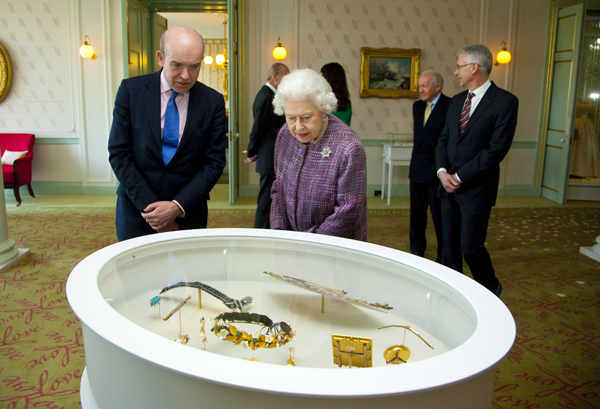
Queen Elizabeth II looks over gifts exchanged by Queen Victoria and Prince Albert in a display which forms part of the Victoria Revealed exhibition at Kensington Palace.
The Queen and Duke of Edinburgh visited palace last week to officially reopen the building following a £12 million, two year renovation project aimed at “transforming the visitor experience”.
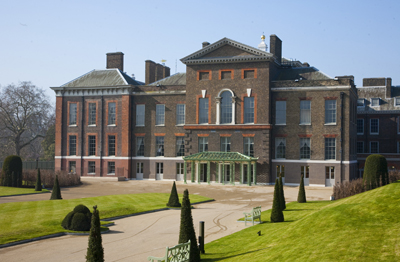 The works have involved restoring the palace gardens – which will now be permanently open to the public free-of-charge – and reconnecting the palace with the surrounding parklands of Kensington Gardens partly through the provision of a new entrance. Landscape designer Todd Longstaffe-Gowan’s plan – which centres on a statue of Queen Victoria – features new lawns and avenues and a “maze-like path” inspired by 18th century “wilderness walks”.
There is also a new visitor reception area and “orientation hub” as well as a new courtyard terrace and cafe to complement The Orangery, shop and learning centre.
Victoria Revealed, a new permanent exhibition at the palace looks in intimate detail at the life of the Queen who once lived here and features everything from her black silk baby shoes to her wedding dress and the mourning clothing she wore following the death of Prince Albert as well as archive film footage showing the celebrations for the Diamond Jubilee of her reign in 1897.
The palace reopens on 26th March.
WHERE: The Broad Walk, Kensington Gardens, Kensington (nearest Tube stations are High Street Kensington or Queensway); WHEN: Daily 10am to 6pm (until 31st October); COST: £14.50 adult/£12 concession/children under 16 free (online booking discounts available, Historic Royal Palaces members free); WEBSITE: www.hrp.org.uk/KensingtonPalace.
PICTURES: Courtesy of Historic Royal Palaces/newsteam.co.uk
 Exploring London