• John Dee (1527-1609), the enigmatic Elizabethan “mathematician, magician, astronomer, astrologer, imperialist, alchemist and spy”, is the subject of an exhibition currently running at the Royal College of Physicians Museum in Regent’s Park. Scholar, courtier, magician: the lost library of John Dee explores his life through remnants of his personal library and features mathematical, astronomical and alchemical texts, many of which he elaborately annotated and even illustrated. The texts are drawn from the collection of the college library which has more than 100 of the doctor’s volumes and which forms the largest collection of Dee’s books in the world. The books represent only a fraction of the more than 3,000 books and 1,000 manuscripts he claimed to own before his library was, so Dee claimed, sold off illicitly by his brother-in-law Nicholas Fromond after he gave them into his care when he travelled to Europe in the 1580s. Many of them apparently fell into the hands of Nicholas Saunder, possibly a former student of Dee’s and later passed into the hands of book collector Henry Pierrepont, the Marquis of Dorchester, whose family gave his entire library to the Royal College of Physicians after his death in 1680. The free exhibition runs until 29th July. For more, see www.rcplondon.ac.uk.
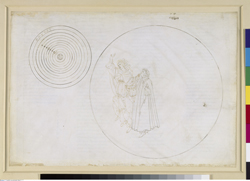 • Botticelli’s drawings for Dante’s epic poem, the Divine Comedy, are at the heart of a new exhibition which opened earlier this month at the Courtauld Gallery in Somerset House. Botticelli and Treasures from the Hamilton Collection, which is being run in collaboration with the Kuperferstichkabinett (Prints and Drawings Museum) in Berlin, features treasures which were sold to Berlin by the 12th Duke of Hamilton in 1882 despite efforts by Queen Victoria to prevent the transaction. They include a selection of 30 of Botticelli’s drawings – which date from about 1480-95 – as well as illuminated manuscripts including the Hamilton Bible. Said to be one of the most important illuminated manuscripts in the world, it is being returned to the UK for the first time since 1882. The exhibition, which coincides with Botticelli Reimagined opening at the V&A next month, runs until 15th May. Admission charge applies. For more, see www.courtauld.ac.uk. PICTURE: Sandro Botticelli – Beatrice explains to Dante the order of the cosmos (Divine Comedy, Paradiso II), around 1481-1495/© Staatliche Museen zu Berlin, Kupferstichkabinett/Philipp Allard.
• The stories of women in times of war form the heart of a new display on show at the Imperial War Museum in Lambeth. Eleven Women Facing War features photographs and films taken by award-winning British photographer and film-maker Nick Danziger. He first photographed the 11 women, who all lived in conflict zones, in 2001 for an International Committee of the Red Cross study documenting the needs of women facing war before setting out 10 years later to find each of the women and see what had become of their lives. The exhibition features 33 photographs and 11 short films from conflict zones including Bosnia, Kosovo, Israel, Gaza, Hebron (West Bank), Sierra Leone, Colombia and Argentina. Among the stories told are those of Mah Bibi, a 10-year-old orphan who was begging for food for herself and two brothers when first photographed in Afghanistan and who, 10 years later, had vanished and is believed to have died in 2006. Another is that of Mariatu, who was struggling to rebuild her life in Sierra Leone after her hands had been forcibly amputated by guerrilla soldiers at the age of 13 when she was photographed in 2001 and who 10 years later had moved to Canada. The exhibition runs until 24th April. Admission is free. For more, see www.iwm.org.uk.
Send all items for inclusion to exploringlondon@gmail.com.
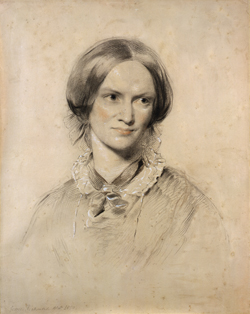
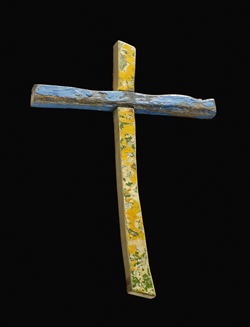
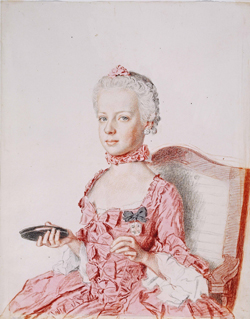

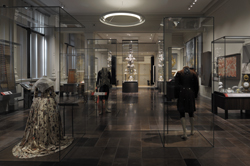

 A detailed picture of the inhabitants of Roman London, known as Londinium, has been created for the first time, the Museum of London announced this week. Detailed analysis of the DNA of four skeletons has revealed a culturally diverse population. The examined skeletons include that of a Roman woman (pictured left), likely to have been born in Britain with northern European ancestry, found buried with high status grave goods at Harper Road, Southwark, in 1979, and another of a man, whose DNA revealed connections to Eastern Europe and the Near East, who was found at London Wall in 1989 with injuries to his skull which suggest he may have been killed in the nearby amphitheatre before his head was dumped in a pit. The other two skeletons examined were found to be that of a blue-eyed teenaged girl found at Lant Street, Southwark, in 2003, believed to have been born in north Africa, whose ancestors lived in south-eastern Europe and west Eurasia, and that of an older man found at Mansell Street who was born in London and whose ancestry had links to Europe and north Africa. The examination – the first multi-disciplinary study of the inhabitants of a Roman city anywhere in the empire – also revealed that all four suffered from gum disease. Caroline McDonald, senior curator at the museum, said that while it has always been understood Roman London was a culturally diverse place, science was now “giving us certainty”. “People born in Londinium lived alongside people from across the Roman Empire exchanging ideas and cultures, much like the London we know today.” The four skeletons will form the basis of a new free display, Written in Bone, opening at the Museum of London on Friday. PICTURE: © Museum of London
 • The largest exhibition ever mounted about the life of 17th century diarist Samuel Pepys opens at the National Maritime Museum in Greenwich tomorrow. Samuel Pepys: Plague, Fire, Revolution features more than 200 paintings and objects brought together from museums, galleries and private collections which explore the life of the famous diarist (depicted here in a bust outside the Guildhall Art Gallery) against the backdrop of the tumultuous events of Stuart London, from the execution London of King Charles I in 1649 through the Great Fire of London and the Glorious Revolution on 1688. Objects on show include the famous painting, Portrait of Charles II in Coronation Robes, objects connected to Pepys’ mistresses including one of his love letters to Louise de Kéroualle (aka ‘Fubbs’ or ‘chubby’) and other personal items such as a lute owned by Pepys. The exhibition is accompanied by a series of events including Pepys Show Late: Party like it’s 1669 (26th November) and a series of walks and talks. Admission charge applies. The exhibition runs until 28th March. For more, see
 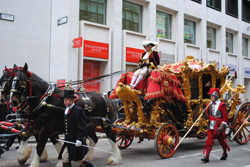 • The Lord Mayor’s Show will mark its 800th anniversary on Saturday as the newly elected Jeffrey Mountevans – the 688th Lord Mayor of the City of London – makes his way through the City to Westminster to swear loyalty to the Crown. The procession of 7,000 people, some 180 horses and 140 vehicles will set off on its way along a three-and-a-half mile route at 11am, starting at Mansion House and traveling down Cheapside to pause at St Paul’s Cathedral (which is open for free all day) before heading on via Ludgate Hill and Fleet Street to the Royal Courts of Justice before returning the City via Queen Victoria Street from 1.10pm. In a special nod to the 800th anniversary, the famous bells of St Mary-le-Bow will ring out a special 800-change at noon. The day will conclude with fireworks over the River Thames kicking off at 5.15pm (for the best view head down to the riverside between Waterloo and Blackfriars Bridges, either on Victoria Embankment or on the South Bank). The show’s origins go back to 1215 when, in exchange for a Royal Charter granting the City of London the right to elect its own mayor, King John insisted the newly elected mayor travelled to Westminster each year to swear loyalty to the Crown. For more (including a map to print out), see
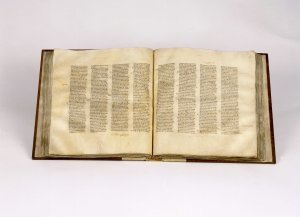 The first major exhibition to explore the history of Egypt after the pharaohs opens at the British Museum today. Egypt: Faith after the pharaohs spans 1,200 years of history – from 30 BC to 1171 AD – with 200 objects showing how Christian, Islamic and Jewish communities reinterpreted the pharaonic past of Egypt and interacted with each other. The exhibition opens with three significant examples of the Hebrew Bible, the Christian New Testament and the Islamic Qur’an – the texts include the New Testament part of the 4th century AD Codex Sinaiticus, the world’s oldest surviving Bible and the earliest complete copy of the New Testament, which is now part of the British Library’s collection. All three are juxtaposed with everyday stamps associated with each of the three religions in an illustration of the relationship between the institutional side of religion and its everyday practice, both key themes of the exhibition. Other exhibits include a pair of 6th-7th century door curtains featuring classical and Christian religious motifs, a 1st-2nd century statue of the Egyptian god Horus in Roman military costume, and a letter from the Roman Emperor Claudius (41-54 AD) concerning the cult of the divine emperor and the status of Jews in Alexandria. Admission charge applies. Runs until 7th February in Room 35. A programme of events accompanies the exhibition. For more, see
