Many people are aware of the memorial to 17th century playwright and poet Ben Jonson that sits among the who’s who of the literary world commemorated in Westminster Abbey’s famous Poet’s Corner. But fewer people visit the poet’s actual grave, located a short distance away in the northern aisle of the nave.
 And while visitors to the northern aisle of the nave may think its a small stone set into the wall above the floor itself, with the inscription ‘O rare Ben Johnson’ (note the ‘h’ used here in his name), which marks the grave’s location, we’re not quite there yet.
The stone, which was indeed the original stone covering Jonson’s grave, was actually moved from the floor to this position when the entire nave floor was being relaid in the 19th century. For the actual location of Jonson’s grave you have to head back to the aisle’s floor and there, just to the east of a brass commemorating John Hunter, you’ll find a small, grey lozenge-shaped stone which marks the actual grave site (and bears the same inscription with the same spelling).
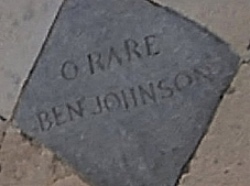 The inscription can also be found on his Poet’s Corner memorial. It was apparently put on Jonson’s grave stone when one Jack Young passed by the grave as it was being covered and gave a mason 18 pence to carve it (Young is said to have been knighted later on).
All that’s very well but what really sets Ben Jonson’s grave apart from the other more than 3,500 graves buried in the abbey is that Jonson is the only person known to have been interred below the abbey floor standing upright.
The poet died in a somewhat impoverished state and it’s that which is said to explain the unusual arrangement. One version of the tale has the poet begging for just 18 square inches of ground for his burial from King Charles I; another has him telling the Abbey’s Dean that he was too poor to be buried with his fellow poets and that a space two foot square would serve him (the Dean apparently granted him his wish which meant Jonson’s coffin lowered into the ground end on end).
The fact he was buried upright in his coffin was apparently confirmed in 1849 when a clerk saw skeletal remains of a standing person in the spot Jonson was buried while doing another burial nearby.
The monument in Poet’s Corner, meanwhile, was erected in the early 1720s by the Earl of Oxford. It features a medallion portrait of him with actor’s masks and a broken golden lamp symbolising death on top. It was designed by James Gibbs and attributed to the sculptor JM Rysbrack.
WHERE: North Aisle, Westminster Abbey (nearest Tube stations are Westminster and St James’s Park); WHEN: Times vary – see the website for details; COST: £23 adults/£20 concession/£10 children (discounts for buying online; family rates available); WEBSITE: www.westminster-abbey.org
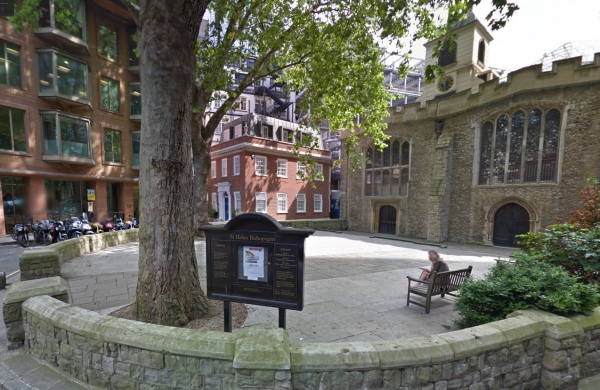
PICTURES: Top – The original grave marker now set in the wall; Below – The tile marking the actual grave site (Google Maps – images have been treated to improve resolution).
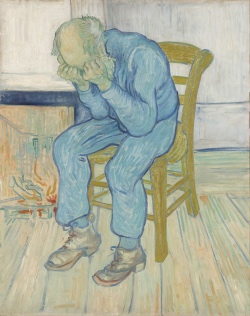 • The first exhibition to examine the work of Dutch artist Vincent van Gogh through his relationship with Britain has opened at Tate Britain this week. Van Gogh and Britain includes more than 40 works by the artist including L’Arlésienne (1890), Starry Night on the Rhone (1888), and Sunflowers (1888). The exhibition will also feature later works by Van Gogh including two he painted while in the Saint-Paul asylum – At Eternity’s Gate (1890 – pictured) and Prisoners Exercising (1890). The exhibition shows how Van Gogh, who lived in London between 1873 and 1876 working as a trainee art dealer, responded to works by artists like John Constable and John Everett Millais and his love of British writers like William Shakespeare, Christina Rossetti and, particularly, Charles Dickens (L’Arlésienne features one of Dickens’ favourite books in the foreground). The show runs until 11th August and is being accompanied by a series of talks and other events. Admission charge applies. For more, see



 Exploring London