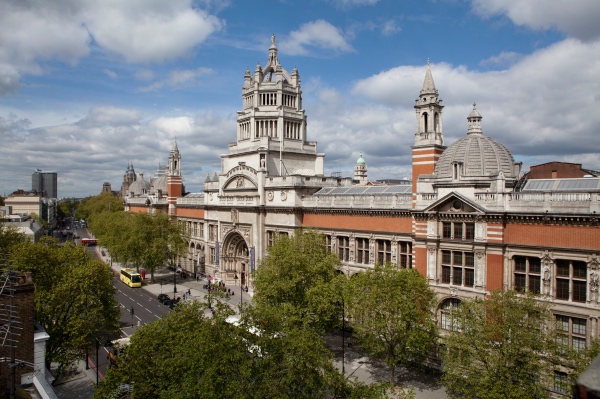
Better known today as the Victoria and Albert Museum following its renaming in 1899, the South Kensington Museum was created in the aftermath of the success of the Great Exhibition of 1851.
Initially located in Marlborough House on the Mall, it moved to its South Kensington site in 1857, opening to the public on 22nd June that year. Recorded among the visitors in the initial couple of years was Queen Victoria – who visited twice in February, 1858, and then again open 14th April when she was accompanied by Prince Albert.
The purpose of the later visit was to open the Art Rooms on the ground floor of Sheepshanks Gallery, a building which had been specifically constructed to house paintings given by John Sheepshanks (the building, located on the eastern side of the John Madejski Garden now contains sculptures on the ground floor and silver and stained glass on the first floor).
One interesting connection between the Queen and the museum can be found in a six metre tall plaster cast of Michelangelo’s David. The cast was given to Queen Victoria as a gift from the Grand Duke of Tuscany in 1857 but she didn’t want the trouble of housing the giant figure (and she was apparently shocked by its nudity – more on that in a moment). So the Queen gave the statue to the museum where it was installed in a prominent position (and can today be seen in Room 46b).
But ah, yes, the nudity. The story goes that in response to the Queen’s shock, a proportionally accurate plaster fig leaf was commissioned to cover David‘s nether regions whenever the Queen visited (apparently by being hung on two small hooks on the cast). The fig leaf, like the statue, can still be seen – it’s housed in a small case on the back of the plinth David‘s standing on.
David is one of only a few items in the V&A’s collection today which once belonged to the Queen or Prince Albert. Others include the Raphael cartoons which she loaned to the museum in 1865 (and are still on loan from the current Queen).
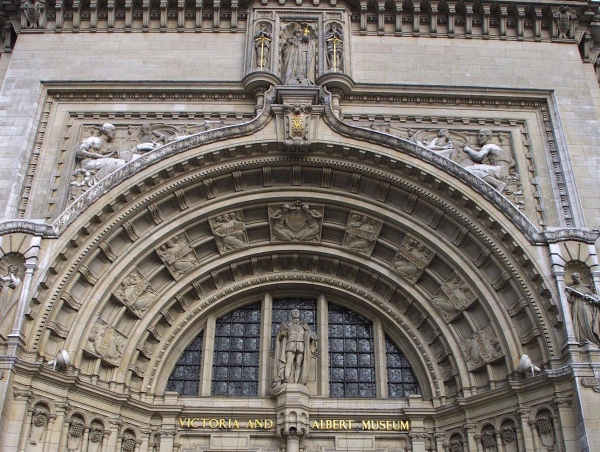
As part of the redevelopment of the museum in the late 19th and early 20th centuries (when it was also renamed the Victoria and Albert Museum despite the Queen’s wishes it be called the Albert Museum), statues of the royal couple were installed above the museum’s main entrance in Cromwell Road with Prince Albert positioned just below the Queen who is flanked by St George and St Michael (see above).
PICTURES: Courtesy V&A
WHERE: Victoria and Albert Museum, Cromwell Road (nearest Tube stations are South Kensington and Gloucester Road); WHEN: 10am to 5.45pm daily (Fridays to 10pm); COST: Free; WEBSITE: www.vam.ac.uk



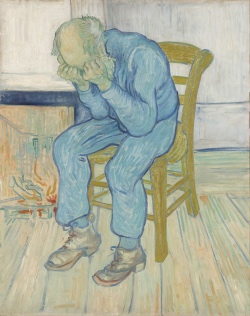 • The first exhibition to examine the work of Dutch artist Vincent van Gogh through his relationship with Britain has opened at Tate Britain this week. Van Gogh and Britain includes more than 40 works by the artist including L’Arlésienne (1890), Starry Night on the Rhone (1888), and Sunflowers (1888). The exhibition will also feature later works by Van Gogh including two he painted while in the Saint-Paul asylum – At Eternity’s Gate (1890 – pictured) and Prisoners Exercising (1890). The exhibition shows how Van Gogh, who lived in London between 1873 and 1876 working as a trainee art dealer, responded to works by artists like John Constable and John Everett Millais and his love of British writers like William Shakespeare, Christina Rossetti and, particularly, Charles Dickens (L’Arlésienne features one of Dickens’ favourite books in the foreground). The show runs until 11th August and is being accompanied by a series of talks and other events. Admission charge applies. For more, see