As the nation awaits the announcement of new Prime Minister following the 48 day tenure of Liz Truss – the shortest of any British Prime Minister, we take a quick look at the circumstances surrounding the next three shortest serving PMs…
1. George Canning. Canning, a Tory, had twice served as Foreign Secretary – between 1807-1809 and 1822-1827 (a period during which he also served as Leader of the House of Commons) when, following the resignation of Prime Minister Lord Liverpool in April, 1827, he was chosen to succeed him in the office. But Canning’s health took a turn for the worse soon after and he died in office on 8th August, 1827, having served just 119 days as Prime Minister.
2. The Viscount Goderich. FJ Robinson, 1st Viscount Goderich, succeeded George Canning as Prime Minister in 1827. But he was unable to hold together Canning’s coalition of Tories and Whigs and so resigned himself after just 144 days in office. He nonetheless went on to serve in the cabinets of both Earl Grey and Sir Robert Peel.
3. Andrew Bonar Law. The only Canadian to have served as British Prime Minister, Law was a Conservative Party leader who became Prime Minister after the fall of David Lloyd George’s Coalition Government on 23rd October, 1922. The party then won a clear majority in a general election on 15th November of that year. But ill with throat cancer he resigned on 20th May the following year, having served just 211 days in office. He died soon after on 30th October that year.
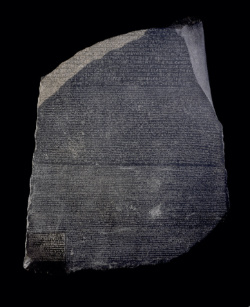
• Marking 200 years since French Egyptologist Jean-Francois Champollion (1790-1832) was able to decipher hieroglyphs using the Rosetta Stone, a new exhibition opening at the British Museum explores how the stone and other inscriptions and objects helped scholars unlock one of the world’s oldest civilisations.Hieroglyphs: unlocking ancient Egypt centres on the Rosetta Stone but also features more than 240 other objects, many of which are shown for the first time. Alongside the Rosetta Stone itself, highlights include: “the Enchanted Basin”, a large black granite sarcophagus from about 600 BCE which is covered with hieroglyphs and images of gods; the richly illustrated, more than 3000-year-old Book of the Dead papyrus of Queen Nedjmet which measures more than four metres long; and the mummy bandage of Aberuait, a souvenir from one of the earliest ‘mummy unwrapping events’ in the 1600s where attendees each received a piece of the linen, preferably inscribed with hieroglyphs. There’s also the personal notes of key figures in the race to decipher hieroglyphs including those of Champollion which come from the Bibliothèque nationale de France as well as those of England’s Thomas Young (1773 – 1829) from the British Library. The exhibition can be seen in the Sainsbury Exhibition Gallery until 19th February. Admission charge applies. For more, see britishmuseum.org/hieroglyphs.
• King Charles III will be crowned at Westminster Abbey on 6th May next year, Buckingham Palace has announced this week. The Queen Consort, Camilla, will be crowned alongside him in the first such coronation since 12th May, 1937, when King George VI and Queen Elizabeth were crowned in the abbey. The ceremony, which will be conducted by the Archbishop of Canterbury, will, according to the palace, “reflect the monarch’s role today and look towards the future, while being rooted in longstanding traditions and pageantry”. King Charles III is expected to sign a Proclamation formally declaring the coronation date at a meeting of the Privy Council later this year. The first documented coronation at Westminster Abbey was that of King William the Conqueror on 25th December, 1066, and there have been 37 since, the most recent being that of Queen Elizabeth II on 2nd June, 1953.
• A new dark comedy, The Admiral’s Revenge, has opened in The Admiral’s House in the Old Royal Naval College, Greenwich. The play, set in 1797, features sea shanties, puppetry and follows a crew of shipmates in the wake of the ill-fated Battle of Tenerife. Audiences have the chance to explore the Admiral’s House before the show and enjoy a complimentary rum cocktail. Runs until 12th November. For ticket prices, head to https://ornc.org/whats-on/1797-the-mariners-revenge/.
• A new exhibition exploring Charles Dickens’ interest in the paranormal has opened at the Charles Dickens Museum in Bloomsbury.To Be Read At Dusk: Dickens, Ghosts and the Supernatural explores Dickens’ famous ghost stories, including A Christmas Carol, and reveals his influence on the genre. Highlights include a copy of The Chimes which Dickens gifted to fellow author Hans Christian Anderson, original John Leech sketches of Dickens’ ghosts of the past, present and future and original tickets and playbills relating to the author’s public performances of his ghost stories. The display will also look into Dickens’ own views on the supernatural as a fascinated sceptic and includes correspondence in which he was asking about the location of a supposedly haunted house. Runs until 5th March. Admission charge applies. For more, see https://dickensmuseum.com/blogs/all-events/to-be-read-at-dusk-dickens-ghosts-and-the-supernatural.
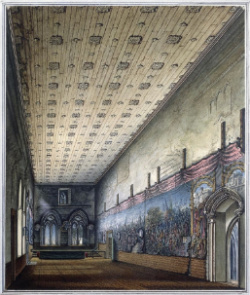
Part of the medieval Palace of Westminster, the Painted Chamber took its name from a series of large paintings which decorated the walls.
A watercolour of the Painted Chamber in Westminster Palace by William Capon made in 1799.
The long and narrow chamber, which stood parallel to St Stephen’s Chapel, was constructed in the 13th century during the reign of King Henry III and was apparently initially intended as a private apartment for the king as well as a reception room.
It featured a state bed at one end positioned under a painting of King Edward the Confessor and also had a “squint” – a small opening at eye level – through which the monarch could view religious services in a chapel located next door.
The chamber was apparently originally known as the King’s Chamber but came to be known as the Painted Chamber when the walls were decorated with paintings depicting vices and virtues and Biblical figures.
These paintings, which were completed over an almost 60 year period from 1226 and which were repaired a couple of times during that period, were added to with commissions by successive monarchs.
The painted chamber was the location for the State Opening of Parliament in the Middle Ages and was where Oliver Cromwell and the others signed King Charles I death warrant in 1649. The body of King Charles II rested here overnight before he was interred in Westminster Abbey.
Later neglected, the walls of the chamber were whitewashed and hung with tapestries and in the early 19th century restoration work was done to reveal the paintings again with artist and antiquarian Charles Stothard commissioned by the Society of Antiquarians in 1819 to make watercolour copies (further copies were also made by the clerk of works at Westminster, Thomas Crofton Croker).
By 1820, the chamber was being used for the Court of Requests, a civil claims court.
The Painted Chamber was gutted when fire devastated much of the Palace of Westminster on the night of 16th October, 1834. It was reroofed and refurnished and used by the House of Lords until 1847 – as well as for the State Opening of Parliament in February, 1835. It was finally demolished in 1851.
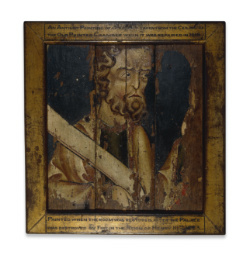
Two ceiling paintings which were removed in 1816 during repairs are now at the British Museum (pictured right).
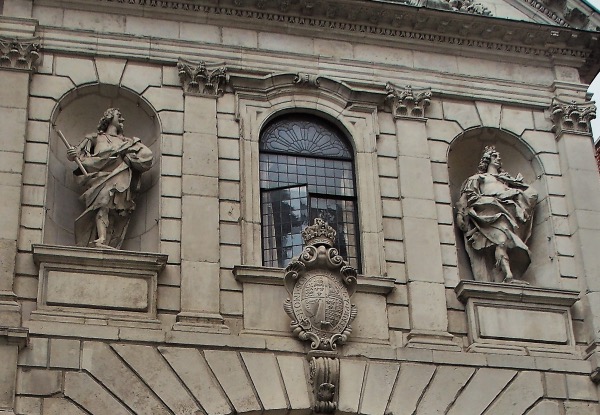
King Charles I (left) and his son King Charles II on what is now the south side of the gateway. PICTURE: haluk ermis (licensed under CC BY 2.0)
The equestrian statue of King Charles I at the top of Whitehall is one of London’s most well-known. But less well-known is the statue of the ill-fated King which can be found standing in a niche on the Temple Bar gateway, located at the entrance to Paternoster Square just outside of St Paul’s Cathedral.
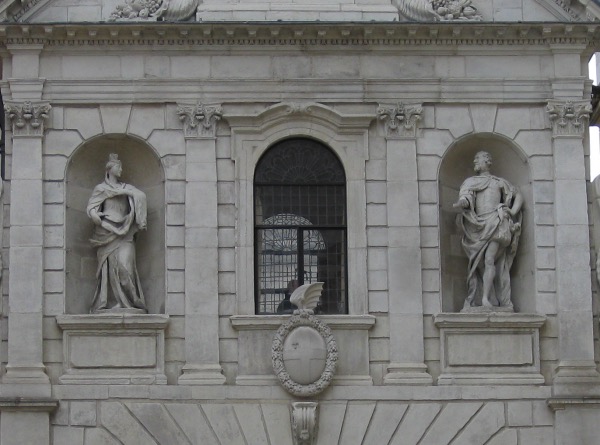
Charles is not alone. Part of the gateway’s purpose was as a dynastic statement in support of the Stuarts so the grand portal also features statues of Charles’ father King James I, his mother Queen Anne of Denmark, and his son King Charles II. King James and Queen Anne can be found on the north side of the gateway (originally the east side) and the two Charles’ on the south side (originally the west side).
The design of the gateway, which originally stood at the intersection of Fleet Street and the Strand as a ceremonial entrance into the City of London, is believed to be the work of Sir Christopher Wren who was acting on the orders of King Charles II after the Great Fire of London.
Queen Anne of Denmark and King James I on the north side of the gateway. PICTURE: lizsmith (licensed under CC BY-NC-ND 2.0)
The statues, which cost a third of the total £1,500 spent on the gateway, are said to have been sculpted by one John Bushnell. They are depicted in Roman attire rather than the dress they would have worn during the period.
They were removed when the gateway was dismantled in 1878 and stored in a yard of Farringdon Road and when the gateway was re-erected at Lady Meux’s Hertfordshire estate at Theobold’s Park, they were placed back in their original locations. And they also accompanied the gateway back to the city when it was positioned its current location in 2004.
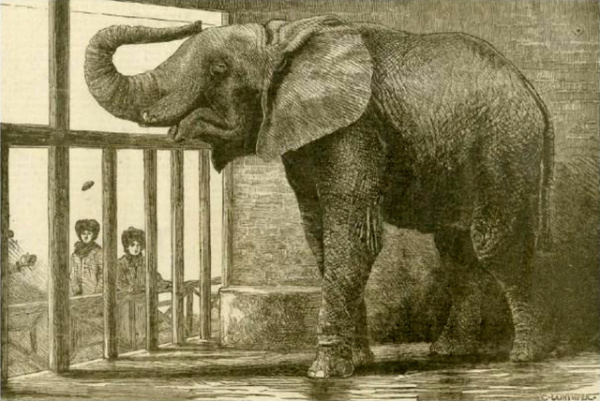
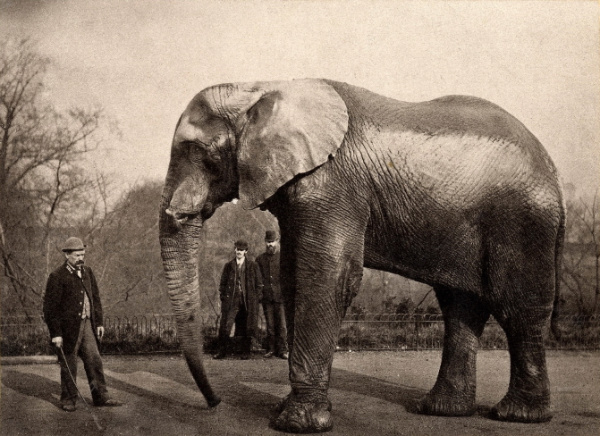
Jumbo greets some visitors as they pass by his den in London Zoo. PICTURE: From ‘Jumbo: This Being the True Story of the Greatest Elephant in the World’ by Paul Chambers
With his name a byword for things of a large size, Jumbo was an African bush elephant who was once one of London Zoo’s most popular residents(but whose life makes for sad reading).
Born in Sudan in about 1860, Jumbo – whose name is apparently a corruption of ‘jumbe’, the Swahili word for chieftain – was captured by hunters after his mother was killed and transported north to Europe. There he was apparently first exhibited in Germany before being sold to the Jardin des Plantes, a zoo in Paris.
In 1865, he was transferred to London Zoo in England where his keeper was Matthew Scott who went on to detail his care of Jumbo in his 1885 autobiography.
Jumbo quickly became a popular exhibit and was trained to give rides to children, including those of Queen Victoria (Teddy Roosevelt and Winston Churchill were apparently also among those who rode the elephant).
But out of public view, Jumbo, particularly as he matured, was growing increasingly destructive, smashing his den and breaking his tusks (it’s said Matthew Scott would pacify him with large quantities of alcohol).
In 1882, protests broke out when, apparently concerned over Jumbo’s growing aggression, then zoo superintendent Abraham Bartlett announced plans to sell Jumbo to American circus founder PT Barnum for £2,000. Some 100,000 school students wrote to Queen Victoria begging her to stop the transaction and a lawsuit was launched to stop the sale. It was unsuccessful.
Despite the protests, the sale went ahead and in March, 1882, Jumbo and Matthew Scott, who had decided to go with the elephant, went to America. In New York, Jumbo was exhibited at Madison Square Garden in a 31 week season. In 1884, he was one of 21 elephants who crossed the Brooklyn Bridge to prove it was safe following the death of 12 people during a collapse caused by a stampede few years earlier.
Jumbo with his keeper Matthew Scott, pictured in June, 1882. PICTURE: From Bierstadt, E ‘Jumbo and trainer.’
Jumbo died on 15th September, 1885, when he was hit by a train as he and other elephants were being led back to their boxcar. According to Barnum, Jumbo was attempting to lead a young elephant Tom Thumb to safety.
Following Jumbo’s death, a postmortem revealed his stomach contents included five English pennies, keys, rivets, and a police whistle.
Sadly, PT Barnum had the body parts separated for display before Jumbo’s skeleton was eventually donated to the American Museum of Natural History in New York City. The elephant’s heart was sold to Cornell University and its hide stuffed and eventually donated to Tufts University where it was destroyed in a fire in 1975 (Jumbo remains the university mascot).
There is a statue of Jumbo near where he died in St Thomas, Ontario, and a six-storey, elephant-shaped building in Margate City, New Jersey, which was built in 1881 is said to be inspired by him. He is also said to have inspired the Disney film, Dumbo.
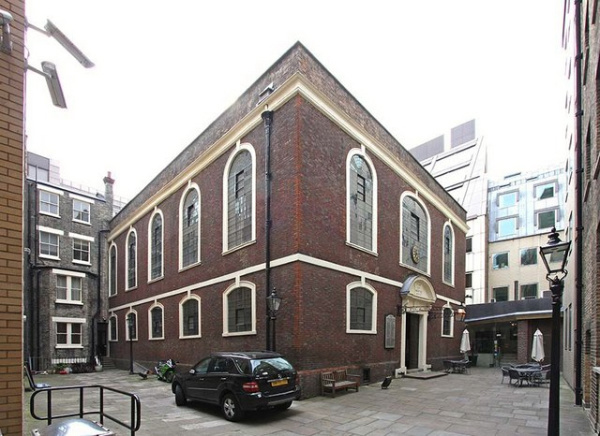
The synagogue has historical ties to the city’s Spanish and Portuguese Jewish community, known as Sephardic Jews, which first started meeting together in a small synagogue in Creechurch Lane in 1657 after it become possible for Jews to openly practice their religion under the rule of Lord Protector Oliver Cromwell.
Increasing numbers in the community soon meant a larger premises was required and a committee was formed which signed a contract with Quaker builder Joseph Avis in February, 1699, to build a larger premises (tradition holds that Avis returned the money he made on the job to the community, saying he would not profit from building a house of God). In June that same year, the community leased a tract of land at Plough Yard, Bevis Marks, on which the new building would be built. Construction commenced soon after.
The property’s design is said to emulate, at least in part, that of the 1675 Portuguese Synagogue of Amsterdam (it’s also thought the design was influenced by the works of Sir Christopher Wren). There’s also a story that the building included an oak beam from one of the Royal Navy’s ships presented by Queen Anne.
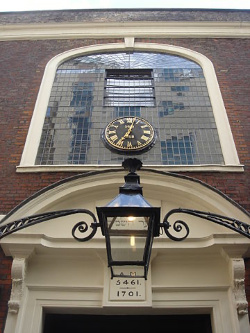
The rectangular building, which features three galleries inside, was eventually completed and dedicated in September, 1701.
The roof of the now Grade 1-listed building was replaced following a fire in 1738 and the synagogue only suffered minor damage during the Blitz. It also suffered some collateral damage from the IRA bombing in 1992 and the 1993 Bishopsgate bombing but remains mostly intact.
Sermons at Bevis Marks were in Portuguese until 1833 when they changed to English.
Features inside include an oak Renaissance-style ark containing the Torah scroll which, painted to resemble coloured Italian marble, is located at the centre of the eastern wall. There are also seven hanging brass candelabra which symbolise the seven days of the week. The largest, which hangs in the centre of the synagogue – represents the Sabbath and was donated by the community of the Great Synagogue of Amsterdam. There are also 10 large brass candlesticks representing the Ten Commandments. While the upright oak seats are said to “reflect the Puritanism of 17th century England”, the backless oak benches at the back are the original seats which were brought from the Creechurch Lane premises.
Twice Prime Minister Benjamin Disraeli’s 1804 birth is recorded in the register but after his father had a falling out with the synagogue officials, Disraeli was in 1817 baptised at St Andrew’s Holborn.
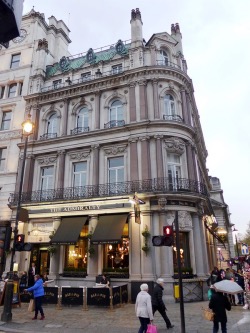
With a claim to be the most central pub in London, this Trafalgar Square pub takes its name from its proximity to…well, all things naval.
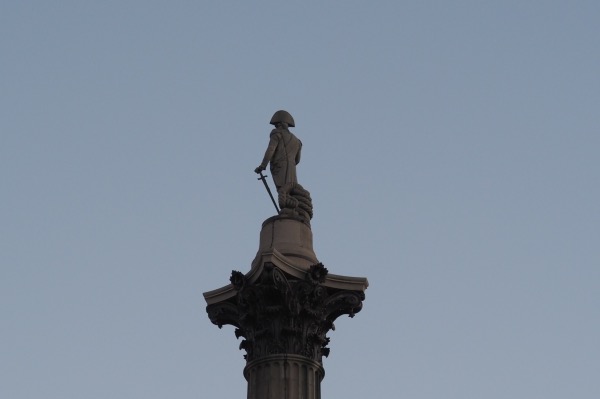
This includes Trafalgar Square itself, of course, and its centrepiece of Nelson’s Column (commemorating the victory at the Battle of Trafalgar and Vice-Admiral Lord Nelson) as well as the the location of Admiralty Arch behind the building and the Old Admiralty Building just down Whitehall.
The Grade II-listed Italianate building, which was designed by FW Porter and dates from 1871, has only been a pub since 2014 when it was acquired by Fullers.
It was originally constructed for the Union Bank and later became a branch of the National Westminster Bank. In 2005, the building became home to Scottish restaurant Albannach before becoming a pub almost 10 years later.
Fittingly, the pub – officially located at 66 Trafalgar Square – features an interior inspired by HMS Victory, Nelson’s flagship at the Battle of Trafalgar.
It was opened on 23rd October, 2014, just two days after Trafalgar Day by former First Sea Lord Admiral Lord West of Spithead and Fuller’s chief executive Simon Emeny. A magnum of beer was reportedly ceremonially smashed on the pub’s exterior in keeping with naval tradition.
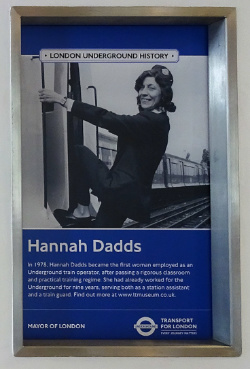
Hannah Dadds, seen in a London Underground poster in 2016. PICTURE: Kake (licensed under CC-BY-NC_SA 2.0)
As the first female driver on London’s Tube, Hannah Dadds broke new ground for working women.
Born on 16th October, 1941, Dadds grew up in the Forest Gate area of Newham. She left school when just 15 and worked in various jobs – including as a shop assistant and at the Bryant and May match factory – before in 1969 joining the London Underground to work as a “railwoman” at the Upton Park Underground Station, earning just over £13 a week.
Dadds went on to become a ticket collector at Tower Hill station and in 1976 became a train guard.
Following the passing of the 1975 the Sex Discrimination Act which opened up new jobs to women, in October, 1978, Dadds completed a seven week training course and, amid considerable fanfare, became the first female train driver on the Tube, driving her first train out of the Acton Depot to Ealing Broadway.
Initially assigned to the District line, she would go on to also drive trains on the Bakerloo and Jubilee lines. Dadds was also sometimes was paired with her sister, Edna, who joined the Underground after her sister and worked as a guard (they became the first all-female crew on the Underground).
Dadds, who retired in 1993, subsequently split her time between London and Spain. She died in 2011.
A plaque commemorating Dadds’ pioneering efforts was unveiled at Upton Park station in May, 2019, with her family and friends in attendance.
We close our series of historic London stairs with a stairway that has raised its share of controversy in recent years, largely due to the plaques associated with it.
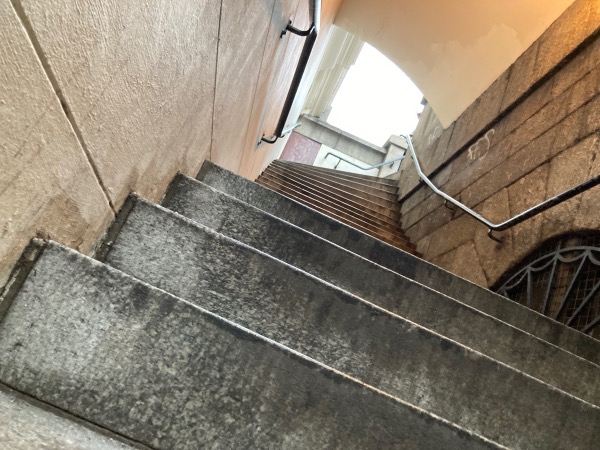
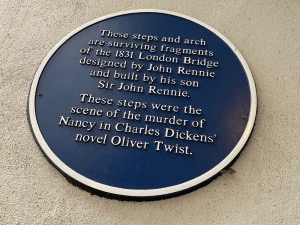
The steps, which are located in Southwark at the southern end of London Bridge and which lead down to Montague Close, are a remnant of the John Rennie-designed London Bridge which was completed in 1831 and which was replaced in the mid-20th century (and which was sold off and relocated to Lake Havasu in the US).
The controversy arises through the plaques associated with the steps which state that the steps where the scene of the murder of Nancy in Charles Dickens’ Oliver Twist. There’s a couple of problems with that claim.
The first is that Nancy wasn’t murdered here in the book – it is in their lodgings that Bill Sikes kills Nancy believing she has betrayed him. The confusion probably comes about because the musical Oliver! did set Nancy’s murder on the steps.
The bridge does, however, play a role in the book and have a connection to Nancy and its probably due to this connection that it has its name, Nancy’s Steps.
Because it was on steps located here – “on the Surrey bank, and on the same side of the bridge as Saint Saviour’s Church [now known as Southwark Cathedral]” that Nancy talks to Oliver’s benefactors while Noah Claypole eavesdropped on the conversation (which leads him reporting back to Sikes and eventually to her murder).
The second error made in the plaque is that Rennie’s bridge (and hence the steps) was completed in 1831 and with Oliver Twist published in serial form just a few years later can’t be the “ancient” bridge referred to in the text. The reference can only relate to the medieval bridge which occupied the site for hundreds of years until it was demolished following the completion of Rennie’s bridge.
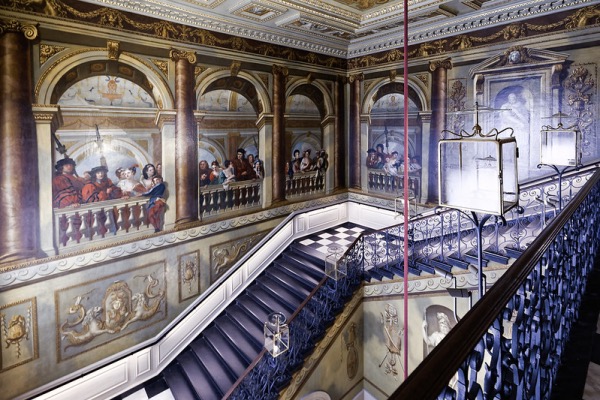
This staircase, a grand entrance to the King’s State Apartments at Kensington Palace, are famous for the paintings on the walls and ceiling which depict an 18th century court looking down on those who ascend.
The work of William Kent, the staircase paintings were complete in 1724 and replaced earlier wooden panelling.
The stairs were originally constructed as part of Sir Christopher Wren’s remodelling Nottingham House into Kensington Palace for King William III and Queen Mary II. Following a fire in 1691, they were rebuilt in marble.
There are 45 people in Kent’s painting and only about a dozen have been identified. As well as members of the Yeomen of the Guard, the images depict King George I’s Polish page Ulric, his Turkish servants Mahomet and Mustapha, Peter the ‘wild boy’, a child found in the woods in Germany, and Dr John Arbuthnot, a medical doctor and satirist who tried to teach Peter to speak.
Interestingly, Kent included a selfie on the ceiling – a depiction of himself, wearing a brown turban and carrying an artist’s palette, standing with his mistress by his side.
The trompe l’oeil (a technique which creates the optical illusion of 3D) work features architecture inspired by Rome where Kent had trained while there’s also a painted figure of Diana on the top landing which is based on an antique statue at Holkham Hall in Norfolk.
In 1734, Queen Caroline commissioned Kent to rework the stairs to the Queen’s State Apartments. His work there features a Roman-inspired scene again created as a trompe l’oeil. There is also a homage to Queen who is compared to Britannia. The staircase’s balustrade was another by Huguenot ironworker Jean Tijou.
WHERE: The Broad Walk, Kensington Gardens, Kensington (nearest tube stations are High Street Kensington or Queensway); WHEN: Daily 10am to 6pm (last admission 5pm); COST: £16 adult/£12.80 concession/£8 child (Historic Royal Palaces members free); WEBSITE: www.hrp.org.uk/KensingtonPalace.
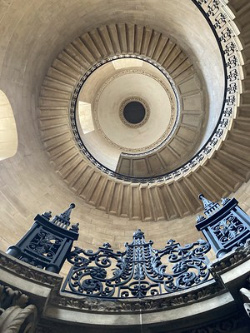
Known more formally as the Dean’s Staircase, this spiral staircase was designed by none other than Sir Christopher Wren and provides access to the triforium in St Paul’s Cathedral.
The staircase – each step of which is embedded into the wall – was built between 1675 and 1710 in the cathedral’s south-west tower by William Kempster. The ironwork is by famed French metal worker Jean Tijou.
Located in the south-west bell tower, the stair’s 88 Portland stone steps rise some 50 feet.
The staircase, which can be seen on the cathedral’s guided tours including triforium tours, has become famous in recent years thanks to its appearance in the 2004 Harry Potter film, The Prisoner of Azkaban, as well as Guy Ritchie’s 2009 film Sherlock Holmes.
The staircase has also been the site of art installations including Antony Gormley’s Flare II – which featured a falling figure within a cloud of wire.
WHERE: St Paul’s Cathedral (nearest Tube stations are St Paul’s, Mansion House and Blackfriars); WHEN: 8.30am to 4.30pm Monday to Saturday; COST: £21 adults/£18.50 concessions/£9 children/£36 family (these are walk-up rates – online advanced and group rates are discounted); WEBSITE: www.stpauls.co.uk (for tours, head to www.stpauls.co.uk/visits/visits/guided-tours)
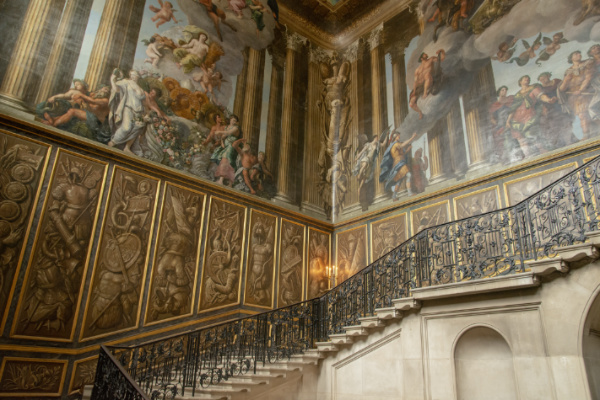
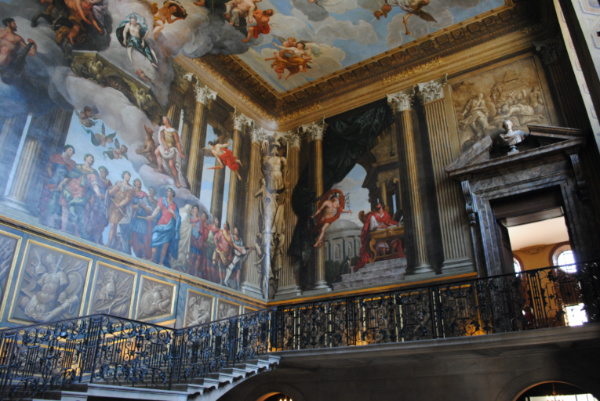
This grand staircase was installed in Hampton Court Palace during the reign of King William III and Queen Mary II as a grand entrance to the King’s Apartments.
The staircase, which features shallow steps, was designed Sir Christopher Wren and features a wrought iron balustrade designed by French ironsmith Jean Tijou.
Another view of the staircase and accompanying art. PICTURE: David Adams
It was decorated in about 1700 by Italian painter Antonio Verrio to resemble a Roman courtyard which is open to the sky. The main image depicts ‘Victory of Alexander over the Caesars’ which features King William III as Alexander the Great and is painted as an allegory of William’s triumph over the Stuart King, James II, in the Glorious Revolution of 1688 (with the Stuarts represented by the 12 Caesars).
The stairs lead up to the Guard Chamber, an anteroom which had to be passed through to reach the Presence Chamber.
Memorialised in the name of the house where he once lived at the Royal Observatory in Greenwich, John Flamsteed was the first Astronomer Royal.
Flamsteed was born in Denby, Derbyshire, on 16th August, 1646, and was the only child of Stephen Flamsteed, who among other things was involved in the brewing industry, and his first wife Mary (who died when John Flamsteed was still quite young).
A bust of John Flamsteed at the Royal Observatory Greenwich.
He was educated at local schools but left off his studies at the age of 15 due to his own ill health and his father’s need for his assistance in the household and with his business.
His poor health meant he pursued some more sedentary activities and it was during this period that he established interest in astronomy, writing his first paper in 1665. Flamsteed did briefly attend Jesus College in Cambridge in the early 1670s, although it’s not thought he ever took up full residence.
Flamsteed was ordained a deacon and was preparing to take up a living in Derbyshire in 1675 – having by then obtained an MA from Cambridge – when his patron Jonas Moore, whom he’d met in the summer of 1670 during a visit to London and then visited again in mid-1674, invited him to return to the city, ostensibly to establish an observatory which Moore, who was Surveyor-General of the Ordnance, had offered to pay for.
Flamsteed arrived in February, 1675, stayed with Moore in the Tower before, after meeting King Charles II, was made an official assistant to a Royal Commission which the king had established charged with examining the merits of a proposal – put forward by a “le Sieur de St Pierre” to find longitude by the position of the Moon.
The commission decided the proposal wasn’t worth taking further but did recommend the establishment of an observatory from which the movement of the stars and Moon could be mapped in the hope of developing a method of finding longitude. Flamsteed was subsequently appointed “The King’s Astronomical Observator” – the first Astronomer Royal – on 4th March, 1675, by royal warrant, and in June that same year, another royal warrant provided for the founding of the Royal Greenwich Observatory. Flamsteed laid the foundation stone on 10th August.
He was admitted as a fellow of the Royal Society in February the following year and in July he moved into the observatory, now known as Flamsteed House (it contains famed Octagonal Room with large windows from which celestial events could be watched), which was designed by Sir Christopher Wren. It was to serve as Flamsteed’s home for next decade or so.
Flamsteed House, Royal Greenwich Observatory, its named after John Flamsteed. PICTURE: Dmitry Djouce.
Flamsteed’s achievements as an astronomer included the accurate calculation of the solar eclipses of 1666 and 1668 and recording some of the earliest sightings of Uranus which he mistakenly thought was a star. He was also in regular contact with many other scientific luminaries of the day and famously fell out with both Sir Edmond Halley (his one-time assistant and future successor as Astronomer Royal) and Sir Isaac Newton.
Flamsteed’s own catalogue of almost 3,000 stars wasn’t published until after death in 1725 thanks to the effort’s of his wife Margaret – whom he had married on 23rd October, 1692 (they were to have no children although Flamsteed’s niece, Ann Heming, did live with them). Margaret also published his star atlas, Atlas Coelestis, posthumously in 1729.
In 1684, Flamsteed was elevated to the priesthood and made rector of the village of Burstow, near Crawley in Surrey – a post, which, along with that of Astronomer Royal, he held until his death on 31st December, 1719.
He was buried in Burstow and there is a plaque on the wall of the church there marking his grave (which was added long after his death). Aside from his earthly honours – which includes the name of Flamsteed House at the Royal Observatory, a crater on the Moon is named after him as is an asteroid.
Located in Somerset House, this grand rotunda stairway rises up through the building to the Navy Board Rooms.
The present five storey stair is a replica of what was there up until the original suffered significant damage in The Blitz during World War II. It was rebuilt in the early 1950s under the supervision of Sir Alfred Richardson using original plans which had been kept safe in Sir John Soane’s House in Lincoln’s Inn Fields.
The architecturally interesting stair, which is located in the South Wing, was originally built in the late 18th century to the designs of Sir William Chambers with each flight a different configuration to the one underneath (the design was apparently made to reflect something of the stairs on ships).
It was initially known as the Navy Stair but renamed the Nelson Stair, ostensibly in honour of the heroic Vice-Admiral Horatio Nelson.
It’s not the only historic stair of note in Somerset House. The cube-like Stamp Stair, also located in the South Wing, is so-named for the stamping of newspapers that once took place here. Meanwhile, the Miles Stair, designed by Eva Jiricna Architects and named for Gwyn Miles, former director of the Somerset House Trust, is a stunning contemporary addition featuring a steel-mesh newel and a transparent balustrade.
Somerset House, Strand (nearest Tube stations are Temple and Charing Cross): WHEN: Daily (check website for times); COST: Free (but charges for exhibitions); WEBSITE: www.somersethouse.org.uk.
Housed now in the building it depicts, the Great Model of St Paul’s Cathedral was created by architect Sir Christopher Wren to show King Charles II what his proposed grand new English Baroque cathedral would look like (following the destruction of the medieval cathedral in the Great Fire of 1666).
Made of oak, plaster and lime wood, the model was made by William Cleere to Wren’s design in between September, 1673, and October, 1674, at a scale of 1:25. It measures 6.27 metres long, 3.68 metres wide and more than four metres tall, making it one of the largest in the UK.
The model, which cost about £600 to make – an extraordinary sum which could apparently buy a good London house, was designed to be “walked through” at eye level and, as well as being a useful way to show the King what the proposed building would look like, was also something of an insurance policy in case something happened to Wren.
It was based on drawings made by Wren and his assistant Edward Woodroofe on a large table in the cathedral’s convocation or chapter house (later demolished in the early 1690s) and was originally painted white to represent Portland stone with a blue-grey dome and gilded details.
There are some differences between the model and the finished cathedral – among them was a substantial extension of the quire, double-height portico on the west front, and, of course, the bell towers on the west front which were made in place of the cupola which was located halfway down the nave on the model.
Part of an earlier wooden model from 1671 also survives – it was apparently lost for many years and rediscovered in 1935.
The Great Model can be seen on tours of the Triforium.
WHERE: St Paul’s Cathedral (nearest Tube stations are St Paul’s, Mansion House and Blackfriars); WHEN: 8.30am to 4.30pm Monday to Saturday; COST: £21 adults/£18.50 concessions/£9 children/£36 family (these are walk-up rates – online advanced and group rates are discounted); WEBSITE: www.stpauls.co.uk (for tours, head to www.stpauls.co.uk/visits/visits/guided-tours)
Running up the centre of the tallest free-standing stone column in the world, this 311 step stairway takes the visitor straight to the top of the Monument erected to commemorate the Great Fire of 1666.
The Monument
The Monument – actually a Doric column – was built close to Pudding Lane in the City – where the fire is believed to have started – between 1671 and 1677. It was designed by Sir Christopher Wren in collaboration with City Surveyor Sir Robert Hooke.
The cantilevered stairway – each step of which measures exactly six inches high – leads up to a viewing platform which provides panoramic views of the City. Above the platform stands is a large sculpture featuring a stone drum topped with a gilt copper urn from which flames emerge as a symbol of the fire (King Charles II apparently squashed the idea of an equestrian statue of himself lest people think he was responsible for the fire).
Interestingly, the circular space in the centre of the stairway was designed for use as a zenith telescope (a telescope which points straight up). There is a small hatch right at the top which can be opened up to reveal the sky beyond and a subterranean lab below (reached through a hatch in the floor of the ticket both) where it was envisaged the scientist could take measurements using a special eyepiece (two lenses would be set into the actual telescope). But it wasn’t successful (reasons for this could have been vibrations caused by passing traffic or the movement of the column in the wind).
Hooke also apparently attempted to use the staircase drop for some other experiences – including measuring differences in air pressure.
Among those who have climbed the stairs was writer James Boswell who visited the Monument and climbed the stairs in 1763. He suffered a panic attack halfway up but was able to complete the climb.
WHERE: The Monument, junction of Fish Street Hill and Monument Street (nearest Tube station is Monument); WHEN: Check website; COST: £5.40 adults/£2.70 children (aged five to 15)/£4.10 seniors (joint tickets with Tower Bridge available); WEBSITE: www.themonument.org.uk
This small stone stairway which now sits in the midst of a grassy expanse at the back of the Ministry of Defence was once part of the Palace of Whitehall.
Named for Queen Mary II, wife of King William III, for whom they were designed, the stairs were part of a terrace built in 1691 abutting the Thames in front of an old river wall constructed for King Henry VIII.
Designed by Sir Christopher Wren, the stairs were one of a pair located at either end of the terrace which gave direct access to the river – and state barges – from the Royal Apartments.
Excavations in 1939 during construction of the MoD revealed the Tudor river wall, the terrace and the northern-most of the two flights of steps. The upper part of the steps have been repaired and the terrace and wall reconstructed.
The steps and palace fragments are now a Grade I listed monument.
London has many beautiful stairways – and some of them have some incredible historic connections. In this series, we’re going to be looking at 10 of them and the history that goes with them. First up, it’s the spectacular Tulip Stairs found in The Queen’s House in Greenwich.
The wrought-iron stairs – which have the honour of being the first self-supporting spiral stair in the UK (meaning each tread is cantilevered from the wall and supported by the stair below rather than being supported by a central pillar) – were designed by Inigo Jones in 1635.
They are so named because the stairs, which are topped with a glass lantern, feature a flower pattern on the railings which resembles tulips although it is thought the flowers could be actually French lilies designed to compliment the Queen at the time of their completion.
For while Jones originally designed the house for Queen Anne of Denmark, wife of King James I, the building was unfinished and the stairs weren’t in place when she died in 1619. It was Queen Henrietta Maria, wife of King Charles I and daughter of French King Henry IV, who was Queen when he completed the property.
The stairs were at the centre of a ghost sighting in the mid 1960s when retired Canadian clergyman Rev RW Hardy took a photograph while visiting the house with his wife which appeared to show a couple of spectral figures on the staircase. The couple were both adamant that the stair was clear when the photo was taken and the mystery of the image, despite subsequent investigations, apparently remains unsolved.
WHERE: The Tulip Stairs, The Queen’s House, Greenwich (nearest stations are Cutty Sark DLR, Greenwich Station and Maze Hill Station or by water, Greenwich Pier); WHEN: Daily 10am to 5pm (but check the website for closures); COST: Free (but a prebooked ticket is required); WEBSITE: www.rmg.co.uk/queens-house.
It’s 260 years ago this month that a supposed poltergeist known as the ‘Cock Lane Ghost’ was at the centre of an infamous scandal.
There had been several reports of strange sounds and spectral appearances at the property prior to January, 1762, but it was the events which took place that month which were to elevate the hauntings to the national stage.
Cock Lane, shown in Charles Mackay’s 1852 work ‘Haunted Houses’. PICTURE: Via Wikipedia
It was in that month that Elizabeth Parsons, the 11-year-old daughter of Richard Parsons, the officiating clerk at St Sepulchre Church, reported hearing knockings and scratchings while she was lying in bed. Her father, Richard Parsons, the officiating clerk at nearby St Sepulchre, enlisted the aid of John Moore, assistant preacher at St Sepulchre and a Methodist, to find their cause and the two concluded that the spirit haunting the house was that of Fanny Lynes, who had formerly lived in the property before apparently dying of smallpox in early February, 1760.
The two men devised a system for communicating with the spirit based on knocks and based on the answers they received, concluded that Lynes had not died of smallpox but actually been poisoned with arsenic by her lover (and brother-in-law) William Kent.
Kent had been married to Fanny’s sister Elizabeth and after her death, he had lived with Lynes as man and wife despite prohibitions on them being married due to their status as in-laws. Parsons, who was their landlord at the time, had taken a loan from Kent while they were living at the property but subsequently refused to pay it back leading Kent to successfully sue him for its recovery.
It was against that backdrop – and earlier reports that the ghost of Fanny’s sister Elizabeth had haunted the property after her death – that the story of ‘Scratching Fanny’ began to spread and led to crowds gathering in Cock Lane to witness the phenomena. Writer Horace Walpole was among them – he attended along with Prince Edward, the Duke of York and Albany, and, apart from not hearing the ghost (he was told it would appear the next morning at 7am), noted that the local alehouses were doing a great trade.
Such was the case’s fame that the Lord Mayor of London, Sir Samuel Fludyer, ordered an investigation – among those who was involved was famed lexicographer Samuel Johnson. They concluded that the girl had been making the noises herself (Dr Johnson went on to write an account of it which was published in The Gentlemen’s Magazine). Further investigations were held – Fanny’s body even exhumed – and Elizabeth was later seen concealing a small piece of wood (apparently to make the sounds), subsequently confessing that her father had put her up to it.
Kent, however, was determined to clear his name and Moore, along with Parsons, Parson’s wife Elizabeth, Mary Frazer, a relative of Parsons, and a tradesman Richard James, were all subsequently charged with conspiracy to take Kent’s life by alleging he had murdered Frances. The trial, which took place at Guildhall before Lord Chief Justice William Murray, on 10th July, 1762, saw guilty verdicts returned for all five defendants. Moore and Richards agreed to pay Kent a sum of more than £500 but the others refused and so in February the following year they were sentenced – Parsons to three turns in the pillory and two years imprisonment, his wife Elizabeth to a year in prison and Frazer to six months hard labour in Bridewell.
The case, which also caused controversy between the new Methodists and Anglicans over the issue of ghosts, was widely referred to in literature of the time including by satirical poet Charles Churchill in his work The Ghost. It was also referenced by William Hogarth in his prints and Victorian author Charles Dickens even alluded to the story in A Tale of Two Cities.