The Royal Wedding – Eight curious facts about Royal Weddings past and present…

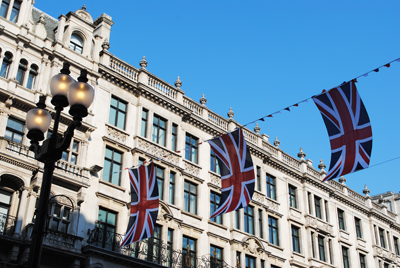
PICTURE: Bunting in Regent Street ahead of the Royal Wedding tomorrow.

Ahead of the wedding of Prince William and Kate Middleton tomorrow, here’s a look at some of the more curious and interesting facts related to London’s Royal Wedding past…

The first public Royal Wedding in modern times was that of Prince Albert, Duke of York (later King George VI), and Lady Elizabeth Bowes-Lyon (later Queen Elizabeth, the Queen Mother) which took place on 26th April, 1923. Instead of being held at a royal chapel as was more usual, they were married at Westminster Abbey in a public display which was apparently staged to lift the national spirit in the aftermath of World War I.

Lady Diana Spencer (later Diana, Princess of Wales) memorably said Prince Charles’ name in the wrong order during their wedding ceremony at St Paul’s Cathedral on 29th July, 1981. Lady Diana accidentally called him Philip Charles Arthur George instead of the correct Charles Philip Arthur George.

• Queen Victoria’s extravagant wedding cake was the first to feature a model of the bride and groom on its summit (with a figure of Britannia looming over them). The two tier cake measured nine foot across and weighed 300 lbs.

While white wedding dresses had been worn for some time, it was apparently after Queen Victoria wore a white dress at her 1840 wedding that the idea spread to the masses. (Interestingly, the first documented princess to wear a white wedding dress is said to have been Philippa of England, the daughter of King Henry IV, in 1406).

The first televised Royal Wedding was that of Princess Margaret, younger sister of Queen Elizabeth II, to Antony Armstrong-Jones (Lord Snowdon) on 6th May, 1960. It attracted some 300 million viewers worldwide.

The tradition of a royal bride leaving her bouquet on the Tomb of the Unknown Warrior in Westminster Abbey was started by Queen Elizabeth, the Queen Mother. She apparently did so in tribute to her brother Fergus who had died during World War I. Princess Mary, daughter of King George V, made a similar gesture at her wedding in 1922 – she left her bouquet at the Cenotaph in Whitehall after her wedding.

One of the most scandalous Royal Weddings was that of George, Prince of Wales (later King George IV) to Princess Caroline of Brunswick on 8th April, 1795 at the Chapel Royal in St James’s Palace. Described as being “far from a love match” on the Historic Royal Palaces’ website, Prince George was said to have been drunk during the wedding and at one stage apparently even attempted to escape from the ceremony.

If the rain stays away, the newly married prince and his bride will be returning to Buckingham Palace in the 1902 State Landau. The open-topped carriage was constructed for King Edward VII’s coronation and apparently made roomy to accommodation him. The carriage was used by Prince Charles and Lady Diana when they left St Paul’s Cathedral after their 1981 wedding. If the weather it poor, it’s expected that the 1881 Glass Coach, bought for the coronation of King George V in 1911, will be used instead.

For more fascinating facts on Royal Weddings, see the BBC website (www.bbc.co.uk/history/royal_weddings), or Historic Royal Palaces’ blog, The ‘other’ royal weddings (http://blog.hrp.org.uk). For more on the current Royal Wedding, see the official website (www.officialroyalwedding2011.org).
The Royal Wedding – Royal residences…

Word is that Prince William and his soon-to-be wife, Catherine Middleton, have yet to formally decide where they will live when in London (they are expected to spend much of their first two-and-a-half years of marriage in North Wales). 

Their initial London base, however, will reportedly be Clarence House. Located in The Mall, just down the road from Buckingham Palace and beside St James’s Palace, the grand building is currently the home of William’s father Charles, the Prince of Wales, his wife Camilla, Duchess of Cornwall, and, William’s brother, Prince Harry (it is also the home of William himself).

In years gone past, Clarence House served as the home of the newly married Queen Elizabeth II (then Princess Elizabeth) and her husband, Prince Philip, the Duke of Edinburgh. Prince Charles, who lived there with his parents until the age of three, returned to the property in August 2003 after the death of his grandmother Queen Elizabeth, the Queen Mother, who had lived in the building from 1953.

Clarence House was built between 1825 and 1827 to the designs of architect John Nash on the orders of Prince William Henry, the Duke of Clarence and later King William IV.

Choices for a permanent home in London for the soon-to-be married couple reportedly include Buckingham Palace (see yesterday’s entry), as well as Kensington Palace.

It was converted from a Jacobean mansion for King William III and Queen Mary II and has since been the home of many royals including, most famously, Diana, Princess of Wales. She and her then husband, Prince Charles, moved in following their wedding in 1981, and Princess Diana continued to live there after her divorce in 1996.

Other notable royal residents have included Queen Anne and Princess Margaret, sister of Queen Elizabeth II.

Another option – St James’s Palace – was built in 1531 on the site of a medieval leper hospital by King Henry VIII. Used initially for state occasions and to house royal relatives (Tudor monarchs actually lived at Whitehall Palace), it became the official royal residence in 1702, when Whitehall Palace burnt down, and remained so until the 1830s when King George III moved to Buckingham Palace.

The Royal Wedding – London’s royal reception venue

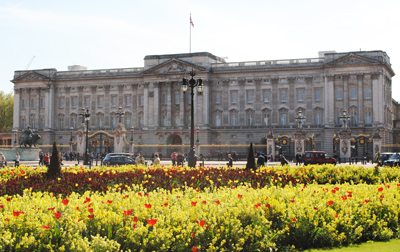
Following the wedding ceremony at Westminster Abbey on Friday, the now married happy couple will head in a carriage via a processional route down The Mall to Buckingham Palace.

There, they will enjoy a champagne reception with 600 guests hosted by the Queen before, at 1.30pm, appearing on the balcony of the palace to wave to the crowds and watch an aircraft flypast expected to include a Lancaster, Spitfire, Hurricane, two Typhoons and two Tornados.

Buckingham Palace, which has served as the official London residence of the reigning monarch since 1837, has a long tradition of hosting royal events. Then much smaller and known as Buckingham House, the property was built for the Duke of Buckingham in 1705.

It passed into royal hands when it was bought by King George III in 1761 for his wife, Queen Charlotte, to use as a family home located conveniently close to St James’s Palace where many court functions were held.

The house was extensively remodelled in 1762 and again, this time on the orders of King George IV, in the 1820s (after initially wanting to use it, like his father, as a family home, the king decided after the works had started to instead transform it into a palace, created to the designs of architect John Nash).

When King George IV died in 1830, his brother King William IV ordered the works to be continued albeit with a new architect, Edward Blore (the spiralling costs of Nash’s work are said to have cost him the contract). The king himself never lived in the house – even offering at at one stage as a seat for Parliament after the Houses of Parliament were destroyed by fire in 1834 – and it wasn’t until the accession of Queen Victoria in 1837 that the palace became the sovereign’s official residence.

Further works were subsequently needed to ensure there was adequate accommodations for the Queen’s family and it was during these works that the monumental Marble Arch – designed as the centrepiece of the palace’s courtyard – was moved away to its present location on the north-eastern corner of Hyde Park.

The palace, which now boasts 775 rooms including 19 staterooms, has since been the site of numerous royal wedding receptions – it was on the balcony  where Queen Elizabeth II and Philip, the Duke of Edinburgh, greeted crowds on 20th November, 1947, after their wedding in Westminster Abbey and, similarly, where Prince William’s parents, Prince Charles and Princess Diana, held a reception before greeting crowds on 29th July, 1981, after their ceremony at St Paul’s Cathedral.

Buckingham Palace was also the location for Queen Victoria’s wedding breakfast following the ceremony in the Chapel Royal at St James’s Palace on 10th February, 1840.

The Royal Wedding – London’s Royal Wedding venues

In the first of a series this week looking at aspects of royal weddings in London in days past, we canvas some of the venues which have hosted the sometimes glittering occasions.

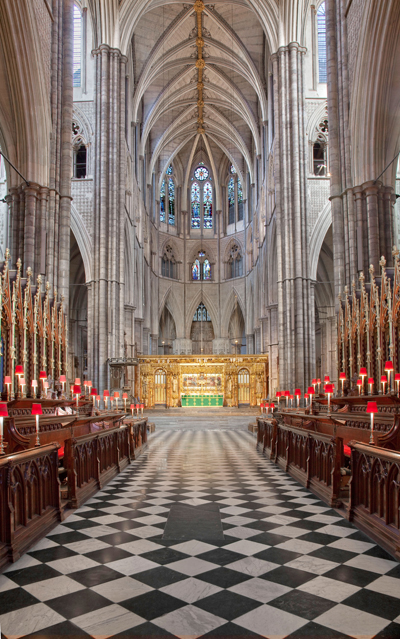
First up is Westminster Abbey (pictured), the location of Prince William and Kate Middleton’s wedding this Friday, which, despite its thousand year history, is only believed to have hosted 15 royal weddings.

Among them is said to have been the wedding of King Henry I to Matilda of Scotland on 11th November, 1100, as well as that of Richard, Earl of Cornwall and brother of King Henry III, who married his second wife, Sanchia of Provence, there on 4th January, 1243, and Joan of Acre, daughter of King Edward I, who married Gilbert, Earl of Gloucester, on 30th April, 1290 (her sister Margaret married John, Duke of Brabant, at the same venue less than three months later). The abbey also hosted the wedding of King Richard II to Anne, daughter of Emperor Charles IV of Bohemia, on 20th January, 1382.

The abbey church has become increasingly favored as a venue for royal weddings in more recent times. Among the most prominent hosted there last century were that of Prince Albert, Duke of York (later King George VI), who married Lady Elizabeth Bowes-Lyon on 26th April, 1923 and that of their daughter Princess Elizabeth (later Queen Elizabeth II) who married Prince Philip of Greece (later the Duke of Edinburgh) there on 20th November, 1947.

Two of the current Queen’s children were also married there – Princess Anne, who married Captain Mark Phillips on 14th November, 1973, and Prince Andrew, who married Sarah Ferguson on 23rd July 1986. (For more on Royal Weddings at the Abbey, see www.westminster-abbey.org/our-history/royals/weddings)

A notable break with the trend in recent times was the marriage of Prince Charles and Lady Diana Spencer – they were married in a fairytale ceremony at St Paul’s Cathedral on 29th July, 1981.

Other London locations for royal weddings have included the now non-existent Greenwich Palace (King Henry VIII married Katherine of Aragon on 11th June, 1509) and Hampton Court Palace (another of King Henry VIII’s marriages – that in which he was wed to Catherine Parr – was held here in a private chapel on 12th July, 1543).

Along with St George’s Chapel at Windsor, the Chapel Royal at St James’s Palace  in London was particularly popular in Victorian times – Queen Victoria married Prince Albert there on 10th February, 1840, and their eldest daughter, Princess Victoria, married Prince Frederick (the future German Emperor Frederick III) there on 25th January, 1858. On 6th July, 1893, the chapel also hosted the wedding of the future King George V and Princess Mary of Teck.

PICTURE: Copyright Dean and Chapter of Westminster

Around London – South Bank marks 60 years since the Festival of Britain; Royal wedding cakes; and, a new cable car for London…

• South Bank is celebrating the 60th anniversary of the 1951 Festival of Britain with a four month series of events. The official celebrations kicked off yesterday and will run until early September. Highlights of the celebrations include the Museum of 1951 – a temporary museum located in Royal Festival Hall featuring exhibits relating to the 1951 festival, themed weekends including next weekend’s ‘London in Love’, featuring performances by Billy Bragg, and a Festival of Britain-inspired ‘Meltdown’ curated by Ray Davies of The Kinks (runs from 10th to 19th June). The original Festival of Britain was opened on 3rd May, 1951, with the intention of developing a sense of “recovery and progress” among the British in the aftermath of World War II and marked the centenary of the 1851 Great Exhibition. The South Bank Exhibition was at the heart of what were national celebrations and was attended by more than eight million people. For more information on what’s happening, see www.southbankcentre.co.uk.

• Historic royal wedding cakes have been recreated this Easter weekend  in an exhibition celebrating the lead-up to this Friday’s Royal Wedding. The English Heritage-event Let Them Eat Cake, which is being held at Wellington Arch near Hyde Park Corner, features a “four-and-20 blackbirds pie” of the sort King Henry VIII gave to his new wife Anne Boleyn as well as recreations of Prince Charles and Lady Diana’s wedding cake and that of Queen Elizabeth II. The event, which is sponsored by Tate & Lyle Sugars, involves some of Britain’s leading bakers. For more, see www.english-heritage.org.uk/daysout/events/765107/. See Exploring London this week for more on the upcoming Royal Wedding.

• The Mayor of London, Boris Johnson, confirmed this week that work will begin on a new cable car to cross the Thames River in East London this summer. The 34 gondola cable car will stretch for 1.1 kilometres, connecting Greenwich Peninsula and the O2 on the river’s south bank with Royal Victoria Docks and the ExCel centre on the north and carrying up to 2,500 people every hour. Construction will be carried out by a consortium of firms led by Mace – the company currently building the Shard Tower – and it is hoped it will be completed before next year’s Olympics.

Lost London – London Bridge

In the first of a new regular series looking at “lost” London, Exploring London takes a look at London Bridge.

It’s a commonly confused fact that many first-time visitors to London think Tower Bridge and London Bridge are the same. As Londoners know, London Bridge (pictured right with St Paul’s and the city in the background) lies west of Tower Bridge. It’s not a particularly inspiring bridge having been built in the early Seventies. But there’s been a bridge spanning the Thames here for almost 2,000 years. So what happened to Old London Bridge?

The first bridge built across the River Thames on or close to the current site of London Bridge is thought to have been a wooden pontoon bridge constructed by the Romans around 50 AD. It was quickly followed by a more permanent bridge (rebuilt after it was destroyed by Boudicca and her marauding army in 60 AD).

Following the end of the Roman era, the bridge fell into disrepair although it’s known that there was a wooden Saxon bridge on the site by around the year 1,000. A succession of Norman bridges followed the Conquest and in 1176, during the reign of Henry II, construction of a new stone bridge began under the supervision of the priest Peter de Colechurch to service to growing numbers of pilgrims travelling from London to Thomas a Becket’s shrine in Canterbury. The new bridge, which had a chapel dedicated to St Thomas at the centre, wasn’t finished until 1209.

The bridge had 19 arches sitting on piers surrounding by protective wooden ‘starlings’ and a drawbridge and defensive gatehouse. The design of the bridge meant the water shot rapidly through the arches, leading boatmen to describe the practice of taking a vessel between the starlings as “shooting the bridge”.

King John, in whose reign the bridge was completed, licensed the building of houses on the bridge and it soon became a place of business with some 200 shops built upon its length, many of them projecting over the sides and reducing the space for traffic to just four metres. Many of the buildings actually connected at the top, creating a tunnel-like effect.

One of the more remarkable buildings on the bridge was Nonsuch House, built in 1577. A prefabricated building, it had been assembled in the Netherlands before being taken apart, shipped to London, and then reassembled. No nails were used in its construction, just timber pegs.

The practice of putting the heads of traitors on pikes above the southern gatehouse (see picture right, dating from 1660) started in 1305 with Scottish rebel William Wallace’s head and continued until it was stopped after 1678 when goldsmith William Stayley’s head was the last to be displayed there. Famous heads to adorn the gateway over the years included Peasant’s Revolt leader Wat Tyler in 1381, rebel Jack Cade in 1450, the former chancellor Sir Thomas More and Bishop John Fisher in 1535, Thomas Cromwell in 1540 and Guy Fawkes in 1606.

Some of the bridge’s arches collapsed over the years and had to be restored and there were several fires which destroyed houses upon it, including those which occurred during the Peasants’ Revolt in 1381 and Jack Cade’s rebellion in 1450.

Congestion reached such a state by the 18th century that in 1756 Parliament passed an act which allowed for the demolition of all the shops and houses upon it (it had remained the only bridge spanning the Thames east of Kingston until Westminster Bridge was completed in 1750). This was carried out in 1758-62 along with the removal of two central arches which were replaced with a single wider span.

With traffic only increasing – by 1896, 8,000 people and 900 vehicles were reportedly crossing the bridge every hour – it was clear a new bridge was needed and work on a new stone bridge with five arches – following a design competition won by John Rennie – began in 1824. The old bridge, located about 30 metres east of the new one, remained in use until the new one was opened in 1831. Widening work carried out the early 20th century, however, was too much for the bridge’s foundations and it began to sink.

What followed was one of the strangest episodes in the bridge’s history when in 1967 the Common Council of the City of London decided to sell the bridge. It was sold the following year to Missourian entrepreneur Robert P. McCulloch of McCulloch Oil for $US2.5 million.

Carefully taken apart piece by piece, the bridge was then transported to the desert resort of Lake Havasu City in Arizona in the US and rededicated in 1971.

The current London bridge, designed by Mott, Hay and Anderson, was built from 1967 to 1972 and opened by Queen Elizabeth II in 1973. It stands on the same site as the previous bridge.

As for the song, “London Bridge is falling down”? There’s several stories to explain its origins – one being that it came about as the result of an attack by a joint force of Saxons and Vikings on Danish held London in 1014 during which they pulled the bridge down, and another being that it became popular after Henry III’s wife, Queen Eleanor, was granted the tolls from the bridge by her husband but instead of spending them on maintenance, used it for her own personal use. Hence, “London Bridge is falling down, my fair lady”.

PICTURES: Top: © Steven Allan (istockphoto.com); Bottom – London Bridge (1616) by Claes Van Visscher. SOURCE: Wikipedia.

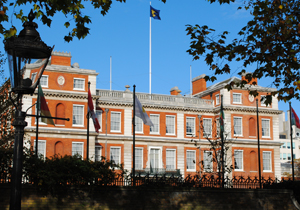
Wren’s London – 9. Marlborough House

We’re nearing the end of our series on Wren’s London (next week we’ll take a final look at some of the Wren designs we’ve not yet mentioned), so this week we look at one of his lesser known (and less accessible) designs – Marlborough House.

Tucked away behind high brick walls next to St James’ Palace just off Pall Mall, Marlborough House was built for Sarah Churchill, the Duchess of Marlborough – a confidant of Queen Anne – and completed in 1711.

The duchess, who secured a lease of the site from Queen Anne, selected Sir Christopher as the architect in preference to Sir John Vanbrugh, but she later fell out with Wren and, after dismissing him, oversaw the completion of the building herself. It is believed that the design of the house was actually the work of Wren’s son, also named Christopher, although the plans were undoubtedly drawn up under Wren senior’s watchful eye.

The house, built of red Dutch bricks brought to England as ballast in troop transports, was noted for its plain design. But the walls of the central salon and staircases were decorated with scenes of battles the Duke had fought in.

The property remained in the hands of the Dukes of Marlborough until it was acquired by the Crown in 1817. The building – which was substantially extended in the mid 1800s to the designs of Sir James Pennethorne – was subsequently used by members of the royal family including Princess Charlotte (only daughter of the future King George IV) and her husband Prince Leopold (later the King of the Belgians), Queen Adelaide, widow of William IV, Edward, Prince of Wales (later Edward VII), George, Prince of Wales (later George V), King Edward VII’s widow, Queen Alexandra, and, lastly, Queen Mary, widow of  George V.

Following the death of the Queen Dowager in 1953, Queen Elizabeth II donated it for use by the Commonwealth Secretariat who still occupy the building today.

WHERE: Pall Mall (nearest Tube stations are Green Park and Piccadilly); WHEN: Two hour tours are usually held every Tuesday morning (check first); WEBSITE: www.thecommonwealth.org/Internal/191086/34467/marlborough_house/