Treasures of London – The Barbor Jewel…

While the style of the setting means this pendant is said to date from the early 17th century, a family tradition holds that it was made for a Protestant William Barbor, variously described as a London tradesman or grocer.

The-Barbor-JewelThe story, said to have been first recorded in the early 18th century, goes that the jewel was made to commemorate Barbor’s escape from being burnt at the stake (thanks to his Protestantism) due to the accession of Queen Elizabeth I in 1558 following the death of her half-sister, Queen Mary I (‘Bloody Queen Mary’).

Barbor had been regarded as a heretic during Queen Mary’s reign and is said to have condemned to death for his faith but the death of the queen meant he no longer faced a sentence of death.

Even so, Barbor died in 1586, and while the onyx cameo of Queen Elizabeth I in the centre of the jewel dates from about 1575-85, the “pea-pod-style” setting of the jewel – which features rubies and diamonds and a cluster of pearls – has been dated to between 1615-25, during the reign of King James I, which places its creation well after Barbor’s demise.

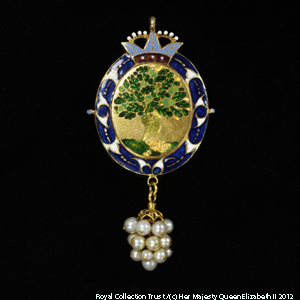
The enameled jewel features an oak tree on the reverse side (pictured).

The Barbor Jewel is currently on display in the exhibition, Treasures of the Royal Courts: Tudors, Stuarts and the Russian Tsars, at the V&A which runs until 14th July. Admission charge applies. For more, see www.vam.ac.uk.

PICTURE: Courtesy of Victoria and Albert Museum, London 

Celebrating the Diamond Jubilee with 10 royal London locations – 9. Royal chapels…

Palaces aside, the Queen also owns a series of chapels – the Chapels Royal – in London which, although not as grand as Westminster Abbey, have each played an important role in the history of the monarchy. 

The term Chapel Royal originally referred to a group of priests and singers dedicated to serving the Sovereign’s personal spiritual needs and as such would follow the monarch around the country. It was in Stuart times that they became more settled establishments with the two main Chapels Royal – the Chapel Royal and the Queen’s Chapel – located in St James’s Palace.

• The Chapel Royal, St James’s Palace. Constructed by King Henry VIII, the chapel was decorated by Hans Holbein the Younger in honor of the king’s (short) marriage to Anne of Cleves. Queen Mary I’s heart is said to be buried beneath the choir stalls and it was here that Queen Elizabeth I apparently prayed waiting for news of the progress of the Spanish Armada. King Charles I took the Sacrament of Holy Communion here before his execution in 1649 and the chapel was where Queen Victoria married Prince Albert (her marriage certificate still hangs on the wall). In more recent times, the coffin of Diana, Princess of Wales, was placed before the altar so family and friends could pay their respects before her 1997 funeral. Among the composers and organists associated with the chapel are Thomas Tallis, William Byrd, Henry Purcell and George Frideric Handel. The chapel is not open to the public except for services.

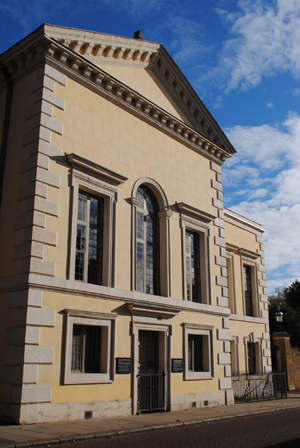
• The Queen’s Chapel, St James’ Palace (pictured right). Now located outside the palace walls, this chapel was built by King James I for the Catholic Henrietta Maria, the bride of his son, then Prince Charles (later King Charles I). Designed by Inigo Jones, Grinling Gibbons and Sir Christopher Wren were also involved in its creation. The chapel was used by Henrietta Maria until the Civil War and later became the home of the Danish Church in London. The chapel is not open to the public except for services.For more on this chapel or the Chapel Royal at St James’s Palace, follow this link.

• The Queen’s Chapel of the Savoy. Built in the Middle Ages to serve the now long gone Savoy Palace, London home of Count Peter of Savoy (uncle to King Henry III’s wife, Eleanor of Provence, the original building was destroyed in the Peasant’s Revolt of 1381. The current building, located in Savoy Hill, off the Strand, was built on the orders of King Henry VII in the late 15th and early 16th century to serve the hospital he founded on the site of the palace. The chapel since served many other congregations – including a German Lutheran congregation – but remains royal property via the Duchy of Lancaster, which is held in trust for the Sovereign and used to provide an income for the British monarch. It is officially the Chapel of the Royal Victorian Order. For more, see www.duchyoflancaster.co.uk/duties-of-the-duchy/the-queens-chapel-of-the-savoy/.

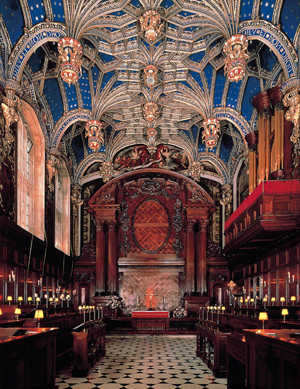
• Chapel Royal, Hampton Court Palace (pictured right). There has been a chapel here since the Knights Hospitallers occupied the site in the 13th century but it was Cardinal Wolsey who built the chapel to its present dimensions after acquiring the property in 1518. The current building, however, dates from the later ownership of King Henry VIII – Wolsey surrendered the property to him when he fell from favour – and further works in the eighteenth and nineteenth centuries. Many subsequent monarchs have worshipped here. The chapel, with its stunning ceiling, is open to the public when visiting Hampton Court Palace. For more, see www.chapelroyal.org. PICTURE: Historic Royal Palaces/newsteam.co.uk

• The Chapel Royal of St Peter ad Vincula, Tower of London. Originally a parish church, this was incorporated into the walls of the Tower in the reign of King Henry III. It was subsequently rebuilt at least twice – in the reign of King Edward I and King Henry VIII – and is home to the graves of important personages executed at the Tower including Henry VIII’s one-time wives, Anne Boleyn and Catherine Howard as well as Jane Grey, the nine day queen, and Sir Thomas More and Bishop John Fisher. The chapel can be accessed during a Yeoman Warder’s tour of the Tower of London. For more, including details of an appeal for its restoration, see www.hrp.org.uk/TowerOfLondon/stories/thechapelproject.

• Chapel Royal of St John the Evangelist, Tower of London. Located within the White Tower, this beautiful chapel – arguably the oldest church in London – dates back to the construction of the tower by King William the Conqueror the late 11th century and remains one of the best preserved examples of Anglo-Norman architecture in England. King Henry III added stained glass windows but for much of its later history the chapel was used for records storage. Tradition records that King Henry VII’s wife, Elizabeth of York, was laid in state here following her death in childbirth and that it was here Queen Mary was betrothed by proxy to Philip of Spain. This can be visited as part of a visit to the Tower of London. For more, see www.hrp.org.uk/TowerOfLondon/Sightsandstories/Prisoners/Towers/ChapelofStJohns

For more on churches in London, check out Stephen Millar’s London’s City Churches
and Stephen Humphrey’s London’s Churches and Cathedrals: A Guide to London’s Most Historic Churches and Cathedrals, Leigh Hatt’s London’s 100 Best Churches: An Illustrated Guide or the Pevsner Architectural Guide London: City Churches.

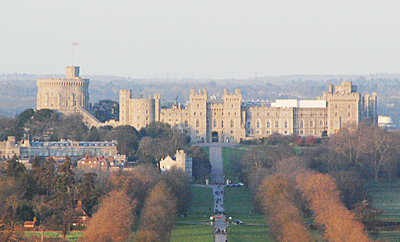
Daytripper – Windsor Castle…

Given we’re marking the Queen’s Diamond Jubilee with a look at sites of significance to her story located in London, it’s perhaps only fitting that we take a look at the nearest royal residence outside the city.
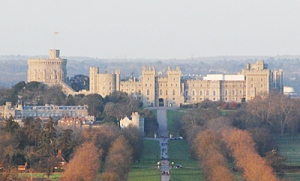
Windsor, located as close as half an hour by train from London’s Paddington station (or around 50 minutes to an hour from Waterloo), boasts plenty to see including the historic town centre, nearby Eton, great river and country walks and, of course, Legoland. But today our attention will remain on Windsor Castle, the oldest and largest inhabited castle in the world.

There has been a fortress on this site since shortly after the Norman invasion when in about 1080 King William the Conqueror ordered it constructed on a ridge above the river bank as part of a series of defensive fortifications around London. The earth and timber Norman castle was gradually added to over the years – King Henry I (reigned 1100-1135), the first king to live here, added domestic quarters while King Henry II (reigned 1154-1189) built substantial royal apartments transforming the castle into a palace and began replacing the outer timber walls with stone fortifications as well as rebuilding the Norman Keep as the Round Tower (parts of which still date from this period). King Henry III (reigned 1216-1272) built upon and expanded his work.

But it was in the reign of King Edward III (1307-1327) that the castle was expanded enormously. This included the reconstruction of the lower ward including the rebuilding of the chapel, naming it St George’s (although the current chapel dates from the reign of King Edward IV – 1461-1470), and the reconstruction of the upper ward complete with apartments for him and his wife, Queen Phillipa, arranged around courtyards (although some of the work wasn’t completed until the reign of his successor, King Richard II – 1377-1399). It was also during King Edward III’s reign that the castle became the base for the Order of the Garter (which he created in 1348), a role it still fulfills.

Other works were ordered by successive Tudor monarchs including King Henry VIII, Queen Elizabeth I, and Queen Mary I. Parliamentary forces seized the castle during the Civil War (Oliver Cromwell did use it as his headquarters for a time) and Royalists were imprisoned here (King Charles I was in fact buried in a vault beneath St George’s Chapel after his execution having been previously imprisoned here).

The next major additions came in the reign of King Charles II (1660-1685) when the Upper Ward and State Apartments were reconstructed in baroque splendor, the latter complete with splendid murals ceiling paintings by Italian artist Antonio Verro (the murals were later destroyed but some of the ceiling paintings survive).

From the time of King William III (1689-1702), monarchs began spending more time at Hampton Court Palace but the focus returned to Windsor with King George III. He ordered a range of improvements and updates including modernising Frogmore House in the Home Park for his wife Queen Caroline (the property was subsequently used by various royals but no-one currently lives there), but many of these were stopped prematurely due to his illness. His son, King George IV, picked up where his father left off.

In the reign of Queen Victoria, Windsor became the royal family’s principal residence and was visited by heads of state including King Louis Philippe in 1844 and Emperor Napoleon III in 1855. The Queen’s husband, Prince Albert, died here on 14th December, 1861.

King Edward VII (1901-1910) and King George V (1910-1936) both had a hand in redecorating the palace and the Queen’s father, King George VI (1936-1952), was living in the Royal Lodge in Windsor Great Park when he succeeded to the throne.

In more recent times, the castle was the home to the Queen, then Princess Elizabeth and her sister Princess Margaret, for much of World War II. The castle suffered its greatest setback in recent times in 1992 when a serious fire broke out in the Queen’s Private Chapel which destroyed several rooms including the ceiling of St George’s Hall which dated from the reign of King George IV. Restoration works took five years to complete.

Today the Queen spends many private weekends at the castle while the court is officially in residence here for a month over the Easter period and during Ascot Week in June – it’s at this time that the Garter Day celebrations take place with the installation of new knights.

The Queen also hosts State Visits here with banquets held in St George’s Hall as well as what are known as a ‘sleep and dine’ in which high profile figures are invited to dinner with the Queen before being shown a special display of items from the Royal Library and then spending the night. The Royal Standard flies from the Round Tower when the Queen is in residence.

As well as touring the State Apartments, the Gallery, Queen Mary’s Dolls’ House (completed in the 1920s for Queen Mary, wife of King George V), and St George’s Chapel, visitors to the castle can experience the Changing of the Guard at 11am every day but Sundays between May and early August (and every second day after that).

WHERE: Windsor (a short walk from either Windsor Central Station or Windsor & Eton Riverside Station); WHEN: 9.45am to 5.15pm until 27th July (times vary after this date – check the website); COST: £17 an adult/£10.20 a child (under 17s – under fives free)/£15.50 concession/£44.75 family (price includes an audio tour); WEBSITE: www.royalcollection.org.uk/visit/windsorcastle.
What’s In a Name?…Elephant and Castle

A somewhat neglected area located in the Borough of Southwark, just south-east of Borough, Elephant and Castle takes its rather odd name from a coaching inn which once stood on the site – the Elephant and Castle.

The area is more correctly known as Newington but the name Elephant and Castle was apparently adopted informally in the mid 18th century as the area rose in prominence thanks in part to the opening of Westminster Bridge.

The inn, which stood on the site of a former playhouse, was apparently rebuilt several times but there is now no sign of it – the current, rather ugly, Elephant and Castle pub which is said to stand a short distance from where the tavern once stood, was built in the 1960s.

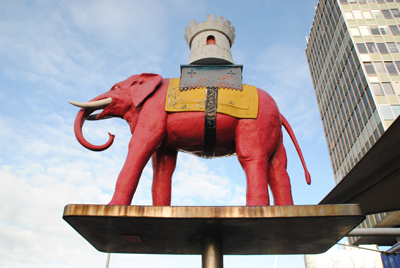
The origins of the sign of the Elephant and Castle, meanwhile, apparently comes from the mid-15th century when members of the Cutler’s Company adopted the sign of the elephant as their symbol (perhaps representing the ivory they used in their trade). The Worshipful Company of Cutlers still has an elephant carrying a castle on its back in its coat-of-arms.

The area of Elephant and Castle, meanwhile, was known for its shopping and theatres before it was heavily bombed in the Blitz. It still features a rather grim shopping mall (pictured is the sign of the elephant and castle out front) which was said to have been the first covered shopping mall in Europe when it opened in the mid-1960s – it is apparently due for demolition as part of a larger regeneration project. The area has already seen some major new developments like the the residential tower known as Strata.

Other prominent buildings include the Metropolitan Tabernacle – standing opposite the shopping centre, this was founded by preacher Charles Hadden Spurgeon in the 19th century and rebuilt after World War II (interestingly, the site of the tabernacle is where three men, known as the Southwark Martyrs, were burnt at the stake for heresy in 1557 during a period of religious persecution in the reign of Queen Mary I).

Famous residents have included Charlie Chaplin – who lived in a workhouse in the area as a child – while other notable features include a large stainless box which stands at the centre of the area’s major road intersection, linking what is now New Kent Road and Kennington Park Road (via Newington Butts) with roads leading to Lambeth, Westminster, Waterloo and London Bridges among others (this is actually a memorial to scientist Michael Faraday, who was born in nearby Newington Butts). The area also boasts its own Tube station, Elephant & Castle.

The Royal Parks – 6. Greenwich Park

The oldest of the royal parks, the 74 hectare (183 acre) Greenwich Park has been associated with royalty since at least the 15th century.

The area covered by the park had been occupied by the Romans (there are some remains of a building, possibly a temple, near Maze Hill Gate) and later the Danes, who raised protective earthworks here in the 11th century. After the Norman Conquest, it became a manor.

Its enclosure only happened in 1433 after the land came into the possession of Humphrey of Lancaster, Duke of Gloucester and brother of King Henry V. At the time regent to the young King Henry VI, Duke Humphrey also built a tower on the heights above the park – where the Royal Observatory now stands.

Following the duke’s death in 1447, the land was seized by Margaret of Anjou – wife of King Henry VI – and subsequently became known as the Manor of Placentia. King Henry VII later rebuilt the manor house, creating what was known as Greenwich Palace or the Palace of Placentia.

Not surprisingly, it was King Henry VIII, who, having been born at Greenwich Palace, introduced deer to the park. Indeed the park was to have strong associations with others in his family – the king married Catherine of Aragorn and Anne of Cleeves at Greenwich Palace, and his daughters, later Queen Mary I and Queen Elizabeth I, were born there while his son, King Edward VI, died there in 1553 at the age of only 15. (There’s a tree in the park known as Queen Elizabeth’s Oak, which is said to be where she played as a child).

In 1613, King James I gave the palace and accompanying park – which he had enclosed with a high wall – to his wife, Queen Anne of Denmark, apparently as an apology after swearing at her in public when she accidentally shot one of his favorite dogs. Queen Anne subsequently commissioned Inigo Jones to design what is now known as the Queen’s House – for more on that, see our earlier post.

Following the Restoration, King Charles II ordered the palace rebuilt and while this work remained unfinished, the king did succeed in having the park remodelled – it is believed that Andre Le Notre, gardener to King Louis XIV of France, had a role in this.

The works included cutting a series of terraces into the slope – these were known as the Great Steps and lined with hawthorn hedges – as well as creating a formal avenue of chestnut trees (now known as Blackheath Avenue), and some woodlands. Work is currently taking place on restoring an orchard which dates from 1666 at the park.

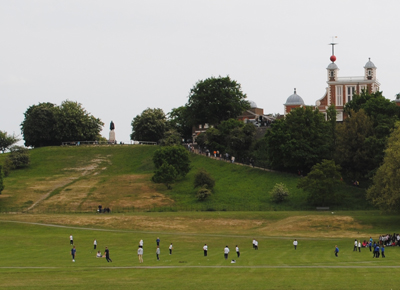
King Charles II also commissioned Sir Christopher Wren to build the Royal Observatory that still stands on the hill overlooking the park – it stands on the site once occupied by the Duke Humphrey Tower (the Royal Observatory is home of the Prime Meridian – see our earlier post on the Royal Observatory for more).

King James II was the last monarch to use the palace and park – his daughter Queen Mary II donated the palace for use as a hospital for veteran sailors and the park was opened to the pensioners in the early 1700s. The hospital later become the Royal Naval College and the National Maritime Museum later moved onto the site (for more on this, see our earlier post).

As an aside, Royal Parks say the truncated shape of some of the trees in the park is apparently due to the fact that when anti-aircraft guns were positioned in the flower garden during World War II, the trees had to be trimmed to ensure a clear field of fire.

Facilities in the park today include a tea house, a children’s playground, sporting facilities such as tennis courts and, of course, the Wilderness Deer Park where you can see wildlife at large. Statues include that of Greenwich resident General James Wolfe, an instrumental figure in establishing British rule in Canada – it sits on the crest of the hill opposite the Royal Observatory looking down towards the Thames.

The park, which is part of the Greenwich World Heritage Site, is slated as a venue for next year’s Olympics – it will host equestrian events and the shooting and running events of the pentathlon.

WHERE: Greenwich Park (nearest DLR station is Cutty Sark – other nearby stations include Greenwich, Maze Hill and Blackheath); WHEN: 6am to at least 6pm (closing times vary depending on the month); COST: Free entry; WEBSITE: www.royalparks.gov.uk/Greenwich-Park.aspx

Treasures of London – The White Tower

It’s one of London’s most famous landmarks and, having just undergone a three year, £2 million restoration, we thought it was time to take a look at the origins of the White Tower.

Now the keep of the Tower of London, the White Tower was first built by the Norman King William the Conqueror following his defeat of Saxon King Harold Godwinson and the cream of the Saxon army at the Battle of Hastings in 1066.

Following his coronation at Westminster Abbey on Christmas Day, King William then withdrew to Barking Abbey while his men built several temporary strongholds in the city to ensure it wouldn’t cause any trouble – this included an earth and timber keep standing on an artificial mound in the south-east corner of the city’s Roman-era walls.

The White Tower, a permanent structure, replaced this and although the exact date its construction started is unknown, building – under the watchful eye of Gundulf, the Bishop of Rochester, was well underway by the mid-1070s. While the labourers were English, the masons in charge of the building were Norman and then even used some Caen stone imported from William’s homeland (along with Kentish ragstone). By 1097 the tower was complete.

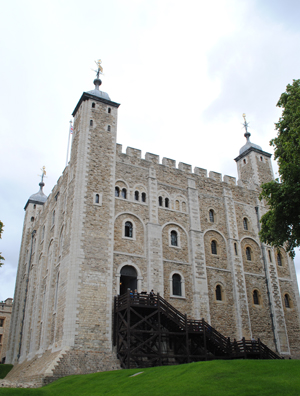
Primarily built as a fortress rather than for comfort, the size of the Tower was intimidating and, at 27.5 metres tall, it would have dominated the skyline for miles. Initial defences surrounding the White Tower included the Roman walls and two ditches although in later years outer walls were added to create the massive fortifications and series of towers one encounters at the site today.

The tower earned its moniker, the White Tower, from the whitewash used on its walls during the reign of King Henry II. The caps on the four turrets which stand at each corner of the tower were originally conical but were replaced with the current onion-shaped domes in the 1500s (the round tower was once home to the Royal Observatory before it moved out to Greenwich). The White Tower’s large external windows are also more modern innovations, these were added in the 1600s by Sir Christopher Wren.

The original entrance to the White Tower was on the first floor, reached by a wooden staircase (that could be removed if necessary), much as it is today while, for security reasons, the internal stone spiral staircase was placed as far from this entry as possible in the north-east turret. A stone forebuilding was later added during the reign of King Henry II but was later demolished.

Inside, accommodation for the king was provided on the second floor – it originally had a gallery above but an extra floor – still there today – was later added. Accommodation for the Tower’s constable was probably on the first floor. Both floors were divided in two – with a large hall on one side and smaller apartments on the other. These rooms now house displays on the Tower’s history – at the present these include the Royal Armouries’ exhibition ‘Power House’.

The White Tower is also home to the Chapel of St John the Evangelist which, made from Caen stone, still looks much the same as it did in Norman times. It was used by the royal family when in residence at the tower but by the reign of King Charles II had become a store for state records. These were removed in 1857. Among some of the events which took place here was the lying in state of Queen Elizabeth of York, wife to King Henry VII, after her death in 1503, and the betrothal of Queen Mary I to Philip of Spain in 1554 (by proxy, Philip was not present). Prince Charles received communion here on his 21st birthday.

Other historic events associated with the White Tower include the apparent murder in 1483 of the ‘Princes in the Tower’ – King Edward V and his younger brother, Richard, Duke of York – while legend says they were killed in the Bloody Tower, the discovery of two skeletons under stairs leading to the chapel during building works in 1674 has led some to believe that they may have been buried here.

It was also in the White Tower that King Richard II was forced to sign away his throne to King Henry IV in 1399 and it was from the White Tower that Gruffydd ap Llywelyn Fawr, the illegitimate son of  Welsh Prince Llywelyn the Great, apparently fell to his death while attempting to escape captivity in 1244.

There are tours of the White Tower daily at 10.45am, 12.45pm, and 2.15pm.

WHERE: Tower of London (nearest tube station Tower Hill); WHEN: 9am to 5.30pm, Tuesday to Saturday, 10am to 5.30pm Sunday to Monday (until 31st October); COST: Included in Tower of London admission – £19.80 adults; £10.45 children under 15; £17.05 concessions; £55 for a family (prices include a voluntary donation); WEBSITE: www.hrp.org.uk/toweroflondon/.

King James I’s London – 10. Westminster Abbey’s Lady Chapel

And so we come to the final instalment in our series on King James I’s London. This week we’re looking at Westminster Abbey’s Lady Chapel where King James I – who was crowned in Westminster Abbey in 1603 – was laid to rest after his death in 1625.

But before we turn to James himself, it’s worth noting that several members of his immediate family are also buried in the abbey’s Lady Chapel (pictured). These include his eldest son, Henry Fredrick, Prince of Wales, who died in 1612 at the age of 18 (and thus opened the way for his younger brother Charles to become King Charles I). He is buried in the south aisle of the magnificent Lady Chapel which had been added at the behest of King Henry VII between 1503 and 1519 and replaced a 13th century chapel.

Three of James’ daughters are also buried in the Lady Chapel – Mary, who died in 1607, aged two, and Sophia, who died in 1606, aged just three days old. Both of them have monuments in the north aisle while their sister Elizabeth, wife of King Fredrick V of Bohemia, who died much later in 1662, is buried near her brother Henry Fitzpatrick.

As we’ve previously mentioned, King James I also outlived his wife, Queen Anne of Denmark, who died of dropsy at Hampton Court Palace on 2nd March, 1619, at the age of 43. She lay in state at Somerset House until her funeral on 13th May and was then buried in the south-eastern area of the Lady Chapel where her gravesite is marked by a modern stone bearing her name. Her wooden funeral effigy is one of a collection which can still be seen in the Abbey’s Museum.

After James himself died on 27th March, 1625, he was laid in the vault beneath King Henry VII’s monument beside Elizabeth of York, Henry’s wife. No monument was erected to mark his passing save for a modern inscription placed nearby (in fact Queen Elizabeth I was the last monarch to be buried with a monument above the site – see below).

It’s also worth noting that in 1612 – nine years into his reign – James arranged for the body of his mother – Mary, Queen of Scots, who was executed in 1587 on the orders of Queen Elizabeth I – to be transferred from its resting place in Peterborough Cathedral to the south aisle of the Lady Chapel where he had an elaborate tomb erected featuring an elegant white marble effigy showing her wearing a coif, ruff and long mantle.

In the north aisle, James had previously erected a marble monument to his predecessor, Queen Elizabeth I and had her body moved from where it had lain in the vault of her grandfather, King Henry VIII, to a place beneath the new monument. Her half-sister, Queen Mary I, is also buried beneath the monument.

That’s the final in our series on King James I’s London – it’s by no means a comprehensive look at significant sites in the early Stuart period and we shall be looking at more from the period down the track, but it’s a good start. Our new special series starts next week. 

WHERE: Westminster Abbey, Westminster (nearest Tube station is Westminster or St James’s Park); WHEN: Open to tourists everyday except Sunday  (times vary so check the website); COST: £16 an adult/£13 concessions/£6 schoolchildren (11-18 years), free for children aged under 11/£38 for a family (two adults, two children); WEBSITE: www.westminster-abbey.org

Famous Londoners – Sir Thomas Gresham

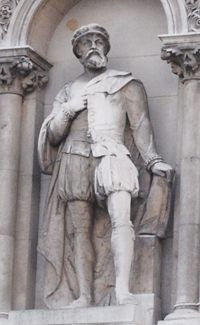
Remembered primarily for having founded the Royal Exchange as a centre for commerce in London and Gresham College, Sir Thomas Gresham was one of London’s leading merchants and financiers and an important advisor to successive monarchs during the sixteenth century.

Gresham was born in Milk Lane, London, to merchant Sir Richard Gresham (himself Lord Mayor of London in 1537-38) around 1518-19. He studied at Cambridge before being apprenticed to learn the family trade with his uncle, Sir John Gresham.

In 1543, he was admitted to the Mercers’ Company and subsequently spent time in the Low Countries, residing principally in Antwerp and acting as an agent for King Henry VIII. In 1544 he married Anne Fernley, widow of another London merchant. He also had a house in Lombard Street at this time.

Sir Thomas became an important advisor  to King Edward VI, helping him alleviate financial concerns, a role he continued to play during the successive reigns of Queen Mary I and Queen Elizabeth I (although he spent some time out of favor during Mary’s reign).

Knighted for his services to the crown in 1559, he proposed to built his ‘exchange’ in 1565, offering to pay for it himself if the City of London and Mercers’ Company provided the land. Modelled on the bourse in Antwerp with a trading floor and shops and offices set around a large central courtyard, it was officially awarded the title ‘royal’ by Queen Elizabeth I in 1571.

Sir Thomas died suddenly in 1579, apparently of a heart attack, and left the majority of his wealth to his widow but included clauses in his will stating that after her death rents from the Royal Exchange be used to create a college which would see seven professors offer free lecturers on subjects ranging from astronomy and geometry to rhetoric and divinity.

Known as Gresham College, it became the first institution of higher education in London when it was founded in 1597 and was initially based at Sir Thomas’ mansion in Bishopsgate (it’s now based in Barnard’s Inn Hall and, as it has for the past 400 years, still offers free public lectures).

In 1666, Sir Thomas’ Royal Exchange burnt down along with much of London but it was rebuilt immediately afterward (King Charles II laid the foundation stone of the new building) and rebuilt again following another fire in 1838 (at the time the building was largely occupied by two insurance companies, one of which was Lloyds of London).

It’s this third building, designed by Sir Thomas Tite to resemble the original plan, which stands on the site today. While trading has long since ceased there – it’s now a luxury-end shopping centre – Sir Thomas’s symbol, the gold ‘Gresham Grasshopper’, can still be seen on the weathervane. For more information on the Royal Exchange, see www.theroyalexchange.co.uk.


Lost London – Nonsuch Palace

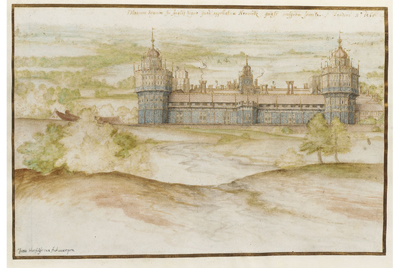
Built as a symbol of the triumphal reign of the Tudor dynasty (not to mention as a response to the French King Francis I’s palace Château de Chambord), Nonsuch Palace near Ewell in Surrey, now part of greater London, was the last palace constructed by King Henry VIII.

Construction on the palace started in 1538, the 30th year of Henry’s reign and only six months after the birth of Henry’s son and heir, later King Edward VI. The medieval village of Cuddington was demolished to make way for the new premises.

The multi-storied building was designed around an inner and an outer courtyard, each entered through a fortified gatehouse, with the royal apartments located in the latter. While plain on the outside, the inner courtyard interior was decorated with stucco reliefs depicting, among other things, Roman emperors, gods and goddesses and Henry VIII with his son Edward. To cap it off, there were two great octagonal towers built at either end.

While the bulk of of the work had been completed when Henry died in 1547, it is believed that the palace may still have been unfinished. In any case, it only remained a royal property for a short time before Queen Mary I sold it to Henry Fitzalan, the Earl of Arundel. It passed back into royal hands when the earl’s son-in-law, John Lumley, was forced to sell it back to Queen Elizabeth I to settle a debt. The queen was said to have stayed frequently at the palace.

King James I granted the palace to his wife, Queen Anne of Denmark, and it was also used by his son Henry, Prince of Wales. King Charles I also granted the palace to his wife, Queen Henrietta Maria, before it was sold off by Parliamentary commissioners after the Civil War. When King Charles II came to the throne, the palace was once again given to Henrietta Maria and then, when she died in 1669, to Barbara Villers, Countess of Castlemaine, a mistress of the king.

The building was demolished in 1682 with the materials and sale of the land used to pay off the countess’ gambling debts. While some parts of the building were carted off to be incorporated into others, no trace of the building remains above the ground but its former site, on the west side of what is now Nonsuch Park in Cheam, is marked by three granite bollards. A separate banqueting house and extensive gardens were also built near the site.

The building, which was only depicted a few works, can be confused with Nonsuch Mansion House, the oldest parts of which date from the 18th century, which still stands on the east side of the park and was probably built on the site of a former keeper’s lodge.

There are exhibitions on the palace in the Honeywood Museum (the heritage centre for the London Borough of Sutton) in Carshalton and in the Tudor house known as Whitehall in Cheam. The Epson and Ewell History Explorer website also have a trail you can follow which encompasses the former site of the palace.

PICTURE: Nonsuch Palace in an engraving by Joris Hoefnagel. Source: Wikipedia.