LondonLife – Superbloom at the Tower of London…

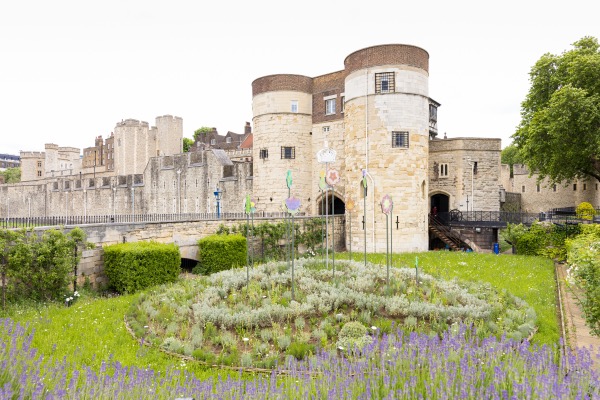
The Queen’s Garden, part of the Superbloom as seen near the Tower’s entrance on 22nd May. PICTURE: © Historic Royal Palaces
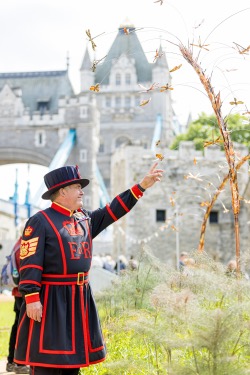
A Yeoman Warder in the transformed moat with Mehrdad Tafreshi’s swarm of insects. PICTURE: © Historic Royal Palaces

Twenty million seeds have been sown into the Tower of London’s moat to create a floral display known as ‘Superbloom’ as part of the celebrations surrounding Queen Elizabeth II’s Platinum Jubilee.

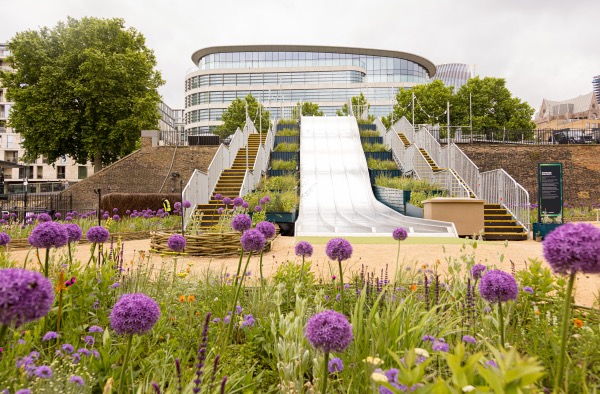
Paths, walkways and viewing points have been installed throughout and in a first at the Tower, a four lane slide has been installed to provide an unusual entrance to the display.

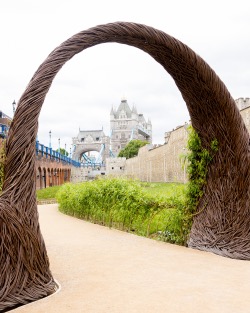
Those visiting the display – which features wildflowers such as red poppies, yellow corn marigolds and blue cornflowers as well as garden plants including sunflowers, cosmos and rudbeckias – will hear a score by Scottish composer Erland Cooper – Music for Growing Flowers – while other attractions include a willow sculpture by artist Spencer Jenkins and a swarm of intricate copper insects by sculptor Mehrdad Tafreshi.

The centrepiece of the display is the “Queen’s Garden” which has been installed by Grant Associates – the lead designers for the Superbloom project – in the Tower’s historic Bowling Green.

A willow sculpture by Spencer Jenkins. PICTURE: © Historic Royal Palaces

Inspired by the Queen’s Coronation gown, this garden features a combination of meadow flowers, topiary and summer-flowering perennials, bulbs and ornamental grasses and draws on the colours, shapes and motifs used by designer Norman Hartnell in the 1953 gown.

Rising above the garden are 12 cast glass forms by glass artist Max Jacquard which represent the national emblems featured in Hartnell’s design and in their centre sits a glass crown, a reminder of the Tower’s role as home of the Crown Jewels.

Tower Wharf, meanwhile, has been transformed into a food and drinks venue, with street food and bars from KERB and fine dining available riverside in ‘The Glass Rooms’. The flowers are expected to gradually bloom in June and will continue to evolve until September. For more, including how to purchase tickets, head here.

The slide entrance to the Superbloom as seen on 22nd May. PICTURE: © Historic Royal Palaces
Mehrdad Tafreshi’s swarm of insects as seen on 22nd May. PICTURE: © Historic Royal Palaces

Famous Londoners – Jumbo…

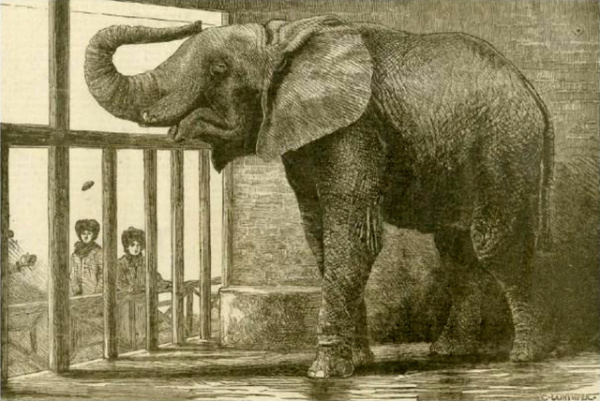
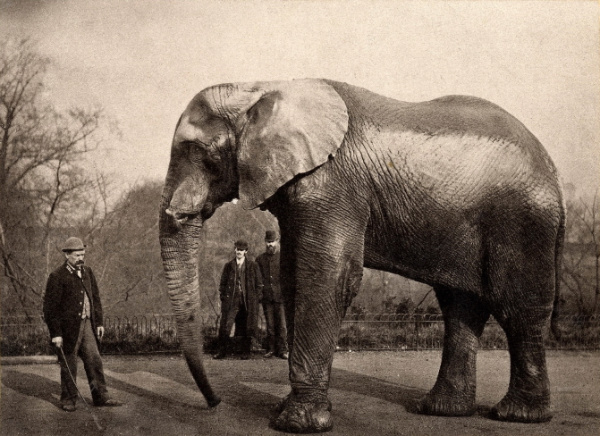
Jumbo greets some visitors as they pass by his den in London Zoo. PICTURE: From ‘Jumbo: This Being the True Story of the Greatest Elephant in the World’ by Paul Chambers

With his name a byword for things of a large size, Jumbo was an African bush elephant who was once one of London Zoo’s most popular residents (but whose life makes for sad reading).

Born in Sudan in about 1860, Jumbo – whose name is apparently a corruption of ‘jumbe’, the Swahili word for chieftain – was captured by hunters after his mother was killed and transported north to Europe. There he was apparently first exhibited in Germany before being sold to the Jardin des Plantes, a zoo in Paris.

In 1865, he was transferred to London Zoo in England where his keeper was Matthew Scott who went on to detail his care of Jumbo in his 1885 autobiography.

Jumbo quickly became a popular exhibit and was trained to give rides to children, including those of Queen Victoria (Teddy Roosevelt and Winston Churchill were apparently also among those who rode the elephant).

But out of public view, Jumbo, particularly as he matured, was growing increasingly destructive, smashing his den and breaking his tusks (it’s said Matthew Scott would pacify him with large quantities of alcohol).

In 1882, protests broke out when, apparently concerned over Jumbo’s growing aggression, then zoo superintendent Abraham Bartlett announced plans to sell Jumbo to American circus founder PT Barnum for £2,000. Some 100,000 school students wrote to Queen Victoria begging her to stop the transaction and a lawsuit was launched to stop the sale. It was unsuccessful.

Despite the protests, the sale went ahead and in March, 1882, Jumbo and Matthew Scott, who had decided to go with the elephant, went to America. In New York, Jumbo was exhibited at Madison Square Garden in a 31 week season. In 1884, he was one of 21 elephants who crossed the Brooklyn Bridge to prove it was safe following the death of 12 people during a collapse caused by a stampede few years earlier.

Jumbo with his keeper Matthew Scott, pictured in June, 1882. PICTURE: From Bierstadt, E ‘Jumbo and trainer.’

Jumbo died on 15th September, 1885, when he was hit by a train as he and other elephants were being led back to their boxcar. According to Barnum, Jumbo was attempting to lead a young elephant Tom Thumb to safety.

Following Jumbo’s death, a postmortem revealed his stomach contents included five English pennies, keys, rivets, and a police whistle.

Sadly, PT Barnum had the body parts separated for display before Jumbo’s skeleton was eventually donated to the American Museum of Natural History in New York City. The elephant’s heart was sold to Cornell University and its hide stuffed and eventually donated to Tufts University where it was destroyed in a fire in 1975 (Jumbo remains the university mascot).

There is a statue of Jumbo near where he died in St Thomas, Ontario, and a six-storey, elephant-shaped building in Margate City, New Jersey, which was built in 1881 is said to be inspired by him. He is also said to have inspired the Disney film, Dumbo.

This Week in London – The Queen in wartime; Dippy returns; and, ‘Cancer Revolution’ at the Science Museum…

A new exhibition exploring the Queen’s role during wartime opens at IWM London in Lambeth tomorrow. Part of a suite of events at IWM venues celebrating the Queen Elizabeth II’s Platinum Jubilee, Crown and Conflict: Portraits of a Queen in Wartime features 18 images drawn from the museum’s image archive which chart the Queen’s experience of war – from growing up during World War II when she served in the Auxiliary Territorial Service to her role in carrying out important public duties involving the armed forces, including at the annual Service of Remembrance. Among newly digitised photographs included in the display are an image of the Queen dressed in overalls and cap while working on a vehicle during her time in the ATS, and another showing her with her father, King George VI, and mother, Queen Elizabeth, during a visit to airborne forces in 1944. IWM London is also launching a dedicated trail of historic objects spread across five gallery spaces which explores the Royal Family’s long-standing association with the British armed forces. Objects include a Princess Mary Gift Fund box which was sent to those serving at Christmas in 1914. Runs until 8th January. Admission charge applies. For more, see www.iwm.org.uk/events/queens-platinum-jubilee-iwm-london.

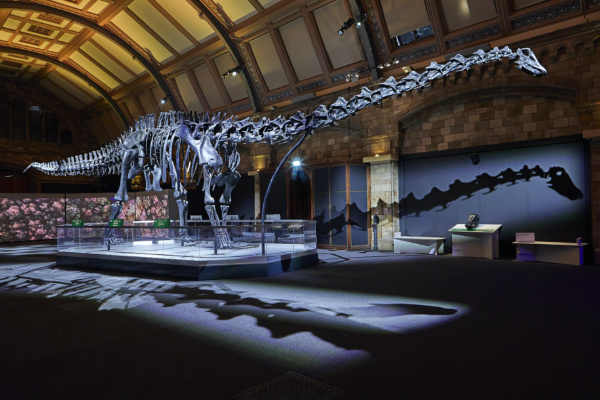
Dippy at the Natural History Museum. © Trustees of the Natural History Museum, London

• Dippy the dinosaur is back for a limited time at the Natural History Museum in South Kensington from tomorrow. A free, temporary exhibition – Dippy Returns: the nation’s favourite dinosaur – gives visitors the chance to get up close and personal with the 26 metre-long dinosaur which first went on display at the museum in 1905. The display comes at the end of a record-breaking tour of the UK in which Dippy was seen by more than two million people. Can be seen until 2nd January. To book tickets, head to www.nhm.ac.uk.

The first major exhibition to explore the history and future of cancer treatment and research opened at the Science Museum in South Kensington this week. Cancer Revolution: Science, innovation and hope features more than 100 objects including some never-before seen as well as information on cutting edge treatment and research, new artist commissions and installations, interactive exhibits and a breadth of personal stories. Runs until January, 2023. Admission is free but bookings required. For more, see www.sciencemuseum.org.uk/see-and-do/cancer-revolution-science-innovation-and-hope.

Send all items to exploringlondon@gmail.com for inclusion.

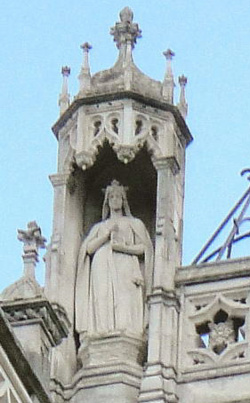
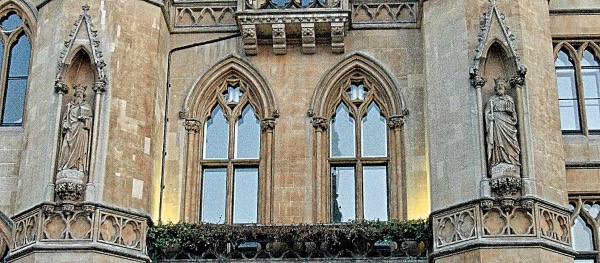
10 (lesser known) statues of English monarchs in London…6. King Edward the Confessor and King Henry III…

PICTURE: Davide Simonetti (licensed under CC BY-NC 2.0/image has been cropped and enhanced).

These two statues are listed together because they both appear on the exterior of the same building – The Sanctuary which stands next to Westminster Abbey.

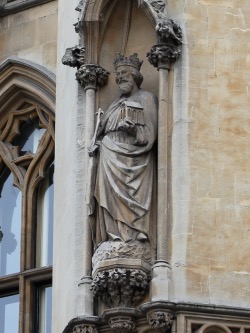
Close-up of Henry III. PICTURE: Can Pac Swire (licensed under CC BY-NC 2.0/image has been cropped).

This Grade II-listed building, which contains a gateway to the Dean’s Yard, was designed by Sir George Gilbert Scott and built in Bath stone with slate roofs in the mid-1850s.

The statues, which stand in niches on the exterior of the turrets on either side of the gateway, have been identified as the two kings on London Remembers.

Their position at this location is not random. The king on the left, identified as Edward the Confessor, had St Peter’s Abbey rebuilt here in the mid 11th century (and was buried in it only a week after its consecration).

The king on the right, King Henry III, rebuilt the abbey church in the mid-13th century to provide a shrine to venerate Edward the Confessor and as a site for his own tomb.

The kings are apparently not the only monarchs adorning the building – two roundels below them depict Queen Victoria and Prince Albert.
LondonLife – Icons turn purple to celebrate Elizabeth Line opening…

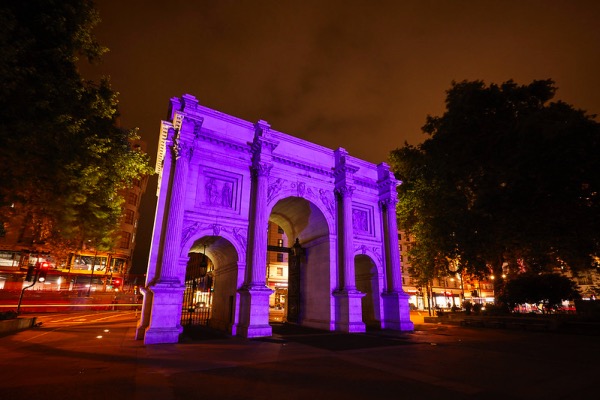
Marble Arch lights up for the launch of the Elizabeth Line.. PICTURE: © TfL
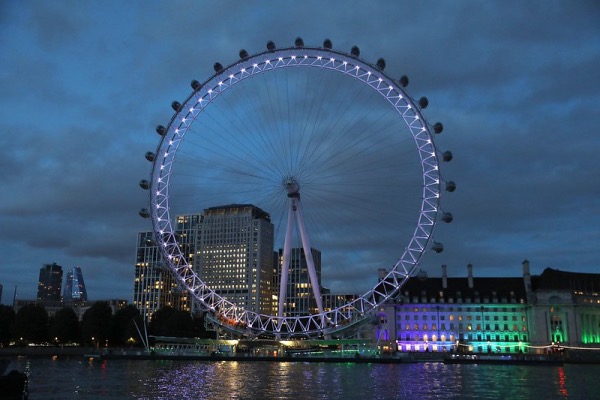
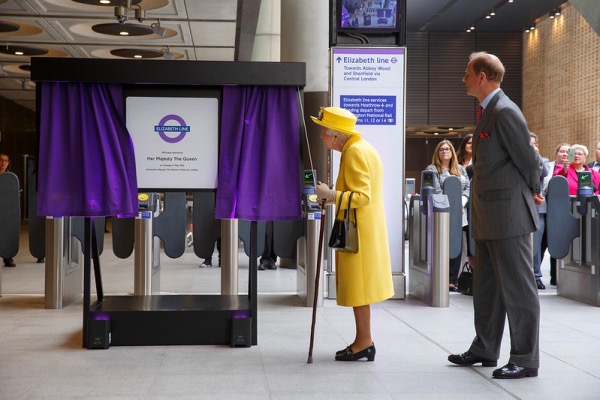
Iconic London locations including Tower Bridge, The London Eye, and Marble Arch turned purple last night to mark the opening of the new Elizabeth Line today. Thousands of people are today expected to use the new Tube line which provides faster journeys between Paddington and Abbey Wood via 10 new stations using Class 345 trains that are more and than one-and-a-half times longer than a standard Tube train and able to carry 1,500 passengers. The line’s opening is the latest step in the £18.8 billion Crossrail project which is linking Reading, to the west of London, with Heathrow before travelling through central London to connect with Shenfield and Abbey Wood in the east. Sadiq Khan, the Mayor of London, said it was an “historic day”. “This is a huge moment, not just for London but the entire country – particularly in this special Jubilee year…This brand new line is the most significant addition to our transport network in decades.” Last week, the Queen and Prince Edward attended Paddington Station to mark the completion of the new line.

The London Eye illuminated. PICTURE: © TfL
Woolwich Town Hall lit up in purple. PICTURE: © TfL
A very excited first customer on the Elizabeth Line at its opening on 24th May. PICTURE: © TfL
HM Queen Elizabeth II, HRH Prince Edward Earl of Wessex, at unveiling of commemorative plaque at Paddington Station on 17th May. PICTURE: © TfL

Treasures of London – The Tijou Screen at Hampton Court Palace…

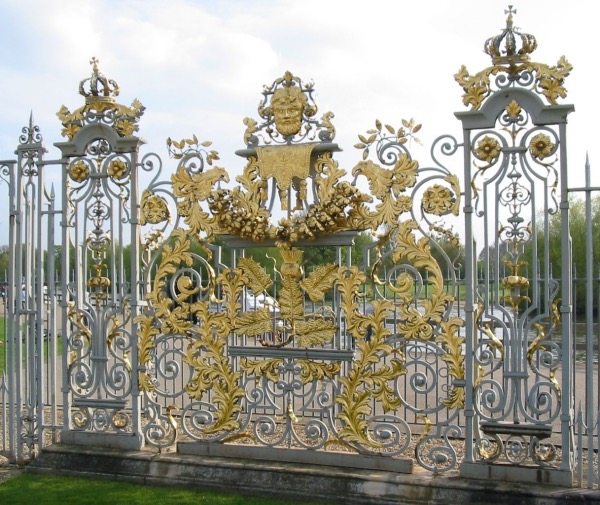
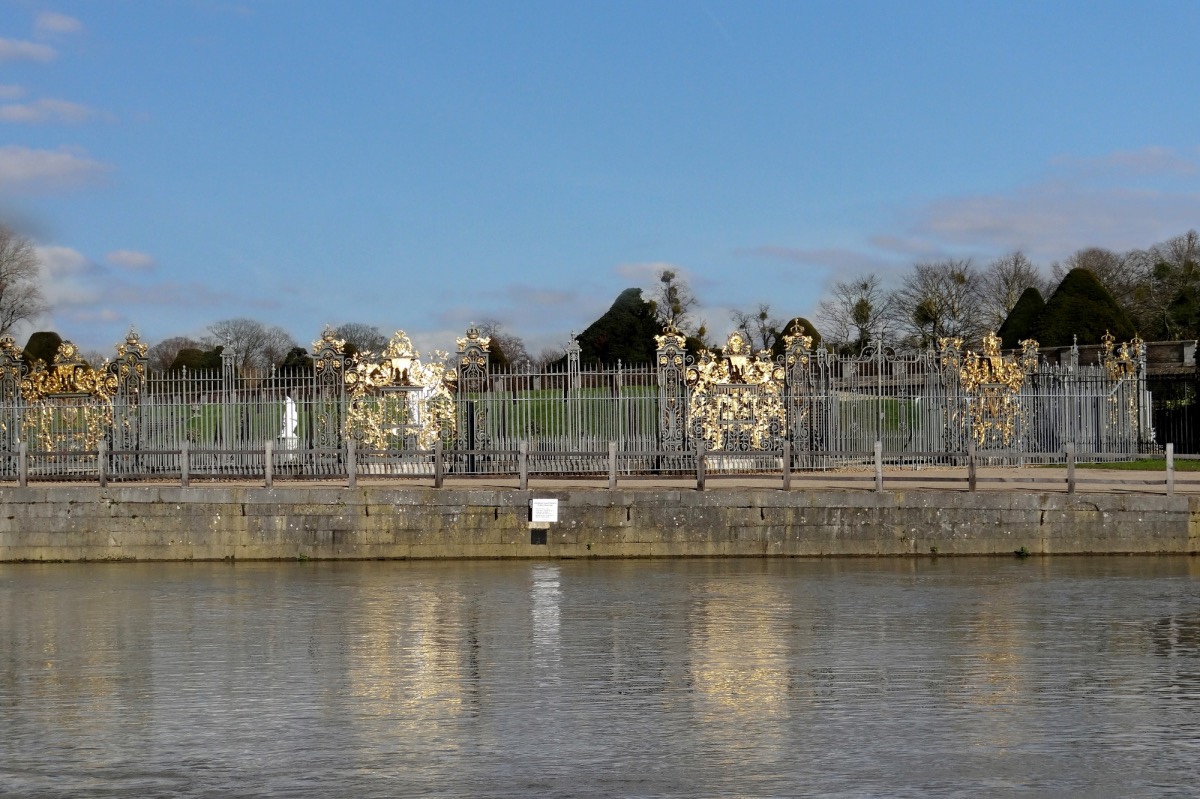
A section of the Tijou Screen representing Scotland. PICTURE: Man vyi

Standing at the river end of the Privy Garden at Hampton Court Palace is a stretch of wrought-iron screen designed and made by Huguenot ironworker Jean Tijou for King William III and Queen Mary II.

The screen, which is one of the finest examples of 17th century ironwork in the world, was created between 1689 to 1692. It features 12 panels displaying symbols including the monogram of William and Mary, the garter emblem and representations of England, Ireland, Scotland and France.

William expressed his personal admiration for the work.

The Tijou Screen seen from the Thames. PICTURE: Maxwell Hamilton (licensed under CC BY-SA 3.0)

The screen was among numerous royal commissions created by Tijou, who had arrived in England in about 1689 and secured the patronage of the joint monarchs.

The screen fell into neglect in the 18th century and were subsequently repaired numerous times before being split up in the 19th century. It was re-erected at Hampton Court in 1902 and since been restored several times.

10 (lesser known) statues of English monarchs in London…5. Queen Elizabeth I at Westminster School…

Close-up of the statue of Queen Elizabeth II. PICTURE: Close-up of the statue of Queen Elizabeth II. PICTURE: Matt Brown (licensed under CC BY 2.0)

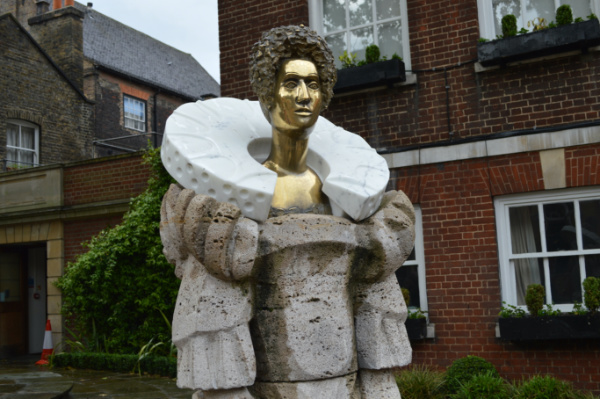
This rather unusual statue of Queen Elizabeth I is a relatively new addition – it was dedicated 12 years ago on what was the 450th anniversary of the refounding of Westminster School – more properly The Royal College of St Peter in Westminster – by the aforementioned Queen.

The larger-than-life statue, which can be found in Little Dean’s Yard, is the work of a former pupil, sculptor Matthew Spender.

It depicts the Queen in white Travertino Noce stone while her head, surrounded by a giant white ruff is gilded bronze with what was auburn hair. The unusual depiction has certainly attracted its share of detractors.

The statue, which was commissioned by the Westminster School Society, was unveiled by the Queen’s namesake, Queen Elizabeth II, on 21st May, 2010.

There’s a more famous – and more typical – statue of Queen Elizabeth I on the exterior of St Dunstan-in-the-West in Fleet Street and another on the exterior of Guildhall.

Guided tours of the school can be arranged during the school’s holidays. For more information, see www.westminster.org.uk/about/our-history/guided-tours/.

London Explained – Royal residences…

There are numerous royal palaces in London but which are royal residences?

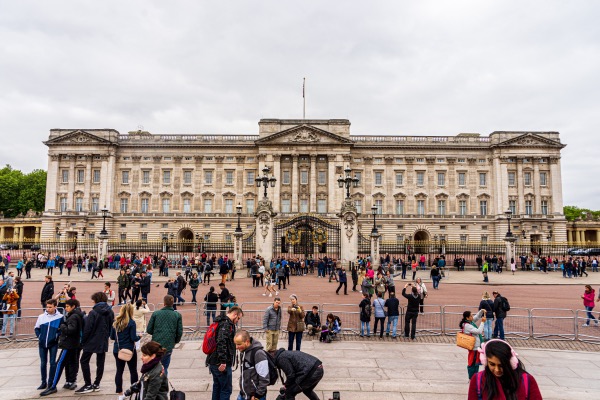
Buckingham Palace. PICTURE: Sung Shin/Unsplash

Foremost is Buckingham Palace, the official residence and office of the monarch – Queen Elizabeth II – in London. The palace – acquired for the Crown by King George III in 1761, converted to a palace by King George IV and first lived in by Queen Victoria – is also used for State ceremonies and for official entertaining.

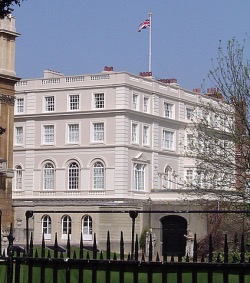
Clarence House. PICTURE: ChrisO (licensed under CC BY-SA 3.0)

Other royal residences include Clarence House which is the official London residence of Prince Charles and Camilla, Duchess of Cornwall.

The property was built between 1825 and 1827 to the designs of John Nash for Prince William Henry, Duke of Clarence (hence the name).

It was the home of Queen Elizabeth, the Queen Mother, between 1953 and her death in 2002, and was also temporarily the home of the then-Princess Elizabeth and Prince Philip following their marriage in 1947.

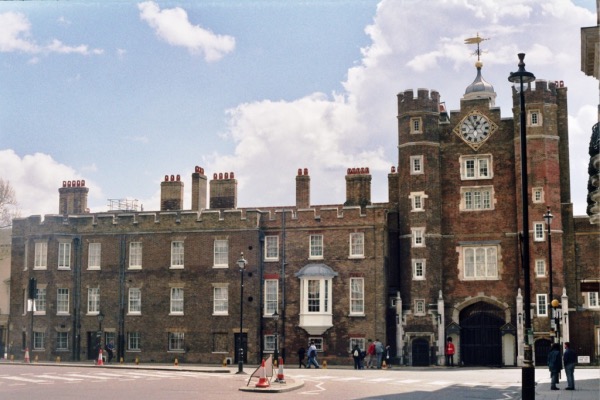
St James’s Palace. PALACE: Elisa.rolle (licensed under CC BY-SA 3.0)

St James’s Palace, which was largely built by King Henry VIII and served as the residence of numerous monarchs until King William IV, also remains the home of several members of the Royal Family – including Princess Anne and Princess Alexandra – and their household offices.

The State Apartments are sometimes used for entertaining during in-coming State Visits, as well as for other ceremonial and formal occasions. Its history means diplomats are still accredited to the Court of St James.

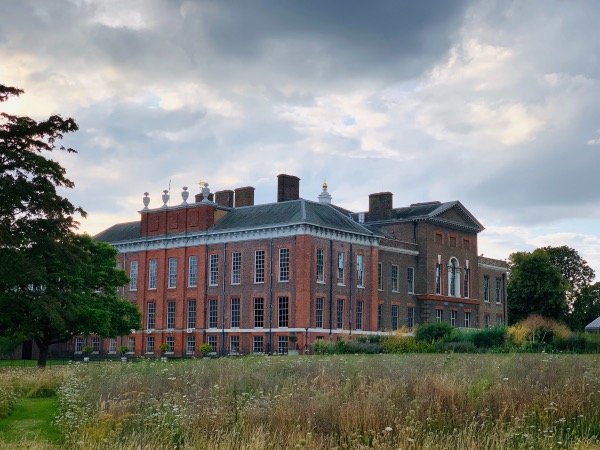
Kensington Palace. PICTURE: Pranav Thombare/Unsplash.

Kensington Palace – childhood home of Queen Victoria and favoured residence of monarchs from King William III to King George II – is these days the official London residence of Prince William and Katherine, the Duchess of Cambridge.

It also contains the London residences and offices of the Duke and Duchess of Gloucester, the Duke and Duchess of Kent and Prince and Princess Michael of Kent.

While Hampton Court Palace, the Tower of London, Kew Palace and the remnant of the Palace of Whitehall known as the Banqueting House are all royal palaces, they ceased being used regularly for royal court purposes in the 18th century and are now in the care of Historic Royal Palaces (along with parts of Kensington Palace).

LondonLife – Green spaces form part of ‘Green Canopy’ for Queen’s Platinum Jubilee…

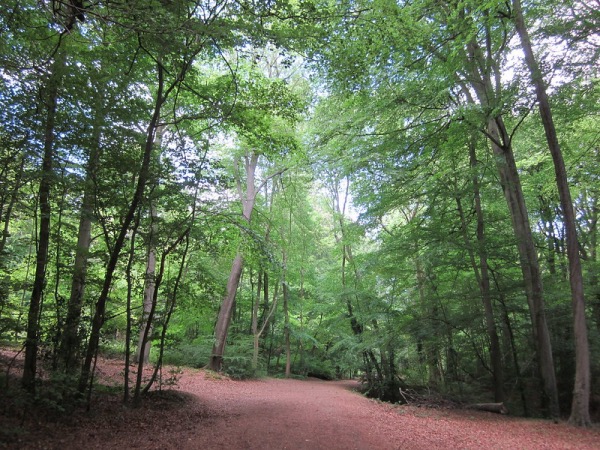
Epping Forest. PICTURE: martin_vmorris (licensed under CC BY-SA 2.0)

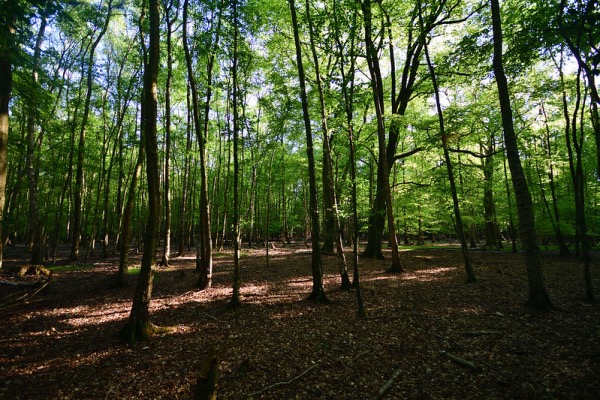
City of London-managed open spaces Epping Forest, Burnham Beeches and Ashtead Common have been selected to be part of a nationwide network of 70 ancient woodlands to be dedicated to The Queen in celebration of the Platinum Jubilee. At almost 6,000 acres, Epping Forest is London and Essex’s largest green space and is known as the “green lungs” of London. Burnham Beeches, located in Buckinghamshire, is only a square mile in size but is described as a “New Forest in miniature” while Ashtead Common in Surrey’s 200 hectares of open public space is home to more 1,000 living ancient oak pollards. For more on The Queen’s Green Canopy initiative, see www.queensgreencanopy.org. For more on the City of London’s green spaces, see www.cityoflondon.gov.uk/things-to-do.

Burnham Beeches. PICTURE: synx508 (licensed under CC BY-NC 2.0)


Ashtead Common. PICTURE: Pollards Hill Cyclists (licensed under CC BY-NC 2.0)

Where’s London’s oldest…synagogue?

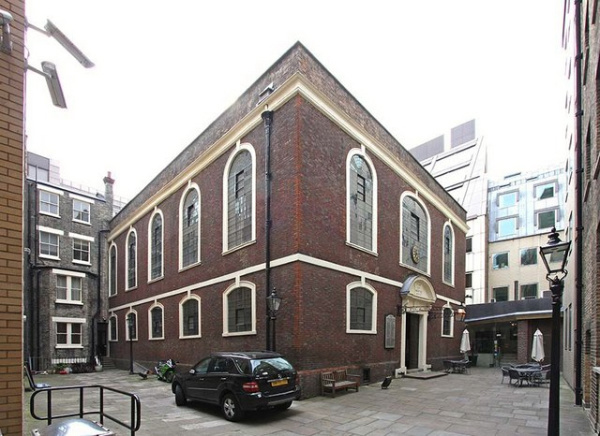
PICTURE: John Salmon (licensed under CC BY-SA 2.0)

Actually the oldest synagogue in continuous use in the entire UK, the Bevis Marks Synagogue in the City of London was built in 1701.


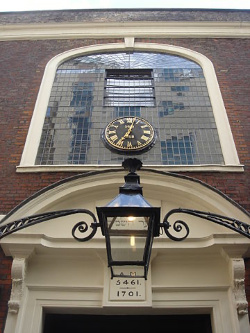
The synagogue entrance. PICTURE: Edwardx (licensed under CC BY-SA 3.0)

The synagogue has historical ties to the city’s Spanish and Portuguese Jewish community, known as Sephardic Jews, which first started meeting together in a small synagogue in Creechurch Lane in 1657 after it become possible for Jews to openly practice their religion under the rule of Lord Protector Oliver Cromwell.

Increasing numbers in the community soon meant a larger premises was required and a committee was formed which signed a contract with Quaker builder Joseph Avis in February, 1699, to build a larger premises (tradition holds that Avis returned the money he made on the job to the community, saying he would not profit from building a house of God). In June that same year, the community leased a tract of land at Plough Yard, Bevis Marks, on which the new building would be built. Construction commenced soon after.

The property’s design is said to emulate, at least in part, that of the 1675 Portuguese Synagogue of Amsterdam (it’s also thought the design was influenced by the works of Sir Christopher Wren). There’s also a story that the building included an oak beam from one of the Royal Navy’s ships presented by Queen Anne.

The rectangular building, which features three galleries inside, was eventually completed and dedicated in September, 1701.

The roof of the now Grade 1-listed building was replaced following a fire in 1738 and the synagogue only suffered minor damage during the Blitz. It also suffered some collateral damage from the IRA bombing in 1992 and the 1993 Bishopsgate bombing but remains mostly intact.

Sermons at Bevis Marks were in Portuguese until 1833 when they changed to English.

Features inside include an oak Renaissance-style ark containing the Torah scroll which, painted to resemble coloured Italian marble, is located at the centre of the eastern wall. There are also seven hanging brass candelabra which symbolise the seven days of the week. The largest, which hangs in the centre of the synagogue – represents the Sabbath and was donated by the community of the Great Synagogue of Amsterdam. There are also 10 large brass candlesticks representing the Ten Commandments. While the upright oak seats are said to “reflect the Puritanism of 17th century England”, the backless oak benches at the back are the original seats which were brought from the Creechurch Lane premises.

Twice Prime Minister Benjamin Disraeli’s 1804 birth is recorded in the register but after his father had a falling out with the synagogue officials, Disraeli was in 1817 baptised at St Andrew’s Holborn.

The synagogue is temporarily closed to visitors and tour groups. For more information, head to www.sephardi.org.uk/bevis-marks/visit-bevis-marks/.

This Week in London – Tulips at Hampton Court; new Falklands-related displays at the IWM; and, a new garden for The Regent’s Park…

Hoping you have a wonderful Easter break.

PICTURE: © Historic Royal Palaces

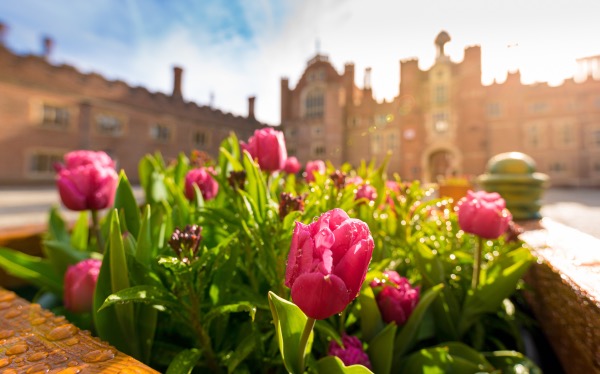
Hampton Court Palace’s Tulip Festival – the largest of its kind in the UK – is returning following its successful inaugural year in 2021. From Friday until 2nd May (depending on flowering periods), the palace’s 60 acres of formal gardens are expected to be filled with rare, historic and specialist tulip varieties inspired by Queen Mary II’s famous 17th century collection which was once housed at the palace. Some 120,000 tulip bulbs of 60 different varieties have been planted, including breath-taking floating tulip vases located in the palace’s famous fountains, and floral displays which will fill the cobbled courtyards of Base Court and Clock Court. Visitors will be able to find out all about the links between the flower and the palace’s history with a dedicated Tulip Festival Guide. Included with admission. For more, head here.

New exhibits marking the 40th anniversary of the Falklands Conflict have gone on show at the Imperial War Museum in Lambeth. Among the new items on display are drawings by Linda Kitson, the first female artist commissioned by IWM to accompany troops into conflict, and images of the conflict – many of which have never been seen before – taken by photographer Paul RG Haley who covered it for Soldier Magazine. The museum is also exploring the story and legacy of the conflict through a digital programme of events including a series of short films and a new episode of the Conflict of Interest podcast featuring actor Katherine Parkinson. For more, see www.iwm.org.uk.

The Regent’s Park will soon boast a new 1.5 acre garden at its centre in honour of Queen Elizabeth II’s Platinum Jubilee. The new garden, to be created on the site of a former plant nursery near the Inner Circle, will include design features that reflect the Queen’s “love of trees and nature”. The Royal Parks will be committing £1 million to the project and will seek external funding and public donations. Designs for the new park will be shared as they are developed. Meanwhile, The Royal Parks have also announced they will be creating a new wood in Richmond Park as part of the Queen’s Green Canopy Initiative. The new woodland, which will be located adjacent to Ham Cross, will be planted with 70 large trees, each one to mark a year of Her Majesty’s reign.

Send all items to exploringlondon@gmail.com.

This Week in London – Japanese works at the Queen’s Gallery; Raphael at The National Gallery; Food Season at the British Library; and, Enid Marx’s Blue Plaque…

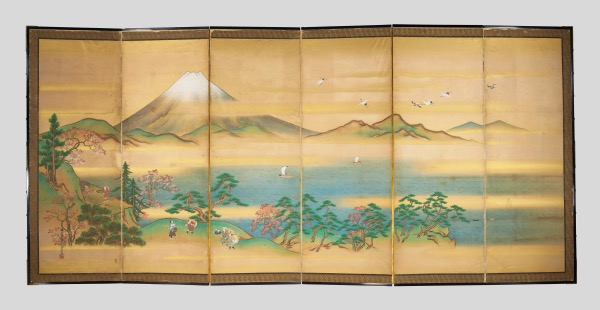
Itaya Hiroharu, folding screen paintings, 1860. Sent to Queen Victoria by Shōgun Tokugawa Iemochi, 1860.

A first-of-its-kind exhibition featuring the Royal Collection’s Japanese works of art opens at the Queen’s Gallery, Buckingham Palace, tomorrow. Japan: Courts and Culture, features more than 150 works including rare porcelain, samurai armour, woodcut prints, embroidered screens and a range of diplomatic gifts sent during the reigns of monarchs ranging from King James I to Queen Elizabeth II. Among the highlights are a pair of folding screens sent to Queen Victoria in 1860 from the Japanese Shōgun Tokugawa Iemochi which will go on public display for the first time since they arrived at the British court 162 years ago. The screen paintings, which depict the changing seasons, were not thought to have survived but in recent years research has revealed the two screens were the work of Itaya Hiroharu, one of the artists likely to have worked on Queen Victoria’s gifts. Also included in gift was a set of lacquer furniture, spears inlaid with glittering mother of pearl, and swords made by leading court swordsmiths – all of which will also be on display. Admission charge applies. Runs until 26 February, 2023. For more, see www.rct.uk.

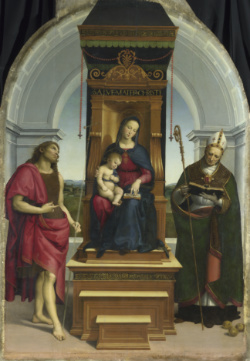
Raphael, The Madonna and Child with Saint John the Baptist and Saint Nicholas of Bari (‘The Ansidei Madonna’) (1505), © The National Gallery, London

• Marking the 500th anniversary of the death of Raphael, one of the first-ever exhibitions to explore the complete career of this giant of the Italian Renaissance opens at The National Gallery on Saturday. The Credit Suisse Exhibition: Raphael, which was supposed to be held in 2020 and was delayed due to the coronavirus pandemic, features more than 90 exhibits. They include a rare gathering of Raphael’s paintings of the Virgin and Child including Ansidei Madonna (The Virgin and Child with Saint John the Baptist and Saint Nicholas of Bari) (1505), two bronze roundels – The Incredulity of Saint Thomas and The Descent into Limbo – from Santa Maria della Pace which have never previously exhibited outside Italy and which are attributed to Cesarino Rossetti after designs by Raphael, and a room devoted to Raphael’s frescoes for Pope Julius II’s private apartments. There are also several of his original print designs, an survey of ancient Rome he undertook for Pope Leo X, tapestry designs including Saint Paul Preaching at Athens (workshop of, or on behalf of, Pieter van Aelst, active about 1490–1533, after design by Raphael, about 1517–19), and portraiture from his final years including Portrait of Lorenzo de’ Medici (1518) and Portrait of Baldassare Castiglione (1519). Admission charge applies. Runs until 31st July. For more, see www.nationalgallery.org.uk/exhibitions/the-credit-suisse-exhibition-raphael.

• The British Library’s Food Season kicks off today with almost two months of online and in-person events inspired by the cookbooks, recipes and culinary stories in the collection. Highlights include chef Ainsley Harriott talking about his life and career with food-writer Melissa Thompson, food-writer Maunika Gowardan celebrating India’s breadth of food cultures with chefs and food-writers including Ravinder Bhogal, Romy Gill, Kavi Thakrar and Farokh Talati, chef and broadcaster Andi Oliver discussing Jessica B Harris’ 50- year career examining the history and meaning of food for the African diaspora, and psychologist Kimberley Wilson chairing a discussion about the food prisoners are fed inside British correctional institutions and if it impacts rehabilitation. Now in its fifth year, the 2022 Food Season is supported by KitchenAid. For the full programme of events, head to www.bl.uk/events/food-season.

Textile designer Enid Marx – famous for her seat fabric designs on the London Underground – has been honoured with an English Heritage Blue Plaque. The plaque was unveiled this week at her former home at 39 Thornhill Road where she lived and worked for more than 30 years. Marx, who shared the house with her partner, Margaret Lambert, and friends Eleanor Breuning and Grace Lambert (Breuning continues to live at the house today), had a purpose-built studio in the back garden which remains in similar condition to when she left it almost 25 years ago. Alongside her work for the London Underground, Marx also is known for her design of postage stamps marking the start of Queen Elizabeth II’s reign in 1953. For more, see www.english-heritage.org.uk/visit/blue-plaques/.

10 historic stairways in London – 8. The King’s Staircase, Kensington Palace… 

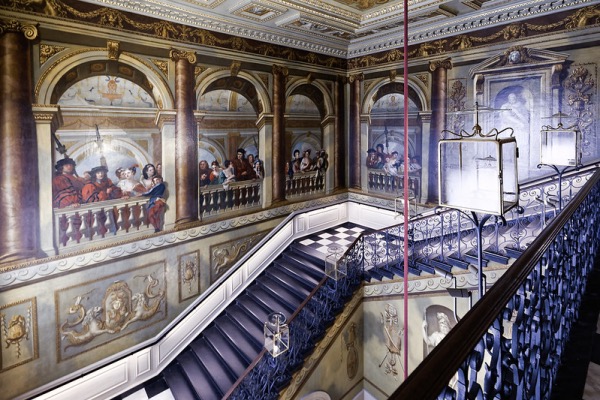
PICTURE: Tuomo Lindfors (licensed under CC-BY-NC-SA 2.0)

This staircase, a grand entrance to the King’s State Apartments at Kensington Palace, are famous for the paintings on the walls and ceiling which depict an 18th century court looking down on those who ascend.

The work of William Kent, the staircase paintings were complete in 1724 and replaced earlier wooden panelling.

The stairs were originally constructed as part of Sir Christopher Wren’s remodelling Nottingham House into Kensington Palace for King William III and Queen Mary II. Following a fire in 1691, they were rebuilt in marble.

There are 45 people in Kent’s painting and only about a dozen have been identified. As well as members of the Yeomen of the Guard, the images depict King George I’s Polish page Ulric, his Turkish servants Mahomet and Mustapha, Peter the ‘wild boy’, a child found in the woods in Germany, and Dr John Arbuthnot, a medical doctor and satirist who tried to teach Peter to speak.

Interestingly, Kent included a selfie on the ceiling – a depiction of himself, wearing a brown turban and carrying an artist’s palette, standing with his mistress by his side.

The trompe l’oeil (a technique which creates the optical illusion of 3D) work features architecture inspired by Rome where Kent had trained while there’s also a painted figure of Diana on the top landing which is based on an antique statue at Holkham Hall in Norfolk.

In 1734, Queen Caroline commissioned Kent to rework the stairs to the Queen’s State Apartments. His work there features a Roman-inspired scene again created as a trompe l’oeil. There is also a homage to Queen who is compared to Britannia. The staircase’s balustrade was another by Huguenot ironworker Jean Tijou.

WHERE: The Broad Walk, Kensington Gardens, Kensington (nearest tube stations are High Street Kensington or Queensway); WHEN: Daily 10am to 6pm (last admission 5pm); COST: £16 adult/£12.80 concession/£8 child (Historic Royal Palaces members free); WEBSITE: www.hrp.org.uk/KensingtonPalace.

10 historic stairways in London – 5. The King’s Staircase, Hampton Court Palace…

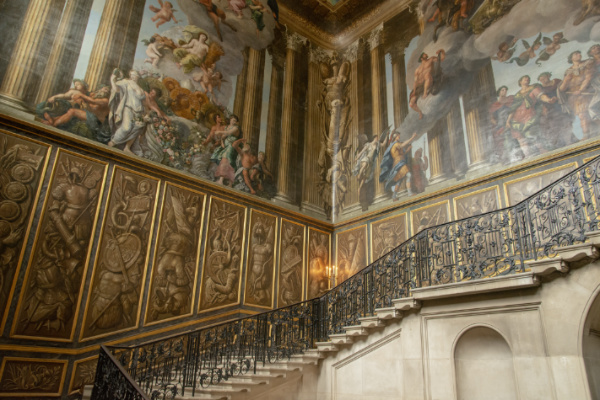
The King’s Staircase at Hampton Court Palace. PICTURE: Peter K Burian (licensed under CC BY-SA 4.0)

This grand staircase was installed in Hampton Court Palace during the reign of King William III and Queen Mary II as a grand entrance to the King’s Apartments.

The staircase, which features shallow steps, was designed Sir Christopher Wren and features a wrought iron balustrade designed by French ironsmith Jean Tijou.

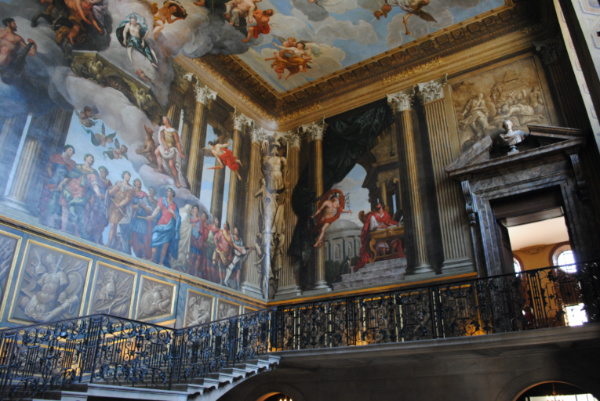
Another view of the staircase and accompanying art. PICTURE: David Adams

It was decorated in about 1700 by Italian painter Antonio Verrio to resemble a Roman courtyard which is open to the sky. The main image depicts ‘Victory of Alexander over the Caesars’ which features King William III as Alexander the Great and is painted as an allegory of William’s triumph over the Stuart King, James II, in the Glorious Revolution of 1688 (with the Stuarts represented by the 12 Caesars).

The stairs lead up to the Guard Chamber, an anteroom which had to be passed through to reach the Presence Chamber.

LondonLife – Gun salutes mark Queen Elizabeth II’s Platinum Jubilee…

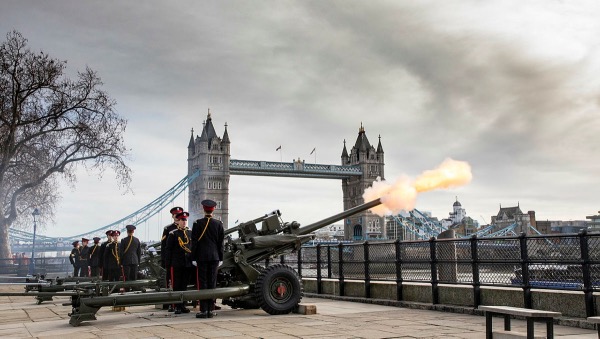
PICTURE: Cpl Victoria Goodall (Copyright:© UK MOD Crown Copyright 2022)

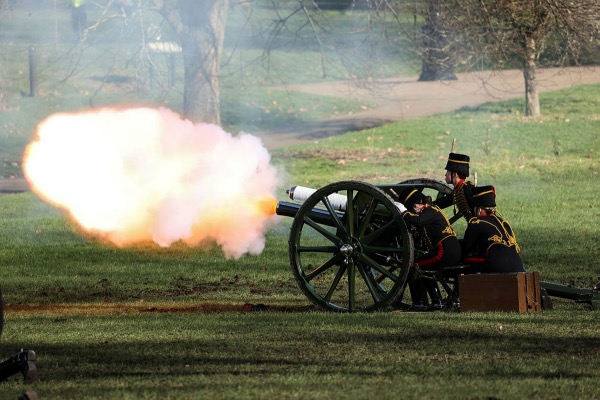
The Honourable Artillery Company fires a 62 gun salute at the Tower of London to mark the 70th Anniversary of Queen Elizabeth II’s accession to the throne. The gun salute at the Tower was one of a number which took place across the UK on Monday – while the date of the Queen’s accession was the 6th February, gun salutes do not traditionally take place on a Sunday. The gun salutes are traditionally comprised of 21 rounds with a further 20 rounds fired at Royal Parks and palaces and a further 21 at the Tower to show the respect the City of London has for the Queen. Below, the King’s Troop Royal Horse Artillery can be seen firing 41 rounds in Green Park.

PICTURE: Corporal Rebecca Brown RLC (Copyright: ©MoD Crown Copyright 2022)

London Explained – Historic Royal Palaces…

The Tower of London is one of the palaces under the care of Historic Royal Palaces. PICTURE: Nick Fewings/Unsplash

Visitors to several of London’s landmark royal properties will across an organisation known as Historic Royal Palaces.

HRP, as its sometimes shortened to, is a self-funding charity charged with the management of palaces which are owned by the Crown (technically by Queen Elizabeth II ‘in Right of Crown’ meaning she holds them in trust for the next monarch and by law cannot sell or lease them). The palaces are generally no longer used as royal residences.

These include the Tower of London, Hampton Court Palace, Kensington Palace, Kew Palace and the Banqueting House (once part of the Palace of Whitehall). Buckingham Palace, which remains the official London residence of Queen Elizabeth II and a working royal palace, is not one of them nor is St James’s Palace, home to several members of the Royal Family and their households.

All five of the properties in London which are under the care of Historic Royal Palaces ceased being regularly used by the Royal Court in the 19th century and were opened up to the public. The government became responsible for their care under the Crown Lands Act 1851.

In 1989, the government established Historic Royal Palaces as part of the Department of the Environment to oversee care of the five palaces. Six years later it became part of the Department of National Heritage (now known as the Department for Culture, Media & Sport).

In April, 1998, Historic Royal Palaces became an independent charity by Royal Charter. It is governed by a board of trustees who include the director of the Royal Collection Trust and the Keeper of the Privy Purse from the Royal Household as well as the Constable of the Tower of London.

Historic Royal Palaces now oversees management of the palaces under a contract with the Secretary of State for Culture, Media & Sport (as well as the five London properties, since 2014, it has also been responsible for the care of Hillsborough Castle in Northern Ireland).

Perhaps the most well-known faces of Historic Royal Palaces are joint curators – Tudor historian Tracy Borman, and architectural and social historian Lucy Worsley.

HRP collects revenues through entries to the palaces but also offer an annual membership through which you can have unlimited entry.

For more, head to www.hrp.org.uk.

10 historic stairways in London – 2. Queen Mary’s Steps, Whitehall…

PICTURE: Paul Farmer (licensed under CC BY-SA 2.0).

This small stone stairway which now sits in the midst of a grassy expanse at the back of the Ministry of Defence was once part of the Palace of Whitehall.

Named for Queen Mary II, wife of King William III, for whom they were designed, the stairs were part of a terrace built in 1691 abutting the Thames in front of an old river wall constructed for King Henry VIII.

Designed by Sir Christopher Wren, the stairs were one of a pair located at either end of the terrace which gave direct access to the river – and state barges – from the Royal Apartments.

Excavations in 1939 during construction of the MoD revealed the Tudor river wall, the terrace and the northern-most of the two flights of steps. The upper part of the steps have been repaired and the terrace and wall reconstructed.

The steps and palace fragments are now a Grade I listed monument.

LondonLife – Buckingham Palace…

Buckingham Palace. PICTURE: Debbie Fan/Unsplash.

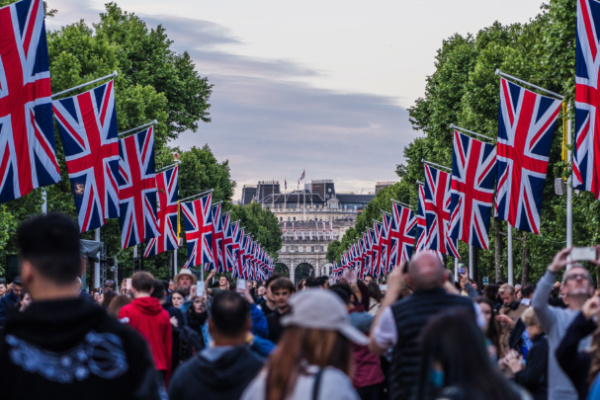
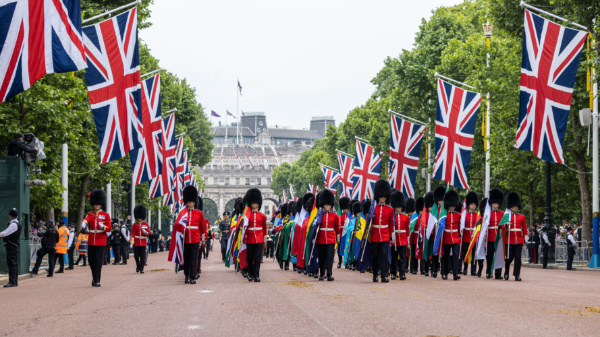
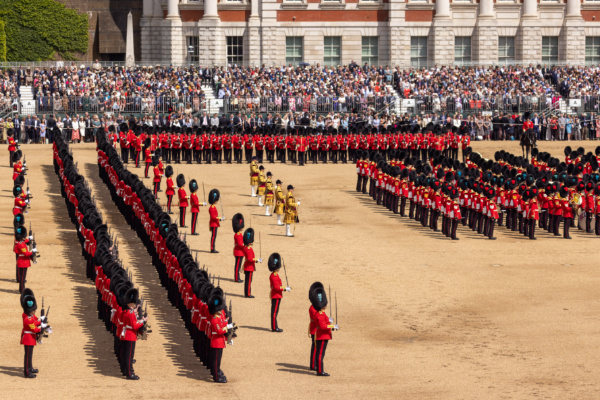
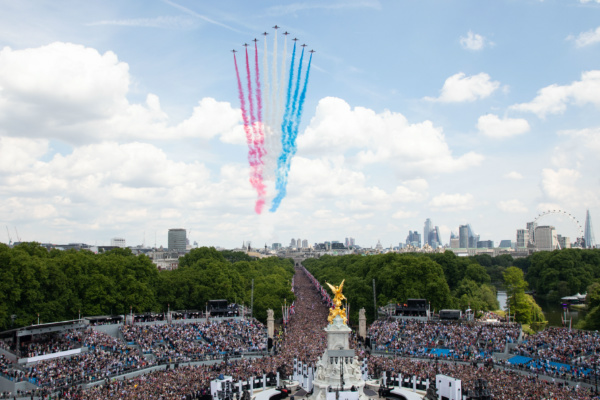
Buckingham Palace is among the sites across London which will be hosting events to mark Queen Elizabeth II’s Platinum Jubilee this June. The Queen’s 70th year on the throne will be marked with four days of celebrations across the June bank holiday weekend which will include the Queen’s Birthday Parade (known as Trooping the Colour), the lighting of Platinum Jubilee Beacons – including the principal beacon at Buckingham Palace, a Service of Thanksgiving at St Paul’s Cathedral, the ‘Platinum Party at the Palace’ – a celebration concert in the gardens of Buckingham Palace, The Big Jubilee Lunch in communities across the city, and a special Platinum Jubilee Pageant, part of which will see a moving river of flags rippling down The Mall. For more information, head to www.royal.uk/platinum-jubilee-central-weekend.

This Week in London – Borealis at Guildhall Yard; princess panto costumes; and ancient Greeks at the Science Museum…

Borealis. PICTURE: Doug Southall

A dazzling light show inspired by the Northern Lights – one of the seven natural wonders of the world – can be seen in the Guildhall Yard this December. Borealis – which can be seen between 11th and 22nd December – is the work of artist Dan Acher and is one of a number of light displays which is illuminating London this winter as part of Mayor Sadiq Khan’s ‘Winter Lights’ campaign. Others include an animal-themed display bringing to life the beasts that once lived at the Tower of London, an outdoor programme of installations and video art projections illuminating the Southbank Centre’s site, the ‘Illuminated River’ display lighting up nine of London’s bridges in what is be the longest public art project in the world, and a free Canary Wharf ‘Winter Lights Spectacular’ in January which will feature 20 new light commissions by some of the most innovative artists across the globe. In Grosvenor Square, Mayfair, thousands of illuminated white roses will form an ‘Ever After Garden’ designed by fashion designer Anya Hindmarch while traditional favourites like the Hyde Park Winter Wonderland as well as winter markets and ice rinks at locations like the Natural History Museum and Somerset House are also once again returning to the city. London’s red buses are an easy way to see the Christmas lights this year with routes 12, 94, 98, 139 and 390 all travelling through Oxford Circus. Free tickets to Borealis can be booked at www.visitlondon.com/Borealis while, for more on the best bus routes, see https://londonblog.tfl.gov.uk/festive-bus-routes/. For more information on all the light shows and events (some of which are already underway), see visitlondon.com    .

Costumes worn by then Princess Elizabeth and her sister Princess Margaret in wartime-era pantomimes are at the heart of a new display at Windsor Castle this Christmas. The princesses spent much of their time at Windsor during World War II – away from the Blitz in London – and, between 1941 and 1944, they performed in and helped to stage a series of pantomimes to raise money for the Royal Household Wool Fund which supplied knitting wool to make comforters for soldiers fighting at the front. Six of the costumes they wore have been brought together for the first time and are being displayed in the castle’s Waterloo Chamber where the pantos were originally performed. The costumes on show were worn in the last two pantos – Aladdin, which was performed in 1943, and Old Mother Red Riding Boots which was performed in 1944. Also on show are 16 large scale pictures of fairy-tale characters that were pasted around the walls to create the space for the performances. Visitors to Windsor this Christmas will also see State Apartments decorated for the festive season and a 20 foot high Christmas tree in St George’s Hall. The Semi-State Rooms, created for King George IV and now used for official entertaining, are also now open to visitors. The costumes can be seen until 31st January. Admission charges apply. For more on the Christmas activities at Windsor, including a ‘Mary, Queen of Scots at Christmas Family Activity Day’ on 18th December, see www.rct.uk/whatson/. Meanwhile, Buckingham Palace is offering guided tours of the State Rooms over winter with special family guided tours available for the first time. The tours run until 30th January. Admission charge applies. For more on the guided tours, head here and for more on the family tours, head here.

• The ancient Greeks’ pursuit of knowledge is the subject of a new exhibition which has opened at the Science Museum in South Kensington. Ancient Greeks: Science and Wisdom takes visitors on a journey in which they will sail the perilous seas with a statue of Hermes that was discovered on a shipwreck off the island of Antikythera, experience the lost music of the aulos instrument through interactive displays and an exclusive video that reimagines its ancient sounds, and gaze at the starry cosmos through ancient Greek eyes via a beautiful and rare silver globe depicting the known constellations and a Byzantine sundial-calendar – the second oldest known geared mechanism in the world. The free display can be seen until 5th June. Tickets are required – to book head to sciencemuseum.org.uk/ancient-greeks.

Send all items for inclusion to exploringlondon@gmail.com.

Lost London – Arundel House…

Arundel House, from the south, by Wenceslas Hollar. Via Wikimedia Commons.

One of a string of massive residences built along the Strand during the Middle Ages, Arundel House was previously the London townhouse of the Bishops of Bath and Wells (it was then known as ‘Bath Inn’ and Cardinal Thomas Wolsey was among those who resided here during this period).

Following the Dissolution, in 1539 King Henry VIII granted the property to William Fitzwilliam, Earl of Southampton (it was then known as Hampton Place). After reverting to the Crown on his death on 1542, it was subsequently given to Thomas Seymour, 1st Baron Seymour of Sudeley, a younger brother of Queen Jane Seymour, Henry VIII’s third wife, and known as ‘Seymour Place’. Then Princess Elizabeth (late Queen Elizabeth I) stayed at the property during this period (in fact, it’s said her alleged affair with Thomas Seymour took place here).

Arundel House, from the south, by Wenceslas Hollar. Via Wikimedia Commons.

Seymour significantly remodelled the property, before in 1549, he was executed for treason. The house was subsequently sold to Henry Fitz Alan, 12th Earl of Arundel, for slightly more than £40. He was succeeded by his grandson, Philip Howard, but he was tried for treason and died in the Tower of London in 1595. In 1603, the house was granted to Charles, Earl of Nottingham, but his possession was short-lived.

Just four years later it was repurchased by the Howard family – in particular Philip’s son, Thomas Howard, 14th Earl of Arundel – who had been restored to the earldom.

Howard, who was also the 4th Earl of Surrey, housed his famous collection of sculptures, known as the ‘Arundel Marbles’, here (much of his collection, described as England’s first great art collection, is now in Oxford’s Ashmolean Museum).

During this period, guests included Inigo Jones (who designed a number of updates to the property) and artist Wenceslas Hollar who resided in an apartment (in fact, it’s believed he drew his famous view of London, published in 1647, while on the roof).

Howard, known as the “Collector Earl”, died in Italy in 1646. Following his death, the property was used as a garrison and later, during the Commonwealth, used as a place to receive important guests

It was restored to Thomas’ grandson, Henry Howard, 6th Duke of Norfolk, following the Restoration. Following the Great Fire of London in 1666, for several years the property was used as the location for Royal Society meetings.

The house was demolished in the 1678. It’s commemorated today by the streets named Surrey, Howard, Norfolk and Arundel (and a late 19th century property on the corner of Arundel Street and Temple Place now bears its name).