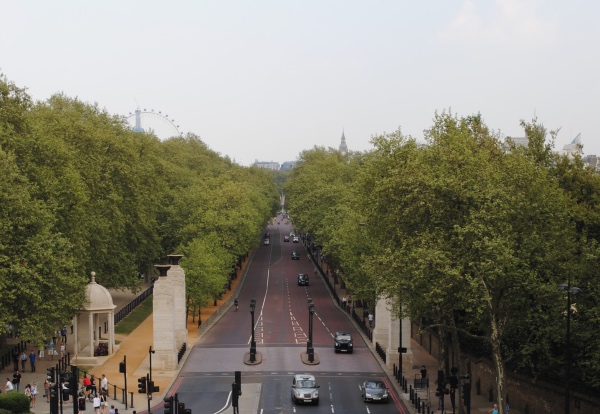
It was on this road connecting the western end of The Mall outside Buckingham Palace with Hyde Park Corner that an infamous incident took place during Queen Victoria and Prince Albert’s early years together.
For it was from a footpath on Constitution Hill that the first of eight assassination attempts were made on the Queen as the couple – the Queen then pregnant – rode out from the palace in a low slung carriage headed for Hyde Park as was their custom.
Edward Oxford was just 18-years-old when at on 10th June, 1840, he took up a position on a footpath on Constitution Hill where he stood for a couple of hours before, at about 6pm, as the royal couple’s carriage sailed past, he fired two pistols at them.
Both shots missed (in fact, no bullets were ever found) and Queen Victoria was quick to order the carriage to drive on (she and Albert would also ride out along the same route the next day despite the scare – this time there was a sizeable crowd of well-wishers eager to convey their good sentiments to the Queen and a procession of these followed their carriage up the hill to Hyde Park).
Oxford, meanwhile, was immediately seized by onlookers and stripped of his guns. He immediately admitted his crime, was subsequently arrested, charged with treason and later acquitted on grounds of insanity before being detained in an asylum at Her Majesty’s pleasure (he was eventually discharged with the proviso that he head to one of England’s overseas colonies and ended up living out his days in Melbourne, Australia).
An interesting footnote is that future artist John Everett Millais, then aged just 11-years-old, was among those standing on Constitution Hill watching the Queen drive past on the day of the assassination attempt.
There were another seven assassination attempts on Queen Victoria over the ensuing years. For more on them, check out Paul Thomas Murray’s detailed book Shooting Victoria: Madness, Mayhem and the Modernisation of the Monarchy.
PICTURE: A view down Constitution Hill towards Buckingham Palace fro, the top of Wellington Arch.

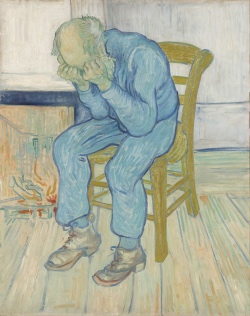 • The first exhibition to examine the work of Dutch artist Vincent van Gogh through his relationship with Britain has opened at Tate Britain this week. Van Gogh and Britain includes more than 40 works by the artist including L’Arlésienne (1890), Starry Night on the Rhone (1888), and Sunflowers (1888). The exhibition will also feature later works by Van Gogh including two he painted while in the Saint-Paul asylum – At Eternity’s Gate (1890 – pictured) and Prisoners Exercising (1890). The exhibition shows how Van Gogh, who lived in London between 1873 and 1876 working as a trainee art dealer, responded to works by artists like John Constable and John Everett Millais and his love of British writers like William Shakespeare, Christina Rossetti and, particularly, Charles Dickens (L’Arlésienne features one of Dickens’ favourite books in the foreground). The show runs until 11th August and is being accompanied by a series of talks and other events. Admission charge applies. For more, see