And so we come to our annual countdown of our most read new posts for 2023 (although the data is indicative only of posts looked at on their own page (and not on the homepage). But, with that caveat, we commence the countdown…
For the final entry in our Wednesday special series, we go to see Sir Christopher Wren’s greatest work – and also his resting place, St Paul’s Cathedral.
Following his death on 25th February, 1723, Wren was buried in the crypt of St Paul’s Cathedral on 5th March.
His burial location was in the south-east corner of the crypt and a simple memorial was placed there near that of his daughter Jane and his sister Susan Holder and her husband William.
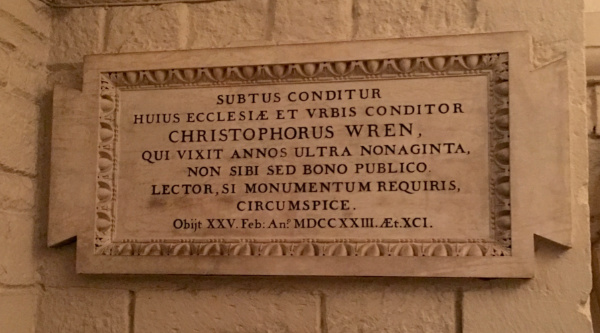
The plaque which marks the location was written by his eldest son Christopher. Inscribed in Latin, it reads: “Here in its foundations lies the architect of this church and city, Christopher Wren, who lived beyond ninety years, not for his own profit but for the public good. Reader, if you seek his monument – look around you. Died 25 Feb. 1723, age 91.”
It’s a fitting tribute to one responsible for some of London’s most famous landmarks.
Interestingly, a fragment of Wren’s coffin can be seen at the RIBA Library. It was taken from his tomb in 1851 when it was last opened to allow for his last surviving direct descendent to be placed within.
WHERE: St Paul’s Cathedral (nearest Tube stations are St Paul’s, Mansion House and Blackfriars); WHEN: 8.30am to 4.30pm Monday to Saturday; COST: £23 adults/£20.50 concessions/£10 children/£56 family (these are walk-up rates – online advanced and group rates are discounted); WEBSITE: www.stpauls.co.uk.
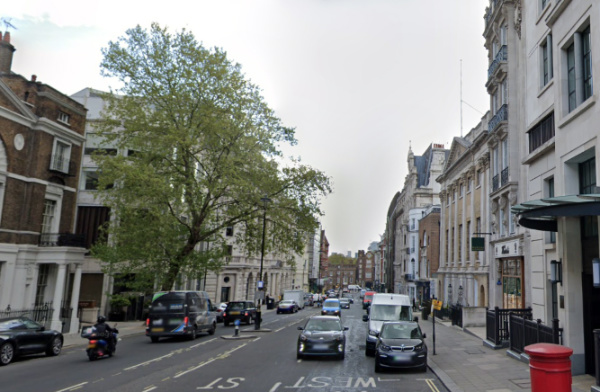
Looking south down St James’s Street. PICTURE: Via Google Maps
As noted at the outset of this series, in his latter years Sir Christopher Wren retired to the property on Hampton Court Palace Green, a property he was granted after he was appointed Surveyor-General to King Charles II in 1669.
But he also still spent time in London and, no longer having access to Scotland Yard, he lodged at his son Christopher’s house in St James’s Street, off Piccadilly. In fact, it was in this property that Wren, having suffered a chill, died while sitting in a chair at the age of 91 on 25th February, 1723.
It’s been suggested that the house in which Wren died was on the west side of the street. There’s an apocryphal story that suggests Wren came to London to check up on his greatest work, St Paul’s Cathedral.
PICTURE: Robin Sones (licensed under CC BY-SA 2.0)
Sir Christopher Wren’s name is one which pops up in association with buildings all over London – some authentically so, others less so.
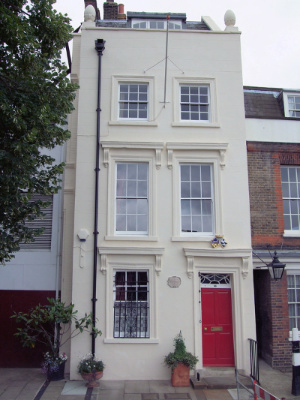
The house at 49 Bankside with the plaque to the left of the door. PICTURE: Jim Linwood (licensed under CC BY 2.0)
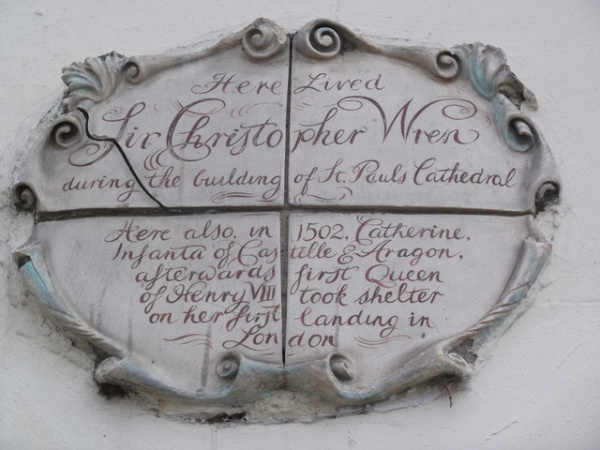
One of the more talked about locations where it can be physically seen is on a plaque attached to the front of a house overlooking the Thames at 49 Bankside, on the corner with Cardinal Cap Alley.
The plaque, written in a flowery script, claims that “Here lived Sir Christopher Wren during the building of St Pauls Cathedral” before going on to state that the property was also where in 1502, Catherine of Aragon, “took shelter” on first arriving in London before her marriage to King Henry VIII.
But author and historian Gillian Tyndall debunks the claim in her 2006 book The House by the Thames and the People who Lived There.
Tyndall explains that the property apparently dates from 1710 – St Paul’s was officially declared complete in 1711, leaving little cross-over (and certainly ruling out any residence by Queen Catherine who actually landed in Plymouth). She says that while it’s true the present house stands in the footprint of an older one, the house where Wren may have actually lodged during the 1670s is located further west along Bankside.
London Remembers notes that this property was apparently marked with an 18th century plaque commemorating Wren. But when that house was demolished in 1906, the plaque was saved and subsequently attached to a power station’s outer wall. When that was redeveloped in the post-war period, the plaque disappeared.
It was apparently that plaque which inspired the creation of the current plaque which was created by Major Malcolm Munthe, who acquired the property in 1945, and subsequently had the plaque made for the home’s exterior.
So it seems the plaque, despite what it says, does not commemorate a Wren residence (although perhaps it may commemorate the residence of Wren in the area). And, it’s been suggested, that while the plaque may not actually have marked a Wren home, its presence may have been enough to protect the building it adorns from threatened redevelopment in the mid-20th century.
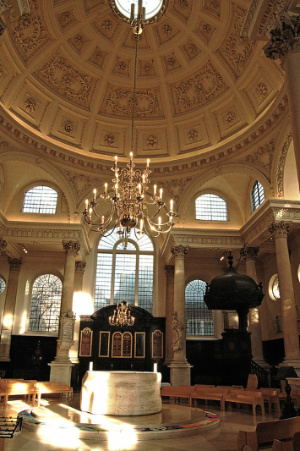
While this series is more focused on Sir Christopher Wren’s life rather than the many works he left behind, we’ve included the remarkable church of St Stephen Walbrook for a couple of reasons.
The first is that it is generally seen as being one of the more important church designs he created, particularly with regard to his later design of St Paul’s Cathedral, of which the St Stephen Walbrook dome is said to be a prototype.
The second is it’s claimed St Stephen Walbrook had a rather personal connection in that Wren lived at number 15 Walbrook during the period the church was being built, making it his parish church.
But the church was built between 1672 and 1679 and we know that from 1669 onwards – when Wren was appointed Surveyor-General of the King’s Works by King Charles II – Wren had a substantial home and office at Scotland Yard which was a perk of the office. Prior to that, he was largely based in Oxford and had rooms within Gresham College.
We’ve been unable to find any detailed reference to Wren living at 15 Walbrook either online or in the biographies we’ve read (we’ll keep searching).
But, his residency in Walbrook aside, it’s clear that St Stephen Walbrook – which has been described as the “pride of English architecture” – was a special church for Wren.
Designed to a rectangular form by Wren (and it’s certain this design was that of Wren himself), the church features a dome located toward the east end supported by eight Corinthian columns with the interior light by sizeable windows at the east end. A tower stands at the west end. The altar, a modern design by Henry Moore, sits under the centre of the dome.
As an interesting final note, it is recorded that Wren attended a dinner hosted by the church wardens – along with collaborator Robert Hooke – at the Swan Tavern in Old Fish Street on 4th March, 1673, as work for the church was underway.
WHERE: St Stephen Walbrook, 39 Walbrook (nearest tube stations are Bank and Cannon Street); WHEN: Opening times vary – check website details; COST: Free; WEBSITE: www.ststephenwalbrook.net.
Think of Sir ChristopherWren and chances are it’s St Paul’s Cathedral – perhaps the most famous building he designed – which comes to mind. Certainly not Westminster Abbey, which he did not.
Yet, aside from his time at the Westminster School as a child, Wren did have a long relationship with the royal church at Westminster. In March, 1698, he was appointed the Surveyor of the Fabric at Westminster Abbey, a post he held until his death (when he was succeeded by Sir Nicholas Hawksmoor).
Wren did some work on the building. Prior to being appointed surveyor he had undertaken some work on schoolmaster Dr Richard Busby’s house (Wren had been one of his students) in the Little Cloister in 1683 (the house was destroyed during the Blitz in World War II).
Following his appointment, Wren did undertake a major restoration of the decayed stonework and roof of the church. He also approved designs by his deputy, William Dickinson, for the north front and an altarpiece which Wren had originally designed for the royal chapel at the Palace of Whitehall was given to the minster by Queen Anne (it was removed in the 19th century).
In 1713, Wren had also created designs for a series of works at the abbey which included the addition of a central tower and spire at the abbey and the completion of the west front which were never realised and which were shelved after his death (the wooden model for the tower and spire is located in Queen’s Diamond Jubilee Galleries, along with a pair of wooden obelisks he designed for the entrance to the Quire).
While there’s no memorial to him in the Abbey, Wren’s image can be seen in the lower right section of a memorial window in the north choir aisle dedicated to 19th century engineer Robert Stephenson while his coat of arms is shown along with numerous others in some post-war glass windows in the Chapter House.
WHERE: Westminster Abbey (nearest Tube stations are Westminster and St James’s Park); WHEN: Times vary – see the website for details; COST: £29 adults/£26 concession/£13 children (family rates available); WEBSITE: www.westminster-abbey.org.
Sir Christopher Wren was apparently a frequent visitor to London’s burgeoning coffee houses in the late 17th and early 18th centuries.
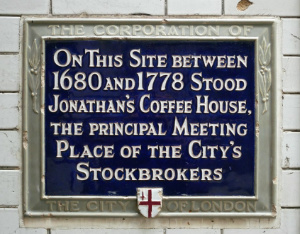
A plaque in the City of London marking the former site of Jonathan’s Coffee House in Exchange Alley. PICTURE: Ethan Doyle White (licensed under CC BY-SA 4.0)
Wren apparently started visiting coffee houses during his time in Oxford (the first in England is said to have opened there in 1652; the first in London – Pasqua Roseé’s premises st Michael’s Alley off Cornhill – opened late that same year) and continued to do so in London.
While it’s hard to pin down those he preferred, he reportedly met Robert Hooke at Man’s Coffee House in Charing Cross. The premises was apparently frequented by stockjobbers.
Wren was in good company attending such premises – other luminaries known to have done so at the time include diarist and naval administrator Samuel Pepys, John Locke, Edmund Halley, John Dryden and Alexander Pope.
Among other prominent coffee houses at the time was Jonathan’s – where in, 1698, the London Stock Exchange was born – and Garraway’s Coffee House, both of them located in Exchange Alley, as well as Button’s in Covent Garden.
Described as “probably the most famous Gresham College professor in history”, Sir Christopher Wren was appointed professor of astronomy at the college in 1657.
Wren is believed to have been educated at the Westminster School before attending Wadham College in Oxford and graduating with a BA in 1651. An MA followed in 1653 and he was subsequently elected a fellow of All Soul’s College in Oxford.
Engraving of Gresham College in the City of London, looking east at the front onto Old Broad Street by George Vertue(1740). PICTURE: Public domain (via Wikipedia).
That was followed by the Gresham appointment with Wren giving his inaugural lecture in August of 1657. His tenure was somewhat interrupted when, following the resignation of Richard Cromwell in May, 1659, the college was occupied by the military (and Wren stayed in Oxford). He returned to London following the Restoration which culminated in King Charles II’s entry into London in May, 1660.
Wren left Gresham later that same year and four years later, in 1664, he was appointed Savilian professor of astronomy at Oxford – a position he held until his appointment surveyor of works to King Charles II.
Gresham College was established in 1597 under the terms of the will of Sir Thomas Gresham and was originally located in Sir Thomas’ former mansion on Bishopsgate. It was here that Wren – and other lecturers including Sir Robert Hooke – lectured.
In the mid-18th century, Gresham moved to the corner of Gresham and Basinghall Streets. In 1991, it again relocated – this time to the 14th century Barnard’s Inn Hall near Chancery Lane. The college today continues its founding tradition of providing free lectures (there’s now a considerable archive of these online).
There was a Corporation of the City of London plaque commemorating the original location of Gresham College in Old Broad Street but it’s apparently been removed.
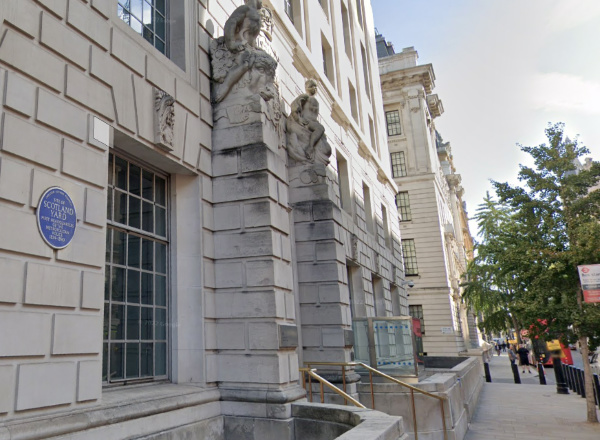
An English heritage Blue Plaque marking the location of Scotland Yard. PICTURE: Google Maps
OK, so there’s not much left to see here – at least not from Wren’s time. But it was in Scotland Yard that Wren spentmuch of his time after being appointed Surveyor-General of the King’s Works.
The yard, which was located just north of the kitchens serving the Palace of Whitehall and to the south of aristocratic mansions built along the Strand, was the location of the Office of Works. It served as a workplace for Wren and was also the location of his main residence between 1669 and 1718 when he lived in a house built by his predecessor in the office, John Denham.
According to a recent lecture by Professor Simon Thurley at Gresham College, newly identified plans of the house show the ground floor contained a hall, with a kitchen and scullery to the rear while on the first floor was a great dining room, a smaller private dining room, bedroom and dressing room. A floor above contains quarters for servants and possibly the nursery for his children. There were cellars below, two yards and a long narrow walled garden (he also had a stable nearby for his horses and carriage). Most importantly, a door connected the house directly with the Office of Works next door.
Said Thurley: “Although slightly further [from] the royal lodgings than some apartments, Wren’s house was amongst the largest and best appointed of all the houses allocated to senior courtiers.”
Wren lived here with his two wives – his first wife Faith Coghill died of smallpox here in 1675 and his second wife Jane Fitzwilliam died of tuberculosis in 1680 as well as their children – Christopher, William and Elizabeth. Both William and Elizabeth never left their father’s care and died before him.
The origins of the name of Scotland Yard – which has since become synonymous with the Metropolitan Police (now based at New Scotland Yard) – apparently come from the fact the site contained lodgings where the Kings of Scotland stayed when visiting London (the last Scottish royal to stay here did so before Wren’s time, apparently in the reign of King Henry VIII).
From the Stuart period onward, the site was used for government offices – as well as Wren, other famous residents included Inigo Jones, one of Wren’s predecessors as Surveyor of Works, and, during the Commonwealth, John Milton, while serving as Latin Secretary to Oliver Cromwell.
The location of Scotland Yard is these days commemorated in the name of Great Scotland Street and Scotland Place, just off Whitehall. There’s also an English Heritage Blue Plaque marking the site in Whitehall Place, although Wren doesn’t get a mention on that (it’s entirely devoted to the former police presence).
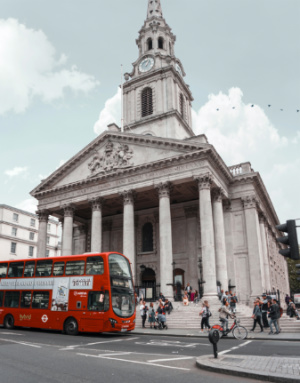
The current Church of St Martin-in-the-Fields. PICTURE: Javier Martinez/Unsplash
Not one of the many churches rebuilt by Wren after the Great Fire of 1666, St Martin-in-the-Fields, located just to the east of what is now Trafalgar Square, is special to the great architect for very personal reasons.
For it was in this church that his first wife Faith (nee Coghill) and his first son Gilbert were both buried, having died within a few years of each other, along with his second wife Jane (nee Fitzwilliam).
Wren married Faith Coghill, a childhood neighbour and daughter of Sir Thomas Coghill of Bletchingdon, at the age of 37 on 7th December, 1669, at the Temple Church (it’s been suggested it was his appointment that year as Surveyor of the King’s Works that may have provided him with the financial security he desired before marrying).
Their first child – Gilbert – was born in October, 1762. But he died at the age of just 18-months-old. A second child, Christopher (Wren the Younger), was born in February, 1675 (he would go on to live a full life and follow in his father’s footsteps as an architect).
Faith died of smallpox on 3rd September that same year. She was buried beneath the chancel of St Martin-in-the-Fields beside Gilbert.
On 24th February, 1677, Wren married again, this time to Jane Fitzwilliam, daughter of William FitzWilliam, 2nd Baron FitzWilliam, and Jane Perry, in a private ceremony believed to have been undertaken in the Chapel Royal at Whitehall. The couple had two children together – Jane in November that year and William in June, 1679.
Tragically, Jane also died after only a few years of marriage of tuberculosis on 4th October, 1680. She was buried alongside Wren’s first wife and child in St Martin-in-the-Fields.
Wren was not to marry again – and for his long 90 years of life, he was only in the end married for nine.
The medieval church of St Martins-in-the-Fields was altered several times during its lifetime – including being enlarged and beautified – but it’s this earlier church that Wren would have known. The current church was rebuilt to the designs of James Gibbs in the early 1720s and was completed in 1726 after Wren’s death in 1723.
Interestingly, the first wife of Wren’s son Christopher – Mary – was also buried in the church in 1712 and a monument to her can still be seen in the crypt.
This year marks the 300th anniversary of the death of Sir Christopher Wren (25th February, 1723), whose designs helped to transform post-Great Fire London.
In a new series we’re looking at 10 locations which help tell Wren’s story but while we’ve previously runs numerous articles focused on the many buildings he designed, in this series the focus is more on his personal life.
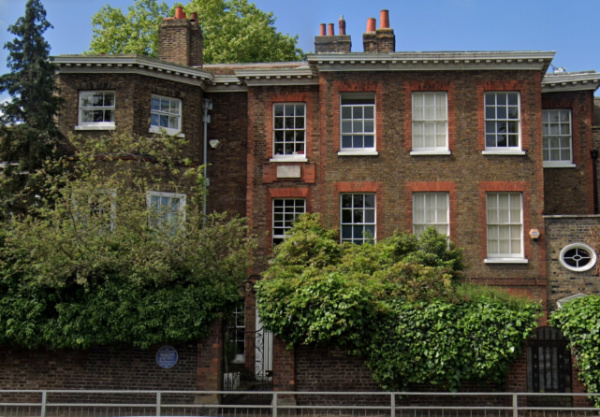
The Old Court House, East Molesey (the blue plaque can be seen on the front wall). PICTURE: Courtesy of Google Maps
First up, it’s one of the most well-known properties related to Wren’s life – the home in which he spent the latter years after his life just outside Hampton Court Palace.
Known as the Old Court House, Wren first came to live in the house after he was appointed Surveyor-General to King Charles II in 1669. His post brought with it lodgings at the royal palaces and at Hampton Court Palace, it was the Old Court House (the property had been built for in 1536 as a wood and plaster house; Wren’s immediate predecessor in the office, Sir John Denham, had rebuilt it partly in brick).
Then in 1708, Queen Anne granted him a 50-year lease on the property, apparently at least partly in lieu of overdue fees he was owed for the building of St Paul’s Cathedral. It’s also believed that the Queen had granted the lease on condition that Wren repair or rebuilt the property.
Wren, who had hitherto only lived intermittently at the property (presumably while working on Hampton Court Palace on the orders of King William III and Queen Mary II), made some major alterations to the property from 1710 onwards (it’s suggested this was done to the designs of Wren’s assistant William Dickinson).
He came to live here on a more permanent basis after he retired from the Office of Works in 1718 and remained here until his death in 1723 (although he didn’t die here – more on that later).
It’s said Wren, whose time as the Royal Surveyor-General spanned the reigns of six monarchs, spent his time here “free from worldly affairs”, choosing to and pass his days ‘in contemplation and studies”.
It was subsequently the home of Wren’s son Christopher (1645-1747) and his grandson Stephen (b 1772). It remained a grace and favour house associated with Hampton Court Palace until 1958.
The Grade II* brown and red brick property, which was combined with the house next door in the early 19th century and them divided off in 1960, is now in private ownership and there’s an English Heritage Blue Plaque on the outside wall mentioning Wren’s residence.
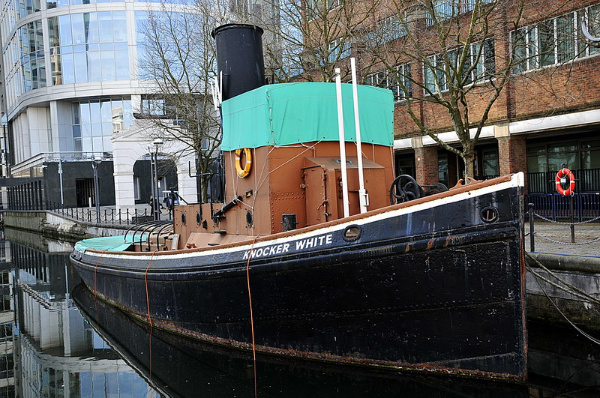
A Dutch-built tugboat, the Knocker White (originally called the steam tug Cairnrock) was built in 1924 by T Van Duijvendijk’s yard at Lekkerkek near Rotterdam, Netherlands for Harrisons (London) Lighterage Ltd.
Following the installation of a steam engine and boiler at Great Yarmouth, the steel-hulled Cairnrock – which was designed for general towage work and featured a drop-down funnel for travelling under bridges – was initially used to Tow the Harrisons’ floating steam-powered coal elevator Wotan around the lower reaches of the Thames.
In 1960, the 77 foot long tug was sold and passed through the hands of a couple of different owners and ended up, by 1962, in the hands of WE White and Sons. It was during this time that its name was changed (after a White family nickname), marine diesel engines installed and the steam engines and boilers removed.
The Knocker White continued in service, operating out of the WE White & Sons base at Hope Wharf in Rotherhithe, working on the Thames and the Solent until 1982.
In November of that year, it was sold for scrap to Todd (Breakers) Ltd of Dartford but, after being drawn to the attention of the Museum of London, was acquired by them in March 1985 as a classic example of an early tall-funnelled Thames steam tug.
In November, 2016, the Knocker White – along with the Varlet – was acquired by Trinity Buoy Wharf with the aim of restoring the vessel and putting on public display. It can be seen moored at the wharf today.
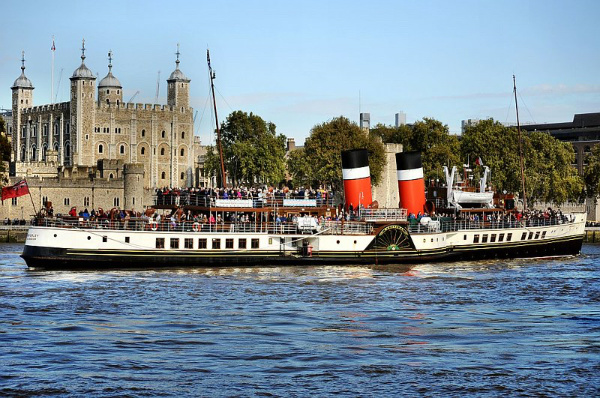
The paddle steamer Waverley on the Thames near the Tower of London. PICTURE: Robert Pittman (licensed under CC BY-ND 2.0)
A visitor rather than a permanent resident in London’s Thames, the Waverley is described as the world’s last seagoing paddle steamer.
The Waverley, which returns to London on 22nd September for a short season lasting into early October, was the last paddle steamer to be built for use on the River Clyde in Scotland and launched on 2nd October, 1946.
Named after Sir Walter Scott’s famous novel, her maiden voyage – on 16th June the following year – saw the Waverley cruise along what was to be her primary route for the next few years up Loch Long and Loch Goil to the villages of Lochgoilhead and Arrochar.
In 1952, the Waverley joined the British Railways Caledonian Steam Packet Co Clyde coast fleet, a role she remained until the company’s end in 1972. Briefly subsequently part of Caledonian MacBrayne’s fleet offering Clyde cruises and ferry duties, she was withdrawn from service in September, 1973, and in November the following year was “sold” for £1 to the Waverley Steam Navigation Co Ltd, which had been formed by the Paddle Steamer Preservation Society.
Following restoration work, the Waverley made her first visit south of the Scottish border to Liverpool and North Wales to celebrate the centenary of Llandudno Pier. Further visits south followed and in April, 1978, she sailed along the Thames for the first time.
From 1981 to 1983, the Waverley completed an annual circumnavigation of Great Britain and in 1985 visited the Isle of Man and Ireland for the first time.
A substantial refit and rebuild took place in the early 2000s returning the ship to her original 1947 livery, and in 2019 she was withdrawn from service so new boilers could be installed before being returned to service in 2020, offering excursions around the coast.
During its London season, the Waverley departs from Tower Pier and travels under Tower Bridge.
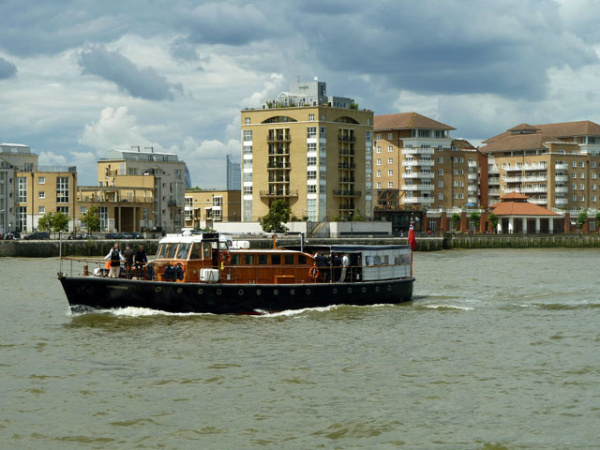
The MV Havengore. PICTURE: Robin Webster (licensed under CC BY-SA 2.0)
Still plying the waters of the Thames, the MV Havengore is perhaps most famous for having carried the coffin of Sir Winston Churchill on the River Thames as part of his state funeral in 1965.
The MV Havengore – named for a low-lying island off the coast of Essex – was originally constructed as a hydrographic survey launch for the Port of London Authority in 1956. As the PLA’s principal survey vessel and flagship, she was moored at Gravesend and tasked with recording changes to Thames bed and estuary. She became the first survey vessel in the UK to have a computer to record survey data.
The highpoint of her during her almost 40 years of service with the PLA came on 30th January, 1965, when she transported the body of Churchill from Tower Pier to Festival Pier. On the journey, she was saluted by flight of 16 fighter jets while dock cranes were made to bow as she passed (there’s a plaque on board commemorating her role in the funeral).
But the almost 26 metre long vessel also participated in other historic events including the river pageant to celebrate the Queen Elizabeth II’s Silver Jubilee in 1977 and, more recently, the flotilla formed to celebrate the Queen’s Diamond Jubilee in 2012 as well as the Thames tribute to the Queen’s long reign in 2015 and the Queen’s 90th birthday parade in 2016.
The MV Havengore was withdrawn from service in 1995 and sold after which she underwent restoration and refitting at the Chatham Historic Dockyard. The vessel was then used to provide excursions for underprivileged children on the Medway.
This red-painted vessel once served as a beacon at South Goodwin Sands off the Kentish coast but, now permanently moored at Trinity Buoy Wharf, has been converted into a recording studio.
The 550 tonne ship was built in 1939 by Philip and Sons of Dartmouth for Trinity House, a company established during the reign of King Henry VIII initially to regulate pilotage on the River Thames. It later established lighthouses and floating lightships and took over responsibility for all buoys in England. It currently maintains 65 automated lighthouses.
The steel-hulled vessel, one of three built to the same design (one, converted into a home, is now at Victoria Dock in Silvertown – and currently for sale with an asking price of £595,000 – and another in Rotterdam, The Netherlands), features a central light tower and originally had crew quarters.
It was mostly used to mark South Goodwin Sands but was also deployed to other locations including Inner Dowsing off the coast of Norfolk.
In the 1990s, it became the first light vessel in the UK to be converted to solar power to enable unmanned operation and underwent a complete refit in 1999.
It was taken out of service in 2003 and subsequently sold at auction by Trinity House. Initially bought by the Port Werburgh Marina on the Medway, it was later onsold to Ben Phillips who converted it to a floating music recording studio. Since 2008, it has been based at Trinity Buoy Wharf.
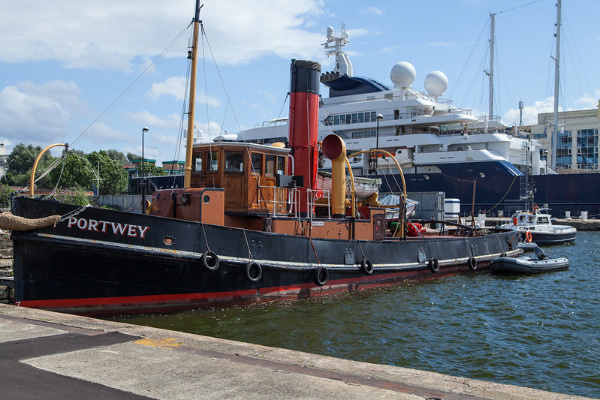
Ordered by the Portland & Weymouth Coaling Co Ltd, Portwey (the name comes from the company’s) was built by Harland & Wolff at Govan yard in Glasgow and launched on 10th August, 1927.
The 80 foot long vessel was based in Weymouth, Dorset, performed a range of tasks including carrying coal to steamers and being on call for any ship in distress requiring assistance or salvage. This included extinguishing a fire aboard the Danish timber-carrier Bodil in 1928, assisting ships like the cargo steamer Winslow (which had developed a list in heavy seas in 1932), and the Winchester Castle which had run aground in 1936, and even being involved in the search for a sunken submarine in 1932.
The Portwey was seconded by the Admiralty and moved to Dartmouth in Devon during World War II. Narrowly avoiding German bombs while in the harbour, during this time the tug was went to the assistance of ships attacked by the enemy. In 1944, she was assigned to US forces as they prepared for D-Day and her duties including clearing obstructions from the channel and supplying fresh water to naval vessels as well as, when a rehearsal for the landings went wrong at Slapton Sands, rescuing personnel and landing craft.
After the war, the Portwey resumed duties as a harbour tug including ferrying pilots and customs officers out into the Channel. In 1947, she helped put out a fire at the Queen’s Hotel in Dartmouth.
The Portwey was sold to the Falmouth Dock and Engineering Company in Cornwall in 1952. As well as rescuing the captain and first officer of the cargo ship Flying Enterprise, during this period she was involved in the construction of the Lizard Lifeboat Station in Cornwall, and a car ferry slipway at Holyhead in north Wales.
In 1967, with coal-fired steam tugs being replaced by diesel-engined ships, she was laid up to be scrapped. But it wasn’t the end for the Portwey, which was bought by Richard Dobson, the assistant harbour master at Dartmouth. Along with a group of friends, he returned her to working condition and during the 1960s and 1970s, she took part in many events on the River Dart and around Torbay.
In 1982, the Portwey joined the Maritime Trust’s Historic Ship Collection at St Katharine’s Dock where the newly formed Friends of Portwey continued with restoration and operation of the tug.
The Friends of Portwey became the Steam Tug Portwey Trust in 2000 and purchased the tug from the Maritime Trust, moving the vessel to West India Dock.
WHERE: Steam Tug Portwey, West India Dock (South Quay) (nearest DLR station is South Quay); WHEN: 2pm to 9pm Wednesdays; WEBSITE: www.stportwey.co.uk.
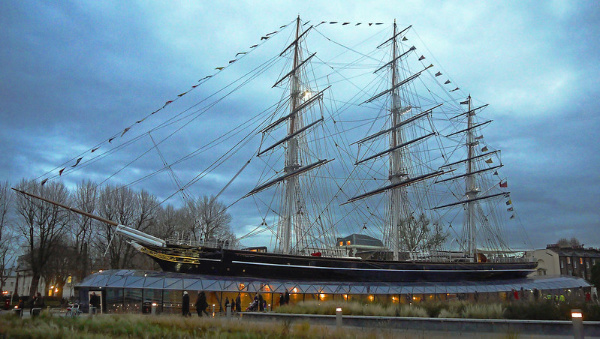
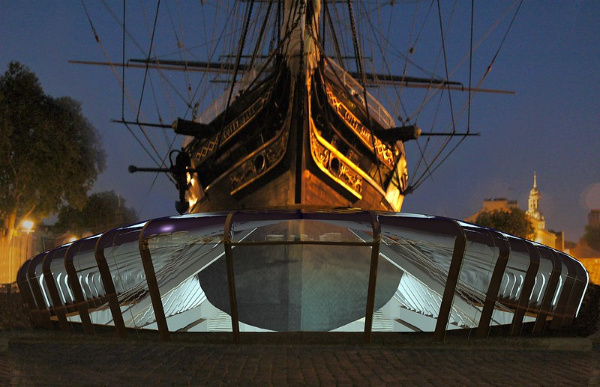
Almost destroyed in a May, 2007, fire, the Cutty Sark, the world’s last surviving 19th century tea clipper, is now a major international tourist attraction (although no longer in the Thames but on a dry dock beside the river).
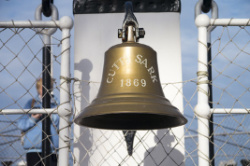
The Cutty Sark was built in Dumbarton, Scotland, in 1869, for shipping company Willis & Sons.
Designed by Hercules Linton specifically for the China tea trade (meaning with speed in mind), she cost some £16,150 and featured some 32,000 square feet of sails, a staggering 11 miles of rigging with a main mast standing 153 feet high and a hull sheathed in a copper and zinc alloy to prevent damage.
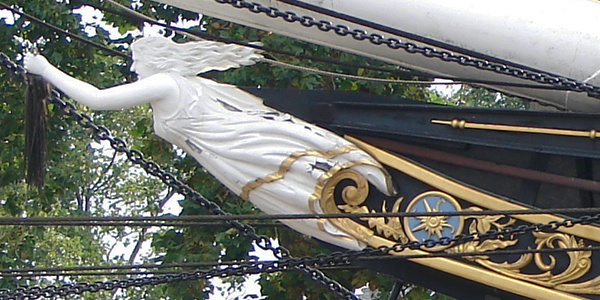
Her name was taken from a Robert Burns poem, Tam o’ Shanter, in which a witch is given the nick-name Cutty-sark because of the short undergarment – in 18th century Scots, a “cutty-sark” or “little shirt” – that she wore (the vessel’s figurehead is a representation of the witch).
On her maiden voyage, the Cutty Sark departed from London on 15th February, 1870, bound for Shanghai and carrying a general cargo including wine, spirits and beer and manufactured goods. Reaching its destination on 31st May, it then returned to London, arriving on 13th October laden with 1,305,812 lbs of tea.
It subsequently made another seven trips to China, collecting its last tea cargo in 1877. Unable to source further tea cargoes, the ship was then used to transport different cargoes to various destinations around the world including everything from coal and gunpowder, to jute, whiskey and buffalo horns.
There was a tragic episode aboard the ship in 1880 when the First Mate Sidney Smith killed seaman John Francis. Smith was confined by Captain James Wallace then helped him escape at Anger in Indonesia. The crew refused to work as a result and Wallace decided to continue the voyage with just six apprentices and four tradesmen but when the ship was becalmed in the Java Sea for three days, he committed suicide by jumping overboard. Wallaces was replaced by William Bruce but a later inquiry suspended him from service because of his incompetence.
While it was never the fastest ship on the tea trade (although it came close on return journey from Shanghai before a rudder mishap in 1872), it did establish itself between the mid-1880s and early 1890s as the fastest ship in the wool trade.
But with steamships starting to dominate the wool trade, in 1895, the Cutty Sark was sold to Portuguese firm J Ferreira & Co and, renamed the Ferreira, spent the next 20 years transporting cargoes between ports including Oporto, Rio, New Orleans and Lisbon.
Damaged during a storm in 1916, the clipper was subsequently converted into a barquentine in Cape Town, South Africa, and then sold in 1920 to Wilfred Dowman, a retired windjammer skipper and owner of the training ship Lady of Avenel.
The Cutty Sark’s figurehead. PICTURE: Sanba38 (licensed under CC BY-SA 3.0)
Her former name now restored, Dowman set about restoring the ship – now docked at Falmouth in Cornwell – back to being a tea clipper and using her as a cadet training ship.
Following Dowman’s death in 1936, the Cutty Sark was given to the Incorporated Thames Nautical Training College, Greenhithe, Kent, where she was used as an auxiliary vessel for the cadet training ship HMS Worcester.
The Cutty Sark was sent to London and moored in the Thames for the 1951 Festival of Britain before returning to Greenhithe.
The deteriorating state of the ship led to the formation of The Cutty Sark Society and in a ceremony held just before the coronation of Queen Elizabeth II, Prince Philip, patron of the society, took possession of the ship on its behalf.
In December, 1954, the ship was towed to a specially constructed dry dock at Greenwich and after three years of restoration work was opened to the public by Queen Elizabeth II in 1957.
The ship has remained there ever since. In November 2006, the ship’s rig was dismantled in preparation for a restoration project but a fire broke out aboard the ship on 21st May, 2007, and almost destroyed it.
Following a major restoration and development project which saw the lower part of the ship, from the waterline down, encased in glass, it was officially reopened by Queen Elizabeth II and Prince Philip on 25th April, 2012. It is now under the operational management of Royal Museums Greenwich.
WHERE: The Cutty Sark, King William Walk, Greenwich (nearest DLR is Cutty Sark; nearest overground stations are Greenwich and Maze Hill); WHEN: Daily 10am to 5pm; COST: £18 adults; £9 children; WEBSITE: www.rmg.co.uk/cuttysark.
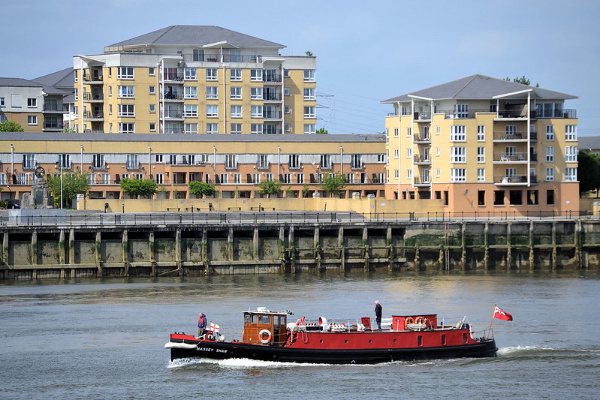
The Massey Shaw in The Thames in 2015. PICTURE: R~P~M (licensed under CC BY-NC-ND 2.0)
Moored at West India Dock, the Massey Shaw is a former London Fire Brigade fireboat.
The fireboat was constructed in 1935 for a cost of £18,000 by the J Samuel White company in Cowes on the Isle of Wight. Named for Sir Eyre Massey Shaw – the first Chief Officer of what was then named the Metropolitan Fire Brigade, the vessel was designed to London County Council specifications with a deliberately low profile so it could fit under the Thames bridges in all tides.
The vessel, which was was powered by two eight cylinder diesel engines and featured a main deck monitor as well as eight deck outlets (and a wheelhouse which was added later), soon proved its worth, playing an important role in saving what the press said was a million pounds worth of stock at a large warehouse fire on Colonial Wharf.
During World War II, the Massey Shaw took part in Operation Dynamo, forming part of the small boat flotilla which evacuated British troops from the beach at Dunkirk. She ferried more than 500 troops to a larger ship offshore and transported almost 100 back to England and it’s believed she was the last of the small boats to leave Dunkirk harbour (rescuing survivors from a French vessel which struck a mine along the way).
Back in London, Massey Shaw performed a critical role during the Blitz, pumping large quantities of Thames water to douse fires along the city’s waterfront.
It remained in service until the early 1970s, although it had operated as a reserve boat since 1960 with newer models taking over frontline duties.
Decommissioned in 1971, the Massey Shaw was found abandoned 10 years later at St Katharine Dock by a group who went on to found The Massey Shaw Fireboat Society with a view to preserving the vessel. They were granted a 50 year lease on the vessel.
In 1985, the Massey Shaw joined the Association of Dunkirk Little Ships on their return to Dunkirk for the first time since 1965 and two years later, she attended the centenary of Sir Eyre Massey Shaw’s review of 1000 firemen at Oxford.
In 1990 the Massey Shaw was sunk close to the London Fire Brigade headquarters at Lambeth but was subsequently salvaged and the following year, after restoration work, joined the 50th anniversary return trip to Dunkirk.
The society gained full ownership of Massey Shaw in 2002 and restoration work was carried out by the TV programme Salvage Squad (a second appearance on the show and more work followed two years later).
In 2008, a £500,000 Heritage Lottery Grant was used to fund the restoration of the vessel at Gloucester docks. She returned to London by road in 2013 where the restoration was completed and in 2015 was officially launched back on the River Thames with an event at the Westminster Boating Base.
Later that year she participated in another “little ships” armada to Dunkirk, this time commemorating the 75th anniversary of the evacuation. Massey Shaw has since taken part in other events including celebrations marking Queen Elizabeth II’s record as longest reigning monarch in 2015.
The vessel is now moored at the eastern end of West India Docks on the Isle of Dogs.
While Massey Shaw did appear in the 1958 film, Dunkirk, recapturing its role as one of the “little ships”, it did not appear in the 2017 film of the same name.
WHERE: Massey Shaw, West India Dock, Poplar (nearest DLR station is South Quay; nearest Tube station is Canary Wharf); WHEN: Between March and November, from 11am to 3pm daily (check website for details); WEBSITE: https://masseyshaw.org.





 Exploring London