10 historic vessels in London’s Thames…1. PS Tattershall Castle…

HMS Belfast is one of London’s star tourist sites. But what are some of the other vessels moored in the Thames? In this series, we’re taking a look at the history behind 10 other vessels, starting with PS Tattershall Castle.

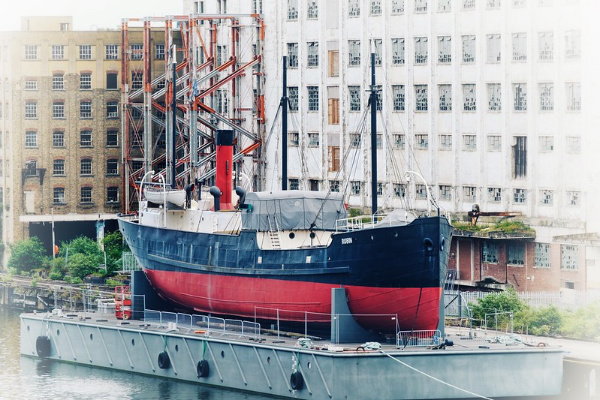
The PS Tattershall Castle in 2017. PICTURE: Tony Hisgett (licensed under CC BY 2.0)

Now a floating restaurant moored off Victoria Embankment, the steam-driven, steel-hulled PS Tattershall Castle was constructed by the West Hartlepool-based company William Gray & Company as a ferry. Its name comes from a castle in Lincolnshire built in the first half of the 15th century/

Launched on 25th September, 1934, with a license to carry 1,000 people, the 209 foot-long ferry was one of three sister ships – the others being the PS Wingfield Castle (now a museum ship in Hartlepool) and the PS Lincoln Castle – which were built to transport passengers along the Humber between Kingston upon Hull, in Yorkshire, and New Holland, in Lincolnshire. It could make eight trips a day and could carry vehicles and livestock.

World War II broke out not long after her launch and the ferry was used to transport troops and supplies along the Humber. Due to the heavy fogs on the river, the Tattershall Castle became one of the first civilian vessels to be equipped with radar.

Following the war and the 1948 nationalisation of the railways, the PS Tattershall Castle became part of part of British Rail’s Sealink service. In 1973, the vessel, with repairs deemed too costly, was retired from service.

Subsequently towed to London, the PS Tattershall Castle was converted into a floating art gallery which was formally opened by the Lord Mayor of London on 27th February, 1975.

In 1981, the former ferry was acquired by the Chef & Brewer Group. After some repairs on the River Medway, she was opened in 1982 as a bar restaurant.

There have been several refits since, the most recent being in 2015, when the former ferry was returned to Hull for some £1.5 million work to be carried out. The former ferry is typically moored off Victoria Embankment opposite the London Eye.

For bookings, head to www.thetattershallcastle.co.uk.

Four sites related to royal coronations in London – 3. Westminster Abbey…

Westminster Abbey has been centre-stage at coronations since at least the Norman Conquest.

William the Conqueror set the precedent for coronations at the abbey when he decided not to get crowned at Winchester Cathedral (where Edward the Confessor had been crowned) and instead chose to be crowned at the minster built by Edward the Confessor (there is some suggestion King Harold Godwinson, the last Saxon King, was crowned at Westminster Abbey before the Conquest but no documentary evidence exists for this).

William the Conqueror’s coronation was held on Christmas Day, 1066, and since then some 39 coronations have been carried out (King Charles III’s will be the 40th).

A view of the pulpit and to the right the Cosmati Pavement and behind it the High Altar inside Westminster Abbey. PICTURE: PJ photography/Shutterstock

Arrangements for the coronation ceremony are the responsibility of the Earl Marshal and the coronation committee but the abbey’s dean acts as a liaison with the sovereign and assists the Archbishop of Canterbury who is usually the bishop who crowns the monarch.

Since the late 14th century, the service has largely followed that laid down in the Liber Regalis (Royal Book), an illuminated manuscript created in around 1390.

Since 1308, the heart of the coronation service has taken place on the Cosmati Pavement, located just before the High Altar, in what is known as the “Coronation Theatre”.

Having processed into the abbey and been acclaimed or “recognised” as sovereign by those present, the monarch then makes promises to God and the people they rule in what is known as the Oath, before being presented with a Bible.

Then, seated in the Coronation Chair, the monarch is anointed with holy oil while a canopy is held over them to shield this most sacred part of the ceremony from the eyes of those gathered.

Still seated, the monarch is then invested with the coronation regalia, including the Sovereign’s Ring, the Sovereign’s Orb, the Sceptre with Cross and the Sceptre with Dove, before St Edward’s Crown is brought from the altar and placed on the monarch’s head (it’s only since that coronation of King James I in 1603 that both the anointing and the crowning are carried out while the monarch is seated on the Coronation Chair – before that, the chair was used for only one aspect of the ceremony).

The monarch then moves to a throne and receives the homage of the royal princes and senior peers. It’s at this point that the coronation of a Queen Consort typically takes place in a simpler form of the ceremony.

The monarch then retires into St Edward’s Chapel where they dress on a purple robe known as the Imperial State Robe or Robe of Estate as well as the Imperial State Crown before processing back out through the abbey.

Other elements of the coronation include music which since the Coronation of King George II has included the George Fredric Handel anthem, Zadok the Priest. The introit I was glad has been sung at every coronation since that of King Charles I in February, 1626.

The abbey is currently closed in preparation for the Coronation of King Charles III. It reopens on Monday, 8th May. The Coronation Theatre will remain in place for visitors to see until 13th May.

WHERE: Westminster Abbey, Westminster (nearest Tube station is Westminster or St James’s Park); WHEN: Open to tourists everyday except Sunday  (times vary so check the website); COST: £27 an adult/£24 for seniors (65+)/£12 a child (6-17 years); WEBSITE: www.westminster-abbey.org.

Four sites related to royal coronations in London – 1. The Jewel House…

In the lead-up to the coronation of King Charles III and Queen Consort Camilla on 6th May, we’re taking a look at sites in London which have played an important role in coronations past (and, mostly, in this coronation as well).

First up, it’s the Tower of London’s Jewel House which is linked to the coronation through the role it plays in housing the Crown Jewels and, more specifically, the Coronation Regalia.

The entrance to the Jewel House in the Waterloo Block. PICTURE: Dave Campbell (licensed under CC BY-NC-ND 2.0)

The centrepiece of the Crown Jewels is St Edward’s Crown, with which King Charles will be crowned in Westminster Abbey.

The crown, which has already been removed from the Tower of London so it could be resized for the occasion, is made from 22 carat gold and adorned with some 444 precious and semi-precious gems. Named for St Edward the Confessor, it dates from 1661 when it was made for the coronation of King Charles II and replaces an earlier version melted down after Parliament abolished the monarchy in 1649.

The crown was subsequently used in 1689 in the coronation of joint monarchs King William III and Queen Mary II and then not used again until 1911 when as used to crown King George V. It was also used to crown King George VI and Queen Elizabeth II in 1953.

St Edward’s Crown is not the only crown that will be used in the coronation ceremony – the King will also wear the Imperial State Crown at the end of the service.

Made by Garrard and Company for the coronation of King George VI in 1937 (replacing a crown made for Queen Victoria in 1838), it features the Black Prince’s Ruby in the front – said to have been a gift to Edward, the Black Prince, in 1357 from the King of Castile.

Further gems in the crown include the Stuart Sapphire, the Cullinan II Diamond and St Edward’s Sapphire, said to have been worn in a ring by St Edward the Confessor and found in his tomb in 1163.

Among other items which will be used in the coronation are the Sovereign’s Sceptre with Cross, the Sovereign’s Orb, and the Coronation Spoon.

The sceptre was made for King Charles II and now features the world’s largest diamond, the Cullinan Diamond, which was added to it in 1911. The orb was also made for King Charles II’s coronation and is topped with a cross.

The spoon, meanwhile, is one of the oldest items in the Crown Jewels, dating from the 12th century. It is used for anointing the new sovereign with holy oil – which comes from the Church of the Holy Sepulchre in Jerusalem – during the ceremony. It survived the abolition of the monarchy after it was purchased by a member of King Charles I’s wardrobe and later returned to King Charles II after the monarchy. The oil is held in a golden vessel known as an ampulla which is shaped like an eagle.

Other items to be used in the coronation are a series of swords – among them the Sword of State, the Sword of Temporal Justice, the Sword of Spiritual Justice, and the Sword of Mercy (this has its tip blunted to represent the Sovereign’s mercy).

The regalia was housed at Westminster Abbey until 1649. They have been kept at the Tower of London since the Restoration (even surviving a theft attempt by Colonel Thomas Blood and accomplices in 1671).

The Crown Jewels, which are now held under armed guard, have been housed in several different locations during their time at the Tower of London including in the Martin Tower and the Wakefield Tower. They were moved into a subterranean vault in the western end of the Waterloo Block (formerly the Waterloo Barracks), now known as the Jewel House (and not to be confused with The Jewel Tower in Westminster), in 1967.

A new Jewel House was opened by Queen Elizabeth II on the ground floor of the former barracks in 1994. The exhibit was revamped in 2012 and following King Charles III’s coronation, the display is again being transformed with a new exhibition exploring the origins of some of the objects for the first time.

WHERE: The Jewel House, Tower of London (nearest Tube station Tower Hill); WHEN: 9am to 4.30pm (last admission), Tuesday to Saturday, 10am to 4.30pm (last admission) Sunday to Monday; COST: £29.90 adults; £14.90 children 5 to 15; £24 concessions (family tickets available; discounts for online purchases/memberships); WEBSITE: https://www.hrp.org.uk/tower-of-london/whats-on/the-crown-jewels/.

10 historic London homes that are now museums – A recap…

Before we start our next Wednesday series, here’s a look back at our last…

1. Benjamin Franklin House…

2. Carlyle’s House…

3. Keats House…

4. Leighton House Museum…

5. The Freud Museum…

6. Hogarth’s House…

7. Sambourne House…

8. Queen Charlotte’s Cottage…

9. Turner’s House…

10. Flamsteed House…

10 historic London homes that are now museums…10. Flamsteed House…

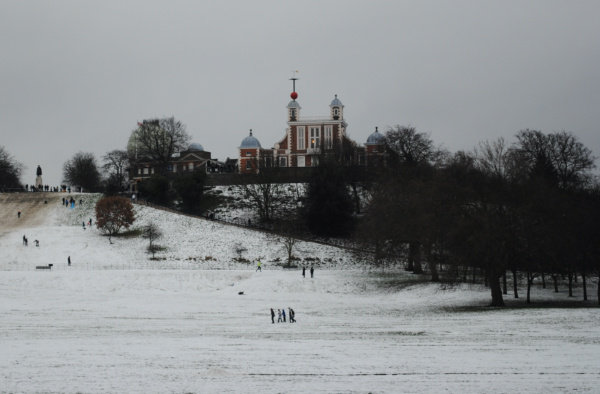
Flamsteed House from Greenwich Park. PICTURE: David Adams

Located at the heart of what is now known as the Old Royal Observatory in Greenwich is a residence, built for the first Astronomer Royal John Flamsteed and subsequently used by his successors to the post.

The property was built at the behest of King Charles II after he appointed Flamsteed to the post in March, 1675. Flamsteed, who initially worked out of the Queen’s House below, laid the foundation stone for the new property on 16th August that year.

Designed by Sir Christopher Wren and built under the supervision of Robert Hooke, the building was constructed on the foundations of the previous building on the site – known variously as Duke Humphrey’s Tower or Greenwich Castle) – and used bricks from spare stock at Tilbury Fort, and wood, iron and lead from a demolished gatehouse at the Tower of London.

Costing some £520, the three story property featured a large hall and parlour on the ground floor, a bedroom and study for the then-single Flamsteed, a basement kitchen and “astronomer rooms” while on the floor above was a single large, octagonal room, known initially as the “Great Room” and later as the “Octagon. Room”, featuring a series of tall windows through which Flamstead could conduct his observations of the heavens.

A telescope was mounted on the roof and two summerhouses, one of which contained Flamsteed’s camera obscura, were built on either side. Other buildings on the site during Flamsteed’s time included the adjoining Quadrant House and Sextant House (so-named for the equipment they housed).

The original property was extended several times and a series of additional buildings were also added to the site including what is now known as the Meridian Building (which incorporates not only Flamsteed’s Sextant House and Quadrant House but subsequent additions including apartments for an assistant, fireproof record rooms and domes to house equipment including the Telescope Dome.

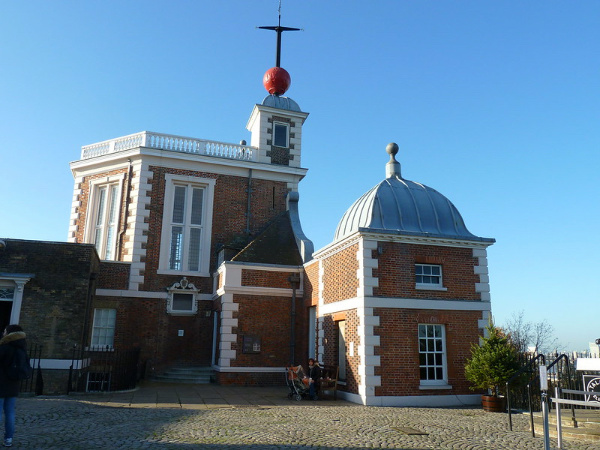
Flamsteed House. PICTURE: givingnot@rocketmail.com (licensed under CC BY-NC 2.0)

In 1946, the scientific work of the observatory was relocated to Herstmonceux in Sussex and the complex came under the management of the National Maritime Museum. In 1960, Flamsteed House was reopened as part of the museum; other buildings later followed suit.

The site was renovated in the early 1990s and reopened to the public as a museum in 1993.

These days Flamsteed House hosts displays about its construction as well as what life was like for those who lived there. Wren’s Octagon Room, which houses a collection of timepieces and astronomical instruments, remains a highlight.

Flamsteed House is now topped by a time-ball which was installed in 1919 (replacing an earlier one which was installed in 1833) and drops each day at 1pm.

WHERE: Flamsteed House, Royal Observatory Greenwich (nearest stations are Cutty Sark DLR and Greenwich and Maze Hill Stations); WHEN: 10am to 5pm daily; COST: £16 adults/£10 under 25s/students/£8 children; WEBSITE: www.rmg.co.uk/royal-observatory/attractions/flamsteed-house.

10 historic London homes that are now museums…9. Turner’s House…

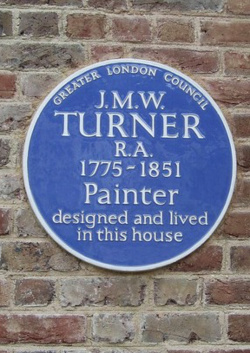
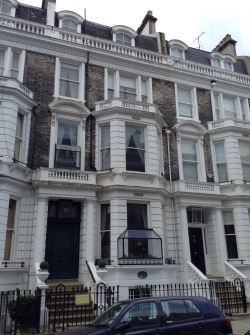
PICTURES: Jim Linwood (licensed under CC BY 2.0)

Located close to the River Thames in south-west London, Sandycombe Lodge was designed and built by the artist JMW Turner as a country retreat.

The Twickenham property, which was constructed in 1812-13 on land the famed “painter of light” had bought six years earlier, also provided a home for Turner’s father, ‘Old William’, who was a retired Covent Garden barber and wigmaker. Old William would tend the garden and keep the house when Joseph Mallord William Turner, who is best known for his expressive landscapes and marine paintings, wasn’t present.

The finished property featured a large sitting room overlooking the expansive garden. It was initially known as Solus Lodge and the name later changed to Sandycombe.

Turner would use the home as a base for sketching and fishing trips. He painted many scenes of local landscapes including, notably, England: Richmond Hill on the Prince Regent’s Birthday in 1819.

Among those who visited Turner at the property was his friend and fishing companion, Sir John Soane (his influence can be seen on the home’s design in features such as the use of arches inside and the skylight above the stairs).

Turner, who also had a property in Cheyne Walk, Chelsea, where he died in 1851, only had the house for 13 years – with his father’s health declining and his own touring schedule which meant he wasn’t able to spend as much time at the property as he would have liked, Turner sold Sandycombe in 1826 to his neighbour Joseph Todd. Todd, the owner of Twickenham Park, enlarged the villa and rented it out.

It subsequently passed through numerous hands (the large grounds around gradually diminishing).

Used as a factory for making goggles in World War II, it was in a poor state when purchased by Professor Harold Livermore and his wife Ann in 1947. In the 1950s, they secured a Grade II*-listing for the property and later set up the The Sandycombe Lodge Trust, now Turner’s House Trust, in 2005.

On Livermore’s death in 2010 at the age of 95, the trust became the owner of Sandycombe. Following a significant restoration which aimed to take the house back to Turner’s original designs and which was completed in 2017, it opened to the public as a museum.

Displayed in the house are some of Turner’s sketches as well as model ships he used in creating his art. A ‘speaking clock’ captures recollections of friends and Old William is brought to life digitally in the basement. What remains of the gardens have also been restored.

The house features an English Heritage Blue Plaque.

WHERE: Sandycombe Lodge, 40 Sandycoombe Road, St Margarets, Twickenham (nearest rail is St Margarets; nearest Tube station is Richmond); WHEN: 12pm to 4pm Wednesday to Sunday (until 2nd July); COST: £8 adults/£3 child (3 to 15 years)/£17 family; WEBSITE: https://turnershouse.org.

10 historic London homes that are now museums…8. Queen Charlotte’s Cottage…

PICTURE: Maureen Barlin (licensed under CC BY-NC-ND 2.0)

A confession to begin – this property, located in Kew Gardens, was never actually a residence but instead was built as a country day retreat for the family of King George III at the behest of his wife Queen Charlotte.

The cottage, which features a thatched roof and half-timbered walls and dates from around 1772, is known as a cottage orné (decorated cottage).

Located in what’s described as “one of London’s finest bluebell woods” with parts of it more than 300-years-old, it was designed to be a place where the Queen and her growing family (the King and Queen would have 15 children) could enjoy picnics or take tea while on walks through the gardens during their summers at Kew.

Inside, the ground floor of the premises features two halls – one for the royal family on the left and another for servants on the right, each of which features a staircase leading to the first floor. In the centre of the ground floor is the Print Room, a small room hung with more than 150 satirical engravings including works by the famed James Gillray. There’s also a small kitchen.

On the upper floor is the Picnic Room which features two expansive recycled 17th century windows looking out to the garden and wall and roof paintings featuring trailing nasturtiums and convolvulus to give the appearance of a bower. The latter are thought to have been the work of Princess Elizabeth, generally viewed as the most artistic of King George III’s children.

Behind the cottage was a large paddock which was used to contain a growing menagerie of animals, no doubt to the delight of the royal children. Initially the occupants were Tartarian pheasants and oriental cattle but later it also housed a now extinct quagga (an animal similar to a zebra) and some of the first kangaroos to arrive in Britain (these were bred by the early 19th century, there were up to 18 of them). In 1806, the gardener was instructed to turn the paddock into a flower garden.

King George III was apparently fond of the cottage but he was last at Kew in 1806. It was used in 1818 following the double wedding of his sons, the Duke of Clarence (who became King William IV) and Edward, the Duke of Kent (father of Queen Victoria).

Queen Victoria rarely visited the cottage but had it maintained by a housekeeper. In 1889, the Queen gave the cottage to the public to commemorate her Diamond Jubilee.

The Grade II* cottage is these days managed by Historic Royal Palaces.

WHERE: Queen Charlotte’s Cottage, the south-west corner of, Kew Gardens (nearest Tube station is Kew Gardens); WHEN: Cottage is open from 4th April from 11.30am to 3.30pm on weekends and bank holidays; COST: (entry to Kew Gardens) £21.50 adults/£10 students/children £5 (discounts apply for advance bookings); WEBSITE: www.kew.org.

10 historic London homes that are now museums…7. Sambourne House…

The former home of famed Victorian illustrator and photographer Edward Linley Sambourne, this property at 18 Stafford Terrace in Kensington has been preserved as a museum.

Sambourne, famed for, among other things, the cartoons he produced for Punch magazine, moved into the property in 1875, shortly after his marriage to Marion Herapath in 1874, and the couple, who would have two children – Roy and Maud – lived there for the rest of their lives.

PICTURE: Jhsteel (licensed under CC BY-SA 3.0)

After moving in, Linley, inspired by the grand houses of his artistic friends in the so-called Holland Park circle such as Nick Fildes, Marcus Stone and Colin Hunter, set about redecorating the property in what was then the popular Aesthetic style. He installed stained glass windows, Morris & Co wallpapers and Chinese ceramic vases and over the next 35 years purchased ceramics and furnishings specifically for the property.

While Sambourne adopted many of Aesthetic elements in his decorative scheme such as the stylised motifs inspired by nature and the muted colour palette, he didn’t particularly follow the style’s call for restraint and the house quickly became home to a growing collection of furnishings and objects (in fact an inventory take in 1877, just two years after the couple moved in, shows the home already contained more than 50 vases, 70 chairs and around 700 framed pictures). 

Sambourne, who was said to have been “skilled at making a great show on a limited budget”, couldn’t afford to create a purpose-built studio and worked in various parts of the house, initially in the morning room, which he had extended to meet his needs, and later in the upstairs drawing room. After their daughter Maud married and left the property, he converted the former nursery on the top floor into a studio.

After the deaths of Linley in 1910 and Marion in 1914, their bachelor son Roy moved in and lived there until his own death in 1946. The house then passed to Maud (now Maud Messel), although she didn’t live there, and on her death passed to her daughter Anne Messel.

Anne had married Ronald Armstrong Jones in 1925 and then, following a divorce, Michael Parsons, sixth Earl of Rosse in 1935, giving her the title of Countess of Rosse. She inherited the house in 1960 – the same year her son Antony married Princess Margaret and received the title of Earl of Snowdon.

Lady Rosse, who had proposed the house be preserved as it had been in Linley’s day, subsequently negotiated the sale of the property to the Greater London Council in 1980 and in turn it was leased to the Victorian Society, which she had co-founded in 1957. It was subsequently opened as a museum.

In 1989, after the Greater London Council was abolished, ownership of the house transferred to the Royal Borough of Kensington and Chelsea (the lease to the Victorian Society meanwhile, ended in 2000). In 2022, the house, now Grade II*-listed, was re-opened to the public after a significant renovation and refurbishment project.

Alongside the decor, furnishings and ceramics, the house displays a number of the cartoons Sambourne drew for Punch as well as drawings he did for other projects, such as Charles Kingsley’s The Water Babies, and some of his collection of more than 30,000 photographs used to aid his production of cartoons (not all of which apparently are suitable for public consumption). Sambourne’s “detective camera” which allowed him to photograph subjects surreptitiously is also there.

WHERE: Sambourne House, 18 Stafford Terrace (nearest Tube stations are Kensington (Olympia) and High Street Kensington); WHEN: 10am to 5:30pm, Wednesday to Sunday; COST: £11 adult/£9 concession/£5 child (six to 18-years-old/five and under free); WEBSITE: www.rbkc.gov.uk/museums/sambourne-house

10 historic London homes that are now museums…6. Hogarth’s House…

Described as the “father of British painting”, 18th century artist William Hogarth bought this property in Chiswick at the height of his fame in 1749.

PICTURE: Patche99z/Public Domain

The property, which had been built between 1713 and 1717 and had previously been the country property of a pastor and his family, then located in what was a rural area and served as the Hogarths country home (they had an inner London home in Leicester Fields).

Hogarth extended the home and had a studio installed above a (now lost) coach house in the rear of the garden. As well as his wife Jane, occupants included Hogarth’s sister Anne and his mother-in-law.

Following Hogarth’s death in 1764 (Hogarth, who actually died in the Leicester Fields property, is buried in the nearby St Nicholas Church), Jane continued to live at the property and along with her cousin Mary Lewis, ran a business selling prints of her husband’s works. Mary inherited the house when Jane died in 1789 and remained there until her own death in 1808.

The house, which features three stories and an attic, subsequently passed through various hands including, from 1814 to 1833, Rev Henry Francis Cary, who translated Dante’s Divine Comedy (and counted literary luminaries such as Samuel Taylor Coleridge and Charles Lamb as friends). It was sold for redevelopment in 1901 and, following a failed campaign by artists and writers to buy the house, it was purchased by Chiswick resident, Lieutenant-Colonel Robert William Shipway.

Drawing on the help of the architect Frederick William Peel and Hogarth’s biographer, Henry Austin Dobson, he had the house restored and turned into a museum, installing a collection of the artist’s works and commissioning replica furniture based on images in Hogarth’s prints (he even personally took photographs for a guidebook).

The house opened to the public in 1904 and in 1909 Shipway gave the house to Middlesex County Council. Its ownership passed to Hounslow Council when Middlesex County Council was abolished in 1965.

It was damaged by in September, 1940, during World War II after a parachute mine detonated nearby but was repaired and reopened in 1951. A single storey extension to the property was rebuilt at the time to provide a space for exhibitions.

The now-Grade I-listed property’s interior was refurbished for the tercentenary of Hogarth’s birth in 1997 and again in 2011. A further project in 2020 known as the Mulberry Garden Project – funded by the National Lottery Heritage Fund – added the Weston Studio for learning and activities, but also re-landscaped and reinterpreted the garden to highlight historic planting and themes. 

The house and garden are currently managed by London Borough of Hounslow.

Inside, the house continues to show Hogarth’s artistic output including such famous engraving series as A Harlot’s ProgressA Rake’s Progress and Marriage à-la-mode. The house also contains some of the replica furniture commissioned by Shipway.

In the garden is a Mulberry tree believed to be the last survivor of an orchard first established on the site in the 1670s.

There’s a statue of Hogarth and his famous pug dog, Trump, located in Chiswick High Road.

WHERE: Hogarth’s House, Hogarth Lane, Great West Road, Chiswick (nearest Tube station is Turnham Green while nearest Overground is Chiswick Station); WHEN: 12pm to 5pm Tuesday to Sunday and Bank Holiday Mondays; COST: Free; WEBSITE: https://hogarthshouse.org.

10 historic London homes that are now museums…5. The Freud Museum…

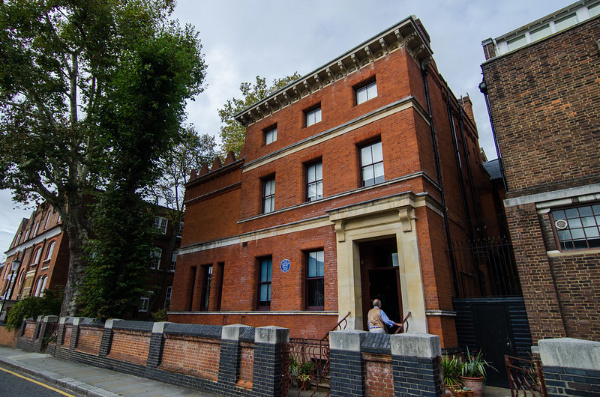
The Freud Museum. PICTURE: A Peace of London (licensed under CC BY-NC 2.0)

The last residence of Sigmund Freud, the founder of psychoanalysis, is located in Hampstead and is now a museum dedicated to his work and that of his daughter, pioneering child psychoanalyst Anna Freud.

The Freuds moved into the property at 20 Maresfield Gardens (having initially briefly stayed at a flat at 39 Elsworthy Road, Primrose Hill) in September, 1938, having left their home in Vienna to escape the Nazi annexation of Austria earlier in the year.

The house dates from 1920 and was built in the Queen Anne Revival Style. A small sun room was added a year after to the rear of the property.

Freud finished his final works Moses and Monotheism and An Outline of Psychoanalysis while at the property and also saw patients there as well as some high profile visitors including Princess Marie Bonaparte, writer HG Wells and literary couple Leonard and Virginia Woolf. Already aged in his 80s when they moved in, he died in the home just a year after on 23rd September, 1939. But his daughter Anna remained in the property until her death in 1982.

As per her wishes, it was subsequently turned into a museum and opened to the public in July, 1986, as The Freud Museum.

Among the rooms which can be visited today are Freud’s study, the library, hall and dining room but some areas – such as Anna Freud’s consulting room – are used as offices and not open to the public.

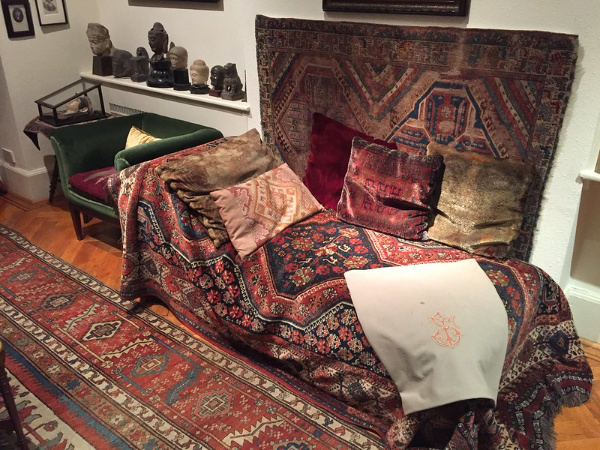
Freud’s couch. PICTURE: John Kannenberg (licensed under CC-BY-NC-ND-2.0)

The star sight inside is undoubtedly Freud’s famous couch. Located in the study, it was originally the gift of a patient, Madame Benvenisti, in 1890, and is covered with a Qashqa’i carpet which Freud added.

Other items which can be seen in the house include several paintings collected by Freud and a series of photographs by Edmund Engelman which depicted Freud’s apartment in Vienna just weeks before he fled. There’s also a portrait of Freud by Salvador Dali who visited him in London, his collection of antiquities and his painted Austrian furnishings as well as many mementoes related to Anna Freud.

The premises also hosts temporary exhibitions and a range of other events.

The garden outside – much loved by the Freuds – has been left largely as Sigmund Freud would have known it.

The house is one of the rare properties in London which features two English Heritage Blue Plaques – one commemorating Sigmund and the other Anna.

There’s a famous statue of Sigmund Freud by Oscar Nemon just a couple of minutes walk away at the corner of Fitzjohns Avenue and Belsize Lane.

WHERE: The Freud Museum, 20 Maresfield Gardens, Hampstead (nearest Tube stations are Finchley Road, Finchley Road & Frognal and Belsize Park); WHEN: 10:30am to 5pm, Wednesday to Sunday; COST: £14 adults/£12 concessions/£9 young persons (aged 12 to 16, under 12s free); WEBSITE: www.freud.org.uk.

10 historic London homes that are now museums…4. Leighton House Museum…

PICTURE: Jeff Hitchcock (licensed under CC BY 2.0)

This extraordinary west London property is an artistic treasure trove thanks to its once being the residence and studio of Victorian artist Frederic, Lord Leighton.

The red brick home at 12 Holland Park Road was purpose-built by Leighton. He acquired the land in 1864 and commissioned his architect friend George Aitchison, who had never before designed a home, to draw up plans (along with his own input).

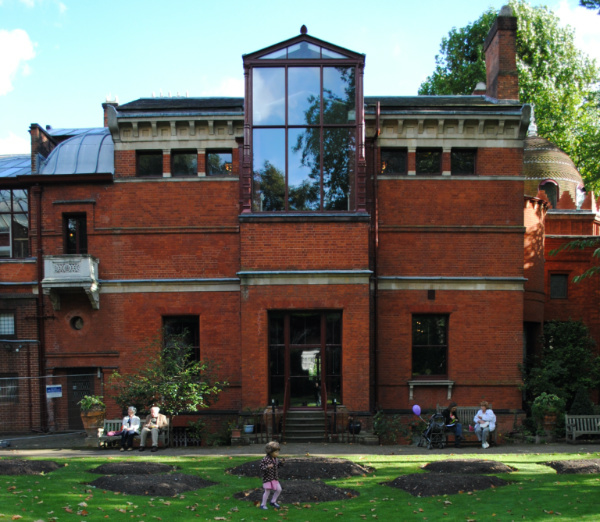
Work started on the property in 1865 and Leighton, who spent some of the year in Spain and Rome, was able to move in late in in the year. The property, which was rather plain on the outside, featured a large studio – with large window overlooking the garden – and his bedroom on the second floor.

Leighton was to subsequently undertake a series of extensions – the first, to enlarge the size of the studio, after just three years.

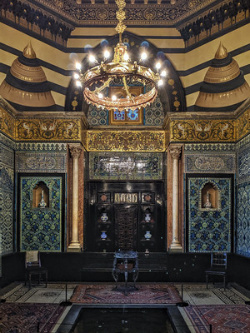
The Arab Hall. PICTURE: Kotomi_ (licensed under CC BY-NC 2.0)

In 1877 he began construction of the domed Arab Hall which was inspired by his trips to Turkey and Syria and the interior of a 12th-century palace in Palermo, Sicily. Craftsmen were sourced from across London and the new room featured a gold mosaic frieze made in Venice and shipped in sections and wall tiles which mostly come from Damascus and which mostly date from the late 16th and early 17th century. It wasn’t fully completed until 1881.

A large “winter studio” featuring a glass roof for light was added in 1889-90 and the final addition was the Silk Room which, built on the first floor, was designed as a picture gallery for the works of Leighton’s contemporaries including the likes of John Everett Millais, George Frederic Watts and John Singer Sargent. It was completed just months before Leighton’s death in 1896.

After Leighton’s death, his collection of art was auctioned off. But his house was retained and in 1900 it opened as a museum run by a committee lead by Leighton’s neighbour and biographer Emilie Barrington to display art by Leighton and others.

In 1927, ownership of the house was transferred to current managers, The Royal Borough of Kensington and Chelsea.

Further additions to the house followed including a new wing for exhibition space.

Many of the home’s fittings and fixtures were lost during the 20th century but in the 1980s curator Stephen Jones began restoring the interiors, a process which continued in 2008-10 in what was known as the Closer to Home project. A further project of restoration was commenced in 2019 to refurbish the home’s 20th century additions and create new visitor facilities including a cafe.

The home’s garden, meanwhile, remains largely unchanged from Leighton’s design.

The rear of the property with the second floor studio window (before the latest refurbishment). PICTURE: David Adams

As well as the artistry contained in the house itself, the museum hosts a significant collection of art including paintings by Leighton himself as well as Pre-Raphaelites including Edward Burne-Jones, Millais and Watts. There’s also several of Leighton’s sculptures.

The Grade II*-listed house, which features an English Heritage Blue Plaque on the facade, has been seen in numerous films, TV shows and music videos including the Poirot TV series and the 2020 film, Rebecca.

WHERE: Leighton House Museum, 12 Holland Park Road (nearest Tube stations are Kensington (Olympia) and High Street Kensington; WHEN: 10am to 5:30pm Wednesday to Monday COST: £11 adults/£9 concession/£5 children (six to 18 years; five and under free); WEBSITE: www.rbkc.gov.uk/museums/leighton-house.

10 historic London homes that are now museums…3. Keats House…

Briefly the home of Romantic poet John Keats, this Hampstead premises is a now a museum dedicated to the writer and exhibition space.

Constructed in around 1815 as a pair of semi-detached dwellings, the now Grade I-listed house was one of the first to be built in the area. The two residences were initially occupied by critic Charles Wentworth Dilke and his family, and by the writer Charles Armitage Brown.

PICTURE: It’s No Game (licensed under CC BY 2.0)

Keats, a friend of Dilke and Brown, began visiting the Regency-era villa, then named Wentworth Place, soon after. He was then living with his two younger brothers nearby in Well Walk but after George married and emigrated to America and Tom died of tuberculosis and, Brown invited Keats to move in as a lodger.

He did so in December, 1818, and it was while living at the property that he composed La Belle Dame sans Mercians, completed The Eve of St Agnes and write his famous odes, including Ode to a Nightingale.

The Dilkes family moved out in April, 1819, and Mrs Brawne and her daughter moved in. Keats developed an intimate relationship with the daughter, Fanny, and the couple were secretly engaged but owing to his premature death, never married.

In September, 1820, with his health failing, Keats left the property and headed to Rome (the trip was funded by friends who hoped the warm climate would help improve his health). He died in the eternal city on 23rd February, 1821, and was buried in the city’s Protestant cemetery.

Brown, meanwhile, left the property in June, 1822 (he also left for Italy) and Keats’ sister Fanny – who had become friends with Fanny Brawne – moved into Brown’s half of the house with her husband Valentin Llanos between 1828 and 1831. The Brawnes left in early 1830.

Subsequent occupants included actor Eliza Chester who converted the two residences into one.

The property was threatened with demolition in the early 20th century but saved by public subscription. It opened to the Keats Memorial House on 9th May, 1925. In 1931, a new building was erected nearby house artefacts related to Keats.

Since 1998 the property has been under the management of the City of London Corporation. It underwent a restoration project in the mid-1970s and again between 2007 and 2009. The Keats Foundation was established in November, 2010, and is involved in educational initiatives, both at Keats House and elsewhere.

Visitors to the house today are taken on a journey through Keats’ short life and legacy. Among the artefacts which can be seen there are items related to his time as a medical student, portraits of some of the famous people Keats met while living at the property including the poets Samuel Taylor Coleridge and Percy Bysshe Shelley as well as Shelley’s wife Mary (author of Frankenstein), a bust of Keats which stands at his actual height – just over five feet tall, and a mask of Keats’ face made by his artist friend Benjamin Haydon. 

There’s also portraits of both Keats and Fanny, Fanny’s engagement ring, and a volume of Shakespeare’s plays Keats gave her before leaving for Rome as well as busts of Charles Brown and editor Leigh Hunt (it was through Hunt that Keats met Dilke and Brown).

The garden features a 200-year-old mulberry tree and a plum tree which was planted to commemorate Ode to A Nightingale.

A Blue Plaque (although it’s actually brown) was unveiled at the house at 10 Keats Grove by representatives of the Royal Society of Arts on the property as far back as 1896 to commemorate Keats.

WHERE: Keats House, 10 Keats Grove, Hampstead (nearest Overground station is Hampstead Heath; nearest Tube stations are Hampstead and Belsize Park); WHEN: 11am to 1pm and 2pm to 4pm, Thursday, Friday and Sunday; COST: £8 adults/£4.75 concession; 18 and under free; WEBSITE: www.cityoflondon.gov.uk/things-to-do/attractions-museums-entertainment/keats-house/visit-keats-house.

10 historic London homes that are now museums…2. Carlyle’s House…

Carlyle’s House frontage. PICTURE: Kotomi_ (licensed under CC BY-NC 2.0)

This Chelsea terraced house, now owned by the National Trust, was once the home of the Victorian literary couple, essayist and historian Thomas Carlyle and his wife (and skilled letter writer) Jane.

The Carlyles moved into the red brick property at 24 Cheyne Row (formerly number 5) in 1834, having left rural Scotland to see what they could make of themselves in London.

As their stars rose – by mid 19th century Thomas, the “sage of Chelsea”, had become an influential social commentator, the home became something of a hub for Victorian literati with the likes of Charles Dickens, Alfred, Lord Tennyson, George Eliot and William Thackeray all visiting them here.

When Thomas died at the property on 5th February, 1881 (Jane had died in 1866), the home reverted to the landlord but a group of admirers decided it needed to be preserved as a memorial to their friend. They raised funds through a public subscription and in 1895 opened it as a shrine to the writer.

The National Trust took over the running of the house, which was built in around 1708, in 1936 with the enthusiastic support of founder Octavia Hill who herself was a Carlyle fan.

The property, which still retains many of its original fixtures and fittings, features a recreation of the couple’s parlour based on Robert Tait’s painting A Chelsea Interior which depicts the Carlyles in the room in 1857.

The property also boasts the attic study that Thomas had constructed in August, 1853, and where he wrote The French Revolution, Latter Day Pamphlets and Fredrick the Great. His attempts at sound-proofing it had failed.

Meanwhile, Jane’s dressing room features a pair of original chintz curtains which she made in the late 1840s.

Inside the parlour at Carlyle’s House. PICTURE: Kotomi_ (licensed under CC BY-NC 2.0)

Among the items on show in the property is a necklace given to Jane by German writer and stateman Johann Wolfgang von Goethe which features a pendant containing a portrait of him. There’s also a a decoupage screen made by Jane using prints in 1849 and wallpapers by William Morris.

The property, which also features a small walled garden and a bust of Thomas Carlyle on the facade, is currently undergoing restoration work and will reopen in March.

WHERE: Carlyle’s House, 24 Cheyne Row, Chelsea (nearest Tube stations are Sloane Square and South Kensington); WHEN: Check website when it reopens; COST: £9 adults/£4.50 children; WEBSITE: www.nationaltrust.org.uk/carlyles-house.

10 historic London homes that are now museums…1. Benjamin Franklin House…

London is replete with historic homes but only a few have become museums. In this series we want to look beyond the more famous ones – think of the Dickens Museum in Bloomsbury or of the John Soane Museum in Lincoln’s Inn Fields, to name two – to some of the lesser known homes that have became museums.

PICTURES: Courtesy of Google Maps

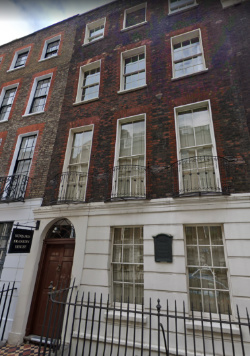
First up, it’s Benjamin Franklin House at 36 Craven Street. While the history of this Georgian terraced house goes back to 1730, Franklin himself is known to have lived in what was a lodging house for some 16 years from 1757 to 1775 (his wife Deborah had apparently refused to come and remained in Philadelphia).

Franklin, who had first lived in London in the mid-1720s while working as a trainee printer and stayed in various lodgings including in Lincoln’s Inn Fields, initially served as an agent for the Pennsylvania Assembly in London but, after a brief time back in Philadelphia, returned to London in 1764, this time as ambassador for the colonies in America. He left the property in 1775 to return to Philadelphia where, shortly after, on 4th July, 1776, he was among the signatories to the Declaration of Independence.

The four storey townhouse, which is the only surviving property lived in by Franklin left in the world, remained a lodging house up until World War II. It later served as the headquarters for the British Society for International Understanding.

The Friends of Benjamin Franklin House was founded by Mary, Countess of Bessborough in 1978 and in 1989 the government gave the friends the freehold to the land. The friends then undertook a major renovation and restoration project.

During the works some 1200 bones fragments – believed to be the remains of 15 people, at least six of them children – were found buried in the cellar. They were dated to about the time Franklin had been living there.

But, fear not, the bodies were not of Franklin’s doing. It is believed that William Hewson, an early anatomist and friend of Franklin (as well as being married to Polly, the daughter of the property’s landlady Margaret Stevenson), was responsible for the remains.

Hewson, who was among tenants at the property between 1770 and 1774, ran a small anatomy school here where he conducted secret dissections to avoid any legal complications. The bodies were thought to have been buried in the back garden which, when the property was expanded, later became part of the basement.

The Grade I-listed property – which contains many original features including the floorboards, ceilings and staircases – finally opened as a museum for the public in January, 2006.

These days, the history of the property – including its architecture and Franklin’s residency – can be explored through an ‘historical experience’ and ‘architectural tour’. There’s also a virtual tour available online recreating what the property may have looked like in Franklin’s time.

Among the artefacts on show in the house are Franklin’s leather wallet (inscribed with the Craven Street address and his name), a bust of Franklin dating from about 1800, and what is believed to be the property’s original door-knocker.

The house also features an English Heritage Blue Plaque – although the plaque, which was erected in 1914, is grey, not blue and rectangular, not circular.

WHERE: Benjamin Franklin House, 36 Craven Street, Westminster (nearest Tube stations are Embankment and Charing Cross); WHEN: Various times for tours – check the website for details; COST: Historical Experience – £9.50 adults/£8 concessions/free for under 12s; Architectural Tour – £7.50 adults/£6 concessions/free for under 12s; WEBSITE: https://benjaminfranklinhouse.org.

10 most popular posts for 2022 – Numbers 2 and 1…

And the final two in our annual countdown (drum roll please)…

2. 10 historic stairways in London – 6. The Geometric Staircase, St Paul’s Cathedral…

1. 10 historic stairways in London – 7. Wapping Old Stairs…

10 most popular posts for 2022 – Numbers 4 and 3…

4. 10 historic stairways in London – 4. The Nelson Stair…

3. Treasures of London – Wren’s Great Model of St Paul’s Cathedral…

10 most popular posts for 2022 – Numbers 6 and 5…

6. 10 historic stairways in London – 3. The Monument stairs…

5. 10 historic stairways in London – 8. The King’s Staircase, Kensington Palace… 

10 most popular posts for 2022 – Numbers 8 and 7…

8. 10 historic stairways in London – 2. Queen Mary’s Steps, Whitehall…

7. 10 historic stairways in London – 3. The Monument stairs…

10 most popular posts for 2022 – Numbers 10 and 9…

It’s that time of year again – our annual countdown of our 10 most read posts for the year!

First up are numbers nine and ten… 

10. Where’s London’s oldest…pharmacy?

9. LondonLife – Greenwich Park restoration…

8 locations for royal burials in London…A recap…

Before kicking off a new series, here’s a recap of our last…

1. (Old) St Paul’s Cathedral…

2. St Clement Danes…

3. St Edward’s Chapel, Westminster Abbey…

4. Christ Church Greyfriars…

5. Henry VII’s Lady Chapel, Westminster Abbey…

6. St Peter ad Vincula…

7. Westminster Abbey (near the High Altar)…

8. Kensal Green Cemetery…