Treasures of London – Henry Moore altar at St Stephen Walbrook…

Henry-Moore-altar

A beautiful church in the round, St Stephen Walbrook has a rich history with one of its stand-out features is an altar designed by world renowned sculptor Henry Moore. 

The centrally located circular altar, carved between 1972 and 1983 of polished travertine marble (the marble was taken from the same quarry as that used in Michelangelo’s work), is eight foot across and weighs several tons.

It was commissioned  by property developer and churchwarden, Lord Palumbo, as part of a £1.3 million restoration of the church – built under the supervision of Sir Christopher Wren in the 1670s, replacing an earlier church which burnt down in the Great Fire – which took place between 1978 and 1987.

It was deliberately designed to be placed at the centre of the church and didn’t take up its new position without controversy with objectors to it taking the matter to the Court of Ecclesiastical Cases Reserved (they ruled the altar was acceptable for use in a Church of England church).

WHERE: St Stephen Walbrook, 39 Walbrook (nearest tube stations are Bank and Cannon Street); WHEN: 10am to 4pm weekdays (check website for changes); COST: Free; WEBSITE: www.ststephenwalbrook.net.  

Treasures of London – Coins at the Tower…

Coin2

In this special edition of Treasures of London, we’re taking a quick look at a new permanent exhibition which has opened at the Tower of London focusing on the 500 years it served as the Royal Mint.

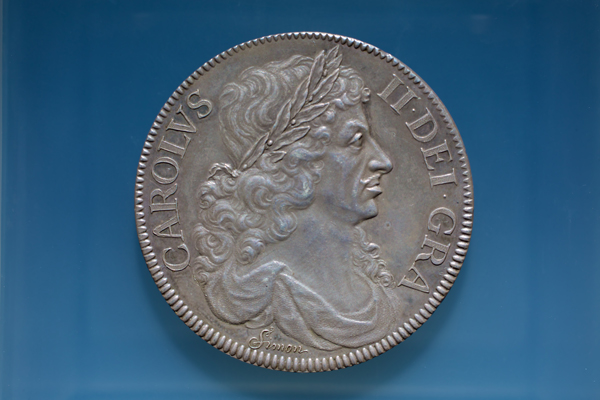
Opened in partnership with the Royal Mint Museum, the new exhibition, Coins and Kings: The Royal Mint at the Tower, features a series of rare coins and other coin-related paraphernalia, including a rare silver groat from the time of King Edward I (1279-1307), a gold “trial plate” dating from 1542 in the reign of King Henry VIII, and a Charles II petition crown dating from 1663 – pictured above, it was sent to King Charles II by engraver Thomas Simon as an example of his work (Simon never got the job and died of plague three years later).

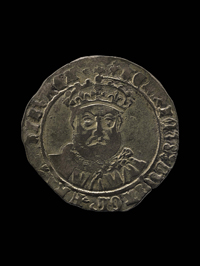
Coin1There’s also a silver ‘testoon’ from the reign of King Henry VIII (it bears a Holbein-style portrait of him) which has been debased – indeed, such was the state of coinage during his reign that the “silver” coins often contained more cheap metal, like copper, than silver so that as they wore down, the copper shone through earning the king the delightful nickname, ‘Old Coppernose’ (pictured right).

The tower was used as the country’s mint from about 1279 – when King Edward I moved the Royal Mint inside the Tower as part of his efforts to clean up England’s coinage – to 1812 – when the Royal Mint was relocated out of the Tower to a purpose-built premises on Tower Hill – and the exhibition focuses on five moments from its history.

They include a look at the efforts of Sir Isaac Newton, Warden (and later Master) of the Royal Mint, in tracking down forgers in the late 1600s (his rather zealous prosecutions of those creating forgeries, in particular one William Chaloner, is retold with aplomb in Thomas Levenson’s book Newton and the Counterfeiter), King Edward I’s harsh punishments for people who dared to tamper with his coinage, Queen Elizabeth I’s restoration of the coinage after her father, King Henry VIII’s meddling with the currency, and King Charles II’s rejection of Commonwealth money.

There’s a series of events to go with the exhibition’s opening including the change to see some of the coins up close and family activities (check out the Tower of London website – link below – for more details).

WHERE: Tower of London (nearest tube station Tower Hill); WHEN: 9am to 5.30pm, Tuesday to Saturday, 10am to 5.30pm Sunday to Monday; COST: £21.45 adults; £10.75 children under 15; £18.15 concessions; £57.20 for a family; WEBSITE: www.hrp.org.uk/toweroflondon/.  

PICTURES: Historic Royal Palaces/newsteam

Treasures of London: The Americus Backers grand piano…

Americus-Backers-piano

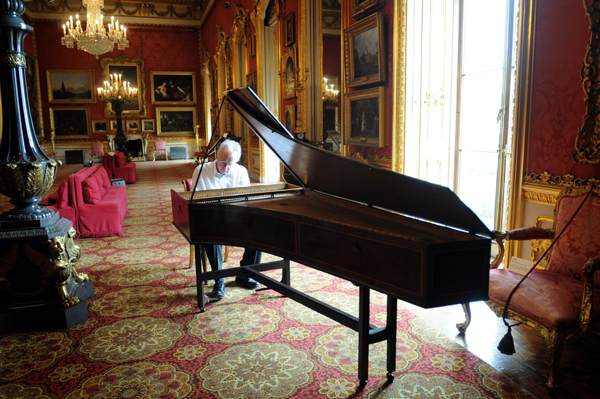
The oldest surviving English grand piano, built in London in 1772 by Americus Backers, has gone on display at Apsley House in London, home of the 1st Duke of Wellington, Arthur Wellesley.

Known to have been played by the Iron Duke’s wife Kitty (nee Pakenham), it has been suggested (although remains unconfirmed) that the piano belonged to the Iron Duke’s father, Lord Mornington, who was politician and a composer.

The piano, which has been loaned to English Heritage by Lord and Lady Douro and is expected to remain at the house for the foreseeable future, is the earliest example of a piano with loud and soft pedals and is illustrative of the impact Backers, described by some as “the father of the English grand pianoforte style”, had on the development of piano design.

While much of the detail of Backers’ life  remains obscured, he was apprenticed to a piano builder in Saxony before coming to England in the 1750s and taking up residence in Jermyn Street in 1763 where he apparently lived until his death in 1778. He is known to have built both pianofortes and harpsicords.

The piano, the only known pianoforte by Backers still existing, was previously on loan to the Russell Collection in Edinburgh.

In celebration of the return of the piano to Apsley House, the residence is hosting a special concert this Tuesday (21st May), between 7pm-9pm – the first time the piano will have been heard for at least 5o years (albeit for a short period only with most of the concert performed on a 1781 Ganer. ‘The Duke of Wellington’s Music of the French Wars’ will be held in the Waterloo Gallery. Tickets are £45 each and limited seats are available. Call English Heritage Customer Services on 0870 333 1183 for bookings or see www.english-heritage.org.uk. PICTURE:  Professor David Owen Norris, who has researched and devised the programme has been devised the programme for the evening, playing the piano.He will be joined by the soprano Amanda Pitt. Image courtesy of English Heritage.

Treasures of London – The Barbor Jewel…

While the style of the setting means this pendant is said to date from the early 17th century, a family tradition holds that it was made for a Protestant William Barbor, variously described as a London tradesman or grocer.

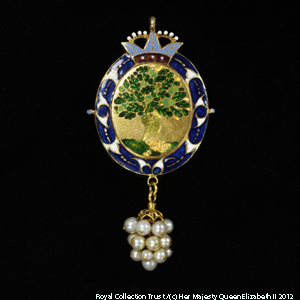
The-Barbor-JewelThe story, said to have been first recorded in the early 18th century, goes that the jewel was made to commemorate Barbor’s escape from being burnt at the stake (thanks to his Protestantism) due to the accession of Queen Elizabeth I in 1558 following the death of her half-sister, Queen Mary I (‘Bloody Queen Mary’).

Barbor had been regarded as a heretic during Queen Mary’s reign and is said to have condemned to death for his faith but the death of the queen meant he no longer faced a sentence of death.

Even so, Barbor died in 1586, and while the onyx cameo of Queen Elizabeth I in the centre of the jewel dates from about 1575-85, the “pea-pod-style” setting of the jewel – which features rubies and diamonds and a cluster of pearls – has been dated to between 1615-25, during the reign of King James I, which places its creation well after Barbor’s demise.

The enameled jewel features an oak tree on the reverse side (pictured).

The Barbor Jewel is currently on display in the exhibition, Treasures of the Royal Courts: Tudors, Stuarts and the Russian Tsars, at the V&A which runs until 14th July. Admission charge applies. For more, see www.vam.ac.uk.

PICTURE: Courtesy of Victoria and Albert Museum, London 

Treasures of London – Siborne’s Large Model…

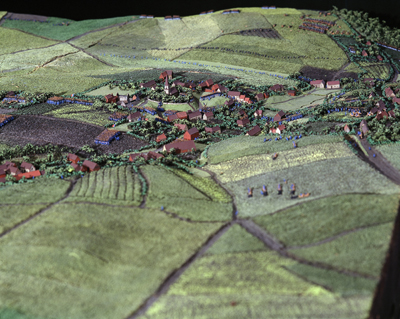
An amazing feat of model-making, Siborne’s Large Model is a painstakingly detailed model reconstruction of the Battle of Waterloo on display at the National Army Museum. Controversial even to this day, the story behind the model’s creation is an incredible tale of one man’s perseverance.

Siborne's-modelA career soldier, Captain William Siborne was commissioned in 1830 by Lord Rowland Hill, then Commander-in-Chief of the British Army, to construct a model of the Battle of Waterloo, fought between British and allied forces under the command of the Duke of Wellington and Prussian field marshal Gebhard von Blücher and French forces under the command of the Emperor Napoleon on 18th June, 1815.

Siborne, who hadn’t been present at the battle but had previously been involved in the construction of a model of the Battle of Borodino, extensively researched it before beginning work including spending eight months surveying the entire field where the battle took place and corresponding with hundreds of those who had fought there.

The model wasn’t completed until 1838, partly due to the fact that Siborne still had military duties to perform and also due to the fact that he ran out of funds and, when the authorities refused to pay up, ended up financing the project out of his own pocket (and then spent much time trying to recover the funds).

In his fascinating book, Wellington’s Smallest Victory: The Duke, the Model Maker and the Secret of Waterloo (well worth a read if you’re interested in learning more about the history of this amazing model), Peter Hofschroer writes in detail about the acrimonious relationship the Duke of Wellington developed with Siborne, thanks to a clash over the model’s depiction of the battle which shows the crisis point in the battle at 7pm – when the French Imperial Guard attacked Wellington’s centre – and has the Prussians helping to win the day.

The model was placed on public display in October 1838 at the Egyptian Hall in Piccadilly after which it went on tour around the UK. He went on to write up his research in a book on the battle, published in 1844, and it was while preparing this – in 1841 – that he announced he had changed his mind and would revise the model, eventually removing figures representing some 40,000 Prussians from the model and thus reducing the role they played at the decisive moment of the battle – a move which could only be seen as a win for Wellington.

It’s also worth mentioning that Siborne created a second, larger scale model of just part of the battlefield, exhibited in 1844 in London and later in Berlin (it’s now on display at the Royal Armouries Museum in Leeds). Siborne’s subsequent efforts to sell either model didn’t bear fruit before he died, said to have been a “broken man”, on 13th January, 1849.

After his death the large model was subsequently purchased by the United Service Museum and can now be found at the National Army Museum in Chelsea.

WHERE: National Army Museum, Royal Hospital Road, Chelsea (nearest Tube station is Sloane Square); WHEN: 10am to 5.30pm daily; COST: Free; WEBSITE: www.nam.ac.uk.

Treasures of London – K2 telephone kiosk at the Design Museum…

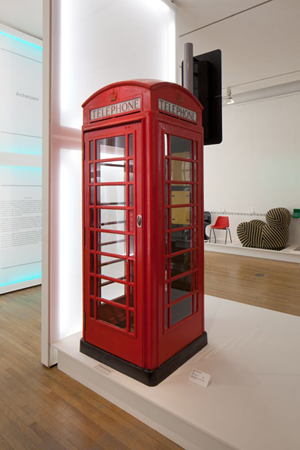
This version of the iconic British ‘institution’ – the red phone box – was designed by architect Sir Giles Gilbert Scott in 1924 (you may know him as the designer of the Battersea Power Station).

K2-KioskFormally known as the K2 telephone kiosk, Scott’s design was selected after a competition organised by the Royal Fine Art Commission (there’s a wooden prototype of Scott’s K2 located under the entrance to the Royal Academy of Arts in Piccadilly – the location where it was originally positioned).

The design featured a classical-looking dome (said to have been influenced by the work of architect Sir John Soane) which featured the royal crest of King George V (done in perforation, so it also provided ventilation). The phone box was made in cast iron and painted red (Scott had apparently suggested silver). From 1926 onwards, around 1,700 of the K2s – which weighed more than a ton – were deployed around London (very few were ever erected outside the city).

The surviving K2s – there are said to be slightly more than 200 – are now listed buildings.

The telephone box is a part of the Design Museum’s permanent collection which is currently held in two locations but from 2015 will be housed in a new purpose-built museum in High Street Kensington.

The box, which will be displayed on the museum’s top floor which will be dedicated to the display of 20th century artefacts, is currently featured in a special exhibition, Design Museum Collection: Extraordinary Stories About Ordinary Things, which runs at the museum’s current premises until January, 2015.

To further explore the Design Museum’s collection, you can download a free Design Museum Collection App for iPad app via iTunes.

WHERE: Design Museum, 28 Shad Thames (nearest Tube stations are London Bridge and Tower Bridge); WHEN: 10am to 5.45pm daily (last admission 5.15pm); COST: £11.85 adults/£10.70 concessions/£7.50 students (children under 12 are free); WEBSITE: www.designmuseum.org

Treasures of London – ‘Drake’s Cupboard’…

One of the foremost seafarers of the Elizabethan age, Sir Francis Drake became the second sea captain to circumnavigate the globe when he did so in his renamed vessel, The Golden Hind, between 1577 and 1580.

Drake's-CupboardWhile it is not believed he was a member of the Middle Temple – one of the Inns of Court, he certainly had some connections and a visit to Middle Temple Hall is recorded in August, 1586, when he was congratulated having just returned from a voyage to the Spanish Indies.

His ongoing connection to the inn can be found in two objects which remain at the hall today.

The first is a ‘cupboard’, known as Drake’s Cupboard (cup board being an alternative for table), it is reputedly to have been made from a hatch cover off the Golden Hind (there’s a replica of this ship in Southwark). Replacing an earlier table, the cupboard is used in various ceremonial aspects of life at the Inn such as, for example, being the table on which members sign a book when they are called to the Bar.

The second, meanwhile, is a lantern which hangs over the entrance to the hall and was reputedly taken from the poop deck of the ship (this was destroyed during the bombings of World War II and a replica now hangs in its place).

Both items can only be viewed when the hall is opened to the public on rare occasions like the annual Open House London event. For more on Middle Temple Hall, see our earlier entry here and www.middletemple.org.uk.

Treasures of London – Temple Church knight effigies…

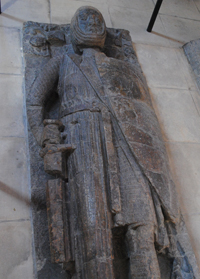
A relic of the early medieval age, the late 12th century Temple Church in the City of London is a marvel in its own right, its circular nave modelled on the Church of the Holy Sepulchre in Jerusalem (for more on its history, see our earlier entry here). But it’s inside the round church – once based inside property that formed the London headquarters of the Templar Knights – that we are concerned with in this piece – for there can be found are series of remarkable effigies of knights which date from the 13th century.

There are nine effigies in all (and one grave cover) and, having survived the Great Fire of 1666, most of them were damaged during World War II when, in a bombing raid on 10th May, 1941, the roof was set alight and came crashing down on top of them. They have since been repaired, using as much of the original material as possible, and still make an imposing sight redolent with the history they depict.

Pre-eminent (at least in his lifetime) among those depicted is William Marshal, the 1st Earl of Pembroke (1146 -1219) and an advisor of kings including King Henry II, King Richard ‘the Lionheart’ and King John who was named Regent during the infancy of King Henry III.

One of the most influential men of his age (described by early thirteenth century Archbishop of Canterbury, Stephen Langton, as the “greatest knight who ever lived”), he lies in the southern group of effigies near his sons William, 2nd Earl of Pembroke (1190-1231) and Gilbert, the 4th Earl of Pembroke (1194-1241). (The 3rd Earl of Pembroke, Richard, was the second son of William – he died after being captured during fighting in Ireland and was buried in Kilkenny). Another of this group is believed t0 depict Robert, Lord de Ros, one of the 25 barons to guarantee the observance of the Magna Carta, signed by King John in 1215.

The only identified effigy in the northern group is that of Geoffrey de Mandeville, the 1st Earl of Essex and a man known for the cruelties he inflicted during the troubled reign of King Stephen (he shifted his allegiances between King Stephen and his rival, the Empress Matilda several times), particularly in the eastern counties where he seized Ramsey Abbey near Peterborough to use as his base.

Interestingly, none of the men named was a Templar but are believed to have been benefactors of the Templar Knights. Some of those shown are cross-legged but whether this denotes a crusader or not remains a matter of debate.

WHERE: Off Fleet Street and down Inner Temple Lane (nearest tube station is Temple); WHEN: Check website for times; COST: £4 (free to under 18s, seniors); WEBSITE: www.templechurch.com.

Treasures of London – The Becket Casket…

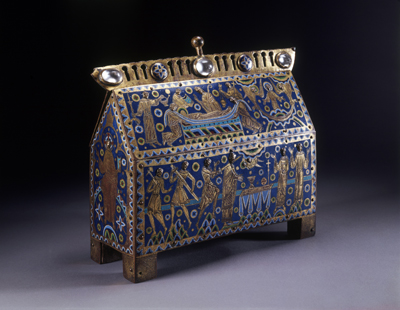
This stunning early medieval casket, dating from around 1180-1190, commemorates one of the most infamous events of the Angevin era – the death of Thomas Becket, Archbishop of Canterbury, who was murdered in Canterbury Cathedral on 29th December, 1170, by four knights of King Henry II.

The murder – for which the king undertook public penance (although whether he ordered the death of Becket, his former chancellor and friend, remains a matter of some dispute) – provoked outrage across Europe and pilgrims soon started flocking to Becket’s tomb.

So much so that the Archbishop was canonised in 1173 and in 1220 a richly decorated shrine was created to house Becket’s remains and serve as a focal point for pilgrims (a pilgrimage to Becket’s shrine is at the heart of Geoffrey Chaucer’s A Canterbury Tale). The shrine was eventually destroyed in 1538 on the orders of King Henry VIII during the Dissolution of the Monasteries.

The beautiful Becket Casket, made of Limoges enamel, depicts, among other things, Becket’s murder, subsequent burial and the ascension of his soul to heaven. On the rear are four long-haired figures who may represent saints or the Cardinal Virtues of Prudence, Justice, Fortitude and Temperance.

One of more than 40 examples still in existence (the British Museum also has one), it was probably made for an important religious house and may have been used to contain relics of the dead saint.

It can now be found in the collection of the V&A’s Medieval and Renaissance Gallery at the museum’s premises in South Kensington.

WHERE: Room 8 (case 20), Victoria & Albert Museum, Cromwell Road, South Kensington (nearest Tube Stations are South Kensington and Knightsbridge). WHEN: 10am to 5.45pm daily (Fridays until 10pm – select galleries after 6pm)COST: Free; WEBSITE: www.vam.ac.uk.

For more on Thomas Becket, see John Guy’s book Thomas Becket: Warrior, Priest, Rebel, Victim: A 900-Year-Old Story Retold.

PICTURE: V&A images

Treasures of London – The Royal Kitchens, Kew…

Given this week’s release of English Heritage’s The London List 2011 – which lists all properties given a new or upgraded heritage listing last year, we thought it was only appropriate to look at one of the properties listed, in this case the Royal Kitchens in Kew Gardens.

Upgraded to a Grade I listing in 2011, the kitchens were opened to the public for the first time in May this year following a £1 million restoration. The origins of the kitchens go back to the 1730s when they were built to the designs of William Kent to serve the White House, the grand mansion of Frederick, Prince of Wales (eldest son and heir of King George II).

While the White House was demolished in 1802, the Georgian kitchens – built in a separate building to mitigate the risk of fire – were kept to serve the nearby premises of Kew Palace (formerly known as the “Dutch House”, it had been originally built in 1631 for a Flemish merchant).

But after the death of Queen Charlotte (wife of King George III) in 1818, members of the Royal family only stayed occasionally and so the kitchen fell into disuse. While the upper floors were given over to accommodation, the lower floor remained untouched, allowing it to survive in a considerable degree of intactness.

The kitchens centre on the double storey ‘Great Kitchen’ featuring three charcoal stoves as well as a rare cooking range with “smoke jack” and fan. Other rooms include a scullery, a bakery, larders and stores for silver and spices while among the surviving furnishings is a preparation table or dresser, cupboards, shelves and baking ovens. Upstairs, the office of the clerk who oversaw the feeding of the Royal Household has been restored.

Historic Royal Palaces, who look after the kitchens, have installed a new permanent exhibition at the site which focuses life on the 6th February, 1789, the date when King George III, having suffered his first bout of ‘madness’ (believed to be porphyria), was given back his knife and fork. William Wybrow was the Master Cook at this time and William Gorton the Clerk of the Kitchen.

WHERE: The Royal Kitchens, Kew Gardens, Kew (nearest Tube Station is Kew Gardens); WHEN: 11am to 5pm daily until 30th September, then Thursday to Sunday until 28th October, then daily again until 4th November; COST: Kew Gardens tickets must be purchased – £16 adults/£14 concessions/children under 16 free – and then tickets to Kew Palace – £6 adults/£4.50 concessions/children under 16 free (or free with annual Historic Royal Palaces membership); WEBSITE: www.hrp.org.uk/kewpalace/stories/palacehighlights/royalkewkitchens.

PICTURE: Forster/HRP

For more on Kew Palace, check out Kew Palace: The Official Illustrated History.

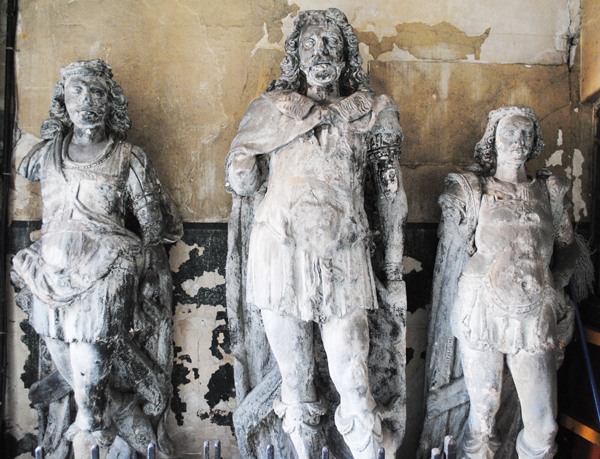
Treasures of London – King Lud and his sons…

A mythical figure from early Britain, King Lud is said to have been a pre-Roman king of Britain who rebuilt London (which according to legend had been originally founded by the exiled Trojan Brutus) and from whom London derives its name.

Lud is said by some to have given his name to the gateway known as Ludgate (although others say it comes from an Old English term meaning swing or postern gate – see our earlier post here for more on Ludgate).

This series of badly weathered statues – depicting King Lud and his two sons, apparently named Androgeus and Theomantius – was originally located on the gate. In fact, the legend goes, the king was buried under it.

Following the gate’s demolition, the statues – said to date from 1586 with the name of the sculptor now lost to time – were moved here at some point to the vestry porch of St Dunstan-in-the West in Fleet Street.

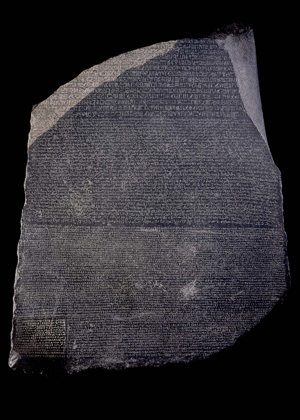
Treasures of London – The Rosetta Stone…

Now housed in the British Museum, the Rosetta Stone, discovered in Egypt in 1799, provided the key to understanding hieroglyphics.

Created in 196 BC, the stone, which measures 112.3 by 75.7 centimetres, has inscribed upon it a priestly decree passed in support of the 13-year-old pharoah, Ptolemy V, and was issued on the first anniversary of his coronation.

Its discovery was a breakthrough in understanding hieroglyphics, which had fallen out of use around the 4th century, due to the fact that the decree was written upon it in three languages – hieroglyphic as well as the everyday Egyptian language of demotic and, importantly, Greek.

Scholars studying the stone were able to use the Greek to decipher the other two languages. Among them were  Jean-François Champollion who announced the translation had been completed in Paris in 1822.

The stone was unearthed near the town of el-Rashid or ‘Rosetta’ by French soldiers in 1799 as they were digging out the foundations of an extension to a fort and following Napoleon’s defeat became the property of the British along with other antiquities under the 1801 Treaty of Alexandria. It has been on display since at the British Museum since 1802 (only briefly removed toward the end of the First World War when it was stored in a subterranean postal railway underneath Holborn).

The stone, said to be the most visited item in the British Museum, underwent a significant restoration and conservation process in 1999 which involved removing grease left by people touching the stone and materials used to create copies of it following its rediscovery – including printers ink from 1799.

WHERE: Room 4, Egyptian Sculpture, British Museum, Great Russell Street (nearest Tube stations are Russell Square, Tottenham Court Road, Goodge Street and Holborn); WHEN: 10am to 5.30pm daily; COST: Free; WEBSITE: www.britishmuseum.org.

PICTURE: The Rosetta Stone © The Trustees of the British Museum

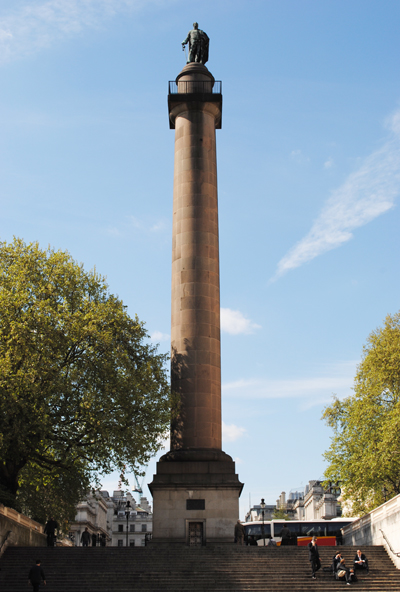
Treasures of London – Duke of York’s Column…

With Nelson’s Column in Trafalgar Square stealing much of the limelight, the Duke of York’s Column in Waterloo Place tends to get overlooked. So we thought it was time we took a more in-depth look at its history.

The monument is dedicated to Prince Frederick (1763-1827), the second son of King George III and commander-in-chief of the British Army during wars which were fought between France and European powers including Britain between 1792 and 1802.

The Duke was not a successful military commander on the field – his one outing in Flanders was a disaster and is said to have resulted in him being immortalised in the song, The Grand Old Duke of York – but he is celebrated for reforming the army after his return to England.

The almost 42-metre high monument  features a larger-than-life bronze statue of the Duke dressed in the robes of the Knights of the Garter – the work of Sir Richard Westmacott – standing on the top of a granite column and gazing down a series of steps and over The Mall towards St James’s Park.

The overall monument was designed by Benjamin Dean Wyatt. His design was selected by a committee from among other submissions and erected between 1830-33. While the Duke was an inveterate gambler and died deeply in debt, the British Army is said to have voted to forgo a day’s pay to fork out the £25,000 required to build the commemorative monument. It was said in jest that the height of the monument allowed the Duke to escape his creditors.

Interestingly, the hollow column contains a spiral staircase which originally gave access to a viewing platform at the top. Access was apparently prohibited after a spate of suicides.

Looking for more on statues and monuments around London – why not check out Peter Matthews’ London’s Statues and Monuments?

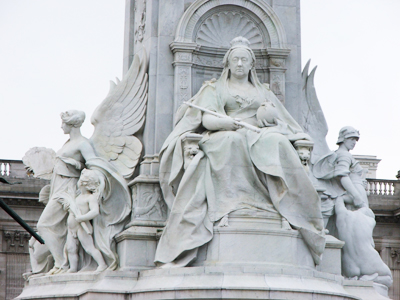
Treasures of London – The Queen Victoria Memorial…

It’s partly obscured now, thanks to preparations for the current Diamond Jubilee, and we have touched on it before (see our earlier post here) but we thought it appropriate to take a look at the main London memorial to the only other British monarch ever to have celebrated a Diamond Jubilee – Queen Victoria.

Prominently located outside of Buckingham Palace at the head of The Mall, work on the Grade I listed Queen Victoria Memorial commenced in 1903.  Dedicated to the Queen, who ruled from 1819-1901, it was unveiled by King George V, grandson of King Victoria, and that of his cousin German Emperor Wilhelm II in May, 1911 (although it wasn’t completed until 1924).

The statue, nicknamed the Wedding Cake, was designed by Sir Aston Webb (he who also designed the currently facade to Buckingham Palace and The Mall – down which the statue of Victoria serenely gazes), and sculpted by Sir Thomas Brock, who, so the story goes, received his knighthood after King George V was so moved at the dedication that he spontaneously decided to knight him then and there.

At 25 metres high, this vast statue is made of 2,300 tons of white marble, 800 tones of granite and 70 tons of bronze. It is the largest statue in London with the exception of that dedicated to Prince Albert in Kensington (it could be described as a companion piece) and is the largest statue of a monarch in England.

The statue is redolent with symbolism – four bronze lions at the base represent the idea of Power (a pair of these was apparently donated by New Zealand) while other bronze figures represent Peace, Progress, Manufacture and Agriculture. There is a nautical theme around the base with depictions of mermaids and ship’s prows among the scenes depicted, all of which evoke Seapower.

On the same level as the seated Queen are Truth, Justice and what’s variously described as Charity or Motherhood while above her are gilded figures representing Courage, Constancy and Winged Victory.

PICTURE: Louise Schuller (www.sxc.hu)

Treasures of London – Diana Memorial Fountain

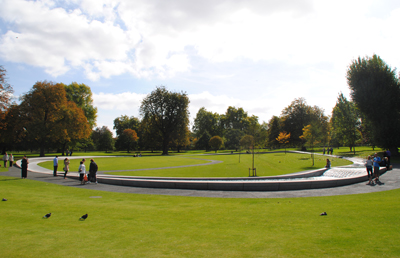
Located in Hyde Park (not far from the Lido), this memorial to Diana, Princess of Wales, is designed as a ring of water – rather like a stream bed – with two cascades tumbling down to meet in a pool at the bottom.

The fountain, which was opened by Queen Elizabeth II in July, 2004, also features three bridges which lead into the heart of the fountain – a symbol, apparently, of Diana’s openness to people.

Designed by US architect Kathryn Gustafson, the fountain – which cost £3.6 million – is made of 545 pieces of Cornish granite, each of which was shaped using laser cutting technology before being pieced together using traditional skills.

Gustafson’s design was selected after more than 10,000 plans were submitted to the Princess Diana Memorial Fountain Committee in 2002. The architect has been reported as saying she wanted the design to reflect Diana’s inclusive “personality”.

The fountain was briefly closed to the public shortly after opening in 2004 because of safety concerns but reopened with new guidelines soon after.

The fountain is located on the route for the the Diana, Princess of Wales, Memorial Walk, which takes on four of the royal parks – Kensington Gardens, Hyde Park, Green Park and St James’s Park.

Diana, whose divorce from Prince Charles had only been finalised the previous year, died in a car crash in Paris in August, 1997, along with Dodi Al Fayed.

WHERE: Hyde Park (nearest Tube stations are Knightsbridge and Hyde Park Corner); WHEN: 10am to 8pm until end of August (check website for times after that); COST: Free; WEBSITE: http://www.royalparks.org.uk/parks/hyde-park/diana-memorial-fountain

Treasures of London – Marble Arch…

Originally installed as a grand entrance to Buckingham Palace, John Nash’s arch was moved to its current location, what is now effectively a traffic island not far from Speaker’s Corner in nearby Hyde Park, in 1851.

The story goes that this took place after it was discovered that the arch was too narrow for the widest of the new-fangled coaches but there are some doubts over this, particularly as the gold state coach passed under it during Queen Elizabeth II’s coronation in 1952. Another story says that it was moved after extensions to Buckingham Palace left insufficient space for it.

Work on the arch had started at Buckingham Palace in the mid 1820s and it was completed by 1833. It was originally moved to replace Cumberland Gate as the new entrance to Hyde Park and to complement Decimus Burton’s arch at Hyde Park Corner. Successive roadworks in the 20th century, however, left it in its current position.

Clad in Carrara marble, the design of the arch was inspired by Rome’s Arch of Constantine and the Arc do Carrousel in Paris. The sculptural ornamentation, which includes works by Sir Richard Westmacott and Edward Hodges Baily, however, was apparently never completed and an equestrian statue of King George IV, originally destined for the top of the arch, instead now stands in Trafalgar Square. The bronze gates – which bear the lion of England, cypher of King George IV and image of St George and the Dragon – were designed by Samuel Parker.

Only senior members of the Royal family and the King’s Troop Royal Horse Artillery are permitted to pass under the central arch of the monumental structure.

The arch stands close to where the Tyburn Tree once stood (for more on this, see our earlier post). It contains three small rooms which, up until the 1950s housed what has been described as “one of the smallest police stations in the world”.

There was some talk in 2005 that the arch would be moved to Speaker’s Corner but this obviously hasn’t eventuated.

Treasures of London – The Banqueting House…

While we’ve looked at some of the history of the Banqueting House during last year’s special on King James I’s London, we thought we’d take a more in-depth look as part of our Treasures of London series…
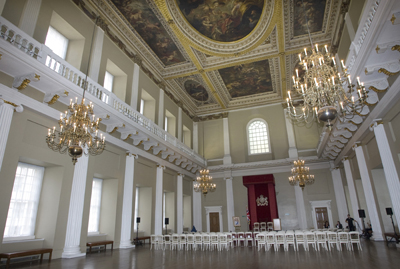
A perfect double cube with a sumptuous painted ceiling, this early 17th century building is the only remaining complete structure from the Palace of Whitehall which was destroyed by fire in 1698.

The building replaced an earlier banqueting hall built on the orders of Queen Elizabeth I and another, shorter-lived hall, built by King James I, which was destroyed by fire in 1619.

Following its destruction, King James had Inigo Jones design a new hall to provide, as the previous hall had, a location for state occasions, plays and masques – something of a cross between an organised dance, an amateur theatrical performance and just a chance to dress up.

Jones, who partnered with Ben Jonson to produce masques, designed the hall – which has a length double the width – with these performances specifically in mind. The first one – Jones and Jonson’s Masque of Augurs – was performed on Twelfth Night, 1622, even before the building was completed (the last masque was performed here, incidentally, in 1635, after which, thanks they were moved to a purpose built structure nearby, ostensibly to save the newly installed paintings from being damaged by the smoke of torches – see below).

The incredible paintings on the ceilings, which celebrate the reign of King James I and will be the subject of their own Treasures of London article at a later date, were installed by March 1636. Produced by Flemish artist Sir Peter Paul Rubens, they had been commissioned by King Charles I, King James’ son, in commemoration of his father. Ironically, it was outside the building where the monarchy was so celebrated that King Charles I was beheaded in 1649 (this is marked in a ceremony held at the Banqueting House on 30th January each year).

Following the king’s execution, Whitehall Palace wasn’t used for several years until Lord Protector Oliver Cromwell took up residence there in 1654, using the Banqueting House as a hall if audience. It stood empty after Cromwell’s death in 1658 until the Restoration in 1660 when King Charles II again used it as a grand ceremonial hall for receiving foreign embassies and conducting court ceremonies (these including the ancient custom of what is known as ‘Touching for the King’s Evil’ to cure those afflicted with the disease of scrofula as well as the washing of the feet of the poor by the sovereign on Maundy Thursday.)

King James II was the last king to live at Whitehall Palace and during his reign, from 1685-88, it was used as a royal storehouse. But it was revived for formal use following his reign – it was here that King William III and Queen Mary II were officially offered the crown on 13th February, 1689.

During their reign, the court’s focus shifted to Kensington but the Banqueting House was used for Queen Mary to lay in state after her death in 1694.

Following the destruction of the remainder of Whitehall Palace in 1698 – the origins of this fire are apparently owed to a maid who had put some linen by a charcoal fire to dry – the Banqueting Hall was used briefly as a Chapel Royal and, following a renovation in the late 1700s, it was used for concerts and, from 1808, as a place of worship for the Horse Guards.

Further renovation works followed and in 1837, it was re-opened as a Chapel Royal and used as such until 1890 when this practice was formally discontinued. In 1893, Queen Victoria gave the Royal United Services Institute the use of the building as a museum – among the things displayed there were the skeleton of Napoleon’s horse, Marengo. In 1962, the exhibits were dispersed and the Banqueting House today is used for a range of royal, corporate and social events.

There is an undercroft underneath, designed as a place where King James I could enjoy drinking with his friends. It was later used for storage.

WHERE: Corner of Whitehall and Horse Guards Avenue (nearest Tube stations are Westminster and Embankment); WHEN: Monday to Saturday 10am to 5pm; COST: £5 adults/£4 concessions/children under 16 free (Historic Royal Palaces members free); WEBSITE: www.hrp.org.uk/BanquetingHouse/.

PICTURE: Courtesy of Historic Royal Palaces/newsteam.co.uk
Treasures of London – The Battersea Shield…

Found in the River Thames near Battersea, the Battersea Shield dates from the Iron Age and is believed to have been created for ceremonial or display purposes (which could be read as showing off), rather than for use in warfare.

Made of a thin layer of highly polished bronze featuring 27 studs into which were placed pieces of red enamel (opaque red glass), the bronze sheets would have originally been placed over a wooden shield. It was clearly designed with spectacle in mind and would have been quickly destroyed in any serious battle. The circular patterns housing the red enamel are designed in what is called the ‘La Tène style’, named for an Iron Age site in Switzerland.

The Celtic shield, which the British Museum dates between 350 to 50 BC, is believed to have been deliberately thrown or placed in the Thames, perhaps as a votive offering, and lay there undisturbed until 1857 when it was dredged up off the river bed near Battersea Bridge during bridge construction.

For a more detailed look at the Battersea Shield, see I.M. Stead’s The Battersea Shield. Unfortunately we were unable to secure permission to run an image of the shield so to see an image of the shield, click here.

WHERE: Room 50, British Museum, Great Russell Street (nearest Tube Stations are Russell Square, Tottenham Court Road, Holborn and Goodge Street). WHEN: 10am to 5.30pm daily (Fridays until 8.30pm)COST: Free; WEBSITE: www.britishmuseum.org.

Treasures of London – Painted Hall, Greenwich

Often described as the “finest dining hall in Europe”, the Painted Hall in Greenwich was originally designed to be the Royal Hospital for Seamen’s communal dining hall. 

But the domed hall, which forms part of King William Court – the image, right, is taken from the west end, wasn’t used as such following its completion in the mid 1720s – designed by Sir Christopher Wren and his assistant Nicholas Hawksmoor with spectacular interior paintings by Sir James Thornhill, it was deemed too grand for such a mundane purpose and instead the veteran seamen, who had moved their dining hall to the undercroft, acted as tour guides for those who would pay to see its splendour.

The paintings, for which Thornhill received his knighthood, took almost 20 years to complete. They were designed to show Britain’s naval power as well as a variety of royal subjects in their splendour. The Stuart dynasty are featured on the ceiling of the Lower Hall while the West Wall depicts the Hanoverians – King George I surrounded by his children and grandchildren including the future King George II. Thornhill himself is also present on the lower right hand section of the West Wall painting while in the background is the dome of St Paul’s Cathedral – a reference to Sir Christopher Wren.

The hall has since served a variety of purposes but among the most significant events to take place there was the lying in state of the body of Admiral Lord Nelson following his death in the Battle of Trafalgar in October, 1805. A plaque at the top of the hall marks the spot where the coffin stood.

Between 1834 and 1936, the Painted Hall served as the National Gallery of Naval Art during which more than 300 paintings around naval themes were displayed there (today these form part of the basis of the National Maritime Museum’s art collection).

After an extensive restoration, in 1939 it was again used as a dining room for officers attending the Royal Naval College and for other grand dinners, including one celebrating the formation of the United Nations in 1946.

It’s now available for hire and has also served as a film location – including for films such as The Madness of King George, Quills and the more recent film Pirates of the Caribbean: On Stranger Tides.

An appeal has been launched to restore the hall with the expected nine month, £450,000 restoration of the West Wall paintings slated to begin after the Olympic Games. To donate, head here.

WHERE: King William Court, Old Royal Naval College, Greenwich (nearest Docklands Light Rail station is Cutty Sark for Maritime Greenwich). WHEN: 10am to 5pm daily COST: Free; WEBSITE: www.ornc.org/visit/attractions/painted-hall.

Treasures of London – Big Ben…

Often used to describe the clock on the Houses of Parliament (or the tower in which it is located), the name Big Ben was actually first given to the bell that resides within.

Officially known as the Great Bell, it is believed the popular nickname of Big Ben came from Sir Benjamin Hall,  First Commissioner for Works (there is an alternative theory that it was named after Ben Caunt, a popular heavyweight boxer in the 1850s but the parliamentary website describes this as “unlikely”).

The initial bell intended for the clocktower of the Houses of Parliament was cast by Warners of Norton, near Stockton-on-Tees, in August, 1856. Transported to London, it was tested in Palace Yard (where a clock tower had stood in medieval times) but a crack appeared during testing and so the bell had to be recast.

With Warners apparently asking too much for the recasting, George Mears at the Whitechapel Bell Foundry was appointed instead. The new bell was cast on 10th April, 1858.

With a diameter of 2.7 metres, the bell was too big to fit up the clocktower’s shaft vertically so it was turned on its side and the 13.7 tonne bell was winched up to the belfry in October that year. Four quarter bells, which chime on the quarter hour and varying in weight from 1.1 to 4 tonnes, were already in place (interestingly, all of the bells are fixed in position and struck on the outside rather than being allowed to swing and have a hammer strike the inside).

Big Ben debuted on 11th July, 1859 (the clock had been started on 31st May), but in September that year the second bell also cracked. It took four years to find a solution (during that time, the bell was struck on the fourth quarter bell) and it was the Astronomer Royal, Sir George Airy, who found it.

The solution involved turning the bell a quarter turn so the hammer didn’t restrike the crack site and replacing the hammer with a lighter one (the current hammer still weighs 200 kilograms!). A small square was also cut into the bell’s crack to prevent it spreading.

Apart from occasional stoppages, the bell has struck ever since.

For more on Big Ben, visit www.parliament.uk/bigben. Tours are only available to UK residents and can be arranged via local MPs (see here for more) or there are virtual tours for those who either don’t live in the UK or can’t get there (see here for more).

IMAGE: Big Ben with a quarter bell in the fourground. PICTURE: Courtesy of UK Parliament.