Beach huts overlook the Thames at Queens Walk, Southbank, in celebration of the 60 year anniversary of the 1951 Festival of Britain. The huts have been individually designed by artists and reflect an element of life by the seaside – from an exhibition of vintage swimwear to a gallery of visual art which recalls when a storm surge flooded much of the North Sea coast in 1953. Nearby is an “urban beach” where you can pause to play in the sand. The huts will remain in position until 4th September. For more on the Festival of Britain 60th anniversary celebrations, see www.southbankcentre.co.uk.
Where’s London’s oldest…bookshop?
Hatchards on Piccadilly (right next to Fortnum & Mason) is generally accepted as being London’s oldest surviving bookshop.
It was founded in 1797 by John Hatchard in Piccadilly (there seems some dispute over whether it still stands on exactly the same site).
The shop currently holds three royal warrants for the supply of books to the Royal Household.
Among high profile past customers have been Queen Charlotte (wife of King George III), former PMs Benjamin Disraeli and Arthur Wellesley, the Duke of Wellington, and literary figures such as Rudyard Kipling, Oscar Wilde and Lord Byron.
It remains popular with lovers of literature and is noted for hosting book-signings by prominent authors with many signed book on the shelves.
For more, see www.hatchards.co.uk.
Lost London – The Rose Theatre
First opened in 1587, The Rose was one of the first purpose-built theatres in London and the first Elizabethan theatre in Bankside, then an area noted for its entertainments including gambling dens, bear and bull baiting pits, and brothels.
The theatre was built for businessman and theatre developer, Philip Henslowe, and his partner John Cholmley, and subsequently hosted plays including Christopher Marlowe’s The Jew of Malta and Shakespeare’s Henry VI part I and Titus Andronicus. Among the actors was Edward Alleyn, Henslowe’s son-in-law, while among the companies which performed there were Lord Strange’s Men, Sussex’s Men, the Queen’s Men and the Admiral’s Men.
Its success led to the building of rival theatres in the area including The Swan in 1595 and The Globe in 1599. It had apparently fallen out of use by 1603 and was abandoned soon after.
The theatre fell out of history until the late 1980s when, following the demolition of a 1950s office block, archaeologists from the Museum of London uncovered the remains of much of the theatre’s floorplan, revealing that it was a smallish many sided structure based on a 14-sided polyhedron. A campaign to save the remains was launched – attracting support from acting luminaries including Sir Laurence Olivier and Peggy Ashcroft – and much of the site was preserved from development.
Some 700 objects, including jewellery, coins and a fragment of one of the moneyboxes used to collect entrance money, were excavated at the site.
The site was reopened to the public in 1999 – it now features displays and some of the objects found by archaeologists – and part of it has been used as a performance space again since 2007.
WHERE: Rose Theatre, Park Street, Bankside; WHEN: 10am to 5pm Saturdays (Shakespeare’s Globe also offer tours during matinee performances at The Globe when tours there are not available – see www.shakespeares-globe.org for more details); COST: Free (donations welcomed and there is a charge for tours from The Globe); WEBSITE: www.rosetheatre.org.uk
Around London – Brixton Windmill reopens; offload your Royal Wedding bunting; and, Women War Artists…
• The Brixton Windmill, the only surviving windmill in inner London, was reopened to the public amid much celebration on 1st May. The windmill, located at Windmill Gardens, was built in 1816 and leased the following year by John Ashby. The Ashby family – including the sons and grandsons of John – operated the mill until the 1860s when the Ashby’s milling business was transferred to what was then a more rural location at Mitcham. Two years later the sails were removed and the mill was subsequently used for storage. A steam and later a gas engine were fitted to the mill in the early 20th century but it was finally closed down in 1934. In the 1970s, the mill passed into the ownership of Lambeth Council. A £400,000 Heritage Lottery grant obtained by Friends of Windmill Gardens and Lambeth Council has enabled a complete restoration of the Grade II* listed building. For more details on the mill, including opening hours and events, see www.brixtonwindmill.org.
• Wanting to offload some Royal Wedding tat? The Museum of London is looking for objects which help tell the story of how London celebrated the marriage of Prince William and Kate Middleton. They are particularly interested in acquiring materials people used in street parties or private celebrations – everything from paper plates and napkins to bunting and “funny hats”. Donations are unable to be returned even if not used. For details on where to send items, see www.museumoflondon.org.uk/Corporate/Press-media/Remembering+the+Royal+Wedding.htm
• Now On: Women War Artists at the Imperial War Museum. Covering the period from World War I to the Kosovo conflict of the 1990s, the exhibition features the work of artists including Anna Airy, one of the first women officially commissioned during the First World War, Dame Laura Knight, Linda Kitson and Frauke Eigen. Admission is free. Runs until 8th January, 2012. For more information, see www.iwm.org.uk.
King James I’s London – 4. Charterhouse
The Charterhouse School was founded in 1611 – the seventh year of King James I’s reign – on the site of a former Carthusian monastery in Smithfield.
It owes its creation to Thomas Sutton (1532-1611) who bought the site – which then contained a Tudor mansion – from Thomas Howard, Earl of Suffolk, in 1611, the year of Sutton’s death.
A Yorkshireman, Sutton (who is buried in the chapel in Charterhouse) is said to have been the “wealthiest commoner in England” at the time, having made a fortune after discovering coal. He used his resources to endow a school and an almshouse on the site.
Among the school’s alumni were John Wesley, founder of the Methodist Church, and novelist William Makepeace Thackeray.
The school – which is this year celebrating its 400th anniversary – moved to Godalming in Surrey in 1872 and the site was subequently occupied by the Merchant Taylor’s School while the almhouse continued to operate on the western part of the land (it still does today under the name Sutton’s Hospital in Charterhouse).
The school later became the medical college of the nearby St Bartholomew’s Hospital and is now occupied by Barts and The London School of Medicine and Dentistry.
For more on the Charterhouse, see www.thecharterhouse.org (tours run on Wednesday afternoons at 2.15pm from April until August and cost £10 per person). For more on the Charterhouse School, see www.charterhouse.org.uk.
Famous Londoners – Henry Fitz-Ailwyn
In the first of a series in Famous Londoners looking at past mayors of London, we profile the first person recorded as having that title, Henry Fitz-Ailwyn (also known as Henry Fitz-Ailwin). While his name might not be familiar to us today, it’s clear than in the 12th century, he was a personage to be reckoned with.
Believed to have been born in the 1130s or 40s, Fitz-Ailwyn is said to have been the son of a wealthy Londoner. Apparently involved in the cloth trade, possibly as a draper, he owned property in several counties and in what was Candlewick Street in London (now named Cannon Street).
Records show he was a London alderman in 1168 and later served as mayor, thanks apparently to the support of King Richard I (the dates are uncertain – some claim he took up the post in 1194 but the City of London Corporation records his tenure as 1189 to 1211).
Among his claims to fame are that he issued London’s first building regulations (concerning the need to build in stone) after a fire in 1212 destroyed parts of the city (although he apparently had no powers to enforce them).
Fitz-Ailwyn died the same year and is noted by the Museum of London as “the only mayor ever to serve in office for a full life term”.
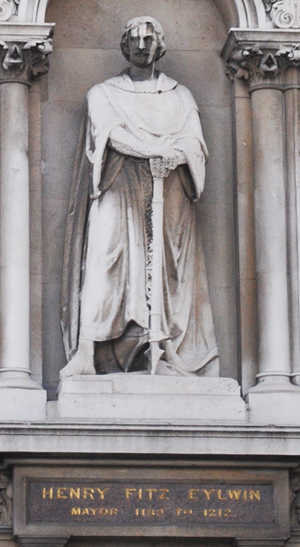
His name is commemorated in a window at the Guildhall and by a statue which stands on the exterior of one of the step buildings at Holborn Viaduct (pictured).
The Royal Wedding – A view from The Mall…
Along with tens of thousands of others, Exploring London took up a post in The Mall to watch festivities surrounding the London wedding of Prince William and Kate Middleton. Here’s some of what we saw…
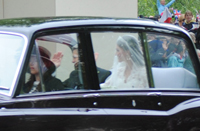
Kate Middleton, newly titled Her Royal Highness the Duchess of Cambridge, rides in a 1977 Rolls Royce Phantom IV from the Goring Hotel in Belgravia to Westminster Abbey via The Mall, greeting crowds along the way. Others, including Prince William, had already passed by.
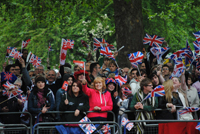
The crowds cheered along The Mall throughout the morning, including after Rowan Williams, the Archbishop of Canterbury, was heard over loudspeakers announcing that the couple were now man and wife. The Bishop of London, Dr Richard Chartres, delivered the address while James Middleton read the lesson.
After the ceremony, the newly married couple processed in the 1902 State Landau down Whitehall and The Mall through a sea of flag-waving well-wishers towards Buckingham Palace after the wedding ceremony. The Landau was the same used by Prince Charles and Princess Diana after their 1981 wedding.
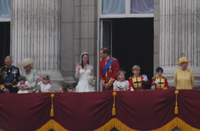
The couple, along with other members of the royal family and Kate Middleton’s parents, appear on the balcony of Buckingham Palace at around 1.30pm, waving to the crowd and exchanging kisses. Here they are flanked by Queen Elizabeth II (right) and the Duke and Duchess of Cornwall (left) along with bridesmaids and pageboys.
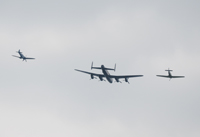
A Lancaster bomber and two Spitfires flew over the top of Buckingham Palace as part of an RAF flypast. They were followed by two tornados and two typhoons. The flypast brought official celebrations to an end after which the royal rejoined the champagne and canape reception already underway.
Crowds fill The Mall in the wedding’s aftermath. The newly weds later left Buckingham Palace driving a vintage convertible Aston Martin owned by Prince Charles. Overhead hovered a Sea King helicopter manned by some of Prince William’s colleagues.
The Royal Wedding – Eight curious facts about Royal Weddings past and present…
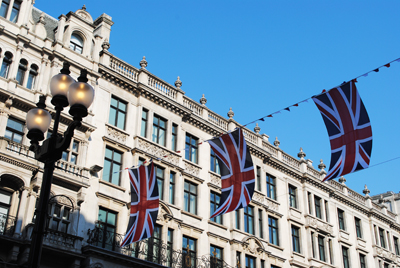
PICTURE: Bunting in Regent Street ahead of the Royal Wedding tomorrow.
Ahead of the wedding of Prince William and Kate Middleton tomorrow, here’s a look at some of the more curious and interesting facts related to London’s Royal Wedding past…
• The first public Royal Wedding in modern times was that of Prince Albert, Duke of York (later King George VI), and Lady Elizabeth Bowes-Lyon (later Queen Elizabeth, the Queen Mother) which took place on 26th April, 1923. Instead of being held at a royal chapel as was more usual, they were married at Westminster Abbey in a public display which was apparently staged to lift the national spirit in the aftermath of World War I.
• Lady Diana Spencer (later Diana, Princess of Wales) memorably said Prince Charles’ name in the wrong order during their wedding ceremony at St Paul’s Cathedral on 29th July, 1981. Lady Diana accidentally called him Philip Charles Arthur George instead of the correct Charles Philip Arthur George.
• Queen Victoria’s extravagant wedding cake was the first to feature a model of the bride and groom on its summit (with a figure of Britannia looming over them). The two tier cake measured nine foot across and weighed 300 lbs.
• While white wedding dresses had been worn for some time, it was apparently after Queen Victoria wore a white dress at her 1840 wedding that the idea spread to the masses. (Interestingly, the first documented princess to wear a white wedding dress is said to have been Philippa of England, the daughter of King Henry IV, in 1406).
• The first televised Royal Wedding was that of Princess Margaret, younger sister of Queen Elizabeth II, to Antony Armstrong-Jones (Lord Snowdon) on 6th May, 1960. It attracted some 300 million viewers worldwide.
• The tradition of a royal bride leaving her bouquet on the Tomb of the Unknown Warrior in Westminster Abbey was started by Queen Elizabeth, the Queen Mother. She apparently did so in tribute to her brother Fergus who had died during World War I. Princess Mary, daughter of King George V, made a similar gesture at her wedding in 1922 – she left her bouquet at the Cenotaph in Whitehall after her wedding.
• One of the most scandalous Royal Weddings was that of George, Prince of Wales (later King George IV) to Princess Caroline of Brunswick on 8th April, 1795 at the Chapel Royal in St James’s Palace. Described as being “far from a love match” on the Historic Royal Palaces’ website, Prince George was said to have been drunk during the wedding and at one stage apparently even attempted to escape from the ceremony.
• If the rain stays away, the newly married prince and his bride will be returning to Buckingham Palace in the 1902 State Landau. The open-topped carriage was constructed for King Edward VII’s coronation and apparently made roomy to accommodation him. The carriage was used by Prince Charles and Lady Diana when they left St Paul’s Cathedral after their 1981 wedding. If the weather it poor, it’s expected that the 1881 Glass Coach, bought for the coronation of King George V in 1911, will be used instead.
For more fascinating facts on Royal Weddings, see the BBC website (www.bbc.co.uk/history/royal_weddings), or Historic Royal Palaces’ blog, The ‘other’ royal weddings (http://blog.hrp.org.uk). For more on the current Royal Wedding, see the official website (www.officialroyalwedding2011.org).
The Royal Wedding – Royal residences…
Word is that Prince William and his soon-to-be wife, Catherine Middleton, have yet to formally decide where they will live when in London (they are expected to spend much of their first two-and-a-half years of marriage in North Wales).
Their initial London base, however, will reportedly be Clarence House. Located in The Mall, just down the road from Buckingham Palace and beside St James’s Palace, the grand building is currently the home of William’s father Charles, the Prince of Wales, his wife Camilla, Duchess of Cornwall, and, William’s brother, Prince Harry (it is also the home of William himself).
In years gone past, Clarence House served as the home of the newly married Queen Elizabeth II (then Princess Elizabeth) and her husband, Prince Philip, the Duke of Edinburgh. Prince Charles, who lived there with his parents until the age of three, returned to the property in August 2003 after the death of his grandmother Queen Elizabeth, the Queen Mother, who had lived in the building from 1953.
Clarence House was built between 1825 and 1827 to the designs of architect John Nash on the orders of Prince William Henry, the Duke of Clarence and later King William IV.
Choices for a permanent home in London for the soon-to-be married couple reportedly include Buckingham Palace (see yesterday’s entry), as well as Kensington Palace.
It was converted from a Jacobean mansion for King William III and Queen Mary II and has since been the home of many royals including, most famously, Diana, Princess of Wales. She and her then husband, Prince Charles, moved in following their wedding in 1981, and Princess Diana continued to live there after her divorce in 1996.
Other notable royal residents have included Queen Anne and Princess Margaret, sister of Queen Elizabeth II.
Another option – St James’s Palace – was built in 1531 on the site of a medieval leper hospital by King Henry VIII. Used initially for state occasions and to house royal relatives (Tudor monarchs actually lived at Whitehall Palace), it became the official royal residence in 1702, when Whitehall Palace burnt down, and remained so until the 1830s when King George III moved to Buckingham Palace.
The Royal Wedding – London’s royal reception venue
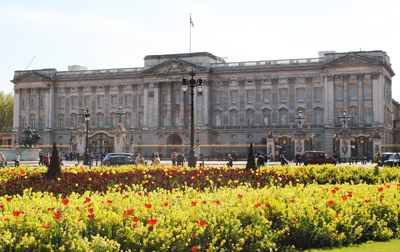
Following the wedding ceremony at Westminster Abbey on Friday, the now married happy couple will head in a carriage via a processional route down The Mall to Buckingham Palace.
There, they will enjoy a champagne reception with 600 guests hosted by the Queen before, at 1.30pm, appearing on the balcony of the palace to wave to the crowds and watch an aircraft flypast expected to include a Lancaster, Spitfire, Hurricane, two Typhoons and two Tornados.
Buckingham Palace, which has served as the official London residence of the reigning monarch since 1837, has a long tradition of hosting royal events. Then much smaller and known as Buckingham House, the property was built for the Duke of Buckingham in 1705.
It passed into royal hands when it was bought by King George III in 1761 for his wife, Queen Charlotte, to use as a family home located conveniently close to St James’s Palace where many court functions were held.
The house was extensively remodelled in 1762 and again, this time on the orders of King George IV, in the 1820s (after initially wanting to use it, like his father, as a family home, the king decided after the works had started to instead transform it into a palace, created to the designs of architect John Nash).
When King George IV died in 1830, his brother King William IV ordered the works to be continued albeit with a new architect, Edward Blore (the spiralling costs of Nash’s work are said to have cost him the contract). The king himself never lived in the house – even offering at at one stage as a seat for Parliament after the Houses of Parliament were destroyed by fire in 1834 – and it wasn’t until the accession of Queen Victoria in 1837 that the palace became the sovereign’s official residence.
Further works were subsequently needed to ensure there was adequate accommodations for the Queen’s family and it was during these works that the monumental Marble Arch – designed as the centrepiece of the palace’s courtyard – was moved away to its present location on the north-eastern corner of Hyde Park.
The palace, which now boasts 775 rooms including 19 staterooms, has since been the site of numerous royal wedding receptions – it was on the balcony where Queen Elizabeth II and Philip, the Duke of Edinburgh, greeted crowds on 20th November, 1947, after their wedding in Westminster Abbey and, similarly, where Prince William’s parents, Prince Charles and Princess Diana, held a reception before greeting crowds on 29th July, 1981, after their ceremony at St Paul’s Cathedral.
Buckingham Palace was also the location for Queen Victoria’s wedding breakfast following the ceremony in the Chapel Royal at St James’s Palace on 10th February, 1840.
The Royal Wedding – London’s Royal Wedding venues
In the first of a series this week looking at aspects of royal weddings in London in days past, we canvas some of the venues which have hosted the sometimes glittering occasions.
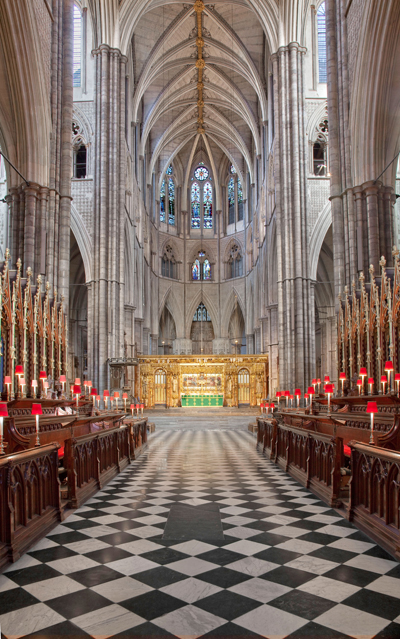
First up is Westminster Abbey (pictured), the location of Prince William and Kate Middleton’s wedding this Friday, which, despite its thousand year history, is only believed to have hosted 15 royal weddings.
Among them is said to have been the wedding of King Henry I to Matilda of Scotland on 11th November, 1100, as well as that of Richard, Earl of Cornwall and brother of King Henry III, who married his second wife, Sanchia of Provence, there on 4th January, 1243, and Joan of Acre, daughter of King Edward I, who married Gilbert, Earl of Gloucester, on 30th April, 1290 (her sister Margaret married John, Duke of Brabant, at the same venue less than three months later). The abbey also hosted the wedding of King Richard II to Anne, daughter of Emperor Charles IV of Bohemia, on 20th January, 1382.
The abbey church has become increasingly favored as a venue for royal weddings in more recent times. Among the most prominent hosted there last century were that of Prince Albert, Duke of York (later King George VI), who married Lady Elizabeth Bowes-Lyon on 26th April, 1923 and that of their daughter Princess Elizabeth (later Queen Elizabeth II) who married Prince Philip of Greece (later the Duke of Edinburgh) there on 20th November, 1947.
Two of the current Queen’s children were also married there – Princess Anne, who married Captain Mark Phillips on 14th November, 1973, and Prince Andrew, who married Sarah Ferguson on 23rd July 1986. (For more on Royal Weddings at the Abbey, see www.westminster-abbey.org/our-history/royals/weddings)
A notable break with the trend in recent times was the marriage of Prince Charles and Lady Diana Spencer – they were married in a fairytale ceremony at St Paul’s Cathedral on 29th July, 1981.
Other London locations for royal weddings have included the now non-existent Greenwich Palace (King Henry VIII married Katherine of Aragon on 11th June, 1509) and Hampton Court Palace (another of King Henry VIII’s marriages – that in which he was wed to Catherine Parr – was held here in a private chapel on 12th July, 1543).
Along with St George’s Chapel at Windsor, the Chapel Royal at St James’s Palace in London was particularly popular in Victorian times – Queen Victoria married Prince Albert there on 10th February, 1840, and their eldest daughter, Princess Victoria, married Prince Frederick (the future German Emperor Frederick III) there on 25th January, 1858. On 6th July, 1893, the chapel also hosted the wedding of the future King George V and Princess Mary of Teck.
PICTURE: Copyright Dean and Chapter of Westminster
Happy St George’s Day!
Amid the celebration of Easter and the flurry of preparations for the upcoming Royal Wedding, you could be forgiven for overlooking the fact that today was St George’s Day.
Hard to do in central London, however, where Trafalgar Square was the centrepoint for celebrations of a musical kind.
Held on the 23rd April each year, St George’s Day – a national day of celebration in England although not yet a national holiday – commemorates the death of St George in 303 AD.
Tradition says St George was a Roman soldier who served the Emperor Diocletian before he was executed for refusing the adjure his Christian faith.
His story – which gradually morphed into a tale in which he defeats a dragon in a symbolic triumph of good over evil – came to England with returning crusaders during the Middle Ages.
He was later adopted as the country’s patron saint (it has been suggested this took place after King Henry V’s victory at the Battle of Agincourt in 1415 but while his feast day was made a national holiday in 1222, it remains a matter of conjecture as to when he become the country’s patron saint).
As one would expect of a national saint, there are numerous depictions of St George around London – the image above is of a massive bronze sculpture by Michael Sandle (1988) which sits in Salisbury Court in the City of London.
Around London – South Bank marks 60 years since the Festival of Britain; Royal wedding cakes; and, a new cable car for London…
• South Bank is celebrating the 60th anniversary of the 1951 Festival of Britain with a four month series of events. The official celebrations kicked off yesterday and will run until early September. Highlights of the celebrations include the Museum of 1951 – a temporary museum located in Royal Festival Hall featuring exhibits relating to the 1951 festival, themed weekends including next weekend’s ‘London in Love’, featuring performances by Billy Bragg, and a Festival of Britain-inspired ‘Meltdown’ curated by Ray Davies of The Kinks (runs from 10th to 19th June). The original Festival of Britain was opened on 3rd May, 1951, with the intention of developing a sense of “recovery and progress” among the British in the aftermath of World War II and marked the centenary of the 1851 Great Exhibition. The South Bank Exhibition was at the heart of what were national celebrations and was attended by more than eight million people. For more information on what’s happening, see www.southbankcentre.co.uk.
• Historic royal wedding cakes have been recreated this Easter weekend in an exhibition celebrating the lead-up to this Friday’s Royal Wedding. The English Heritage-event Let Them Eat Cake, which is being held at Wellington Arch near Hyde Park Corner, features a “four-and-20 blackbirds pie” of the sort King Henry VIII gave to his new wife Anne Boleyn as well as recreations of Prince Charles and Lady Diana’s wedding cake and that of Queen Elizabeth II. The event, which is sponsored by Tate & Lyle Sugars, involves some of Britain’s leading bakers. For more, see www.english-heritage.org.uk/daysout/events/765107/. See Exploring London this week for more on the upcoming Royal Wedding.
• The Mayor of London, Boris Johnson, confirmed this week that work will begin on a new cable car to cross the Thames River in East London this summer. The 34 gondola cable car will stretch for 1.1 kilometres, connecting Greenwich Peninsula and the O2 on the river’s south bank with Royal Victoria Docks and the ExCel centre on the north and carrying up to 2,500 people every hour. Construction will be carried out by a consortium of firms led by Mace – the company currently building the Shard Tower – and it is hoped it will be completed before next year’s Olympics.
Around London – Giant screens for the Royal Wedding; Graham Greene plaque; and, getting down and dirty at the Wellcome Collection…
• The Royal Wedding will be broadcast live on giant screens at Trafalgar Square and Hyde Park under plans announced by the Department for Media, Culture & Sport, the Mayor of London and The Royal Parks. The live coverage will be free to watch from 7am on 29th April and guests are advised to get there early. A “celebration wheel” has also been set up in Hyde Park – fees apply. See www.london.gov.uk/royalwedding.
• A blue plaque has been unveiled at the house where novelist Graham Greene wrote Brighton Rock. Greene, who died in 1991, lived at 14 Clapham Common North Side in London from 1935 to 1940 and while here wrote several works – these also included the Cannes’ winning collaboration with Carol Reed, The Third Man, and The Power and the Glory – before he joined the forerunner to intellgience service MI6 in 1941. Graham moved out of the house at Clapham Common after it was hit by a bomb in October 1940 (the Queen Anne-style property has since been rebuilt). No-one was in the house at the time – Greene’s wife Vivien and his children had been evacuated to Sussex while Greene himself was staying in Bloomsbury with his lover Dorothy Glover when the bomb hit. The English Heritage plaque was unveiled by Greene’s daughter, Caroline Bourget.
• On Now: Dirt, the Filthy Reality of Everyday Life. Get down amongst it at the Wellcome Collection where they’re running an innovative exhibition on dirt and humanity’s at times desperate efforts to keep it under control. The exhibition features 200 artefacts including visual art, scientific artefacts, film and literature with highlights including the earliest sketches of bacteria, John Snow’s ‘ghost map’ showing the spread of cholera in London in the 1850s, and a bejewelled broom. The exhibition features six different locations – from a street in Victorian London to a New York landfill site in 2030 – from where to begin the exhibition. Runs until 31st August. See www.wellcomecollection.org.
King James I’s London – 3. Golf on Blackheath
When King James I came south to take up the throne England, he is known to have brought that peculiarly Scottish game of golf with him and it is believed that it was at Blackheath, above the then Royal Palace of Placentia in Greenwich, that his courtiers first played the game.
According to the Royal Blackheath Golf Club, now located some way to the south of Blackheath in Eltham (the club moved there is 1923), documentary evidence shows the earliest players included James I’s son Henry Frederick, Prince of Wales, who is known to have gone golfing in 1606. The club itself notes that while it is generally accepted it was established in 1608, no documentary evidence to support this has yet been unearthed (records prior to 1787 are missing).
The first course at Blackheath – which has played a significant role in several events including as a rallying point during the Peasant’s Revolt of 1381 – apparently consisted of five holes, each of which was played three times.
Famous Londoners – Peter, the Wild Boy
Found living ‘wild’ in the woods near Hamelin in northern Germany, in 1725, Peter was brought to London at the behest of King George I the following year (the king had heard of his plight while visiting his Hanoverian homeland and had initially had him taken to his summer palace at Herrenhausen). Peter subsequently spent time at the court of the king as well as those of the Prince of Wales, the future King George II, and his wife, Caroline of Ansbach.
On his arrival in London, Peter, believed to be about 15 or 16 years old when he was found, quickly acquired celebrity status – Daniel Defoe wrote a pamphlet, Mere Nature Delineated, in which he mused about his nature and Jonathan Swift wrote a satire on the excitement surrounding his arrival in London while a wax figure of him was exhibited in the Strand and along with other palace courtiers, he appears in a now famous painting by William Kent which still hangs on the king’s grand staircase in Kensington Palace.
Treated by the royals as something of a ‘pet’, efforts were made to educate Peter but later abandoned due to his apparent lack of progress. Many were also said to have been shocked at his lack of manners – something that may have helped contribute to his eventual departure from court.
When the king died in 1727, his daughter-in-law, now Queen Caroline, granted a yeoman farmer in Hertfordshire, James Fenn, a pension in return for looking after Peter. He is recorded as having wandered off on a couple of occasions and, after one incident involving a fire in 1751, was fitted with a collar to prevent further escapes (the collar is still in the keeping of the Berkhamsted School in Hertfordshire).
Peter subsequently spent the remainder of his life in rural England (where he was known to have developed a love for gin but was generally remarked upon as being timid). Meeting him a few years before his death, Scottish philosopher and judge James Burnett, Lord Monboddo, recorded that while Peter could understand what was said to him, he could only say the words ‘Peter’ and ‘King George’.
Peter died in 1785, when he was at least 70-years-old. He was buried in the churchyard of St Mary’s Church in Northchurch, Hertfordshire.
It is now believed that Peter may have been affected by the chromosomal disorder Pitt-Hopkins Syndrome, thanks to the work of Historic Royal Palaces historian Lucy Worsley who, while researching the lives of courtiers at Kensington Palace for her book Courtiers, noted features such as Peter’s “cupid bow lips”, coarse hair and drooping eyelids in Kent’s portrait and passed on a description to a professor of genetics.
It is thought such a diagnosis may help explain why Peter ended up living alone in the German forest where he was found.
LondonLife – The Olympic countdown…
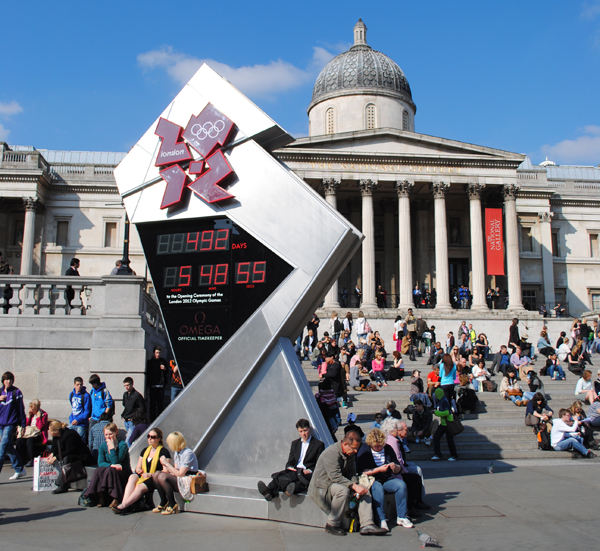
OK, it’s had some teething issues (stopping less than 24 hours after it was launched was one; being daubed with paint another). But the countdown to next year’s Olympics on the official 6.5 metre high clock located in Trafalgar Square continues unabated. The clock was unveiled in mid-March, 500 days before the start of the Games.
Where’s London’s oldest…hospital?
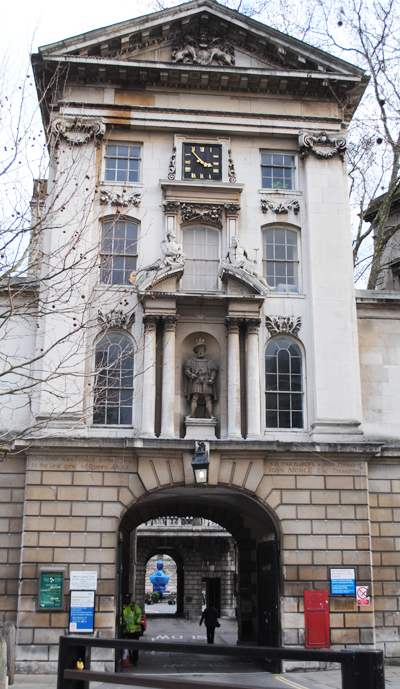
London’s oldest hospital – St Bartholomew’s Hospital in what is known now as Smithfield – was founded in the 12th century.
The hospital owes its foundations – like the neighbouring Priory of St Bartholomew (London’s oldest church – see our previous story on this here) – to Rahere, a courtier (possibly a minstrel or jester) at the court of King Henry I who, tired with triviality, may have become a priest.
In any event, after the death of Henry’s son William – he is believed to have drowned when the White Ship foundered in November 1120 – and that of his wife Queen Matilda, Rahere went on pilgrimage to Rome. He did so but contracted malaria while there and, while under the care of monks, he vowed to found a hospital for poor men if he recovered.
He did recover and on his return journey had a vision of St Bartholomew who informed him that it was he who had helped him to recover and now desired him to found a church in Smithfield (then known as Smedfield).
Back in London, Rahere as he’d promised and, after petitioning the king, was granted a royal charter in 1122 to found the priory of Augustinian canons and the hospital.Work began in March 1123 and it was completed by 1145 when Rahere died (his tomb can still be seen in the church).
The hospital – one of a number in London at the time – was probably little more than a single hall with a chapel at one end. Other buildings and some cloisters were added later as was the Church of St Bartholomew the Less.
Under a charter of 1147, it was open to the needy, orphans, outcasts and the poor as well as sick people and homeless wanderers. In the 14th century, the definition was honed to include the sick until they recovered, pregnant women (until delivery) and for the maintenance of children born there until they were seven-years-old.
As well as the master (Rahere was the first), other ‘staff’ at the hospital initially included eight Augustinian brothers and four sisters but the hospital gradually became independent of the priory and by 1300, the hospital has its own dedicated master. By 1420, the two institutions had apparently become completely separate.
Following the Dissolution in 1539, the hospital was refounded in the 1540s thanks to a deal brokered between King Henry VIII and the Corporation of the City of London. Along with Bethlem, Bridewell and St Thomas’, St Bartholomews was one of four Royal Hospitals administered by the City.
The first regular physician – a Portuguese man by the name of Roderigo Lopez – was appointed around 1567 (he was later hung, drawn and quartered for an allegedly plotting against Queen Elizabeth I). Among the most famous physicians to serve at St Barts in later years was William Harvey, renowned for having ‘discovered’ the circulatory system.
The hospital survived the Great Fire in 1666 but in the 1700s most of the medieval buildings, with the exception of the tower in the Church of St Bartholomew the Less, were demolished as the hospital was rebuilt to the design of James Gibbs. The new design featured a central courtyard with a Great Hall contained in the north wing, reached by a ‘Grand Staircase’ decorated with images of the Good Samaritan and Christ at the Pool of Bethesda by celebrated artist William Hogarth.
The famous Henry VIII gate (pictured above) dates from 1702, slightly before Gibb’s rebuilding project. Other buildings have been added in more recent times.
In more recent times, the hospital was amalgamated with The Royal London and the London Chest Hospitals in 1994 with the establishment of The Royal Hospitals NHS Trust (now known as the Barts and The London NHS Trust). St Barts is now a specialist cancer and cardiac hospital.
There is a museum at the hospital which houses exhibits including a facsimile of Rahere’s grant of 1137 (now in the hospital’s archives), amputation instruments dating from the early 1800s once used by surgeon John Abernathy and a display on William Harvey. Hogarth’s paintings are visible from the museum. There are also guided tours of the hospital.
WHERE: Museum at St Barts Hospital (nearest tube station is Barbican); WHEN: 10am to 4pm Tuesday to Friday ; COST: Free (donations welcomed); WEBSITE: www.bartsandthelondon.nhs.uk/about-us/museums-and-archives/st-bartholomew-s-museum/
Treasures of London – ‘The Ambassadors’
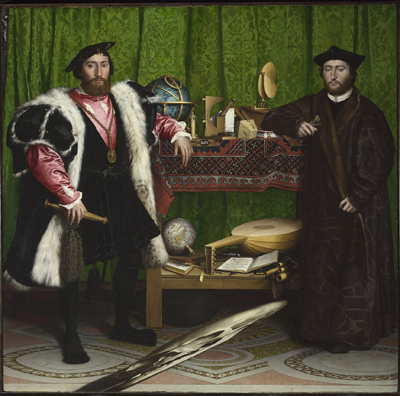
A stunning portrait on a grand scale, The Ambassadors depicts two influential figures from the 16th century – Jean de Dinteville, the then 29-year-old French ambassador to England and Georges de Selve, the then 25-year-old bishop of Lavaur and sometime French ambassador to the Emperor, the Venetian Republic and the Holy See.
The oil on oak work, which is housed in room four of the National Gallery and is also one of the images featured online as part of the Google Art Project, was painted by Hans Holbein the Younger in 1533 and is meant as a portrait to show the men’s power, learning and wealth – they are surrounded by objects which include celestial and terrestrial globes, a portable sundial, a lute (and its case), and books including one of hymns and another of arithmetic as well as richly decorated furnishings.
Yet there’s more to this painting than initially meets the eye – a closer look reveals a distorted skull in the foreground which, when viewed from the painting’s right-hand side comes into its proper perspective. A reflection on mortality perhaps?
And though no typically viewed as a religious work, there are also some striking religious overtones to this image including a broken string on the lyre – often seen as a Christian symbol of disharmony – and, partly hidden behind the curtain on the far left of the painting as you look at it, a crucifix hanging on the wall.
Holbein painted the work during his second stint in England while depicting life at the Tudor court. Among his most famous other images are one of King Henry VIII (held in the National Portrait Gallery) and another of Christina of Denmark (also in the National Gallery – painted to show Henry VIII the image of a potential future wife although the relationship never went any further than that).
PICTURE: Ng1314, Hans Holbein the Younger, Detail of Jean de Dinteville and George de Selve (‘The Ambassadors’), 1533 © The National Gallery, London.
WHERE: Room 4, National Gallery, Trafalgar Square (nearest tube stations Leicester Square and Charing Cross); WHEN: 10am to 6pm (Fridays 10am to 9pm); COST: Free; WEBSITE: www.nationalgallery.org.uk. The image is also available online as part of the Google Art Project here:www.googleartproject.com/museums/nationalgallery/the-ambassadors.
Keats’ love letter to be returned home; a royal wedding Oyster; youngest Spitfire pilot honored; and, The Cult of Beauty at the V&A
• A love letter Romantic poet John Keats wrote to his beloved Fanny Brown will be returned to the house in which it was written. Keats wrote the letter in 1820 while living next door to her at Wentworth House in Hampstead, north London – his home from 1818 to 1820 and the setting that inspired some of his most memorable poetry including Ode to a Nightingale. The City of London Corporation, who manage the house – now a museum known as Keats House, recently purchased the letter with the support of the Heritage Lottery Fund for £80,000. They say it will now be returned to the house and displayed there. In the letter Keats wrote: “I shall Kiss your name and mine where your Lips have been – Lips! why should a poor prisoner as I am talk about such things.” He said his consolation was “in the certainty of your affection”. See www.keatshouse.cityoflondon.gov.uk.
• Amid the host of souvenirs and trinkets up for sale in the lead-up to the wedding of Prince William and Catherine Middleton comes news of a unusual offering from Transport for London – a limited edition royal wedding Oyster card. The card, which will go on sale in the week leading up to the ceremony, features a portrait of the couple and their wedding date – 29th April, 2011. More than 750,000 of the cards will be offered for sale. The move is not without precedent – in 1981, a unique ticket was produced for the marriage of Prince Charles and Lady Diana.
• Squadron Leader Geoffrey Wellum, the youngest Spitfire pilot to take part in the Battle of Britain, was granted the Freedom of the City of London at a ceremony at Guildhall last week. Wellum was just 18-years-old when he joined the RAF in August 1939. Serving in a frontline squadron, he flew many combat missions including dogfights during the Battle of Britain and was subsequently awarded the Distinguished Flying Cross.
• On Now: The Cult of Beauty: The Aesthetic Movement 1860-1900 at the Victoria & Albert Museum in . Said to be the “most comprehensive” exhibition ever staged on the Aesthetic Movement in Britain, it brings together masterpieces in painting as well as sculpture, design, furniture, architecture, fashion and literature of the era and explores some of the key personalities involved in the movement – from William Morris and Frederic Leighton through to James McNeil Whistler, Dante Gabriel Rossetti, Edward Burne-Jones and Oscar Wilde. Organised in collaboration with the Fine Arts Museums of San Francisco, the exhibition runs until 17th July. Tickets are £12 (concessions available). See www.vam.ac.uk.