London’s newest shopping mall (and the first to open in the City for 130 years), One New Change, has opened up some interesting new views of the city, in particular of St Paul’s Cathedral which stands opposite. The views including those seen from the 6th floor public rooftop terrace which was opened last week. Located in Cheapside (‘cheap’ meaning market), the more than £500 million development was designed by Pritzker Prize winning French architect Jean Nouvel. For more information, see www.onenewchange.com.
What’s in a name?…Pall Mall
This curiously named street in the heart of London’s St James district traces the origins of its moniker back to the 17th century when the game of “pall mall” (“pell mell” and “paille maille” being among a host of alternative spellings) was played there.
 The game, mentioned by Samuel Pepys in his famous diary, involves the use of a mallet and ball similar to that used in modern croquet but, according to some commentators, pall mall was more likely a predecessor of golf than croquet, with players attempting to belt the ball as far as possible along a pitch before putting the ball through a hoop suspended high off the ground.
Pall Mall, which runs parallel to The Mall from St James’ Street in the west to Haymarket in the east with an eastern extension, Pall Mall East, completing the journey from Haymarket into the northern end of Trafalgar Square, became famous in the 19th and early 20th centuries for housing numerous ‘gentlemen’s clubs’. Among those still in business are the Travellers Club, the Athaenaeum Club, the Reform Club, the Army and Navy Club, the Oxford and Cambridge Club, and the Royal Automobile Club.
St James’s Palace sits at the street’s western end and it is of note that nearly all of the southern side of the street is still part of the Crown Estate (the exception being a home Charles II is believed to have given to the actress Nell Gwynne, who apparently sensibly demanded the freehold on the property).
Other buildings along the street include Schomberg House, built for the Duke of Schomberg in the late 17th century (only the facade of which remains), and the Sir Christopher Wren-designed Marlborough House, which is tucked in between Pall Mall and The Mall and sits opposite St James’s Palace. The National Gallery and the Royal Academy also both briefly had homes in Pall Mall.
Treasures of London – The Cosmati Pavement
Hidden underneath carpet and a layer of grime for years, this unique medieval “carpet of stone” before the High Altar of Westminster Abbey can now be seen in all its glory, thanks to two years of restoration works.
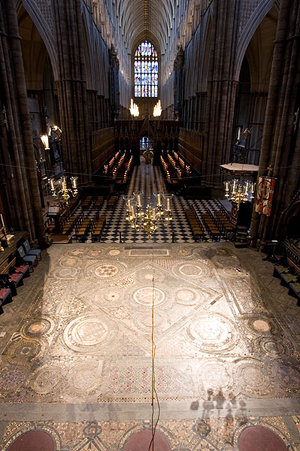 Laid down in 1268 on the orders of King Henry III who, 23 years earlier had started rebuilding the abbey in the new Gothic style, it was created by a team of workmen from Rome headed by a man called Odoricus.
The decision to create the pavement was apparently taken after the Abbot of Westminster, Richard de Ware, visited the Pope, saw a newly made pavement in His Holiness’ summer residence, and thought it would be just the ticket for the abbey.
The pavement, described by one writer as a “prayer set in stone”, takes its name from ‘Cosmati’ work which describes the type of inlaid stone decoration used in its making (Cosmati work, in turn, was named after one of the families that specialised in it).
Made from rare marbles, gemstones and even glass (with some pieces recycled from earlier projects), the design is abstract. Unlike Roman and earlier medieval mosaic work which tended to feature stones cut into squares of equal sizes, it features stones of various colors and sizes cut into a range of different shapes which create a geometric pattern and is believed to symbolise the world, the universe and the end of both.
In this regard, the pavement also features three brass inscriptions, now damaged, which refer to the end of the world and suggest that at the time of its creation, there were 19,683 years left to go. The inscriptions, which also express the date of its making in a most unusual style, are a unique feature of the pavement and are not found on other Cosmati works.
The pavement has recently undergone a two year restoration program, now completed, which has removed the dirt and stains which had covered it – this was in part caused by the thick carpets which have covered it for the most of the 150 years.
WHERE: Westminster Abbey, Westminster (nearest Tube station is Westminster or St James’s Park); WHEN: Open to tourists everyday except Sunday (times vary so check the website); COST: £15 an adult/£12 concessions/£6 schoolchildren (11-18 years), free for children aged under 11/£36 for a family (two adults, two children); WEBSITE: www.westminster-abbey.org
PICTURE: Copyright: Dean and Chapter of Westminster.
Around London – New VC gallery at Imperial War Museum; Roman remains unearthed at Syon Park; and, High Society at the Wellcome Collection…
• An exhibition containing the world’s largest collection of Victoria Crosses has opened at the Imperial War Museum, housed in what is the museum’s first new major permanent gallery for 10 years. The Extraordinary Heroes exhibition – housed in the Lord Ashcroft Gallery – contains his Lordship’s collection of 162 Victoria Crosses, awarded for parts played in wars stretching from the Crimean to the Falklands, displayed alongside the 48 Victoria Crosses and 31 George Crosses already held by the museum. As well as the awards, the new gallery will display many objects for the first time, including a badly damaged backpack worn by Lance Corporal Matt Croucher when he leapt on a grenade during action in Afghanistan in 2008 to save the lives of his fellow soldiers (he survived as well), and the diving suit worn by Acting Leading Seaman James Magennis who won a VC for his role in placing limpet mines in the Johore Straits in World War II. The gallery was paid for with a £5 million donation from Lord Ashcroft. Admission is free. For more information, see www.iwm.org.uk.
• The remains of a Roman settlement have been unearthed at historic home, Syon Park, in London’s west. Archaeological experts from the Museum of London have already removed around 11,500 pieces of pottery, jewellery and about 100 coins from the site on the Syon Park estate. Syon Park, the home of the Duke of Northumberland, sits on the northern bank of the Thames, opposite Kew Gardens. The site was excavated in 2008 in preparing for the construction of a new luxury hotel there. Some of the artefacts will go on display at the new hotel, the London Syon Park, A Waldorf Astoria Hotel, which will open early next year. The settlement, which includes a Roman road and burials, was discovered only half a metre below ground level. For more information on the property, see www.syonpark.co.uk.
• Now on: From an early morning coffee in European cities to chewing betel nut in Asia, the Wellcome Collection’s major winter exhibition, High Society, traces the role mind-altering drugs have played in history and culture. The display includes more than 200 exhibits, from an 11th century manuscript written by monks in Suffolk detailing poppy remedies, to a 17th century account by Captain Thomas Bowrey describing his crew’s experiments with the cannabis drink bhang, and an account of NASA’s experiments with intoxicated spiders. Admission is free. The exhibition runs until 27th February. For more information, see www.wellcomecollection.org.
Wren’s London – 10. The Monument, The Temple Bar, and more churches…
So we come to the final in our series on Wren’s London. This week we take a quick look at some of Wren’s remaining London works (keep an eye out for our upcoming ‘daytripper’ on Oxford for some detail of his works there)…
• The Monument. Built between 1671-77 to commemorate the Great Fire of London, it was designed by Wren and Dr Robert Hooke. For further information, see our previous post.
• The Temple Bar. Designed by Sir Christopher Wren in 1672 to replace a crumbling wooden predecessor, it’s only recently been returned to the City and now stands adjacent to St Paul’s. For further information, see our previous post.
• Churches. We’ve only looked in depth at a few of the existing churches Wren designed in London. But here are some of the others among the more than 50 he designed that still stand:
• St Benet Paul’s Wharf. Originally completed in 1685, it claims to be the only “undamaged and unaltered” Wren church in the city, having survived World War II intact. Now the Welsh church of the City of London. See www.stbenetwelshchurch.org.uk.
• St James Garlickhythe. Built according to Wren’s design, it was completed in 1682 (the tower not until 1717). It is known as ‘Wren’s Lantern’ due to its light interior. See www.stjamesgarlickhythe.org.uk.
• St Margaret Pattens. Built between 1684 and 1687 after the previous church was destroyed in the Great Fire, the church gets its unusual name of ‘pattens’ from wooden undershoes that were worn to elevate people out of the mud, and were sold nearby. See www.stmargaretpattens.org.
• St Margaret Lothbury. Completed in 1692, it now incorporates seven adjacent parishes thanks to losses in the Great Fire, World War II and building projects and is now officially known as the parish church of “St Margaret Lothbury and St Stephen Coleman St with St Christopher-le-Stocks, St Bartholomew-by-the-Exchange, St Olave Old Jewry, St Martin Pomeroy, St Mildred Poultry and St Mary Colechurch.” See www.stml.org.uk.
• St Martin-within-Ludgate. Rebuilding was largely completed by 1680. The previous church on the site was where William Penn, founder of Pennsylvania, was married. See www.stmartin-within-ludgate.org.uk.
Others, some of which have been rebuilt since Wren’s day, include St Andrew-by-the-Wardrobe, St Andrew Holborn, St Anne and St Agnes (Now St Anne’s Lutheran Church), St Clement Eastcheap, St Lawrence Jewry, St Mary Abchurch, St Mary Aldermary, Mary-le-Bow, St Michael, Cornhill, St Michael Paternoster Royal, St Nicholas Cole Abbey (being redeveloped as a centre for religious education), St Peter upon Cornhill, and St Vedast alias Foster. (We’ll be featuring some in more detail in later entries).
LondonLife – Lord Mayor’s Show 2010
On Saturday, the City of London paused for the 2010 Lord Mayor’s Show. We’ve captured some images from the event…

The crowd waiting patiently in Poultry, looking towards Mansion House, home of the Lord Mayor. The parade makes its way to the Royal Courts of Justice, stopping off at St Paul’s and then back via Victoria Embankment.
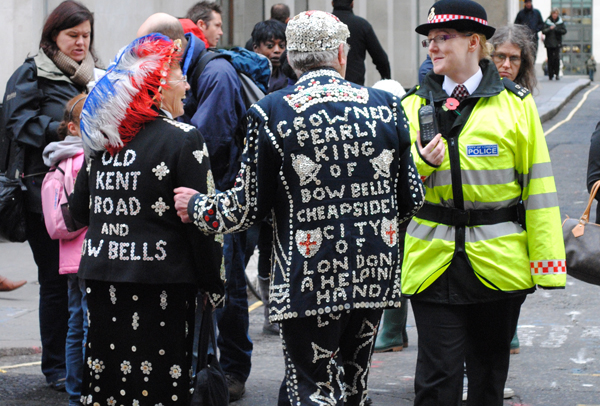
A Pearly King and Queen seek some advice from the local constabulary.

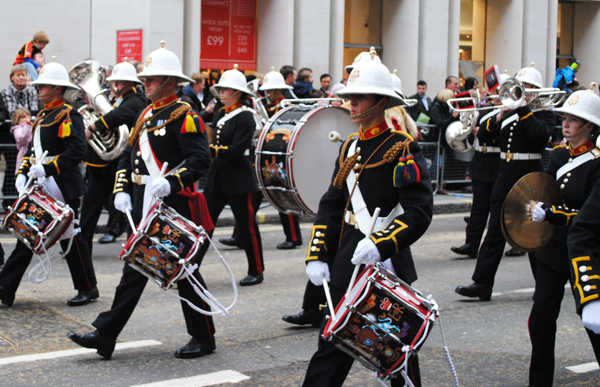
The parade opened with the Band of Grenadier Guards, formed in 1685 by Charles II.
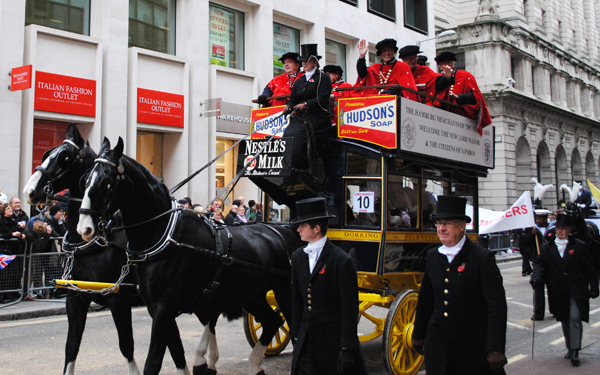
Members of the Council of the Hamburger Morgensprache, successor to the medieval gathering of merchants of Hanseatic cities on the Baltic and North Sea coasts of which Hamburg was a leading member. Under a charter granted by Henry III, the merchants had their own enclave in the City of London.
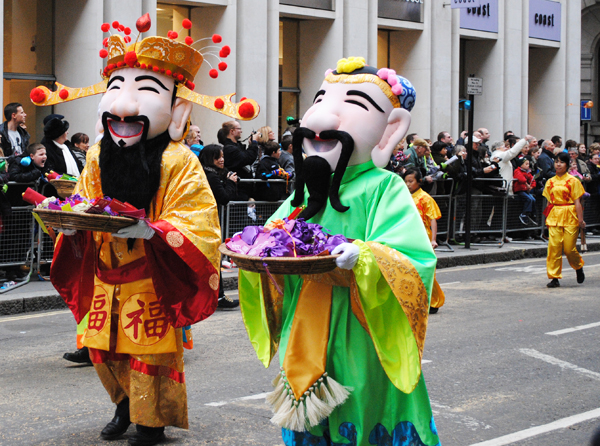
Part of the Hong Kong Economic and Trade Office’s representation.

One of the many bands in the parade.
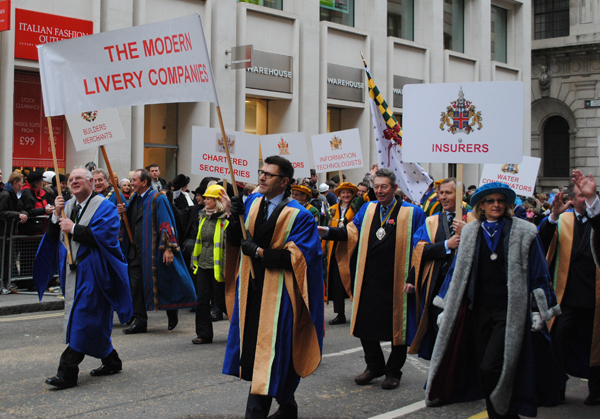
The Modern Livery Companies had walkers representing 21 livery companies, from Actuaries and Arbiters to Farmers, Solicitors, Tobacco Pipe Makers and World Traders. Other livery companies represented in the parade included the Worshipful Company of Lightmongers, the Worshipful Company of Paviors, and the Worshipful Company of International Bankers.

One of the many carriages transporting city officers. This one contains Sheriff Richard Sermon and his chaplain, Rev Michael Marshall, with two Doggett’s Coat and Badge men at the back.
Doggetts Coat and Badge Men – every year since 1715, apprentices from the Company of Watermen have contested a boat race on the Thames to win the coveted Doggett’s Coat and Badge.
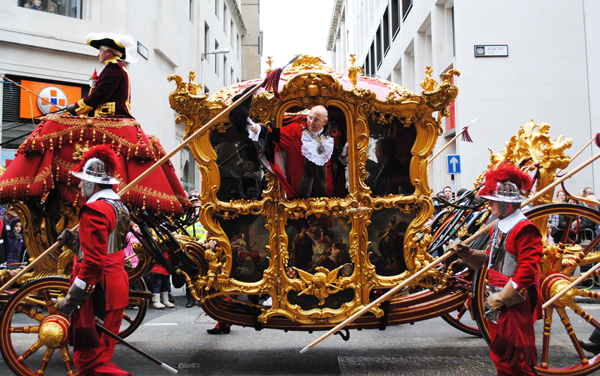
Lord Mayor Michael Bear, the 683rd Lord Mayor of London, greets Londoners. The State Coach dates from 1757.

Pikemen, part of the Lord Mayor’s bodyguard for ceremonial occasions. The style of uniform dates from the reign of Charles I.

On the Thames, looking out from Waterloo Bridge. A fireworks display was held here from 5pm onwards.
Where’s London’s oldest…restaurant?
For a city packed with restaurants of all shapes and sizes catering to all sorts of tastes, this title remains apparently undisputed with Rules in Covent Garden generally agreed to be London’s oldest restaurant.
 Founded in 1798 by Thomas Rule, the restaurant has only been owned by three families – the Rules, the Bell family and that of the current owner, John Mayhew, who purchased the restaurant in 1984.
Those who have dined there include literary luminaries such as HG Wells, William Makepeace Thackeray, Charles Dickens, Graham Greene (it features in his novel, The End of the Affair – only one of a number of books in which the restaurant makes an appearance), John Le Carre, and poet John Betjeman, actors including Clark Gable, Harrison Ford, Paul Newman and Joan Collins, politicians including Michael Heseltine, John Prescott and William Hague, and even royalty – Edward VII, when Prince of Wales, was known to meet his mistress Lillie Langtry here.
Originally opened as an ‘oyster bar’, the restaurant at 35 Maiden Lane is these days known for its game dishes.
For more information, see www.rules.co.uk.
Around London – Lord Mayor’s Show tomorrow; Book of the Dead at British Museum; and Evolving English at the British Library
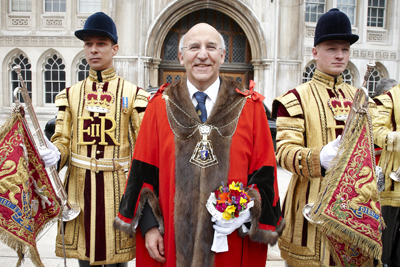 • The Lord Mayor’s Show is tomorrow. The world’s oldest civic procession, it’s been held for 795 years (the last time it was interrupted was due to the Duke of Wellington’s funeral) and commemorates the day when the newly elected Mayor had to make the journey from the City to Westminster to declare his allegiance to the monarch. This year’s Lord Mayor of the City of London – the City’s 683rd – is Alderman Michael Bear (not to be confused with the Mayor of London Boris Johnson). The procession kicks off at 11am and travels from Mansion House to St Paul’s Cathedral, where the Lord Mayor, who formally took office yesterday in a silent ceremony held at Guildhall, is blessed. The procession then moves on to the Royal Courts of Justice where the Lord Mayor swears an oath of allegiance before returning to Mansion House via Victoria Embankment. This year the procession will involve from than 6,000 people from livery companies, military units, marching bands, local schools and businesses and community groups as well as 200 vehicles, 21 carriages – including, of course, the Lord Mayor’s State Coach – and 71 floats. Don’t forget to hang around for the fireworks. For more about the event – where to stand and what you’ll be seeing, see www.lordmayorsshow.org.
PICTURE: Alderman Michael Bear on the occasion of his election as the 683rd Lord Mayor of London. Courtesy Lord Mayor’s Show.
• Now On: The British Museum exhibition, Journey through the afterlife: ancient Egyptian Book of the Dead, was launched last week. The exhibition centres on the museum’s collection of Book of the Dead papyri, many of which have never before been put on display to the public. They include the Greenfield Papyrus, which at 37 metres long is the longest Book of the Dead in the world and has never been displayed in its entirity before. The display also features famous paintings from the papyri of Ani and Hunefer and an array of painted coffins, gilded masks, amulets, jewellery, tomb figurines and mummy trappings. Runs until 6th March. For more information, including admission prices, see www.britishmuseum.org.
• Now On: A new exhibition exploring the development of the English language opens today at the British Library. Evolving English: One Language, Many Voices looks at how the language has evolved from Anglo-Saxon runes to modern day rap and where it’s headed next. Highlights of the exhibition include the first book printed in English, Recuyell of the Historyes of Troye (printed by William Caxton), a 1611 King James Bible, Poor Letter H – a pamphlet dating from 1854 explaining why pronouncing your h’s correctly is important to climbing the social ladder, and the earliest surviving copy of Beowulf. On until April 3rd. Admission is free. For more information, see www.bl.uk.
Remembrance Day
It’s Remembrance Day and all across the UK – and around the world – people are pausing to reflect on those who gave their lives fighting for their country. While the main events related to the day – the laying of wreaths at the Cenotaph and a parade – takes place on Remembrance Sunday, we’re marking the day today with a list of 10 of London’s World War I and II-related war memorials.
This list is by no means comprehensive – there are scores of other memorials in London which relate to the two world wars – but we’d welcome your comments of any others you think we should mention. Lest We Forget…
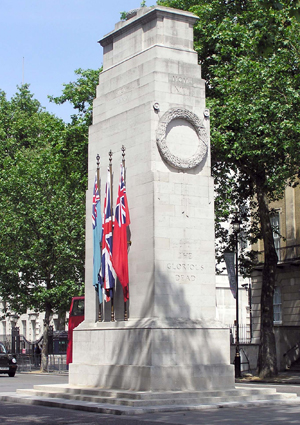 1. The Cenotaph – The most famous of London’s war memorials (pictured right), this simply designed – almost plain – monument stands in the middle of Whitehall and was designed by Sir Edwin Lutyens to commemorate the dead of World War I. It is here that the Queen and other dignitaries lay wreaths on Remembrance Sunday in remembrance of the war dead of both world wars.
2. The Monument to the Women of World War II – Located just along from the Cenotaph, this much criticised memorial marks the role more than seven million women played during World War II. Unveiled in 2005, the memorial was designed by John W. Mills and depicts a series of coats worn by women during the war hanging as though on pegs.
3. The Tower Hill Memorial – This memorial, which was originally unveiled in 1928 and then added to after World War II, commemorates the men and women of the merchant navy and fishing fleets who were killed in either world war and have no known grave. It lists more than 36,000 names. For more information, see www.cwgc.org/search/cemetery_details.aspx?cemetery=90002&mode=1.
4. The Battle of Britain Monument – Located on the north bank of the Thames at Victoria Embankment, this monument pays tribute to those who took part in the Battle of Britain during World War II. Sculpted by Paul Day, it features scenes from the battle in high relief bronze with virtually life-sized statues of airmen scrambling to their aircraft at its centre. Unveiled on 18th September, 2005, the 65th anniversary of the battle. For more information, see www.bbm.org.uk
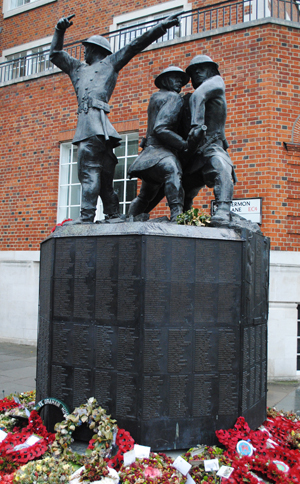 5. The National Firefighters Memorial – Marking the role played by firefighters during the Blitz of London in World War II (as well as the role of firefighters generally), the memorial (pictured right) was designed by John Mills and features the “Blitz” statue – two life-sized firefighters and an officer cast in bronze – standing atop a plinth. First unveiled in by Queen Elizabeth II in 1991, it originally featured the names of 997 men and women who died during the Blitz inscribed upon it but this was extended to include firefighters who have died in peacetime and an additional 1192 names were added prior to a rededication in 2003. Located just south of St Paul’s on the main route to the Millennium Bridge, it is the focus of the annual Firefighters Day of Remembrance held each September. For more information, see www.firefightersmemorial.co.uk.
6. The Animals in War Memorial – Commemorating all the animals that died alongside British, Commonwealth and Allied forces during the wars and conflicts of the 20th century, this unusual monument at Brook Gate in Park Lane was unveiled in 2004. The sculptures include two mules, a horse and a dog all cast in bronze while other animals are depicted in bas-relief on a wall of Portland stone. For more information, see www.animalsinwar.org.uk
7. Canada Memorial – Located in Green Park (just inside Canada Gate), the memorial, designed by Quebec artist Pierre Granche, honors the more than 100,000 Canadians who died in the world wars as well as the more than one million who served. Made of red granite inset with bronze maple leaves, it was designed to create the impression of maple leaves floating down a stream. Unveiled by Queen Elizabeth II in 1994. www.vac-acc.gc.ca/remembers/sub.cfm?source=memorials/ww2mem/green-park-memorial
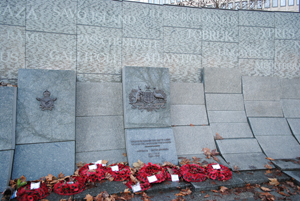 8. Australian War Memorial – Located close to Wellington Arch at Hyde Park Corner, this monumental wall (pictured right) marks the role Australians played in both World Wars. More than 100,000 Australians died during the conflicts and the names of the 23,844 towns in which they were born are inscribed on the wall over which is superimposed the names of 47 battles in which Australians fought in. Unveiled on the 85th anniversary of Armistice Day, 2003. For more information, see www.awmlondon.gov.au.
9. New Zealand War Memorial – Located at Hyde Park Corner diagonally opposite the Australian War Memorial, this monument was designed by architect John Hardwick-Smith and sculptor Paul Dibble and features 16 bronze cross-shaped ‘standards’ of varying heights set in formation and inscribed with text, patterns and some small sculptures. Dedicated on Armistice Day, 2006, by Queen Elizabeth II.
10. Soviet War Memorial – Found in the Geraldine Mary Harmsworth Park – adjacent to the Imperial War Museum in Southwark, the Soviet War Memorial was unveiled in 1999. Designed by sculptor Sergei Shcherbakov, it commemorates the 27 million people who died in the Soviet Union during World War II. For more information, see www.scrss.org.uk/sovietmemorial.htm.
Wren’s London – 9. Marlborough House
We’re nearing the end of our series on Wren’s London (next week we’ll take a final look at some of the Wren designs we’ve not yet mentioned), so this week we look at one of his lesser known (and less accessible) designs – Marlborough House.
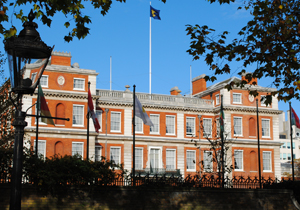 Tucked away behind high brick walls next to St James’ Palace just off Pall Mall, Marlborough House was built for Sarah Churchill, the Duchess of Marlborough – a confidant of Queen Anne – and completed in 1711.
The duchess, who secured a lease of the site from Queen Anne, selected Sir Christopher as the architect in preference to Sir John Vanbrugh, but she later fell out with Wren and, after dismissing him, oversaw the completion of the building herself. It is believed that the design of the house was actually the work of Wren’s son, also named Christopher, although the plans were undoubtedly drawn up under Wren senior’s watchful eye.
The house, built of red Dutch bricks brought to England as ballast in troop transports, was noted for its plain design. But the walls of the central salon and staircases were decorated with scenes of battles the Duke had fought in.
The property remained in the hands of the Dukes of Marlborough until it was acquired by the Crown in 1817. The building – which was substantially extended in the mid 1800s to the designs of Sir James Pennethorne – was subsequently used by members of the royal family including Princess Charlotte (only daughter of the future King George IV) and her husband Prince Leopold (later the King of the Belgians), Queen Adelaide, widow of William IV, Edward, Prince of Wales (later Edward VII), George, Prince of Wales (later George V), King Edward VII’s widow, Queen Alexandra, and, lastly, Queen Mary, widow of George V.
Following the death of the Queen Dowager in 1953, Queen Elizabeth II donated it for use by the Commonwealth Secretariat who still occupy the building today.
WHERE: Pall Mall (nearest Tube stations are Green Park and Piccadilly); WHEN: Two hour tours are usually held every Tuesday morning (check first); WEBSITE: www.thecommonwealth.org/Internal/191086/34467/marlborough_house/
Daytripper – The Historic Dockyard, Chatham
Once a pivotal player in ensuring the UK’s navy remained on top at sea, the Historic Dockyard in Chatham has been involved in preparing ships involved in some of history’s greatest naval engagements – everything from England’s defeats of the Spanish Armada in 1588 to Admiral Lord Nelson’s famous victory at the Battle of Trafalgar.
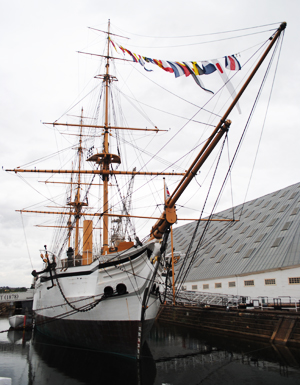 Located 35 miles south-east of London on the River Medway, these days the dockyard plays host to tourists rather than hundreds of craftsmen who once worked there, eager to gain an insight into its rich history (as well as two film crews for movies and TV series).
While the history of the dockyard on its present site goes back to the 1600s, most of the surviving buildings date from between 1700 to the end of the Napoleonic Wars in 1815, during which time the Chatham Dockyard built and launched 125 ships including Nelson’s Victory (which can now be found at Portsmouth).
The dockyard officially closed in 1984 and is now under the care of the Chatham Historic Dockyard Trust.
Attractions these days are many and range from the chance to ramble over historic warships permanently docked there – these include the sloop, the HMS Gannet – launched in 1878 it served as an anti-slaver and later as a training ship, the HMS Cavalier – launched in 1944, it was one of 96 emergency destroyers built during the Second World War and, having served in various places around the world until being ‘paid off’ in 1972, is now preserved as a memorial, and the last vessel built for the Royal Navy there, the Oberon class submarine HMS Ocelot – launched in 1962.
Other features include the Wooden Walls of England – an interactive walk-through looking at what life was like aboard England’s timber-hulled vessels of the mid-1700s, No 1 Smithery which now houses the maritime model collections of the National Maritime Museum and the Imperial War Museum as well as paintings and other artefacts, the Royal National Lifeboat Institution’s collection of historic lifeboats and The Royal Dockyard Museum which houses a large range of artefacts.
Also well worth a visit is the still working Victorian Ropery. Its curmudeonly attendants who provide a fascinating insight in what life was like for those formerly employed there and you can see how rope is still made in the 346 metre long rope house which, when constructed, was the longest brick building in Europe.
There’s also a cafe on site and a range of other odd artefacts at various locations – including the railway carriage used by Lord Kitchener in Sudan in 3 Slip – The Big Space – as well as the historic buildings of the dockyard itself.
There’s certainly more than can be seen in a day but thankfully all tickets are valid for a year.
WHERE: Chatham, Kent (nearest railway station is Chatham). For detailed driving instructions see website; WHEN: Open everyday until 12th December from 10am-4pm (check for times after that); COST: £15 an adult/£12.50 concessions/£10.50 children (aged five to 15 years)/£42.50 for a family; WEBSITE: www.thedockyard.co.uk
Favourite Places – The Museum of London’s Lynne Connell revisits Greenwich
 In the first of a new series looking at some of the favorite historical places of Londoners, Lynne Connell, a host at the Museum of London, nominates Greenwich…
“When I was a child my grandparents took me to Greenwich for the day. I remember being very impressed with Admiral Nelson’s uniform (complete with blood stains) and the haunted tulip staircase in the Queen’s house. While we sat and ate cheese and onion crisps in front of the Cutty Sark, my Grandmother (who was a little eccentric) told me ‘there is so much history here you can feel it’.
“So what can you see in Greenwich today?
“You can visit the Greenwich Observatory, stand on the Meridian line and know you are in the centre of the world! Admission is free there, as well as the National Maritime Museum and the Queen’s House. You can also see the magnificent Wernher collection at Ranger’s House (free to members of English Heritage) and don’t forget the tiny Fan Museum.
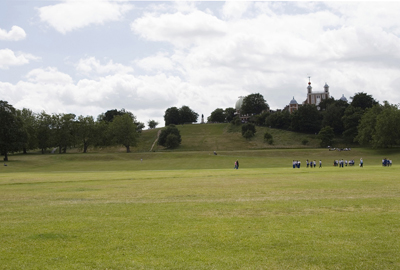 “A favourite lazy Sunday morning, includes a stroll in the Royal Park to visit the deer enclosure, a leisurely coffee in one of the two cafes and a visit to the craft market.
“The remains of a Roman villa can be seen in the park and you can visit Princess Caroline’s bath. Don’t miss Queen Elizabeth’s oak, Henry VIII is reputed to have courted Anne Boleyn under the boughs of his ancient hollow tree. It fell during high winds in the 1990’s and is now slowly rotting away.
“Look down from the Observatory Gardens upon the magnificent Royal Naval College and go to visit the beautiful painted hall. Remember, beneath the college lie the remains of the Royal Palace of Placentia, birth place of Henry VIII and Elizabeth I.
“It is easy to get to Greenwich by over ground train, DLR or (to really pick up the atmosphere) by river boat.
“It is more than 40 years since my introduction to the history of Greenwich, and perhaps I am becoming a little eccentric myself, but my grandmother was right, you really can ‘feel the history’.”
PICTURE: Greenwich Park, © Anne Marie Briscombe (Royal Parks)
It’s Guy Fawkes Day!
 Guy Fawkes Day has arrived. In case you missed it earlier this week, here’s our explanation of the origins of Bonfire Night.
For a comprehensive list of where you local bonfire is taking place in London, take a look at the View London website.
Around London – The Magazine gets a new life, Lennon’s former home commemorated, and, The Titanic Exhibition
 • News this week that The Magazine building in Kensington Gardens – which dates from 1765 and was built to house munitions initially intended to help repel a Napoleonic invasion – is getting a new lease of life as an art gallery. The Royal Parks have awarded the Serpentine Gallery a contract to create a new art space – the Serpentine Sackler Gallery – in the building. Pritzker Prize architect Zada Hadid will oversee the renovation of the building which will be open in time for the Olympic Games in 2012. PICTURE: John Offenbach © The Royal Parks and Serpentine Gallery.
• A Blue Plaque commemorating singer, songwriter and one-time Beatle John Lennon’s stay in a house in Marylebone was unveiled last month. Yoko Ono unveiled the plaque at 34 Montagu Square, where she and John lived in the basement and ground floor flat in the latter half of 1968 when Lennon was working on The Beatles’ White Album. It was the first home the couple shared and, while Lennon lived at a number of London addresses between 1963 and 1971, of those that survive it is the home he occupied for the greatest period. Previous occupants included Ringo Starr, Paul McCartney and Jimi Hendrix.
• ON NOW: Titanic: The Artefact Exhibition will be held at the O2 from 5th November until 1st May. The exhibition traces the Titanic’s final journey, from Cherbourg on 10th April, 1912 to its sinking with the loss of 1,500 lives after striking an iceberg three days later. Featuring more than 200 artefacts from the ship, the exhibition includes recreated interiors from the ship. Tickets start at £13 for adults. For more information, see www.titaniclondon.co.uk.
Wren’s London – 8. Old Royal Naval College, Greenwich
Hunkering down on the south bank of the Thames, the Old Royal Naval College at Greenwich is yet another Wren masterpiece and the centrepiece of the UNESCO-listed Greenwich Maritime World Heritage Site.
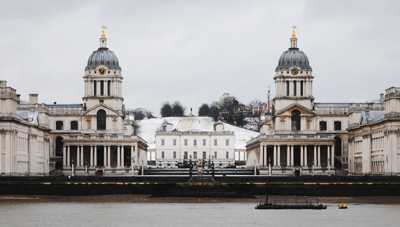 What is now known as the college was originally designed as a ‘hospital’ or retirement home for old or infirm sailors. Established by Royal Charter in 1694, it was King William III who pushed the project into fruition as per the wishes of his then late wife Queen Mary II.
Wren was selected to design the building and along with the diarist John Evelyn, who had been appointed treasurer, laid the foundation stone on 30th June, 1696.
Wren’s initial design – for a three side courtyard facing the river – was rejected by Queen Mary who insisted the view from the existing Queen’s House to the river be maintained. So, instead, the hospital was built as a series of four pavilions, each with its own court, with the Queen’s House standing as it’s centrepiece when viewed from the river.
Wren himself never lived to see the building’s completion – it was in the end completed by a number of other famous architects including Sir John Vanbrugh, Thomas Ripley, and Wren’s pupil Nicholas Hawksmoor. Fortunately Wren had laid out all the foundations which ensured the basic design conformed to his plans.
The first 42 pensioners moved in in 1706 and the numbers grew as buildings were completed to a peak of 2,710 in 1814. However, declining numbers of pensioners by the mid 1800s – thanks to a period of peace on the seas and the success of a program which saw more pensioners living with their families, eventually led to the hospital’s closure in 1860.
In 1873, the Royal Naval College took over the premises, assuming the role of both the former Naval College at Portsmouth and the School or Naval Architecture and Marine Engineering which had been based in South Kensington. The Naval Staff College opened on the site in 1919 and further navy departments including the Department of Nuclear Science and Technology moved there in later years. The Royal Navy left the college in 1998.
Now in the care of the Greenwich Foundation, the college is now used by the University of Greenwich and the Trinity College of Music as well as for public events. The public can also visit certain parts of the former college including the grounds, the spectacular Painted Hall and the Chapel.
The domed Painted Hall, which features a series of classically themed paintings with King William III and Queen Mary II at its heart, was originally planned by Wren to be the hospital’s dining hall but due to the length of time it took for Sir James Thornhill to complete – 19 years – his paintings it was never used as such. Instead it stood empty until the body of Admiral Lord Nelson was brought there to lie in state in January 1806. In 1824 it became the National Gallery of Naval Art but in the 1930s became a dining room again with the gallery’s contents transferred to the National Maritime Museum.
The Chapel of St Peter and St Paul, meanwhile was completed in 1751 to the design of Sir Thomas Ripley but was gutted by fire only 28 years later. It was then rebuilt, largely to the designs of James “Athenian” Stuart with some of the detailing designed by his Clerk of Works William Newton, and was reopened in 1789. Restored in the 1950s, it is said to look “almost as it was” when it opened in 1789. The chapel is still in use for services.
WHERE: Located adjacent to Greenwich Pier with entry from Cutty Sark Gardens, College Approach, Romney Road Gate, Royal Gate or Park Row, Greenwich (nearest DLR station is Cutty Sark for Maritime Greenwich); WHEN: The Painted Hall and Chapel are open daily from 10am to 5pm (chapel used for worship on Sunday mornings, open for sightseeing from 12.30pm); COST: Free (Booked guided tours are available for £5 an adult/children under 16 free); WEBSITE: www.oldroyalnavalcollege.org
A Moment in History – Guy Fawkes and the Gunpowder Plot
This week, on November 5th and surrounding days, people across England will mark Bonfire Night, an annual event which involves burning effigies of Guy Fawkes on top of a bonfire and setting off copious amounts of firecrackers.
So who was Guy Fawkes and what’s it all about?
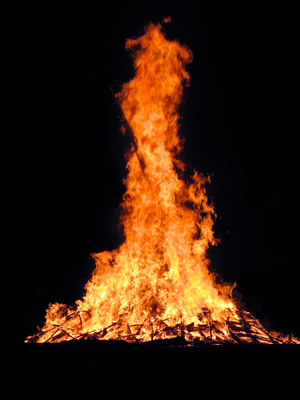 Bonfire Night (the 5th November is also known as Guy Fawkes Day or Fireworks Night) has its origins in 1605 when a group of Catholics – including Guy or Guido Fawkes (the latter the Spanish form of his name) – attempted to blow up parliament in what became known as the Gunpowder Plot.
Born in York in 1570, Fawkes converted to Catholicism some time before selling his inheritance and heading to continental Europe where he fought as a mercenary for Catholic Spain against the Protestant Dutch in the Eighty Years War.
Having later travelled to Spain where he unsuccessfully tried to drum up support for a Catholic rebellion in England, he then returned to England where he was introduced to Robert Catesby, who planned to assassinate King James I and much of parliament and put a Catholic monarch back on the throne.
Having leased an undercroft beneath the House of Lords, the group of 13 plotters stockpiled gunpowder there with Fawkes put in charge of lighting it on 5th November before making his escape to the Continent. An anonymous letter, however, to Catholic Lord Monteagle warning him not to attend the State Opening of Parliament, led authorities to the site around midnight on 4th November and there they found Fawkes guarding the 36 barrels of gunpowder.
Arrested (he initially gave them the name of John Johnson), he subsequently confessed under torture and was sentenced to be hung, drawn and quartered – a sentence which he shortened by leaping off the scaffold and breaking his own neck before it could be carried out. The other plotters were also either killed, imprisoned or executed.
Bonfires were supposed to have been lit the night after the plot was foiled – 5th November – to celebrate the king’s safety and they have been ever since that date (in fact, James I passed an Act of Parliament making 5th November a day of thanksgiving – it remained in force until 1859).
Effigies of Fawkes followed (although some people substitute that of Fawkes with other people) as did the firecrackers. Some children carry effigies of Fawkes around asking for a “penny for the Guy” in an effort to apparently raise money for firecrackers. The poem which starts “Remember, remember, the fifth of November” is also associated with the night.
The night, which is now celebrated for all sorts of reasons – some suggest Guy Fawkes should be recognised as a hero for defending persecuted people against governments, is reportedly still observed in places as far afield as the US and New Zealand.
The cellar where Fawkes was arrested no longer exists – it was destroyed during a fire which consumed much of the medieval Houses of Parliament in 1834. But interestingly, the Yeoman of the Guard still do search the Houses of Parliament before each State Opening of Parliament. Two confessions signed by Fawkes are held at the National Archives.
PICTURE: Agata Urbaniak (www.sxc.hu)
What’s in a name?…Fleet Street
Renowned around the world for its associations with journalism (not to be mention, it’s desirability as a Monopoly property), the origins of Fleet Street’s name go back to a river which still runs through London today.
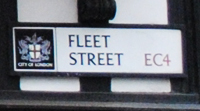 The River Fleet (the name Fleet is believed to come from a Saxon word, fleot, which means ‘flood’) these days actually runs under London, flowing from Hampstead Heath in the city’s north via sewers to spill into the Thames beneath Blackfriars Bridge.
A significant river in Roman times, by the medieval period the river had become polluted, thanks to the growth of industry along its banks. After the Great Fire of 1666, it was converted into the New Canal but this rather quickly fell out of use and sections of the river were covered for various urban projects from the 1730s onwards (the final sections, near the headwaters, were apparently covered in the 1870s).
Fleet Street, which takes its name from the river, has been known as such since medieval times and along its length, which runs east from where The Strand ends at Temple Bar to Ludgate Circus, is the location of a number of significant properties – from the Temple, formerly the property of the Knights Templar and now site of two Inns of Court, through to St Bride’s Church, St Dunstan-in-the-West and several old taverns, including Ye Olde Cheshire Cheese.
The street’s association with publishing goes back to the early 1500s when Wynkyn de Worde, apprentice to William Caxton, set up shop there and other printers and publishers followed. London’t first daily newspaper, The Daily Courant, was published there from 1702 and the street subsequently became home to many national newspapers (the press in the UK is still referred to as ‘Fleet Street’ although these days no newspapers are based there – the last media outlet, Reuters, moved out in 2005).
There have recently been suggestions that the river Fleet could once again be uncovered as part of a bid to revitalise London’s “lost” waterways.
LondonLife – Horse Guards Parade…
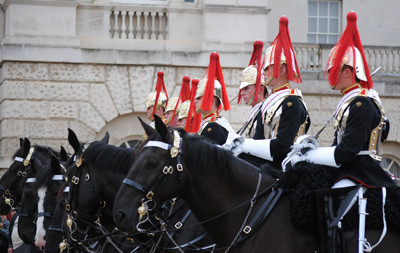
The Queen’s Life Guard at Horse Guards Parade. The parade ground, which lies between Whitehall and St James’ Park, was formerly the site of the tiltyard of the Palace of Whitehall and was the location for tournaments during the rule of Henry VIII. It now serves as the site for the annual Trooping the Colour ceremony. The men pictured (wearing blue tunics and red plumed helmets) are part of a squadron of The Blues and Royals (Royal Horse Guards and 1st Dragoons) who, along with a squadron of The Life Guards (wearing red tunics and white plumed helmets), make up the Household Cavalry Mounted Regiment, responsible for providing The Queen’s Life Guard. The “Horse Guards” have guarded this site – still regarded as the official entrance to St James’ Palace and Buckingham Palace – since the Restoration of Charles II in 1660 and can be seen there in the Changing of the Guard ceremony on weekdays and Sundays. For more information, visit www.army.mod.uk/events/ceremonial/2355.aspx
Around London – HMS Belfast restored, Buckingham Palace record, plumber’s new statue
• The HMS Belfast’s newly restored masts were unveiled to the public this week following an 18 month restoration project. Moored on the Thames between Tower and London Bridges, the ship is one of only a few surviving Royal Navy ships that served in Arctic convoys supplying Russia during World War II. The restoration was carried out for free by a team of more than 20 men and women from the JSC Shipbuilding plant, Severnaya Verf, in St Petersburg, Russia as a tribute to the British and Allied sailors who risked their lives on the convoys. The work involved removed and replacing all of the masts. For more information, see http://hmsbelfast.iwm.org.uk.
• A record 413,000 people visited Buckingham Palace over the summer – the highest number in 16 years. The record numbers were partly ascribed to the new Garden Cafe which served 46,000 cups of tea. Meanwhile, the palace has announced the exhibition, Victoria & Albert: Art & Love, at the Queen’s Gallery has been extended until 5th December. For more information, see www.royalcollection.org.uk.
• The Worshipful Company of Plumbers has reportedly announced it will be installing a bronze statue of a plumbers’ apprentice outside Cannon Street station next year. The statue’s installation will mark 400 years since the company first received its Royal Charter from King James I. The station was the site of the company’s livery hall until 1863 when the site was compulsorily acquired to make way for the new railway.
Wren’s London – 7. Kensington Palace
A once favored residence of British monarchs, Kensington Palace’s connections with royalty date back to 1689 when, then a private country home known as Nottingham House, the building was purchased by King William III and Queen Mary II.
 The royal couple turned to Sir Christopher Wren, then Surveyor of the King’s Works, who was charged with adapting the property into a suitably regal residence.
Wren’s work included the addition of four new pavilions – one at each corner – to provide extra accommodation for the king and queen. The King’s Apartments, approached by a Grand Staircase, were located in the south east, and the Queen Apartment’s in the north west. While many later additions were made, the basic layout of these buildings remains true to Wren’s original design.
Among the many spectacular original rooms is the King’s Gallery, built for William in 1695. It features an 1694 wind dial connected to a weather vane which turns according to the direction of the prevailing wind.
The property’s subsequent royal residents have included Queen Anne, King George I and King George II (it was King George III who made Buckingham Palace his primary London residence). Princess (later Queen) Victoria was born here in 1819 (it was she who first opened the State Apartments to visitors in 1899) while more recent residents in the palace’s private areas have included Princess Margaret and, of course, Diana, Princess of Wales.
WHERE: The Broad Walk, Kensington Gardens, Kensington (nearest tube stations are High Street Kensington or Queensway); WHEN: Daily 10am to 5pm (last admission 4pm); COST: £12.50 adult/£11 concession/£6.25 child/£34 family (online booking discounts available, Historic Royal Palaces members free); WEBSITE: www.hrp.org.uk/KensingtonPalace
PICTURE: Historic Royal Palaces/newsteam.co.uk
 Exploring London