Treasures of London – ‘The Fighting Temeraire’

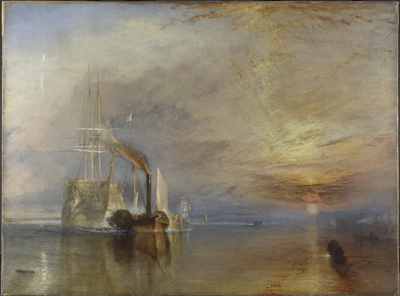
fighting-temeraireIt’s an atmospheric image – both literally and metaphorically – that will soon be sitting in wallets and purses across the UK. Painter JMW Turner’s The Fighting Temeraire tugged to her last berth to be broken up, 1838 is among the most famous artworks hanging in The National Gallery and, as the Bank of England has announced earlier this year, will adorn newly produced £20 notes from 2020 onwards. It commemorates the end of the famous ship, the 98 gun HMS Temeraire, which had played a heroic role in Lord Nelson’s victory at the Battle of Trafalgar in 1805 and, say reports, had been dubbed the “Fighting” Temeraire ever since (although it’s also suggested the ship was actually known by the crew as the “Saucy” Temeraire) . The oil painting, which Turner created in 1839, depicts the ship being towed away to be broken up (although, while it was actually towed from Sheerness to Rotherhithe in London –  a westerly trip, the painting depicts it going eastward). The Temeraire itself is drawn romantically, almost spectrally, while in front of it is a steam tug shown in hard modernity and, of course, in the backdrop is the majestic setting sun, evoking a sense of the end. The painting, which was bequeathed to the gallery by the artist in the 1850s, and which incidentally appeared in the James Bond film Skyfall in a scene in which 007 (Daniel Craig) meets Q (Ben Wishaw) in front of it, can be found in Room 34 of gallery.

WHERE: The National Gallery, Trafalgar Square (nearest Tube stations are Charing Cross and Leicester Square); WHEN: 10am to 6pm daily (open to 9pm Saturdays); COST: free; WEBSITE: www.nationalgallery.org.uk.

PICTURE:  Joseph Mallord William Turner, The Fighting Temeraire tugged to her last berth to be broken up, 1838, © National Gallery, London

This Week in London – Medieval embroidery; Maino on show; former toilet block becomes Kensington Garden’s newest eatery; and, a new Lord Mayor…

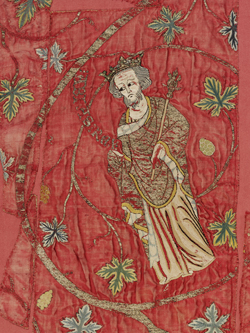
the_jesse_cope_detail_ca-_1310-25_c_victoria_and_albert_museum_londonObjects associated with some of the most notable personages of the Middle Ages – from King Edward I and his wife, Queen Eleanor of Castile through to Edward, the Black Prince, and martyred archbishop, Thomas Becket – will go on show at the V&A in South Kensington as part of a display of medieval embroidery. Opening Saturday, Opus Anglicanum: Masterpieces of English Medieval Embroidery features embroidered treasures such as a seal-bag which, dating from the early 12th century, was made to hold the foundation document of Westminster Abbey, the Toledo Cope which has been brought back to England from Spain for the first time since its creation in the 14th century and an embroidered vestment associated with Thomas Becket. There’s also the Hólar Vestments from Iceland, the Jesse Cope from the V&A’s own collections (pictured), the Daroca Cope from Madrid and an embroidered tunic worn by Edward, the Black Prince. As well as embroidery, the display features panel paintings, manuscripts, metalwork and sculpture. Runs until 5th February along with a season of events. Admission charges apply. See www.vam.ac.uk/opus for more. PICTURE: © Victoria and Albert Museum, London.

Two works by Spanish painter Fray Juan Bautista Maino have gone on exhibition for the first time in the UK at The National Gallery, off Trafalgar Square. The Adoration of the Shepherds and The Adoration of the Kings, dating from 1612-14, have been loaned from the Museo Nacional del Prado in Madrid, Spain, and can be seen for free in a display being held in conjunction with the upcoming exhibition Beyond Caravaggio. Each of the paintings measures more than three metres in height and were originally part of a retable (altarpiece) created for the altar of the Dominican church of San Pedro Martir in Toledo. The work took three years to complete and it was while he was doing so that Maino took religious vows and joined the Dominican Order (there’s also a chance he included a self portrait in the work in the form of a pilgrim on the altar’s far left). Can be seen until 29th January. For more, see www.nationalgallery.org.uk.

A former disused toilet block has been converted into a new cafe overlooking the 150-year-old Italian Gardens in the Kensington Gardens. Formally opened by Loyd Grossman, chairman of the Royal Parks charity, earlier this month, the cafe has a “living roof” aimed at supporting the biodiversity and wildlife of the gardens and has been designed in sympathy with the gardens and the nearby Grade 2* listed Queen Anne’s Alcove, currently being restored. The Italian Gardens were a gift from Prince Albert to Queen Victoria. For more on the cafe, including opening times, head here.

Alderman Andrew Parmley has been elected as the 689th Lord Mayor of London. In keeping with tradition, he will take up the office after the ‘Silent Ceremony’ in Guildhall on 11th November followed by the annual Lord Mayor’s Show parade through the City the following day.

Send all items to exploringlondon@gmail.com for inclusion.

10 sites commemorating the Great Fire of London – 8. St Paul’s memorial to John Donne…

As mentioned earlier, there are several memorials to the Great Fire of London at St Paul’s Cathedral – we’ve already mentioned one of them, the Resurgam, which can be found on the south side of the cathedral’s exterior. 

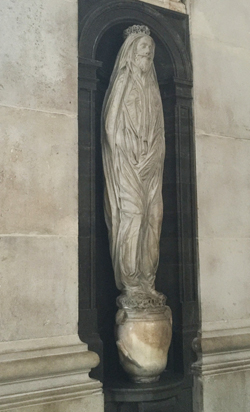
john-donneAnother can be found in a monument which actually commemorates the poet and priest, John Donne, a dean of St Paul’s who died in 1631 (incidentally, it’s not the only place he’s commemorated – there’s also a bronze bust of him outside the cathedral, placed there in 2012).

The marble effigy inside the cathedral, however, is significant because, erected within 18 months of his death,  it is among the few monuments to survive the Great Fire of London. Located in the south quire aisle, the effigy, the work of Nicholas Stone, depicts Donne in his funeral shroud (he apparently posed for it while still alive, wrapped in a sheet).

The effigy was apparently saved by the fact that when the fire raged through the cathedral, it fell into the crypt. And, in a poignant reminder of the fire’s destructive power, if you look closely at the base you can still see scorch marks from the blaze.

It lay in the crypt among other remains of the Great Fire until the late 19th century when it was recovered and restored to its place in the cathedral above in a position close to where it had formerly stood in the Old Cathedral.

PICTURE: Victor Keegan/Flickr/CC BY 2.0/image cropped and lightened.

LondonLife – Rooftop view…

london-skyline

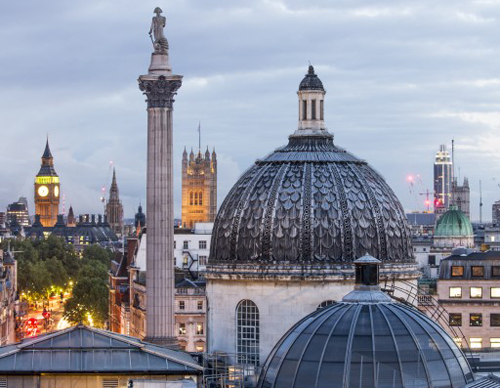
Looking across the roof of the National Gallery past Nelson’s Column to Westminster. PICTURE: London & Partners.

Famous Londoners – Sir Thomas Bludworth…

fireSir Thomas Bludworth (also spelt Bloodworth) is usually only remembered as the man who had the unfortunate job of being Lord Mayor of London when the Great Fire broke out in 1666. So, given the fire’s 350th anniversary this month, we thought it timely to take a more in-depth look at his life and career.

Bludworth was born in London in February, in about 1620, the second surviving son of John Bludworth, master of the Vintner’s Company and a wealthy merchant. Trained to succeed his father – his elder brother having joined the clergy, Bludworth was himself admitted to the Vintner’s Company in the 1640s and joined the Levant Company in 1648.

First elected an alderman in 1658, he was discharged when he refused to serve as a sheriff and the following year served as the master of the Vintner’s Company. In 1660, he was briefly arrested along with 10 other members of City of London’s common council after the body refused to pay taxes until a representative parliament was convened.

Elected MP for Southwark later that year, Bludworth among city and parliamentary representatives who sailed to The Netherlands to attend the king, Charles II, in exile, and invite him to return to England. It was while attending the king in The Hague that he was knighted. Re-elected in 1661, he was an active parliamentarian who served in numerous different capacities.

Sir Thomas was twice married and had a number of children including a formidable daughter Anne who eventually married the historically unpopular George Jeffreys, (later King James II’s Lord Chief Justice and Lord Chancellor).

In mid-1662, he was once again made a City of London alderman and appointed one of two sheriffs for the following year. He became Lord Mayor of London in November, 1665, but apparently there was no pageant as was customary due to the plague.

During his year in the office – “the severest year any man had” – he faced both the plague and the Great Fire and his reputation has been largely formed out of his response to the latter thanks in large part his alleged response when woken and told of the fire as being: “Pish, a woman might piss it out!”.

Bludworth was heavily criticised at the time and over the years since his reaction to the fire – including not pulling down homes to create a firebreak and thus prevent the spread of the fire, but it should be noted that had he done so before he had received the king’s permission, he would have found himself personally liable.

Diarist Samuel Pepys’ who, following two encounters in the months before the fire had already described Bludworth as “mean man of understanding and despatch of any public business”, recorded that when he finally brought a message from the king ordering the creation of a firebreak, Sir Thomas seemed like “a man spent”.

“To the King’s message (to create a firebreak by pulling down houses), he cried, like a fainting woman, ‘Lord, what can I do? I am spent: people will not obey me. I have been pulling down houses, but the fire overtakes us faster than we can do it’.”

Another eyewitness describes him as looking like he was “frighted out of his wits” during the fire.

Sir Thomas’ own property at Gracechurch Street was among the casualties of the fire but he later built a new mansion in Maiden Lane.

He continued to serve as an MP after the fire and was, perhaps ironically, appointed to a committee working on a bill to provide “utensils” for the “speedy quenching of fire”. In the mid-1670s, he become one of the governing members of the Royal African Company.

Sir Thomas died on 12th May, 1682, aged around 60. He was apparently buried in Leatherhead.
This Week in London – Marking the transatlantic cable’s 150th; Sir James Thornhill celebrated; and, food at the Foundling Museum…

commerce-and-sea-power_william-lionel-wyllie

• This year marks the 150th anniversary of the transatlantic cable connecting Europe and America and in celebration of the event, the City of London Corporation’s Guildhall Art Gallery is holding an exhibition looking at the impact of cable telegraphy on people’s understanding of time, space and the speed of communication. Victorians Decoded: Art and Telegraphy, a collaboration between the gallery, King’s College London, The Courtauld Institute of Art and the Institute of Making at University College London, features never-before-seen paintings from the gallery’s collection as well as rare artefacts such as code books, communication devices, samples of transatlantic telegraph sales and ‘The Great Grammatizor’, a messaging machine that will enable the public to create a coded message of their own. It took nine years, four attempts and the then largest ship in the world, the Great Eastern, to lay the cable which stretched from Valentia Island in Ireland to Newfoundland in Canada and enabled same-day messaging across the continents for the first time. Displayed over four themed rooms – ‘Distance’, ‘Resistance’, ‘Transmission’ and ‘Coding’, the exhibition features works by artists including Edward John Pointer, Edwin Landseer, James Clarke Hook, William Logsdail, William Lionel Wyllie and James Tissot. The free exhibition, which runs until 22nd January, is accompanied by a series of special curator talks. For more information, see www.cityoflondon.gov.uk/victoriansdecoded. PICTURE: Commerce and Sea Power, William Lionel Wyllie/Courtesy Guildhall Art Gallery.

• The life of artist Sir James Thornhill – the painter behind the remarkable Painted Hall at the Old Royal Naval College in Greenwich, has opened at The Stephen Lawrence Gallery in Greenwich. A Great and Noble Design: Sir James Thornhill’s Painted Hall explores the story behind the commissioning of the Painted Hall, painted between 1708 and 1727, through a series of preparatory sketches made by the artist, including three newly-conserved original sketches by Thornhill. Also on show will be the results of new research undertaken into the paintings in the light of upcoming conservation work on the hall’s ceiling. The free exhibition runs at the centre at Stockwell Street until 28th October. For more, see www.ornc.org.

The food served at the Foundling Hospital comes under scrutiny in a new show at The Foundling Museum in Bloomsbury. Based on new research, Feeding the 400 looks at the impact food and eating regimes had on children at the hospital between 1740 and 1950 through an examination of art, photographs, objects including tableware and the voices of former student captured in the museum’s extensive sound archive. Guest curated by Jane Levi, the exhibition also includes a newly commissioned sound work which evokes the experience of communal eating. A programme of events accompanies the exhibition which runs until the 8th January. Admission charge applies. For more, see www.foundlingmuseum.org.

Send all items for inclusion to exploringlondon@gmail.com.

10 sites commemorating the Great Fire of London – 7. The ancient plaque commemorating St Olave Silver Street…

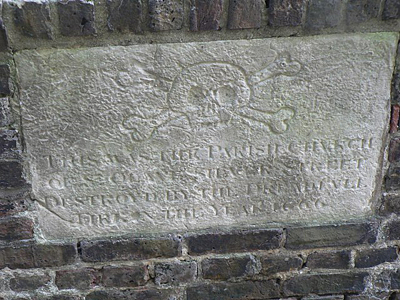
st-olave-silver-streetMany of the monuments commemorating the Great Fire of London, date from succeeding centuries (the Monument being a notable exception), one of the earliest can apparently commemorating the site of the Church of St Olave Silver Street.

The church dated from at least the 12th century and is one of a number in London which were apparently named after King Olaf, the first Christian King of Norway who fought alongside the Anglo-Saxon King Ethelred II against the Danes in England in the 11th century.

The church served as the parish church of the silversmiths and apparently in recognition of that boasted a figure of Christ on the cross which had silver shoes.

The church had been rebuilt in the early 1600s but was completely destroyed in the Great Fire of London and never rebuilt, the parish united with that of St Alban Wood Street.

The site of the church, now on the corner of London Wall and Noble Street, is now a garden and boasts an almost illegible plaque featuring a skull and crossbones, which is believed to date from the late 17th century, and which commemorates the destruction of the church in the Great Fire.

PICTURE: © Chris Downer/CC BY-SA 2.0

LondonLife – ‘Floating Dreams’ on the Thames

floating-dreams1

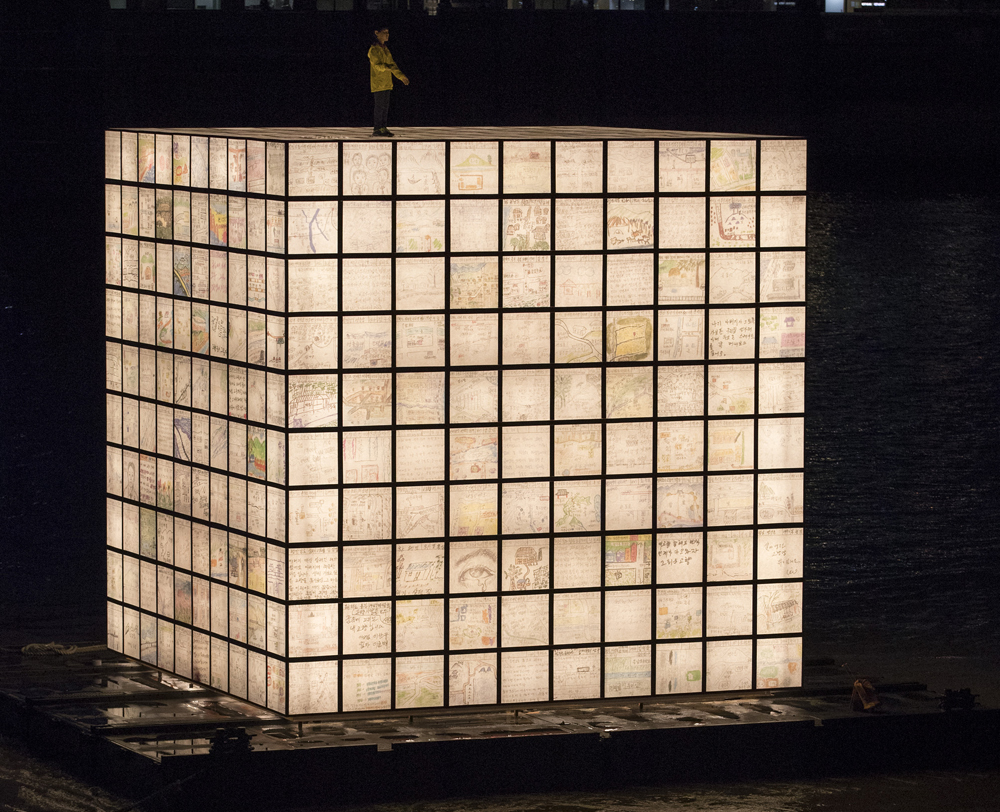
Part of the Totally Thames festival, South Korean artist Ik-Joong Kang’s eye-catching installation, Floating Dreams, acts a memorial to the millions of people who were displaced and divided during the Korean War (1950-53) as well as symbolising the hopes that North and South Korea will once again be unified. The three-storey high installation, which sits on the river alongside Millennium Bridge, is constructed from 500 drawings created by the generation, now aged in their 80s and 90s, who had fled North Korea for South Korea during the war. Their images have been transferred on pieces of a traditional Korean rice paper known as Hanji and then compiled into the cube. The illuminated installation can be seen throughout the festival which runs until 30th September. For more on what’s happening throughout Totally Thames, see http://totallythames.org.

totally-thames-2

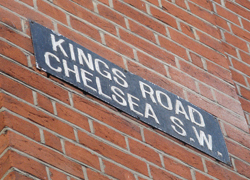
What’s in a name?…Kings Road, Chelsea

Sure, it’s quite obvious that this well-known thoroughfare through Chelsea and Fulham in west London was named for a king but which king and why?

kings-roadIt was the Stuart king Charles II who first starting using the road’s course as part of his route to Hampton Court which meant it was closed to the public.

Access was granted only to those whom the monarch permitted – initially via ticket and from the 1720s via a copper pass stamped with the king’s monogram. Entry was controlled by a series of gates located along its length.

King George III was also known to use the route to travel to his palace at Kew and it was only in 1830 that it was finally opened to the public.

The road, which now runs west from Sloane Square for two miles through Chelsea, transforming into the New King’s Road after entering Fulham, is now known for its shopping (not to mention the site of the UK’s first Starbucks in 1999) although in the 1960s and 1970s it served as something of a hub for London’s counter-culture.

The road has been associated with many famous figures over the years – the king aside. Composer Thomas Arne lived at number 215 and apparently composed Rule Britannia while he did, actress Ellen Terry lived in the same property from 1904-1920 and bon vivant Peter Ustinov after her.

Other famous associations include one with Mary Quant, who opened her ground-breaking boutique Bazaar at number 138a in 1955 and Thomas Crapper, toilet entrepreneur, who had a premises at number 120.

PICTURE: Secret Pilgrim/Flickr/CC BY-SA 2.0

This Week in London – GPO’s archaeological finds on show; Flora Japonica at Kew; and, a blue plaque for Freddie Mercury…

roman-mortarium-made-by-albinus The most prized archaeological finds from a 1975 excavation of the General Post Office on Newgate Street, one of the largest archaeological sites ever excavated in London, are on show in a new exhibition at the Museum of London. Delivering the Past, the free display features objects from across a 3,000 year period and include everything from Roman era finds such as a dog skull, a rare amber die, a spoon and mortar with the makers’ names of Albinus, Sollus and Cassarius stamped on the side (pictured) to floor tiles and architectural fragments from the medieval parish church of St Nicholas Shambles. There’s also a 17th century Bellarmine beer bottle (these were widely imported from Germany in the 1600s), the only 19th century twisted clay tobacco pipe ever excavated in London, and a 19th/20th century ceramic fragment showing General Post Office branding. The exhibition runs until 8th January. The museum is also offering free 45 minute walks to notable excavation sites around Newgate Street every weekday until the end of October. For more, see www.museumoflondon.org.uk.

• Japan’s native flora comes to Kew from this weekend with a new exhibition in the Shirley Sherwood Gallery of Botanical Art. Flora Japonica features paintings from 30 of the Asian nation’s best contemporary artists as they attempt to capture the beauty of everything from camellias to cherry trees and the delicate Japanese maple. The watercolours have been produced based specimens collected from across Japan as well as, in a couple of cases, specimens found within Kew Gardens. Also on display are works never before seen outside Japan including historic drawings and paintings by revered botanists and artists such as Dr Tomitaro Makino (1863-1957), Sessai Hattori and Chikusai Kato (both Edo period artists), artefacts from Kew’s Economic Botany Collection including traditional Japanese lacquerware collected in the 1880s and wooden panels from 1874, and  illustrations from Kew’s collections such as a 17th century illustrated manual of medicinal plants. Runs from Saturday until 5th March after which the exhibition will move to Japan. Admission charge applies. For more, see www.kew.org.

An English Heritage blue plaque honouring late Queen frontman Freddie Mercury was unveiled at his childhood home in Feltham, in London’s west, earlier this month. Mercury’s parents bought the house in Gladstone Avenue in 1964 after the family had left Zanzibar for the UK. He was still living in the home when he met Queen band mates Brian May and Roger Taylor. The new plaque was revealed on 1st September, on what would have been the singer’s 70th birthday.  For more, see www.english-heritage.org.uk/visit/blue-plaques/.

Send all items for inclusion to exploringlondon@gmail.com.

10 sites commemorating the Great Fire of London – 6. A rare survivor…

Walk around the streets of the City of London and it’s hard to miss the myriad of plaques commemorating many buildings lost in the Great Fire of London. On the Strand, however, can be found a plaque which commemorates a building that survived the fire.

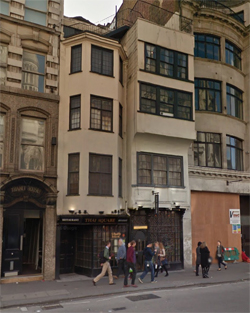
strand-buildingLocated at 230 Strand (opposite the Royal Courts of Justice), the narrow four storey building, complete with projecting second floor, dates from 1625 and was apparently originally built as the home of the gatekeeper of Temple Bar.

According to the sign upon it, the now Grade II* building was the only structure on the Strand to survive the fire of 1666.

Now a rather plain-looking building, it has been much altered over the years and for much of the 20th century housed the Wig and Pen Club for journalists and lawyers – running from at least 1908, it closed in 2003.

Along with the late 17th century building next door (the two are pictured above with number 230 on the right), it’s now part of a Thai restaurant.

PICTURE: Google Street View

LondonLife – West End street scene…

shaftesbury-avenue-london

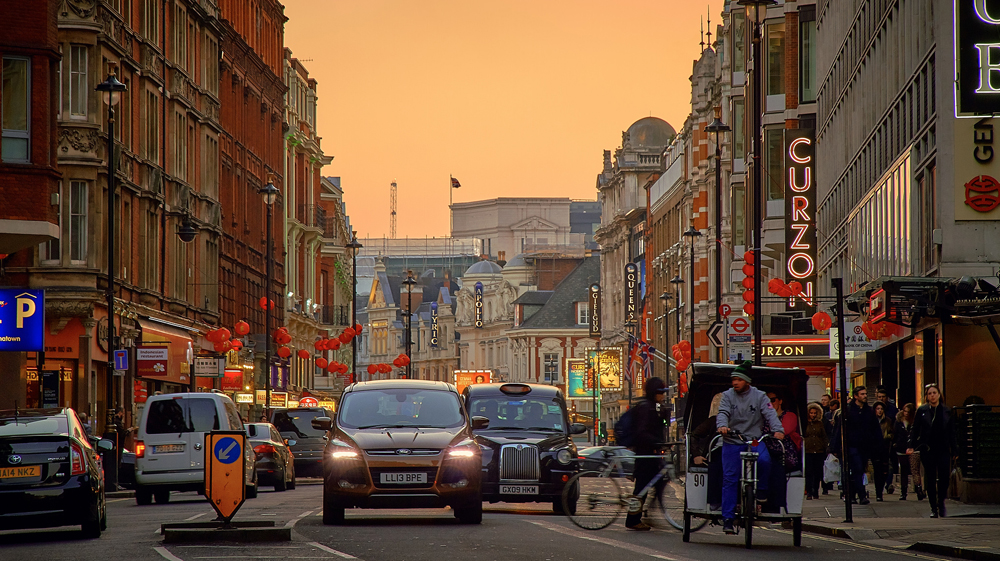
Looking down Shaftesbury Avenue, the heart of London’s Theatreland, in the West End. PICTURE: Pedro Szekely/Flickr/CC BY-SA 2.0

A Moment in London’s History – The ‘Great Tea Race’ crosses the finish line…

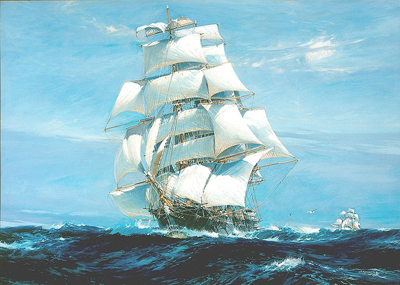
great-tea-raceIt’s 150 years ago this month that the ‘Great Tea Race’  of 1866 ended in London with the clipper ship Taeping taking the honours followed just 28 minutes later by the Ariel.

The race, which had started in China, was part of a tradition for ships carrying cargoes of tea from the east to engage in a race to be the first to dock in London – and quite a lucrative one, for it was common for the first ship to arrive to receive a premium of at least 10 per cent (although 1866 was apparently the last time this was offered).

At least 57 ships apparently sailed in the 1866-67 ‘tea season’, departing for Britain from a range of ports including Shanghai, Canton and Hong Kong. But it was the fastest which gathered the most attention – these chosen clippers set sail for Britain from the Min River, downriver from Foochow (now Fuzhou), in late May, 1866.

As well as the Taeping, launched in 1863 and captained by Donald MacKinnon, and the Ariel, launched only the previous year and captained by John Keay, other favourites in the 1866 race included Fiery CrossSerica and Taitsing.

The race was followed breathlessly in the London press although details were limited – largely due to the time it took for the news to reach London – as the ships set a course which took them through Indonesia via the Sunda Strait and around the southern tip of Africa and up via the Atlantic to the UK.

The Taeping, the race winner, reached London Docks at 9.47pm on 6th September while Ariel arrived at the East India Dock at 10.15pm. The Serica, meanwhile, reached West India Docks at 11.30pm. (It wasn’t to be too unfortunate for the runner-up – Captains McKinnon and Keay had apparently agreed to split the premium of 10 shillings a ton).

Amazingly, this means the three ships – which had all left China on the same tide – had sailed more than 14,000 miles in a race of 99 days yet had managed to dock with just two hours between them.

PICTURE: The Ariel and Taeping, by Jack Spurling (1926)/Wikimedia Commons

Treasures of London – Lighthouse at Trinity Buoy Wharf…

trinity-buoy-wharf-lighthouse

September is the month of ‘Totally Thames’, London’s celebration of its mighty river, so we thought it only fitting that we look at one of the city’s riverside treasures.

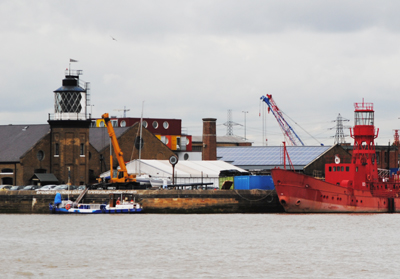
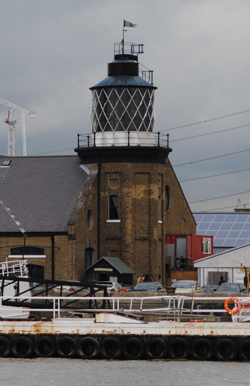
Located to the east of the City at Trinity Buoy Wharf on the north bank of the Thames can be found London’s only lighthouse (pictured left). No longer operational, it was built between 1864-66 for what became known as the Corporation of Trinity House, an association of shipmen and mariners.

trinity-wharf-lighthouseGranted its charter by King Henry VIII in 1514, in 1573 it was given the authority to erect and maintain beacons, mark and signs to help sea navigation. It’s since been the provider of buoys, lighthouses and lightships and, while headquartered at Trinity House in the City of London, established Trinity Bouy Wharf, located at the confluence of the Bow and Thames Rivers, as its Thames-side workshop in 1803.

The wharf was originally used to make and store wooden buoys and sea marks and as a mooring site for the Trinity House yacht which laid and collected buoys.

The lighthouse is the second on the site – the first was built in 1854 by the then chief engineer of Trinity House James Walker. The second, existing, lighthouse was built James Douglass – Walker’s successor – and as an “experimental lighthouse” was used for testing equipment and training lighthouse keepers.

The wharf, meanwhile, continued to be used until 1988 when it was purchased by the London Docklands Development Corporation and the site is now leased to Urban Space Management who have developed it as a centre for art and cultural activities. The area around the wharf also now features two prototype “cities” made out of shipping containers.

This Week in London – Totally Thames; Sixties revolution at the V&A; and, French portrait drawings…

totally-thamesIt’s September and that means Totally Thames, an annual month of events celebrating London’s great watery artery. Highlights among this year’s 150 events include this Saturday’s Great River Race in which more than 300 boats from across the UK and around the world compete on a course running from Millwall Slipway to Ham House in Richmond, Life Afloat, an exhibition looking at the evolution of the houseboat living on the Thames across the last 100 years, and the 8th annual Classic Boat Festival at St Katharine Docks this weekend as well as walks, talks, performances, art installations and boat trips including a tour of Brunel’s London. Runs until the end of the month. For more information and the full programme of events, see www.totallythames.org. PICTURE: Totally Thames/Barry Lewis.

The changes that swept across society in the late 1960s are the subject of a new exhibition which opens at the V&A this weekend. You Say You Want a Revolution? Records and Rebels 1966-70 is divided into six distinct sections, and starts with a recreation of Carnaby Street as it was before moving on to subjects like clubs and counterculture, revolution on the street, revolution in consumerism, festivals and alternative communities. Among the objects on display are costumes designed for Mick Jagger, a Cecil Beaton portrait of Twiggy, Roger Corman’s 1967 film about LSD, The Trip, a wall of protest posters, film, sound and still footage from the 1967 Montreal and 1970 Osaka World Expos, a kaftan worn by Grace Slick of Jefferson Airplane at Woodstock, and a rare Apple 1 computer. Runs from 10th September to 26th February at the South Kensington institution. For more, see www.vam.ac.uk/revolution.

A new exhibition showcasing the British Museum’s holdings of French portrait drawings opens at the Bloomsbury establishment today. French portrait drawings from Clouet to Courbet offers the chance to see some well-known French portrait drawings alongside others that have never been exhibited before. Pictures on show include Francois Clouet’s portrait of Catherine de’Medici, Jean-Michel Moreau le Jeune’s chalk drawing of his infant daughter, and a ‘playful’ portrait of artist Artemisia Gentileschi by Pierre Dumonstier. The free display can be seen in Room 90 until 29th January.

Send all items for inclusion to exploringlondon@gmail.com.

10 sites commemorating the Great Fire of London – 5. Paternoster Square Column…

paternoster-square-column2
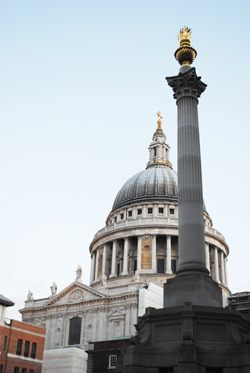
Located just to the north of St Paul’s Cathedral can be found Paternoster Square in the centre of which stands a column.

paternoster-square-columnThe 75 foot (23.3 metre) tall Corinthian column of Portland stone, which was designed by Whitfield Architects and erected in 2003, is topped by a gold leaf covered flaming copper urn which is lit up at night.

While it has been said that the column is “purely decorative”, the developers of Paternoster Square claim on their website that it actually serves several purposes in this case including both commemorative and practical.

Not only is it part of the ventilation system for the carpark underneath, they say its design is apparently a recreation of columns designed by Inigo Jones for the west portico of Old St Paul’s Cathedral.

And then there’s the three metre high urn on top which, not unlike that found on The Monument, they say commemorates the fact the site of the square has twice been destroyed by fire – the first time in the Great Fire of 1666 and the second in the Blitz during World War II.

The area around Paternoster Square was once home to booksellers and publishers’ warehouses.

LondonLife – Remembering the Great Fire of 1666…

London-1666,-designed-by-David-Best-for-London's-Burning,-produced-by-Artichoke,-(c)-Matthew-Andrews0.1

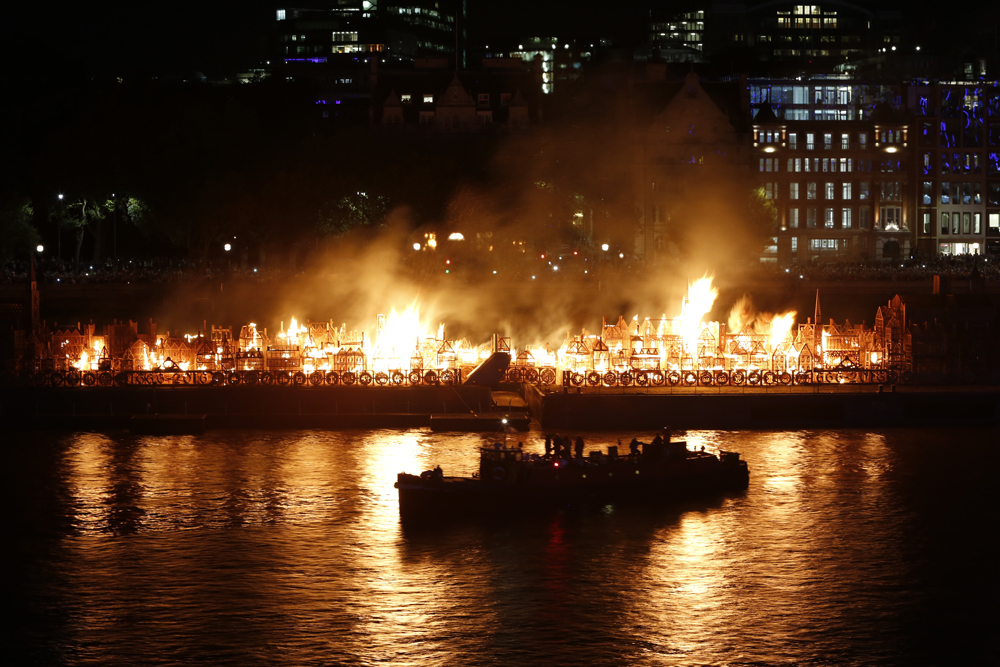
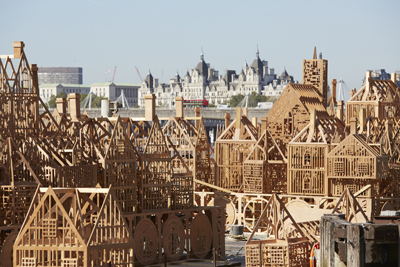
London blazed again on Sunday night when a 120 metre long wooden replica of the city as it was in Restoration times was set alight to mark 350th years since the Great Fire of London. London 1666 was designed by US “burn artist” David Best for London’s Burning – a festival of events in the City of London produced by Artichoke to mark the anniversary. It had been placed on a barge moored in the River Thames before it was lit up to ensure that the fire didn’t spread anywhere it wasn’t wanted. The actual Great Fire of London broke out in a bakery on Pudding Lane shortly after midnight on 2nd September, 1666, and blazed across the city for four days, destroying more than three quarters of the old City of London as it render tens of thousands of Londoners homeless and devastated iconic structures like Old St Paul’s Cathedral. You can see a video of the burn herePICTURES: © Matthew Andrews.


London-1666,-designed-by-David-Best-for-London's-Burning,-produced-by-Artichoke,-(c)-Matthew-Andrews

London Pub Signs – The Assembly House, Kentish Town…

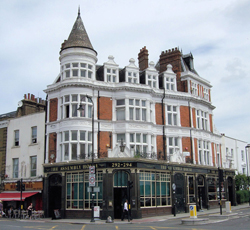
The-Assembly-HouseThis name of this Kentish Town establishment, which dates from the late Victorian era, apparently has nought to do with politics.

Rather it apparently takes its name from the fact that during the 18th century, this site served as a gathering – assembly – point for travellers heading further to the north – to places such as Hampstead Heath – in the belief that safety in numbers could protect them from highwaymen.

There has been a public house on the site since at least the end 18th century (it’s suggested it was at one stage named the Bull), the current capacious, Grade II listed pub, was built in 1898 and, designed in the French chateau-style, features a corner turret.

Inside there are still many original features including a circular glass dome, brilliant cut mirrors and elaborate wrought-iron screening.

The pub can also apparently be seen in the 1971 Richard Burton film, The Villain.

For more on the pub, which is located at 292-294 Kentish Town Road, see www.assemblyhouse.co.uk.

PICTURE: Jim Linwood/CC BY 2.0/Via Wikimedia

This Week in London – The Great Fire of London’s 350th anniversary…

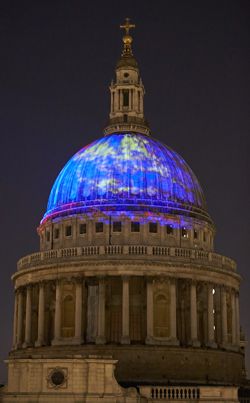
London-1666-by-David-Best-in-collaboration-with-Artichoke-©-Matthew-Andrews-(3)• The 350th anniversary of the Great Fire of London is upon us and to mark the event, the City of London is playing host to London’s Burning, a “festival of arts Fires-of-London--Fires-Ancient-and-Moden-by-Martin-Firrell-©-C.-Totman-(1)and ideas”, over the coming weekend. Produced by Artichoke, the festival includes everything from Fire Garden – an installation by French street art group Compagnie Carabosse at the Tate Modern, and Holoscenes – a six hour underwater performance installation by Los Angeles-based company, Early Morning Opera, in Exchange Square, Broadgate, to Fires of London: Fires Ancient and Fires Modern – two large scale projections by artist Martin Firrell onto St Paul’s Cathedral (pictured right) and The National Theatre, Station House Opera’s Dominoes – a kinetic sculpture of breeze block dominoes which retraces the path of the fire through the streets, and London 1666 – a 120 metre long wooden sculpture of Restoration London by American artist David Best working in collaboration with Artichoke which will be set alight on Sunday at a site on the river between Blackfriars Bridge and Waterloo Bridge (the sculpture is pictured above – you can also watch it live online here). Events run until 4th September. Head here to see the list of events in London’s Burning and to download a copy of the programme complete with map. PICTURES: © Matthew Andrews and C Totman.

Entry to The Monument – built as a permanent reminder of the great conflagration of 1666 – will be free from 2nd to 4th September in celebration of the Great Fire anniversary. Opening hours at the iconic 202 foot tall column have also been extended for the weekend but be warned that due to limited capacity, tickets mist be booked in advance with allotted time slots for entry. To book, head here.

A free exhibition telling the story of London’s bakers and their cakes, bread and puddings over the 350 years since 1666 has opened at the London Metropolitan Archives this week. London’s Baking! Bakers, Cakes, Bread and Puddings from 1666 takes its inspiration from Thomas Farriner and his Pudding Lane bakery, ground zero for the fire. And along with the displays, it features recipes for you to take away and bake including almond cakes from 1700, suet puddings from 1850 and “questionable” school dinner chocolate sponge traybake from the 1970s. Runs at the Clerkenwell-based organisation until 1st February. For more, see www.cityoflondon.gov.uk/events/Pages/event-detail.aspx?eventid=2749.

• Of course, these are just some of the events taking place as part of Great Fire 350. Others include the Fire Food Market in Guildhall Yard, running from 6.30pm to 10pm Saturday night and from 5pm to 10pm Sunday night, as well as events we’ve previously mentioned including the programme of events running at St Paul’s Cathedral and the Fire! Fire! exhibition at the Museum of London. For more of the walks, talks, performances, installations and other events taking place, head to www.visitlondon.com/greatfire350.

Send all items for inclusion to exploringlondon@gmail.com.

10 sites commemorating the Great Fire of London – 4. St Paul’s ‘Resurgam’…

Resurgam3
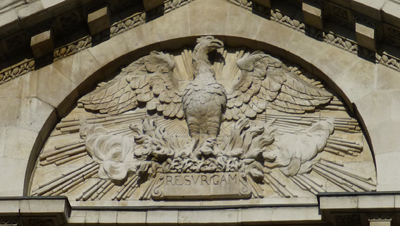
Old St Paul’s Cathedral was certainly the largest and most famous casualty of the Great Fire of London of 1666. And its passing – and rebirth – is recorded on several memorials, one of which can be found on the building itself.

Set on the pediment which, carved by Caius Gabriel Cibber, sits above south portico off Cannon Street, the memorial depicts a phoenix rising from clouds of smoke (ashes), a symbol of Sir Christopher Wren’s new cathedral which rose on the site of the old Cathedral in the wake of the fire. Below the phoenix is the Latin word, ‘Resurgam’, meaning “I Shall Rise Again”.

The story goes that Wren had this carved after, having called for a stone to mark the exact position over which St Paul’s mighty dome would rise, the architect was shown a fragment of one of the church’s tombstones which had been inscribed with the word.

The foundation stone for the new cathedral, largely built of Portland stone, was laid without any fanfare on 21st June, 1675, and it only took some 35 years before it was largely completed. Some of the stonework from the old cathedral was used in the construction of the new.

We should note that the old cathedral was in a state of some disrepair when the fire swept through it – the spire had collapsed in 1561 and despite the addition of a new portico by Inigo Jones, it was generally in poor condition.

Stonework from the Old St Paul’s – everything from a Viking grave marker to 16th century effigies – are now stored in the Triforium, rarely open to the public (tours of the Triforium are being run as part of the programme of events being held at the cathedral to mark the 350th anniversary of the Great Fire – see www.stpauls.co.uk/fire for more).

PICTURE: givingnot@rocketmail.com/CC BY-NC 2.0 (image cropped)