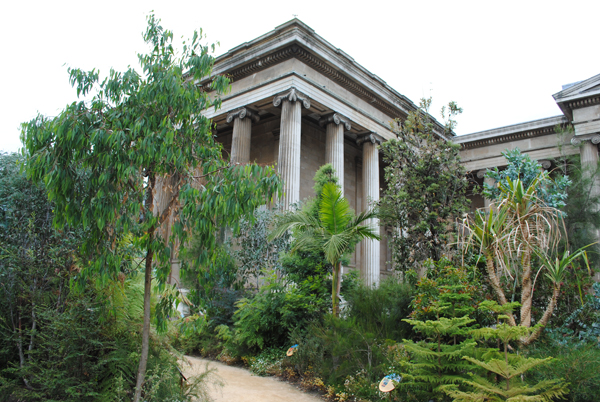
 An Australian landscape constructed in the forecourt of the British Museum as part of the museum’s Australian Season. The landscape takes the intrepid on a journey across the vast Australian continent through the arid red desert of the red centre to the granite outcrops of the country’s west coast. The plants include iconic Australian flora such as the kangaroo paw, wattle, coast banksia, gums and ferns as well as a Wollemi pine. The landscape is the fourth created in the museum’s forecourt under a partnership with the Royal Botanic Gardens, Kew. But time is running out to see it – the garden will disappear on 16th October. Other events held at the museum as part of Australian Season have included an exhibition of Australian artworks and handcrafted baskets. Admission to the garden is free. For more, visit www.britishmuseum.org.
British Museum
Around London – Design Festival in full swing; museum acquires rare merchant figure; Olympic medals on display; and, remembering Polish, Czech and Slovak airmen…
• The London Design Festival is in full swing in London this week with more than 250 events taking place across the city over its 10 days. Launched last Saturday, the festival runs until Sunday and there’s still plenty of time to get involved. Among the highlights is a series of events, workshops and talks being held at the Victoria & Albert Museum (where you can also see 12 specially commissioned installations, one of which sees the museum’s grand entrance transformed with a sculptural form), a series of shows focusing on design in six London “design districts” – Brompton, Pimlico Road, Covent Garden, Fitzrovia, Clerkenwell and Shoreditch, and a broad program of ‘partner’ and ‘international’ events – everything from a festival featuring African-Caribbean design through to an exhibition of experimental chairs by the Danish Cabinetmaker’s Association. To find out more, simply head to www.londondesignfestival.com.
• The Museum of London has announced the purchase of a rare 18th century clay figure of London druggist and tea merchant Thomas Todd. The figure, which was acquired with the help of the Art Fund and MLA/V&A Purchase Grant Fund, is one of only two known portrait works attributed to the Chinese artists Chitqua on show in Britain. The figure, which is made from unfired clay held together by bamboo and brightly painted, was acquired from Todd’s great, great, great, great grand nephew, Thomas Todd, and will appear shortly in the Expanding City Gallery in the Galleries of Modern London. Based in Fleet Street, Pat Hardy, the museum’s curator of paintings, prints and drawings, says Todd “epitomised the kind of business acumen which ensured the growth of Britain’s industrial, mercantile and commercial empire in the eighteenth century”. For more, see www.museumoflondon.org.uk
• The British Museum has opened an exhibition giving the public their first chance to see next year’s Olympic and Paralympic Games medals. Medals have been awarded at the Olympic Games since the first modern games were held in 1896. The latest Olympic medals were designed by jeweller David Watkins, for many years Professor of Goldsmithing, Silversmithing, Metalwork and Jewellery at London’s Royal College of Art, while the latest Paralympic Medals were designed by jeweller Lin Cheung, a senior lecturer for Jewellery Design at London’s Central Saint Martins College of Art and Design. The exhibition tells how, using minerals mined in the US and Mongolia (Rio Tinto is sponsoring the exhibition), the medals were produced at the Royal Mint in Llantrisant, South Wales. Mine to medals: the London 2012 Olympic and Paralympic Games medals runs until 9th September next year. Admission is free. For more, see www.britishmuseum.org.
• On Now: Brothers in Arms – Airmen of Poland and Czechoslovakia in the Battle of Britain & Beyond. The Royal Air Force Museum in Colindale, north London, is hosting an exhibition looking at the contribution of Polish, Czech and Slovak airmen in the Battle of Britain and their life afterwards. Curated in association with the Polish Institute of National Remembrance, the exhibition features drawings, archival film footage and sculpture as well as uniforms, diaries and combat reports. Opened by Poland’s Foreign Affairs Minister Radoslaw Sirkorski (who later attended the annual banquet held in honor of the Veterans of the Battle of Britain), it runs until 4th March, 2012. Entry is free. For more, visit www.rafmuseum.org.uk.
Famous Londoners – Sir Hans Sloane
An Ulster-Scots born physician, scientist and avid collector, Sir Hans Sloane served as doctor to no less than three British monarchs during the 17th and 18th centuries and during his life amassed a vast collection of natural specimens and curiosities which after his death were used to form the core of the British Museum’s collection.
 Born on 16th April, 1660, at Killyleagh in County Down, Ireland, Sir Hans was the son of Alexander Sloane, a “receiver-general of taxes” who originally hailed from Scotland.
Even as a young man, he developed a keen interest in the natural sciences. Having suffered from some ill-health which, at the age of 16 is said to have kept him confined to a room for a year, in 1679, at the age of 19, he moved to London where he studied chemistry at the Apothecaries Hall and botany at the Chelsea Physic Garden – a period during which he befriended the botanist John Ray and chemist Robert Boyle.
Four years later, he travelled through France where he received his Doctorate of Physics. On his subsequent return to London in 1685, he was made a Fellow of the Royal Society and in 1687 a Fellow of the Royal College of Physicians.
Given the chance to travel to Jamaica as physician to the new Governor, Christopher, the 2nd Duke of Albemarle, he only spent 15 months there (the Governor died soon after arrival). But it was an important period during which not only did he document and collect a vast amount of flora and fauna (bringing some 800 specimens back to London), he also came up with the idea of drinking chocolate with milk after witnessing locals drinking the dark chocolate with water but finding the mix made him “nauseous” (back in England, his concoction was first sold as a medicine and was later manufactured as a drink by Cadburys).
Having returned to London in 1689, he published the information he had gathered in Jamaica, and in 1693 he become secretary to the Royal Society.
In 1695 he married a Jamaican sugar planter’s widow, Elizabeth Langley Rose (with whom he had several children but of whom only two daughters, Sarah and Elizabeth, survived) and, thanks in part to an ongoing association with the duke’s widow, was able to set up a fashionable medical practice at 3 Bloomsbury Place on the northern end of Bloomsbury Square.
The house, not far from where the British Museum now stands, become something of an attraction in its own right, filled with objects and specimens he had collected on his travels as well as those – in some cases complete collections – given to him by others including friends and patients (in fact, he had to purchase the property next door, number four, to find room for them all – this property is now marked with a Blue Plaque).
The composer Handel is said to have been among those who visited the property and there is a delightful tale that says Sir Hans was outraged when Handel placed a buttered scone on one of his rare books.
With his services as a physician highly prized, in 1696, he was appointed physician to Queen Anne, the first of the three monarchs he would serve. In 1712-13, with his collection still growing, he purchased the Manor of Chelsea to help house it (four acres of which were leased to the Chelsea Physic Garden, which had been founded in 1673 with the idea of providing a training ground for apprentice apothecaries, in perpetuity).
He subsequently moved his collection out to this property and his connection with Chelsea is still celebrated in place names such as name Sloane Square (not to mention Sloane Street, Sloane Gardens, Hans Street, Hans Crescent, Hans Road and Hans Place). There is also a statue of the bewigged man in Duke of York Square (pictured), not far from Sloane Square – this is a 2007 copy of 1737 original by John Rysbrack, another (older) copy of which can be found in the Chelsea Physic Garden.
Following Queen Anne’s death in 1714, in 1716 Sir Hans was appointed physician to her successor, King George I (he was also created a baronet the same year, becoming the first medical practitioner to receive a hereditary title).
Three years later, in 1719, he become president of the Royal College of Physicians, an office he held for 16 years, and in 1727, he was appointed physician to King George II. The same year he succeeded Isaac Newton as president of the Royal Society, an office which he held until 1741.
In 1742, Sir Hans retired to his property in Chelsea.
By the time of his death on 11th January, 1753 at the ripe old age of 93, Sir Hans had collected more than 71,000 objects including books, manuscripts, drawings, coins and medals and plant specimens which he bequeathed to King George II in exchange for a payment of £20,000 to his executors.
Parliament agreed, following a lottery to raise the money, his collection went on to form the basis of the British Museum, first opened to the public in 1759 in Bloomsbury. It was also to form the basis of the museum’s later offshoot, the Natural History Museum at South Kensington.
Sir Hans was buried at Chelsea Old Church with his wife Elizabeth who died in 1724.
Around London – Apsley House history goes online; Australian landscapes at the British Museum; Dame Judy Dench awarded Freedom of the City of London; and, Out of this World on at British Library
• A detailed history of Apsley House, the former home of Arthur Wellesley, 1st Duke of Wellington, has gone live online as part of a pilot project aimed at “deepening the public’s understanding of English history”. The property, known as Number 1, London, is one of 12 initially being profiled in depth in a pilot project on the new English Heritage online resource, Portico. Others include Down House, the former home of Charles Darwin, located in Kent, as well as Beeston Castle, Brough Castle, Byland Abbey, Carlisle Castle, Dunstanburgh Castle, Easby Abbey, Kenilworth Castle, Lullingstone Roman Villa, Rievaulx Abbey and Wroxeter Roman City near Shrewsbury. Brief historical details are also provided for an additional 220 lesser known free sites including Dunster Yarn Market in Somerset. For more see www.english-heritage.org.uk/professional/archives-and-collections/portico/.
• The West Lawn of the British Museum Forecourt has been turned into an image of the Australian continent as part of a five year partnership programme between the museum and the Royal Botanic Gardens, Kew. The landscape moves from the vegetation of the eastern Australia’s coast through to the red centre and onto a rocky Western Australian outcrop. It showcases some of the continent’s unique and highly threatened flora. The construction of the landscape, which follows one showcasing that of South Africa last year, is part of the museum’s ‘Australian season’. Runs until October. Admission is free. See www.britishmuseum.org.
• Dame Judy Dench was awarded the Freedom of the City of London for services to acting at a ceremony at the Guildhall last week. The winner of an Academy Award, nine BAFTAs and three Laurence Olivier Awards, Dame Judy is an icon of stage and screen. She is reportedly looking forward to driving her sheep over London Bridge and occasionally wearing a sword in public – both privileges of those awarded the Freedom of the City of London. The Freedom of the City’s origins are believed to date back to 1237 and enabled recipients to carry out their trade. Today people are nominated for or apply for the Freedom for the link with the City or are awarded it for a significant contribution to London life. Many of the traditional privileges – such as driving your sheep over London Bridge or being hanged with a silken rope – no longer exist.
• Now On: Out of this World: Science Fiction but not as you know it. The British Library’s first exhibition which explores science fiction through literature, film, illustrations and sound. Guest curated by Andy Sawyer, director of science fiction studies MA at the University of Liverpool, the exhibition traces the evolution of the genre from Lucian of Samosata’s True History, written in the 2nd century AD, through to the recent writings of Cory Doctorow and China Mieville. Highlights include a 1516 edition of Sir Thomas More’s Utopia, a 1647 edition of Lucian’s True History, and a 1906 edition of HG Wells text, The War of the Worlds. Runs until 25th September. For more see, www.bl.uk/sciencefiction.
Around London – Burial place of Bunyan, Defoe and Blake gets Grade I listing; Kew Gardens joins Streetview; and, Afghan treasures on show…
• The London burial place of writers John Bunyan and Daniel Defoe and artist and poet William Blake has been recognised as one of the city’s most significant historic landscapes with a Grade I listing on the national Register of Parks and Gardens. The news, which was announced last month, also sees 75 tombs located within Bunhill Fields Cemetery individually listed. Bunhill, located between City Road and Bunhill Row, is one of 106 registered cemeteries in London (and now one of only seven Grade I listed cemeteries). It was established in 1660 and, thanks to its not being associated with Anglican place of worship, is viewed as the “pre-eminent graveyard for Nonconformists in England” . About 123,000 burials took place in its four acres before it was closed in 1869. The oldest monument is that of theologian Theophilus Gale, who died in 1678. As well as the tombs of Buynan, Defoe and Blake, others listed on the register include that of Dame Mary Page, who died in 1728 and whose tomb inscription talks of her stoicism in the face of 240 gallons of water being taken out of her prior to her death, and Joseph Denison, a banker who died in 1806 and was one of England’s wealthiest commoners at the time. The listing was made by the Department of Culture, Media and Sport following advice from English Heritage. For more on Bunhill Fields, follow this link…
• Kew Gardens has joined Google Streetview, meaning it’s now possible to navigate your way around the gardens from the comfort of your own home. More than 26 kilometres of paths and the interiors of some of the garden’s glasshouses – including the Palm House and the Temperate House – can now be seen on Streetview which offers 360 degree views. Professor Stephen Hopper, director at Kew, says the new technology is “bound to encourage people to visit us and experience Kew for themselves”. Follow this link to see the gardens on Streetview.
• On Now: Afghanistan’s heritage is on display in a newly opened exhibition at the British Museum. Afghanistan: Crossroads of the Ancient World showcases more than 200 objects from the National Museum of Afghanistan as well as some items from the British Museum and includes sculptures, ivory inlays once attached to furniture, Roman glassware and Egyptian stone tableware, and inlaid gold ornaments once worn by the area’s “nomadic elite”. The objects were found between 1937 and 1978 and were preserved thanks to officials who kept them out of harm’s way during the Soviet and Taliban eras. The museum announced this week that they would be joined by carved ivory fragments that were stolen from Afghanistan’s national museum in the early 1990s and only recently presented to the British Museum by a benefactor with the idea that they will eventually be returned to Kabul. The exhibition runs until 3rd July. There is an admission charge. For more information, see www.britishmuseum.org.
Treasures of London – The Cheapside Hoard
It’s been described as the greatest find of Jacobean and Elizabethan jewellery ever made – an extraordinary cache of some 500 gemstones, jewellery and other related items found buried under the floor during the demolition of a building at 30-32 Cheapside on 18th June, 1912.
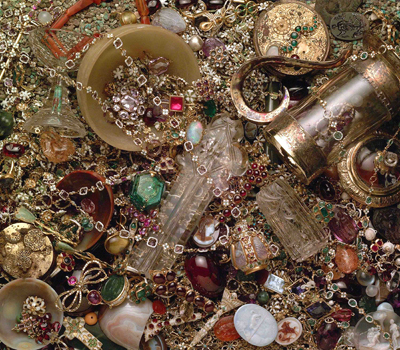 Now known as the Cheapside Hoard, it dates from the 16th and 17th centuries and includes neck chains, pendants, hat ornaments, cameos and rings – among the items is a gold watch set into a hinged case made from a Columbian emerald, a tiny bejewelled gold scent bottle, and an onyx cameo of Queen Elizabeth I.
Other items include unfinished ornaments and unmounted gemstones which have origins spanning the world – from Asia and Middle East to South America. While these give support to the idea that the hoard is part of a goldsmith’s reserve stock, mystery still surrounds why it was buried in the building (although Cheapside was known for its goldsmiths during the era which the hoard dates from).
The majority of the hoard is held at the Museum of London where some of the items are on display. Other items are at the British Museum and one, an enamelled gold chain, is at the Victoria & Albert Museum. The Museum of London is planning major exhibition of the hoard starting in late 2013. Stay tuned for more information.
WHERE: Museum of London, 150 London Wall (nearest tube station is Barbican, St Paul’s or Moorgate); WHEN: 10am to 6pm, Monday to Sunday; COST: Free; WEBSITE: www.museumoflondon.org.uk
PICTURE: Museum of London
Around London – New fourth plinth sculptures announced; Australian Season at British Museum; and Kenwood House shows off gardens…
• Sculptures of a child on a rocking horse and a giant blue cockerel will occupy Trafalgar Square’s fourth plinth in 2012 and 2013 respectively, it was announced late last week. The Mayor of London, Boris Johnson, described the artworks as “witty and enigmatic creations”. The first proposed first sculpture, correctly titled Powerless Structures, Fig. 101, is the creation of Elmgreen & Dragset while the second, Hahn/Cock, is that of Katharina Fritsch. The plinth is currently occupied by Yinka Shonibare’s Nelson’s Ship in a Bottle. See www.fourthplinth.co.uk.
• The British Museum has announced it will be holding a series of exhibitions and events focusing on Australia later this year. Highlights of Australian Season will include Australia Landscape: Kew at the British Museum (21st April to 16th October), an exhibition of prints and drawings dating from the ‘Angry Penguin’ school of the 1940s through to the rise of Aboriginal printmaking (Out of Australia: prints and drawings from Sidney Nolan to Rover Thomas, from 26th May to 11th September), and an exhibition focusing on indigenous Australian baskets (Baskets and belong: Indigenous Australian histories, 26th May to 29th August). See www.britishmuseum.org.
• On Now: Kenwood House in Hampstead is hosting a new exhibition, The Gardens of English Heritage. The exhibition, which is based on the publication of the same name, features stunning images of some of the UK’s most impressive gardens.Runs until 3rd April. For more information, see www.english-heritage.org.uk/daysout/properties/kenwood-house/
Treasures of London – The Sutton Hoo ship burial
Now housed in the British Museum (pictured), the artefacts discovered in a ship burial at Sutton Hoo near Woodbridge in Suffolk helped to shed new light on what life was like in Anglo-Saxon society.
 The excavation at the Sutton Hoo site was carried out in 1939, just before World War II. The finds were impressive and centred on a 27 metre long oak ship in the midst of which was constructed a burial chamber for a man of some significance along with his possessions.
The latter included his armour (the centrepiece of which is the spectacular and painstakingly reconstructed Sutton Hoo helmet complete with face mask), weapons such as a sword and spears, silverware and silver-mounted drinking horns and cups, clothes and other assorted items of wealth, including a purse with a ‘lid’ containing, among other things, Merovingian gold coins struck believed to have been struck between 595 and 640 AD.
While the remains found date to around the early seventh century, the man’s exact identity remains something of a mystery. But it is possible he may have been one of four Anglo-Saxon kings known to have been buried in the area.
WHERE: Room 41 at the British Museum, Great Russell Street (nearest tube is Tottenham Court Road, Holborn or Russell Square); WHEN: 10.30am-5.3opm daily; COST: Entry to the museum is free; WEBSITE: www.britishmuseum.org. (For more information on visiting the Sutton Hoo site in Suffolk, visit www.nationaltrust.org.uk/main/w-vh/w-visits/w-findaplace/w-suttonhoo)
Around London – Lord Mayor’s Show tomorrow; Book of the Dead at British Museum; and Evolving English at the British Library
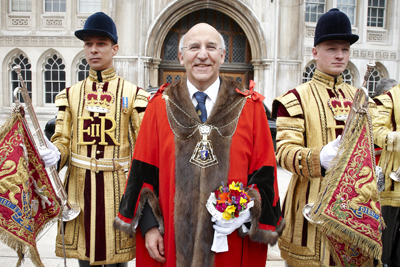 • The Lord Mayor’s Show is tomorrow. The world’s oldest civic procession, it’s been held for 795 years (the last time it was interrupted was due to the Duke of Wellington’s funeral) and commemorates the day when the newly elected Mayor had to make the journey from the City to Westminster to declare his allegiance to the monarch. This year’s Lord Mayor of the City of London – the City’s 683rd – is Alderman Michael Bear (not to be confused with the Mayor of London Boris Johnson). The procession kicks off at 11am and travels from Mansion House to St Paul’s Cathedral, where the Lord Mayor, who formally took office yesterday in a silent ceremony held at Guildhall, is blessed. The procession then moves on to the Royal Courts of Justice where the Lord Mayor swears an oath of allegiance before returning to Mansion House via Victoria Embankment. This year the procession will involve from than 6,000 people from livery companies, military units, marching bands, local schools and businesses and community groups as well as 200 vehicles, 21 carriages – including, of course, the Lord Mayor’s State Coach – and 71 floats. Don’t forget to hang around for the fireworks. For more about the event – where to stand and what you’ll be seeing, see www.lordmayorsshow.org.
PICTURE: Alderman Michael Bear on the occasion of his election as the 683rd Lord Mayor of London. Courtesy Lord Mayor’s Show.
• Now On: The British Museum exhibition, Journey through the afterlife: ancient Egyptian Book of the Dead, was launched last week. The exhibition centres on the museum’s collection of Book of the Dead papyri, many of which have never before been put on display to the public. They include the Greenfield Papyrus, which at 37 metres long is the longest Book of the Dead in the world and has never been displayed in its entirity before. The display also features famous paintings from the papyri of Ani and Hunefer and an array of painted coffins, gilded masks, amulets, jewellery, tomb figurines and mummy trappings. Runs until 6th March. For more information, including admission prices, see www.britishmuseum.org.
• Now On: A new exhibition exploring the development of the English language opens today at the British Library. Evolving English: One Language, Many Voices looks at how the language has evolved from Anglo-Saxon runes to modern day rap and where it’s headed next. Highlights of the exhibition include the first book printed in English, Recuyell of the Historyes of Troye (printed by William Caxton), a 1611 King James Bible, Poor Letter H – a pamphlet dating from 1854 explaining why pronouncing your h’s correctly is important to climbing the social ladder, and the earliest surviving copy of Beowulf. On until April 3rd. Admission is free. For more information, see www.bl.uk.
What’s in a name? – Bloomsbury
Famous for its literary, intellectual and artistic heritage, Bloomsbury covers an area in central London which lies between Holborn and Euston Road.
The area, which became a fashionable residential district in the 17th and 18th centuries, derives its name from an earlier era and is named after William de Blemund (‘Blemundsbury’ means the manor of Blemund), who acquired land there in 1201.
It was later owned by the Earl of Southampton, who had begun developing the area in the 1660s – a task which was continued when the land passed, through the marriage of his daughter, into the hands of the Dukes of Bedford. Successive dukes were then involved – to varying degrees – in the development of series of residential squares and streets which eventually included the likes of Bedford, Russell and, of course, Bloomsbury Squares.
In the early 20th century, the area become home to what is known as the Bloomsbury Group – its members included the writers Virginia Woolf, Lytton Strachey and EM Forster. These days the area is noted for being home to the British Museum (first opened to the public in 1759) and the University of London.

