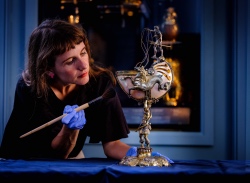
 • The Ranger’s House in Greenwich – home to a world class art collection known as the Wernher Collection – reopened to the public this week after a makeover by English Heritage. The property – a Georgian villa located on the edge of Greenwich Park – displays the collection – which includes more than 700 works gathered by diamond magnate Julius Wernher in the late 1800s – across 11 period rooms. Highlights include a gold earring in the shape of Victory (the Greek goddess of war) which dates from 2BC, a carved pendant in the shape of a skull from around 1500, a silver gilt, steel and nautilus shell cup dating from 1660 (pictured) and an enamelled jug depicting the Greek god Triton. The collection was originally displayed at Wernher’s London townhouse – Bath House in Piccadilly – and at his country estate, Luton Hoo in Bedfordshire, but after Luton Hoo closed in the 1990s, English Heritage agreed to display the collection at the Ranger’s House (which it had acquired in 1986) on a 125 year loan. Photographs showing how Wernher displayed his collection in his own homes have informed how the objects are presented in the house today. The house is open from Sunday to Wednesday until the end of September. Admission charge applies. For more, see www.english-heritage.org.uk/rangershouse. PICTURE: © English Heritage
• The Great Pagoda at Kew has been reopened to visitors for the first time in years following a four year restoration project. Built in 1762, the pagoda was used by the Georgian Royal Family to entertain visitors and was for the first 20 years famously adorned with 80 brightly coloured wooden dragons (until, that is, they disappeared in the 1780s when they were rumoured to have been used as payment for the Prince Regent’s gambling debts). Thanks to a major restoration project by Historic Royal Palaces in conjunction with the Royal Botanic Gardens, Kew, dragons have returned to the structure and for the first time in decades visitors are being allowed access to the upper floors from where they can gain a birds-eye view of the gardens. They will also be able to learn about the role the pagoda played in planning for the D-Day landings and try out the automata on the ground floor for a tour in miniature of Kew’s Georgian ‘royal route’. Admission charge applies. For more, see www.hrp.org.uk.
• The art of Germany’s Weimar Republic goes on show at Tate Modern on South Bank from Monday. Magic Realism: Art in Weimar Germany 1919-1933 features about 70 paintings and works on paper drawn from The George Economou Collection – some of which have never seen in the UK before – and the Tate’s own collection. The display explores the “paradoxes” of the Weimar era, a time when liberalisation and anti-militarism flourished amid political and economic uncertainty (the title draws on the coining of the phrase ‘magic realism’ – today often associated with the literature of Latin America – by artist and critic Franz Roh in 1925 in an effort to describe the shift from the emotional art of the expressionist era, toward the unsettling imagery of this inter-war period). Works by artists like Otto Dix, George Grosz and Max Beckmann will be presented alongside those of under recognised artists such as Albert Birkle, Jeanne Mammen and Rudolf Schlichter and others whose careers were curtailed thanks to the rise of Nationalist Socialism and its agenda to promote art that celebrated its political ideologies. Admission is free. Runs until 14th July, 2019. For more, see www.tate.org.uk.
Send all items for inclusion to exploringlondon@gmail.com.





 conservationist and influential figure in the Arts and Crafts movement” as well as being the father of world famous writer Rudyard Kipling – opens at the V&A in South Kensington on Saturday. The exhibition is the first exploring the life and work of Kipling (1837-1911) who campaigned for the preservation of Indian crafts as well as being a craftsman himself (his terracotta panels can still be seen on the exterior of the V&A) and an illustrator of his son’s books. Lockwood Kipling: Arts and Crafts in the Punjab and London features paintings of the Indian section of the 1851 Great Exhibition as well as objects which were on display (the exhibition was visited by Kipling while a teenager), Kipling’s sketches of Indian craftspeople observed during his many years living in India as well as objects he selected for the V&A while there, designs and illustrations for books, and furniture he helped his former student architect Bhai Ram Singh design for royal residences Bagshot Park and Osborne. The free exhibition, a collaboration between the V&A and the Bard Graduate Centre in New York, runs until 2nd April (it will be on display at the Bard Graduate Center, New York, from 15th September this year). For more, see


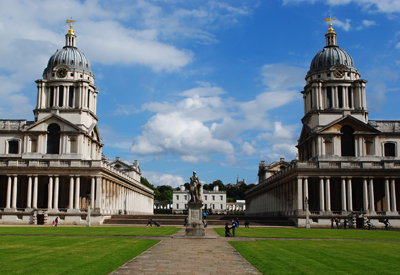
 • The largest exhibition ever mounted about the life of 17th century diarist Samuel Pepys opens at the National Maritime Museum in Greenwich tomorrow. Samuel Pepys: Plague, Fire, Revolution features more than 200 paintings and objects brought together from museums, galleries and private collections which explore the life of the famous diarist (depicted here in a bust outside the Guildhall Art Gallery) against the backdrop of the tumultuous events of Stuart London, from the execution London of King Charles I in 1649 through the Great Fire of London and the Glorious Revolution on 1688. Objects on show include the famous painting, Portrait of Charles II in Coronation Robes, objects connected to Pepys’ mistresses including one of his love letters to Louise de Kéroualle (aka ‘Fubbs’ or ‘chubby’) and other personal items such as a lute owned by Pepys. The exhibition is accompanied by a series of events including Pepys Show Late: Party like it’s 1669 (26th November) and a series of walks and talks. Admission charge applies. The exhibition runs until 28th March. For more, see