10 of London’s greatest Victorian projects – 4. The Palace of Westminster…

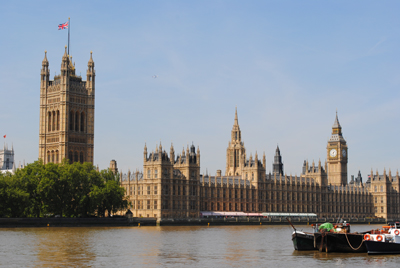
Commonly thought to be older than it actually is due to its Gothic stylings (although, to be fair, parts of it do date from medieval times), the Palace of Westminster – or, as it’s more commonly known, the Houses of Parliament – didn’t actually take on much of its current appearance until the latter half of the 19th century.

The need for a new building for parliament arose after 1834 when a fire, caused by the overheating of two underfloor stoves used to incinerate the Exchequer’s obsolete tally sticks, tore through the former complex, leaving only some structures from the old palace intact. They included the 11th century Westminster Hall (the largest in Europe when it was built), 14th century Jewel Tower and a chapterhouse, crypt and cloisters, all of which was once attached to the now gone St Stephen’s Chapel.
Houses-of-Parliament2While King William IV offered the use of Buckingham Palace for Parliament, the idea – along with a host of other options – was rejected as unsuitable. Instead, a competition was held for a new design and after almost 100 entries were considered, architect Charles Barry and his design for a new palace in the perpendicular Gothic style was chosen. Interestingly, while Barry was a classical architect, under the terms of the competition, designs were required to be in a Gothic style, thought to embody conservative values .

Incorporating some of the remains of the old palace – including Westminster Hall but not the Jewel Tower which to this day stands alone – the design was based around a series of internal courtyards with the House of Commons and House of Lords located on either side of a central lobby (first known as Octagonal Hall). The design involved reclaiming some land from the Thames so the building’s main river-facing facade could be completed.

Towers stand at either end of the complex – the Victoria Tower over the Sovereign’s Entrance at the southern end of the complex (for many years the tallest square stone tower in the world) and the narrower tower formerly known as the Clock Tower which houses the bell Big Ben, at the northern end – and there is a central Octagonal Tower which stands directly over the Central Lobby. The Clock Tower, incidentally, was renamed the Elizabeth Tower last year in honour of Queen Elizabeth II’s Diamond Jubilee (for more on it and Big Ben, see our earlier entries here and here).

Other towers include the Speaker’s Tower (located at the northern end of the building on the waterfront, this contains a residence for the Speaker), the Chancellor’s Tower (located at the southern end, it too contained a residence originally used by the Lord Chancellor) and St Stephen’s Tower – located in the middle of the building’s west front, it contains the public entrance to the building. Significant other rooms in the palace complex include the Robing Room – where the Queen puts on her ceremonial robes and crown before the State Opening of Parliament – and the Royal Gallery, used for state occasions.

The foundation stone (the building was constructed out of sand-coloured limestone from Yorkshire) was laid in 1840 and construction of the monumental building – which features more than 1,100 rooms and two miles of passageways – wasn’t completely finished until the 1870s although most of the work had been completed by 1860 (the year Barry died). The House of Lords first sat in their new chamber in 1847 and the House of Commons in 1852 (it was at this point that Barry was knighted for his work).

The cost, meanwhile, originally estimated at less than £750,000, ended up coming in at more than £2 million.

Much of the interior decoration owes its appearance to the Gothic revivalist Augustus Pugin who designed everything from wallpapers, to floor tiles and furnishings. Pugin also helped Barry with the external appearance but like Barry died before the project was completely finished (in 1852).

The palace was bombed numerous times in World War II – in one raid, the Commons Chamber was destroyed as firefighters opted to save the much older Westminster Hall instead. It was later rebuilt under the direction of Sir Giles Gilbert Scott and completed by 1950. Other aspects of the building have also been restored.

A Grade I-listed building classified as a World Heritage Site, Barry’s Houses of Parliament remain one of London’s most iconic structures. We’ll be looking in more detail at some of the building’s features in future posts.

WHERE: Houses of Parliament (nearest Tube stations are Westminster, St James’s Park and Embankment); WHEN: Tours (75 minutes) are run from 9.15am to 4.30pm on Saturdays (also six days a week during summer opening); COST: £15 adults/£10 concessions/£6 children five to 15 years (children under five are free). Prices go up after 1st April – check website for details and to purchase tickets (tours for UK residents, including climbing the Elizabeth Tower, can also be arranged through your MP); WEBSITE: www.parliament.uk.

For more, see Robert Wilson’s guide to the The Houses of Parliament or David Cannadine’s indepth,  The Houses of Parliament: History, Art, Architecture. For more on the story of the fire in 1834, see head parliamentary archivist Caroline Shenton’s recent book The Day Parliament Burned Down.

Treasures of London – The Burghers of Calais…

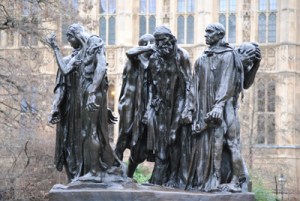
One of 12 casts made of an original which stands in Calais, France, this sculptural group commemorates one of the most poignant moments of the bloody Hundred Years War.

Burghers-of-CalaisThe original work, by the renowned Auguste Rodin who beat five others with his design, was completed in 1889 and stands outside Calais’ town hall. This cast was produced in 1908 and presented to the nation in 1914 by the National Art Collections Fund. It stands in Victoria Tower Gardens, just to the south of the Houses of Parliament in Westminster.

The sculpture commemorates an event which took place in 1347. Calais, then, as now, an important French port, had been besieged by the English for more than a year and, in a desperate situation as the townspeople starved (and despite orders from the French King Philip IV to hold out), the city authorities were seek terms from the English king, Edward III, still flushed with the success of the Battle of Crecy the year before.

Edward’s conditions for their surrender were harsh – six of the city’s leaders had to be handed over and the rest of the city would be spared. But more than that, the six had to leave the city stripped of almost all their clothes, wearing nooses around their necks and carrying the keys to the city and castle.

Six burghers, led by Eustache de Saint Pierre and also including John Daire and brothers James and Peter Wisant, did so and it is the scene of them making their way to King Edward that Rodin has captured. Their bravery was rewarded – while King Edward apparently order them to be beheaded, his pregnant English Queen, Philippa of Hainault, intervened on their behalf and they were spared execution, dressed and fed before they were safely escorted away.

Only 12 casts of the group were ever permitted under French law – the London cast was the third to be made.

Around London – Notting Hill Carnival; Paralympics comes to town; Albert Adams at the IWM; and, exploring the anatomy of athletes at the Hunterian…

• The Notting Hill Carnival – the largest festival of its kind in Europe – takes place in London’s west this Sunday and bank holiday Monday. More than a million people are expected top attend to see the floats, listen to the traditional steel drum bands and sample some of the food found at the hundreds of stalls along the streets of Notting Hill.  Sunday, when the costume prizes are awarded, has been designated as Children’s Day and Monday, when the main parade takes place, as Adult’s Day. The festival has been held every summer since 1966. For more, see www.thenottinghillcarnival.com.

• With the memories of the Olympics still fresh in our minds, it’s time to turn our attention to the impending Paralympics and associated events including the 24 hour Torch Relay which hits London next Wednesday, just before the Opening Ceremony. The torch enters London at Watford and and then moves south through the city, taking in many of London’s most famous landmarks as it visits all six boroughs before arriving at the Olympic Stadium. For more on the route, see www.london2012.com/paralympics/torch-relay/route/. Meanwhile, as with the Olympics, those who don’t have tickets to the Paralympics will be able to watch on a giant screen at Trafalgar Square daily between 11am and 10pm where there will also be live music and activities including the chance to try out a range of Paralympic sports. For more, see www.btlondonlive.com/trafalgar-square. Tower Bridge, meanwhile, is undergoing a makeover with the installation of the Paralympics symbol, Agistos, tomorrow following the earlier removal of the Olympic Rings. Historic projections, meanwhile, will once again appear on the Houses of Parliament. Other events taking place around the Paralympic Games include Surprises: What You Will: Pop-Up Shakespeare – which will see Shakespearean characters like Juliet, Hamlet and Puck suddenly appearing and performing at “cultural hotspots” around the city (the exact time and location of the performances will remain a surprise until the day but you can register for updates at www.molpresents.com/surprises or follow @molpresents and @London2012Fest.

• A series of artworks by South African-born Expressionist Albert Adams are on show at the Imperial War Museum this summer. The works on show include the last painting he completed before his death in 2006 – title Abu Ghraib, it was inspired by reports of abuse perpetrated at the Abu Ghraib prison in Iraq – as well as a series of etchings Adams created between 2001 and 20064 which address conflicts like that Iraq War and Darfur. Admission is free. For more, see www.iwm.org.uk.

On Now: Anatomy of an Athlete – Elite sport, surgery and medical art. This exhibition in the Qvist Gallery at the Royal College of Surgeons’ Hunterian Museum in Lincoln’s Inn Fields features new artworks by world-leading medical artists which explore the anatomy and physiology of elite athletes. The art works come in a variety of forms – watercolour, video and sculpture – and represent the human body in a selection of sports and para-sports. Admission if free. Runs until 29th September. For more, see www.rcseng.ac.uk/museums/.

What’s in a Name?…Trafalgar Square

It wasn’t until some time after Admiral Lord Nelson’s victory over the French fleet in the Battle of Trafalgar off the coast of Spain on 21st October, 1805, that the large public space in Westminster we now know as Trafalgar Square took its name.

Prior to the development of the square, much of the area it covers was occupied the King’s Mews – stables linked to the Palace of Whitehall – and was simply seen as part of the district known as Charing Cross (named for the memorial cross which stood close to where the equestrian statue of King Charles I now stands – for more on this, see our earlier post and follow the links).

Following the relocation of the Mews in the early 19th century, plans were drawn up by architect-of-the-age John Nash to redevelop the area while the square itself, completed in 1845, was designed by Sir Charles Barry (best known for his work on the Houses of Parliament).

The final design incorporated a statue of Admiral Lord Nelson atop a column, known as ‘Nelson’s Column’, in the centre – apparently against Barry’s wishes (see our earlier post for more on Nelson’s Column).

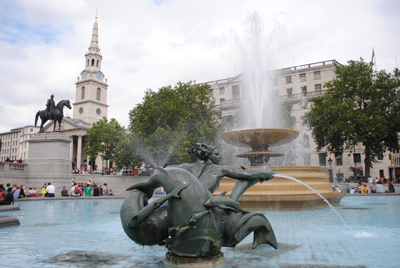
Originally designed with an upper terrace and a lower piazza linked by stairs at the eastern and western end of the terrace, the square contains two fountains on either side of the column – the current fountains were designed by Sir Edwin Lutyens in 1937-9 and replaced earlier ones.

It was originally suggested that the square be named King William IV Square but it was apparently architect George Ledwell Taylor who provided the alternative of Trafalgar Square in honor of Nelson’s great battle.

Bordered by significant landmarks including the National Gallery to the north, the church of St Martin’s-in-the-Fields to the north-east, South Africa House to the east and Canada House to the west, the square stands at the confluence of a number of major roadways including Whitehall, Strand, Charing Cross Road and The Mall.

Aside from the aforementioned statue of King Charles I, monuments within the square include Nelson’s Column along with plinths set in the four corners of the square. These bear statues of King George IV, Victorian military figures General Sir Charles James Napier and Major-General Sir Henry Havelock while the fourth plinth, located in the north-west corner, was originally intended to bear an equestrian statue of King William IV.

Instead, it was left empty for many years before the advent of the Fourth Plinth project under which a variety of contemporary artworks – most recently a massive sculpture of a boy astride a rocking horse – have occupied the space (you can see a picture of the current work in our earlier post here).

The square, once known as the home of thousands of pigeons before these were banished midway through last decade to allow greater public use of the space, also features the busts of three admirals – John Jellicoe, David Beatty and Andrew Cunningham, located against the north wall under the terrace.

There are also two statues on a lawn in front of the National Gallery – these are of US President George Washington and King James II. Curiously, the square also features a small pillar box in the south-east corner, referred to by some as the smallest police station in London.

A renovation project in 2003 pedestrianised the roadway along the north side of the square and installed a central stairway between the the upper and lower levels along with lifts, public toilets and a cafe.

For some more on the history of Trafalgar Square, see Jean Hood’s Trafalgar Square: A Visual History of London’s Landmark Through Time.

Where’s London’s oldest…manufacturing company?

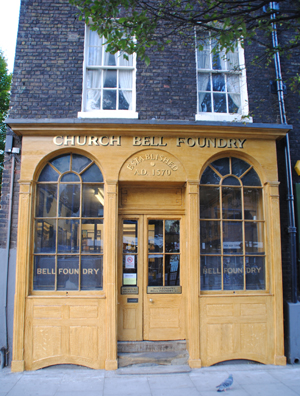
London’s oldest manufacturing company is the same as Britain’s oldest and is, according to the Guinness Book of Records, the Whitechapel Bell Foundry.

The company was established in 1570 (although founders have been discovered operating in the area as far back as 1420) and, according to its website, still concentrates solely on the manufacture of bells and their fittings with large church bells accounting for 80 per cent of the company’s business. The remainder of the business is involved in manufacturing handbells and other smaller bells.

The foundry’s current buildings, apparently originally used as a coaching inn named The Artichoke, date from 1670 and are presumed to have replaced structures consumed in the Great Fire of London. The foundry had earlier been located in smaller premises on the other side of Whitechapel Road.

The foundry has typically operated under the name of the master founder and owner but since 1968 has apparently operated under its current name.

The most famous bells cast at the foundry include the Liberty Bell (1752) – the symbol of American independence which cracked when first rung and was recast in Philadelphia, the Great Bell of Montreal Cathedral, ‘Great Tom’ of Lincoln Cathedral, and, of course, Big Ben (1858) – at 13,760 kilograms, the largest bell ever cast at the foundry.

Westminster Abbey and St Paul’s Cathedral also feature bells cast at the foundry and replacement bells for St Mary-le-Bow and St Clement Danes made here following their destruction in World War II and bells from the foundry have been sent as far afield as Australia and India.

Among the most recent bells to be cast at the foundry are the Royal Jubilee Bells, used in the Thames Diamond Jubilee Pageant and now housed at St James Garlickhythe in the City of London (each of the bells, which bear the Royal Arms, is named after a member of the Royal Family – Elizabeth being the largest with others named Philip, Charles, Anne, Andrew, Edward, William and Henry.)

There is a small exhibition on bell-making in the foundry shop looking at the history of the foundry and bell-making in general, and one-and-a-half-hour tours of the foundry run Saturdays (booking well in advance is usually required). Additional tours are being held every day during the Olympics.

WHERE: 32/34 Whitechapel Road; WHEN: Tours are usually held on Saturdays when no work is being undertaken – see website for dates – but special tours are being held daily from 10am to 5pm, 28th July to 12th August, 2012; COST: The exhibition/museum is free but tours are usually £12 a head for over 14s (Olympic period tours are £10 a head/£25 a family – children under 14 not admitted without adult supervision) – see website for more details on purchasing tickets; WEBSITE: www.whitechapelbellfoundry.co.uk.

Treasures of London – The Clock Tower…

The tower at the northern end of the Houses of Parliament is known to many simply as Big Ben – what isn’t often realised is that (as was pointed out in this earlier article) Big Ben actually refers to a bell inside the tower and not the tower itself. The tower, rather, has the rather plain moniker of The Clock Tower. But in honor of the Queen’s Diamond Jubilee, that’s all about to change.

News broke this week that politicians have decided to rename the tower the Elizabeth Tower in honor of Queen Elizabeth II. The move does have precedent – the great southern tower which stands over the Sovereign’s Entrance to the House of Lords was once known as the King’s Tower but was renamed the Victoria Tower in honor of Queen Victoria’s Diamond Jubilee in 1897 (Queen Victoria is the only other British monarch to have celebrated a Diamond Jubilee).

The 96 metre high tower, part of the Houses of Parliament (officially known as the Palace of Westminster), is not the first clock tower to stand on the site of the palace. The first, located on the north side of New Palace Yard, was built in 1288-90 in the reign of King Edward I and contained a bell and clock.

It was replaced in 1367 with a tower that featured the first public chiming clock in England. This second tower was demolished in 1707 after falling into disrepair and replaced with a sundial.

Following a fire which destroyed much of the Palace of Westminster in 1834, architect Sir Charles Barry was selected to design new buildings to house Parliament but interestingly his initial designs didn’t include a clock tower – this was added to the plans in 1836.

Construction of the new Clock Tower, which was built from the inside out and clad in Yorkshire Anston stone and Cornish granite, began in September 1843 but wasn’t completed until 1859 following considerable delays. The ‘lantern’ at the top is known as the ‘Ayrton Light’, named for Acton Smee Ayrton, an MP and the First Commissioner of Works in the 1870s. Not installed until 1885, it is lit up when either House is sitting at night.

The clock was constructed by Edward John Dent and his stepson Frederick to the designs of Edmund Beckett Denison. It included a “revolutionary mechanism” known as the ‘Grimthorpe Escapement’ (Denison was later created Baron Grimthorpe), which helped ensure the clock’s accuracy despite external factors like wind pressure on the clock’s hands and which was adopted in many subsequent clocks. The design of the dials were a collaboration between Barry and Augustus Welby Pugin.

The clock was installed in April 1859 but the cast-iron hands were too heavy and had to be replaced with copper ones. It began keeping time on 31st May, 1859.

It’s worth noting that the tower tilts at 0.26 degrees to the north-west but experts say this is apparently not going to be a major structural problem for 10,000 years.

For more on the Clock Tower including a terrific virtual tour, see www.parliament.uk/bigben. It is possible to tour the Houses of Parliament – including climbing the 334 steps to the top of the Clock Tower – but this is only open to UK residents (and they book up months in advance). For more on the tours, see www.parliament.uk/visiting/visiting-and-tours/ukvisitors/bigben/.

Treasures of London – Big Ben…

Often used to describe the clock on the Houses of Parliament (or the tower in which it is located), the name Big Ben was actually first given to the bell that resides within.

Officially known as the Great Bell, it is believed the popular nickname of Big Ben came from Sir Benjamin Hall,  First Commissioner for Works (there is an alternative theory that it was named after Ben Caunt, a popular heavyweight boxer in the 1850s but the parliamentary website describes this as “unlikely”).

The initial bell intended for the clocktower of the Houses of Parliament was cast by Warners of Norton, near Stockton-on-Tees, in August, 1856. Transported to London, it was tested in Palace Yard (where a clock tower had stood in medieval times) but a crack appeared during testing and so the bell had to be recast.

With Warners apparently asking too much for the recasting, George Mears at the Whitechapel Bell Foundry was appointed instead. The new bell was cast on 10th April, 1858.

With a diameter of 2.7 metres, the bell was too big to fit up the clocktower’s shaft vertically so it was turned on its side and the 13.7 tonne bell was winched up to the belfry in October that year. Four quarter bells, which chime on the quarter hour and varying in weight from 1.1 to 4 tonnes, were already in place (interestingly, all of the bells are fixed in position and struck on the outside rather than being allowed to swing and have a hammer strike the inside).

Big Ben debuted on 11th July, 1859 (the clock had been started on 31st May), but in September that year the second bell also cracked. It took four years to find a solution (during that time, the bell was struck on the fourth quarter bell) and it was the Astronomer Royal, Sir George Airy, who found it.

The solution involved turning the bell a quarter turn so the hammer didn’t restrike the crack site and replacing the hammer with a lighter one (the current hammer still weighs 200 kilograms!). A small square was also cut into the bell’s crack to prevent it spreading.

Apart from occasional stoppages, the bell has struck ever since.

For more on Big Ben, visit www.parliament.uk/bigben. Tours are only available to UK residents and can be arranged via local MPs (see here for more) or there are virtual tours for those who either don’t live in the UK or can’t get there (see here for more).

IMAGE: Big Ben with a quarter bell in the fourground. PICTURE: Courtesy of UK Parliament.

Where is it? #12

The latest in the series in which we ask you to identify where in London this picture was taken and what it’s of. If you reckon you know the answer, leave a comment below. We’ll reveal the answer early next week. Good luck!

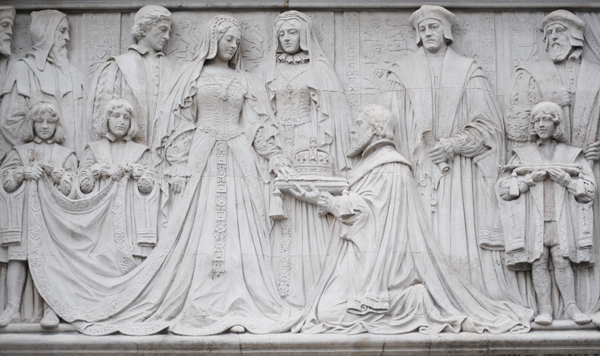
And the answer is…this is part of the decorative facade of the Middlesex Guildhall which stands opposite the Houses of Parliament in Parliament Square. The building, which dates from 1912-13 and stands on the former site of the Westminster Abbey Sanctuary Tower and Old Belfry (where fugitives from the law could seek sanctuary), is now home to the Supreme Court and the Judicial Committee of the Privy Council.

Designed by architect James Gibson, it is the latest in a series of buildings which stood on the site which have served as courthouses and the headquarters of the Middlesex County Council (the first Middlesex Guildhall was built here in 1889). Described by Nikolaus Pevsner as “art nouveau Gothic”, it features a series of medieval-looking decorative friezes and sculptures by Henry Charles Fehr.

The image pictured above shows one of the friezes – this one of the Duke of Northumberland offering the ill-fated Lady Jane Grey the Crown (known as the “Nine Days Queen”, she was later imprisoned and eventually executed on 12th February, 1554). Others show King John handing the Magna Carta to the English barons and the granting of the charter of Westminster Abbey.

It was refurbished for use of the Supreme Court in 2007 and the court has occupied it since its creation in 2009.

Interestingly, according to Ed Glinert of The London Compendium, it was here that courts martial were held of those suspected of giving aid to the enemy during World War I.

The Royal Wedding – London’s royal reception venue

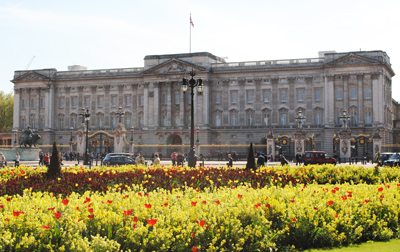
Following the wedding ceremony at Westminster Abbey on Friday, the now married happy couple will head in a carriage via a processional route down The Mall to Buckingham Palace.

There, they will enjoy a champagne reception with 600 guests hosted by the Queen before, at 1.30pm, appearing on the balcony of the palace to wave to the crowds and watch an aircraft flypast expected to include a Lancaster, Spitfire, Hurricane, two Typhoons and two Tornados.

Buckingham Palace, which has served as the official London residence of the reigning monarch since 1837, has a long tradition of hosting royal events. Then much smaller and known as Buckingham House, the property was built for the Duke of Buckingham in 1705.

It passed into royal hands when it was bought by King George III in 1761 for his wife, Queen Charlotte, to use as a family home located conveniently close to St James’s Palace where many court functions were held.

The house was extensively remodelled in 1762 and again, this time on the orders of King George IV, in the 1820s (after initially wanting to use it, like his father, as a family home, the king decided after the works had started to instead transform it into a palace, created to the designs of architect John Nash).

When King George IV died in 1830, his brother King William IV ordered the works to be continued albeit with a new architect, Edward Blore (the spiralling costs of Nash’s work are said to have cost him the contract). The king himself never lived in the house – even offering at at one stage as a seat for Parliament after the Houses of Parliament were destroyed by fire in 1834 – and it wasn’t until the accession of Queen Victoria in 1837 that the palace became the sovereign’s official residence.

Further works were subsequently needed to ensure there was adequate accommodations for the Queen’s family and it was during these works that the monumental Marble Arch – designed as the centrepiece of the palace’s courtyard – was moved away to its present location on the north-eastern corner of Hyde Park.

The palace, which now boasts 775 rooms including 19 staterooms, has since been the site of numerous royal wedding receptions – it was on the balcony  where Queen Elizabeth II and Philip, the Duke of Edinburgh, greeted crowds on 20th November, 1947, after their wedding in Westminster Abbey and, similarly, where Prince William’s parents, Prince Charles and Princess Diana, held a reception before greeting crowds on 29th July, 1981, after their ceremony at St Paul’s Cathedral.

Buckingham Palace was also the location for Queen Victoria’s wedding breakfast following the ceremony in the Chapel Royal at St James’s Palace on 10th February, 1840.

Curious London Memorials – 4. The Suffragette Memorial

Tucked away in a corner of Christchurch Gardens, opposite New Scotland Yard in Victoria Street, St James, this memorial was only erected in 1970.

Designed to resemble an uncurling scroll, the bronzed glass fibre scroll – designed by Edwin Russell – was put there by the Suffragette Fellowship (a group which was founded in 1926 to commemorate the suffrage movement of the early 20th century) and dedicated to the “courage and perseverance of all those men and women who in the long struggle for votes for women, selflessly braved derision, opposition and ostracism, many enduring physical violence and suffering”.

The monument, which is located near Caxton Hall – a now-listed building opened as the Westminster Town Hall in 1883 and “historically associated with women’s suffrage meetings”, was unveiled by former campaigner and hunger-striker Lillian Lenton.

While we’re on the subject of women’s suffrage, we should also mention the memorial to the most prominent member of the early 20th century women’s suffrage movement, Emmeline Pankhurst (1857-1928). Located not far away in Victoria Tower Gardens, right under the shadow of Victoria Tower at the southern end of the Houses of Parliament, stands a 1930 statue of the suffrage leader, who was imprisoned for her stand.

The statue is accompanied by two bronze medallions – one commemorating Mrs Pankhurst’s daughter and suffragette, Dame Christabel Pankhurst (1880-1958), and the other showing the badge of the Women’s Social Political Union (WSPU).

A Moment in History – Guy Fawkes and the Gunpowder Plot

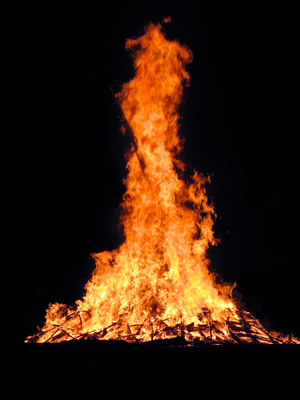
This week, on November 5th and surrounding days, people across England will mark Bonfire Night, an annual event which involves burning effigies of Guy Fawkes on top of a bonfire and setting off copious amounts of firecrackers.

So who was Guy Fawkes and what’s it all about?

Bonfire Night (the 5th November is also known as Guy Fawkes Day or Fireworks Night) has its origins in 1605 when a group of Catholics – including Guy or Guido Fawkes (the latter the Spanish form of his name) – attempted to blow up parliament in what became known as the Gunpowder Plot.

Born in York in 1570, Fawkes converted to Catholicism some time before selling his inheritance and heading to continental Europe where he fought as a mercenary for Catholic Spain against the Protestant Dutch in the Eighty Years War.

Having later travelled to Spain where he unsuccessfully tried to drum up support for a Catholic rebellion in England, he then returned to England where he was introduced to Robert Catesby, who planned to assassinate King James I and much of parliament and put a Catholic monarch back on the throne.

Having leased an undercroft beneath the House of Lords, the group of 13 plotters stockpiled gunpowder there with Fawkes put in charge of lighting it on 5th November before making his escape to the Continent. An anonymous letter, however, to Catholic Lord Monteagle warning him not to attend the State Opening of Parliament, led authorities to the site around midnight on 4th November and there they found Fawkes guarding the 36 barrels of gunpowder.

Arrested (he initially gave them the name of John Johnson), he subsequently confessed under torture and was sentenced to be hung, drawn and quartered – a sentence which he shortened by leaping off the scaffold and breaking his own neck before it could be carried out. The other plotters were also either killed, imprisoned or executed.

Bonfires were supposed to have been lit the night after the plot was foiled – 5th November – to celebrate the king’s safety and they have been ever since that date (in fact, James I passed an Act of Parliament making 5th November a day of thanksgiving – it remained in force until 1859).

Effigies of Fawkes followed (although some people substitute that of Fawkes with other people) as did the firecrackers. Some children carry effigies of Fawkes around asking for a “penny for the Guy” in an effort to apparently raise money for firecrackers. The poem which starts “Remember, remember, the fifth of November” is also associated with the night.

The night, which is now celebrated for all sorts of reasons – some suggest Guy Fawkes should be recognised as a hero for defending persecuted people against governments, is reportedly still observed in places as far afield as the US and New Zealand.

The cellar where Fawkes was arrested no longer exists – it was destroyed during a fire which consumed much of the medieval Houses of Parliament in 1834. But interestingly, the Yeoman of the Guard still do search the Houses of Parliament before each State Opening of Parliament. Two confessions signed by Fawkes are held at the National Archives.

PICTURE:  Agata Urbaniak (www.sxc.hu)

10 sites in London you may not know about – 8. Jewel Tower

Overshadowed by its more impressive neighbours, Westminster Abbey and the Houses of Parliament, the Jewel Tower is just one of few remnants of medieval London left in the city.

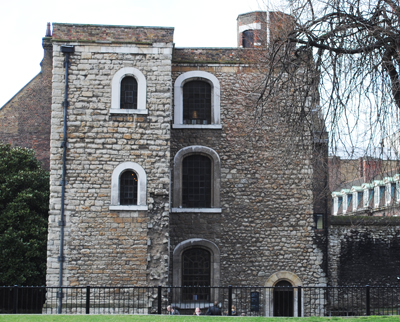
The L-shaped, three story tower was built of white Kentish stone in the mid 1365 during the reign of Edward III in order to provide a safe place to store the king’s personal jewels (as distinct from the Crown Jewels which were held in the Tower of London).

It remained in use as the home of the King’s Privy Wardrobe until 1512 when, following a fire at the Palace of Westminster, the court moved to Whitehall and the jewels were taken to a new home there. Later, in 1621, it became the official house for the records of Parliament and in 1869 it changed roles again, this time becoming the home of the official Weights and Measures Office.

In 1938, the Standards Department moved to a new location in Westminster and, following the war – during which the timber roofs were extensively damaged as a result of air raids – it underwent substantial conservation works.

Now in the care of English Heritage, the building currently houses a fascinating exhibition on the history of parliament and its own past as well as giving access to some of it’s most impressive original features including a vaulted ceiling in the ground level room, complete with carved stone bosses.

Worth visiting to gain a sense of what the medieval Palace of Westminster must have been like not to mention the exhibitions it contains, the Jewel Tower is itself a jewel in London’s medieval heritage.

WHERE: Abingdon Street, Westminster (opposite Victoria Tower at the southern end of the Houses of Parliament). Nearest tube is Westminster; WHEN: Daily, 10am-5pm (summer hours); COST: £3.20 adults/£2.70 concessions/£1.20 children; WEBSITE: www.english-heritage.org.uk/daysout/properties/jewel-tower/