What’s in a name?…Lancaster Gate…

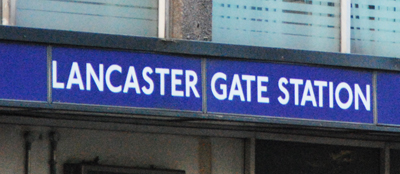
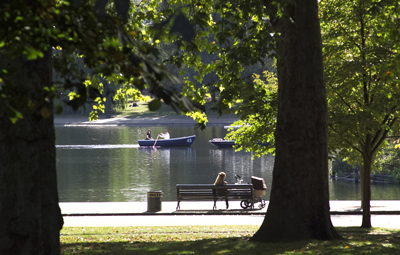
Now perhaps best known as a Tube station and a street and square in Bayswater, just west of the City, the name Lancaster Gate was actually first applied to a gateway located on the northern side of Kensington Gardens, close to where the ornamental water gardens known as the Italian Gardens now stand.

The gate is believed to have been named after Queen Victoria, in her capacity as the head of the Duchy of Lancaster (since the days of King Henry IV, the duchy has been the personal property of the monarch).

The nearby housing development of Lancaster Gate, centred on Christ Church followed in the mid 1800s (designed by Sancton Wood). The church closed in 1977 and was turned into housing in 1983; all that now remains architecturally are the church’s tower and spire.

Among people associated with the street is the Ethiopian Emperor Haile Selassie who resided in a hotel here at the start of World War II.

The Tube station where bears the name Lancaster Gate opened in 1900.

For more on Tube station names, try Cyril M Harris’ What’s in a Name?: Origins of Station Names on the London Underground.

Treasures of London – Diana Memorial Fountain

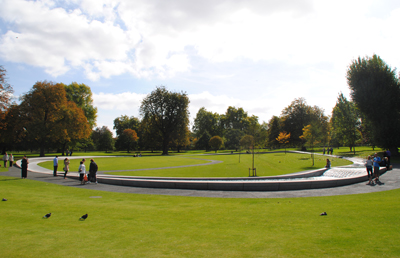
Located in Hyde Park (not far from the Lido), this memorial to Diana, Princess of Wales, is designed as a ring of water – rather like a stream bed – with two cascades tumbling down to meet in a pool at the bottom.

The fountain, which was opened by Queen Elizabeth II in July, 2004, also features three bridges which lead into the heart of the fountain – a symbol, apparently, of Diana’s openness to people.

Designed by US architect Kathryn Gustafson, the fountain – which cost £3.6 million – is made of 545 pieces of Cornish granite, each of which was shaped using laser cutting technology before being pieced together using traditional skills.

Gustafson’s design was selected after more than 10,000 plans were submitted to the Princess Diana Memorial Fountain Committee in 2002. The architect has been reported as saying she wanted the design to reflect Diana’s inclusive “personality”.

The fountain was briefly closed to the public shortly after opening in 2004 because of safety concerns but reopened with new guidelines soon after.

The fountain is located on the route for the the Diana, Princess of Wales, Memorial Walk, which takes on four of the royal parks – Kensington Gardens, Hyde Park, Green Park and St James’s Park.

Diana, whose divorce from Prince Charles had only been finalised the previous year, died in a car crash in Paris in August, 1997, along with Dodi Al Fayed.

WHERE: Hyde Park (nearest Tube stations are Knightsbridge and Hyde Park Corner); WHEN: 10am to 8pm until end of August (check website for times after that); COST: Free; WEBSITE: http://www.royalparks.org.uk/parks/hyde-park/diana-memorial-fountain

Where is it? #23…

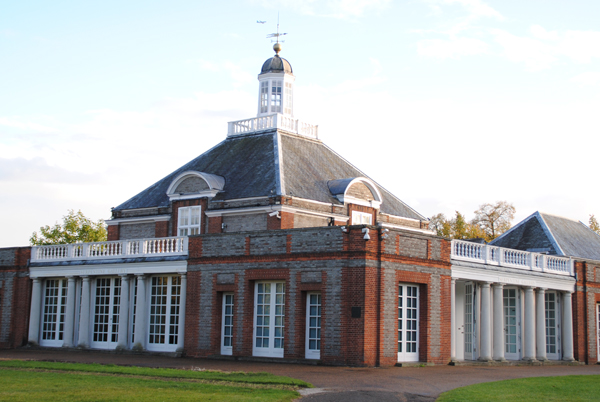
The latest in the series in which we ask you to identify where in London this picture was taken and what it’s of. If you think you can identify this picture, leave a comment below. We’ll reveal the answer early next week. Good luck!

Well done to Jameson Tucker and Sean Dennis, both of whom identified this correctly as the Serpentine Gallery in Kensington Gardens. The gallery, which features modern and contemporary art, was created in 1970 and is housed in a tea pavilion which dates from the 1930s. Every summer since the year 2000, the Serpentine – named for the body of water which, strictly speaking, just runs through Hyde Park (although the section in Kensington Gardens is also often referred to in the same way) – has had a different temporary pavilion, designed by a leading architect, set up outside.

The Serpentine Gallery is to be expanded this year with the creation of the Serpentine Sackler Gallery in The Magazine building in the gardens. Located only a short distance from the existing gallery, the new premises is being designed by Pritzker Prize-winning architect Zaha Hadid and is named after Dr Mortimer and Theresa Sackler, whose foundation made the project possible through the largest single donation ever received by the Serpentine Gallery.

WHERE: Kensington Gardens; WHEN: Daily 10am to 6pm; COST: Free; WEBSITE: www.serpentinegallery.org.

LondonLife – The Queen visits the newly transformed Kensington Palace…

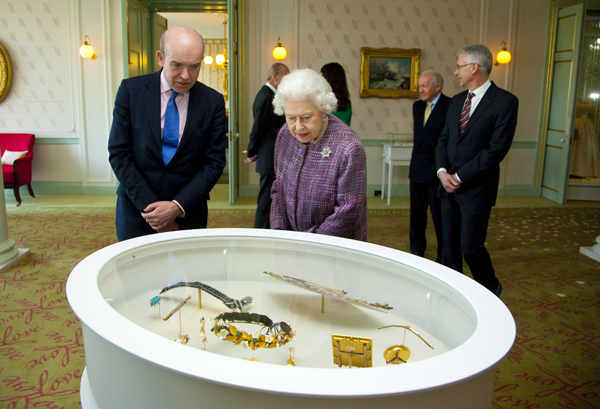
Queen Elizabeth II looks over gifts exchanged by Queen Victoria and Prince Albert in a display which forms part of the Victoria Revealed exhibition at Kensington Palace.

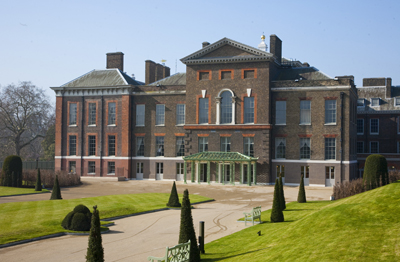
The Queen and Duke of Edinburgh visited palace last week to officially reopen the building following a £12 million, two year renovation project aimed at “transforming the visitor experience”.

The works have involved restoring the palace gardens – which will now be permanently open to the public free-of-charge – and reconnecting the palace with the surrounding parklands of Kensington Gardens partly through the provision of a new entrance. Landscape designer Todd Longstaffe-Gowan’s plan – which centres on a statue of Queen Victoria – features new lawns and avenues and a “maze-like path” inspired by 18th century “wilderness walks”.

There is also a new visitor reception area and “orientation hub” as well as a new courtyard terrace and cafe to complement The Orangery, shop and learning centre.

Victoria Revealed, a new permanent exhibition at the palace looks in intimate detail at the life of the Queen who once lived here and features everything from her black silk baby shoes to her wedding dress and the mourning clothing she wore following the death of Prince Albert as well as archive film footage showing the celebrations for the Diamond Jubilee of her reign in 1897.

The palace reopens on 26th March.

WHERE: The Broad Walk, Kensington Gardens, Kensington (nearest Tube stations are High Street Kensington or Queensway); WHEN: Daily 10am to 6pm (until 31st October); COST: £14.50 adult/£12 concession/children under 16 free (online booking discounts available, Historic Royal Palaces members free); WEBSITE: www.hrp.org.uk/KensingtonPalace.

PICTURES: Courtesy of Historic Royal Palaces/newsteam.co.uk

The Royal Parks – 3. Green Park

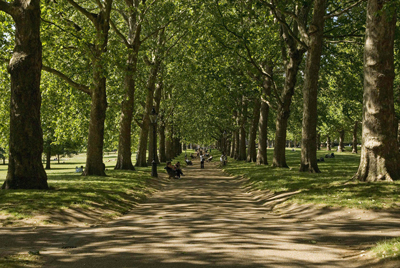
Perhaps the most overlooked and least celebrated of central London’s Royal Parks, Green Park (officially The Green Park) is a peaceful oasis of leafy trees between the bustle of Piccadilly and traffic of Constitution Hill and part of an unending swathe of green which connects Kensington Gardens with, eventually, St James’ Park.

Originally meadowland used for hunting, the earliest known mention of the area where the park now stands was apparently in 1554 when it was believed to be a staging point for Thomas Wyatt (the younger) who led a group of rebels protesting against the marriage of Queen Mary I to King Philip II of Spain. The unfortunate – and unsuccessful (in terms of his rebellion at least) – Wyatt was later beheaded for treason.

In 1668, King Charles II had the park enclosed with a brick wall and stocked with deer, as well as having a ranger’s lodge and icehouse built (to keep his drinks cool when entertaining in summer). While it was initially known as Upper St James’s Park, by 1746 Green Park had its own name. It’s not really known what prompted the name change but the unofficial story is that Queen Catherine of Braganza, wife of King Charles II, found out that her philandering husband had picked some flowers there for another woman – a milkmaid. In revenge, she had every flower in the park pulled up with orders they were not to be replanted. To this day, while some 250,000 daffodils bloom here in spring, there remain no formal flowerbeds in the park.

The 47 acre (19 hectare) park, which was also used on occasion as a duelling ground, underwent further development at the beginning of the following century with the creation of the ornamental Tyburn Pool near the centre of the park.

Queen Caroline, the wife of King George II, meanwhile, had a reservoir built to supply water to St James’s Palace and Buckingham Palace (it was known as the Queen’s Basin) as well as a library and the Queen’s Walk. Planted in 1730, this runs along the eastern side of the park and helped to turn it into a fashionable place in which to be seen (and led to the building of many a mansion in nearby Piccadilly).

Other buildings in the park have included two temporary ‘temples’ – the Temple of Peace (erected in 1749 to mark the end of the War of Austrian Succession) and the Temple of Concord (erected in 1814 to mark 100 years of the rule of the Hanoverian dynasty). Both of these, believe it or not, burnt down during the celebrations they were built for.

The park, which underwent a redesign in which the first trees were planted in the 1820s as part of architect John Nash’s grand plans for St James’s Park, was opened to the general public in 1826 but by then many of its earlier features – including the ranger’s house, Tyburn Pool and the Queen’s Basin – were already gone.

In more recent times, war memorials have been added to the park – the maple-leaf daubed, Pierre Granche-designed memorial to Canadian soldiers in 1994 (Canada is also remembered in Canada Gate on the park’s south side, installed in 1908 to mark the nation’s contribution to the Empire), and a set of memorial gates on Constitutional Hill at the park’s western end which is dedicated to the five million people from the Indian Sub-Continent, Africa and the Caribbean who served in World War II in 2004. The park also features the ‘Diana fountain’, installed in 1952 by the Constance Fund (and currently undergoing restoration).

On 14th June, a 41 royal gun salute is fired here to mark the Queen’s birthday. Salutes are also fired here for the State Opening of Parliament in November or December, Remembrance Sunday, and for State Visits.

WHERE: Green Park (nearest tube station is Green Park and Hyde Park Corner); WHEN: daily; COST: free; WEBSITE: http://www.royalparks.gov.uk/Green-Park.aspx

PICTURE: Courtesy of Royal Parks. © Anne Marie Briscombe 

The Royal Parks – 2. Kensington Gardens

Once the western part of King Henry VIII’s hunting ground, the 111 hectare Kensington Gardens is now primarily associated with the palace which sits at its heart.

The origins of the gardens go back to 1689 when King William III and Queen Mary II decided to make Kensington Palace (which, as we mentioned last week, was formerly known as Nottingham House) their home. Queen Mary oversaw the creation of a formal, Dutch-style garden featuring hedges and flower beds.

Queen Anne expanded the gardens after King William III’s death and commissioned landscape designers Henry Wise and George Loudon to create an English-style garden. She also ordered the construction of the Orangery which still stands to the north of the palace complex today (and houses a fine restaurant).

But it’s to Queen Caroline, wife of King George II, to whom Kensington Gardens owe its current form for it was she who in 1728, scythed off 300 acres of Hyde Park and employed Charles Bridgeman to create a new garden. His designs included damming the Westbourne stream to create the Long Water and the adjoining Serpentine in Hyde Park. He was also responsible for the creation of the Round Pond in front of the palace and, a landscape-history making move, used a ditch known as a ha-ha to separate the gardens from Hyde Park.

By the reign of King Charles II, the gardens had become fashionable for the elite to stroll in with the Broad Walk a popular promenade. But the gardens gradually fell from favour – a move exacerbated when Queen Victoria, who was born in Kensington Palace, moved to live at Buckingham Palace.

There were some changes made during the era, however. They included the creation of the ornamental Italian water gardens at the northern end of the Long Water and the Albert Memorial (see our previous story here) on the southern edge of the gardens.

Other highlights there today include the Peter Pan statue (see our earlier story on this), the Serpentine Gallery (with, in summer, a temporary pavilion), the Peter Pan-themed Diana, Princess of Wales Memorial Playground (opened in 2000), and the Elfin Oak, a stump which originally came from Richmond Park and is carved with tiny figures of woodland animals and fairies.

There’s also a statue of Queen Victoria directly outside of Kensington Palace which, interestingly, was sculpted by her daughter Princess Louise in celebration 50 years of her reign, as well as statues of Edward Jenner, creator of the small pox vaccine, and John Hanning Speke, discoverer of the Nile.

Other facilities include a cafe and, next to the magazine, an allotment.

WHERE: Kensington Gardens (nearest tube stations are that of Queensway, Bayswater, Lancaster Gate, South Kensington, Gloucester Road and Kensington High Street); WHEN: 6am to dusk; COST: Free; WEBSITE: http://www.royalparks.gov.uk/Kensington-Gardens.aspx

PICTURE: Courtesy of Royal Parks. © Giles Barnard

The Royal Parks – 1. Hyde Park

This year marks the 160th anniversary of the transfer of the care of the Royal Parks to the government (meaning the public was freely able to enjoy access for the first time). To celebrate, over the next weeks we’ll be taking a look at the history of each of them. First up is the 142 hectare Hyde Park, perhaps the most famous of all eight Royal Parks.

Formerly owned by Westminster Abbey, King Henry VIII seized the land in 1536 for use as a private hunting ground. He had it enclosed with fences and the Westbourne Stream, which ran through the park – it now runs underground – dammed.

It remained the king and queen’s private domain (Queen Elizabeth I is known to have reviewed troops there) until King James I appointed a ranger to look after the park and permitted limited access to certain members of the nobility in the early 17th century.

The park’s landscaping remained largely unaltered until the accession of King Charles I – he created what is known as the ‘ring’ – a circular track where members of the royal court could drive their carriages. In 1637, he also opened the park to the public (less than 30 years later, in 1665, it proved a popular place for campers fleeing the Great Plague in London).

During the ensuring Civil War, the Parliamentarians created forts in the park to help defend the city against the Royalists – some evidence of their work still remains in the raised bank next to Park Lane.

After King William III and Queen Mary II moved their court to Kensington Palace (formerly Nottingham House) in the late 1600s, they had 300 oil lamps installed along what we know as “Rotten Row’ – the first artificially lit road in the country – to enable them and their court to travel safely between the palace and Westminster.

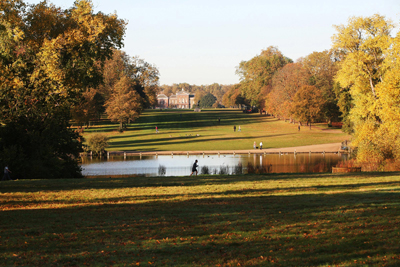
The natural looking Serpentine – the great, 11.34 hectare, lake in the middle of Hyde Park (pictured) – was created in the 1730s on the orders of Queen Caroline, wife of King George II, as part of extensive work she had carried out there. It was Queen Caroline who also divided off what we now know as Kensington Gardens from Hyde Park, separating the two with a ha-ha (a ditch).

The next major changes occurred in the 1820s when King George IV employed architect and garden designer Decimus Burton to create the monumental park entrance at Hyde Park Corner – the screen still remains in its original position while Wellington Arch was moved from a parallel position to where it now stands (see our previous posts for more on that). Burton also designed a new railing fence and several lodges and gates for the park. A bridge across the Serpentine, meanwhile, was built at about the same time along with a new road, West Carriage Drive, formally separating Hyde Park and Kensington Gardens.

While the basic layout of the park has been largely unchanged since, there have been some additions – among them, the establishment in 1872 of Speaker’s Corner as a place to speak your mind in the north-east corner of the park (near Marble Arch), the creation in 1930 of the Lido for bathing in warm weather, and, more recently, the building of the Diana, Princess of Wales’ Memorial Fountain (unveiled in 2004), and the 7 July Memorial (unveiled in July 2009).

Other sculptures in the park include Isis (designed by Simon Gudgeon, located on the south side of the Serpentine), the Boy and Dolphin Fountain (designed by Alexander Munro, it stands in the Rose Garden), and a monumental statue of Achilles, a memorial to the Duke of Wellington designed by Richard Westmacott, near Park Lane. There are also memorials to the Holocaust, Queen Caroline, and the Cavalry as well as a Norwegian War Memorial and a mosaic marking the site of the Reformer’s Tree (the tree was burnt down during the Reform League Riots of 1866).

The park has been integral part of any national celebrations for centuries – in 1814 a fireworks display there marked the end of the Napoleonic Wars, the Great Exhibition – with the vast Crystal Palace – was held there in 1851 and in 1977 a Silver Jubilee Exhibition was held marking Queen Elizabeth II’s 25 year reign. Cannons are fire there on June 2nd to mark the Queen Elizabeth II’s coronation and on 10th June for the Duke of Edinburgh’s birthday.

Facilities these days include rowing and pedal boats, tennis courts, deck chairs, a restaurant and cafe (the latter based in the Lido) and, of course, some Boris bikes. There is a heritage walk through the park which can be downloaded from the Royal Parks website.

WHERE: Hyde Park (nearest tube stations are that of Marble Arch, Hyde Park Corner, Lancaster Gate, Knightsbridge and South Kensington); WHEN: 5am to midnight; COST: Free; WEBSITE: www.royalparks.gov.uk/Hyde-Park.aspx?page=main

PICTURE: Courtesy of Royal Parks. © Indusfoto Ltd 

Treasures of London – Peter Pan statue, Kensington Gardens

It’s now one of the most popular statues in London – the diminuative “boy who wouldn’t grow up”. But few people today are aware of its somewhat unusual origins.

Located about half-way along the western shore of the Long Water in Kensington Gardens, the bronze statue first “appeared” in the park in 1912. The story goes that author JM Barrie, who published his first story about Peter Pan – The Little White Bird – in 1902, chose the location of the statue based on it being the place where, in the story, Peter Pan landed after flying out of the nursery window of his home.

Peter Pan first appeared on stage two years later in 1904 in the play Peter Pan, or The Boy Who Wouldn’t Grow Up, and this was later expanded into a novel by Barrie, Peter and Wendy. He’s since appeared in numerous film and stage adaptations – including sequels and prequels to the original tales.

Barrie had apparently been thinking about the statue for some time prior to its appearance – in 1906 he went so far as to take a series of photographs of six-year-old  Michael Llewelyn Davies wearing a Peter Pan costume (it was Barrie’s relationship with the Llewelyn Davies family which is said to have inspired Peter Pan’s creation).

Six years later Barrie commissioned Sir George Frampton to create the statue – interestingly, in what was a cause of some friction between the artist and patron, Sir George modelled his figure not on Llewelyn Davies but on another boy. Peter is seen playing on some pipes and is surrounded by small animals and fairies. There’s no sign of Captain Hook.

On the 1st of May, the statue simply appeared in its current position after being taken into the park under the cover of darkness. Barrie announced what he called his “May Day gift” to the children of London in The Times newspaper, describing it as “delightfully conceived”.

There was apparently some initially concerns raised among MPs about the appropriateness of an author erecting a statue to promote his own work but it has since become an iconic symbol of the gardens (and undergone some repairs – including after an incident in 1952 when Peter’s pipes were stolen).

So popular has the statue proved, that copies of the Peter Pan statue – created using Sir George’s mould – can now be found in Liverpool as well as in countries including Canada, Brussels, Australia and the US. There are others (not copies) in Kirriemuir, Scotland (Barrie’s birthplace) and another of him with Tinkerbell outside Great Ormond Street Hospital for Children (which holds the copyright to the character).

WHERE: Peter Pan statue (nearest Tube station is Lancaster Gate); WHEN: 6am to dusk daily; COST: Free; WEBSITE: www.royalparks.gov.uk/Kensington-Gardens.aspx

Around London – The Magazine gets a new life, Lennon’s former home commemorated, and, The Titanic Exhibition

News this week that The Magazine building in Kensington Gardens – which dates from 1765 and was built to house munitions initially intended to help repel a Napoleonic invasion – is getting a new lease of life as an art gallery. The Royal Parks have awarded the Serpentine Gallery a contract to create a new art space – the Serpentine Sackler Gallery – in the building. Pritzker Prize architect Zada Hadid will oversee the renovation of the building which will be open in time for the Olympic Games in 2012. PICTURE: John Offenbach © The Royal Parks and Serpentine Gallery.

• A Blue Plaque commemorating singer, songwriter and one-time Beatle John Lennon’s stay in a house in Marylebone was unveiled last month. Yoko Ono unveiled the plaque at 34 Montagu Square, where she and John lived in the basement and ground floor flat in the latter half of 1968 when Lennon was working on The Beatles’ White Album. It was the first home the couple shared and, while Lennon lived at a number of London addresses between 1963 and 1971, of those that survive it is the home he occupied for the greatest period. Previous occupants included Ringo Starr, Paul McCartney and Jimi Hendrix.

• ON NOW: Titanic: The Artefact Exhibition will be held at the O2 from 5th November until 1st May. The exhibition traces the Titanic’s final journey, from Cherbourg on 10th April, 1912 to its sinking with the loss of 1,500 lives after striking an iceberg three days later. Featuring more than 200 artefacts from the ship, the exhibition includes recreated interiors from the ship. Tickets start at £13 for adults. For more information, see www.titaniclondon.co.uk.