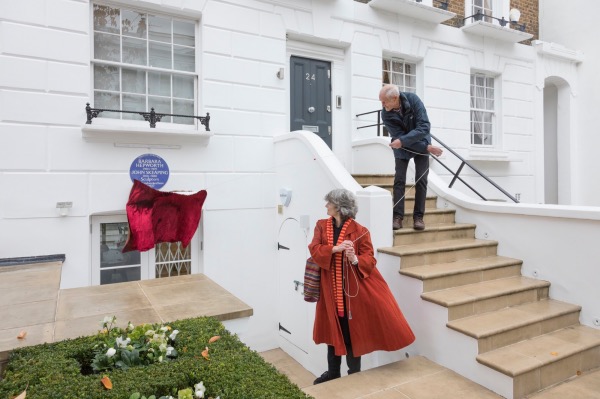
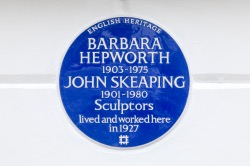
Twentieth century sculptors Barbara Hepworth (1903-1975) and John Skeaping (1901-1980) have been recognised with an English Heritage Blue Plaque at their former home in St John’s Wood. The couple lived in the basement flat at 24 St Ann’s Terrace for less than a year in 1927 but during that time held a joint exhibition (Hepworth’s first ever) in the studio, located in a former billiards room at the rear of the house. The room was also where Hepworth created one of her earliest Mother and Child sculptures as well as works including Doves and Seated Figure. Present at the unveiling last Friday were Sophie Bowness, Barbara Hepworth’s grand-daughter, and Nicholas Skeaping, John Skeaping’s son. For more, on English Heritage Blue Plaques, head to www.english-heritage.org.uk/visit/blue-plaques/.
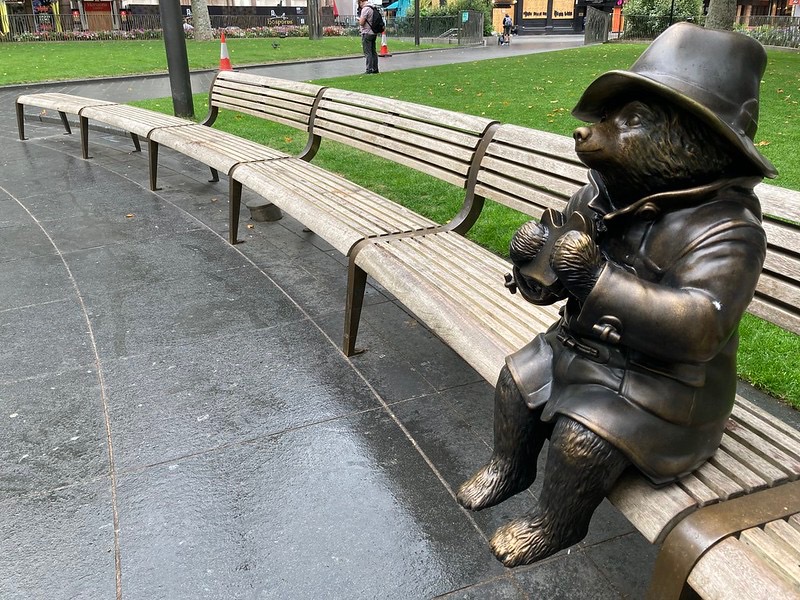
Paddington Bear may look lonely seated on a park bench but he is actually among a host of new statues which were placed in Leicester Square earlier this year. Others include Mr Bean, Mary Poppins, Laurel and Hardy, and Harry Potter and now comes news that Paddington will have more company from spring next year. A 10th statue – depicting the “King of Bollywood”, Shah Rukh Khan, and his co-star Kajol – will be placed in the famous square in what will be the first ever Bollywood statue erected in the UK. The new statue will recreate a scene from the award-winning rom-com, Diwale Dulhania Le Jayenge. PICTURE: Matt Brown (licensed under CC BY 2.0).
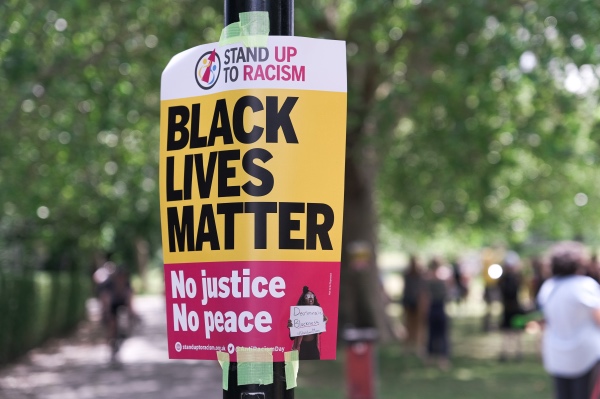
A Black Lives Matter tribute shirt worn by Arsenal captain Pierre-Emerick Aubameyang during the 2020-21 Premier League season is being donated to the Museum of London as part of its Collecting COVID project. The Black Lives Matter logo was added to all Premier League shirts following anti-racism protests across the globe earlier this year. Aubameyang – the latest Black player to captain Arsenal – said it was “an honour to have the opportunity to donate my Black Lives Matter shirt to the Museum of London’s Collecting COVID project”. “I hope this will be remembered as the moment that football stood against all forms of racism and that it will inspire young people for the future,” he said. The Collecting COVID project was launched in April this year with the aim of collecting objects relating to how Londoners lived during coronavirus pandemic. For more, see www.museumoflondon.org.uk/discover/museum-for-london-collecting-covid.
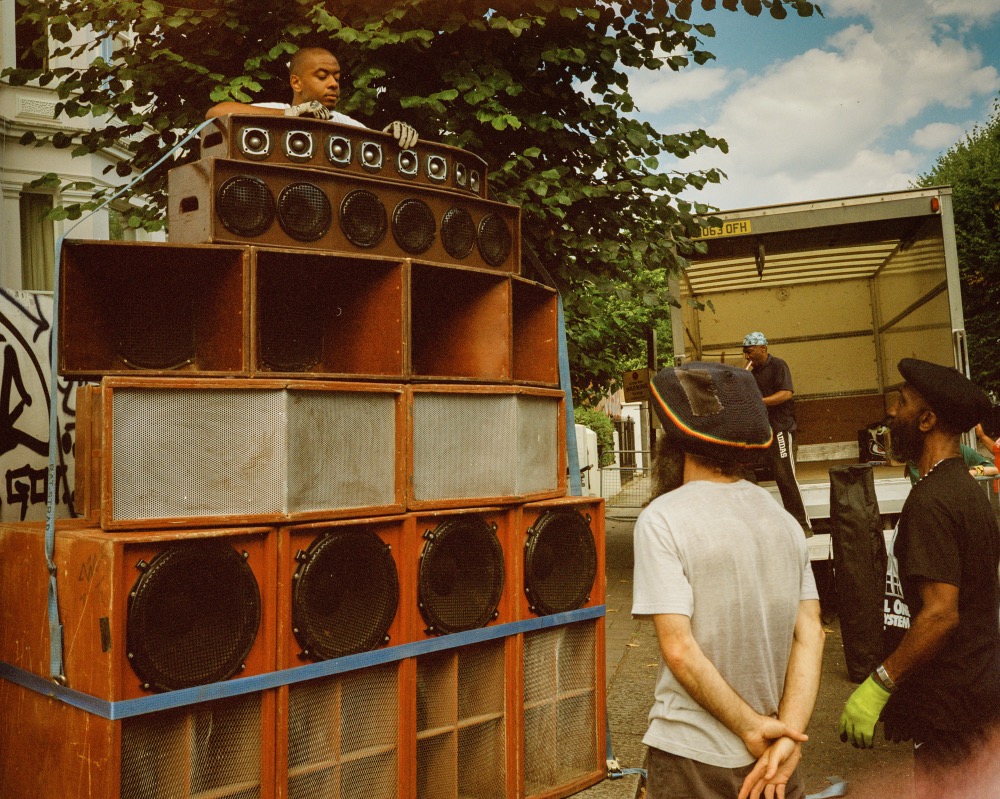
• Dub music and the impact it’s had on London’s identity and people is the subject of a new, long delayed, exhibition which opened at the Museum of London late last week. Dub London: Bassline of a City, which had been postponed due to the coronavirus pandemic, charts how, from its roots in Jamaican reggae, dub music went on to influence multiple genres and played a key role in the development of punk bands like The Clash. The display includes the iconic speaker stack belonging to Channel One Sound System that has appeared yearly at Notting Hill Carnival since 1983 (pictured above) and a specially created bespoke record shop with a selection of 150 vinyl records chosen by 15 London based independent record shops which can be listened to. Runs until 31st January. Admission is free but must be booked in advance (and bring your own headphones). For more, see www.museumoflondon.org.uk/museum-london/whats-on/exhibitions/dub-london.
• The concept of sin is at the heart of a new free exhibition at The National Gallery. Sin brings together 14 works dating from the 16th century to now by artists ranging from Jan Brueghel the Elder and William Hogarth to Andy Warhol and Ron Mueck. Among the paintings on show are Lucas Cranach the Elder’s Adam and Eve (1526), Hogarth’s The Tête à Tête and Marriage A-la-Mode, Diego Velázquez’s Immaculate Conception, William Holman Hunt’s The Scapegoat (1854-55), and Ron Mueck’s sculpture Youth (2009). The display can be seen in Room 1. For more, see nationalgallery.org.uk.
• The science of the coronavirus is explored in a special night event at the Science Museum next Wednesday, 14th October. Staff from the Francis Crick Institute will be joining with those from the Science Museum in exploring how the immune system remembers and evolves and how the Crick was turned from a biomedical research centre into a COVID-19 testing facility. Visitors can also hear from NHS transplant surgeon Pankaj Chandak who has been using 3D printing tech to make life-saving PPE for frontline staff while the Leonard Cheshire charity shows how assistive eyegaze technology has played a vital role in helping to keep people with access needs connected. There will also be a chance to make a facemask as part of the museum’s #MaskSelfie campaign and the opportunity to explore the museum’s new Medicine: The Wellcome Galleries. Admission charge applies and pre-booking is essential. Head to sciencemuseum.org.uk/see-and-do/lates.
Send all items for inclusion to exploringlondon@gmail.com.
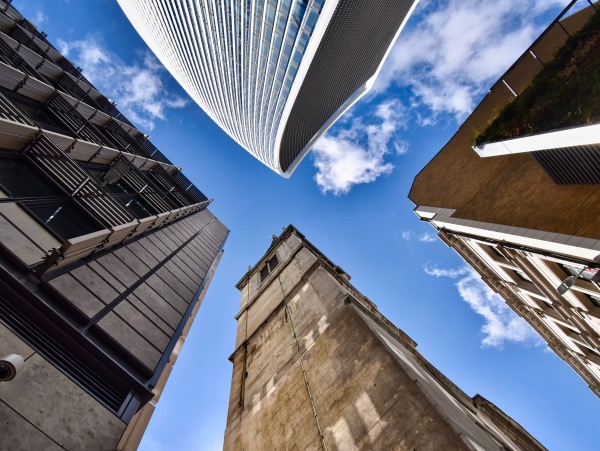
Arne Quinze, Lupine Tower, 2020, Aluminium, Maruani Mercier Gallery. PICTURE: Stephen White.
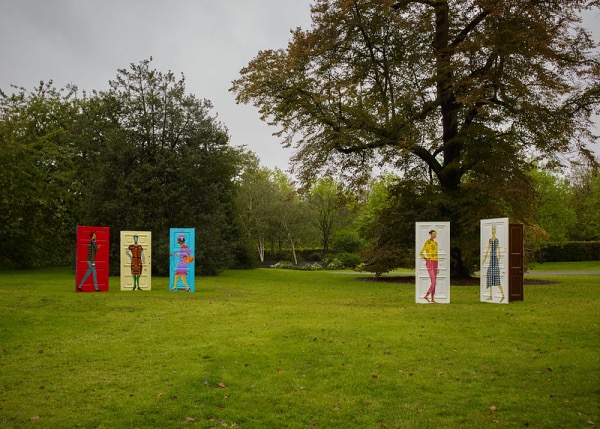
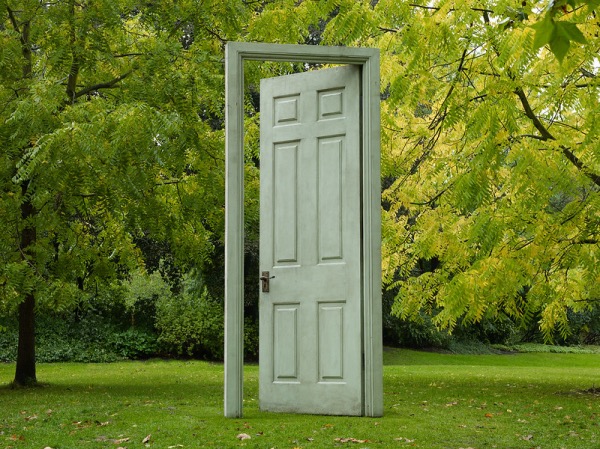
Twelve works by leading international artists have gone on show in the English Gardens, The Regent’s Park, in this year’s Frieze Sculpture display. The works, which can be seen until 18th October and form part of an expanded Frieze Week programme, includes pieces from Patrick Goddard, Kalliopi Lemos and Arne Quinze as well as a recent commission by Lubaina Himid which is being exhibited in the UK for the first time. The works touch on a range of themes – from civil rights and ecology to the role of the artist as a disruptor. The display is accompanied by a free audio tour by curator Clare Lilley, director of programme at Yorkshire Sculpture Park, and can also be seen virtually in the Frieze Viewing Room. For more, see www.frieze.com/FriezeSculpture.
Sarah Lucas, Sandwich, 2011 – 2020, Concrete, Sadie Coles HQ. PICTURE: Stephen White.
Lubaina Himid, Five Conversations, 2019, Acrylic paint on five reclaimed wooden doors from traditional Georgian townhouses, Hollybush Gardens. PICTURE: Stephen White.
This delightfully named establishment – one of the most well-known chocolate houses in London – was apparently opened on the back of the opening of myriad coffee houses in London.
With a sign depicting the cocoa tree, this premises occupied several different locations in Pall Mall including number 46, occupied by an annexe of the Army and Navy Club, and number 89, the site where the Royal Automobile Club now stands.
It is said to have been first mentioned in 1698 – chocolate was first brought to England in the 1650s and the first “chocolate houses” opened soon after.
It was popular among Tories in the early 1700s serving as something as a defacto headquarters and later, apparently, a hotbed for those with Jacobite sympathies. Around the middle of the 18th century, it was converted into a private club and become notorious for the gambling conducted therein.
Among those said to have dined there during this later period was 18th century historian Edward Gibbon.
The Cocoa Tree later relocated to 64 St James’s Street, where it stood between 1799 and 1835. The property apparently finally closed in 1932.
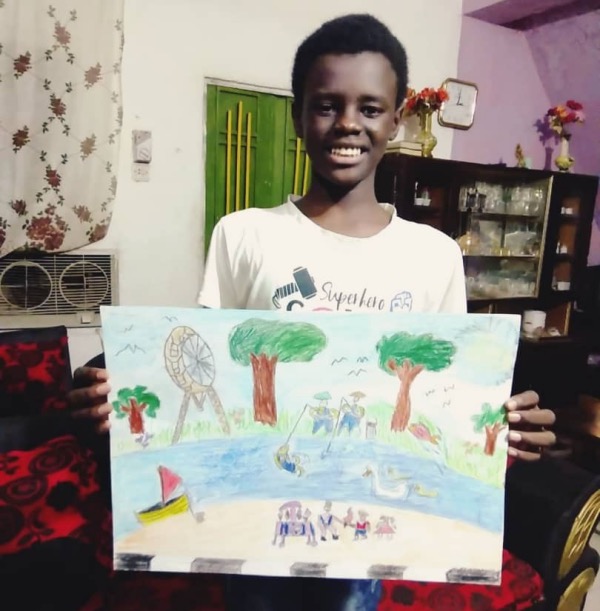
River inspired artwork created by young people from across London, the UK and around the world is one show on South Bank as part of the Totally Thames festival. The art for Rivers of the World was created during the coronavirus lockdown under the guidance of professional artists who provided briefs and films to help the young artists. The outdoor exhibition, on Riverside Walkway near the Tate Modern, is free to visit. For more on Totally Thames, London’s annual month-long celebration of its river, head to https://thamesfestivaltrust.org. PICTURES: Young artists with work created as part of ‘Rivers of the World’ (Courtesy of Totally Thames).
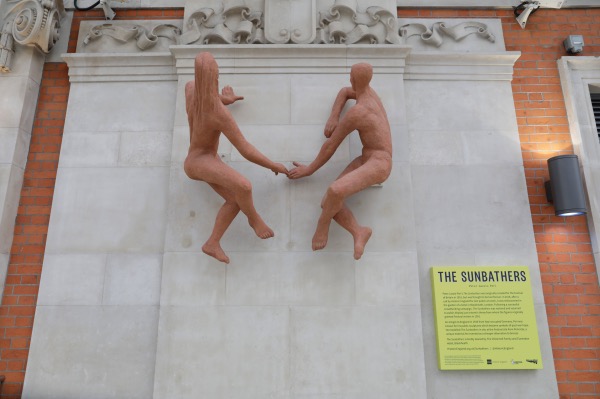
A sculpture created for the 1951 Festival of Britain has returned to Waterloo Station where it was first displayed almost 70 years ago. The work of Hungarian-born artist Peter Laszlo Peri, The Sunbathers features two figures – made from ‘Pericrete’, a special kind of concrete created by the artist as a cheaper alternative to casting in bronze – and was mounted on the wall close to the station’s entrance. It was presumed lost until it was rediscovered in 2016 at the Clarendon Hotel in Blackheath and, following restoration, was put on show in 2017 in the Southbank Centre’s Royal Festival Hall. Now, thanks to the efforts of Historic England and Network Rail, the sculptures have returned to the station, close to its original site, and will stay there for five years. PICTURES: Courtesy of Network Rail
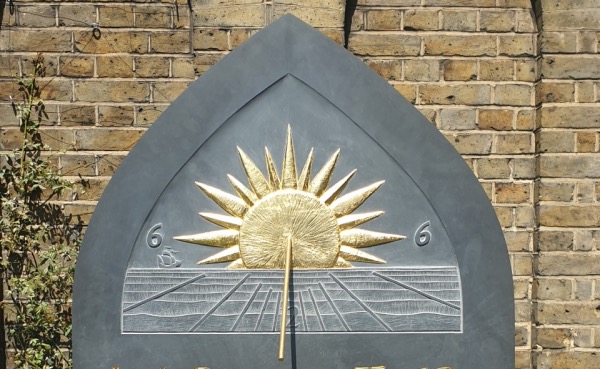
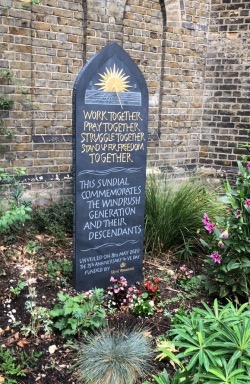
A new sundial and garden have been unveiled in Kensal Green commemorating the Windrush generation. The sundial, the work of carver Martin Cook, is located at St John The Evangelist Church which, according to its vicar, Rev David Ackerman, has relied upon the local Caribbean community to survive and thrive since the 1960s. The sundial has been made of a single piece of slate and carved with the words “Work Together, Pray Together, Struggle Together, Stand Up for Freedom Together” which are taken from Martin Luther King Jr’s famous ‘I have a dream’ speech. An official opening ceremony for the sundial – which was funded by Westminster City Council – was held earlier this month. In a statement, Jonathan Glanz, the Lord Mayor of Westminster, said he hoped the outdoor space would become a “beacon of peace and unity for the local community in troubled times”. PICTURES: Courtesy of the City of Westminster.
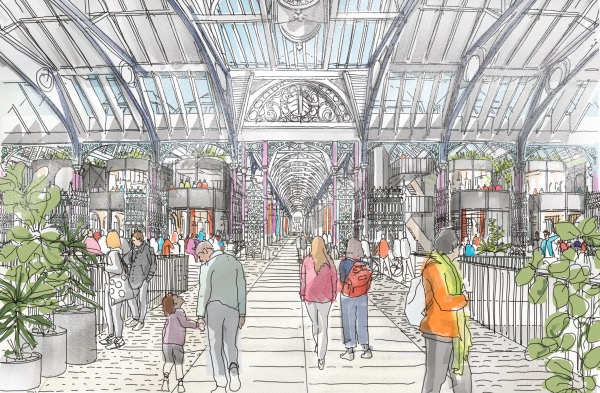
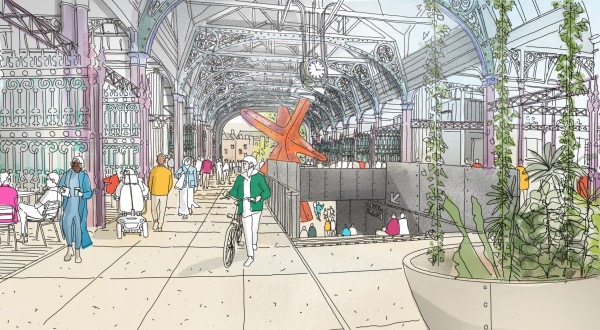
The City of London Corporation has unveiled early ideas for the redevelopment of the Smithfield Market following the proposed relocation of the meat market to Dagenham Dock along with Billingsgate and New Spitalfields. The work of architecture practice Studio Egret West, the new designs see the Grade II*-listed East and West Smithfield buildings and Grade II-listed Rotunda transformed for public and commercial use including removing some of the modern additions to the market buildings, such as loading bays and cold rooms, to reveal the elegance of the original Victorian structure and create four large, clear “halls” under the oversailing roof. While there’s been a meat market on the site since the 12th century, the Victorian-era markets buildings, featuring ornate iron frames, were built between 1866 and 1883. Members of the public are able to share their feedback on the initial concept drawings via the website, www.wholesalemarkets.co.uk/smithfield until 4th September.
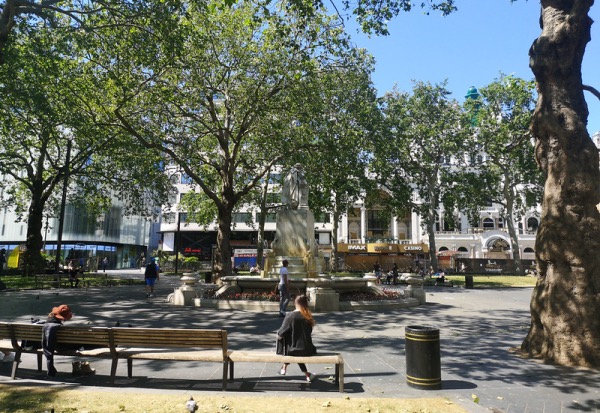
The first recorded soundscape of London’s busy streets was created in 1928 as part of a Daily Mail campaign calling for noise restrictions. Recordings were made at five sites – Whitechapel East, St George’s Hospital at Hyde Park Corner, Leicester Square, Cromwell Road and Beauchamp Place in South Kensington – in a collaborative project between the Mail and the Columbia Graphophone Company. Now, more than 90 years later, the sounds at the five original locations – or rather the lack of sounds during the coronavirus pandemic lockdown – have been captured again, this time as binaural recordings, a method of recording sound that uses two microphones to create a 3D stereo sound. It’s all part of the Museum of London’s ongoing ‘Collecting COVID’ project and was created in collaboration with String and Tins, an award-winning team of sound designers, composers, sound supervisors and mix engineers. Both the 1928 recordings (now digitised) and the modern recordings have been made available to listen to in their entirety for the first time on the Museum of London’s website. There are accompanying photographs by Damien Hewetson as well as historic imagery from the museum’s archive. PICTURE: A sparsely populated Leicester Square in an image taken in May this year during the coronavirus lockdown (ACME/licensed under CC BY-NC 2.0)











 Exploring London