Almost destroyed in a May, 2007, fire, the Cutty Sark, the world’s last surviving 19th century tea clipper, is now a major international tourist attraction (although no longer in the Thames but on a dry dock beside the river).
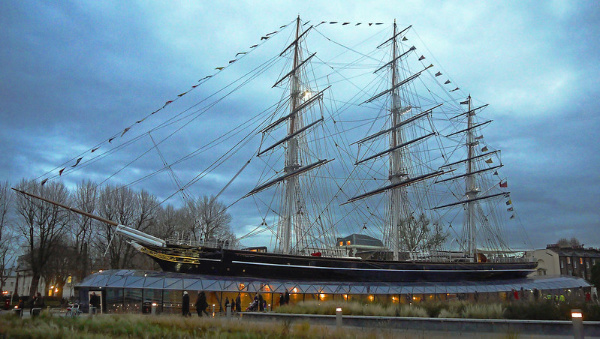
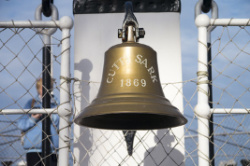
The Cutty Sark was built in Dumbarton, Scotland, in 1869, for shipping company Willis & Sons.
Designed by Hercules Linton specifically for the China tea trade (meaning with speed in mind), she cost some £16,150 and featured some 32,000 square feet of sails, a staggering 11 miles of rigging with a main mast standing 153 feet high and a hull sheathed in a copper and zinc alloy to prevent damage.
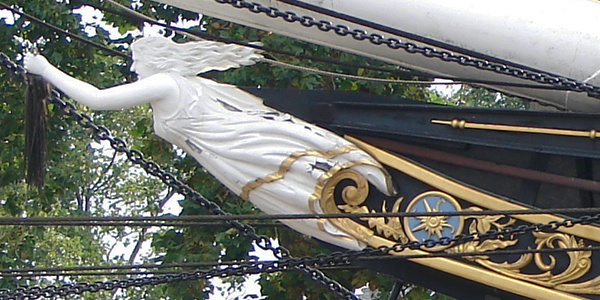
Her name was taken from a Robert Burns poem, Tam o’ Shanter, in which a witch is given the nick-name Cutty-sark because of the short undergarment – in 18th century Scots, a “cutty-sark” or “little shirt” – that she wore (the vessel’s figurehead is a representation of the witch).
On her maiden voyage, the Cutty Sark departed from London on 15th February, 1870, bound for Shanghai and carrying a general cargo including wine, spirits and beer and manufactured goods. Reaching its destination on 31st May, it then returned to London, arriving on 13th October laden with 1,305,812 lbs of tea.
It subsequently made another seven trips to China, collecting its last tea cargo in 1877. Unable to source further tea cargoes, the ship was then used to transport different cargoes to various destinations around the world including everything from coal and gunpowder, to jute, whiskey and buffalo horns.
There was a tragic episode aboard the ship in 1880 when the First Mate Sidney Smith killed seaman John Francis. Smith was confined by Captain James Wallace then helped him escape at Anger in Indonesia. The crew refused to work as a result and Wallace decided to continue the voyage with just six apprentices and four tradesmen but when the ship was becalmed in the Java Sea for three days, he committed suicide by jumping overboard. Wallaces was replaced by William Bruce but a later inquiry suspended him from service because of his incompetence.
While it was never the fastest ship on the tea trade (although it came close on return journey from Shanghai before a rudder mishap in 1872), it did establish itself between the mid-1880s and early 1890s as the fastest ship in the wool trade.
But with steamships starting to dominate the wool trade, in 1895, the Cutty Sark was sold to Portuguese firm J Ferreira & Co and, renamed the Ferreira, spent the next 20 years transporting cargoes between ports including Oporto, Rio, New Orleans and Lisbon.
Damaged during a storm in 1916, the clipper was subsequently converted into a barquentine in Cape Town, South Africa, and then sold in 1920 to Wilfred Dowman, a retired windjammer skipper and owner of the training ship Lady of Avenel.
Her former name now restored, Dowman set about restoring the ship – now docked at Falmouth in Cornwell – back to being a tea clipper and using her as a cadet training ship.
Following Dowman’s death in 1936, the Cutty Sark was given to the Incorporated Thames Nautical Training College, Greenhithe, Kent, where she was used as an auxiliary vessel for the cadet training ship HMS Worcester.
The Cutty Sark was sent to London and moored in the Thames for the 1951 Festival of Britain before returning to Greenhithe.
The deteriorating state of the ship led to the formation of The Cutty Sark Society and in a ceremony held just before the coronation of Queen Elizabeth II, Prince Philip, patron of the society, took possession of the ship on its behalf.
In December, 1954, the ship was towed to a specially constructed dry dock at Greenwich and after three years of restoration work was opened to the public by Queen Elizabeth II in 1957.
The ship has remained there ever since. In November 2006, the ship’s rig was dismantled in preparation for a restoration project but a fire broke out aboard the ship on 21st May, 2007, and almost destroyed it.
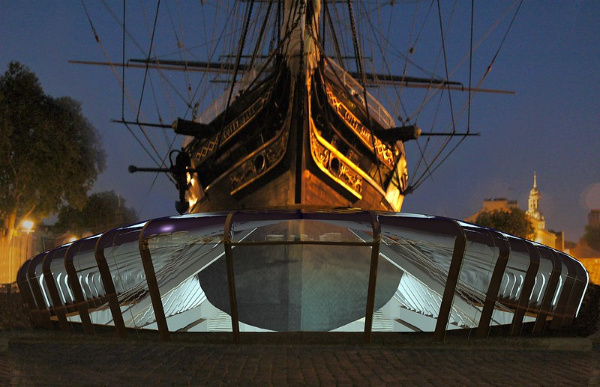
Following a major restoration and development project which saw the lower part of the ship, from the waterline down, encased in glass, it was officially reopened by Queen Elizabeth II and Prince Philip on 25th April, 2012. It is now under the operational management of Royal Museums Greenwich.
WHERE: The Cutty Sark, King William Walk, Greenwich (nearest DLR is Cutty Sark; nearest overground stations are Greenwich and Maze Hill); WHEN: Daily 10am to 5pm; COST: £18 adults; £9 children; WEBSITE: www.rmg.co.uk/cuttysark.





 or Andrew Martin’s
  .
.


 . For related music, check out
  ,
,  or Gary Barlow & the Commonwealth Band’s
  (featuring Prince Harry).
 Exploring London