This Week in London – Lost music venues; the Iraq war remembered; and, ‘Queen Elizabeth II: Her Life in Style’ extended…

Lost UK music venues are recalled in a new exhibition opening at the V&A in South Kensington on Saturday. Lost Music Venues features more than 100 objects celebrating 50 lost venues and includes gig posters, membership cards, club photography, band merch, and subculture fashions which have been gathered together following a call to the public. Highlights include handwritten Oasis lyrics, a Blur set list, Mark Webber’s briefcase from his stint as Pulp’s tour manager, the exterior sign from the Astoria London, Joan Baez’s note of support for Rainbow Theatre, a poster for an early Banksy exhibition held at The Arches, a bespoke club outfit designed by Vivienne Westwood, and flyers from Plastic People. Free to visit, the display can be seen until 30th October, 2027. For more, see vam.ac.uk.

Marking the 15th anniversary of the end of the war in Iraq, a Warrior Infantry Fighting Vehicle will go on display outside the National Army Museum from next Tuesday to Sunday, 14th June. The vehicle has been recently decommissioned after more than 40 years of Army service and was present during operations in Iraq in 2004. It was almost certainly the vehicle in which then-Private Johnson Beharry earned the Victoria Cross for two separate acts of bravery under sustained enemy attack. Now Warrant Officer Class 1, Beharry became the first living British soldier in 35 years to be awarded the Victoria Cross for his heroic actions in saving the lives of his comrades during ambushes in Iraq. In the first, after his platoon commander was wounded in an attack on 1st May, 2004, Beharry took control of a Warrior Infantry Fighting Vehicle and, despite being severely injured, he led his patrol to safety under heavy machine-gun fire from the enemy. In the second incident on 11th June, 2004, Beharry, who sustained a severe head injury when a rocket-propelled grenade detonated just six inches from his head, still managed to drive his vehicle out of danger and saved the lives of those around him before losing consciousness. Beharry’s Victoria Cross will be among the first medals from Lord Ashcroft’s collection of Victoria Crosses and George Crosses to go on display inside the museum from 2nd June. His Iraq Medal and Kosovo Medal will also be on display. For more, see https://www.nam.ac.uk/.

Buckingham Palace have announced the landmark centenary exhibition at the King’s Gallery marking the centenary of the late Queen’s birth – Queen Elizabeth II: Her Life in Style – will be extended by six months due to popular demand. The exhibition, which will now close on 18th April next year, is the largest exhibition of Queen Elizabeth II’s fashion ever staged featuring more than 300 items drawn from her personal fashion archive. Admission charge applies. For more, see www.rct.uk/queenelizabeth

This Week in London – Queen Elizabeth II’s fashion archive on show; London Transport Museum Depot’s open days; and, wartime London in art…

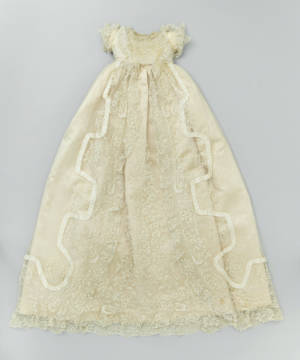
Janet Sutherland, the royal christening robe, 1841. © Royal Collection Enterprises Limited 2026 | Royal Collection Trust.

A christening robe, first worn by Queen Victoria’s eldest child, Princess Victoria, at her christening in 1841, and subsequently by 61 other royal babies including Queen Elizabeth II, is one of the stars of a new exhibition opening at The King’s Gallery in Buckingham Palace tomorrow. Queen Elizabeth II: Her Life in Style features around 200 items from Queen Elizabeth II’s fashion archive – the largest exhibition of her clothing ever staged. Other highlights include a Norman Hartnell apple-green gown worn by the Queen a state banquet given for President Eisenhower at the British Embassy in Washington, DC, in 1957; a crinoline-skirted blue gown and matching bolero jacket worn by the late Queen for her sister Princess Margaret’s wedding in 1960; and, perhaps more surprisingly, a clear plastic raincoat made by Hardy Amies in the 1960s. The latter is just one example of late Queen’s private, off-duty wardrobe which is also included in the show. Other examples include a Harris tweed jacket and Balmoral Tartan skirt, designed by Norman Hartnell and worn in the 1950 and a green coat made by Angela Kelly. The exhibition runs until 18th October. Admission charge applies. For more, see www.rct.uk.

• Celebrate 120 years of the Bakerloo and Piccadilly Lines and 70 years of the Routemaster bus at a London Transport Museum Depot open day. The first to be held this year, the four open days at the Acton Town facility, will allow visitors to discover the more than 320,000 objects not on display at the museum’s Covent Garden site including the chance to climb aboard historic train stock dating from 1927 and 1938, get a close-up look at the pioneering RM1 and RM2 buses, and explore everything from rare signalling equipment to models, maps, station architecture and posters. A programme of talks is also taking place across the weekend along with activities for kids, heritage demonstrations, displays and stalls. The days run from today – 9th April – through to Sunday (12th April). Admission charges apply. For more, see www.ltmuseum.co.uk/whats-on/depot-open-days/icons-london.

On Now: Beauty and Destruction: Wartime London in Art. This free exhibition at IWM London tells the story of London during World War II and features more than 45 paintings and drawings as well as photographs, films, objects and oral histories. Works include some by well-known artists such as Eliot Hodgkin, Graham
Sutherland, Henry Carr, Evelyn Dunbar, Duncan Grant and Edward Ardizzone as well as lesser known figures, many of whom were employed by the War Artists’ Advisory Committee. The works are presented under four themes -Travel, Thames, Street and Shelter – and highlights include Frances MacDonald’s Sketch for ‘London Docks’ (1944), John Edgar Platt’s Wartime traffic on the River Thames (1942) and fireman artist Leonard Rosoman’s The Houses of Parliament on Fire, May 1941 (1941) – which captures the last night of the Blitz. Other works in the display are Duncan Grant’s painting of that iconic symbol of wartime resistance, St Paul’s Cathedral, Henry Carr’s St Clement Dane’s Church on Fire after being Bombed (1941), Evelyn Gibbs’ WVS Clothing Exchange (1943) and Evelyn Dunbar’s Convalescent Nurses Making Camouflage Nets (1941). The display can be seen until 1st November. For more, see www.iwm.org.uk/events/beauty-and-destruction-wartime-london-in-art.

Send all items for inclusion to exploringlondon@gmail.com.