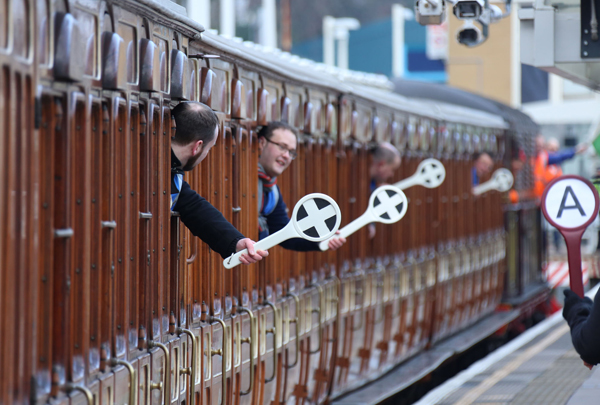
This Week in London – New artworks on the Tube network; Boulle clocks at the Wallace Collection; and, see extinct-in-the-wild doves at London Zoo…

Transport for London has announced it will be unveiling four major new artworks on the Tube network this year as part of its Art on the Underground programme which this year celebrates its 25th anniversary. The works include Saved by the Whale’s Tail, Saved by Art, a large-scale piece by artist Ahmet Öğüt in collaboration with New Contemporaries In Art which, to be unveiled at Stratford Underground station in March, explores the role art plays in everyday life. There’s also a new artwork by Hungarian-born American artist Agnes Denes which will be featured in a new pocket Tube map, a new audio work produced by artist and composer Rory Pilgrim with the Mayor of London’s Culture and Community Spaces at Risk (CCSaR) programme which will be heard at Waterloo Station in June and July, and, a new mural by Rudy Loewe which will be unveiled at Brixton Tube station in November. For more on Art on the Underground, see https://art.tfl.gov.uk.
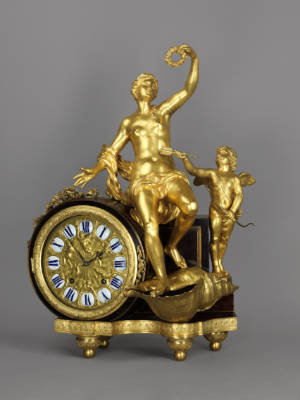
Attributed to André-Charles Boulle, movement by Jean Jolly, Mantel clock (About 1715)/© The Trustees of the Wallace Collection 

On Now: Keeping Time: Clocks by Boulle. This exhibition at the Wallace Collection in Manchester Square explores the art and science of timekeeping through a display of five pieces created by André-Charles Boulle (1642–1732). Boulle, the most famous cabinetmaker working for the court of the Sun King, Louis XIV (1638–1715), ended up giving his name to a style that featured elaborate veneer designs incorporating turtleshell, brass and other materials. The objects on show in the Housekeeper’s Room include a monumental wardrobe from 1715 that encloses a clock; two mantel clocks, one from around 1715 featuring Venus and Cupid, and another, from a decade later, with the figure of Father Time; as well as two pedestal clocks. A complementary display in the museum’s Billiard Room brings together two artworks as it explores the concept of time – The Dance to the Music of Time (about 1634-6) by Nicolas Poussin in which the Four Seasons dance to the song of Father Time, the composition of their rhythmic bodies echoing the workings of a clock movement, and The Borghese Dancers (1597–1656), where five female figures masquerade as the Hours, attendants to the goddesses of the Dawn and Moon. Runs until 2nd March. Free admission. For more, see www.wallacecollection.org.

Adult Socorro doves at London Zoo’s Blackburn Pavilion. PICTURE: © London Zoo

London Zoo has welcomed three new Socorro doves as part of a global effort to breed and reintroduce them to the wild. The three doves, which moved from Portugal’s Lagos Zoo at the end of 2024, have joined six other Socorro doves at the zoo. The species, which is extinct in the wild, is endemic to the tiny Socorro Island off the coast of Mexico and the Socorro Dove Project, an international initiative, is working to reintroduce the species to the island by 2030. The Socorro doves can be seen in Blackburn Pavilion, London Zoo’s historic tropical birdhouse, which is also home to the endangered Sumatran laughingthrush, the critically endangered Bali starling and the critically endangered blue-crowned laughingthrush. For more, see www.londonzoo.org

Send all items for collection to exploringlondon@gmail.com.
This Week in London – ‘The Tudor World’ explored; ‘Crossing Borders’ at the Horniman; and, TfL deal at the Painted Hall…

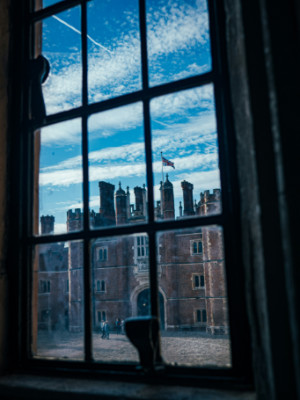
Looking out a window at Hampton Court Palace. PICTURE: Greg Willson/Unsplash

• The oldest surviving rooms at Hampton Court Palace – the Wolsey Rooms which King Henry VIII and Thomas Wolsey once used – are the location of a new display opening today exploring the early years of Henry VIII’s reign and the lives of the ‘ordinary’ men and women who shaped the Tudor dynasty. The Tudor World has, at its centre, rare surviving paintings from the Royal Collection including The Embarkation of Dover – depicting the Tudor navy – and The Field of Cloth of Gold which details Henry VIII’s summit with King Francis I of France in 1520. Also on show is a gold ring believed to have belonged to the Boleyn family, a brightly coloured silk hat linked to King Henry VIII, Wolsey’s portable sundial, a wooden chest used to hide religious contraband by Catholic priests during the reign of Queen Elizabeth I, and, an original Tudor chain pump used to help empty the Hampton Court cesspool. Among the stories of “ordinary” Tudor people being shared is that of Anne Harris, Henry VIII’s personal laundry woman who washed the bandages for his leg ulcers and, Jacques Francis, a free-diver from West Africa who was involved in the expedition to salvage guns from the sunken Mary Rose and who later became one of the first Black African voices heard in an English court, when he was called to testify in a case concerning his employer, Paulo Corsi. Included in palace admission. For more, see www.hrp.org.uk/hampton-court-palace/.

Crossing Borders, a day of free activities, performances and workshops run by local newly arrived people, will be held at the Horniman Museum Gardens in Forest Hill this Saturday. The day will feature arts and crafts workshops led by IRMO, dance performances by Miski Ayllu and the Honduran Folkloric Pride Group, the chance to learn circus skills with young people from Da’aro Youth Project and South London Refugee Association, and the opportunity to make kites with Southwark Day Centre for Asylum Seekers. The free event runs from 11am to 4pm. For more, see https://www.horniman.ac.uk/event/crossing-borders/.

Transport for London customers can save 30 per cent on entry to the Painted Hall at the Old Royal Naval College when using the TfL network until 17th November. Simply show customers show your TfL journey on the day of your visit via the TfL Oyster and Contactless app and receive the discount, taking the adult entry price, when booked online to just £11.55. For bookings, head to https://londonblog.tfl.gov.uk/2022/07/27/in-the-city/.

Send all items for inclusion to exploringlondon@gmail.com.
LondonLife – New Overground lines named to reflect London’s history…

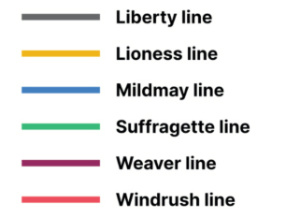
Each of London’s six Overground lines are for the first time being given a new name and colour by which they can be identified.

The Overground lines. GRAPHIC: Wiesenpinguin/Wikipedia (detail only)/Public Domain

The new names and colours – which include the Lioness line (yellow), Mildmay line (blue), Windrush line (red), Weaver line (maroon), Suffragette line (green) and Liberty line (Grey) – were chosen through engagement with customers, stakeholders, historians, industry experts and local communities, according to Transport for London.

Mayor of London, Sadiq Khan, described the move as a “hugely exciting moment, transforming how we think about London’s transport network”. 

“Giving each of the Overground lines distinct colours and identities will make it simpler and easier for passengers to get around. In re-imagining London’s tube map, we are also honouring and celebrating different parts of London’s unique local history and culture. 

Each of the new lines’ names reflects an aspect of the city’s culture and history. The Lioness line, which runs from Euston to Watford Junction through Wembly, honours the achievements and legacy of England women’s football team while the the Mildmay line, which runs from Stratford to Richmond/Clapham Junction through Dalston, honours a small charitable hospital in Shoreditch that played a pivotal role in the HIV/AIDS crisis in the 1980s and Windrush Line, which runs from Highbury & Islington to Clapham Junction/New Cross/Crystal Palace/West Croydon, honours the Windrush generation and runs through areas with strong ties to Caribbean communities today, such as Dalston Junction, Peckham Rye and West Croydon.

Meanwhile the The Weaver line, which runs from Liverpool Street to Cheshunt/Enfield Town/Chingford, runs through areasknown for their textile trade such as Liverpool Street, Spitalfields, Bethnal Green and Hackney, the Suffragette line, which runs from Gospel Oak to Barking Riverside, celebrates how the working-class movement in the East End fought for votes for woman and paved the way for women’s rights and ends at Barking, home of the longest surviving Suffragette Annie Huggett, who died at 103. The Liberty Line, which runs from Romford to Upminster, celebrates the freedom described as a “defining feature of London” and references the historical independence of the people of Havering, through which it runs.

For more on the new names and colours, see https://tfl.gov.uk/modes/london-overground/overground-line-naming?cid=naming-overground.

LondonLife – Icons turn purple to celebrate Elizabeth Line opening…

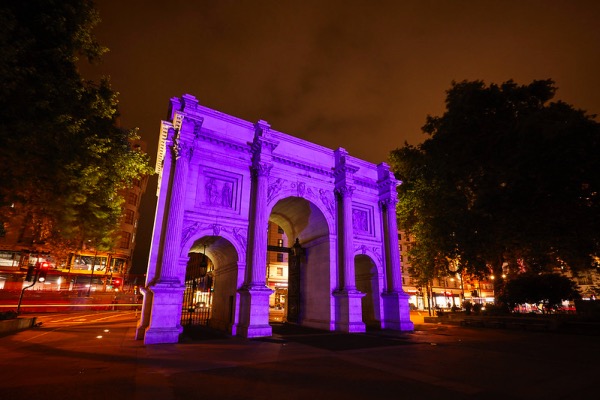
Marble Arch lights up for the launch of the Elizabeth Line.. PICTURE: © TfL

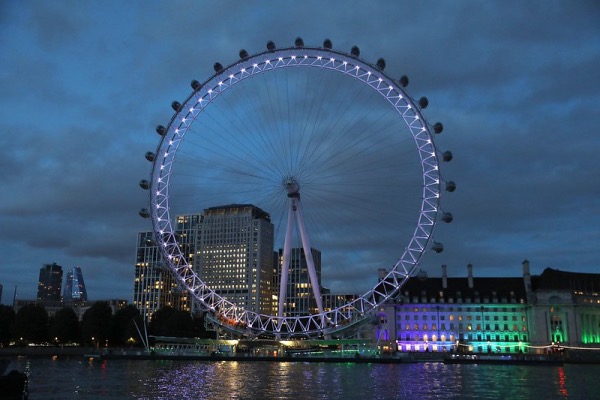
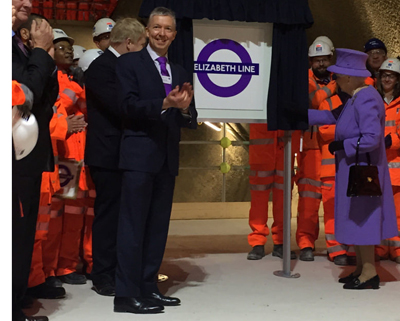
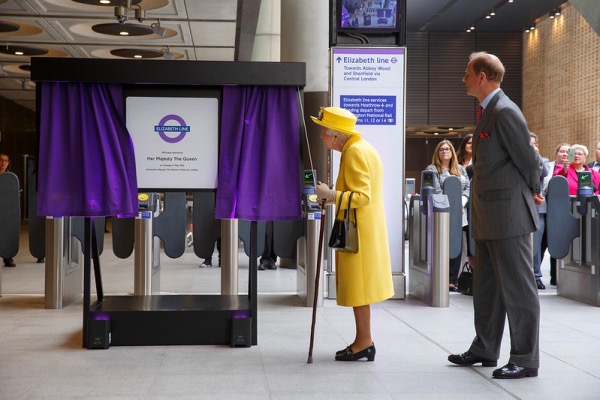
Iconic London locations including Tower Bridge, The London Eye, and Marble Arch turned purple last night to mark the opening of the new Elizabeth Line today. Thousands of people are today expected to use the new Tube line which provides faster journeys between Paddington and Abbey Wood via 10 new stations using Class 345 trains that are more and than one-and-a-half times longer than a standard Tube train and able to carry 1,500 passengers. The line’s opening is the latest step in the £18.8 billion Crossrail project which is linking Reading, to the west of London, with Heathrow before travelling through central London to connect with Shenfield and Abbey Wood in the east. Sadiq Khan, the Mayor of London, said it was an “historic day”. “This is a huge moment, not just for London but the entire country – particularly in this special Jubilee year…This brand new line is the most significant addition to our transport network in decades.” Last week, the Queen and Prince Edward attended Paddington Station to mark the completion of the new line.

The London Eye illuminated. PICTURE: © TfL
Woolwich Town Hall lit up in purple. PICTURE: © TfL
A very excited first customer on the Elizabeth Line at its opening on 24th May. PICTURE: © TfL
HM Queen Elizabeth II, HRH Prince Edward Earl of Wessex, at unveiling of commemorative plaque at Paddington Station on 17th May. PICTURE: © TfL

This Week in London – Spitfires at Duxford; The Jam in photos; and, Waterloo & City line reopens…

A Spitfire at IWM Duxford. PICTURE: Peter Bromley/Unsplash

The largest collection of Spitfires gathered under one roof can be seen at the Imperial War Museum Duxford’s AirSpace hall. Twelve of the iconic planes have been gathered at the airfield, often referred to as the “home of the Spitfire”. Spitfire: Evolution of an Icon, which is being accompanied by a programme of tours, talks, events and family activities, shows how the plane evolved throughout World War II in order to keep pace with German aircraft development. As well as the IWM’s iconic Mk Ia Spitfire, the display also features Mk V, Mk IX and Mk XIV models. The Spitfires be seen until 20th February. Admission charge applies. For more including details of events, head to www.iwm.org.uk/events/spitfire-evolution-of-an-icon.

A new exhibition focused on photographs of iconic 70s and early 80s band The Jam opens at the City of London Corporation’s Barbican Music Library tomorrow. True is the Dream features the photography of Derek D’Souza who has captured the band and frontman Paul Weller, who went on to found The Style Council, on film over several decades. D’Souza’s work include a career-defining shoot of the band at Chiswick House. The display is free to see until 16th May. For more, see www.barbican.org.uk/whats-on/2022/event/true-is-the-dream.

The Waterloo & City line has reopened following a brief closure over Christmas. The London Underground line, which connects Waterloo to Bank, was temporarily closed by Transport for London in late December following increasing COVID cases in the capital and the impact on staff absence. Meanwhile, the Bank branch of the Northern line (between Moorgate and Kennington) for 17 weeks from 15th January to allow for upgrade works.

Send all items to exploringlondon@gmail.com.
Where’s London’s oldest…(unchanged) bus route?

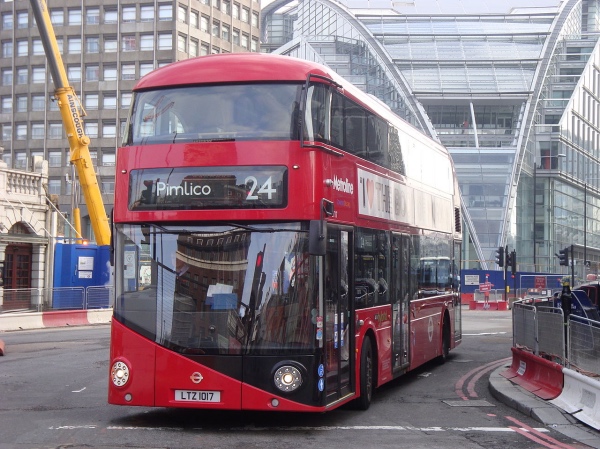
London’s oldest unchanged bus route in London is commonly cited as Route 24 which runs over seven miles from Hampstead to Pimlico.

The route was first launched in 1910 but initially stopped at Victoria Station. It was extended to Pimlico just two years later in 1912 and has largely unchanged ever since (apparently with the exception of some minor adjustments due to one-way traffic schemes).

The route, which operates 24 hours a day, does take in some key landmarks of London – among them Trafalgar Square, Horse Guards Parade and Parliament Square. In 2013, Transport for London, said some 28,000 people used the route each day.

In 1965, the double-decker buses on the route – which have always been powered by motors rather than horses – became the first to have front entry. In 1988, it became the first route through central London to be privatised when purchased by Grey-Green (the line is now operated by Metroline).

Mostly recently, in 2013, it became the first route to fully implement the curvaceous new ‘Routemasters’ (while they’ve commonly been called that, the new buses are actually just called the ‘new bus for London’).

PICTURE: One of the new buses on the route in 2014 (Aubrey Morandarte (licensed under CC BY-SA 2.0))

Where’s London’s oldest…skyscraper?


There’s several candidates for this title – NatWest Tower, built in 1980, has been described as London’s first “genuine” skyscraper (we’ll deal with that in our current special) but we’re looking back to earlier times (after all, the term first started to be used in the 1880s) when candidates included 55 Broadway in Westminster.

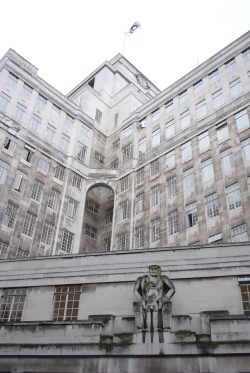
Once the tallest office building in London, 55 Broadway was constructed in 1927-29 as the headquarters of the Underground Electric Railways Company of London (which later became London Transport and then Transport for London). The building contains the St James’s Park Underground Station which is one of the most intact of the early underground stations.

Designed by Charles Holden (also noted for his design of the University of London’s Senate House and war cemeteries in Belgium and France) , the 14 storey Art Deco building is cruciform in plan to maximise street views and the amount of light entering each office as well as to ensure that the bulk of the building’s tower didn’t overwhelm the surrounding streetscapes (and to ensure the building complied with the then current building height restrictions).

The building, the design of which was influenced by US architecture, is made from a steel frame encased on concrete and faced in Portland stone. Based on a two storey pedestal which covers the entire site, the spur wings around the tower rise a further five storeys above the base while the tower itself rises 53.3 metres (175 foot).

Internally, the building features bronze and marble decoration and what was a state-of-the-art system known as a Cutler mailing chute to send letters around the building.

Of special note are the many sculptures which adorn the building, described as a “showcase of pre-Second World War British sculpture”.

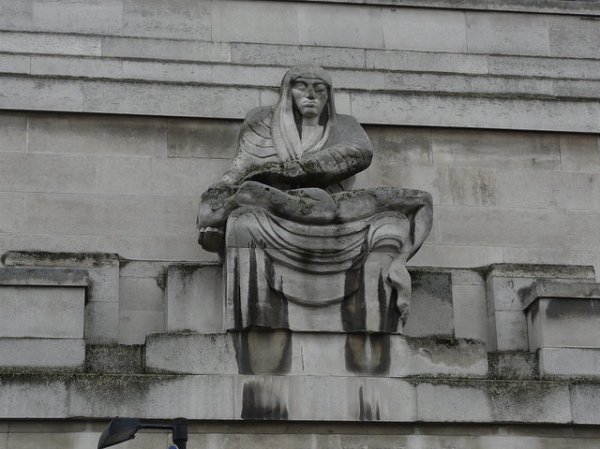
Among them are two Jacob Epstein sculptures representing ‘Day’ and ‘Night’ and eight figurative reliefs representing the winds for each cardinal point, the work of sculptors led by Eric Gill and also including Eric Aumonier, Alfred Gerrard, Samuel Rabonovitch, Allan Wyon and Henry Moore (it was his first public commission).

The sculptures proved somewhat controversial at time particularly due to Epstein’s depiction of ‘Day’ featuring a nude male – Ezra Pound famously said Epstein was contributing to a “cult of ugliness”. And while this sculpture eventually had his manhood truncated slightly following the outcry, the sculptures were otherwise left untouched.

Holden won the RIBA London Architecture Medal for the building which received Grade I-listing in 2011 (it had earlier been Grade II listed), partly due to its being London’s first ‘skyscraper’ and a building which “heralded the epoch of tall steel-framed office buildings”.

The building was damaged during the Blitz but remains largely intact. There are now plans to convert the building to luxury apartments although at present Transport for London continue to use the building.

PICTURES: Top – Epstein’s ‘Night’ – One of the less controversial sculptures adorning the building (Loz Pycock (licensed under CC BY-SA 2.0))/Right – The mass of 55 Broadway with the controversial (and altered) sculpture of ‘Day’ (David Adams).

Note: The original article said 55 Broadway was once the tallest building but should have, of course, said tallest office building. St Paul’s Cathedral was the tallest building until 1967. The building was also damaged during the Blitz but apparently not by a flying bomb.

LondonLife – London’s DLR celebrates 30 years…

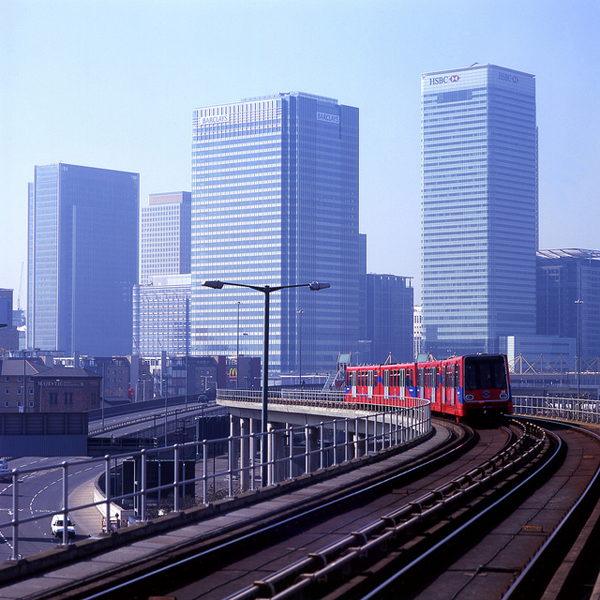
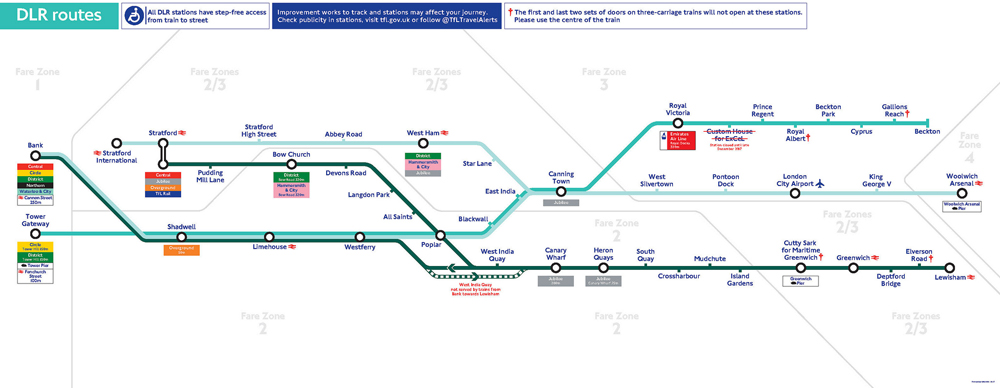
London’s Docklands Light Railway – the DLR as it’s better known – is celebrating 30 years of operation. The railway was officially opened by Queen Elizabeth II in the summer of 1987 and then had just 11 single carriage trains serving 15 stations. Extended six times since and now including some 38 kilometres of track, it now serves 45 stations using mainly three carriage trains. Carrying some 6.7 million passengers in its first year, it now carries a massive 122 million people annually. To mark the occasion, Transport for London has released a Destination DLR travel guide featuring 30 attractions across east and south-east London all easily reached by the DLR, ranging from the National Maritime Museum at Greenwich and the Tower of London to Queen Elizabeth Olympic Park and Wilton’s Music Hall. Transport for London have also released a new diagram of the DLR system (pictured below). PICTURES: Transport for London.

Treasures of London – The Knowledge of London…

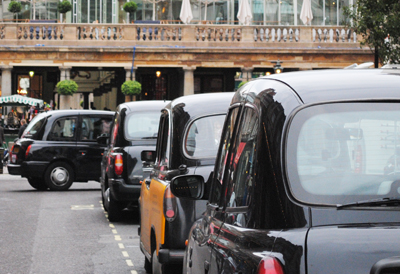
Black-cabsHaving celebrated its 150th anniversary last year, The Knowledge of London is the world famous test given to the city’s black cab drivers.

The test dates back to 1865 and involves drivers memorising 320 routes, 25,000 street names and some 20,000 landmarks and places of public interest including museums, theatres, churches, police stations, schools and parks within a six mile radius of Charing Cross.

The routes through central London – which previously numbered as many as 468 – are contained within the Blue Book (there’s also a series of ‘Knowledge schools’ to help would-be drivers prepare for the test).

The test includes a written exam and a series of one-to-one interviews, known as appearances, in which the prospective driver is given start and finish points and expected to describe the shortest route between them. It is overseen by the Public Carriage Office, once part of the Metropolitan Police Force, but now part of Transport for London.

It was introduced by Sir Richard Mayne, First Joint Commissioner of the Metropolitan Police Service, after thousands of complaints were received about the lack of knowledge of London cabbies from visitors to the Great Exhibition in Hyde Park in 1851.

It apparently takes on average between two and four years to learn all you need to know to pass the test and you can often spot what are fondly known as ‘knowledge boys (or girls)’ riding scooters around the city with a clipboard attached to the handlebars as they learn what they need to know for the test.

LondonLife – New Underground line named in honour of Queen Elizabeth II…

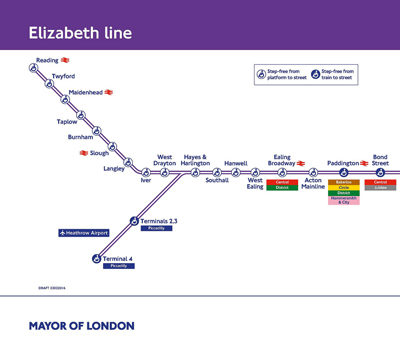
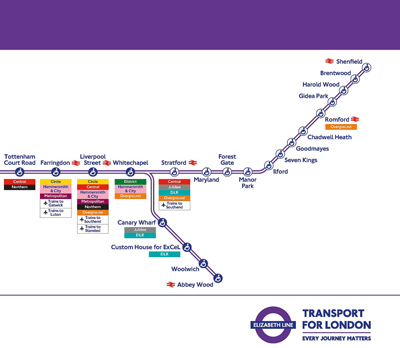
Queen-at-CrossrailBoris Johnson, the Mayor of London, announced last week that the new Underground line under construction in the Crossrail project will be named the Elizabeth line, in honour of Queen Elizabeth II. The Queen (pictured above with Transport Commissioner Mike Brown), who became the first ruling monarch to travel on the Underground when she did so in 1969 at the opening of the Victoria line, was on hand for a tour of the line’s Bond Street Station site and was presented with a commemorative Elizabeth line roundel. The new line, which will change the way people travel across London, stretches from Reading and Heathrow in the west to Shenfield and Abbey Wood in the east. PICTURES: © Transport for London/James O Jenkins (above).

Elizabeth-Line,-part-1

Elizabeth-line,-part-2

LondonLife – Celebrating London Underground’s 150th…

London-Underground1

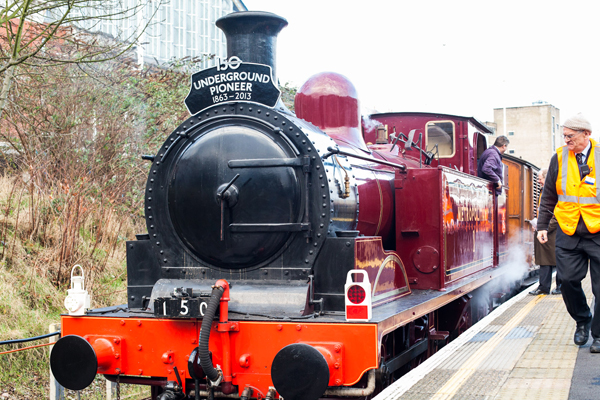
Metropolitan Locomotive No 1 recreated the first London Underground journey, which took place on 9th January, 1863, on the Metropolitan Line between Paddington and Farringdon, as part of the network’s 150th anniversary celebrations last Sunday. The newly restored locomotive was the last to be built at Neasden in 1898 by the Metropolitan Railway. It was pulling the Metropolitan Railway Jubilee Carriage No 353, the oldest operational underground carriage in existence. Ex Metropolitan Railway electric Locomotive No.12 Sarah Siddons also formed part of the train. The train will also be running this coming Sunday (20th January) and on special occasions throughout this year and is just one of a series of events planned by the London Transport Museum to mark the anniversary of what is the world’s oldest underground railway. They include an upcoming exhibition of London Underground’s poster art (more on that to come). For more, see www.ltmuseum.co.uk. PICTURES: © Transport for London from the London Transport Museum collection.

London-Underground3

LondonLife – Flying over the Thames by night…

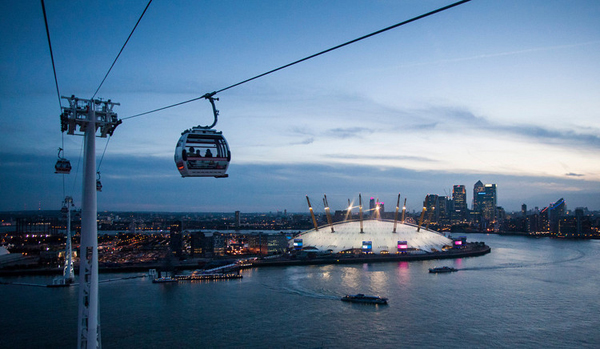
Sailing high over the River Thames between North Greenwich in the river’s southern bank and the Royal Docks on the river’s northern bank is the cable car formally known as the Emirates Air Line. Opened in late June and running every day, the cable car – the UK’s first in an urban area – is operated by Transport for London and links into the Underground and Docklands Light Rail network. Travelling at about 90 metres above the ground along a course of more than half a mile, passengers can take in the City, Docklands, Greenwich and as far eastward down the river as the Thames Barrier. This image, which shows the 02 Arena in the background, was taken just after the Closing Ceremony of the Olympic Games in August. For more, see www.emiratesairline.co.ukPICTURE: © Transport for London

Around London – Website to showcase UK’s oil paintings; Arctic explorer John Rae gets Blue Plaque; sharing experiences of kindness; and Toulouse-Lautrec and Jane Avril hit the Courtauld…

• A new website has been launched to showcase the UK’s vast national collection of oil paintings. While the website, which is a partnership between the BBC, the Public Catalogue Foundation, and participating collections and museums, currently hosts around 60,000 works, it is envisaged that by the end of 2012 it will carry digitised images of all 200,000 oil paintings in the UK (in an indicator of how many there are, the National Gallery currently has around 2,300 oil paintings, about one hundredth of all those in the nation). The works on the site will eventually include almost 40,000 by British artists. The 850 galleries and organisations participating so far include 11 in London – among them the National Gallery, the Tate Gallery, the Victoria and Albert Museum, the Bank of England, the Imperial War Museum and Dr Johnson’s House. For more, see www.bbc.co.uk/arts/yourpaintings/

• Arctic explorer John Rae has had a Blue Plaque unveiled in his honor at his former home in Holland Park. Although his feats were relatively unsung in his lifetime, the explorer’s expeditions in the Canadian Arctic saw him travel 13,000 miles by boat and foot and survey more than 1,700 miles of coastline. He is also credited with having “signposted” the only north-west passage around America that is navigable without icebreakers. Rae, who died in 1893, lived at the property at 4 Lower Addison Gardens in Holland Park for the last 24 years of his life.

Transport For London is calling on Londoners to share experiences of “kindness” that they have witnessed or participated in while travelling on the Underground. Artist Michael Landy has created a series of posters which are calling on people to submit their stories. Some of the stories will then be shown at Central Line stations (the first four posters go up on 23rd July at stations including Hollard Park, Holborn and Liverpool Street). For more, go to www.tfl.gov.uk/art.

On the Olympic front, the City of London Corporation has announced Tower Bridge will be bedecked with a set of giant Olympic Rings and the Paralympic Agitos during the 45 days of next year’s Games. Meanwhile, the Corporation has also unveiled it will host next week the launch of a London-wide campaign to get people involved in sport and activity in the lead-up to the Games. More to come on that.

On Now: Toulouse-Lautrec and Jane Avril Beyond the Moulin Rouge. The Courtauld Gallery, based at Somerset House, is running an exhibition celebrating the “remarkable creative partnership” between Jane Avril, a star of the Moulin Rouge in Paris during the 1890s, and artist Henri de Toulouse-Lautrec. Lautrec created a series of posters featuring Avril which ensured she became a symbol of Lautrec’s world of “dancers, cabaret singers, musicians and prostitutes”. Runs until 18th September. See www.courtauld.ac.uk for more.


Around London – Celebrating visits to the Royal Parks; pregnant cows at the British Library; and, lost tube art found…

Royal Parks are celebrating the 160th anniversary of the opening of London’s Royal Parks to the public with a season of events including Trooping the Color (St James’s Park, this weekend), BBC Proms in the Park (Hyde Park) and various sporting events being held in the lead-up to the London Olympics next year. Last month also saw the unveiled of a new permanent art project in Hyde Park commemorating the Great Exhibition of 1851. Organised by the Royal Commission for the Exhibition of 1851 in conjunction with Royal Parks, it marks the site where the exhibition was held. London’s Royal Parks were opened to the public in 1851 after the passing of the Crown Lands Act which transferred management of the parks to the government. For more, see www.royalparks.org.uk.

Who could pass up a chance to feel whether a cow is pregnant? The British Library will be hosting staff from The Royal Veterinary College on 28th June for a day of hands-on demonstrations including the chance to use haptic technology and “feel” whether a cow is pregnant as well as opportunity to create a virtual, touchable 3D model using interactive software. The demonstrations are part of the library’s Growing Knowledge Exhibition showcasing innovative research tools. Spaces are limited so get in quick. To book your place, visit http://cowlooseinthelibrary.eventbrite.com/%3C/a%3E

On Now – The Lost Collection. In conjunction with Transport for London’s Lost Property Office, KK Outlet in Hackney is running an exhibition of unclaimed art that was left on London’s tube, buses, overground trains and black cabs. The work by nameless artists includes drawings, painting and photographs and, in some cases, whole portfolios. Runs until 30th June (42 Hoxton Square). For more information, see www.kkoutlet.com