Exploring London’s 100 most popular posts of all time! – Numbers 96 and 95…

The next couple in our year-long countdown

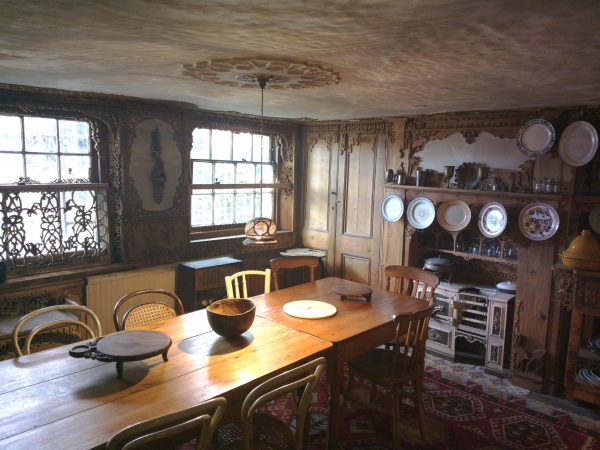
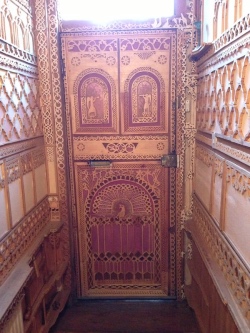
96. Treasures of London – Swiss Court…

95. Lost London – The Roman basilica and forum…

Treasures of London – One of the world’s first stethoscopes…

Now found in the newly opened Medicine: The Wellcome Galleries at the Science Museum in South Kensington, this stethoscope was made by the French physician René Laennec in about 1820.

Several years earlier, Laennec, working in a hospital in Paris, wanted to listen to a young woman’s heart beat but, for the sake of propriety he didn’t want to put his ear to her chest as was common practice. In sudden inspiration, he used a rolled up piece of paper with one end placed over her heart and his ear on the other open end.

It proved a good way to amplify sound and Laennec was so impressed he followed up by making brass and wooden versions like the one at the Science Museum., drawing on the skills he used, no doubt, he had previously used in making flutes.

Laennec called his invention the “stethoscope” (from the Greek word for chest, “stethos”). His invention was succeeded in the following decades by the creation of the modern binaural stethoscope with its two earpieces and dial for listening.

The Science Museum stethoscope is labelled. It reads: “This is one of Laennec’s original stethoscopes, and it was presented by him to Dr Bégin a French Army surgeon whose widow gave it to me in 1863.”

WHERE: Medicine: The Wellcome Galleries, Science Museum, Exhibition Road, South Kensington (nearest Tube is South Kensington); WHEN: 10am to 6pm daily; COST: Free; WEBSITE: www.sciencemuseum.org.uk.

PICTURE: Laennec stethoscope made by Laennec, c1820. Science Museum Group Collection
© The Board of Trustees of the Science Museum

This (Year) in London – Five exhibitions you won’t want to miss in 2020…

It’s our first ‘This Week in London’ for 2020 so instead of our usual programming, we thought we’d briefly look at five key exhibitions that you won’t want to miss this year…

1. Thomas Becket at the British Museum. Marking the 850th anniversary of the murder of the medieval Archbishop of Canterbury on 29th December, 1170, the museum will host the first ever major exhibition on the life, death and legacy of the archbishop as part of a year-long programme of events which also includes performances, pageants, talks, film screenings and religious services. The exhibition will run from 15th October to 14th February, 2021. PICTURE: Alabaster sculpture, c 1450–1550, England. Here, Becket is shown kneeling at an altar, his eyes closed and his hands clasped in prayer, all the while four knights draw their swords behind him. To Becket’s right is the monk Edward Grim, whose arm was injured by one of the knight’s swords. © The Trustees of the British Museum.

2. Elizabeth and Mary at the British Library. This exhibition draws on original historic documents to  take a fresh look at what’s described as the “extraordinary and fascinating story of two powerful queens, both with a right to the English throne: Elizabeth I and Mary, Queen of Scots”. Letters and other 16th century documents will show how their struggle for supremacy in the isles played out. Runs from 23rd October to 21st February, 2021.

3. Tudors to Windsors at the National Maritime Museum. This major exhibition promises to give visitors “the opportunity to come face-to-face with the kings, queens and their heirs who have shaped British history and were so central to Greenwich”.  Including more than 150 works covering five royal dynasties, it will consider the development of royal portraiture over a period spanning 500 years and how they were impacted by the personalities of individual monarchs as well as wider historical changes. Will be held from April.

4. Gold and Glory: Henry VIII and the French King at Hampton Court Palace. Marking the 500th anniversary of the Field of Cloth of Gold – King Henry VIII’s landmark meeting with his great rival, the French King François I, the exhibition will feature a treasure trove of precious objects from the English and French courts as well as a never-before-seen tapestry, manufactured in the 1520s, which depicts a bout of wrestling at the meeting presided over by François and which also shows a black trumpeter among the many musicians depicted. Opens on 10th April. The palace will also play host this year to Henry VIII vs François I: The Rematch, a nine day festival of jousting, wrestling and foot combat complete with feasting, drinking and courtly entertainment. Runs from 23rd to 31st May.

5. Faces of a Queen: The Armada Portraits of Elizabeth I at the Queen’s House in Greenwich. This display brings together, for the first time, the three surviving versions of the iconic ‘Armada Portrait’ of Elizabeth I. The portrait commemorates the Spanish Armada’s failed attempt to invade England and the display will include the Royal Museums Greenwich’s own version of the painting along with that from the National Portrait Gallery and that which normally hangs in Woburn Abbey. Runs from 13th February to 31st August.

We’ll feature more details in stories throughout the coming year. But, of course, this is just a sample of what’s coming up this year – keep an eye on Exploring London for more…

10 (lesser known) monuments featuring animals in London – 4. Trump…

Sitting at the foot of a statue of artist William Hogarth – described on the monument as the “father of English painting” but perhaps best known today for his satirical prints such as Gin Lane – in Chiswick High Road in London’s west is his beloved pug dog, Trump.

Trump, who famously features in Hogarth’s 1745 self-portrait, The Painter and his Pug (now at the Tate Britain), was one of several pugs owned by the artist over his career.

Trump, like the other dogs, appears in several of Hogarth’s works including the self-portrait and the 1746 work Captain Lord George Graham in his Cabin, now at the National Maritime Museum.

The dog was also the subject of a terracotta sculpture by Frenchman Louis-François Roubiliac, created to accompany a bust of Hogarth in 1741. It was later reproduced in porcelain versions and plaster casts of it were sold after Hogarth’s death in 1764. While the original of sculpture of the dog is lost, the bust of Hogarth can still be seen at the National Portrait Gallery.

Hogarth is often said to have compared himself to his dogs and his close connection was noted by others who used it to make fun of the artist including Paul Sandby who, in a 1753 etching, depicted Hogarth as half-pug.

The statue, which stands opposite the intersection with Turnham Green Terrace, is located not far from the country retreat where Hogarth lived – splitting his time between it and his Leicester Square townhouse – between 1749 and his death (now a museum known as Hogarth’s House; the artist is also buried nearby)

The work of Jim Matheison, it was unveiled by Ian Hislop and David Hockney in 2001.

LondonLife – London’s tranquil top 10…


Woodlands, former churches and secluded city parks are all among the top 10 most tranquil places in London, according to the Tranquil City Index. According to a list published by the London Evening Standard, the top 10 puts Woodberry Wetlands in Stoke Newington (pictured above) at number one followed by the church ruins (now a park) of St Dunstan-in-the-East in the City of London (below), Cody Dock at Bow Creek and Beckenham Place Park. Postman’s Park in the City of London comes in at number five, followed by the Red Cross Garden in Southwark, Myatt’s Fields Park in Camberwell, Southmere Lake at Thamesmead, the Japanese Garden in Hammersmith Park (pictured) and, at number 10, the Paddington Arm of the Grand Union Canal. The index is the work of Tranquil City, an organisation which explores “our relationship with tranquillity in the urban environment to promote health, wellbeing and balance”. PICTURE: Top – diamond geezer (licensed under CC BY-NC-ND 2.0); Below – James Stringer (licensed under CC BY-SA 2.0).

Where’s London’s oldest…bicycle shop?

Thanks to Guinness World Records, Pearson Cycles in Sutton, south-west London, is officially not just London’s but the world’s oldest bicycle shop.

The premises was established by blacksmith Tom Pearson in about 1860 (when Sutton was still a town in Surrey and not at that stage part of London) and he soon found his skills put to use in working on bicycles.

In 1889, Tom was succeeded by his son Harry who moved full-time into the manufacture of bicycles with the Endeavour the first model.

The shop, at 126 High Street in Sutton, is now run by a fifth generation of the family, Guy and Will Pearson. The company also has a shop in East Sheen.

PICTURE: Tony Monblat (licensed under CC BY-SA 2.0/image cropped)

Exploring London’s 100 most popular posts of all time! – Numbers 98 and 97…

We’ll return to our regular programming next week but in the meantime, enjoy the next couple of entries in our year-long countdown…

98. Lost London – Bridewell Palace…

97. Lost London – Exeter/Essex House…


Exploring London marks 10 years!

Did you know that 2020 marks 10 years since Exploring London first began…well…exploring London?

We’ll be celebrating our anniversary across the year in a number of ways including counting down our 100 most read stories ever…

So let’s kick off the countdown with numbers 100 and 99…

100. LondonLife – A new crown for King Henry VIII…

99. 10 sites of significance in Jane Austen’s London…1. 10 Henrietta Street, Covent Garden…

PICTURE: Adi Goldstein/Unsplash

Happy New Year!

Wishing you a great start to 2020 from Exploring London! PICTURE: Alexander London/Unsplash

Exploring London’s 10 most popular posts for 2019…Numbers 2 and 1…

2. Treasures of London – The Armada Portrait of Elizabeth I…

and the most popular post of 2019…

1. Where’s London’s oldest…door?

Exploring London’s 10 most popular posts for 2019…Numbers 4 and 3…

4. 10 of London’s most curious (and historic) graves – A recap…

3. Lost London – The Mappin & Webb building…

Exploring London’s 10 most popular posts for 2019…Numbers 6 and 5…

6. 10 historic London hotels…5. The Great Western Hotel (Hilton London Paddington)…

5. This Week in London – City of London’s biggest rooftop viewing platform opens; Rembrandt at the British Museum; and, Franz West at the Tate…

Exploring London’s 10 most popular posts for 2019…Numbers 8 and 7…

8. Lost London – The Jerusalem Coffee House…

7. Lost London – South Sea House…

Exploring London’s 10 most popular posts for 2019…Numbers 10 and 9…

And so we come to our annual countdown of the most popular stories published in 2019. Without further ado here’s the first two…

10. 10 of London’s most curious (and historic) graves – 7. Ben Jonson (Westminster Abbey)…

9. 10 of London’s most curious (and historic) graves – 2. Hannah Courtoy…  

We’ll publish the next two tomorrow…

Merry Christmas to all our readers!

Hoping you have a wonderful Christmas! PICTURE: johnc001 (licensed under CC BY-NC-ND 2.0)

What’s in a name?…St Martin’s-le-Grand…

This City of London street is named for a church which once stood to the east of the thoroughfare.

The church was founded as part of a monastery the 11th century by brothers Ingelric and Girard – the former was apparently a man of some influence in the courts of King Edward the Confessor and King William the Conqueror (although there is apparently a tradition that the church was founded earlier, by the Saxon King Wihtred of Kent, in the 7th or 8th century).

The collegiate church, which had the job of sounding the curfew bell in the evenings to announce the closing of the city gates during the reign of King Edward I (the right later moved to another church), gave special rights to the precinct in which it stood including that of sanctuary for certain types of criminals. Indeed, by the 14th century, it was the largest area of sanctuary in England.

This was particularly useful for those making what was supposed to be their final journey from Newgate to their execution at Tower Hill – the precinct lay along the route and, yes, some were said to have escaped into the district as they passed by. But perhaps the most famous said to have sought sanctuary in the precinct were Miles Forrest, one of those accused of murdering the so called “Princes in the Tower” – King Edward V and his brother Richard, Duke of York.

The institution was dissolved during the reign of King Henry VIII and demolished in the mid-16th century but the name lived on in the precinct where it once stood – during the Elizabethan era it was apparently famous for its lace.

The site of the church was later the site of the General Post Office, built in 1829, which was eventually demolished in 1911 and replaced by a premises located to the west.

The street, which becomes Aldersgate Street in the north and runs into Cheapside in the south, was also once home to the The Bull and Mouth Inn, destroyed in the Great Fire of 1666, and a French Protestant Church. The latter was built in 1842 but demolished in 1888 to make way for more Post Office buildings.

PICTURES: Looking south (top) and north (below) from St Martin-le-Grand (Google Maps).

10 (lesser known) monuments featuring animals in London – 3. Hodge…

This famous cat, belonging to lexicographer Dr Samuel Johnson (1709-84), is memorialised outside his former home in Gough Square.

Johnson was known for his fondness of this particular cat – his biographer James Boswell, reports, for example: “I recollect him one day scrambling up Dr Johnson’s breast, apparently with much satisfaction, while my friend smiling and half-whistling, rubbed down his back, and pulled him by the tail.”

According to Boswell, Johnson told him that while he had had finer cats, Hodge – who is believed to have been a black cat – was a “very fine cat indeed”. Such was the cat’s renown that poet Percival Stockdale wrote an Elegy on The Death of Dr Johnson’s Favourite Cat.

This statue to Hodge was erected in 1966 by then Lord Mayor of London, Sir Roger Cook. The work of Jon Bickley (who apparently modelled Hodge on his own cat Thomas Henry), it depicts Hodge sitting on top of Johnson’s famous (and massive) dictionary and next to some empty oyster shells (the latter a reference to Johnson’s habit of feeding oysters to Hodge – while this wasn’t unusual, Johnson’s going out himself to fetch them himself – lest his servants resent Hodge – was).

The monument, which has Hodge looking towards his former home, features a plaque which has Johnson’s quote about Hodge – “a very fine cat indeed” – as well as his famous quote about the city in which they lived – “Sir, when a man is tired of London, he is tired of life, for there is in London all that life can afford.”

Dr Johnson’s former house and workplace at number 17 Gough Square, where he lived for 11 years, is now a museum.


LondonLife – Opening presents at the Zoo…

Christmas came early at ZSL London Zoo on Monday when animals woke to find their presents had been delivered. Among them was a new Christmas climbing frame decorated with edible gifts for the ever-popular Bolivian black-capped squirrel monkeys, turkey wings for Sumatran tiger Asim and hanging stockings stuffed with vegetable trimmings for the ring-tailed lemurs. “Just like children all over the country when they wake up on Christmas morning, Asim loved tearing into his brightly wrapped presents to get at the meaty snacks inside, while our squirrel monkeys and lemurs enjoyed finding the festive treats hidden in their stockings,” said Angela Ryan, the Zoo’s animal manager. The zoo is open every day with the exception of Christmas Day itself. For more, see www.zsl.org/London. ALL PICTURES: © ZSL London Zoo

Famous Londoners – George Eliot…

Last month marked the 200th anniversary of the birth of leading English novelist George Eliot – actually the pen name of Mary Ann Evans. 

Born in Warwickshire on 22nd November, 1819, Evans was the third child of Robert Evans, an estate manager, and Christiana Evans, daughter of a local mill owner.

Described as a “voracious reader” from an early age, she was a boarder at various schools up until the age of 16 when, following the death of her mother, she returned home to act as housekeeper (she apparently continued her education in the library of Arbury Hall, the property her father managed).

In 1841, when her brother Isaac married and took over the family home, she moved with her father to Foleshill near Coventry. There, they met Charles and Cara Bray – Charles was a wealthy ribbon maker and religious free-thinker who used his wealth to establish schools and hospitals to help improve conditions of the poor.

Thanks to her friendship with the Brays, Evans came into contact at their house, Rosehill, with the likes of Welsh social reformer Robert Owen, Harriet Martineau, often described as the first female sociologist, and American essayist Ralph Waldo Emerson as well as German theologian David Friedrich Strauss and German philosopher Ludwig Feuerbach (in fact, her first major literary work was the completion of an English translation of Strauss’ The Life of Jesus Critically Examined and she also later translated Feuerbach’s The Essence of Christianity).

Evans, who was a devout evangelical Christian in her youth, lived with her father until his death in 1849. She had questioned her faith some years before but after she’d informed her father she would no longer go to church, they had reached a compromise under which she had been free to think as she wished as long as she continued to attend church.

Following her father’s death, Evans – now 30 – had visited Switzerland and, following her return to England, moved to London to pursue a career in writing.

In London, Evans initially stayed in the Strand home of radical publisher John Chapman, whom she’d met through the Brays. She eventually went on staff at his left-wing journal, The Westminster Review – becoming, in time, Chapman’s right-hand, the editor in fact if not in title, at publication by the time she left in 1854.

At that time she moved in with journalist George Henry Lewes, who had met her several years earlier. He was still married to Agnes Jervis, despite her having born to children to another man, and the new couple’s relationship caused a great scandal, leading many to shun Evans. The couple travelled together to Germany for research and thereafter Lewes and Evans apparently considered themselves married.

While she had stories published in magazines in the years earlier, her first novel, Adam Bede, was published under the pseudonym George Eliot in 1859 (she’d first used the pseudonym on a short story, The Sad Fortunes of the Reverend Amos Barton, published in 1857). Much acclaimed, the public interest surrounding the novel led Evans – who now called herself Marian Evans Lewes – to acknowledge the work as hers – a revelation which came as a shock to many given her unconventional private life but which, despite that, failed to dent the novel’s popularity.

Encouraged by Lewes, she wrote several novels over the next 15 years including The Mill on the Floss in 1860, Silas Marner in 1861, Romola in 1863, Felix Holt, the Radical in 1866 and her most acclaimed novel (sometimes described as the greatest English novel ever written), Middlemarch in 1871-72. Her final novel, Daniel Deronda, was published in 1876.

Celebrated for the depth of her characterisations and her descriptions of English rural life, she was recognised as the greatest English novelist of her time.

The couple, meanwhile, lived in several properties in London – including one in Richmond, ‘Holly Lodge’ in Wimbledon Park Road, Wandsworth (it was the first property south of the Thames to be marked with an English Heritage Blue Plaque), and ‘The Priory’ near Regent’s Park in Marylebone.

Eliot’s success as a novelist saw the couple gradually gain social acceptance – in an indication that can be seen in that Charles Darwin, Aldous Huxley, Henry James and Frederic Leighton were all among those entertained at The Priory in the couple’s latter years together.

Lewes died in 1878 and two years later, on 16th May, 1880, Lewes married John Cross – a longstanding friend who was 20 years younger and who had provided comfort following the loss of her husband.

Following their honeymoon in Venice, the couple returned to London where they lived at a property in Cheyne Walk, Chelsea (an English Heritage Blue Plaque marks the property).

It was to be a short-lived marriage – soon after moving into their new home, Mary Ann (now) Cross fell ill with a throat infection and coupled with the kidney disease she had suffered for several years, she died on 22nd December of that year at age 61.

Eliot was buried in Highgate Cemetery beside Lewes. A memorial stone was erected in Westminster Abbey’s Poet’s Corner in 1980.

PICTURES: Top – George Eliot, replica by François D’Albert Durade, oil on canvas, 1850-1886, based on a work of 1850, 13 1/2 in. x 10 1/2 in. (343 mm x 267 mm), Purchased 1905, Primary Collection, NPG 1405; Below – The English Heritage Blue Plaque on the Cheyne Walk property (Spudgun67 (licensed under CC BY 2.0))

This Week in London – Troy explored at British Museum; Georgian theatre in London; and, Green Plaque for Europe’s first recording studio…

A major exhibition on the legendary city of Troy has opened at the British Museum. Troy: myth and reality showcases works of art inspired by the “tales of war, love and loss” connected to the Trojan cycle of myths and follows in the footsteps of archaeologists and adventurers who have sought to find evidence of the ancient city. Among the almost 300 objects on show are original finds – such as pottery, silver vessels, bronze weapons and stone sculptures – found by Heinrich Schliemann’s work at the site between 1870 and 1890, a Roman sarcophagus lid picturing a wheeled – and armed – wooden horse (on loan from Oxford’s Ashmolean), Filippo Albacini’s (1777–1858) marble sculpture, The Wounded Achilles, and a Roman silver cup from the National Museum of Denmark depicting the meeting of Priam and Achilles as described in Homer’s The Iliad (pictured). Admission charges applies. Runs until 8th March. For more, see www.britishmuseum.org/Troy. PICTURE: Priam and Achilles, Roman silver cup, 1st century AD, National Museum of Denmark Photograph: Roberta Fortuna and Kira Ursem © National Museet Denmark.

Queen drummer, Roger Taylor, unveiled a Westminster City Council Green Plaque commemorating the site of Europe’s earliest recording studio in Covent Garden earlier this month. The studio was opened on Maiden Lane, one street north of the Strand, in 1898 by audio pioneer Fred Gaisberg and The Gramophone Company, a precursor to EMI – the same company which opened the world-famous Abbey Road Studios 33 years later. The campaign for the plaque – located on a building now housing a pizza restaurant – was led by music journalist and author James Hall with support from the EMI Archive Trust. For more, see www.westminster.gov.uk/green-plaques.

• On Now: Two Last Nights! Show Business in Georgian Britain. This interactive display throughout the entire Foundling Museum in Bloomsbury features more than 100 objects which highlight the similarities and differences between theatre going in the Georgian era and now. It explores key venues in London and beyond and is divided into four sections focusing on Georgian theatres like Drury Lane and Covent Garden, the Vauxhall Pleasure Gardens, the importance of the Foundling Hospital Chapel as a music venue, and the provincial music festivals held in other major cities in Britain. Runs until 5th January. Free with museum admission. For more, see www.foundlingmuseum.org.uk.

Send all items for inclusion to exploringlondon@gmail.com.