Treasures of London – The Steeple of St George’s Bloomsbury…

Adorned with giant beasts and topped with a statue of King George I, the steeple of this 18th century Nicholas Hawksmoor-designed English Baroque church is a sight to behold.
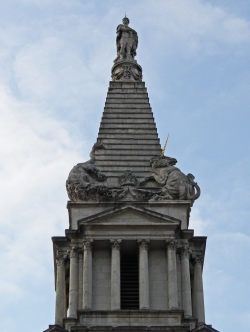
The unusual spire, which has topped the church since it was completed in 1731, is stepped like a pyramid and was apparently inspired by Pliny’s description of the Mausoleum at Halicarnassus (one of the Seven Wonders of the Ancient World).

At its base can be seen four heraldic creatures – two 10 foot tall lions and two similarly-sized unicorns. They’re actually recreations of the originals by sculptor Tim Crawley based on drawings by Hawksmoor. The originals were removed – and subsequently lost – in 1870 amid fears they were about to topple off.

It’s suggested that lions and unicorns – which look as if they are in conflict over the crown in the middle – symbolise the tussle for the Crown as seen in the several Jacobite risings which took place in the late 17th and early 18th centuries.

The statue on top has King George I dressed in Roman attire and standing on an altar as a symbol of St George – as clear a PR exercise as you’ll find on a steeple. It even featured in a verse by Horace Walpole:

“When Henry VIII left the Pope in the lurch,
The Protestants made him the head of the church,
But George’s good subjects, the Bloomsbury people
Instead of the church, made him head of the steeple.”

The steeple did prove controversial when it was completed – the church commissioners initially refused to pay Hawksmoor, apparently deeming the spire too frivolous for such a serious building. But it was soon recognised as an important part of the landscape – it can be seen in the background of William Hogarth’s 1751 engraving Gin Lane.

In the mid-Noughties, the church and steeple, which had fallen into a state of dishevelment and was apparently on the verge of closure, underwent a major renovation. Funded by American Paul Mellon and the Heritage Lottery Fund, it saw the long-lost (albeit recreated) beasts returned to their place on the steeple (the project was recorded in detail by Harris Digital).

PICTURE: Right – Amanda Slater (licensed under CC BY-SA 2.0 – image cropped and straightened); Below – Londres Avanzado (licensed under CC BY-NC-ND 2.0 – image cropped and lightened).


This Week in London – Courtauld’s Impressionists visit the National Gallery; the British Library’s ‘Season of Sound’; and, Renzo Piano at the Royal Academy…

For the first time in 70 years, key Impressionist and Post-Impressionist works from the Courtauld Gallery are going on display at The National Gallery. The 26 works, which include pieces by Daumier, Manet, Renoir, Cézanne, Seurat and Bonnard, were all purchased by Samuel Courtauld in the 1920s and are being displayed alongside paintings from the National Gallery’s own collection which he helped acquire. The works are being loaned as the Courtauld Gallery closes this month for a major transformation project, dubbed Courtauld Connect. The exhibition, Courtauld Impressionists: From Manet to Cézanne, traces the development of modern French painting from the 1860s to the turn of the 20th century and reveals the vision, taste and motivation of Courtauld as he acquired the pieces. Highlights from the Courtauld Gallery’s collection include Renoir’s La Loge (Theatre Box) (1874), Cézanne’s The Card Players (about 1892–6) and Lac d’Annecy (1896 – pictured), Toulouse-Lautrec’s Jane Avril in the Entrance to the Moulin Rouge (about 1892), Manet’s A Bar at the Folies-Bergère (1882), and Seurat’s Young Woman Powdering Herself (about 1888–90). Among the works from The National Gallery’s collection being displayed alongside them are Renoir’s At the Theatre (La Première Sortie) (1876–7); as well as Seurat’s Bathers at Asnières (1884), Cézanne’s Self Portrait (about 1880–1) and Van Gogh’s A WheatKeld with Cypresses (1889) – the first paintings by the latter three artists to enter a British public collection. The display can be seen in The Wohl Galleries from next Monday until 20th January. Admission charge applies. For more, see www.nationalgallery.org.uk. PICTURE: © The Samuel Courtauld Trust, The Courtauld Gallery, London.

The British Library’s second ‘Season of Sound’ kicks off this month with a series of events celebrating the library’s vast Sound Archive. Among highlights are the pop group Saint Etienne’s only UK performance this year, a live orchestra celebration of ‘library music’ by KPM All Stars and a silent disco. The programme of events at the King’s Cross venue kicks off next Monday. Admission charges apply. For the full programme, see www.bl.uk/events/season-of-sound.

The work of internationally-renowned architect and honorary Royal Academician, Renzo Piano, goes on show at the Royal Academy in Piccadilly from Saturday. Renzo Piano: The Art of Making Buildings is the first comprehensive survey of Piano’s career to be held in London since 1989 and presents 16 of his most important projects. They include the Centre Pompidou in Paris (1971), the Jean-Marie Tjibaou Cultural Centre in Nouméa (1998), The New York Times Building in New York City (2007), The Shard in London (2012), the Jérôme Seydoux Pathé Foundation in Paris (2014) and the Whitney Museum of American Art in New York City (2015). Among events being held to mark the RA’s 250th anniversary, the display in the Gabrielle Jungles-Winkler Galleries can be seen until 20th January. Admission charge applies. For more, see www.royalacademy.org.uk.

Send all items for inclusion to exploringlondon@gmail.com.

10 sites from Mary Shelley’s London…1. Somers Town…

This year marks the 200th anniversary of Mary Shelley’s thought-provoking novel, Frankenstein or, The Modern Prometheus, so we thought that before the year is out (the novel was actually published in January, 1818), we’d take a look 10 London locations integral to her story.

First up, it’s to Somers Town, which lies just to the north of Euston Road, where Mary Wollstonecraft Godwin (later Mary Shelley) was born on 30th August, 1797, the second child of feminist writer Mary Wollstonecraft and journalist, philosopher and novelist William Godwin.

Wollstonecraft sadly died 12 days after the birth due to complications. Mary was left in the care of her father and half-sister Fanny Imlay (Wollstonecraft’s first child whose father was an American adventurer named Gilbert Imlay) and, after her father remarried in 1901, a step-mother Mary Jane Clairmont (with whom Mary would have an acrimonious relationship).

While Mary was provided with little formal education during her childhood, her father saw that she received a broad education in a range of subjects, generally described as unusually advanced for the time.

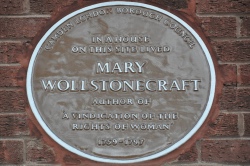
The family’s home was located at number 29 in the Polygon Building on the north side of Clarendon Square – it was demolished in 1904 and the site is now occupied by a block of council flats called Oakshott Court. There’s a commemorative plaque to Wollstonecraft on the side of the complex in Werrington Street – it was erected by the Camden London Borough Council (pictured).

Mary Shelley, meanwhile, is also commemorated in a mural in Polygon Road which depicts many of the famous figures associated with the area (her parents and future husband Percy Bysshe Shelley are also depicted in it). The mural, the work of Karen Gregory, was commissioned by the Greater London Council in the 1980s.

PICTURE: Ellaroth (licensed under CC BY-SA 3.0)

LondonLife – A different perspective on the British Museum…

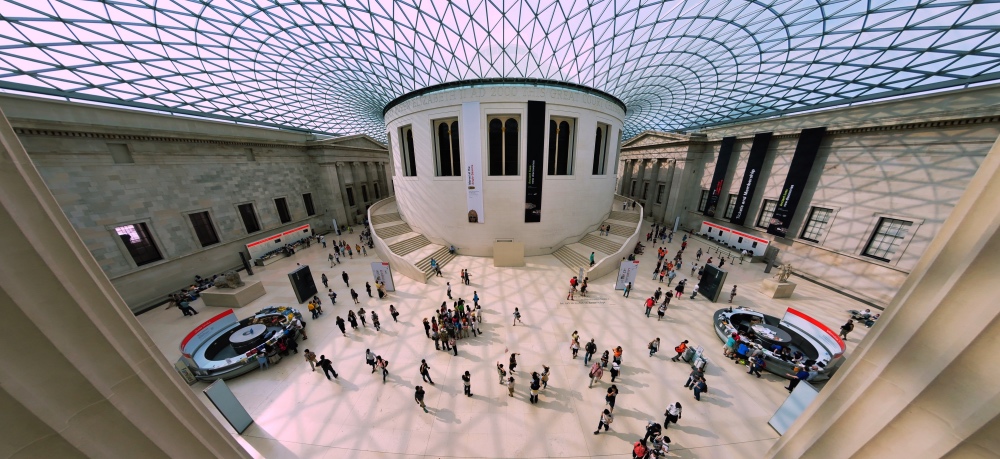
Looking across the Queen Elizabeth II Great Court of the British Museum, off Great Russell Street in Bloomsbury. Designed by Foster and Partners, the two acre court opened in 2000 and was at the time the largest covered public square in Europe. It’s glass and steel roof features more than 3,300 panes of glass, no two of which are the same. The court features a Reading Room at its centre.

PICTURE: Viktor Forgacs/Unsplash

This Week in London – Video games explored; NHM celebrates ‘James and the Giant Peach’; and Thames Mudlarks’ finds on show…

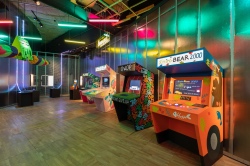
Video games – their design and use both in terms of gaming but also in pushing boundaries – are the subject of a new exhibition opening at the V&A this Saturday. Videogames: Design/Play/Disrupt will provide rare glimpses into the creative process behind games like The Last of Us, Journey and Kentucky Route Zero through original prototypes, early character designs and notebooks as well as cultural inspirational material ranging from a Magritte painting to a viral cat video. The display also features large scale, interactive and immersive multimedia installations featuring games like Minecraft and League of Legends, and explore how major technological advancements have transformed the way games are designed, discussed and played. Runs in Room 39 and North Court until 24th February. Admission charge applies. For more, see vam.ac.uk/videogames. PICTURE: V&A.

The Natural History Museum is celebrating Roald Dahl Day (13th September) with a James and the Giant Peach weekend. The South Kensington museum will this weekend offer a range of James and the Giant Peach-inspired family-friendly events and activities including the chance to see insects up close in the Darwin Centre and the Wildlife Garden as well as specimens in the Attenborough Studio. There’s also the chance to take in a ‘Whizzbanging Words’ session with a team from the Roald Dahl Museum and Story Centre, and music from the three-piece band, Roald Dahl’s Giant Bugs. Runs from 11am to 4.50pm on Saturday and Sunday. Admission is free (but some events are ticketed – check website for details). For more, see www.nhm.ac.uk/events/james-and-the-giant-weekend.html

An exhibition revealing some of the historical artefacts found by some of London’s most prolific Mudlarks along the banks of the River Thames opens on Tuesday as part of Totally Thames. Hannah Smiles has been taking the pictures over the past year and they capture everything from Tudor-era pins to World War II shells, medieval pottery, human teeth and even messages in bottles. The photographs and artefacts themselves both form part of the display. A series of talks by Mudlarks accompanies the free display. It can be viewed at the Art Hub Studios, 5-9 Creekside, in Deptford until 16th September. For more information, head to www.totallythames.org.

Send all items for inclusion to exploringlondon@gmail.com.

10 (lesser known) memorials to women in London – The recap…

We’ve come to the end of our Wednesday series on 10 (lesser known) memorials to women in London, so here’s the recap. We’ll kick off a new Wednesday series next week…

1. Dame Louisa Brandreth Aldrich-Blake…

2. Margaret Ethel MacDonald…

3. Lady Henry Somerset…

4. Noor Inayat Khan…

5. Ada Salter…

6. Sarah Siddons…

7. Catherine Booth…

8. Virginia Woolf…

9. Anna Pavlova…

10. Emmeline and Christabel Pankhurst…

LondonLife – The race for Doggett’s Coat and Badge…

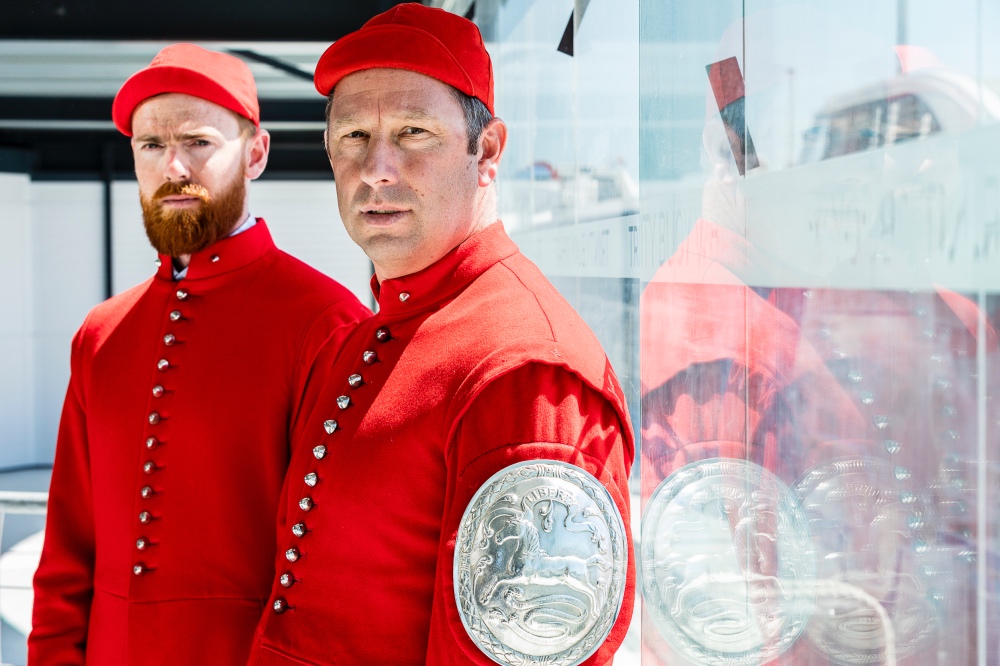
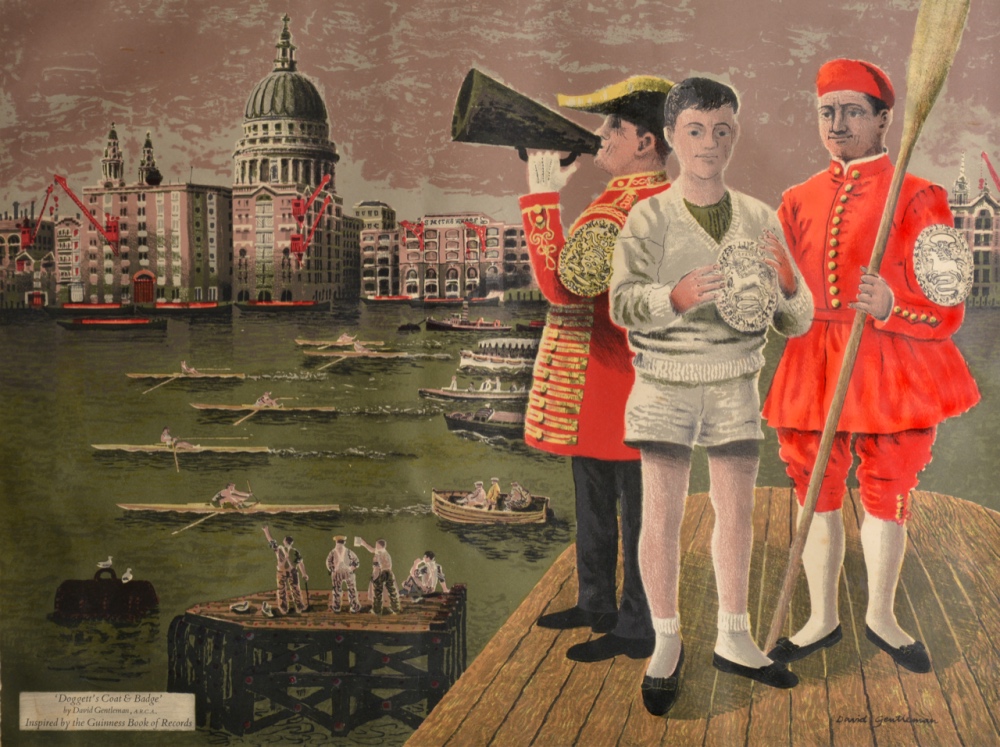
To be held from 4pm today on the River Thames, Doggett’s Coat and Badge Race is a London institution. The race originated in 1715, and sees up to six apprentice watermen (this year there are two – Alfie Anderson and George McCarthy – rowing the four mile, seven furlong course stretching from London Bridge upriver to Cadogan Pier in Chelsea (these days under 11 bridges) as they compete for the prize of a coat and badge (pictured above). The race came about thanks to Thomas Doggett, a Dublin-born actor and noted Whig, who founded it in honour of the accession of the House of Hanover – in the form of King George I – on 1st August, 1714. Doggett himself personally organised the race for the first few years before leaving provisions in his will for it to be continued. It’s been run almost every year since – there was apparently a break during World War II. While it was initially rowed against the tide, since 1873 competitors have had the luxury of rowing with it, meaning race times have dropped from what sometimes stretched to as long as two hours to between 25 and 30 minutes. This year, the event is being held as part of the Totally Thames festival which, among its packed programme of events, also features a series of exhibitions about the race – titled ‘The World’s Oldest Boat Race’, being held at various locations. PICTURES: From The World’s Oldest Boat Race exhibitions. Top – Doggett’s Coat and Badge (© Hydar Dewachi); Below – ‘Doggett’s Coat and Badge’, a coloured lithograph commissioned to mark the first publication of Guinness Book of World Records.

What’s in a name?…Hammersmith


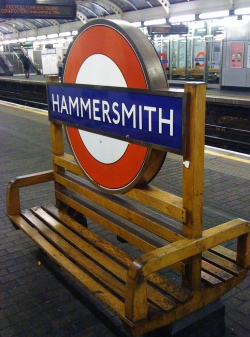
A fairly self-explanatory place name, Hammersmith, a district located in London’s west, records the fact there was once a blacksmith’s forge here.

The name, which also refers to the westernmost of London’s inner boroughs – since 1979 under the combined name of Hammersmith and Fulham, derives from two Anglo-Saxon words and dates back to at least the 13th century.

The village of Hammersmith sprang up along the major roads leading out of London and its roads, including some of the busiest in the city, still dominate the area’s landscape.

There’s been a chapel of ease in the village of Hammersmith since the early 1660s but in 1834 it became the parish church. The current Grade II-listed church, St Paul’s Hammersmith, dates from 1883 and contains some monuments from the original building.

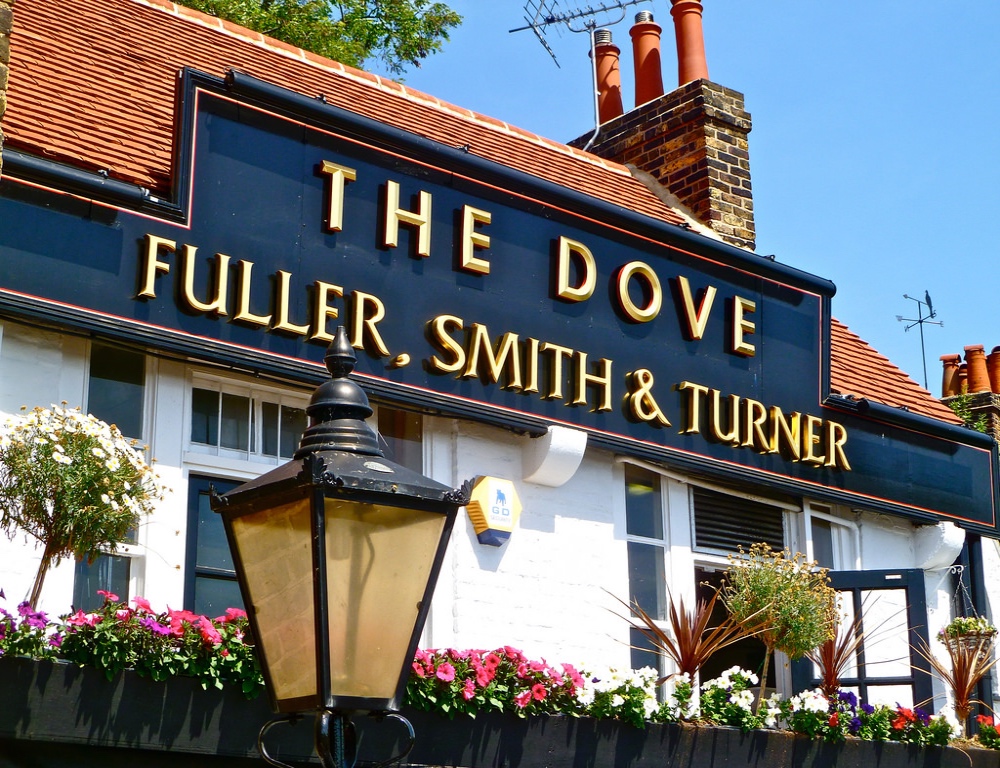
Other significant sites in Hammersmith include St Peter’s Church which, built in 1829, is now the oldest church, the Lyric Theatre which has origins going back to the 1880s, and, The Dove, which was listed by Guinness World Records as having the smallest bar in the world.

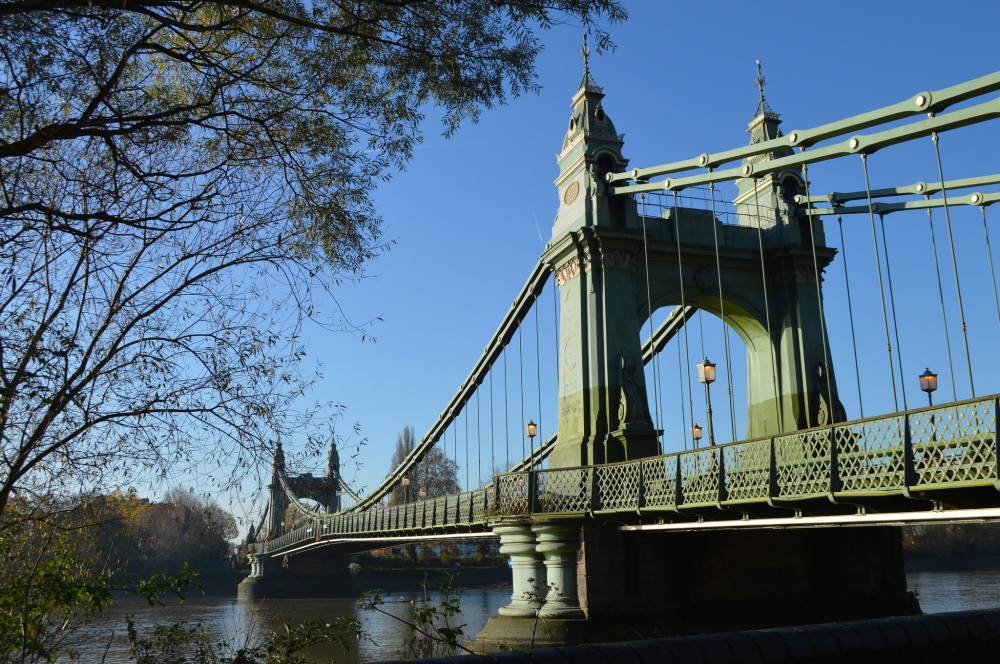
Hammersmith Bridge, which runs across the River Thames to Barnes, is a Grade II* suspension bridge designed by the civil engineer Joseph Bazalgette and opened in 1887. It replaced an earlier bridge designed by William Tierney Clark and opened in 1827 (it was the first suspension bridge across the Thames).

PICTURES: Above – Hammersmith Bridge (Matt Brown – licensed under CC BY 2.0); Hammersmith Underground Station (Peter Gasston – licensed under CC BY-ND-NC 2.0); The Dove  (Herry Lawford – licensed under CC BY 2.0).


This Week in London – Totally Thames, and, Cooper Car Company commemorated…

• Totally Thames – London’s annual celebration of its river – kicks off on Saturday with a packed programme of walks and talks, performances, exhibitions, and the chance to explore the waterway itself. Among the exhibitions are one focusing on the history of the annual Doggett’s Coat and Badge race and another featuring river-inspired artwork created by young people from across the globe, while variously themed walks include a series taking place along the Thames foreshore at low tide. Other events include a concert series in Tower Bridge’s Bascule Chamber, tours of the Billingsgate Roman House and Baths, and talks including one on the “scandalous” history of whitebait and another on the connections between Florence Nightingale, St Thomas’ Hospital and the river. There’s also the chance this Saturday to see the tall ship, STS Lord Nelson, arrive in London to cross the finish line in ‘Lord Dannatt’s Round Britain Challenge’, the Classic Boat Festival at St Katharine’s Docks (running from 7th to 9th September), and the Great River Race (held on 8th September). For the full programme of events, head to www.totallythames.org. PICTURE: The Thames in central London (NASA/GSFC/METI/ERSDAC/JAROS, and U.S./Japan ASTER Science Team)

Iconic car manufacturer, The Cooper Car Company, has been commemorated with an English Heritage Blue Plaque. The plaque, unveiled earlier this month at the company’s former works in Hollyfield Road in Surbiton, makes mention of the company’s success in winning two Formula One World Championships in 1959 and 1960. The former works building, the site where Charles Cooper and his son John created a company which became part of motoring history, is a rare surviving purpose-built and architect-designed 1950s motor workshop. It features an unusual curved frontage – described as a “striking example of ‘Thunderbirds’ architecture” – in what is perhaps an intentional homage to the curved design of the Cooper racing cars, something English Heritage believes is quite possible given its architect, Richard Maddock, was the father of the late Cooper chief designer Owen ‘The Beard’ Maddock. For more, see www.english-heritage.org.uk/visit/blue-plaques/.

Email all items for inclusion to exploringlondon@gmail.com.

10 (lesser known) memorials to women in London – 10. Emmeline and Christabel Pankhurst…

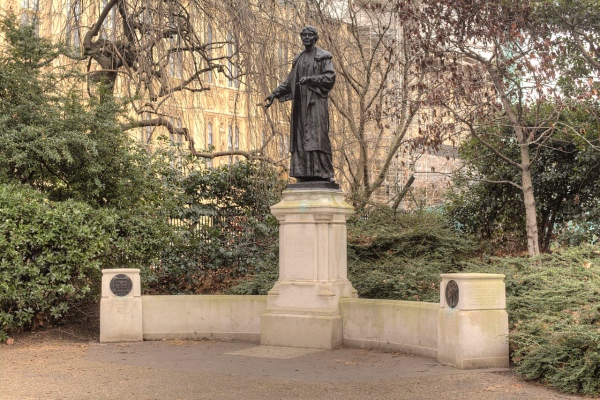
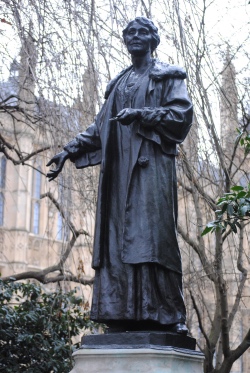
And so we come to the last entry in our series on lesser known memorials to women in London. And for our final memorial, we’re heading to Westminster where a memorial actually commemorating two women – Suffragettes Emmeline Pankhurst (1858-1928) and her daughter Christabel (1880-1958) –  sits in Victoria Tower Gardens next to the Houses of Parliament. 

Erected in 1930, the statue, which stands atop a central pedestal set in a low wall, was, according to the plaque on the front, installed as a tribute to Emmeline’s “courageous leadership of the movement for the enfranchisement of women” and was funded through subscriptions made to the Pankhurst Memorial Fund established following her death.

Sculpted by Arthur George Walker (he also sculpted a statue of Florence Nightingale in Waterloo Place), the now Grade II-listed statue depicts Pankhurst standing with arms appealing to those before her as if addressing a crowd.

Inside the pedestal upon which the statue stands there is apparently a metal box containing some of her letters and an obituary to her published in The Times.

The statue, which was originally installed as a stand-alone monument further to the south of its current position (but still in the gardens), was unveiled on 6th March, 1930, by then Prime Minister Stanley Baldwin. The Metropolitan Police Band, conducted by Ethel Smyth, a friend of Pankhurst’s, played during the unveiling – some of those police officers who played had previously arrested Suffragettes.

The monument was moved to its current location in 1958 and in 1959 the low wall was added to accommodate a second memorial, this one to Dame Christabel. It consists of two medallions sculpted by Peter Hill. Located at each end of the wall on either side of the statue, they depict the Women’s Social and Political Union badge, known as the “Holloway Prison brooch”, and a portrait of Christabel (right).

There are reportedly controversial plans to move the memorial to a site in The Regent’s Park. The proposed new site, which sits inside Regent’s University grounds, was apparently selected because of the historical association of the Suffragettes with Bedford College which once stood on the site.

There is also apparently a proposal for another statue of Emmeline Pankhurst to be located on Canning Green outside the Supreme Court on Parliament Square.

PICTURES: Top – Prioryman (licensed under CC BY-SA 4.0); Right – David Adams; Lower right – Lupo (licensed under CC BY 3.0/image cropped)

LondonLife – St Paul’s Cathedral rises over the City…

St Paul’s Cathedral and the City of London. PICTURE: Brunel Johnson/Unsplash

Lost London – The Royal Aquarium and Winter Garden…

Opened on 22nd January, 1876, this short-lived building at the junction of Tothill and Victoria Streets in Westminster – across the road from Westminster Abbey, was designed as an entertainment venue offering a space for art exhibitions, concerts and plays in similar fashion to that of the famous Crystal Palace then located in Sydenham.

The classically styled and highly ornamented two storey building was designed by Alfred Bedborough and built of Portland stone and red brick. Its initial board of directors included composer Arthur Sullivan (he of Gilbert and Sullivan fame), retailer William Whiteley, and financier Henry Labouchére, covered an area of almost three acres.

It featured a central hall which stood 340 feet in length and 160 feet wide and was covered with a barrel-shaped iron and glass roof. The interior featured palm trees and other exotic plants, fountains, sculptures, space for a 400 member orchestra, and, 13 large tanks for sea creatures which were fed with fresh and sea water from four cisterns

These tanks, which gave the premises its name as well as its nickname, ‘The Tank’, didn’t prove all that successful. They were initially left empty, prompting author Charles Dickens to note that they become something of a “standing joke”, and even as late as 1896 were described as providing a “beggarly show of fish”.

As well as the main hall, the premises also boasted multiple smaller rooms including eating and drinking establishments, an art gallery, ice-skating rink, reading room, telegraph office, and, at its west end, the Aquarium Theatre, which in 1879 was renamed the Imperial Theatre. There was even apparently a division bell installed for MPs visiting from the nearby Houses of Parliament.

By the 1890s, the entertainments had become more low-brow and the building had become associated with illicit sexual liaisons. Its popularity declined.

In 1903, it was sold to the Methodist Church and Methodist Central Hall was built on the site in 1911. The theatre, however, wasn’t demolished until 1907 – the interior, however, was saved and apparently re-erected as the Imperial Palace of Varieties in Canning Town in 1909 (which itself was destroyed by fire in 1931).

PICTURE: A from 1896 book, The Queen’s London: a Pictorial and Descriptive Record of the Streets, Buildings, Parks and Scenery of the Great Metropolis, showing the Royal Aquarium in c1876.

This Week in London – Smithfield Market celebration; Hampton Court’s annual food festival; and, Edwardian illustrators…

The 150th anniversary of the Smithfield Market will be celebrated at a street party this weekend. The Museum of London and Smithfield Market are joining in offering the free event which, reminiscent of St Bartholomew’s Fair, will feature food, music and historical re-enactments. Performers include Nadia Rose, Stealing Sheep, Girls Rock London, Gandini Juggling and Horrible Histories. Designed by Sir Horace Jones, the redesigned market – which is owned and managed by the City of London Corporation, was officially opened on 24th November, 1868. Runs from 11am to 8pm on Saturday and Sunday. For more, see www.culturemile.london/festival/smithfield-150/.

Hampton Court Palace is hosting its annual food festival over the August Bank Holiday weekend. Highlights include The Kitchen theatre featuring live cookery demonstrations from top chefs and gastronomic experts including Nadiya Hussain, Melissa Hemsley, Dr Rupy Aujla, Rhiannon Lambert, Lisa Faulkner and Michel Roux, Jr and The Classroom, which will be offering hands-on masterclasses such as sourdough workshops and ‘naked cake’ decorating with the BBC Good Food Cookery Team, gin and cocktail masterclasses and kids’ cookery. There will be stalls from more than 100 food providers offering everything from oysters to sausages, sweet treats and ales as well as a bandstand with live music and activities including vintage games, shire horses and a circus school. The festival runs from 25th to 27th August. Free entry to the palace and gardens is included with the ticket. For more, see www.hrpfoodfestivals.com.

• The work of largely forgotten Edwardian female illustrators Alice Bolingbroke Woodward and Edith Farmiloe is going on show in a new exhibition at the Heath Robinson Museum in Pinner. Peter Pan and the Other Lost Children, which opens Saturday, has been designed around 19 of Woodward’s original watercolour drawings from the first Peter Pan and also includes seven watercolours from her drawings from a 1930s edition of Alice in Wonderland. The display, which also includes works by Farmiloe, has been timed to coincide with the centenary of the Representation of the People Act of 1918. For more, see www.heathrobinsonmuseum.org.

Send all items for inclusion to exploringlondon@gmail.com.

10 (lesser known) memorials to women in London – 9. Anna Pavlova…

This statue of famed ballerina Anna Pavlova (1881-1931) is actually a replica of an original which was first installed here atop the cupola of the Victorian Palace Theatre, in Victoria Street in the West End, in 1911.

Commissioned by the theatre’s owner, Alfred Butt, it had been installed to mark Pavlova’s London debut. The ballerina, who had started her career in Russia, moved to settle in Ivy House in Golders Green in 1912 and subsequently went on to tour the world.

It is believed that the gilded statue was the work of the theatre’s architect, Frank Matcham. Larger than life-sized (although that’s hard to ascertain given its lofty position), it depicts Pavlova in a classical tutu standing on one leg in what’s known as the “arabesque” position.

The story goes that the superstitious dancer hated the idea of the statue and always refused to look at it, even pulling closed the curtains on her cab when passing.

It was removed for safe-keeping in 1939 following the outbreak of World War II but apparently lost soon after.

The replica, which was created by Hary Franchetti  based on photographs, was reinstalled in 2006. The fate of the original remains a mystery.

PICTURES: Top – amateur_photo_bore (licensed under CC BY-NC-ND 2.0); Below – David Adams.

LondonLife – The dragons have returned to Kew…

More than 200 years after they disappeared, the dragons have returned to Kew Garden’s Great Pagoda. The 10 storey octagonal pagoda – which, as we reported, reopened to the public in July after a four year, £5 million restoration project by Historic Royal Palaces in conjunction with the Royal Botanic Gardens, Kew – was built in 1762 to the designs of Sir William Chambers and was a birthday gift for Princess Augusta, founder of the gardens. Used by the Georgian Royal Family to entertain visitors, it was famously adorned with 80 brightly coloured dragons but these disappeared in the 1780s. Rumours suggested they were used as payment for the Prince Regent’s gambling debts but apparently the truth is more banal – Chambers took them off when he restored the building in 1784 and they were found to be rotten. But they’re back (some of the new dragons are gilded with real gold and while some are hand carved from cedar, others were reportedly made on a 3D printer) and to celebrate their return (and the reopening of the pagoda to the public for the first time in decades, complete with a 253 step climb), we today publish some images. Admission charge applies. For more, see www.kew.org/kew-gardens/whats-on/climb-the-great-pagodaPICTURES: © Richard Lea-Hair – Historic Royal Palaces.

A Moment in London’s History – The opening of “new” London Bridge…

This month marks the 187 years since the opening of “new” London Bridge – the first bridge built over the Thames in London for more than 600 years.

Designed by John Rennie (who had won a competition, beating the likes of Thomas Telford for the honour), work on the new granite bridge had began in 1825 and was completed in 1831.

It was constructed alongside the medieval bridge which had been first completed in the 13th century and added to over the years since (and was eventually completely demolished after the opening of the ‘new’ bridge).

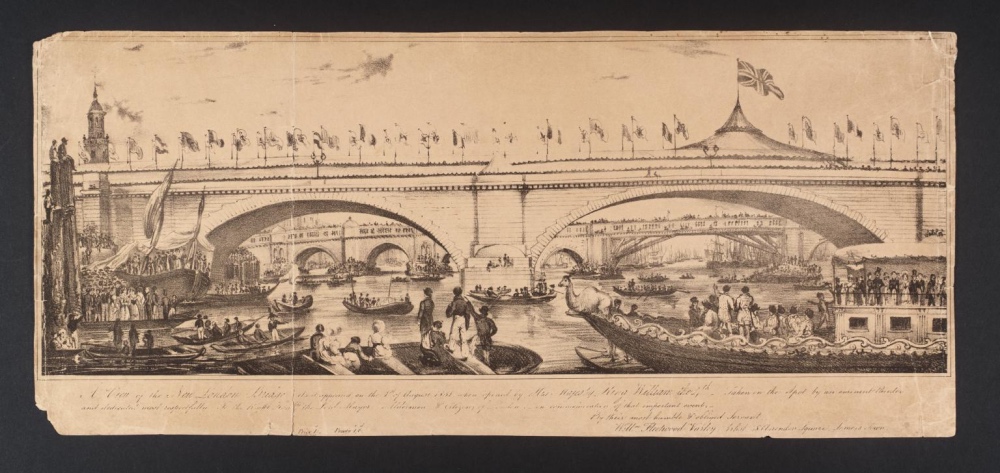
The ‘new’ bridge, said to have cost £506,000 to construct, was formally opened by King William IV on 1st August, 1831, in an event described by The Times as “the most splendid spectacle that has been witnessed on the Thames for many years”.

The royal party – which included Queen Adelaide – had approached the bridge, lined with flags for the occasion, after setting off from Somerset House amid cheering described as “almost deafening” (to add to cacophony of sound, church bells were rung and cannon fired throughout the day).

Watched by thousands of onlookers (who were entertained by bands at various locations), the royal party had processed their way downstream on the river to the bridge with the royal bargemen wearing new livery specially designed for the occasion. Two parallel lines of rivercraft – including barges and steamers – had gathered along the river to provide a sort of honour guard and ensure they had clear passage.

The royals arrived at the bridge at 4pm and the royal party made their way up red carpeted stairs to the bridge’s City end. Following a short ceremony in which the King was presented by the Lord Mayor of London with the sword and keys to the City of London as well as a specially made gold medal to mark the occasion, their Majesties then walked across from the across the bridge to the Southwark end where entertainments had included the ascension of a hot air balloon.

The King and the royal party then returned to the City end of the bridge to attend a banquet – guests were said to number 1,500 people – held under a pavilion erected atop the new structure.

The Gentleman’s Magazine reported that food was provided by a coffee house proprietor, a Mr Leech, and was said to include 150 hams and tongues, 370 “dishes of chickens”, and 300 turtles as well as 200 fruit tarts and 300 “ice-creams”.

The King and royal party then returned up the river.

Rennie’s bridge was replaced in the mid-20th century with another bridge which was officially opened by Queen Elizabeth II in 1973 and rather than being demolished, was sold to US oil magnate Robert P McCulloch who had it dismantled and shipped to Arizona where it was reconstructed at Lake Havasu City where it can now be seen.

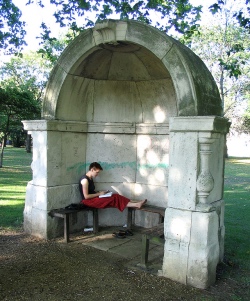
A couple of sections of the bridge survive in London – two of its pedestrian alcoves, one of which can be found in Victoria Park in London’s east and the other at King’s College London.

There is a famous painting – Clarkson Stanfield’s, The Opening of New London Bridge, 1 August 1831 – which captures the moment of the bridge’s opening and is part of the Royal Collection.

PICTURES: Top – ‘A View of the New London Bridge as It Appeared on the 1st August 1831, When Opened by His Majesty, King William the 4th’, Unknown artist, Lithograph on paper, Photo © Tate (licensed under CC-BY-NC-ND 3.0 (Unported)); Right – The alcove in Victoria Park (Public Domain).

10 (lesser known) memorials to women in London – 8. Virginia Woolf…

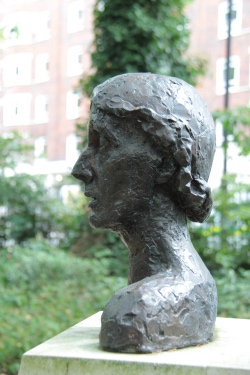
Located in Tavistock Square in Bloomsbury, this bronze bust of writer and literary pioneer Virginia Woolf (1882-1941) was erected in 2004.

Commissioned by the Virginia Woolf Society of Great Britain, it is a copy of a bust of Woolf sculpted by Stephen Tomlin in 1931 (there is a 1953 version of the work, apparently the only 3D representation of Woolf taken from life, in the National Portrait Gallery) and was set on a Portland stone plinth designed by Stephen Barkway.

A plate on the plinth explains that Woolf, a central figure in the Bloomsbury group of writers and artists, lived from 1924 to 1939 in a house which once stood on the south side of Tavistock Square, the period when her greatest novels were written.

It also features a quote from Woolf concerning the writing of her novel To the Lighthouse – “Then one day walking round Tavistock Square I made up, as I sometimes make up my books, To the Lighthouse; in a great, apparently involuntary, rush.”

There are, incidentally, plans to erect a new life-sized, seated statue of Woolf at Richmond on the bank of the River Thames. Woolf and her husband Leonard lived for a time the riverside borough at Hogarth House (where they also ran their publishing company).

Mock-ups have been created by artist Laury Dizengremel and there is a funding appeal to raise £50,000 currently underway.

PICTURE: Maureen Barlin (licensed under CC BY-NC-ND 2.0)

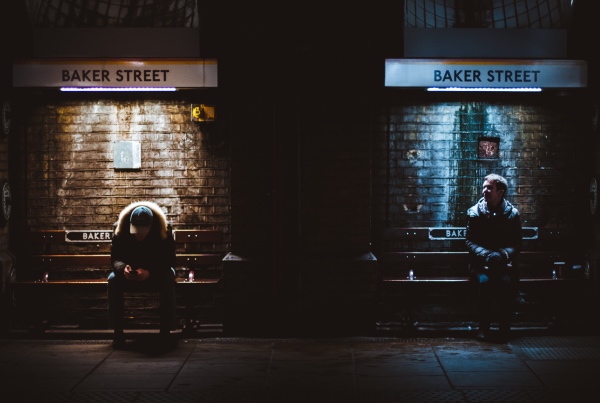
LondonLife – Waiting for the Tube, Baker Street…

PICTURE: Jack Finnigan/Unsplash

Treasures of London – The Great Hall at Eltham Palace…

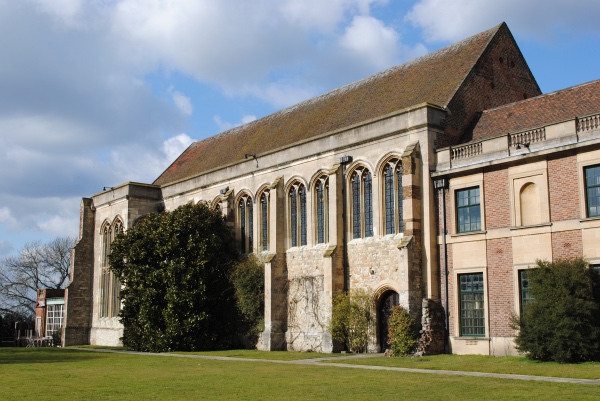
Originally built as a dining hall for King Edward IV in the 1470s, the Great Hall is a survivor of the medieval royal palace that once stood on the site and later become incorporated into the Art Deco home created by Stephen and Virginia Courtauld in the 1930s.

The hall, which is comparable in size to that of Hampton Court Palace, was designed by Thomas Jordan, chief mason to the king, and Edmund Graveley, his chief carpenter.

It is 101 foot long and 36 foot wide and has a magnificent oak roof described as a ‘false’ hammerbeam construction (the ‘false’ because the posts are morticed into the ends of the hammerbeams rather than resting on them).

The hall would have once had a raised dais at one end while the other end joined to the rest of the would have featured a screen behind which doors led to a buttery, pantry and kitchen. A hearth was located near the dais end of the hall.

The windows, which are set high in the walls, would have been of stained glass (the stained glass there now was added in 1936 and is the work of George Kruger Gray) and the walls below them would have been decorated with tapestries.

Eltham was a favourite residence of King Edward IV and one of the most lavish feasts ever held there was at Christmas, 1482, when some 2,000 people were fed (it was the king’s last visit to the palace before his death the following April). The hall would have also been familiar to King Henry VIII who spent much of his childhood here but later in his life rarely came to Eltham.

King Charles I was the last king to visit the palace and in 1651 it was sold off by Parliament to Colonel Nathaniel Rich who, as well as demolishing many buildings, stripped the lead off the hall’s roof. The property was later used as a farm and the hall became a barn.

In the early 19th century a campaign was launched to save the hall from demolition which saw the roof propped up and during the latter half of the 1800s it was used as an indoor tennis court.

Further repairs were made in the 1890s and again between 1911 and 1914 when the roof was dismantled and reassembled under the direction of the Office of Works.

The Courtaulds, who had their spectacular adjoining property built in the 1930s, apparently intended to use the hall as a music room and carried out a number of repairs – including to the roof – and additions including a minstrel’s gallery (there is no evidence of such a feature in the original).

After World War II, the Ministry of Works assumed responsibility for the Great Hall (and other palace remains) – opening the hall to the public for three days a week – before in 1984 English Heritage took over management of the Great Hall (and later the entire site).

PICTURE: David Adams

WHERE: The Great Hall, Eltham Palace, Court Yard, Eltham, Greenwich (nearest train station is Mottingham); WHEN: 10am to 6pm Sunday to Friday; COST (without Gift Aid): £15 adults/£9 children/£13.50 concessions/£39 family (English Heritage members free); WEBSITE: www.english-heritage.org.uk/visit/places/eltham-palace-and-gardens/.


This Week in London – Celebrating Antarctica through dance and science; and, the Freuds in exile…

A free dance and science festival celebrating Antarctica opens at the Science Museum in South Kensington on Tuesday. Antarctica Live features daily dance performances – including a newly devised performance by award-winning choreographer Corey Baker, workshops and hands-on experiences with real survival equipment to shed light on how the frozen continent is responding to increasing human activity and how its fate can affect us all. Visitors will also be able to see a scale model of the recently launched polar research vessel, the RRS Sir David Attenborough. A special “lates” event on 29th August in the museum’s IMAX Theatre will premiere the documentary film Dancing on Icebergs, which charts the two year making of the short film, Antarctica: The First Dance, featuring Madeleine Graham, star of the Royal New Zealand Ballet (pictured). The screening will be followed by a live Q&A with Corey Baker. Antarctica Live runs until 30th August. For more, see www.sciencemuseum.org.uk/see-and-do/antarctica-live. PICTURE: Madeleine Graham in Antarctica The First Dance © Jacob Bryant.

On Now: Leaving Today – the Freuds in Exile 1938. This exhibition at the Freud Museum London in Hampstead focuses on the flight and exile of Sigmund Freud, his wife Marta and daughter Anna as, following Hitler’s annexation of Austria, they left Vienna on 4th June, 1938, heading to a new life in London. It features original documents, letters and objects, many of which have never been on public display before. Highlights included the documents Freud and his family required to exit Austria and enter Britain, Freud’s personal correspondence with figures like Albert Einstein and HG Wells, and the first public display of Marie-Louise von Motesiczky’s painting The Psychoanalyst. The exhibition also features a series of works created by young people attending the Baobab Centre for Young Survivors in Exile in collaboration with Barnaby Barford. Runs until 30th September. Admission charge applies. For more, see www.freud.org.uk.

Send all items for inclusion to exploringlondon@gmail.com.