Pharmacist, entrepreneur, philanthropist, and collector, American-born Sir Henry Solomon Wellcome’s name lives on in London’s Wellcome Collection and Wellcome Library as well as the world-renowned biomedical research charity known as the Wellcome Trust.
The son of a farmer turned itinerant preacher, Wellcome was born on 21st August, 1853 in a log cabin on the American frontier in northern Wisconsin and, working in his uncle’s drugstore in Garden City, Minnesota, developed an interest in medicine, particularly the marketing of medicine (his first marketing success was his own invisible ink).
Taking various positions at other pharmacies over the ensuing years, he studied at the Philadelphia College of Pharmacy and there meet Silas Burroughs. Graduating in 1874, he spent a few years as a pharmaceutical salesman (and an explorer, travelling to South America to search for rare native cinchona trees, a source of quinine) before, with the encourage of Burroughs, he moved to London in 1880.
 There they founded a pharmaceutical company, Burroughs, Wellcome & Co. They introduced the selling of medicine in the form of compressed tablets – it had hitherto been sold largely in liquid or powder form – to England with their patented ‘tabloid’. They also pioneered direct marketing to doctors.
When Burroughs died in 1895 (they had already fallen out), Wellcome took over the flourishing company in its entirety and set up two research laboratories connected to his pharmaceutical company. In 1924, he consolidated all his commercial and non-commercial entities in one holding company, The Wellcome Foundation Ltd.
In 1901, Wellcome married Gwendoline Maud Syrie Barnardo, daughter of Dr Thomas John Barnardo, founder of children’s charity Barnardo’s (they had met in Khartoum).
They had one child, Henry Mounteney Wellcome, who was born in 1903 and sent to foster parents at about the age of three due to the travelling lifestyle of his parents. The couple, however, were not happy and Gwendoline, known as ‘Syrie’, reportedly had several affairs including one with department store identity Harry Gordon Selfridge and another with author William Somerset Maugham, whom she later married. Wellcome and Gwendoline divorced in 1916.
Wellcome, meanwhile, became a British subject in 1910 and was knighted in 1932, the same year he was made an honorary fellow of the Royal College of Surgeons of England. Something of a recluse in his later years, he died in pneumonia at The London Clinic on 26th July, 1936, following an operation.
Under the terms of his will, the Wellcome Trust was established for “the advancement of medical and scientific research to improve mankind’s wellbeing” which, initially funded by the income from the Wellcome Foundation and now a separate charity, continues to fund biomedical research and training.
Wellcome, meanwhile, had amassed an enormous collection of artefacts with the aim of creating a ‘Museum of Man’, which by the time of his death amounted to more than a million objects including at least 125,000 medically related ones and such oddities as Napoleon’s toothbrush and King George III’s hair. The first exhibition of selected objects from his collection opened at a temporary exhibition in Wigmore Street in 1913 next door to the Wellcome Burroughs showroom and since 1976 some of his collection have been on show at the Science Museum.
The Wellcome Collection, based in Euston Road, was established in 2007 to display some of Wellcome’s medical collection as well as artworks. The Wellcome Library, now part of the Wellcome Collection, is based on the book collection of Sir Henry which he started collecting seriously late in the 1890s. The books were housed in a series of locations around London before, in 1949, opening as the Wellcome Historical Medical Library in Euston Road.
An English Heritage Blue Plaque can be found at Sir Henry’s former home at 6 Gloucester Gate, Regent’s Park, which he leased from about 1920 until his death.
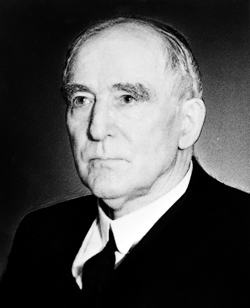
PICTURE: Henry Solomon Wellcome in 1930/Wikimedia/CC BY 4.0
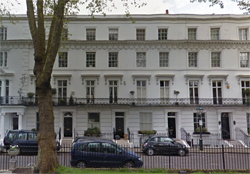 In Ian Fleming’s books about the adventures of 007, he has the spy living in a ground-floor flat in a “converted Regency house” in a “plane tree’d square” off the King’s Road.


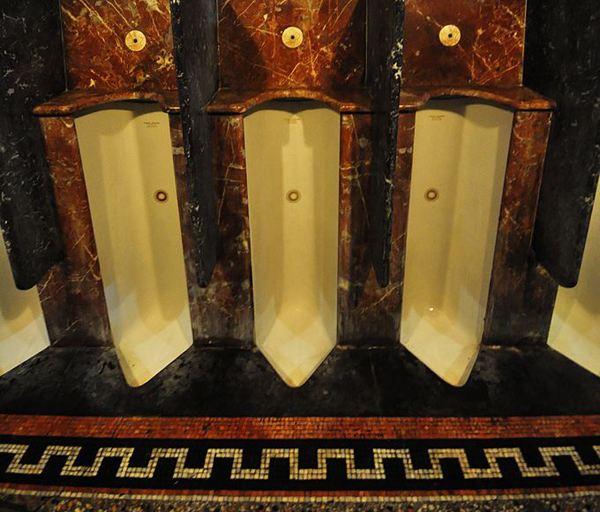
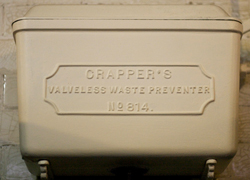 The gentlemen’s facilities, located off to the side of the chapel, were designed by the famous Thomas Crapper & Co and consist of enclosed wooden-walled cubicles, a series of urinals and wash basins.