 The result of four years of research, the Elytra Filament Pavilion is inspired by the fibrous forewing shells of flying beetles known as elytra. Featuring components which have been fabricated by a robot at the University of Stuttgart and then assembled on site in the V&A’s John Madejski Garden, the installation will grow and move in response to how visitors use the canopy thanks to anonymous data collected from sensors installed in the canopy fibres. On select dates – 17th and 18th June and 22nd September – visitors will be able to see new cells – each of which weighs about 45 kilograms and take an average of three hours to create – manufactured live by a Kuka robot. The installation is the work of experimental architect Achim Menges with Moritz Dorstelmann, structural engineer Jan Knippers and climate engineer Thomas Auer. The pavilion is one of the highlights of the V&A’s first ever ‘engineering season’ with the landmark exhibition – Engineering the World: Ove Arup and the Philosophy of Total Design opening on 18th June. Admission to see the installation, which can be seen at the South Kensington location until 6th November, is free. For more, see www.vam.ac.uk/EngineeringSeason. PICTURES: © Victoria and Albert Museum, London.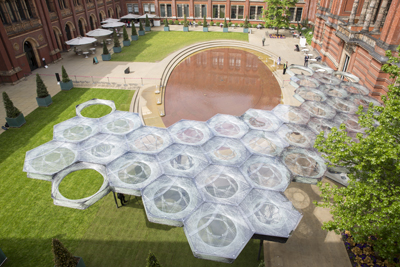
Author: exploringlondon
London Pub Signs – The Bricklayer’s Arms, Putney…
OK, so it doesn’t look like the most historic of pubs but the Bricklayer’s Arms in Putney does boast an interesting history (as well as a much accoladed menu ales).
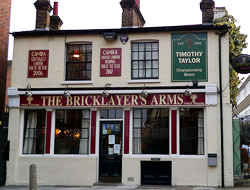 The Waterman Street pub is apparently the oldest in the south-western riverside district, dating back to 1826 when it was constructed on the site of a former coaching house and blacksmith’s forge.
Then named the Waterman’s Arms, thanks no doubt to its Thames proximity and the fact that, as a result, most of the clientele were freeman and lightermen working on the river, it changed its name to the Bricklayer’s Arms around the turn of the 20th century when, thanks to the extension of the District line railway, there was a sizeable amount of construction going on in the area.
It was briefly known as the Putney Brick before the current owners – actress Becky Newman and her husband John – took over the pub just over 10 years ago, during which time it has won a swag of awards including being named one of the top 10 English pubs by National Geographic and winning the CAMRA National Pub of the Year Award in 2007 and 2009.
For more on the pub (and the plans to extend it), check out www.bricklayers-arms.co.uk.
PICTURE: Ewan Munro-Flickr/CC BY-SA 2.0 (image has been cropped and brightened)
Treasures of London – Elfin Oak, Kensington Gardens…
 Delightfully carved out of a hollow oak tree, the Elfin Oak takes its name from the many colourful figures that adorn it.
The sculpture, which sits beside the Diana Princess of Wales Memorial Playground is the work of children’s book illustrator Ivor Innes.
He spent two years – 1928 to 1930 – carving “Little People” upon an ancient oak tree trunk that had been found in Richmond Park and relocated to Kensington Gardens (and in 1930, with his wife Elsie, published the children’s book, The Elfin Oak of Kensington Gardens).
The characters depicted include animals and fanciful creatures such as a gnome called Huckleberry, a series of elves including Grumples and Groodles and a witch named Wookey.
The hollow, incidentally, had been presented to The Royal Parks by Lady Fortescue in response to an appeal run to improve facilities in line with a scheme by George Lansbury (among other things, he also founded the Serpentine Lido).
Now a Grade II listed structure (and well protected by wire mesh), it has a few pop culture associations – among them, the fact that it appeared on the cover of Pink Floyd’s 1969 album, Ummagumma (the head of the band’s lead singer and guitarist David Gilmour can be seen projecting from the trunk).
Meanwhile, in 1996, Spike Milligan – long a fan of the oak – was the face of a successful campaign to raise funds for its restoration.
Announcing the Grade II listing in 1997, then Heritage Minister Tony Banks noted that the oak sat alongside the late Victorian fascination with Little People and complemented Sir George Frampton’s statue of Peter Pan (also located within the gardens).
“Together the two sculptures make Kensington Gardens very much the world capital of fairies, gnomes and elves,” he reportedly said.
PICTURE: Lonpicman/Wikimedia/CC BY-SA 3.0/
This Week in London – Architecture on show; designing London’s transport system; and, the Battle of the Somme commemorated…
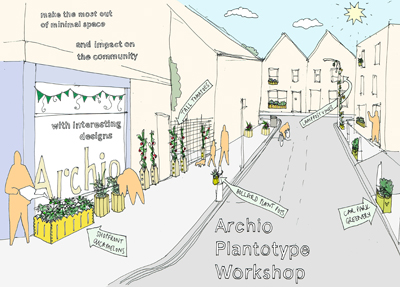 • The London Festival of Architecture kicked off this week with more than 200 events planned for the capital across the month of June. Highlights include “open studios” in which 50 architectural practices across London open their doors to the public, a series of film showing at the BFI concerning the portrayal of the built environment in documentaries and hosted tours through some of London council estate’s green spaces and private gardens. The festival, which centres around three key themes – housing renewal and regeneration, creative workspaces and community engagement, also features a range of exhibitions, installations, talks and workshops including the Archio Plantotype Workshop on 25th June in which participants are asked to help design and build model prototype planters to grow compact and hybrid plants (pictured). For the full programme, check out www.londonfestivalofarchitecture.org.
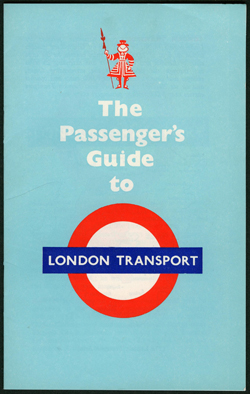 • The design of London’s transport system – from posters, maps and signage to the styling of trains and stations – is the subject of a new exhibition at the London Transport Museum in Covent Garden. Designology – Shaping London explores the role design has played in London’s public transportation systems, spanning the period from the system’s Victorian origins to today. Among the objects on display are an 1834 Shillibeer Woolwich Omnibus timetable, original architectural drawings by Charles Holden of Arnos Grove and Sudbury art deco stations, and a 1994 magnetic ticket hall station model. There are also case studies on key design features found across the transport network such as the New Johnston typeface and the design of Moquette fabric used on the Underground and buses. Visitors are also encouraged to design their own bus stop sign (and share it on social media with the hashtag #pimpmybusstop) and visit a pop-up design studio to find out more about contemporary design innovation. There’s an accompanying programme of events. Admission charges apply. For more, see www.ltmuseum.co.uk. PICTURE: The Passenger’s Guide to London Transport, issued by London Transport, March, 1962./The London Transport Museum.
• The “worst day” in the history of the British Army – 1st July, 1916, when almost 60,000 died during the Battle of the Somme – is being commemorated in an exhibition marking the battle’s centenary in Guildhall Yard. Fields of Battle, Lands of Peace: Somme 1916, features a series of evocative photographs by Michael St Maur Sheil of the battlefields as they look today contrasted with images taken at the time. The outdoor exhibition is being accompanied by a display of Somme-related artefacts in the City of London Heritage Gallery at the Guildhall Art Gallery. Admission to the display is free. Runs until 5th July.
Send all items for inclusion to exploringlondon@gmail.com.
10 notable blue plaques of London – 3. The City of London’s only ‘blue plaque’ (and it’s not even blue)…
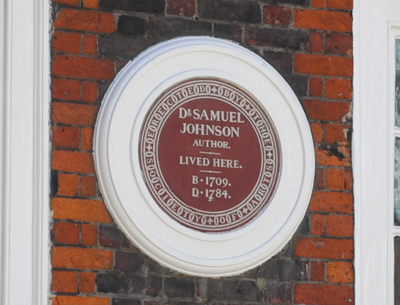 There is only one official blue plaque in the square miles of the City of London – that which marks the property of lexicographer Dr Samuel Johnson in Gough Square (he always did like to stand out from the crowd) – and, like many of the plaques in the scheme, it’s not even blue.
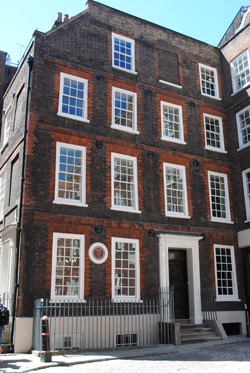 The plaque was among the 35 erected in the first 35 years of the scheme – this one in 1876 – and was done so by the Society of Arts which then ran the scheme (later the Royal Society of Arts). In common with most of the first 35 plaques, it is brown in colour.
In 1879, just three years after this plaque was erected, the Society of Arts came to an agreement with the Corporation of the City of London that the corporation – the governing body of the square mile – would commemorate sites of historic significance within its boundaries and the agreement has stood ever since.
The hundreds of “blue plaques” since erected by the City of London Corporation are rectangular in nature and commemorate everything from structures like the long-gone historic gate of Aldgate (88 Aldgate High Street) to homes of the notable such as martyred Archbishop of Canterbury Thomas á Becket (86 Cheapside).
There’s a searchable database of all the City of London plaques which can be found here.
And, of course, Dr Johnson’s house, which he lived in from 1748-59 which compiling his famous A Dictionary of the English Language (the first comprehensive English language dictionary), is now a museum – for details of that, see our earlier post here.
LondonLife – A view down Constitutional Hill…
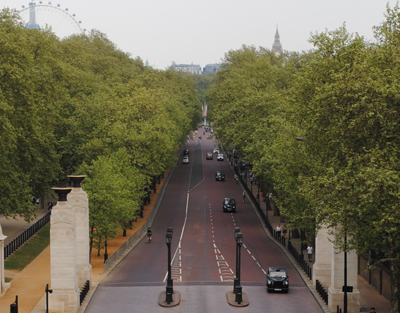
A view down Constitution Hill looking toward Whitehall, taken from the top of Wellington Arch at Hyde Park corner. To the left is Green Park and to the right, the grounds of Buckingham Palace. Constitutional Hill apparently has nothing to do with a document of any sort but takes its name from the fact that, considered to be a fine “constitutional” walk from St James’s Park to Hyde Park (King Charles II is rumoured to have been among those said to have taken their “constitutional” along this route while Queen Victoria survived a couple of assassination attempts on the road). The pillars at the near end are symbolic gates commemorating those who served Britain in World War I and II from the Indian subcontinent, Africa and the Caribbean (more on them in an upcoming post).
Daytripper – Lavenham, Suffolk…
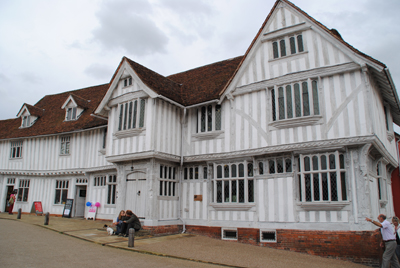 It’s a Bank Holiday weekend and thoughts are turning to a day out, so we thought it a good time to take a look at the beautiful village of Lavenham in Suffolk, one of the finest “medieval villages” remaining in England.
While settlement of the village, which is about an hour and 45 minutes north-east of London by car, goes back to before Saxon times (indeed the village apparently takes its name from a Saxon thegn called Lafa) it was in the medieval period that it attained the charming character which is still so evident today.
 The village was awarded its market charter in 1257 and it was from this period until about 1530 that its ‘golden years’ occurred, based on its prominent role in the wool trade (in particular the production of sought-after blue broad cloth – ‘Lavenham Blue’) and its location between London and the key ports like Kings Lynn.
It was during this period that its several guildhall were constructed and it was recorded as one of the richest parts of England with some of its most prominent families becoming extremely wealthy, like the De Vere family headed by the Earl of Oxford, and the Spring and Branch families who used their wealth to raise themselves to the nobility.
Lavenham’s decline began in the later 1500s and followed a sharp downturn in the wool trade amid greater competition from Europe. Its fortunes reached a low in the late 18th century before industrialisation in the 19th century revitalised the village somewhat (although nowhere close to the prominence and affluence it once boasted).
Today Lavenham is something of a tourist mecca, boasting an amazing collection of timber-framed buildings – more than 320 of which are listed – mostly dating from between 1450 and 1500.
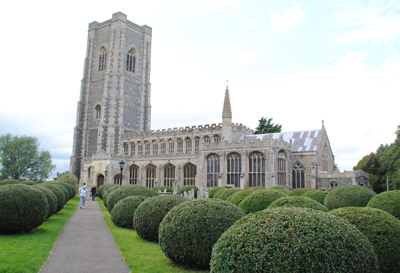
Central among them is the Guildhall (pictured top), located on the market place, which dates from about 1530, and as well as hosting religious guild activities (its formal name was the Guild of Corpus Christi), has also served as a prison, workhouse, almshouse, and wool store and now houses a National Trust-run museum.
One of the most famous photographed buildings in the town is the Crooked House on High Street (pictured above right), so-called because of the dramatic lean its upper story is on.
There’s also the Little Hall, which, dating from the 14th century, was the wool hall of clothier William Causation and is now home to the Suffolk Preservation Society (open to the public over the warmer months). And among other notable homes is De Vere House, a grade I-listed property (now available to stay in) which still had elements dating back to the Middle Ages (and was the last home in the village to be owned by the Earls of Oxford).
The Church of St Peter and St Paul (pictured below) is also notable – described as “one of the finest parish churches in England”. The current version (there has apparently been a church here since Saxon times) was apparently funded by the 13th Earl of Oxford and wealthy cloth merchants including Thomas Spring III (whose coat of arms appears 32 times on the parapet) to celebrate their safe return from Battle of Bosworth Field where King Henry VII was victorious in 1485.
A couple of interesting notes to finish on. Among the residents in the late 18th century was the London-born Jane Taylor who lived in Shilling Street with her family. Jane and her sister Ann published a collection of poetry which included the poem, The Star, from which the lyrics for Twinkle, Twinkle Little Star are taken.
There’s also a John Constable connection – the landscape painter was a student at the Grammar School which opened in Barn Street in 1647.
And, as you might expect in such a well-preserved location, Lavenham has also appeared on the big screen, notably De Vere House as the birthplace of Harry Potter and his mentor Albus Dumbledore.
A charming village to pass a few hours walking around (and, relax in, there’s plenty of pubs and cafes to refresh yourself at afterwards).
For more, check out www.discoverlavenham.co.uk and www.visit-lavenham.co.uk.
This Week in London – Exploring flight and space; ‘Horrible’ Tudors at Hampton Court; BioBlitz at Brompton Cemetery; and sleeping with the lions…
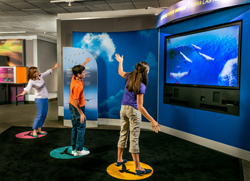 • A “ground-breaking” hands-on exhibition exploring the concept and future of flight and space travel opens at the National Maritime Museum in Greenwich this week. Above and Beyond, produced by Evergreen Exhibitions in association with Boeing (and created in collaboration with NASA), features more than 10 interactive displays, allowing visitors to learn to fly like a bird, take an elevator to space, enjoy a view of Earth from above or go on a marathon mission to Mars and see how your body would cope. Runs until 29th August. Admission charge applies. For more, see www.rmg.co.uk/see-do/exhibitions-events/above-and-beyond-exhibition.
• Horrible Histories is bringing the world of the ‘Terrible Tudors’ to life at Hampton Court Palace this half-term break. The Birmingham Stage Company is offering the chance for visitors to dip into 100 years of Tudor history, spanning the reigns of the “horrible” Henries to that of the crowning of King James I in 1603. Get behind the dry facts and discover what the role of the Groom of the Stool was, which queen lost her wig as she was executed and decide whether to join in punishing the ‘whipping boy’ or the monarch and which side you’ll be on as the Spanish Armada set sail. The hour long performances will take place on the palace’s historic East Front Gardens (unreserved seating on the grass). Admission charge applies. Runs from today until 2nd June. For more see, www.hrp.org.uk/hampton-court-palace/.
• The Royal Parks is hosting its first ever BioBlitz at Brompton Cemetery this Bank Holiday weekend. For 24 for hours from 5pm on Friday, people are invited to join in the hunt to track down as many species of plants, animals and fungi as possible with events including tree and nature walks, earthworm hunts, bee and wasp counts and lichen recording. There will also be a range of stalls for people to visit with representatives from a range of nature and wildlife organisations present. The BioBlitz is one of several projects linked to the £6.2 million National Lottery-funded facelift of the cemetery. For more, head to www.royalparks.org.uk/events/whats-on/bioblitz.
• Sleep with the lions at ZSL London Zoo next to Regent’s Park from this week. The zoo new overnight experience at the Gir Lion Lodge, in which guests can stay in one of nine cabins at the heart of the new Land of the Lions exhibit, opened on Wednesday. Guests will also be taken on exclusive evening and morning tours in which they’ll find out more about how ZSL is working with local communities and rangers in India’s Gir Forest to protect these endangered cats. The private lodges will be available six nights a week until December with designated adults-only and family nights available. For more, see www.zsl.org/zsl-london-zoo/gir-lion-lodge.
Send all items for inclusion to exploringlondon@gmail.com.
10 notable blue plaques of London – 2. The (now long gone) first Blue Plaque…
The concept of a scheme involving placing commemorative plaques on what was once the homes of notable people was first raised by MP William Ewart in 1863 in Parliament.
 Three years later, in 1866, the idea was adopted by the then Society of Arts (later the Royal Society of Arts) and in 1867 it erected two blue plaques, the first being one commemorating the birthplace of Lord Byron at 24 Holles Street just south of Cavendish Square in Marylebone and the second being that erected to Emperor Napoleon III in King Street (see last week’s post).
But the Byron plaque had the honour of being the first and it remained on the property until it was demolished in 1889 and the plaque, presumably, lost.
It has, however, been replaced several times on subsequent buildings on the site – the latest incarnation, is a “green plaque” erected by Westminster City Council on what is now a John Lewis store and was unveiled on National Poetry Day in 2012 (it replaced a non-standard, rectangular-shaped plaque – pictured above – which was installed after the building was bombed during World War II).
The current plaque describes Lord Byron as “one of the greatest British poets” and quotes him: “Always laugh when you can. It is a cheap medicine.”
Byron is said to have been born at the property on 22nd January, 1788 and was baptised George Gordon Byron at the nearby St Marylebone Parish Church. Interestingly, English Heritage says that recent research has shown there is no clear evidence for which house in Holles Street Lord Byron actually lived in meaning none of the plaques may have actually marked the correct site.
During the first 35 years of the scheme’s existence it erected on some 35 plaques (there are now some 900 in existence, so the pace has quickened since).
Less than half of them now survive but among those that do are plaques to poet John Keats (erected in 1896 on Keats’ House in Hampstead), novelist William Makepeace Thackeray (erected in 1887 on 2 Palace Green in Kensington) and politician and author Edmund Burke (erected in 1876 on 37 Gerrard Street in Soho.
PICTURE: Wikimedia
LondonLife – Richmond Weir and Lock…
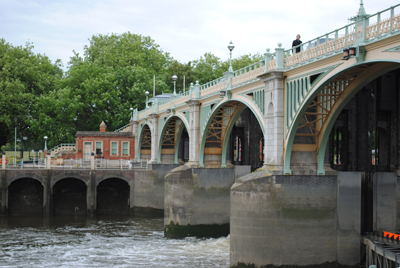
Crossing the River Thames just downstream of Richmond and Twickenham Bridge, the Richmond weir and lock complex (actually it’s a half-lock and it also incorporates a footbridge) was built in the early 1890s to maintain a navigable depth of water upstream from Richmond. The Grade II*-listed structure, which is maintained by the Port of London Authority, was formally opened by the Duke of York (later King George V) on 19th May, 1894.
Famous Londoners – Dr John Dee…
The subject of a current exhibition at the Royal College of Physicians, Dr John Dee – mathematician, courtier, astrologist and ‘magician’ are just some of the tags he is labelled with – is one of the most enigmatic figures of Tudor England.
 Born in London’s Tower ward in 1527, Dee was of Welsh descent and the son of Roland Dee, a mercer and courtier to King Henry VIII, and Johanna Wild. He attended school in Chelmsford and, at the age of 15 entered St John’s College, Cambridge, awarded a Bachelor of Arts in 1545 and a master’s degree in 1548. He was also a founding fellow of Trinity College when it was founded in 1546.
Dee travelled through Europe during the late 1540s and early 1550s, studying and lecturing at places including Louvain, Paris and Brussels. It was during this trip that he met mathematicians and cartographers like Gemma Frisius and Gerardus Mercator.
Back in England, Dee was appointed rector at Upton-upon-Severn (apparently on the recommendation of King Edward VI), and in 1555 was made a member of the Worshipful Company of Mercers. He had, meanwhile, turned down offers of professorships at both the Sorbonne in Paris and the University of Oxford, ostensibly because he had hopes of obtaining an official position at court.
It was perhaps in pursuit of this that he subsequently appeared at England’s Royal Court where he took on the role of teacher of the mathematical sciences while also serving as an astrologer to Queen Mary I and courtiers.
The latter role led to Dee’s arrest and imprisonment in 1555 on charges of being a ‘magus’ (magician) – he would go on to appear for questioning in the infamous Star Chamber – but he was eventually cleared of all charges.
In 1558, Dee became a scientific and medical advisor to Queen Elizabeth I and, by the mid-1560s, had established himself in the village of Mortlake (now in the south-west of Greater London) where he built a laboratory and gathered together what was the largest private library in the country at the time, said to have consisted of more than 4,000 books and manuscripts (and the subject of the current exhibition).
Dee was also associated with several English voyages of exploration for which he provided maps and navigational instruments, most famously Sir Martin Frobisher’s expedition to Canada in 1576-78.
He is also known for his strong views on natural philosophy and astrology and the occult, which included the idea that mathematics had a special, supernatural power to reveal divine mysteries. Some of his occult-related ideas were explored in his 1564 text Monas hieroglyphics – one of numerous works he authored – but his most influential work is said to have been a preface he wrote to an English translation of Euclid’s Elements published in 1570 in which he argued for the central role of mathematics.
Dee is said to have married three times – the first in the mid-1560s and, following the deaths of his previous two wives, the last time in 1578 when he was wedded to Jane Fromond, who was less than half his age and who had been a lady-in-waiting to the Countess of Lincoln. She bore him some eight children (although there are questions over the paternity of at least one) and died in 1604 of the plaque.
By the 1580s, having failed to win the influence he hoped to have at court and wanting to further his explorations into the supernatural (in particular, communication with ‘angels’ through occult practice of crystal-gazing), he travelled to Europe with a convicted counterfeiter and medium Edward Kelley to Europe.
Returning to England, after much lobbying, Queen Elizabeth I appointed him warden of Manchester College in 1596, but despite this, he returned to London in 1605 where his final years were marked by poverty.
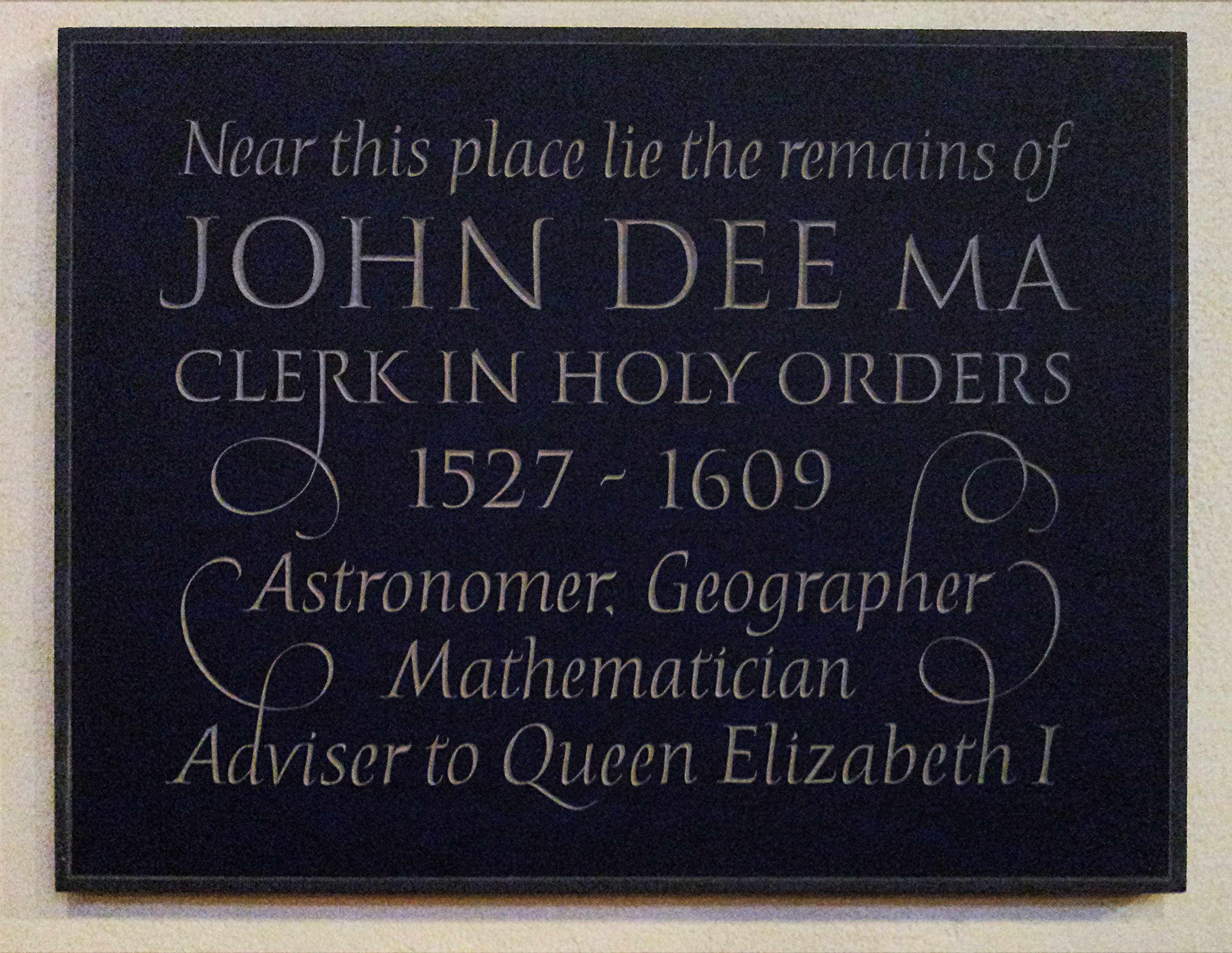
He is believed to have died in March, 1609, at the London home of a friend and was apparently buried in Mortlake (pictured, above, is a memorial plaque at St Mary the Virgin in Mortlake).
It’s believed that William Shakespeare modelled the figure of Prospero in the 1611 play The Tempest on Dee (it’s also claimed that he was the model for Marlowe’s Doctor Faustus).
Scholar, courtier, magician: the lost library of John Dee runs at the Royal College of Physicians at 11 St Andrews Place, Regent’s Park, until 29th July. Entry is free (check website for opening hours). For more, see www.rcplondon.ac.uk.
PICTURE: Robert Smith/CC BY-SA 3.0/Wikipedia
Lost London – The Nunnery of St Mary, Clerkenwell…
 The Church of St James, which stands just to the north of Clerkenwell Green, is all that remains today of the medieval nunnery which once occupied a large swathe of land in the area.
The Augustinian Nunnery of St Mary was founded in about 114o by Jorden de Briset, the lord of Clerkenwell Manor (he also founded the Hospitaller Priory of St John of Jerusalem which lay to the south – more on this here) on 14 acres of land to the east of the famous “Clerk’s Well” (more on the well, which was located close to, but within, the western border of the nunnery, in our earlier post here).
By 1160 a wall had been built around the precinct said to have been roughly bounded by Farringdon Lane, Clerkenwell Green (an open space between the two religious houses), St James’s Walk and a boundary to the south of, and parallel with, Bowling Green Lane to the north.
The church – where Briset and his wife were later buried and which doubled as a parish church – was built about the same time, along with an adjoining chapter-house – both of which were made of stone in contrast to the timber buildings which initially made up the rest of the complex.
A cloister and other stone buildings were erected to the north of the church later in the 12th and 13th centuries including a lodging for the prioress, a dormitory, refectory and kitchen for the nuns. Other buildings on the site included a gatehouse, what was known as the “Nun’s Hall” – possibly a hall for guests – and an infirmary with its own chapel, the location of which is apparently something of a mystery.
Substantial renovation works were carried out in the late 15th and early 16th centuries and by the time of King Henry VIII’s dissolution, it had become one of the wealthiest monasteries in England (although it only ever housed about 20 canonesses).
One of the last nunneries to be suppressed, it was dissolved in 1539 with the nuns being pensioned off.
The site was initially granted to Thomas Howard, 3rd Duke of Norfolk, who held it only briefly being returning it to the king in a deal for another property and subsequently purchased by a succession of different owners.
Many of the buildings were converted for use as private mansions and outbuildings, among them Newcastle House and Challoner (later Cromwell due to the legend that Oliver Cromwell resided there) House which faced them across what had been the cloister courtyard.
The mansions were gradually redeveloped into smaller properties – it remained a popular residential area despite the building of a House of Detention to the immediate north – and in 1788-92, the parish church of St James was rebuilt to the designs of local architect James Carr, with the spire apparently modelled on St Martin-in-the-Fields (Carr also bought Newcastle House and pulled most of it down before redeveloping the area).
Church gardens, which are open to the public, now occupy some of the site of the former nunnery – in 1987, part of the medieval cloisters were excavated here.
For some insightful walks delving into the history of London, see Stephen Millar’s three books, London’s Hidden Walks: Volumes 1-3
This Week in London – Commemorating the Battle of Jutland; ‘lost’ Egyptian cities; and, new Blue Plaques…
• The largest naval conflict of World War I – the Battle of Jutland – is the subject of a new exhibition opening at the National Maritime Museum in Greenwich tomorrow. 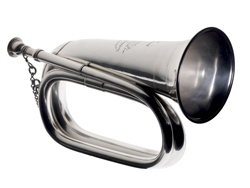 Marking the centenary of the battle, Jutland 1916: WWI’s Greatest Sea Battle explores the battle itself (which claimed the lives of more than 8,500 as the British Grand Fleet met the German High Seas Fleet in what neither side could claim as a decisive victory) as well as its lead-up, aftermath and the experience of those serving on British and German warships through paintings and newspaper clippings, photographs, ship models and plans, sailor-made craft work and medals. Among the objects on display is a 14 foot long shipbuilder’s model of the HMS Queen Mary, which, one of the largest battle cruisers involved,was destroyed with only 18 survivors of the 1,266 crew. Among the personal stories told in the exhibition, meanwhile, is that of boy bugler William Robert Walker, of Kennington, who served on the HMS Calliope and, severely wounded during the battle, was later visited by King George V
and presented with a silver bugle by Admiral Sir John Jellicoe (the bugle, pictured, is on display). A series of events will accompany the exhibition which runs until November. Admission is free. For more, see www.rmg.co.uk/national-maritime-museum. PICTURE: © National Maritime Museum, London
• Two ‘lost’ Egyptian cities and their watery fate are the subject of a new exhibition which opens at the British Museum today. Sunken cities: Egypt’s lost worlds is the museum’s first exhibition of underwater discoveries and focuses on the recent discoveries of Thonis-Heracleion and Canopus – submerged at the mouth of the Nile for more than 1,000 years. Among the 300 objects on display are more than than 200 artefacts excavated between 1996 and 2012. Highlights include a 5.4 metre statue of Hapy, a sculpture excavated from Canopus representing Arsine II (the eldest daughter of the Ptolemaic dynasty founder Ptolemy I) who became a goddess after her death, and a stela from Thonis-Heracleion which advertises a royal decree of Pharaoh Nectanebo I concerning taxes. The exhibition runs until 27th November. Admission charge applies. For more, see www.britishmuseum.org.
• New English Heritage Blue Plaques marking the homes of comedian Tommy Cooper and food writer Elizabeth David have been unveiled this month as part of the 150th anniversary of the scheme. Tommy Cooper lived at his former home at 51 Barrowgate Road in Chiswick between 1955 to 1984 and while there entertained fellow comedians such as Roy Hudd, Eric Sykes and Jimmy Tarbuck. Elizabeth David, meanwhile, is the first food writer to ever be commemorated with a Blue Plaque. She lived at the property at 24 Halsey Street in Chelsea for some 45 years until her death in 1992. For more, see www.english-heritage.org.uk/visit/blue-plaques/.
Send all items for inclusion to exploringlondon@gmail.com.
LondonLife – New Elizabeth line stations on show…
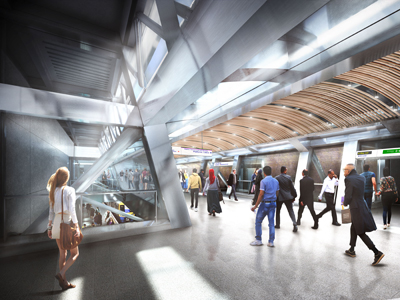
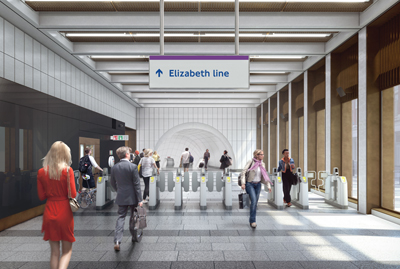
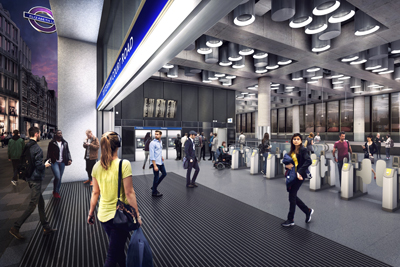
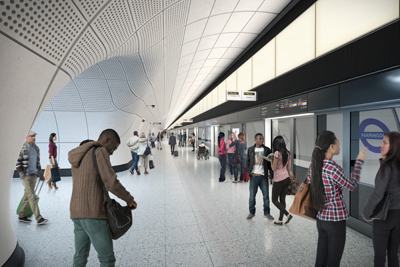
A new exhibition featuring designs for the 10 new Elizabeth line Underground stations has opened at the Royal Institute of British Architects (RIBA). Platform for Design: Stations, Art and Public Space provides insights into the design of the new railway – part of the massive Crossrail project, its stations and public spaces which are slated to open in 2018. Each of the new stations will have their own distinct character designed to reflect the environment and heritage of the area in which they are located. The new Elizabeth line station at Paddington, for example, is said to “echo the design legacy of Brunel’s existing terminal building” while the design of the new Farringdon station is inspired by the historic local blacksmith and goldsmith trades and the distinctive architecture of the Barbican. Many of the new stations will also featured permanent, integrated works of art design to create a “line-wide exhibition”. The Elizabeth line runs from Heathrow and Reading in the west across London to Abbey Wood and Shenfield. The exhibition at RIBA at 66 Portland Place in Marylebone runs until 14th June. Admission is free. For more on the exhibition, including the accompanying programme of events, see www.crossrail.co.uk/news/news-and-information-about-crossrail-events.
What’s in a name?…Fitzrovia…
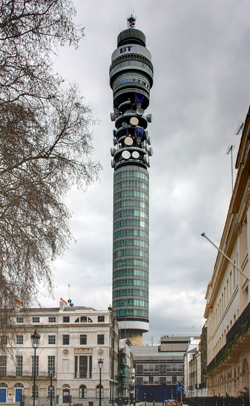 This West End district, located between Bloomsbury, Marylebone and Soho, probably owes its name to the Fitzroy Tavern, a public house which in turn is believed to owe its name to the Dukes of Grafton, whose family name was Fitzroy.
The Fitzroys (the name derives from a Norman-French phrase and was typically associated with base-born royal sons), owned land in the area until the end of the 1800s.
The family first become associated with the area after the Manor of Tottenham (more on that name in an upcoming post) came into the possession of Henry Fitzroy, an illegitimate son of King Charles II who became the Earl of Euston and later Duke of Grafton.
Incidentally, the grand Fitzroy Square, developed by the duke’s great-grandson, and Fitzroy Street are both also named after the family as are numerous other locations in the area including Grafton Street.
Fashionable as a residential area in the 1700s, the houses were gradually transformed into workshops – the area was noted for furniture-makers in particular – or cheap tenements and it’s during this period in the early 1800s that artists like John Constable were living in the area.
The name Fitzrovia apparently became popularised for the district which in the inter-war years, due to the community of artists and writers that met at the pub; it is said to have first appeared in print in the 1940s. Among those who were associated with the area during this period were the likes of writers Dylan Thomas and George Orwell and artists like Roger Fry and Augustus John.
More recently the area has become home to numerous media companies, particularly TV-related companies, and still hosts ample pubs, restaurants and cafes.
Notable buildings in the area include the BT Tower, a communications tower completed in 1964 which was until 1980, the tallest building not only in London but in the UK (and from where panoramic views could once be had – sadly it’s been long closed to the public).
Fitzrovia is also home to the quirky Pollock’s Toy Museum.
PICTURE: David Castor (caster)/Wikipedia
Correction: Fitzroy Square was developed by the great grandson of the 1st Duke of Grafton, not grandson as was originally stated.
Treasures of London – The Golden Hinde II…
Launched in 1973, this full-sized, working replica of the galleon sailed by Elizabethan seafarer and courtier Sir Francis Drake on his circumnavigation of the globe between 1577 and 1580 is moored at St Mary Overie Dock in Bankside.
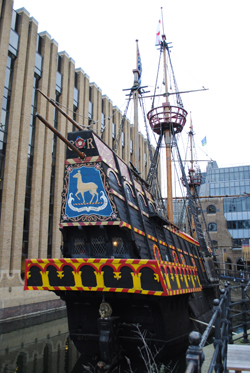 The ship was made at the behest of two American businessmen, Albert Elledge and Art Blum, who wished to commemorate the 400th anniversary of Sir Francis Drake’s landing on the west coast of North America in 1579.
The ship was designed by Loring Christian Norgaard, a Californian naval architect, who spent three years researching it, drawing on original journals of the crew members and other manuscripts.
The two year job of building the vessel was given to J Hinks & Son who did so in Appledore, North Devon, using traditional methods and tools (with a few modern concessions).
The ship was officially launched from the Hinks shipyard by the Countess of Devon on 5th April, 1973. She sailed out of Plymouth on her maiden voyage in late 1974 and arrived in San Francisco the following May to commemorate Sir Francis’ proclamation of New Albion at a site believed to have been in northern California in 1579.
Since then, the ship has sailed more than 140,000 miles around the world – like its forebear, it has circumnavigated the world – and been feared in various films including Shogun (1979), Drake’s Venture (1980) and St Trinian’s 2: The Legend of Fritton’s Gold (2009).
It has been moored in Southwark since 1996 – it did leave briefly for a visit to Southampton in 2003 – and as well as hosting school visits, is also open for tours and can be booked for private functions.
WHERE: Golden Hinde II, Bankside (nearest Tube station is London Bridge); WHEN: Self-guided tours 10am to 5.30pm daily (check website for other tour times and dates); COST: Various (depending on tour); WEBSITE: www.goldenhinde.com.
This Week in London – Photography and art at the Tate; punk’s 40th birthday; and, Sunday dome openings at St Paul’s…
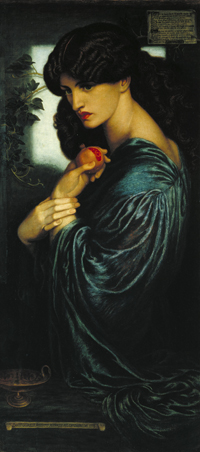 • The “dynamic dialogue” between British painters and photographers is the subject of a new exhibition which opened at Tate Britain in Millbank this week. Painting with Light: Art and Photography from the Pre-Raphaelites to the Modern Age features almost 200 works, revealing their common influences and showing how photography adapted many of the “Old Master traditions” to create new works. Among those whose works are featured in the exhibition are everyone from David Octavius Hill and Robert Adamson to JMW Turner, John Everett Millais, Dante Gabriel Rosetti and photographer Julia Margaret Cameron. Highlights include examples of three-dimensional photography which used models and props to recreate popular works of the time, including a previously unseen private album in which the Royal Family re-enact famous paintings. Runs until 25th September in the Linbury Galleries. For more, see www.tate.org.uk. PICTURE: Dante Gabriel Rossetti (1828-1882), Proserpine 1874. Tate.
• The 40th anniversary of punk is being commemorated in a new exhibition which opens at the British Library tomorrow. Punk 1976-78 traces the impact of punk from its roots in the French Situationist movement and New York City art-rock scene through to the rise and fall of the Sex Pistols and looks at the impact punk had on music, fashion and design in the mid-Seventies. Located in the library’s Entrance Hall Gallery, the free display – which includes materials from the UK’s biggest punk-related archive held at Liverpool John Moores University – features a rare copy of the Sex Pistol’s God Save the Queen single, fanzines such as the first punk fanzine Sniffin’ Glue, flyers, posters and gig tickets from venues including the Roxy Club, Covent Garden and Eric’s Club, audio recordings, and original record sleeves such as John Peel’s personal copy of the Undertones’ single Teenage Kicks. There’s a full calendar of events to accompany the exhibition including John Lydon’s only live interview of the year. Runs until 2nd October. For more, see www.bl.uk/events/punk-1976-78.
• Climb St Paul Cathedral’s dome on special Sunday openings during May. And in order not to disturb Sunday services, visitors who wish to climb to the dome’s Stone Gallery and Golden Gallery will see parts of the cathedral not normally open to the public as they enter through a not-normally used side door and climb 22 extra steps. Admission charge applies. For more, see www.stpauls.co.uk.
Send all items for inclusion exploringlondon@gmail.com.
10 notable blue plaques of London – 1. The oldest surviving blue plaque…
English Heritage are celebrating 150 years of the blue plaque scheme this year – the oldest of its kind in the world – and so to celebrate we’re looking at 10 of the most notable among them.
 First up, it’s the oldest surviving blue plaque. Located in King Street in Mayfair, just off St James’s Square, it commemorates the last French Emperor, Napoleon III, who lived at the property while a prince in 1848.
It was only a brief stay for the then soon-to-be emperor. The nephew and heir of Emperor Napoleon I, he , like other members of his family was exiled from France after the Battle of Waterloo in 1815 and spent the following years in various other countries in Europe as well as, finally, London where he lived firstly at Carlton Gardens and then at the King Street property.
He took the lease on this newly built house in February, 1847, and created what English Heritage has called a “shrine to the Bonapartes” inside, displaying such relics as Napoleon I’s uniforms and a portrait of his famous uncle by the celebrated French artist Paul Delaroche.
The prince was something of a society favourite during his time in London and was invited to join various of St James’s clubs and apparently even enrolled as a special constable during the Chartist riots of 1848.
When the Bourbon monarchy – in the person of King Louis Philippe – was overthrown in France in September that year, the prince abandoned the house to rush back to France (apparently in such a hurry that the story goes that he left his bed unmade and his bath still full of water).
The prince was elected first President of the Second Republic on his return to Paris and in 1852 took his place as Emperor Napoleon III on the restoration of the empire (incidentally, he ended up returning to England in exile following his defeat in the Franco-Prussian War and died in Kent in 1873).
The plaque, installed in 1867, also has the distinction of being the only one installed while the person it commemorates was still alive. The rule now is that those commemorated by a blue plaque need to have been dead for at least 20 years before the honour can be bestowed.
The plaque, which is rather more elaborate than modern versions, was put up by the Society of Arts (they’re mentioned on it) and the design features a French imperial eagle. It was manufactured by Minton Hollins & Co.
For more on Blue Plaques, see www.english-heritage.org.uk/visit/blue-plaques/.
LondonLife – Terraced living…

Old Palace Lane, Richmond, in London’s south-west.
A Moment in London’s history…The ‘longest night’…
 It was 75 years ago this year – on the night of 10th/11th May, 1941 – that the German Luftwaffe launched an unprecedented attacked on London, an event that has since become known as the ‘Longest Night’ (it’s also been referred to as ‘The Hardest Night’).
Air raid sirens echoed across the city as the first bombs fells at about 11pm and by the following morning, some 1,436 Londoners had been killed and more than that number injured while more than 11,000 houses had been destroyed along and landmark buildings including the Palace of Westminster (the Commons Chamber was entirely destroyed and the roof of Westminster Hall was set alight), Waterloo Station, the British Museum and the Old Bailey were, in some cases substantially, damaged.
The Royal Air Force Museum records that some 571 sorties were flown by German air crews over the course of the night and morning, dropping 711 tons of high explosive bombs and more than 86,000 incendiaries. The planes were helped in their mission – ordered in retaliation for RAF bombings of German cities – by the full moon reflecting off the river below.
The London Fire Brigade recorded more than 2,100 fires in the city and together these caused more than 700 acres of the urban environment, more than double that of the Great Fire of London in 1666 (the costs of the destruction were also estimated at more than double that of the Great Fire – some £20 million).
Fighter Command sent some 326 aircraft into the fight that night, not all of them over London, and, according to the RAF Museum, the Luftwaffe officially lost 12 aircraft (although others put the figure at more than 30).
By the time the all-clear siren sounded just before 6am on 11th May, it was clear the raid – which turned out to be the last major raid of The Blitz – had been the most damaging ever undertaken upon the city.
Along with the landmarks mentioned above, other prominent buildings which suffered in the attack include Westminster Abbey, St Clement Danes (the official chapel of the Royal Air Force, it was rebuilt but still bears the scars of the attack), and the Queen’s Hall.
Pictured above is a statue of firefighters in action in London during the Blitz, taken from the National Firefighters Memorial near St Paul’s Cathedral – for more on that, see our earlier post here.
For more on The Longest Night, see Gavin Mortimer’s The Longest Night: Voices from the London Blitz: The Worst Night of the London Blitz
 Exploring London