A Moment in London’s History – ‘The London Gazette’ first published 350 years ago…

The-London-Gazette

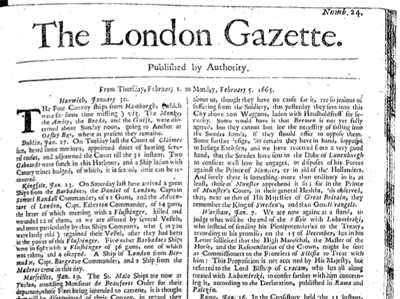
An official public record of the British Government, The London Gazette, initially known as The Oxford Gazette, was first published on 7th November, 1665. 

But its publication didn’t take place in London – rather it was in Oxford (hence its being initially named – The Oxford Gazette) where King Charles II, having fled London due to the plague, ordered the publication to be printed at the University Press.

There’s several reasons behind its publication – one is that courtiers were apparently so worried about the plaque they didn’t even want to touch newspapers from London for fears of contagion of the plaque. But there was also a need, amid the swirl of rumours, gossip and sensationalism found in other publications, for a reputable publication of record (not the least because the introduction of censorship a few years before had suppressed other publications).

Published for the first couple of months under its Oxford masthead, it wasn’t until the following year – on 5th February, 1666 – that the gazette was first published in London (issue 24) after the royal court’s return.

The gazette had unparalleled access to government information – including reports from foreign embassies about what was happening abroad (important when news from overseas was limited), and official reports, including those ‘Mentioned in despatches’ from the War Office and Ministry of Defence.

Adopting the same model, official government gazettes followed in the coming years in Edinburgh (1699) and Dublin (1706 – later The Belfast Gazette). All three, from 1889, were published by Her Majesty’s Stationery Office. Today, The Gazette is published by The Stationary Office (TSO), on behalf of The National Archives (and is now online as well as in print).

Initially published only a couple of days a week, it is now published every weekday except on Bank Holidays.

Notable events published in The London Gazette include the Great Fire of London in 1665 (issue 85), the founding of the Bank of England in 1694 (issue 2982), the burial of Sir Isaac Newton in 1727 (issue 6569), the announcement of the American Declaration of Independence in 1776 (issue 11690), the outcome of the Battle of Waterloo in a “Gazette Extraordinary” in 1815 (issue 17028), and the Coronation of Queen Elizabeth II in 1953 (Supplement 40020).

You can see The London Gazette today and back issues as well as to order commemorative editions, head to www.thegazette.co.uk.

A Moment in London’s History – Publication of Charles Dickens’ ‘A Christmas Carol’…

St-Michael's-CornhillCredited as “the man who invented Christmas”, Victorian author Charles Dickens’ featured Christmas celebrations in many of his works – but none more so than in his famous story, A Christmas Carol.

Published 172 years ago this December, the five part morality tale centres on the miserly Londoner Ebenezer Scrooge who, following several ghostly visitations by the likes of the Ghosts of Christmas Past, Present and Yet to Come, becomes a changed man and recaptures the essence of what Christmas is all about.

The book – whose characters (said to have been partly based on people he knew in real life) also include the abused clerk Bob Cratchit and his ever positive youngest son, Tiny Tim – is based in London.

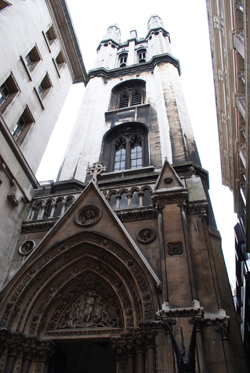
Among key locations mentioned in the book is Scrooge’s counting house, said to have been located in a courtyard off Cornhill (it’s been suggested this is Newman’s Court, thanks to a reference to a church tower, believed to be St Michael’s Cornhill – pictured), the home of Scrooge (it has been speculated this was located in Lime Street), and the home in Camden Town where the Cratchits celebrate their Christmas (perhaps based on one of Dickens’ childhood homes in Bayham Street). City of London institutions like the home of the Lord Mayor, Mansion House, and the Royal Exchange are also mentioned.

The book, which apparently only took Dickens six weeks to write while he was living at 1 Devonshire Terrace in Marylebone, was first published on 19th December, 1843, by London-based firm Chapman & Hall. Based at 186 Strand, they published many of Dickens’ works – everything from The Old Curiosity Shop to Martin Chuzzlewit – along with those of authors such as William Makepeace Thackeray and Elizabeth Barrett Browning.

A Christmas Carol‘s first print run of 6,000 sold out any Christmas Eve that same year and sales continued to be strong into the following year. Despite its warm reception by critics and popularity among the public, the book’s profits were somewhat disappointing for Dickens who had hoped to pay off his debts (he also lost out when he took on some pirates who printed their own version two months after its publication; having hauled them to court Dickens was apparently left to pay costs when they declared bankruptcy).

Dickens would later give some public readings of the book, most notably as a benefit for the Great Ormond Street Hospital for Sick Children (his last public reading of the book took place at St James’s Hall in London on 15th March, 1870, just three months before his death).

The book, which has apparently never been out of print, went on to become something of a Christmas classic and has been adapted into various films, theatre productions, radio plays and TV shows (one of our favourites is The Muppet Christmas Carol, dating from 1992).

A Moment in London’s History – News of the victory at Agincourt reaches the city…

It wasn’t until four days after the battle which had taken place on 25th October, 1415, that news of King Henry V’s stunning victory over the French reached the English capital.

Westminster-Abbey-frontThe news apparently reached London very early in the morning and church bells were rung in celebration and a Te Deum sang in thanksgiving in many.

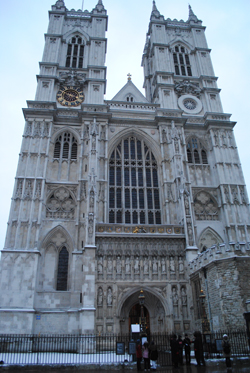
At 9am, a solemn procession of clergy made their way from St Paul’s Cathedral in the City to the shrine of St Edward the Confessor in Westminster Abbey (pictured) to give thanks.

Other attendees at the abbey included the Mayor-elect, Nicholas Wotton (this was the first of two occasions on which he was elected Lord Mayor), and the alderman of London, as well as the Queen Dowager, Joan of Navarre.

A few days later, on the 4th November, King Henry V’s brother – John of Lancaster, the Duke of Bedford, announced the news to Parliament.

King Henry V, meanwhile, arrived back in Dover on 16th November (apparently as a great snowstorm was making its presence felt) and headed for London. After pausing in Canterbury to give thanks in the cathedral and St Augustine’s Abbey, he reached the manor of Eltham (now in south-east London) on 22nd November.

He was met the next day on Blackheath by Wotton and City dignitaries who then, along with what were recorded as a crowd of 20,000 citizens, accompanied him and his small retinue, which included some of his most high profile prisoners such as Charles d’Orléans, Duke of Orléans (who spent 25 years as a prisoner in England), and Marshal Boucicaut (he would die six years later in Yorkshire), towards London.

There, welcomed as Henry V, “King of England and France”, he processed through the City which had been elaborately decorated – the decorations included the hanging of various coats of arms from various prominent sites as well as the positioning of statues of the likes of St George – ahead of his arrival.

Travelling down Cheapside, the king – who was modestly dressed in a purple gown and had eschewed wearing a crown for the event – stopped at St Paul’s where he performed his devotions, before proceeding to Westminster where he did the same before taking up residence for the night in the nearby Palace of Westminster.

On the king’s orders, a solemn mass was held in St Paul’s the next day for the fallen of both sides. The victorious king had returned!

A Moment in London’s History – The execution of William Wallace…

William-Wallace-big

This year marks the 710th anniversary of the execution of Scottish rebel William Wallace in Smithfield so we thought we’d take a quick look at the circumstances of that event – made famous in recent times through the movie Braveheart.

William-WallaceFor some eight years, Wallace had been a thorn in the side of the King Edward I, promoting active resistance to his rule in Scotland after Edward forced the abdication and usurption of the crown of John Balliol.

Following a crushing defeat at the Battle of Falkirk on 22nd July, 1298, however, Wallace went to France where he attempted to gain French support for rebellion in Scotland but the effort proved ultimately futile and Wallace, back in Britain but refusing to submit to English rule, remained on the run.

At least until he was captured on 5th August, 1305, by Sir John Monteith, who had been made Sheriff of Dumbarton by King Edward I, at Robroyston near Glasgow.

Taken to Carlisle, he was bound hand and foot before being taken south to London in chains.

Wallace’s trial took place on 23rd August that year at Westminster Hall and, despite his protestations that he couldn’t be guilty of treason having never sworn loyalty to the English Crown, a guilty verdict was handed down along with the sentence of a traitor’s death – being hung, drawn and quartered.

Taken to the Tower of London, Wallace was stripped naked and then strapped to a wooden hurdle which was dragged by two horses through the streets via Aldgate to The Elms at Smithfield where he was hanged on a gallows.

Cut down while yet living, he was disembowelled and castrated and his entrails burnt. Wallace was then decapitated and his body cut into quarters which were sent to Berwick, Newcastle, Stirling and Perth as a warning against treason. His tarred head, meanwhile, was put on a pike and set above London Bridge.

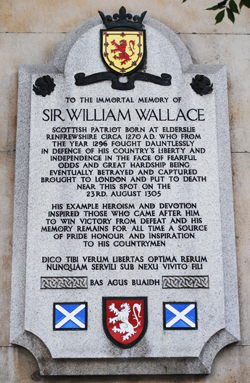
A memorial to Wallace can now be found on the wall of St Bartholomew’s Hospital at West Smithfield (pictured – for more on that, see our earlier post here).

A Moment in London’s History – Outbreak of the Great Plague…

St-Olave-Hart-StreetIt’s 350 years ago this year that the Great Plague broke out in London in 1665, bringing death on an unprecedented scale to the city.

The plague, which was apparently also known as the Poor’s Plague, is said to have broken out in early 1665 – perhaps February – with the first areas to be affected dockside districts and the crowded slum of St Giles in the Fields before it moved into the City proper. There are claims that the outbreak’s origins occurred a couple of months earlier at a property in Drury Lane where contaminated bales of goods imported from Holland were opened by Flemish weavers.

However it came to be in London, it soon spread and by July was running rampant with many of the nobility, merchants, and tradesmen choosing to flee the city in the hope of escaping its reach. They included King Charles II and his family and court who moved to Hampton Court in early July and then to Salisbury at the start of August before, following some cases there, to Oxford in September.

Those who did come down with the disease – generally thought to have been bubonic plague, a disease of rats which is transmitted to humans via fleas – were confined to their homes with red crosses and the words ‘Lord, have mercy on us’ painted on the door while gatherings in public – such as for the theatre – were banned to prevent the disease’s spread.

Other measures to contain the disease included the imposition of a curfew and the killing of an estimated 40,000 dogs and 200,000 cats, thought to be spreaders of the disease, on the orders of the mayor, Sir John Lawrence.

Bills of mortality recorded the number of deaths weekly – in the week of 19th to 26th September, the number peaked at 7,165 people before declining. By late in the year life in the capital had started returning to normal.

While the bodies were buried in mass graves, by September the growing numbers of dead meant many were simply left to rot where they fell.

The estimated numbers of those who died varies somewhat depending on the source but according to the Museum of London’s website, the Great Plague of 1665 is estimated to have killed 100,000 people – about a fifth of the population – within just seven months of its outbreak.

While the sheer number of dead is unprecedented, other plagues were proportionally deadlier, in particular the coming of the Black Death in 1348 which killed about half of all Londoners over an 18 month period (equating to an estimated 40,000 people).

The Great Plague was, thankfully, the last major plague to affect London. Among those who had survived was the diarist Samuel Pepys whose entries provide a valuable source of information on how the plague affected Londoners (pictured above is detail from the gateway into the church of St Olave Hart Street – Pepys’ parish church at the time of the plague – where a number of victims of the Great Plague were buried).

A Moment in London’s History – Princess Victoria’s christening…

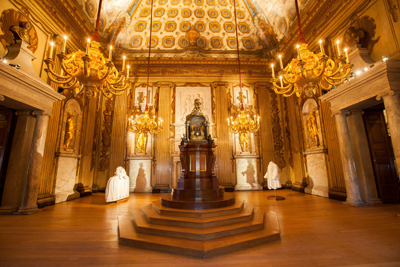
Cupola-Room

On Sunday, Princess Charlotte, daughter of Prince William and Princess Kate, was christened at Sandringham. So we thought we’d take a quick look at another christening that took place in London almost 200 years ago, that of Princess Victoria.

The future Queen Victoria was born on 24th May, 1819 – the daughter of Edward, Duke of Kent (fourth son of King George III), and his wife, Princess Victoria Mary Louisa of Saxe-Coburg-Saalfeld.

At the insistence of the Prince Regent (later King George IV), the christening was a small affair and was held a month after the birth on the afternoon of 24th June in the magnificent Cupola or Cube Room of Kensington Palace (pictured as it is now, above).

The guest list was small and included the Prince Regent, Prince Frederick, the Duke of York, and his wife Princess Frederica, Princess Augusta Sophia, Princess Mary, the Duchess of Gloucester, and her husband, Prince William, and Prince Leopold, who had recently become a widower after the death of Princess Charlotte.

The ceremony was conducted by Charles Manners-Sutton, the archbishop of Canterbury, and, thanks to the intransigence of the Prince Regent, her name was apparently only decided at the last minute.

The Prince Regent has earlier forbidden the use of such ‘royal’ names including Charlotte, Elizabeth, Georgina or Augusta and when asked by the archbishop what she would be named, he replied brusquely that she would be named Alexandrina in honour of the Russian Tsar Alexander, one of the new princess’s godparents.

Her second name was Victoria in honour of her mother, and while Victoria was often called “Drina” while a girl, she herself apparently preferred her second name to her first.

The gold font used in the ceremony formed part of the Crown Jewels and its origins go back to the time of King Charles II.

Interestingly, there were a couple of significant Victorian connections during Princess Charlotte’s christening – the font used at this christening was known as the Lily Font (like its predecessor, it is usually found with the Crown Jewels in the Tower of London).

It was commissioned by Queen Victoria and Prince Albert for the christening of their first daughter, Princess Victoria, in 1841, apparently due to Queen Victoria’s dislike for the gold font used at her own christening – it had been used by King Charles II to christen his illegitimate children.

The Lily Font has apparently been used at every royal christening since except that of Princess Eugenie who had a public baptism in Sandringham in 1990.

Princess Charlotte also wore a replica of the christening gown worn by Princess Victoria.

WHERE: The Broad Walk, Kensington Gardens, Kensington (nearest Tube stations are High Street Kensington or Queensway); WHEN: Daily 10am to 6pm (until 31st October); COST: £17.50 adult/£14.10 concession/children under 16 free (online booking discounts available, Historic Royal Palaces members free); WEBSITE: www.hrp.org.uk/KensingtonPalace.

PICTURE: HRP/newsteam

A Moment in London’s History – Londoners granted the right to elect their mayor…

It was on 9th May, 2015, 800 years ago this year that, in the lead-up to the creation of the Magna Carta in June, King John issued a charter granting the City of London the right to freely elect its own mayor.

The charter, which was issued at the Temple – King John’s power base to the west of the City (for more on it, see our earlier post here), was a fairly blatant bid to keep the support of the city.

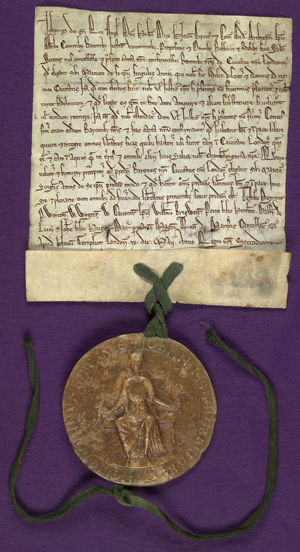
King-John-CharterKnown simply as the King John Charter, it stated that the barons of the city, “may choose to themselves every year a mayor, who to us may be faithful, discreet, and fit for government of the city, so as, when he shall be chosen, to be presented unto us, or our justice if we shall not be present”.

In return, the mayor was required to be presented to the monarch to take an oath of loyalty each year – a practice commemorated in the Lord Mayor’s Show each November.

The charter, which has a particularly good impression of the king’s seal, is currently on display in the City of London’s newly opened Heritage Gallery, located at the Guildhall Art Gallery.

The event was one of a series leading up to the signing of the Magna Carta in June. Only 10 days after King John issued the charter to the City of London, rebel barons, who have previously taken Bedford, marched on the city to demand their rights and arrived their before the Earl of Salisbury (whom John had ordered to occupy the city).

Aldgate was apparently opened to them by some supporters within the city and the forces of the rebel barons went on to attack the home of royalists as well as those of Jews along with a Jewish burial ground in Barbican – the latter because Jewish moneylenders had lent money to the king.

They later besieged the Tower of London and while they couldn’t take the fortress, their seizure of the city was enough to help force the king to open negotiations late in the month, asking the Archbishop of Canterbury, Stephen Langdon, on 27th May  to arrange truce (which, while it was apparently not observed terribly well, did help pave the path to the Magna Carta).

The exhibition at the Heritage Gallery runs until 4th June. For more information, see www.cityoflondon.gov.uk/things-to-do/visiting-the-city/attractions-museums-and-galleries/guildhall-art-gallery-and-roman-amphitheatre/Pages/Heritage-Gallery.aspx.

PICTURE: City of London: London Metropolitan Archives

A Moment in London’s History – Colonel Blood’s attempt to steal the Crown Jewels…

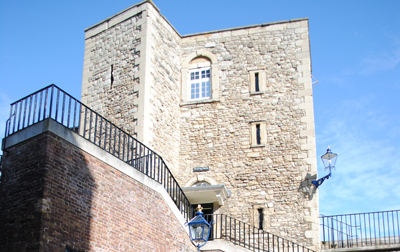
Martin-Tower

London has been making headlines around the world recently thanks, in part, to the estimated £200 million  heist which took place in Hatton Garden last week. So we thought it was a good time to take a look back to one of London’s most famous robberies (or attempts at least)…

The attempt dates back to 1671 when a self-styled colonel, Irish adventurer Thomas Blood, made an attempt to steal the Crown Jewels from the Tower of London.

The Irishman – whose history included fighting on both sides in the English Civil War, first with the Royalists and then with the Parliamentarians when he saw the tide was turning – visited the Tower of London several times in the lead-up to the attempt as he, disguised as a parson, cultivated a relationship with Talbot Edwards, an elderly keeper of the jewels, and his family.

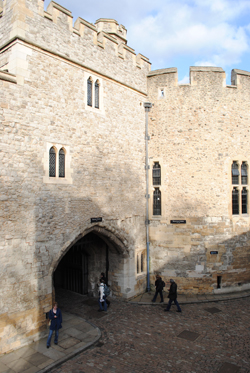
On the night of 9th May, he and a group of accomplices, including his son, attended a dinner put on by the Edwards at the Tower. While waiting for the meal, Blood asked to see the jewels which were housed behind a grille in the basement of the Martin Tower (pictured above) above which the Edwards had an apartment.

Edwards complied and once in the Jewel House, Blood and his accomplices attacked him, knocking him to the floor with a mallet and then stabbing him before binding and gagging him.

They then turned their attention to the jewels – Blood used a mallet to flatten St Edwards Crown so he could hide it beneath his coat while his brother-in-law Hunt filed the Sovereign’s Sceptre with Cross in two to fit it in his bag and a third man, Robert Perot, stuffed the Sovereign’s Orb down his trousers.

Things didn’t go smoothly after that and the alarm was raised before the gang could make their getaway. It has been suggested it was Edwards who raised the alarm – that despite efforts to shut him up he managed to remove his gag and raise the alarm  – but other versions say it was his son, returning from service in Flanders, who raised the alarm on seeing the gang.

In any event, the gang fled, evading efforts of the warders to stop them, before Blood, Hunt and Perot were captured on the Tower of London wharf. The crown, globe and orb were all recovered, albeit damaged.

Blood refused to speak after his capture and was eventually taken before King Charles II for interrogation. But he was evidently so impressed with his captive that he not only pardoned Blood but also rewarded him with land in Ireland.

Blood did later end up briefly in prison after a dispute with the Duke of Buckingham and died soon after his release in August, 1680, but in the intervening years he had become something of a celebrity around London including the Royal Court.

Security around the Crown Jewels, meanwhile, was upgraded somewhat in the wake of the attempt. While others have tried to steal them, none have ever been successful.

WHERE: Tower of London (nearest Tube station is Tower Hill); WHEN: 9am to 5.30pm Tuesday to Saturday, 10am to 5.30pm Saturday and Monday (last admission 5pm); COST: £24.50 an adult/£11 a child (5-15 years)/£18.70 concession/£60.70 a family of four (discount applies to online bookings); WEBSITE: www.hrp.org.uk/TowerOfLondon/.

A Moment in London’s History – The first Crufts show…

The annual Crufts dog show has been making headlines around the world recently (sadly not all for good reasons), so we thought it was a good chance to take a look back at where it all began.

While the event is this year being held in Birmingham, the first Cruft’s Show was actually held in London in the late 1800s.

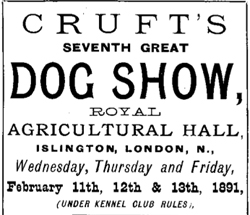
Crufts-catalogueCharles Cruft – the show’s founder – had left college in 1876 and instead of joining the family’s jewellery business, had taken up employment in Holborn with James Spratt’s business selling ‘dog cakes’ (aka dog biscuits).

While he started off as an office boy, he was soon promoted to travelling salesman and he was soon travelling across Europe. So impressed were his customers that in 1878, just two years after leaving school, he was invited to organise the promotion of the canine section of the Paris Exhibition.

Eight years later in 1886, back in England, he took up the role of managing the Allied Terrier Club Show at the Royal Aquarium in Westminster.

The first show bearing the Crufts name – known then as ‘Cruft’s Great Dog Show’ – followed five years later in 1891 (although this was actually called Cruft’s Seventh Great Dog Show thanks to his involvement with the earlier shows).

Held at the Royal Agricultural Hall in Islington (now a Grade II-listed building) on 11th, 12th and 13th February, the show boasted 2,437 entries spanning 36 different dog breeds.

Among the entries in 1891 were six Pomeranians owned by Queen Victoria – one of them, Gena, placed equal first (apparently the judges didn’t want to mark down the monarch’s dogs!)

It’s not the only landmark Crufts event held in London. In 1948, with Charles Cruft having died 10 years earlier his widow Emma handed over control of the show to the Kennel Club. The first show under the club’s auspices was held at Olympia with 84 different breeds entered (there are now around 200 entered annually). In 1979 the show moved to Earl’s Court before eventually, in 1991, moving to Birmingham.

For more on Crufts, see www.crufts.org.uk

A Moment in London’s History – De Montfort’s Parliament is convened in London…

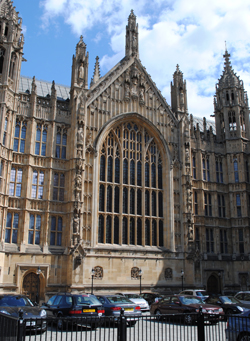
It was in 1265, 750 years ago this month, that a parliament convened by English rebel leader Simon de Montfort, took place in Westminster Hall (exterior pictured below).

The French-born De Montfort, who led a group of rebel barons, was riding high after defeating King Henry III at the Battle of Lewes on 14th May, 1264. While he ruled in the king’s name through a council – having captured both the king and his son Prince Edward, the monarch was no more than a figurehead. De Montfort was effectively the man in charge. Westminster-Hall

In a bid to solidify his hold on the country, he summoned not only the barons and clergy but knights representing counties to a parliament along with – for the first time – representatives from major towns and boroughs like York, Lincoln and the Cinque Ports (the representatives were known as burgesses).

It’s this latter move which led this three month-long parliament to be described as the first English parliament and which has led de Montfort to be described by some as the founder of the House of Commons.

Presided over by King Henry III, the parliament was held in Westminster Hall in London – a city loyal to de Montfort’s cause. It dealt with a range of political matters including the enforcement of a series of government reforms known as the Provisions of Westminster which had been aimed at strengthening baronial rights and the role of courts.

Prince Edward (later King Edward I) managed to escape from de Montfort’s clutches later in 1265 and led forces against de Montfort. The rebel leader was killed at the Battle of Evesham on 4th August, 1265.

The UK Parliament is marking the 750th anniversary of De Montfort’s Parliament with a series of events (along with the 800th anniversary of the sealing of the Magna Carta) – check out www.parliament.uk/2015 for more.

A Moment in London’s History – Peace Day Parade, 1919…

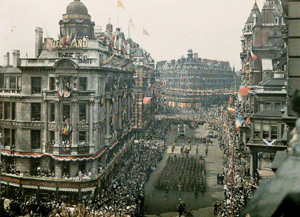
With Remembrance Sunday having been observed earlier this month, we thought it was an appropriate time to take a quick look at the Peace Day Parade of 19th July, 1919, at which the Cenotaph – the National War Memorial – was first unveiled.

London-Victory-ParadeThe parade, organised by a Peace Celebrations Committee appointed by the War Cabinet, was seen as the high point of a series of celebrations to mark the end of the war which had only officially ended on 28th June with the signing of the Treaty of Versailles.

Prime Minister David Lloyd George, on hearing French troops were to salute a ‘great catafalque’ (a raised structure upon which sits a coffin) built beside the Arc de Triomphe in honour of their war dead as part of their victory march, commissioned architect Edwin Lutyens to create a similar monument for the occasion.

Lutyens had apparently already started sketching, having been sounded out earlier about the possibility of such a structure, and eventually opted for a cenotaph, an empty tomb erected in honour of people buried elsewhere, in place of the catafalque.

The Cenotaph, one of a number of temporary structures built for the day, was unveiled in Whitehall early on the morning of Saturday, 19th July. Made of plaster and wood, it had been constructed in just two weeks (and, of course, it was replaced the following year with the stone Cenotaph which now stands there). Wreaths were soon piled high around its base.

As many as five million people reportedly turned out for the parade along a seven mile route from Knightsbridge (depicted above) through to Westminster and onto Buckingham Palace on Saturday – many of them had arrived from other parts of the country the previous night – and, eager not to miss out, had secured their space by sleeping in parks or streets overnight.

Also known as the London Victory Parade, the procession included some 15,000 Allied forces representing 12 victorious nations including, of course, Britain as well as France, the US, various European and Asian nations and small contingents from Australia, New Zealand and South Africa.

Also marching were military commanders such as Field Marshall Sir Douglas Haig – the British Commander-in-Chief, French Marshal Ferdinand Foch – Supreme Allied Commander during the last year of the war, and General John J Pershing, head of the American Expeditionary Force.

Some veterans apparently refused to take part, seeing the parade as “militaristic celebrations”.

After splitting into two columns and filing past the Cenotaph – inscribed with the words ‘The Glorious Dead”, those in the parade then marched down the Mall, which was lined with stands set aside for widows and orphans before King George V took their salute standing beneath a golden cupola erected at the base of the Victoria Memorial outside Buckingham Palace.

A Moment in London’s History – The London Beer Flood of 1814…

For some it sounds like a dream come true but what is known as the London Beer Flood of 17th October, 1814, was a very real tragedy, leaving eight dead in its wake.

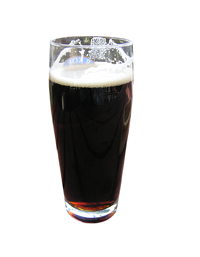
PorterThe flood of more than a million litres of fermenting porter – a dark beer (pictured) – occurred when corrosion caused one of the metal hoops around a three storey high vat to give way inside the Horse Shoe Brewery.

The force of the vat’s collapse – which took place late in the afternoon – caused further vats to rupture and the resulting wave of beer reportedly stood as tall as 15 foot high as it smashed into neighbouring buildings.

Standing at the corner of Tottenham Court Road and Oxford Street in central London, the brewery was located in the midst of the St Giles Rookery – a overcrowded slum filled with flimsy structures. This meant the damage was considerable and while many buildings were at least partially damaged, the worst hit were a pair of homes which were apparently completely destroyed.

Among the dead were four women and a three-year-old boy who were attending a wake for a child in a nearby basement and a four-year-old girl and her mother who were having tea in their house.

While an enterprising watchman apparently charged voyeurs to see the ruins of the vat, it is believed that reports mobs ran amok getting drunk on the spilt beer have no basis in fact.

The brewers, Henry Meux & Co, were subsequently taken to court but, with the incident ruled an “Act of God”, no-one could be held accountable (in fact, the brewers were refunded duties they had paid on the lost beer). The brewery itself was finally demolished in 1922 and the Dominion Theatre now stands on the part of the site.

The nearby Holborn Whippet pub now commemorates the event with a special brew.

PICTURE: Michal Zacharzewski/www.freeimages.com

A Moment in London’s History – The landing of King George I at Greenwich…

GreenwichFollowing on from the last moment in London’s history which looked at the death of Queen Anne, we pause a moment to look at the day 300 years ago – 18th September, 1714 – when her successor, King George I, landed at Greenwich as he arrived to take up his new throne.

There was apparently thick fog when the Elector of Hanover made his way up the Thames accompanied by a flotilla of boats carrying his family and entourage including 18 cooks as well as his mistress, Ehrengard Melusine von der Schulenburg, and his half-sister Sophia Charlotte von Kielmansegg (known rather nastily among English courtiers as the “Maypole” and the “Elephant”).

He landed at the water gates of the Sir Christopher Wren-designed Royal Hospital for Seamen, now known as the Old Royal Naval College, in Greenwich (pictured above) but when the waiting crowds cheered the disembarking king, it was a case of mistaken identity. In fact, they were cheering his son, George Augustus (and future King George II) and by the time the king actually disembarked, much of the crowd had already dissolved, leaving a much smaller – and probably disappointing – gathering to welcome him.

The arrival of the king – a re-enactment of which took place at the ORNC last week – is depicted in a painting in the upper part of the the college’s Painted Hall. The work of artist James Thornhill, it depicts the king wearing Roman costume riding a chariot and appears alongside a figure of St George defeating the dragon (who, of course, stood for the papacy and family of the deposed King James II).

The Painted Hall also features a family portrait of the new Royal Family, excluding George’s wife Sophia Dorothea who was imprisoned in Germany at the time following allegations of infidelity. The future King George II is featured with his back to the king in reference to the hostility between the two of them.

The ORNC is currently looking to raise £5.5 million to conserve Thornhill’s paintings following a restoration of the Painted Hall in 2013. For more details, head to www.ornc.org/support/current/conserve-the-painted-hall.

A Moment in London’s History – The death of Queen Anne…

Queen-Anne

While much attention is being paid this year to the fact it’s the 300th anniversary of the accession of King George I (and the House of Hanover), we thought we’d take a quick look at the event which precipitated that moment – the death of the last Stuart monarch, Queen Anne, on 1st August, 1714.

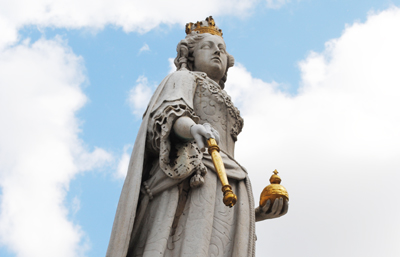
The queen (depicted here in Richard Belt’s copy of a Francis Bird original outside St Paul’s Cathedral), who had ruled since 1702 and was the first monarch of Great Britain thanks to the 1707 Act of Union, died at Kensington Palace at about 7.30am. She had apparently suffered a series of strokes, having experienced declining health for the previous couple of years (this included gout which had severely limited her mobility and saw her carried in a chair even at her coronation). She was 49.

Her body was so swollen at the time of her death that she had to be placed in a large square-shaped coffin which was carried by 14 men.

Following her funeral, on 24th August she was laid to rest next to her husband, George of Denmark (he’d died at Kensington six years before), in the Stuart vault on the south side of King Henry VII’s chapel in Westminster Abbey.

Many of the bones of her infant and stillborn children lie nearby (Anne was pregnant 18 times) and apparently due to a lack of space, only a “small stone” marks her grave site. Anne’s seated wax funeral effigy, modelled from her death mask, can be seen in the abbey’s museum.

The idiom “Queen Anne is dead” – used as a response to someone who brings old news or who states the obvious – is thought to have its origins in the idea that while news of her death was officially kept quiet so the Hanoverian succession could be shored up, news of it nonetheless leaked quite quickly meaning that by the time it was officially announced, it was already well known.

A Moment in London’s History – The execution of John Austin, the last person hanged at Tyburn…

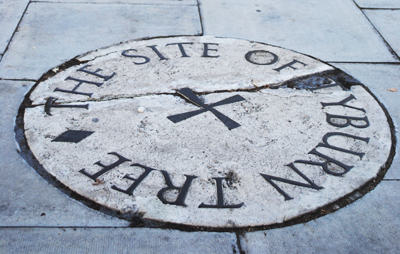
Tyburn-TreeThe site of public executions for hundreds of years, it’s generally accepted that at about 9am on 3rd November, 1783, John Austin became the last person to be hanged there (for more on the history of executions at Tyburn – and in particular the massive gallows known as the Tyburn Tree – see our previous post here).

Austin had been convicted of being a highwayman – specifically for inflicting “robbery with violence” upon labourer John Spicer, two weeks before during which Austin had attacked Spicer, beating and cutting him, “in a cruel manner”.

As he stood on the cart beneath the gallows (a mobile gallows had been in use since 1759 when the Elizabethan-era Tyburn Tree was dismantled), Austin’s last words were somewhat predictable – he requested that the crowd pray for his “departing soul”, that they would heed his example and that Jesus would have “mercy upon my poor soul”.

His death, it is said, was “hard”. As the cart was moved off, the halter around his neck apparently slipped “to the back part of his head” and instead of his neck being broken, Austin slowly choked to death.

The decision to cease executions at Tyburn (near where Marble Arch now stands) and move them to outside Newgate Prison was apparently due to complaints. These came from both City traders who felt the condemned person’s three mile procession from Newgate to Tyburn disrupted making money and the fashionable who sought to live in the city’s outlying western areas like Marylebone and who didn’t want to see the unruly mob that typically accompanied  outside their front doors. Such groups had long been lobbying for the practice to come to an end.

For more on the history of Tyburn see Robert Bard’s Tyburn: The Story of London’s Gallows.

A Moment in London’s History – The day the Globe Theatre burnt down…

FireSince we’re talking about all things Shakespearean at the moment, we though we’d take a look again at the day on which The Globe Theatre burnt down.

The theatre was only about 14-years-old when on  29th June, 1613 – the 400th anniversary of which passed last year – a “special effects” cannon was fired during a performance of King Henry VIII (also known as All is True) – specifically as the king made his entrance on the stage. While cannons had apparently been used for years with no ill effect – that was not to be the case this time.

It is said sparks from the cannon landed on either directly on the theatre’s thatched roofing or a roof beam near the thatch and caught fire – there are also suggestions the fire was in fact caused when one of the stoppers used to block up the cannon came into contact with the thatch.

Theatre patrons apparently initially thought the smoke was simply from the cannon blast but can’t have been confused for long – the fire was said to have moved very quickly; in fact one contemporary letter writer – author, diplomat and politician Sir Henry Wotton – says the entire theatre was burnt to the ground in less than an hour.

The audience – the theatre is thought to have housed some 1,000 people seated and a further 2,000 standing – is thought to have escaped unharmed. There are no reports, at least, of any deaths as a result of the fire.

The theatre was quickly rebuilt – apparently more opulently – and reopened the following year. Traces of the burnt theatre was found during an excavation of the Globe site in 1989.

For more on The Globe, see our earlier post here.

PICTURE: Ashley Nummerdor/www.freeimages.com

A Moment in London’s History – The Battle of Barnet helps to secure the throne for King Edward IV (again)…

It was exactly 543 years ago today that the Battle of Barnet – one of the key battles of the Wars of the Roses – was fought near what was then the small town of Barnet but is now an area on Greater London’s outer northern fringe.

Hadley-HighstoneKing Edward IV, returning from exile in Burgundy after he was ousted by the Lancastrians, led an estimated 10,000 Yorkists in an engagement with some 15,000 Lancastrians (who backed King Henry VI) under the command of Richard Neville, 16th Earl of Warwick and known as the Kingmaker, who had previously supported the Yorkists (and before that the Lancastrians).

The forces met on 14th April, 1471, at around dawn but thick fog sewed confusion in the Lancastrian ranks with allies attacking each other and the army eventually fell apart amid cries of treachery. Warwick was killed in the battle as he attempted to flee.

The exact site of the battle remains something of an unknown although it is thought to span the community of Monken Hadley just to the north of Barnet itself (that is the area marked on the official English Heritage Register of Historic Battlefields).

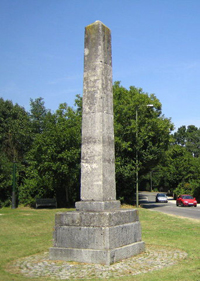
A stone monument to the battle, the Hadley Highstone, was erected in the 18th century and in the 1800s was moved to its current location at the junction of Kitts End Road with the Great North Road in Monken Hadley and was originally thought to have marked the spot on which Warwick died. The Battlefields Trust is currently developing a project to pin down the location further.

The battle was important because, along with the following Battle of Tewkesbury during which the Lancastrian heir Edward was killed (and the murder of King Henry VI shortly after), it secured the throne for King Edward IV for the next 14 years.

PICTURE: Nigel Cox/Wikipedia

A Moment in London’s History – When the last ‘frost fair’ was held on the Thames…

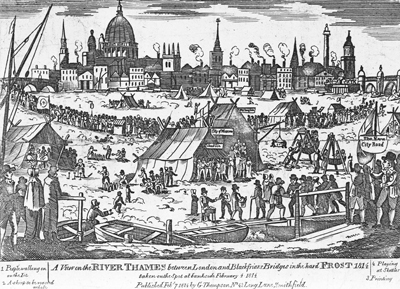
A-view-of-the-River-Thames-1814-by-G-Thompson-©-Museum-of-London

Held during particularly cold winters when the River Thames froze over, ‘frost fairs’ had been part of London’s history, from the Middle Ages up until the last one was held in February 1814, two hundred years ago last month.

The five day revelry started on 1st February and took place on a stretch of the river between Blackfriars and London Bridge (it was the medieval London Bridge in particular – with its 19 arches and wide piers – which helped to slow the river enough to freeze, something unlikely to happen again with the current bridge).

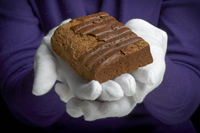
Gingerbread-bought-at-the-last-Frost-Fair-of-1814-©-Museum-of-LondonPeople began to venture out onto the ice and an impromptu fair started taking shape as tents and booths were established selling all manner of food including roast ox, drinks including alcohol like gin as well as hot chocolate, tea and coffee, and souvenirs to take advantage of the passing traffic (a piece of gingerbread from the fair is a star attraction at the Museum of London’s current exhibition on the fair – pictured right). Some of the tents were known by names (similar to a pub sign), such as the Moscow and the Wellington.

Other attractions recorded include children’s play equipment, a gambling den, and printing presses which produced keepsakes to mark the occasion. There were even reports of sightings of an elephant crossing the river.

Several people apparently died at the fair having sunk beneath the ice by the time the snow turned to rain and the ice began to break up. An engraving of the frost fairs by Richard Kindersley can be found on a pedestrian walkway underneath the Southwark end of Southwark Bridge.

The dates for Frozen Thames: Frost Fair 1814 at the Museum of London have been extended until 21st April (there is an accompanying exhibition, Frozen Thames: Frost Fair 1684 running concurrently at the Museum of London Docklands). Admission is free. For more, see www.museumoflondon.org.uk.

MAIN PICTURE: A view of the river Thames, 1814, George Thompson © Museum of London. This print shows the 1814 Frost Fair from the south bank of the Thames, with St Paul’s in the background.

A Moment in London’s History – When London Bridge was pulled down…

This year we’re launching a new regular edition to Exploring London in which we take a brief look at a moment in the city’s long and colourful history.

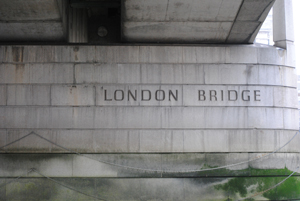
London-BridgeFirst up, we travel back exactly 1,000 years to 1014. The story – recorded in Viking Skaldic poetry but apparently not in Anglo-Saxon sources – goes that during the ongoing conflict between the Danes and Anglo-Saxons, the Danish had taken the city, occupying both the city proper and Southwark. At that stage, there was a timber bridge crossing the Thames.

Desperate to regain the city (the Viking ruler Sweyn died on 3rd February that year – this may have been why the attack was launched), the Anglo-Saxon King Æthelred (known to history as ‘the Unready’) and his Norwegian Viking allies apparently under King Olaf II sailed up the Thames in a large flotilla.

Despite meeting fierce resistance from the Danish occupiers – they lined the bridge and attacked the invasion force with spears – the attackers, apparently using thatching stripped from the rooves of nearby houses to shield themselves, managed to get close enough to attach cables to the bridge’s piers and then pull the bridge down.

There’s much speculation that the song London Bridge is falling down was inspired by the incident but it, like much of this story itself, remains just that – conjecture (but it’s still a nice story!)

The bridge was subsequently rebuilt and King Æthelred died only two years later, on 23rd April, 2016. The crown passed to his son Edmund Ironside but he too died after ruling for less than a year before the Viking Canute was crowned king.

For more on the history of London Bridge, see our earlier posts Lost London – London Bridge and Lost London: Gates Special – The Stone Gate, London Bridge.

PICTURE: Not the original London Bridge