Celebrating the Diamond Jubilee with 10 royal London locations – 7. Silver Jubilee memorials…

For those who may not be aware, the current Diamond Jubilee is, of course, not the first jubilee Queen Elizabeth II has celebrated. In 1977, the Queen and the nation marked her Silver Jubilee, celebrating her 25th year on the throne.

Just as this year is designed as a year of celebration, so too was 1977 with the anniversary of the Queen’s accession culminating in a series events run over a week in early June. They included street parties, the lighting of a chain of beacons across the country (the Queen lit the first fire at Windsor), a national service of thanksgiving at St Paul’s Cathedral (which the Queen went to in the Gold State Coach) and a river progress from Greenwich to Lambeth.

To mark the Jubilee, the Queen and Prince Philip also travelled across the country, visiting as many as 36 counties during a Royal Tour, and went overseas where they visited nine countries as far afield as Australia and New Zealand, the West Indies and Canada.

In London, a number of memorials were installed which can still be visited today. They include:

The Silver Jubilee Walkway. Opened by the Queen on 9th junee 1977, this is made up of five circular sections which are themselves located in a 15 mile (24 kilometre) circle around the city and takes in many of the city’s greatest sites, including St Paul’s Cathedral, Buckingham Palace, Tower Bridge and Shakespeare’s Globe. For more on the walk, see www.walklondon.org.uk/route.asp?R=3

• South Bank Jubilee Gardens. Originally created to celebrate the Silver Jubilee in 1977, these gardens, located between Waterloo and Westminster Bridges, have recently been remade – including planting 70 new trees – for the Queen’s Diamond Jubilee and the Olympic Games.

Memorial Urn in Queen Square, Bloomsbury. This monument has inscriptions by poets Philip Larkin (“In times when nothing stood, But worsened or grew strange, There was one constant good, She did not change”) and Ted Hughes (A nation’s a soul, A soul is a wheel, With a crown for a hub, To keep it whole”) in front of and behind it.

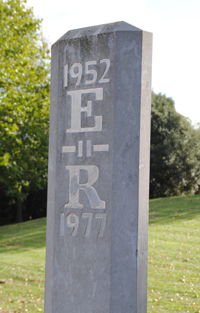
King’s Stairs Memorial Stone. This memorial stone (pictured) located on the edge of King’s Stairs Gardens by the Thames in Bermondsey was first installed to mark the Queen’s Silver Jubilee. The other side of the stone was inscribed during the Golden Jubilee in 2002.

• Plaque on Queen Elizabeth II’s birthplace. We’ve mentioned this plaque at 17 Bruton Street in Mayfair in an earlier entry but it’s interesting to note that it was erected in 1977.

Any others you can think of?

Celebrating Charles Dickens – 6. Dickens the philanthropist

As the fame of author Charles Dickens grew, so too did his philanthropy and today we’re highlighting a couple of the London institutions he was known to support (and yes, we’ve changed the title for this series as most of the entries comprised more than one site!)…

1. Urania Cottage. A home for the redemption of “fallen women” or prostitutes, Urania Cottage was founded by an initially reluctant Dickens in Shepherd’s Bush in the city’s west in the late 1840s following an approach by Angela Burdett Coutts, heiress to the Coutts banking fortune. The home was founded as an alternative to existing institutions for such women – known for their “harsh and punishing” routines – and instead looked to provide an environment where they could learn skills, such as reading and writing, to help them successfully reintegrate into society (this would be overseas as all the women who spent time at the house were apparently required to emigrate following their time there). After founding the home in Lime Grove, Dickens became heavily involved in establishing the day-to-day running of the home – including interviewing prospective residents and personally searching prisons and workhouses for suitable candidates. It’s estimated that 100 women graduated from the home between 1847 and 1859. (For more, see Jenny Hartley’s Charles Dickens and the House of Fallen Women).

2. Great Ormond Street Hospital. Dickens played an important role in helping to publicise the work of this hospital – then known as the Hospital for Sick Children in Great Ormond Street, it opened in a converted 17th century townhouse in Great Ormond Street in 1852 and, initially with just 10 beds, was the first hospital in Britain to offer inpatient care only to children. The hospital was apparently initially regarded with suspicion by many and had few patients but Dickens, a close friend of Dr Charles West, the principal founder of the hospital, was able to write a powerful article about the hospital in his publication Household Words and so help to popularise its ground-breaking work. Dickens was a regular at the hospital’s annual fundraising dinner, was appointed an honorary governor and helped save the church from financial collapse in 1858 when he gave a public reading at St Martin-in-the-Fields’ church hall to raise funds. For more on the history of Great Ormond Street, see www.gosh.nhs.uk/about-us/our-history/.

3. Battersea Dogs & Cats Home. Clearly concerned with the well-being of all creatures great and small, Dickens was an influential supporter of the dogs home – then housed in a disused barn in Hollingsworth Street, Holloway – writing an article in the 1860s in his magazine All The Year Round about how dogs were cared for at the then fledgling organisation. In honor of the bicentenary of his birth, the home has been naming some of the animals in its care after some of the characters created by the Victorian author – these include a Staffordshire bull terrier called Copperfield and a bull mastiff cross called Dodger. For more on the home, see www.battersea.org.uk.

We’d be interested to hear from you if there are any other organisations you’re aware of which Dickens supported…

10 London sites to celebrate Charles Dickens – 4. Dickens at home…

We’ve already mentioned Charles Dicken’s Doughty Street house (now the Charles Dickens Museum) and his many childhood homes, but where else in London did Dickens reside during his adult life?

Following his marriage to Catherine Hogarth on 2nd April, 1836, at St Luke’s Church in Chelsea, Dickens and his new bride settled into chambers the writer had taken the now non-existent Furnival’s Inn (the author had been living there prior to his marriage), the site of which  is now occupied by the Holborn Bars Building).

In January the following year the couple had their first child – Charles Culliford Boz Dickens – and shortly afterwards made the move to the property at 48 Doughty Street. As we mentioned, the house was where two of his children were born and where Catherine’s 17-year-old sister Mary died (her death is believed to be the inspiration for that of the character Little Nell in the novel The Old Curiosity Shop) as well as being where Dickens wrote some of his most famous novels, including Oliver TwistNicholas Nickleby, and The Pickwick Papers.

In 1839, however, the family upsized into a much grander property at 1 Devonshire Terrace in Marylebone near Regent’s Park. This property at what is now 15-17 Marylebone Road was demolished in the late Fifties but there is a sculptural frieze on the wall marking where the property once stood.

Among the works Dickens wrote while living here were The Old Curiosity Shop, A Christmas Carol, Martin Chuzzlewit and David Copperfield. Six of Dickens’ children were born while he lived in this property. During this time, Dickens also made his first visit to North America and also travelled with his family in Europe for considerable periods.

In November 1851, Dickens moved the family again – this time to Tavistock House, located Tavistock Square in Bloomsbury. The property was demolished in 1901 and the site is now occupied by the headquarters of the British Medical Association (there’s a blue plaque commemorating Dickens’ time here).

Among the works Dickens wrote while living here were Bleak House, Hard Times, Little Dorrit and A Tale of Two Cities. The last of Dickens’ 10 children were born here – Edward Bulwer Lytton Dickens, later an Australian MP – and it was while living here, that in 1858 he separated from his wife Catherine. Dickens also put on amateur theatricals in the property.

Dickens’ time at Tavistock house ended around 1860 when Gad’s Hill in Kent became the main family home.

PICTURE: A section of the sculptural frieze depicting Dickens and some of his characters on the building that now stands at what was 1 Devonshire Terrace now in Marylebone Road. PICTURE: grahamc99 

10 London sites to celebrate Charles Dickens – 2. A London childhood…

Born the second child of a naval clerk then stationed in Portsmouth, Charles Dickens had what one would imagine was a fairly typical childhood for the son of a naval clerk, his family following his father John Dickens from one place to another – Sheerness, Chatham and briefly, in 1815, in London – as he took up different posts.

But in 1822, amid increasing financial difficulties, John Dickens was recalled to London and he and the family moved into a house at 16 Bayham Street in Camden Town in the city’s north, Charles joining them after completing schooling in Chatham (the house at number 16 Bayham Street is now commemorated by a plaque – it was demolished in 1910).

The family subsequently moved to another, recently built, premises at 4 Gower Street North (later renumbered 147 Gower Street) but soon after this, on 20th February, 1824, John Dickens was arrested over debt and taken to Marshalsea Prison where he subsequently resided with his family with the exception of Charles (the prison, in use since the 14th century, was closed in 1842 and finally mostly demolished in the 1870s – a single wall of the second prison on the site is all that remains).

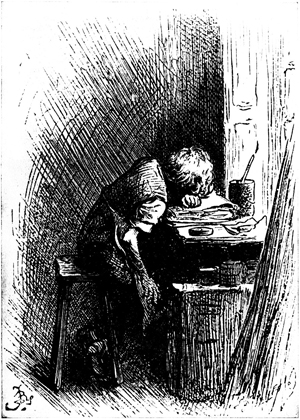
Twelve-year-old Charles, meanwhile, was put to work in the Warren’s Blacking Factory (pictured) near Hungerford Stairs, which stood just off the Strand (it’s said to have stood roughly where Charing Cross Railway Station now stands). While doing so, he roomed firstly at a house in Little College Street, Camden Town, and then in rooms at Lant Street in Borough (which was much closer to the prison).

John Dickens was out of prison in May but Charles continued working at the factory for almost another year until his father’s fortunes improved and Charles, now living with the family once again – at 29 Johnson Street and then, after being evicted, at The Polygon in Somers Town (an area in St Pancras) – returned to school, becoming enrolled at the Wellington House Classical and Commercial Academy in Hampstead Road.

In 1827, his father’s finances once more having taken a turn for the worse, he began work as a solicitor’s clerk (but more of that later)…

PICTURE: A nineteenth century etching of Dickens at Warren’s Blacking Factory – Source: Wikipedia.

10 London sites to celebrate Charles Dickens – 1. The Charles Dickens Museum

In the first of a new special series written in honor of the bicentenary of the birth of author Charles Dickens (he was born on 7th February, 1812), we take a look at the Charles Dickens Museum.

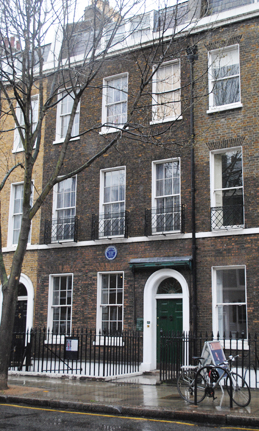
Housed in one of Dickens’ former London residences at 48 Doughty Street in Bloomsbury, this property is now the focal point for people wanting to find out more about the writer and his life as evidenced by the visit of Prince Charles and Camilla, the Duchess of Cornwall, on Tuesday to officially mark Dickens’ birth.

Dickens lived in the property from 1837 to 1839 and it was here that significant family events, such as the birth of two of his children – Mary and Kate – and the death of his wife Catherine’s 17-year-old sister Mary took place (Mary’s tragic death is believed to be the inspiration for that of the character Little Nell in the novel The Old Curiosity Shop). It was also at the property that he wrote some of his most famous novels, including Oliver Twist, Nicholas Nickleby, and The Pickwick Papers.

A growing demand for space, however, led Dickens to move his household to 1 Devonshire Terrace in 1839. The Doughty Street house meanwhile, the only one of Dickens’ London homes to have survived, remained a residential property but in 1923 it was threatened with demolition and subsequently acquired by the Dickens Fellowship. The museum opened there two years later.

The museum now claims to hold more than 100,000 Dickens-related artifacts. The house is displayed as it might have been when Dickens lived there – artifacts on display over four floors include his personal possessions and furnishings as well as manuscripts, letters, first edition copies of some of his books and portraits, including R.W. Buss’ spectacular (and unfinished) Dickens’ Dream, showing the author at his country home of Gads Hill Place in Kent surrounded by many of the characters that he had created.

It’s important to note that from 9th April, the museum will be closed as it undergoes a £3.2 million project, called Great Expectations, which will involve the restoration and expansion of the museum. It is expected to reopen in December this year in time to celebrate a Dickensian Christmas.

For more on events celebrating Charles Dickens and his works this year, see www.dickensfellowship.org or www.dickens2012.org.

WHERE: 48 Doughty Street, Bloomsbury (nearest Tube stations are Russell Square, Chancery Lane or Holborn). WHEN: 10am to 5pm Monday to Sunday (last admission 4.30pm) COST: £7 adults/£5 concessions/£3 children (under 10 free); WEBSITE: www.dickensmuseum.com.

London Pub Signs – The Queen’s Larder

In the first of an occasional series looking at the story behind some of London’s pub signs, we take a look at The Queen’s Larder in Queen Square, Bloomsbury.

The origins of the pub go back to the early 18th century – around 1710 – when there was known to be an alehouse on the site now occupied by the tavern. The story goes that as King George III (aka the ‘Mad King George’ depicted in the film of the same name) began to be affected by mental illness he was brought to a house in Queen Square where he stayed and was treated by a Dr Willis.

While he was undergoing this treatment – which was apparently initially successful, his wife Queen Charlotte rented an underground cellar below the alehouse and there stored some of the king’s favorite delicacies.

When a tavern was later built on the site, it was named The Queen’s Larder in honor of the role it had played in providing a storehouse for his treats.

The square itself contains a statue which was believed to be of Queen Anne – after whom the square was renamed (it had previously been known as Devonshire Square) – but it is now thought that the statue may in fact be of Queen Charlotte.

Famous Londoners – Captain Thomas Coram

A ship-builder and New World colonist of some renown, Thomas Coram is primarily remembered now as the founder of London’s Foundling Hospital.

While details of Coram’s early life are sketchy, it is known that he was born in Dorset, possibly in Lyme Regis, in 1668 and was believed to be the son of a merchant seaman, John Coram.

Coram’s mother apparently died while he was still young and he went to sea at the age of just 11. Following his father’s remarriage, however, the family moved to Hackney in East London and it was after that move that Coram was apprenticed to a shipwright working beside the Thames.

In 1694, having previously worked for the Government auditing troop and supply ships, a group of merchants asked Coram to establish a new shipyard in Boston, Massachusetts. He did so and spent the next 10 years building ships in Boston and Taunton. But, a staunch Anglican living among Puritans, he apparently make some enemies while doing so (this led to lawsuits and even apparently an attempt on his life). It was during this time that he also married a Bostonian, Eunice Wait.

Following his return to England in 1704, Coram found further success as a merchant and was soon commanding merchant ships during the War of the Spanish Succession (it is believed it was during this time that he acquired the title of captain). Throughout the following years he continued to conduct business in the New World colonies – particularly Massachusetts and Maine – as well as in London.

It was after he had moved to Rotherhithe in 1719 that Coram’s eyes were opened to the plight of abandoned children – he would apparently see them when travelling into London – and, his heart obviously moved, he began to advocate for the creation of a foundling hospital similar to those he had seen on the continent during his travels.

While his efforts initially came to nothing, Coram eventually received the backing of Queen Caroline, wife of King George II – an important step for the plain-speaking seaman. Having presented numerous petitions to the king, His Majesty finally signed the Foundling Hospital Charter on 14th August, 1739. The first meeting of the governors – which included notables such as artist William Hogarth and prominent physician Dr Richard Mead – was held at Somerset House that November.

A temporary hospital opened it’s doors at Hatton Garden on 25th March, 1741, and the first foundlings were baptised Thomas and Eunice Coram. But it was only four and a half years later – in October, 1745 – that a purpose-built hospital opened its doors in an area known as Bloomsbury Fields. As well as Hogarth (who painted Coram in 1740 – the picture can still be seen in the Foundling Hospital today), the hospital also attracted the support of composer George Frideric Handel.

Coram’s role in the governance of the hospital effectively came to an end in 1741-1742 (he is said to have made some indiscreet comments about some of his fellow governors) but – despite being still engaged in numerous business activities – he continued to visit the hospital regularly and, as well as being Godfather to more than 20 of the foundlings, the story goes that he found the time to sit in an arcade at the hospital and pass out pieces of gingerbread to the children.

Captain Thomas Coram died on 29th March, 1751, in lodgings on Spur Street near Leicester Square (his wife Eunice had died earlier, in July 1740, and the couple had no children). He was buried in the Foundling Hospital chapel.

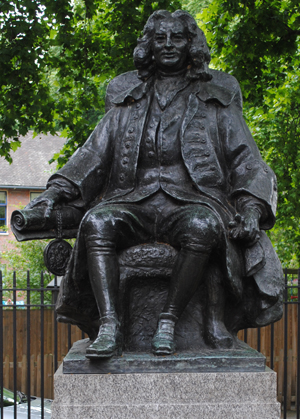
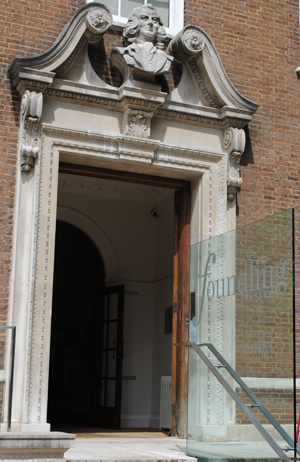
One of the best places to visit to find out more about Captain Coram and his life is the Foundling Museum, housed in part of the former hospital. For our previous story on the hospital, follow this link. A statue of Coram (pictured above) stands outside in Brunswick Square.

10 small (and fascinating) museums in London…7. The Cartoon Museum

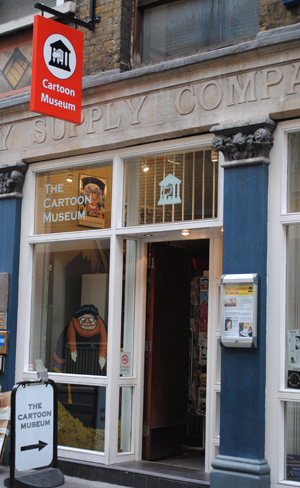
Hidden away in Bloomsbury almost in the shadow of the gigantic bulk of the British Museum, this small museum offers an interesting insight into the development of cartoons and comic strips from a uniquely British perspective.

Opened in 2006, the museum exhibits are spread over two floors and trace the history of cartoons and comic strips from their origins in the 1700s through to today’s graphic novels.

While it can seem at first glance only a small display, there’s a wealth of information accompanying the more than 200 exhibits which range from Hogarth prints and early satirical political cartoons by the likes of James Gillray and George Cruikshank through to the works of more modern artists like David Low and Donald McGill, originals of comic strips like Dennis the Menace and Andy Capp and even manga Shakespeare.

And no need to worry about the kids – if they become bored (as is likely), there’s an interesting exhibition on the creation of Peppa Pig complete with original storyboards and a cartoon running on the television as well as plenty of reading materials and, upstairs, the chance for them to indulge their passion for cartoons by designing their own.

The museum is also currently running a splendid exhibition on Dr Who comics spanning the period from 1964 (the year after the first Dr Who was televised) through to today. For Dr Who fans, this exhibition – which runs until 30th October – is a must.

Don’t forget to pause at the shop on the way out – it’s stocked with all sorts of comic-related paraphernalia.

WHERE: The Cartoon Museum, 35 Little Russell Street (nearest Tube stations are Tottenham Court Road, Holborn and Russell Square); WHEN: 10.30am to 5.30pm, Tuesday to Saturday, 12.30pm to 5pm Sundays; COST: £5.50 an adult/£4 concessions (£3 students)/children under 18 free (children 12 or under must be accompanied by an adult); WEBSITE: www.cartoonmuseum.org

10 small (and fascinating) museums in London…3. The Foundling Museum

Opened in 2004, the Foundling Museum was created to look after the former Foundling Hospital’s collection of art and artifacts and provides a unique and deeply moving insight into the work of the hospital and those who came under its care.

The Foundling Hospital’s origins go back to the 1720s when former mariner and ship-builder Captain Thomas Coram, shocked by the number of abandoned babies he saw in London (it’s estimated that in the early 1700s, there were as many as 1,000 babies being abandoned every year), began a campaign to found a hospital for “exposed and deserted young children”, that is, ‘foundlings’.

The hospital was founded in 1739 after King George II granted it a royal charter and, from that date until its closure in 1953, had some 27,000 children pass through its doors.

The museum’s story is not an easy one to tell for while the hospital was founded with the best of intentions, the life of the children who came into its care – even in the 20th century – remained far from easy; it was not, as one of those who formerly lived at the hospital notes, a life they would wish on anyone else. But the museum handles their story – as well as that of those behind the hospital’s founding – with care and dignity.

Located at 40 Brunswick Square – close to the site of the original hospital, the museum is spread over four floors. On the ground floor is an exhibition which details the hospital’s history and features objects including a series of sketches by the controversial 18th century artist William Hogarth, an ardent supporter of the hospital’s work and later one of the many artists who became a governor, as well as the founding charter document itself.

Among the most poignant of the artifacts to be found in the museum are the tokens mothers left with their children so they could later identify them (these were removed from the children on being taken into the hospital, however, to ensure the child’s anonmity).

The lower ground floor has a space for temporary exhibitions – at present this contains the ‘Foundling Voices’ exhibition in which those who once lived under the care of the hospital tell their stories firsthand in what is an emotional journey into the hospital’s relatively recent past (the exhibition runs until 30th October). It is also home to the reconstructed Committee Room, built as part of the original hospital in the mid-1700s, dismantled and then reconstructed in the new headquarters.

Upstairs (the stairs themselves were taken from the boy’s wing of the original hospital), is a reconstruction of the hospital’s original Picture Gallery which was London’s first public art gallery and was instrumental in raising the profile of the work of the hospital. Among the works it contains is Hogarth’s 1740 portrait of Captain Thomas Coram. Nearby is the Court Room, another reconstruction from the original hospital, this time of the building’s most splendid room, used for meetings of the Board and Governors and other special occasions. It too contains numerous artworks.

The top floor of the building houses the Gerald Coke Handel Collection, said to be the greatest collection of artifacts relating to composer George Frideric Handel in the world. Handel’s assocation with the museum goes back to 1749 when he offered a performance of his music to help fund the hospital’s completion. He held another the following year, this time performing the Messiah, and after that Handel agreed to an annual benefit performance – a practice which continued until his death in 1759.

Key artifacts in the Handel collection include the composer’s will and codicils, written in his own hand, as well as programme from the first performance of the Messiah along with other documents and artworks.

WHERE: The Foundling Museum, 40 Brunswick Square, Bloomsbury (nearest Tube station is Russell Square); WHEN: 10am to 5pm, Tuesday to Saturday/11am to 5pm Sunday (closed Mondays); COST: £7.50 an adult/£5 concessions/children under 16 free; WEBSITE: www.foundlingmuseum.org.uk.

Famous Londoners – Sir Hans Sloane

An Ulster-Scots born physician, scientist and avid collector, Sir Hans Sloane served as doctor to no less than three British monarchs during the 17th and 18th centuries and during his life amassed a vast collection of natural specimens and curiosities which after his death were used to form the core of the British Museum’s collection.
Born on 16th April, 1660, at Killyleagh in County Down, Ireland, Sir Hans was the son of Alexander Sloane, a “receiver-general of taxes” who originally hailed from Scotland.

Even as a young man, he developed a keen interest in the natural sciences. Having suffered from some ill-health which, at the age of 16 is said to have kept him confined to a room for a year, in 1679, at the age of 19, he moved to London where he studied chemistry at the Apothecaries Hall and botany at the Chelsea Physic Garden – a period during which he befriended the botanist John Ray and chemist Robert Boyle.

Four years later, he travelled through France where he received his Doctorate of Physics. On his subsequent return to London in 1685, he was made a Fellow of the Royal Society and in 1687 a Fellow of the Royal College of Physicians.

Given the chance to travel to Jamaica as physician to the new Governor, Christopher, the 2nd Duke of Albemarle, he only spent 15 months there (the Governor died soon after arrival). But it was an important period during which not only did he document and collect a vast amount of flora and fauna (bringing some 800 specimens back to London), he also came up with the idea of drinking chocolate with milk after witnessing locals drinking the dark chocolate with water but finding the mix made him “nauseous” (back in England, his concoction was first sold as a medicine and was later manufactured as a drink by Cadburys).

Having returned to London in 1689, he published the information he had gathered in Jamaica, and in 1693 he become secretary to the Royal Society.

In 1695 he married a Jamaican sugar planter’s widow, Elizabeth Langley Rose (with whom he had several children but of whom only two daughters, Sarah and Elizabeth, survived) and, thanks in part to an ongoing association with the duke’s widow, was able to set up a fashionable medical practice at 3 Bloomsbury Place on the northern end of Bloomsbury Square.

The house, not far from where the British Museum now stands, become something of an attraction in its own right, filled with objects and specimens he had collected on his travels as well as those – in some cases complete collections – given to him by others including friends and patients (in fact, he had to purchase the property next door, number four, to find room for them all – this property is now marked with a Blue Plaque).

The composer Handel is said to have been among those who visited the property and there is a delightful tale that says Sir Hans was outraged when Handel placed a buttered scone on one of his rare books.

With his services as a physician highly prized, in 1696, he was appointed physician to Queen Anne, the first of the three monarchs he would serve. In 1712-13, with his collection still growing, he purchased the Manor of Chelsea to help house it (four acres of which were leased to the Chelsea Physic Garden, which had been founded in 1673 with the idea of providing a training ground for apprentice apothecaries, in perpetuity).

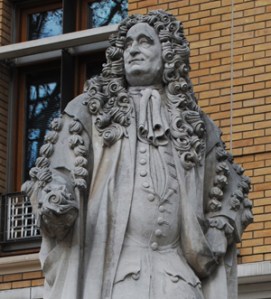
He subsequently moved his collection out to this property and his connection with Chelsea is still celebrated in place names such as name Sloane Square (not to mention Sloane Street, Sloane Gardens, Hans Street, Hans Crescent, Hans Road and Hans Place). There is also a statue of the bewigged man in Duke of York Square (pictured), not far from Sloane Square – this is a 2007 copy of 1737 original by John Rysbrack, another (older) copy of which can be found in the Chelsea Physic Garden.

Following Queen Anne’s death in 1714, in 1716 Sir Hans was appointed physician to her successor, King George I (he was also created a baronet the same year, becoming the first medical practitioner to receive a hereditary title).

Three years later, in 1719, he become president of the Royal College of Physicians, an office he held for 16 years, and in 1727, he was appointed physician to King George II. The same year he succeeded Isaac Newton as president of the Royal Society, an office which he held until 1741.

In 1742, Sir Hans retired to his property in Chelsea.

By the time of his death on 11th January, 1753 at the ripe old age of 93, Sir Hans had collected more than 71,000 objects including books, manuscripts, drawings, coins and medals and plant specimens which he bequeathed to King George II in exchange for a payment of £20,000 to his executors.

Parliament agreed, following a lottery to raise the money, his collection went on to form the basis of the British Museum, first opened to the public in 1759 in Bloomsbury. It was also to form the basis of the museum’s later offshoot, the Natural History Museum at South Kensington.

Sir Hans was buried at Chelsea Old Church with his wife Elizabeth who died in 1724.
Around London – Apsley House history goes online; Australian landscapes at the British Museum; Dame Judy Dench awarded Freedom of the City of London; and, Out of this World on at British Library

A detailed history of Apsley House, the former home of Arthur Wellesley, 1st Duke of Wellington, has gone live online as part of a pilot project aimed at “deepening the public’s understanding of English history”. The property, known as Number 1, London, is one of 12 initially being profiled in depth in a pilot project on the new English Heritage online resource, Portico. Others include Down House, the former home of Charles Darwin, located in Kent, as well as Beeston Castle, Brough Castle, Byland Abbey, Carlisle Castle, Dunstanburgh Castle, Easby Abbey, Kenilworth Castle, Lullingstone Roman Villa, Rievaulx Abbey and Wroxeter Roman City near Shrewsbury. Brief historical details are also provided for an additional 220 lesser known free sites including Dunster Yarn Market in Somerset. For more see www.english-heritage.org.uk/professional/archives-and-collections/portico/.

The West Lawn of the British Museum Forecourt has been turned into an image of the Australian continent as part of a five year partnership programme between the museum and the Royal Botanic Gardens, Kew. The landscape moves from the vegetation of the eastern Australia’s coast through to the red centre and onto a rocky Western Australian outcrop. It showcases some of the continent’s unique and highly threatened flora. The  construction of the landscape, which follows one showcasing that of South Africa last year, is part of the museum’s ‘Australian season’. Runs until October. Admission is free. See www.britishmuseum.org.

• Dame Judy Dench was awarded the Freedom of the City of London for services to acting at a ceremony at the Guildhall last week. The winner of an Academy Award, nine BAFTAs and three Laurence Olivier Awards, Dame Judy is an icon of stage and screen. She is reportedly looking forward to driving her sheep over London Bridge and occasionally wearing a sword in public – both privileges of those awarded the Freedom of the City of London. The Freedom of the City’s origins are believed to date back to 1237 and enabled recipients to carry out their trade. Today people are nominated for or apply for the Freedom for the link with the City or are awarded it for a significant contribution to London life. Many of the traditional privileges – such as driving your sheep over London Bridge or being hanged with a silken rope – no longer exist.

Now On: Out of this World: Science Fiction but not as you know it. The British Library’s first exhibition which explores science fiction through literature, film, illustrations and sound. Guest curated by Andy Sawyer, director of science fiction studies MA at the University of Liverpool, the exhibition traces the evolution of the genre from Lucian of Samosata’s True History, written in the 2nd century AD, through to the recent writings of Cory Doctorow and China Mieville. Highlights include a 1516 edition of Sir Thomas More’s Utopia, a 1647 edition of Lucian’s True History, and a 1906 edition of HG Wells text, The War of the Worlds. Runs until 25th September. For more see, www.bl.uk/sciencefiction.

What’s in a name? – Bloomsbury

Famous for its literary, intellectual and artistic heritage, Bloomsbury covers an area in central London which lies between Holborn and Euston Road.

The area, which became a fashionable residential district in the 17th and 18th centuries, derives its name from an earlier era and is named after William de Blemund (‘Blemundsbury’ means the manor of Blemund), who acquired land there in 1201.

It was later owned by the Earl of Southampton, who had begun developing the area in the 1660s – a task which was continued when the land passed, through the marriage of his daughter, into the hands of the Dukes of Bedford. Successive dukes were then involved – to varying degrees – in the development of series of residential squares and streets which eventually included the likes of Bedford, Russell and, of course, Bloomsbury Squares.

In the early 20th century, the area become home to what is known as the Bloomsbury Group – its members included the writers Virginia Woolf, Lytton Strachey and EM Forster. These days the area is noted for being home to the British Museum (first opened to the public in 1759) and the University of London.