This Week in London – The Van de Veldes at the Queen’s House; Young V&A to open in July; Roman pottery kiln to return to Highgate Wood; and, welcome to ‘Kyiv Road’…

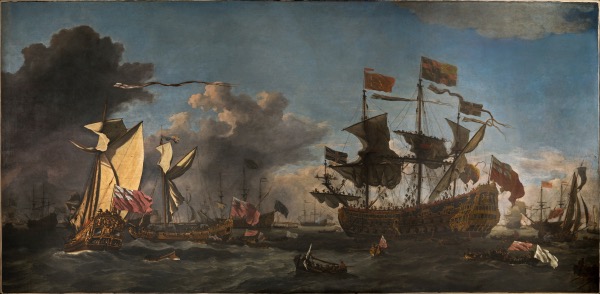
‘Royal visit to the fleet in the Thames Estuary, 6 June 1672’ by Willem Van De Velde The Younger © National Maritime Museum, London

The work of 17th century marine painters Willem van de Velde the Elder and Willem van de Velde the Younger is the subject of a new exhibition at the Queen’s House in Greenwich – the location of a studio King Charles II granted to them. The Van de Veldes: Greenwich, Art and the Sea features the newly conserved painting, A Royal Visit to the Fleet, which they worked on in their studio at the Queen’s House in the 1670s and which, at almost four metres across, was the largest seascape Van de Velde the Younger had painted to date (pictured after conservation above). Also on show is the The Burning of the Royal James at the Battle of Solebay, 28 May 1672, otherwise known as The Solebay Tapestry and originally one of six, along with a selection of some of the more than 1,400 drawings from the National Maritime Museum’s collection. The exhibition, which is free to visit, runs until 14th January, 2024. For more, see www.rmg.co.uk/van-de-velde.

• The Young V&A will open on 1st July following a three year transformation project, it was announced this week. Formerly known as the V&A Museum of Childhood, the Bethnal Green institution will display “remarkable and optimistic stories of children’s ingenuity” alongside 2,000 works from the V&A’s collection of art, design, and performance. Features will include an interactive Minecraft installation, murals by street artist Mark Malarko, tech solutions created for Raspberry Pi’s Coolest Projects, and, a display of portraits by photographer Rehan Jamil capturing young people expressing what creativity means to them and set alongside self-portraits by the likes of Chila Kumari Singh Burman, Quentin Blake, Kenneth Branagh, Dapo Adeola, and Linda McCartney. Also announced was the first exhibition at the new facility – Japan: Myths to Manga – which will open on 14th October. For more, see vam.ac.uk/young.

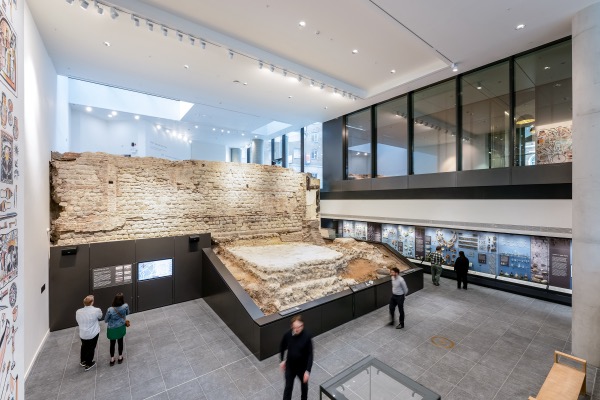
The most complete Roman pottery kiln ever found in Greater London is going on display in a visitor centre at Highgate Wood from September next year. The kiln, which was excavated from the wood in Haringey in the 1960s and 1970s, has been in storage beneath Bruce Castle Museum. But thanks to a £243,550 grant by The National Lottery Heritage Fund to charity Friends of Highgate Roman Kiln, it will be returned for public display. The kiln is said to be one of the best-preserved Roman pottery kilns found in the UK and is thought to be the last one built by Roman potters who worked in Highgate Wood between 50CE to 160CE to supply Londinium and south-east England with distinctive ‘Highgate Ware’ pottery. 

A small section of Bayswater Road has been renamed Kyiv Road to mark the first anniversary of the invasion of Ukraine by Russia. The new road name was installed last Friday on the road which runs from Palace Court to Ossington Street and is located not far from the Russian Embassy. Councillor Adam Hug, leader of Westminster City Council, said the request for the new name came from the Ukrainian community. “Westminster is home to Ukrainians displaced by the war, and our residents have opened their hearts and their doors to those fleeing Putin’s war machine,” he said in a statement. “As the centre of an international capital, it seemed to us entirely fitting that part of our City should carry a torch for the unbowed defenders of Ukraine. It’s a small stretch of road, but we want to show the people of Ukraine that their struggle has a visible place in our city.”

Send all items to exploringlondon@gmail.com.

This Week in London – Freud’s antiquities; how design can help the aging; and, new home for the Migration Museum…

Sigmund Freud’s collection of ancient antiquities and books inspired by them are the subject of a new exhibition at the Freud Museum London in Hampstead. Freud’s Antiquity: Object, Idea, Desire, which opens Saturday, explores the crucial role the collection played Freud’s development of the concepts and methods of psychoanalysis. The display, which is co-curated by Professor Miriam Leonard of UCL, Professor Daniel Orrells of Kings College London, and Professor Richard Armstrong, of the University of Houston, discusses six separate aspects of Freudian theory alongside representative objects from the collection and spans his entire psychoanalytic career from 1896 to 1939. Alongside the physical objects is a comprehensive digital multimedia resource, containing video recordings, podcasts, photographs of rarely seen objects from the collection, and a list of suggested reading. A series of events accompanies the exhibition. Runs until 16th July. Admission charge applies. For more, see www.freud.org.uk/exhibitions/freuds-antiquity-object-idea-desire/.

PICTURE: Ardfern (licensed under CC BY-SA 4.0/image cropped)

A new display at the Design Museum will showcase how cutting-edge design can help people live “more independently, sustainably and healthily but also with joy and fulfilment” as they age. Designing for our Future Selves, which opens on Friday, follows on from last Future of Ageing exhibition and will feature 10 design initiatives currently being developed by Design Age Institute and its partners which aim to positively impact the way we live and work as we grow older. The exhibition is free to visit. Runs until 26th March. For more, head here.

A permanent home for the Migration Museum, currently based in Lewisham, will be built in the Square Mile following planning approval this week. The new facility at 65 Crutched Friars will be located in a 21-storey building and will consist of three floors featuring space for exhibitions and events, a cafe and a shop. The City of London Corporation said the developer had agreed to provide the museum space rent-free for 60 years and to cover its operating costs for three years, and has also donated £500,000 to support its fund-raising campaign.

Send all items from inclusion to exploringlondon@gmail.com.

LondonLife – London writ large…

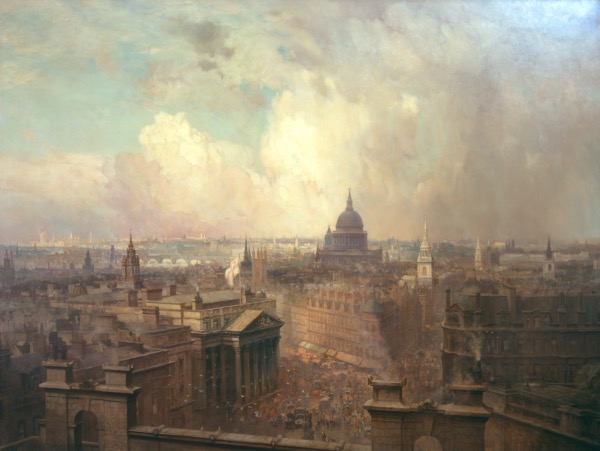
Niels Moller Lund, ‘The Heart of Empire’, 1904, © Guildhall Art Gallery, City of London Corporation

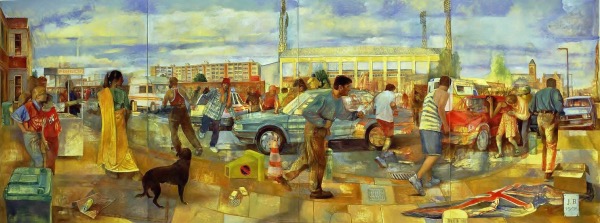
A celebration of the artists who have painted London on a monumental scale, The Big City is currently running at the Guildhall Art Gallery. The exhibition, which runs until 23rd April, can be visited on a ‘pay what you can’ basis. For more, see www.cityoflondon.gov.uk/events/the-big-city.

John Bartlett, ‘Cars and Chaos’, 1995-96, © Guildhall Art Gallery, City of London; Image © John Bartlett
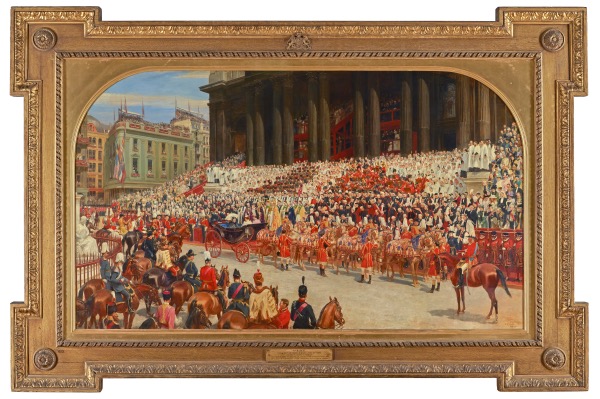
Andrew Carrick Gow, ‘Queen Victoria’s Diamond Jubilee Service’, 22nd June 1897 © Guildhall Art Gallery, City of London Corporation

This Week in London – London painted large; Donatello at the V&A; and, the first King Charles III stamps…

The most extensive collection of large scale paintings of London ever seen opens at the City of London Corporation’s Guildhall Art Gallery on Friday. The Big City: London painted on a grand scale has at its heart a series of works by David Hepher which, on display in London for the first time, were given to the City by the artist in 2022. There’s also a four piece panel installation by John Bartlett and huge works by Frank O Salisbury and Terence Cuneo. The exhibition is open on a ‘pay what you can’ basis and runs until 23rd April. For more, see www.cityoflondon.gov.uk/thebigcity.

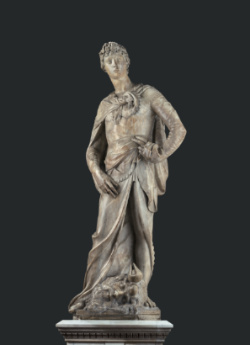
Donatello and Desiderio da Settignano, St. John the Baptist (Martelli Baptist), Museo Nazionale
del Bargello, Florence, courtesy of the Ministry of Culture. Photo: Bruno Bruchi.

The first major exhibition to explore the work of Renaissance sculptor Donatello opens at The V&A on Saturday. Donatello: Sculpting the Renaissance features works never before on display in the UK including his early marble David and the bronze Attis-Amorino – both of which come from the Museo Nazionale del Bargello in Florence, as well as the reliquary bust of San Rossore from the Museo Nazionale di San Matteo, Pisa, and bronzes from the High Altar of the Basilica of St Anthony in Padua. And, for the first time, the V&A’s carved shallow relief of the Ascension with Christ giving the keys to St Peter will be displayed alongside the Madonna of the Clouds from the Museum of Fine Arts, Boston, and Desiderio da Settignano’s Panciatichi Madonna from the Museo Nazionale del Bargello. Among the 130 objects in the display are also works by Donatello’s contemporaries and followers. Admission charge applies. The display runs until 11th June. For more, see www.vam.ac.uk.

See the designs for the first Royal Mail stamp to feature King Charles III in a new exhibition at The Postal Museum. The King’s Stamp traces the story of definitive stamps and features stamps from the reigns of six monarchs. Along with the designs for the first definitive stamps featuring King Charles III, highlights include one of only two sheets of Edward VII ‘Tyrian Plum’ and original letters revealing the influence of past monarch’s on stamp designs as well as the chance to see your silhouette on a stamp. Runs until 3rd September. Admission charge applies. For more, see www.postalmuseum.org/event/the-kings-stamp/.

Send all items for inclusion to exploringlondon@gmail.com.

What’s in a name?…Shoe Lane…

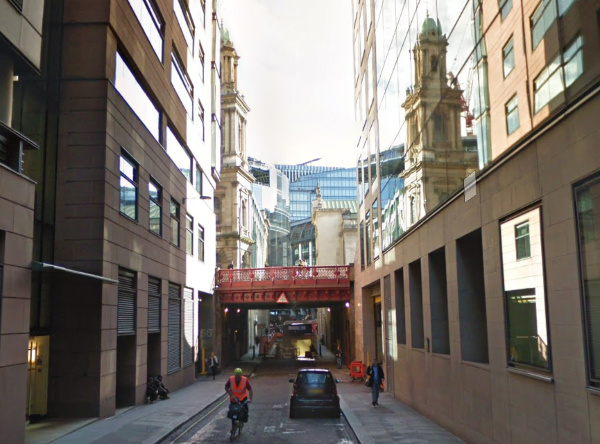
Looking south down Shoe Lane from near Charterhouse Street where it passes under the Holborn Viaduct. PICTURE: Courtesy of Google Maps.

This name of this rather long laneway, which runs from Charterhouse Street, under Holborn Viaduct, all the way south to Fleet Street, doesn’t have anything to do with footwear.

The name is actually a corruption of the Sho Well which once stood at the north end of the thoroughfare (and which itself may have been named after a tract of land known as Shoeland Farm thanks to it resembling a shoe in shape).

In the 13th century the lane was the London home of the Dominican Black Friars – after they left in the late 13th century, the property became the London home of the Earl of Lincoln and later became known as Holborn Manor.

In the 17th century, the lane was known as for its signwriters and broadsheet creators as well as for a famous cockpit which was visited by none other than diarist Samuel Pepys in 1663. It was also the location of a workhouse.

Prominent buildings which have survived also include St Andrew Holborn, designed by Sir Christopher Wren (it actually survived the Great Fire of London but was in such a bad state of repair that it was rebuilt anyway). The street these days is lined with office buildings.

Famous residents have included John de Critz, Serjeant Painter to King James I and King Charles I, preacher Praise-God Barebone who gave his name to Barebone’s Parliament held in 1653 during the English Commonwealth, and Paul Lovell, who, so the story goes, refused to leave his house during the Great Fire of 1666 and so died in his residence.

This Week in London – Stephen Lawrence and Dick Whittington remembered; Museum of London seeks Jewish-fashion items for new display; and, become a volunteer ranger at The Regent’s Park…

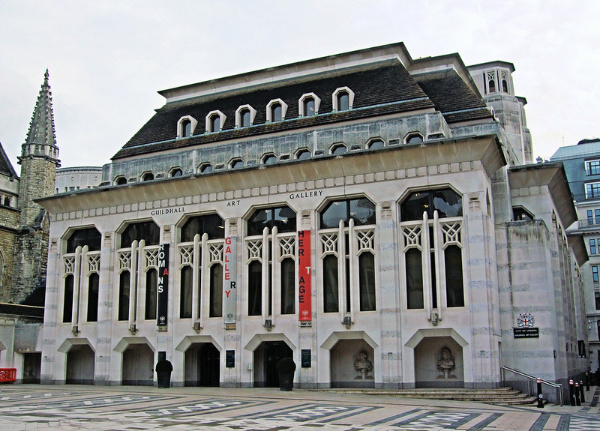
The Guildhall Art Gallery which contains the City of London Heritage Gallery. PICTURE: Jim Linwood (licensed under CC BY 2.0)

Stephen Lawrence, a London teenager who was killed in a racially motivated murder in 1993, and four-times medieval Mayor of London, Richard Whittington, are both remembered in a new display at the City of London Heritage Gallery. Among the items on show is a report by the headteacher of John Roan School in Greenwich which was created following Lawrence’s death along with the last will and testament of Whittington and a book recording his third election as mayor in 1406 and showing his decorated coat of arms. Also on show in the gallery is a Bomb Damage Map which, produced by London County Council, shows the extent of damage to Rotherhithe and part of the Isle of Dogs following a German Luftwaffe raid in September, 1940. The display can be seen until 28th April. Admission is free but booking is recommended. For more, see www.cityoflondon.gov.uk/events/heritage-gallery-exhibition.

The Museum of London is seeking information on high-profile items of clothing created by leading Jewish fashion designers ahead of an exhibition running later this year. Fashion City: How Jewish Londoners Shaped Global Style, scheduled to open in October, will explore the major contribution of Jewish designers had in making London an iconic fashion city during the 20th century. It will feature pieces from the museum’s own collections but those behind the exhibition are also looking for a range of other high profile items. These include menswear made by Mr Fish and Cecil Gee which were worn by famous names such as Sean Connery, David Bowie, Mick Jagger, Muhammad Ali, Michael Caine and The Beatles, womenswear made by Rahvis in the 1930s and 1940s and worn by Hollywood film stars, hats made by Otto Lucas and worn by the likes of Greta Garbo and Wallis Simpson, a theatre costume made by Neymar for Cecil Landau’s 1949 production of Sauce Tartare, and 1930s gowns made by dressmaker Madame Isobel (Isobel Spevak Harris). Anyone who has information about the location of these objects are asked to email fashioncity@museumoflondon.org.uk with any information. More information on the exhibition will be provided closer to the date.

The Royal Parks is looking for volunteer rangers in The Regent’s Park this spring. Following the success of volunteer ranger programmes in Richmond, Bushy and Greenwich Parks, the charity is seeking “friendly and chatty people who are passionate about The Regent’s Park, and keen to inspire and educate visitors”. Volunteers, who need to commit to a minimum of three hours per month, will work in pairs and share facts about the park’s heritage as well as provide tips on the best walking and cycling routes and inform visitors on how everyone can help nature thrive in the parks. Rangers can choose from a range of 90-minute volunteering sessions across weekdays and weekends. Applications close on 26th February. Full training will be provided. To apply, visit www.royalparks.org.uk/rangers.

Send all items for inclusion to exploringlondon@gmail.com

10 most popular posts for 2022 – Numbers 2 and 1…

And the final two in our annual countdown (drum roll please)…

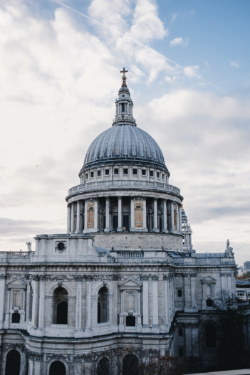
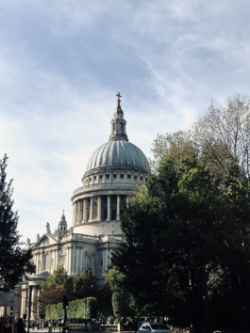
2. 10 historic stairways in London – 6. The Geometric Staircase, St Paul’s Cathedral…

1. 10 historic stairways in London – 7. Wapping Old Stairs…

10 most popular posts for 2022 – Numbers 4 and 3…

4. 10 historic stairways in London – 4. The Nelson Stair…

3. Treasures of London – Wren’s Great Model of St Paul’s Cathedral…

10 most popular posts for 2022 – Numbers 6 and 5…

6. 10 historic stairways in London – 3. The Monument stairs…

5. 10 historic stairways in London – 8. The King’s Staircase, Kensington Palace… 

10 most popular posts for 2022 – Numbers 8 and 7…

8. 10 historic stairways in London – 2. Queen Mary’s Steps, Whitehall…

7. 10 historic stairways in London – 3. The Monument stairs…

Five locations located to Charles Dickens’ ‘A Christmas Carol’…

Charles Dickens’ A Christmas Carol is forever linked to Christmas in London. So, with Christmas almost upon us, here’s a quick look at five locations mentioned or alluded to in the famous book…

1. 16 Bayham Street, Camden Town. Bob Cratchit’s house is described as being in Camden Town but what’s interesting is that as a child Dickins’ himself lived here at this property. So whether or not it’s the actual address Dickens had in mind for Cratchit’s property, it’s certainly in the vicinity.

The Royal Exchange today. PICTURE: Klaudia Piaskowska/Unsplash

2. The Royal Exchange. Referenced in regard to Ebenezer Scrooge who did business there. The current building was still being completed when Dickens wrote A Christmas Carol in 1843 following a fire at the premises several years before. It was opened in 1844.

3. Simpsons Tavern. Scrooge is said to have taken his “melancholy dinner in his usual melancholy tavern” which has been suggested could refers to Simpsons. Located in Ball Court, the current premises opened in 1757. The George & Vulture in Michael’s Alley is also mentioned as a possibility.

4. Newman’s Court. Located near Cornhill (which is mentioned in the book as the site where Bob Cratchit goes on a slide after leaving Scrooge’s office), it’s been suggested more than once that while the location of Scrooge’s counting house is not specified in the text, a location in Newman’s Court would fit the bill.

5. Leadenhall Market. Following Scrooge’s transformation, he sends a boy out to buy a turkey- commentators suggest the poulterer the boy attends was located in Leadenhall Market which would have been a predecessor to the current building which dates from 1881.

Four unusual London Christmas traditions (redux)…

1. The Ceremony of the Christmas Cheeses…

2. The Smithfield Meat Auction…

3. The Peter Pan Cup…

4. The Boy Bishop of St Paul’s…

This Week in London – Carols at Westminster Abbey; cathedrals at St Paul’s; and, ‘Making Modernism’ at the Tate…

PICTURE: Manuel Weber/Unsplash

The Princess of Wales will host a Christmas carol service at Westminster Abbey today. The service, which will be attended by members of the Royal Family, will recognise the selfless efforts of individuals, families and communities across the UK as well as paying tribute to Queen Elizabeth II and the values she demonstrated at Christmas and throughout her life, including empathy, compassion and support for others. The service will be broadcast on ITV One in the UK on Christmas Eve. Meanwhile, a special Christmas episode of Westminster Abbey: Behind Closed Doors will be shown on Channel 5 next Wednesday, 21st December. For more, see My5: Westminster Abbey: Behind Closed Doors.

An exhibition show-casing the work of photographer Peter Marlow, who has photographed all 42 Church of England cathedrals, can be seen at St Paul’s Cathedral. Commissioned in 2008 by Royal Mail to photograph six cathedrals – images of which were used on commemorative stamps marking the 300th anniversary of the completion of St Paul’s Cathedral, Marlow went on to continue taking pictures of cathedrals using just natural light. The display, which is touring all 42 cathedrals, can be found in the South Nave aisle until 26th January. Included in admission charge. For more, see www.stpauls.co.uk/whats-on/exhibition-peter-marlows-english-cathedral.

On Now: Making Modernism. The first major UK exhibition devoted to women artists working in Germany in the early 20th century, this exhibition at the Royal Academy’s Gabrielle Jungels-Winkler Galleries includes 67 paintings and works on paper. The artists featured include Paula Modersohn-Becker, Käthe Kollwitz, Gabriele Münter and Marianne Werefkin, with additional works by Erma Bossi, Ottilie Reylaender and Jacoba van Heemskerck. Runs until 12th February. Admission charge applies. For more, see www.royalacademy.org.uk.

Send all items to exploringlondon@gmail.com

8 locations for royal burials in London…A recap…

Before kicking off a new series, here’s a recap of our last…

1. (Old) St Paul’s Cathedral…

2. St Clement Danes…

3. St Edward’s Chapel, Westminster Abbey…

4. Christ Church Greyfriars…

5. Henry VII’s Lady Chapel, Westminster Abbey…

6. St Peter ad Vincula…

7. Westminster Abbey (near the High Altar)…

8. Kensal Green Cemetery…

This Week in London – 12 Days of Christmas at the Tower; Museum of London celebrates its London Wall closing; and, William Beatty at the Old Royal Naval College…

The Tower of London is getting into the festive spirit with a celebration of the Twelve Days of Christmas. Twelve installations have been installed at the Tower, each representing as different aspect of the fortress’s unique history – from nine wreaths representing “nine rowdy ravens” to five gold coins representing the Mint once housed there. There’s also the six Queens of King Henry VIII and three “lordly lions” – a reference to a gift presented to King Henry III and housed in a Lion Pit at the tower. Visitors will have the chance to collect a map at the start of their visit and follow a trail to find the installations at they explore the Tower. Christmas at the Tower of London runs daily until 3rd January. Admission charge applies. For more, see www.hrp.org.uk/tower-of-london/.

The Museum of London is preparing to close its doors at its London Wall site as it moves to its new location in Smithfield and to celebrate it’s holding two free weekend festivals. The first, to be held this weekend, will feature family-friendly activities including arts and crafts, dance, face painting and theatrical performances while the second, to be held on the weekend of 3rd and 4th December (after which the museum will close), will feature a celebration of London’s music scene from the 70s to the present day with a DJ sets, a late night film festival and museum’s first ever 24 hour opening. Visitors on both weekends can also take part in London Biggest Table Football competition for a chance to win an England shirt signed by Harry Kane and to see the museum’s collection in a new light thanks to an illuminated display. For more on the festivals, see www.museumoflondon.org.uk/museum-london.

Now On: Blood and Battle: Dissecting the life of William Beatty. The life and work of renowned 19th-century naval surgeon and physician, Sir William Beatty, is explored in this exhibition at the Old Royal Naval College in Greenwich. The display – which marks 200 years since Beatty, who had served as ship’s surgeon on HMS Victory during the Battle of Trafalgar (and who wore the musket ball that killed Nelson in a locket on his watch chain for the rest of his life afterwards) – took up the post of Physician to the Royal Hospital for Seamen – explores Beatty’s work as a ship’s surgeon, his time at Greenwich Hospital and how he was honoured by being knighted and appointed Physician Extraordinary to George IV and the Duke of Clarence (later William IV) as well as his outside interests including his involvement in developing the London – Greenwich Railway. Admission charge applies. For more, see https://ornc.org.

Send all items for inclusion to exploringlondon@gmail.com.

LondonLife – Marking the King’s birthday; remembering the sacrifice of those who gave their lives in war; and, welcoming a new Lord Mayor…

Members of the King’s Troop Royal Horse Artillery arrive at Green Park for the 41 gun salute to celebrate King Charles III’s 74th birthday on Monday. In London, The King’s Troop Royal Horse Artillery and The Honourable Artillery Company each fired celebratory Royal Salutes at 12 noon and 1pm respectively in what was the first formal birthday salute for King Charles III since he became monarch. PICTURE: Giles Anderson/UK MOD © Crown copyright 2022.
Members of the King’s Troop Royal Horse Artillery firing a 41-gun salute to celebrate King Charles III’s 74th birthday. PICTURE: Giles Anderson/UK MOD © Crown copyright 2022.
King Charles III leads the royal party to their position at the Cenotaph on Sunday as armed forces personnel from the Royal Navy, British Army and Royal Air Force came together for Remembrance Sunday and the National Service of Remembrance. Joining the King and members of the Royal Family, more than 600 members of the Armed Forces honoured the brave servicemen and women killed in all conflicts since the First World War. PICTURE: Simon Walker / No10 Downing Street/UK MOD © Crown copyright 2022.
Armed Forces personnel from the Royal Navy, British Army and Royal Air Force gathered at the Cenotaph on Remembrance Sunday, for the National Service of Remembrance. PICTURE: Cpl Tim Hammond/UK MOD © Crown copyright 2022.
Pikeman march through the streets of the City of London for the Lord Mayor’s Show on Saturday. Some 6,500 people, 250 horses, more than 50 decorated floats, and a flying pig, took part in the parade. PICTURE: Corporal Rob Kane/UK MOD © Crown copyright 2022.
Nicholas Lyons, elected as the 694th Lord Mayor of the City of London, waves from the golden State Coach, which has been used in every Lord Mayor’s Show since 1757 and is the oldest ceremonial vehicle in regular use in the world. PICTURE: Lt Reilly AGC (ETS)/UK MOD © Crown copyright 2022

London Explained – Londinium…

Simply put, this is the name London was given during Roman times (and perhaps derives from an earlier Celtic word – although this remains the matter of much speculation).

There’s no substantial evidence of a settlement where London now stands until after the arrival of the Romans in 43 AD. The location was selected for the ease with which the Thames could be bridged and two hills which stand in what is now the city of London – Ludgate Hill on which St Paul’s cathedral stands and Cornhill – which could be fortified as a military stronghold.

A reconstruction of Londinium in 120 AD by Peter Froste which has was on show in the Museum of London. PICTURE: Carole Raddato (licensed under CC BY-SA 2.0)

The fledging settlement was destroyed during the revolt of Queen Boudicca of the Iceni in 60 AD but rebuilt centred on Cornhill and the Walbrook stream. By the 70s AD, the main public buildings of the forum and basilica were placed on high ground east of the Walbrook and by the end of of the first century AD further grand buildings – the governor’s palace, amphitheatre and baths – had been added. Waterfront infrastructure for shipping – including quays and warehouses – stretched along the northern side of the river.

A fort was added and public buildings renovated before the visit of the Emperor Hadrian in 122 AD. Another fire destroyed much of the city but it was again rebuilt and late in the 2nd century walls were built around it, partially encircling a site of some 330 acres. Buildings subsequently constructed in the 3rd century included the Temple of Mithras and a monumental arch.

There were known to have been “suburbs” including at both Southwark and to the west around Trafalgar Square and cemeteries were built outside the walls.

The city’s population had already contracted somewhat by the time the legions were recalled to Rome in 410 AD. While the walls still offered the inhabitants some protection 50 years after the withdrawal of the legions, there’s scant evidence for how much longer it remained inhabited with the Anglo-Saxons known to have viewed the ruins of the Roman buildings with some trepidation.

This Week in London – The Lord Mayor’s Show; Mass-Observation remembered; and, modern and contemporary art at the British Museum…

The Lord Mayor’s Show will be held this Saturday, 12th November, welcoming the 694th Lord Mayor of London, Alderman Nicholas Lyons, into office. The Show, which dates back to the early 13th century, features more than 6,500 people, 250 horses and more than 130 floats as well as the golden State Coach which has been used to carry the Lord Mayors since as far back as 1757 and is said to be the oldest ceremonial vehicle still in regular use anywhere in the world. The three mile long procession will start passing by Mansion House at 11am and make its way to St Paul’s Cathedral and then head on to the Royal Courts of Justice where the Mayor will swear an oath of allegiance to the monarch, before returning along the Embankment and Victoria Street to Mansion House. For more on the history of the Show and details about the best places to stand, head to https://lordmayorsshow.london.

The original headquarters of Mass-Observation, a pioneering social research organisation, has been marked with an English Heritage Blue Plaque. The organisation started its worked at the property 6 Grotes Buildings in Blackheath from 1937 until 1939 – by the end of its first year there were around 600 ‘mass observers’ involved in the work, one of the key aims of which was to gauge public opinion on a range of issues to help enable the writing of “a democratic people’s history from below”. During World War II, Mass-Observation worked on behalf of the government and morphed into a market research company in 1949, Mass Observation Ltd, before being incorporated into the British Market Research Bureau. The project was restarted in 1981 at the University of Sussex and continues to this day. For more on English Heritage Blue Plaques, see www.english-heritage.org.uk/visit/blue-plaques/.

A collection of about 100 modern and contemporary artworks on paper have gone on show at the British Museum, part of a larger gift of works donated by London-based art collector Hamish Parker. Art on paper since 1960: the Hamish Parker collection features works by works by the likes of British artist Lucian Freud, French-Israeli artist Avigdor Arikha, American artist Richard Serra and Pakistani artist Imran Qureshi. There are also two “artist in focus” sections which take a more in-depth look at the work of American artists Carroll Dunham and Al Taylor. Runs until 5th March in Gallery 90. For more, see www.britishmuseum.org.

Send all items for inclusion to exploringlondon@gmail.com

8 locations for royal burials in London…4. Christ Church Greyfriars…

We’ll return to Westminster Abbey shortly but first we’re heading into the City of London.

Christ Church Greyfriars, also known as Christ Church Newgate Street, was the burial site of several queens in the medieval era.

Christ Church Greyfriars. PICTURE: Karmakolle (licensed under CC BY-SA 4.0).

These include the second wife of King Edward I, Queen Marguerite, who partly financed construction of the church which commenced in the 1290s and finished well after her death in the 1360s.

Marguerite, who was the first uncrowned queen since the Norman Conquest (apparently due to the expense), was only 26 when she was widowed in 1307 (having married the king in 1299 when he was at least 40 years her senior).

She died on 14th February, 1318, while at her castle at Marlborough but her remains were brought to London where she was buried in Greyfriars wearing a Francisan habit. Her tomb, sadly, was destroyed during the Reformation.

Also buried in Greyfriars was Queen Isabella, the widow (and adversary) of the ill-fated King Edward II. Isabella, who was also known as the ‘She-wolf of France’, is said to have been buried in the clothes she wore at her wedding to the King 50 years earlier. Despite rumours to the contrary, her lover, Roger Mortimer, was not buried with her (although Isabella’s daughter – Joan of the Tower, who was the wife of King David II of Scotland – was).

While their predecessor as Queen, Eleanor of Provence, wife of King Henry III, was buried at Amesbury Priory in Wiltshire where she had died (the grave is unmarked), her heart was brought to London and buried in Greyfriars.

Others buried in the church include King Henry III and Eleanor’s daughter, Beatrice of England, and King Edward III’s daughter Isabella, Countess of Bedford.

There’s not much left of Greyfriars these days – the medieval church, one of the largest then in London, burned in the Great Fire of London of 1666 and following a rebuild under Sir Christopher Wren’s supervision, it was again all but destroyed during the Blitz in World War II.

It was decided not to rebuild and what remained of the church – some of the outer walls and tower – were designated a Grade I-listed building in 1950. Plantings inside are laid out to resemble the pews of the church in plan.

WHERE: Christ Church Greyfriars, King Edward Street (nearest Tube station is St Paul’s); WHEN: Anytime; COST: Free; WEBSITE: www.cityoflondon.gov.uk/things-to-do/city-gardens/find-a-garden/christchurch-greyfriars-church-garden

This Week in London – London’s history of executions; myth-making around Alexander the Great; and, Édouard Manet’s ‘Eva Gonzalès’ examined…

Charles I vest, Executions 2022 © Museum of London

• The history of public executions in London – spanning a period of some 700 years – is the subject of a landmark new exhibition at the Museum of London Docklands in West India Quay. Executions explores how capital punishment became embedded in the city’s landscape – from the first recorded public execution in 1196 to the last in 1868 – and looks at the rarely told and often tragic human stories behind them. Items on display include an intricately woven silk vest said to have been worn by King Charles I at his execution outside the Banqueting House (pictured), a 300-year-old bedsheet embroidered with a love note in human hair and personal items which once belonged to prison reformer Elizabeth Fry. Visitors can also stand in front of the Newgate Prison door, marking the last steps for prisoners heading to the scaffold, and see a dramatic recreation of the Tyburn “Triple Tree” gallows. Visitors will also learn about the 200 offences that became punishable by death and the spectacle and rituals of execution days as well as what led celebrity criminals to the gallows. Admission charge applies. Runs until 16th April next year. For more, see https://www.museumoflondon.org.uk/museum-london/whats-on/exhibitions/executions.

Marble head of Alexander © Museum of Classical Archaelogy

The first exhibition exploring the rich history of story-telling around one of the most famous figures of the ancient world – Alexander the Great – opens at the British Library tomorrow. Alexander the Great: The Making of a Myth features almost 140 exhibits from 25 countries including astrological clay tablets, ancient papyri and medieval manuscripts as well as comics, films and video games. It reveals how Alexander’s character has been adapted and appropriated by different cultures and religions, with conflicting interpretations. Runs until 19th February. Admission charge applies. A season of in-person and online events accompanies the exhibition. For more, see www.bl.uk/events/alexander-the-great-the-making-of-a-myth.

• Portraits of the Euro 2020 England men’s football squad and its manager, Gareth Southgate, will be shown at the City of London Corporation’s Guildhall Art Gallery from today. The free exhibition, This is England, features the most successful men’s national team – finalists in Euro 2020 – since the winners of the World Cup in 1966, from Harry Kane and Jude Bellingham to Bukayo Saka and Raheem Sterling. The paintings are the work of artist Matt Small and were commissioned by the FA and exhibited at the St George training ground during the Euro 2020 finals. The paintings can be seen until 19th February. For more, see www.cityoflondon.gov.uk/events/this-is-england.

Edouard Manet, ‘Eva Gonzalès’, 1870

Édouard Manet’s 1870 portrait of Eva Gonzalès is the subject of a new exhibition at The National Gallery opening on Friday. The painting was considered by the early 20th century to be the most famous modern French painting in the UK and Ireland. The exhibition, the first in a new series of ‘Discover’ exhibitions to be staged in the Sunley Room with the aim of exploring well-known paintings in the collection through a contemporary lens, examines the lifelong artistic dialogue and the complexities of the friendship and mentorship between Manet and Gonzalès, his only formal pupil. It also looks at the broader context of female self portraits from the 18th to early 20th centuries, alongside portraits of women artists by male friends, husbands, and teachers The free exhibition includes works by Eva Gonzalès, Elisabeth Louise Vigée Le Brun, Edouard Manet, Berthe Morisot, Alfred Stevens and Laura Knight. Runs until 15th January. For more, see www.nationalgallery.org.uk/exhibitions/discover-manet-eva-gonzalès.

Send all items for inclusion to exploringlondon@gmail.com.