The Tower of London is one of the palaces under the care of Historic Royal Palaces. PICTURE: Nick Fewings/Unsplash
Visitors to several of London’s landmark royal properties will across an organisation known as Historic Royal Palaces.
HRP, as its sometimes shortened to, is a self-funding charity charged with the management of palaces which are owned by the Crown (technically by Queen Elizabeth II ‘in Right of Crown’ meaning she holds them in trust for the next monarch and by law cannot sell or lease them). The palaces are generally no longer used as royal residences.
These include the Tower of London, Hampton Court Palace, Kensington Palace, Kew Palace and the Banqueting House (once part of the Palace of Whitehall). Buckingham Palace, which remains the official London residence of Queen Elizabeth II and a working royal palace, is not one of them nor is St James’s Palace, home to several members of the Royal Family and their households.
All five of the properties in London which are under the care of Historic Royal Palaces ceased being regularly used by the Royal Court in the 19th century and were opened up to the public. The government became responsible for their care under the Crown Lands Act 1851.
In 1989, the government established Historic Royal Palaces as part of the Department of the Environment to oversee care of the five palaces. Six years later it became part of the Department of National Heritage(now known as the Department for Culture, Media & Sport).
In April, 1998, Historic Royal Palaces became an independent charity by Royal Charter. It is governed by a board of trustees who include the director of the Royal Collection Trust and the Keeper of the Privy Purse from the Royal Household as well as the Constable of the Tower of London.
Historic Royal Palaces now oversees management of the palaces under a contract with the Secretary of State for Culture, Media & Sport (as well as the five London properties, since 2014, it has also been responsible for the care of Hillsborough Castle in Northern Ireland).
Perhaps the most well-known faces of Historic Royal Palaces are joint curators – Tudor historian Tracy Borman, and architectural and social historian Lucy Worsley.
HRP collects revenues through entries to the palaces but also offer an annual membership through which you can have unlimited entry.
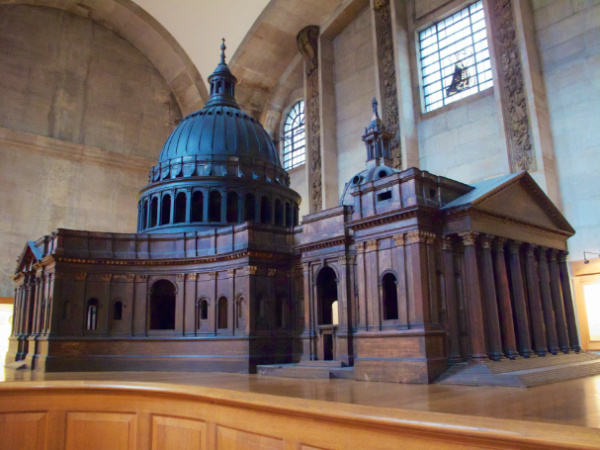
Housed now in the building it depicts, the Great Model of St Paul’s Cathedral was created by architect Sir Christopher Wren to show King Charles II what his proposed grand new English Baroque cathedral would look like (following the destruction of the medieval cathedral in the Great Fire of 1666).
Made of oak, plaster and lime wood, the model was made by William Cleere to Wren’s design in between September, 1673, and October, 1674, at a scale of 1:25. It measures 6.27 metres long, 3.68 metres wide and more than four metres tall, making it one of the largest in the UK.
The model, which cost about £600 to make – an extraordinary sum which could apparently buy a good London house, was designed to be “walked through” at eye level and, as well as being a useful way to show the King what the proposed building would look like, was also something of an insurance policy in case something happened to Wren.
It was based on drawings made by Wren and his assistant Edward Woodroofe on a large table in the cathedral’s convocation or chapter house (later demolished in the early 1690s) and was originally painted white to represent Portland stone with a blue-grey dome and gilded details.
There are some differences between the model and the finished cathedral – among them was a substantial extension of the quire, double-height portico on the west front, and, of course, the bell towers on the west front which were made in place of the cupola which was located halfway down the nave on the model.
Part of an earlier wooden model from 1671 also survives – it was apparently lost for many years and rediscovered in 1935.
The Great Model can be seen on tours of the Triforium.
WHERE: St Paul’s Cathedral (nearest Tube stations are St Paul’s, Mansion House and Blackfriars); WHEN: 8.30am to 4.30pm Monday to Saturday; COST: £21 adults/£18.50 concessions/£9 children/£36 family (these are walk-up rates – online advanced and group rates are discounted); WEBSITE: www.stpauls.co.uk (for tours, head to www.stpauls.co.uk/visits/visits/guided-tours)
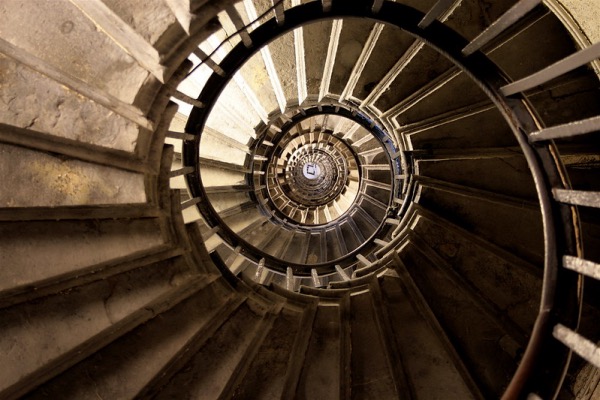
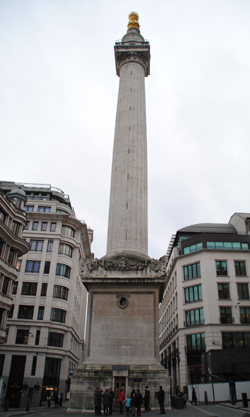
Running up the centre of the tallest free-standing stone column in the world, this 311 step stairway takes the visitor straight to the top of the Monument erected to commemorate the Great Fire of 1666.
The Monument
The Monument – actually a Doric column – was built close to Pudding Lane in the City – where the fire is believed to have started – between 1671 and 1677. It was designed by Sir Christopher Wren in collaboration with City Surveyor Sir Robert Hooke.
The cantilevered stairway – each step of which measures exactly six inches high – leads up to a viewing platform which provides panoramic views of the City. Above the platform stands is a large sculpture featuring a stone drum topped with a gilt copper urn from which flames emerge as a symbol of the fire (King Charles II apparently squashed the idea of an equestrian statue of himself lest people think he was responsible for the fire).
Interestingly, the circular space in the centre of the stairway was designed for use as a zenith telescope (a telescope which points straight up). There is a small hatch right at the top which can be opened up to reveal the sky beyond and a subterranean lab below (reached through a hatch in the floor of the ticket both) where it was envisaged the scientist could take measurements using a special eyepiece (two lenses would be set into the actual telescope). But it wasn’t successful (reasons for this could have been vibrations caused by passing traffic or the movement of the column in the wind).
Hooke also apparently attempted to use the staircase drop for some other experiences – including measuring differences in air pressure.
Among those who have climbed the stairs was writer James Boswell who visited the Monument and climbed the stairs in 1763. He suffered a panic attack halfway up but was able to complete the climb.
WHERE: The Monument, junction of Fish Street Hill and Monument Street (nearest Tube station is Monument); WHEN: Check website; COST: £5.40 adults/£2.70 children (aged five to 15)/£4.10 seniors (joint tickets with Tower Bridge available); WEBSITE: www.themonument.org.uk
• The largest collection of Spitfires gathered under one roof can be seen at the Imperial War Museum Duxford’s AirSpace hall. Twelve of the iconic planes have been gathered at the airfield, often referred to as the “home of the Spitfire”. Spitfire: Evolution of an Icon, which is being accompanied by a programme of tours, talks, events and family activities, shows how the plane evolved throughout World War II in order to keep pace with German aircraft development. As well as the IWM’s iconic Mk Ia Spitfire, the display also features Mk V, Mk IX and Mk XIV models. The Spitfires be seen until 20th February. Admission charge applies. For more including details of events, head to www.iwm.org.uk/events/spitfire-evolution-of-an-icon.
• A new exhibition focused on photographs of iconic 70s and early 80s band The Jam opens at the City of London Corporation’s Barbican Music Library tomorrow.True is the Dream features the photography of Derek D’Souza who has captured the band and frontman Paul Weller, who went on to found The Style Council, on film over several decades. D’Souza’s work include a career-defining shoot of the band at Chiswick House. The display is free to see until 16th May. For more, see www.barbican.org.uk/whats-on/2022/event/true-is-the-dream.
• The Waterloo & City line has reopened following a brief closure over Christmas. The London Underground line, which connects Waterloo to Bank, was temporarily closed by Transport for London in late December following increasing COVID cases in the capital and the impact on staff absence. Meanwhile, the Bank branch of the Northern line (between Moorgate and Kennington) for 17 weeks from 15th January to allow for upgrade works.
Buckingham Palace is among the sites across London which will be hosting events to mark Queen Elizabeth II’s Platinum Jubilee this June. The Queen’s 70th year on the throne will be marked with four days of celebrations across the June bank holiday weekend which will include the Queen’s Birthday Parade (known as Trooping the Colour), the lighting of Platinum Jubilee Beacons – including the principal beacon at Buckingham Palace, a Service of Thanksgiving at St Paul’s Cathedral, the ‘Platinum Party at the Palace’ – a celebration concert in the gardens of Buckingham Palace, The Big Jubilee Lunch in communities across the city, and a special Platinum Jubilee Pageant, part of which will see a moving river of flags rippling down The Mall. For more information, head to www.royal.uk/platinum-jubilee-central-weekend.
It’s 260 years ago this month that a supposed poltergeist known as the ‘Cock Lane Ghost’ was at the centre of an infamous scandal.
There had been several reports of strange sounds and spectral appearances at the property prior to January, 1762, but it was the events which took place that month which were to elevate the hauntings to the national stage.
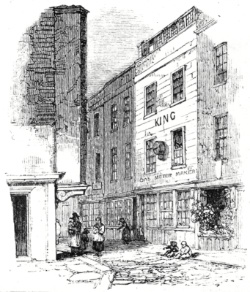
Cock Lane, shown in Charles Mackay’s 1852 work ‘Haunted Houses’. PICTURE: Via Wikipedia
It was in that month that Elizabeth Parsons, the 11-year-old daughter of Richard Parsons, the officiating clerk at St Sepulchre Church, reported hearing knockings and scratchings while she was lying in bed. Her father, Richard Parsons, the officiating clerk at nearby St Sepulchre, enlisted the aid of John Moore, assistant preacher at St Sepulchre and a Methodist, to find their cause and the two concluded that the spirit haunting the house was that of Fanny Lynes, who had formerly lived in the property before apparently dying of smallpox in early February, 1760.
The two men devised a system for communicating with the spirit based on knocks and based on the answers they received, concluded that Lynes had not died of smallpox but actually been poisoned with arsenic by her lover (and brother-in-law) William Kent.
Kent had been married to Fanny’s sister Elizabeth and after her death, he had lived with Lynes as man and wife despite prohibitions on them being married due to their status as in-laws. Parsons, who was their landlord at the time, had taken a loan from Kent while they were living at the property but subsequently refused to pay it back leading Kent to successfully sue him for its recovery.
It was against that backdrop – and earlier reports that the ghost of Fanny’s sister Elizabeth had haunted the property after her death – that the story of ‘Scratching Fanny’ began to spread and led to crowds gathering in Cock Lane to witness the phenomena. Writer Horace Walpole was among them – he attended along with Prince Edward, the Duke of York and Albany, and, apart from not hearing the ghost (he was told it would appear the next morning at 7am), noted that the local alehouses were doing a great trade.
Such was the case’s fame that the Lord Mayor of London, Sir Samuel Fludyer, ordered an investigation – among those who was involved was famed lexicographer Samuel Johnson. They concluded that the girl had been making the noises herself (Dr Johnson went on to write an account of it which was published in The Gentlemen’s Magazine). Further investigations were held – Fanny’s body even exhumed – and Elizabeth was later seen concealing a small piece of wood (apparently to make the sounds), subsequently confessing that her father had put her up to it.
Kent, however, was determined to clear his name and Moore, along with Parsons, Parson’s wife Elizabeth, Mary Frazer, a relative of Parsons, and a tradesman Richard James, were all subsequently charged with conspiracy to take Kent’s life by alleging he had murdered Frances. The trial, which took place at Guildhall before Lord Chief Justice William Murray, on 10th July, 1762, saw guilty verdicts returned for all five defendants. Moore and Richards agreed to pay Kent a sum of more than £500 but the others refused and so in February the following year they were sentenced – Parsons to three turns in the pillory and two years imprisonment, his wife Elizabeth to a year in prison and Frazer to six months hard labour in Bridewell.
The case, which also caused controversy between the new Methodists and Anglicans over the issue of ghosts, was widely referred to in literature of the time including by satirical poet Charles Churchill in his work The Ghost. It was also referenced by William Hogarth in his prints and Victorian author Charles Dickens even alluded to the story in A Tale of Two Cities.
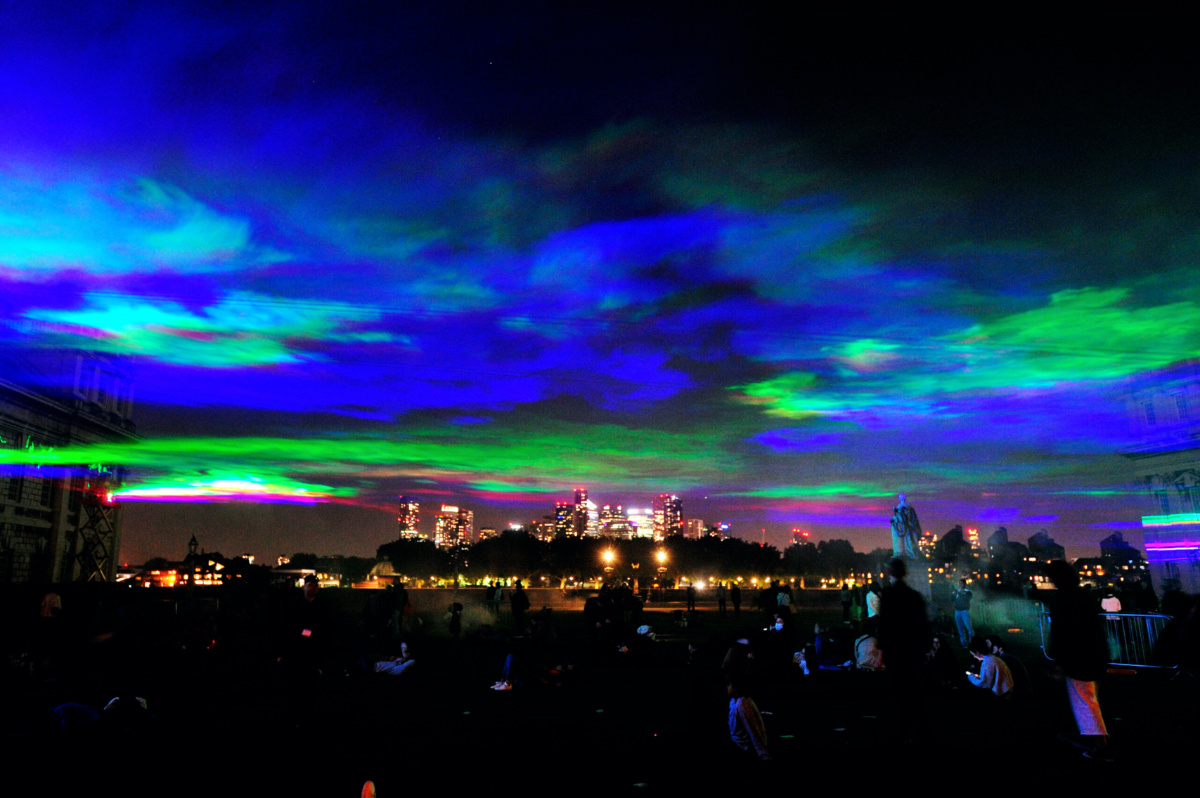
• A dazzling light show inspired by the Northern Lights – one of the seven natural wonders of the world – can be seen in the Guildhall Yard this December. Borealis – which can be seen between 11th and 22nd December – is the work of artist Dan Acher and is one of a number of light displays which is illuminating London this winter as part of Mayor Sadiq Khan’s ‘Winter Lights’ campaign. Others include an animal-themed display bringing to life the beasts that once lived at the Tower of London, an outdoor programme of installations and video art projections illuminating the Southbank Centre’s site, the ‘Illuminated River’ display lighting up nine of London’s bridges in what is be the longest public art project in the world, and a free Canary Wharf ‘Winter Lights Spectacular’ in January which will feature 20 new light commissions by some of the most innovative artists across the globe. In Grosvenor Square, Mayfair, thousands of illuminated white roses will form an ‘Ever After Garden’ designed by fashion designer Anya Hindmarch while traditional favourites like the Hyde Park Winter Wonderland as well as winter markets and ice rinks at locations like the Natural History Museum and Somerset House are also once again returning to the city. London’s red buses are an easy way to see the Christmas lights this year with routes 12, 94, 98, 139 and 390 all travelling through Oxford Circus. Free tickets to Borealis can be booked at www.visitlondon.com/Borealis while, for more on the best bus routes, see https://londonblog.tfl.gov.uk/festive-bus-routes/. For more information on all the light shows and events (some of which are already underway), see visitlondon.com .
• Costumes worn by then Princess Elizabeth and her sister Princess Margaret in wartime-era pantomimes are at the heart of a new display at Windsor Castle this Christmas. The princesses spent much of their time at Windsor during World War II – away from the Blitz in London – and, between 1941 and 1944, they performed in and helped to stage a series of pantomimes to raise money for the Royal Household Wool Fund which supplied knitting wool to make comforters for soldiers fighting at the front. Six of the costumes they wore have been brought together for the first time and are being displayed in the castle’s Waterloo Chamber where the pantos were originally performed. The costumes on show were worn in the last two pantos – Aladdin, which was performed in 1943, and Old Mother Red Riding Boots which was performed in 1944. Also on show are 16 large scale pictures of fairy-tale characters that were pasted around the walls to create the space for the performances. Visitors to Windsor this Christmas will also see State Apartments decorated for the festive season and a 20 foot high Christmas tree in St George’s Hall. The Semi-State Rooms, created for King George IV and now used for official entertaining, are also now open to visitors. The costumes can be seen until 31st January. Admission charges apply. For more on the Christmas activities at Windsor, including a ‘Mary, Queen of Scots at Christmas Family Activity Day’ on 18th December, see www.rct.uk/whatson/. Meanwhile, Buckingham Palace is offering guided tours of the State Rooms over winter with special family guided tours available for the first time. The tours run until 30th January. Admission charge applies. For more on the guided tours, head here and for more on the family tours, head here.
• The ancient Greeks’ pursuit of knowledge is the subject of a new exhibition which has opened at the Science Museum in South Kensington. Ancient Greeks: Science and Wisdom takes visitors on a journey in which they will sail the perilous seas with a statue of Hermes that was discovered on a shipwreck off the island of Antikythera, experience the lost music of the aulos instrument through interactive displays and an exclusive video that reimagines its ancient sounds, and gaze at the starry cosmos through ancient Greek eyes via a beautiful and rare silver globe depicting the known constellations and a Byzantine sundial-calendar – the second oldest known geared mechanism in the world. The free display can be seen until 5th June. Tickets are required – to book head to sciencemuseum.org.uk/ancient-greeks.
Send all items for inclusion to exploringlondon@gmail.com.
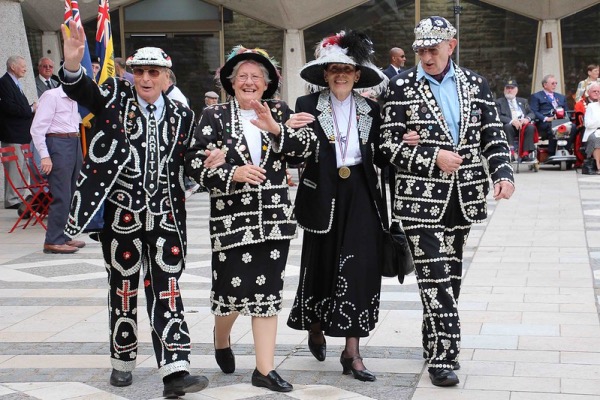
Pearly Kings and Queens at a Harvest celebration outside Guildhall in September, 2014. PICTURE: Maureen Barlin (licensed under CC BY-NC-ND 2.0)
Often simply called ‘Pearlies’, Pearly Kings and Queens are easily identified through their tradition of wearing clothes decorated with mother-of-pearl buttons.
The habit of wearing clothes decorated with mother-of-pearl buttons was adopted by London’s costermongers (street vendors) in the 19th century. The costermongers had a tradition of helping each other out during tough times and costermongers later elected “Coster Kings” to organise and represent them.
It was this tradition that street sweeper Henry Croft, who was raised in a workhouse orphanage in Somers Town, north-west of the City of London, is said to have drawn on when he created a suit completely covered in mother-of-pearl buttons in a bid to help his efforts to raise funds for the orphanage he grew up in (although some say he was inspired by the costumes of music hall ‘coster-singers’ who entertained crowds in music halls with cockney songs).
Such was Croft’s success at raising funds that hospitals and other charities subsequently asked him to fundraise on their behalf as well. The work soon grew beyond what Croft, who is often referred to as the first ‘Pearly King’, could personally handle and so many costermongers and others joined in his efforts giving birth to the broader movement.
By the early 20th century there were 28 ‘Pearly families’ in London, one for each borough. Pearly titles are pass down through families, a tradition which continues to this day (although there have been cases of Pearly families leaving their title behind as they left London which case it it awarded to someone new). There are a number of “pearly” organisations in London these days which engage in a range of charitable activities.
It’s also worth noting that the symbols, patterns and images on the pearly costumes have various meanings – a heart, for example, means charity. One of the key events the Pearlies take part in each year are Harvest festivals.
• The Lord Mayor’s Show returns to London this weekend after being cancelled last year due to the coronavirus pandemic. More than 6,500 people, 120 horses and more than 50 decorated floats are expected to take part in the event – which dates back to the 13th century – on Saturday. It comes a day after Alderman Vincent Keaveny, who has been elected as the 693rd Lord Mayor of the City of London, officially takes office tomorrow. Highlights in this year’s three mile-long procession include colourful full-size model elephants, Japanese taiko drummers, and a horse-drawn bus as well as a fire engine with a 210-foot extendable turntable ladder – the tallest in Europe. The procession, which will be watched by millions live on the BBC and through online streaming, will leave The Mansion House, the Lord Mayor’s official residence, at 11am. In honour of this year’s show, three of London’s Thames bridges – London, Cannon St and Southwark – are being lit specially for the occasion. For more, including details on where to watch the show, see www.lordmayorsshow.london.
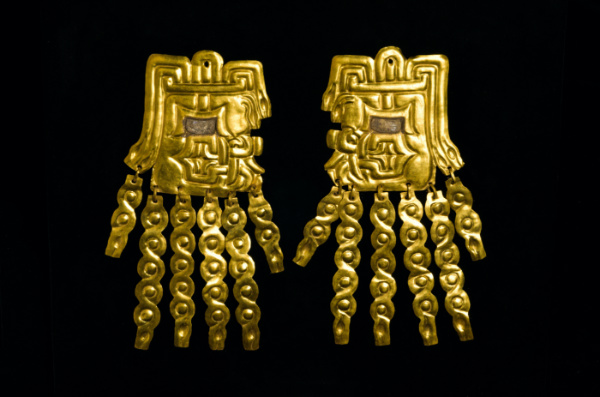
Gold alloy and shell ear plates with feline features, Peru, 800–550 BC. Museo Kuntur Wasi.
• More than 40 ancient objects from Peru are the centrepiece of a new exhibition which opened at the British Museum this week.Peru: a journey in time is the first major exhibition the museum has ever staged focused on Peru and coincides with the 200th anniversary of the country’s independence. The exhibition charts the rise and fall of six societies, from the early culture of Chavin in 1200 BC to the fall of the Incas in AD 1532. Highlights include a 2,500-year-old gold headdress and pair of ear plates which were part of an elite burial found at the site of Kuntur Wasi, Cajamarca, a ceremonial drum from around 100 BC-AD 650 featuring a depiction of the capture of defeated enemies in ritual combat, and, the oldest object on loan – a ceremonial vessel from the Cupisnique culture in the shape of a contorted human body, which dates from up to 1200 BC. The display can be seen until 20th February, 2022, in the Joseph Hotung Great Court Gallery. Admission charge applies. For more, see www.britishmuseum.org.
• Streatham Hill Theatre in London’s south is among buildings added to Historic England’s ‘Heritage at Risk’ register for this year. Opened in 1929, the Grade II-listed building was designed by William George Robert Sprague and is described as an “unusually lavish example of a theatre built outside of the West End”. Other London buildings on the list include everything from a Toll Gate House in Spaniards Road, Highgate, to Alexandra Palace in Wood Green, and churches such as St Mary Woolnoth in the City of London. Meanwhile, among the sites removed from the list this year after being “saved” are the Battersea Power Station, first added to the list in 1991 and in recent years the subject of a major redevelopment, and former public conveniences at Guilford Place, Lamb’s Conduit Street, in Bloomsbury, which have been “sensitively transformed into a cosy wine and charcuterie bar”. For more, see https://historicengland.org.uk/whats-new/news/heritage-at-risk-2021/.
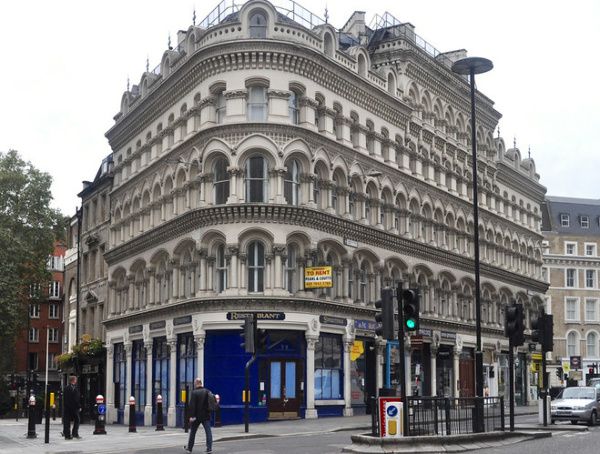
Sweetings Restaurant (ground floor) in the Albert Buildings, Queen Victoria Street. PICTURE: Phil Beard (licensed under CC BY-NC-ND 2.0)
London’s oldest seafood restaurant is generally said to be Sweetings, the origins of which go back to the opening of John S Sweetings, Fish and Oyster Merchant, in Lad Lane, Islington, in 1830.
Additional premises at 159 Cheapside and 17 Milk Street soon followed, promoted as “Very Superior Oyster Rooms”. In 1889, Sweetings Restaurant opened at its present site at 39 Queen Victoria Street, inside the Grade II-listed Albert Buildings which was constructed in 1871 and the shape of which (if not the scale) has been compared to New York City’s Flatiron Building.
The food aside, Sweetings is famous for its signature ‘Black Velvet’, a mix of champagne and Guinness which was created in 1861 in response to the death of Prince Albert.
Famous patrons have reportedly included the French painter Henri de Toulouse-Lautrec as well as the late George Francis, reportedly an associate of the Kray twins, who is said to have offered £1 million to buy the restaurant (an offer which was refused).
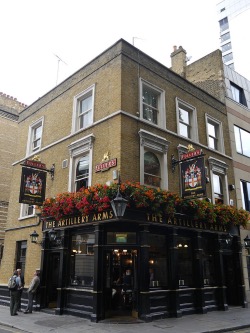
This City of London pub is located opposite the Bunhill Fields Burial Ground, final resting place of the likes of Daniel Defoe, John Bunyan and William Blake, and dates from the 1850s.
Originally known as The Blue Anchor, it – under the landlord ship of Jemmy Shaw – was once notorious for the “sport” of rat-baiting which usually involved betting how long a dog would take to kill a rat and which apparently became popular after the 1835 Cruelty to Animals Act banned bull baiting, cock fighting and dog fighting.
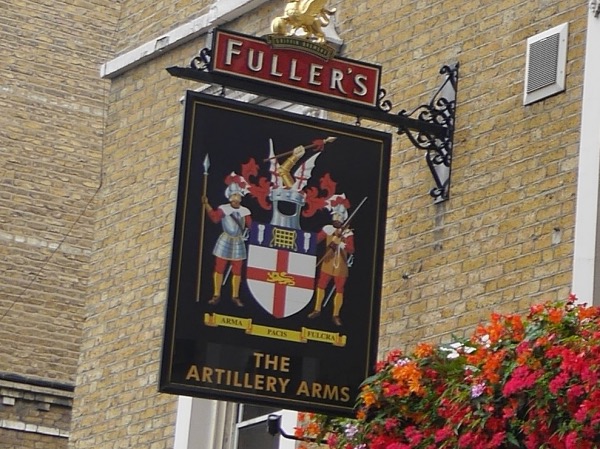
The name of this premises at 102 Bunhill Row comes from the nearby location (just ton the south on the other side of the road) of the Honourable Artillery Company, which was incorporated by a Royal Charter issued by King Henry VIII in 1537 located here since the mid-17th century. The company’s coat-of-arms are on the pub’s sign.
St John Houghton is remembered as the first Catholic Englishman to have been executed for refusing to take the oath prescribed by King Henry VIII’s Act of Supremacy.
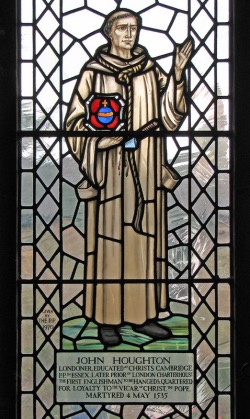
Stained glass depicting St John Houghton in St Etheldreda’s Catholic Church in Ely. PICTURE: Lawrence OP (licensed under CC BY-NC 2.0)
Houghton was born around 1487 and is believed to have been educated at Cambridge, becoming ordained around 1511 before he entered the London Charterhouse in 1515 or 1516. By 1523, he held the position of sacristan and in 1528 that of procurator before, in 1531, he was transferred to Beauvale Priory in Nottinghamshire to serve as its prior.
But he returned to London in November that same year when he was unanimously elected Prior of the London Charterhouse. The following year was named Visitor of the English Province for the Carthusian Order.
When the King’s agents visited in April, 1534, requiring the community to take an oath as required under the 1534 Act of Succession (which excluded Katherine of Aragon’s daughter Mary in favour of Anne Boleyn’s daughter, Elizabeth), Houghton asked that the community be exempted.
Such a request was not looked upon kindly and Houghton, along with his procurator, Humphrey Middlemore, was arrested and taken to the Tower of London. Subsequently convinced that the oath was consistent with their Catholic faith by fellow clerics, the two returned to the Charterhouse in May, and there, in the presence of an armed force, the whole community eventually took the oath.
But in 1535, the community was again required to take an oath – this time recognising King Henry VIII as the Supreme Head of the Church of England as required by the 1534 Act of Supremacy. But Houghton, along with the heads of the other two English Carthusian houses – Robert Lawrence, Prior of Beauvale, and Augustine Webster, Prior of Axholme – sought an audience with Thomas Cromwell and asked for an exemption. All three were sent to the Tower.
The three men were interrogated by Cromwell on 26th April and then, a few days later, were called before a special commission and sentenced to death.
Houghton was among five clerics – along with the other two Carthusian priors as well as Bridgettine monk Richard Reynolds and John Haile, the parish priest of Isleworth – who were dragged through the streets to Tyburn on 4th May. There, Houghton – wearing his religious habit – is said to have embraced his executioner as he recited the words of the 31st Psalm before he was the first to be hanged, drawn and quartered.
Catholic tradition says that when Houghton’s body was cut open to remove his heart, he said to have prayed: “O Jesus, what wouldst thou do with my heart?”
Pieces of Houghton’s body were then displayed around London – his head was displayed above London Bridge and his arm was nailed to the gate of the Charterhouse,
Houghton was beatified on 9th December, 1886, and canonised in 25th December, 1970. He is considered one of the 40 Catholic Martyrs of England and Wales, all of whom were executed between 1535 and 1679 during the English Reformation.
• The extraordinary story of 18th century foundling and sailor George King, who fought in the Battle of Trafalgar, is the subject of a new exhibition opening at the Foundling Museum in Bloomsbury tomorrow.Fighting Talk: One Boy’s Journey from Abandonment to Trafalgar features King’s hand-written account of his life, a fragment of the flag from Nelson’s coffin, letters between the Foundling Hospital’s matron and Lady Emma Hamilton (annotated by Nelson himself) and two rare Naval General Service Medals, of which only 221 were awarded retrospectively when the medal was first issued in 1849, belonging to King and the foundling William South, who served aboard HMS Victory. There is also a display of works by contemporary artist and photographer Ingrid Pollard – Ship’s Tack – which reflects on the Foundling Hospital’s connections with Empire, trade and the Navy and which includes newly commissioned work responding directly to George’s autobiography. Runs until 27th February. Admission charge applies. For more, see www.foundlingmuseum.org.uk.
• Two Guildhall statues portraying figures with links to the slave trade will be retained but have information added detailing those links. The City of London Corporation’s Court of Common Council voted last week to keep the statues of William Beckford and Sir John Cass which will have plaques or notices placed alongside them containing contextual information about the two men’s links to slavery. William Beckford was an 18th century slave owner and two-time Lord Mayor of London, while Cass – an MP and philanthropist – was a key figure in the Royal African Company, which traded in slaves in the 17th and 18th centuries. Sir John Cass’s Foundation Primary School in the City and the nearby Cass Business School have already changed their names to remove the association with their founder and his links to slavery.
• French underwater photographer and biologist Laurent Ballesta has won the Natural History Museum’s Wildlife Photographer of the Year for an image showing camouflage groupers exiting their milky cloud of eggs and sperm in Fakarava, French Polynesia. The image was selected out of 50,000 entries from 95 countries and is being displayed with 100 images in an exhibition opening at the museum on Friday. Meanwhile 10-year old Vidyun R Hebbar, who lives in Bengaluru, India, was awarded the Young Wildlife Photographer of the Year 2021 for his colourful image, Dome home, showing a tent spider as a tuk-tuk passes by. The exhibition can be seen until 5th June next year. Admission charge applies. For more, see www.nhm.ac.uk/visit/exhibitions/wildlife-photographer-of-the-year.
Send all items for inclusion to exploringlondon@gmail.com.
Not to be confused with the Mayor of London (a position currently held by Sadiq Khan, the Mayor is the head of the Greater London Authority – more on that in a later post), the Lord Mayor of London serves as the head of the City of London Corporation which governs the Square Mile.
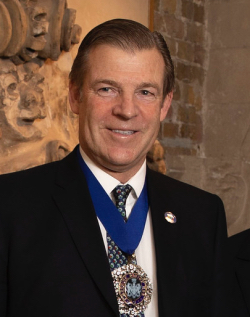
Lord Mayor of London William Russell in February, 2020. PICTURE: Bank of England (licensed under CC BY-NC-ND 2.0/image cropped)
The Lord Mayor of London is generally elected annually (last year was an exception due to the coronavirus pandemic) by members of the City’s livery companies who are summoned by the previous Mayor to meet at at Guildhall on Michaelmas Day (29th September) or on the closest weekday
The Lord Mayor is subsequently sworn into office in November in an event known as the ‘Silent Ceremony’ because, aside from a short declaration from the incoming mayor, no speeches are made. The following day, the Lord Mayor participates in a procession from the City of London to the Royal Courts of Justice in the City of Westminster, where they swear allegiance to the Crown. The event is known as the Lord Mayor’s Show (this year it’s being held on 13th November).
Lord Mayors must be one of the City of London’s 25 alderman (elected to represent the City’s wards) and must first served as one of the City’s two sheriffs prior to taking on the position – the sheriffs support the Lord Mayor in their role as advisors. They also host dinners for visiting dignitaries, accompany the Lord Mayor in their business travels and look after the judges at the Old Bailey.
The first Lord Mayor is said to have been Henry FitzAilwin, who served between 1189 and 1212. The current Lord Mayor, William Russell, is the 692nd to hold the post. Until 1354, the title was simply Mayor of London.
The role of the Lord Mayor these days is to serve as an international ambassador for the UK’s financial and professional services sector.
The official residence of the Lord Mayor is called the Mansion House. It is used for some of the City’s official events.
• Visitors to Kew Gardens are being invited to immerse themselves in the art, plants and culture of Japan in a month long celebration of the Asian nation. The Japan Festival kicks off this Saturday in Kew’s Temperate House and features at its heart a large-scale artistic installation by Japanese artist Chiharu Shiota entitled One Thousand Springs which is constructed of 5,000 haikus submitted by members of the public. There will also be a specially commissioned Chalk Garden – a contemporary response to a Japanese garden showcasing native plants including grasses, shrubs and trees – as well as a display showcasing six different chrysanthemums, Japan’s national flower, and an immersive soundscape by sound artist Yosi Horikawa featuring the natural sounds of the rivers and waterfalls of Kagoshima, atmospheric soundscapes from the Cedar mountains of Gifu and bird calls set across the waves of the Philippine Sea. The Temperate House will also be illuminated for Japan: After hours featuring a varied programme of dance, theatre, and live music performances as well as traditional flower arranging and sake sipping. The festival, supported by Daikin UK, runs to 31st October. Admission charge applies. For more, see www.kew.org.
Sky Brown from Great Britain during women’s park skateboard at the Olympics at Ariake Urban Park, Tokyo, Japan on August 4, 2021. PICTURE: Ulrik Pedersen/NurPhoto via Getty Images.
• Thirteen-year-old Olympian Sky Brown’s skateboard, children’s garments created by sustainable fashion designer, humanitarian and artist Bethany Williams, and Open Bionics’ 3D printed prosthetic, The Hero Arm, are among new acquisitions to be displayed at what was the former V&A Museum of Childhood. Now renamed the Young V&A, the Grade II* Bethnal Green institution is undergoing a £13m transformation ahead of reopening in 2023. The new interior fit-out, by firm AOC Architecture, will include three new galleries – Play, Imagine and Design – as well as interactive collection displays, a suite of dedicated learning workshops, an in-gallery design studio for visitors, and a new café and shop.
• The late Princess Diana has been honoured with an English Heritage Blue Plaque at her former flat in Kensington. Flat 60, Coleherne Court, Old Brompton Road, was her home between 1979 and 1981 during her courtship with Prince Charles. She shared it with three friends including Virginia Clarke who was at the unveiling ceremony this week. Diana, who died aged 36 in a Paris car crash in 1997, described her years at the property as “the happiest time of her life”, according to biographer Andrew Morton’s book Diana, In Her Own Words.
• Vincent Keaveny was this week elected as the 693rd Lord Mayor of the City of London. Alderman Keaveny succeeds Lord Mayor William Russell, who served a second year in office after his term was extended to ensure continuity of leadership during the current COVID-19 pandemic (the last time a Lord Mayor served a second year in office was in 1861 when William Cubitt was re-elected). The annual Lord Mayor’s Show is scheduled for Saturday, 13th November, and will be followed by Lord Mayor’s Banquet at Guildhall on 15th November.
One Night Light Show by Leo Villareall as part of Totally Thames. PICTURE: Totally Thames.
• Totally Thames, the annual month-long celebration of London’s river, is celebrating its 25th iteration this month. Highlights this year include Leo Villareal’s Illuminated River which lights up the Thames every night (along with a special three-day celebration including guided tours, talks, sketching workshops and a one-off illumination event on 23rd September) as well as the chance to explore the foreshore with ‘Mudlarking’ at St Paul’s Cathedral, take a deep dive into the history of dockside communities with ‘The Islanders’ and see river-themed art from children across the globe come together at the National Maritime Museum in Rivers of the World. More than 80 events are included in the programme which runs until the end of the night. For more, see https://thamesfestivaltrust.org/whats-on.
• Muppet creator Jim Henson was honoured with an English Heritage Blue Plaque at his former Hampstead home this week. Henson lived in the home at 50 Downshire Hill between 1979 and 1982 and continued to use it as his base until his death in 1990. It stands opposite the former ‘Jim Henson’s Creature Shop’, where creatures from fantasy films including The Dark Crystal, The Storyteller and Labyrinth were created. Henson’s son Brian, chairman of the board at The Jim Henson Company, said it was an honour to have the property recognised, “knowing that he so admired and respected the talent in London, and that this is the place he called home when creating some of his most memorable productions.” For more, see www.english-heritage.org.uk/visit/blue-plaques/.
• Beerfest-Lite takes place in Guildhall Yard in the City of London today. The event , which runs from noon to 9pm – features beers from the Meantime, Windsor and Eaton, Hook Norton and Shepherd Neame breweries and a street vendor menu including paella, hot dogs, souvlaki and Caribbean dishes as well as a jazz performance from the Alvar Tree Frogs and Bavarian Oompah band Würst Brass. For more, see www.citybeerfest.org.
Piccadilly Circus lies at the heart of London’s West End. PICTURE: Sheep purple (licensed under CC BY 2.0)
This term is used to describe what was traditionally the western end of London as it developed beyond the City of London boundaries and has since became a word synonymous with the city’s theatre district.
The term’s origins are lost to history although it’s said it first started being used in earnest to describe fashionable areas to the west of Charing Cross in the late 17th or early 18th centuries. The term as it’s used today covers an area which contains the commercial and entertainment heart of London.
While the eastern boundary of the West End can be easily defined as where the City of London ends (Temple Bar on the Strand marks the City of London’s boundaries), thanks to its not being a formally designated geographic area, exactly where the West End finishes is a matter of considerable debate.
While the some see the West End only including Theatreland itself – an area stretching from Aldwych across to Piccadilly Circus and north from Trafalgar Square to Oxford Circus, others have adapted a broader definition which sees include not only Aldwych, Soho and Covent Garden but also Mayfair, Fitzrovia and Marylebone with Oxford Circus at the centre (some even go further and include districts such as Bloomsbury and Knightsbridge in their definition of the West End).
John Brodie Donald, the creator of the Lost London Churches Project, talks about how the project came about, its aim and his personal favourite “lost” church…
1. First up, when you talk about London’s “lost churches”, what do you mean by the expression? “Of the 108 churches in the City of London in 1600 only 39 remain. The rest have been lost in the last 350 years, either destroyed in the Great Fire of London in 1666 or in the Blitz or demolished by commercial developers as property prices soared.”
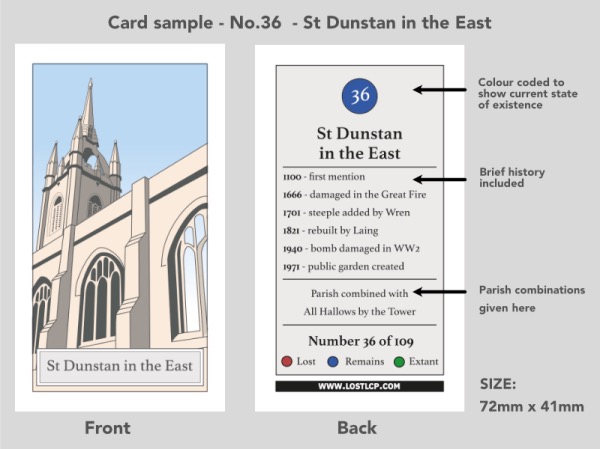
2. What is the aim of the Lost London Churches Project? “The Lost London Churches Project aims to promote interest in the ancient church buildings and parishes of the City of London through collectable cards, books, maps and downloadable explorers walks. We have created a ecclesiastical treasure hunt – a way of exploring the history of the square mile that costs nothing and can be easily fitted into a few spare lunchtimes.”
3. How many churches are included in the project? “There are 78 churches for which collectable cards have been produced and these are available in a growing number of churches in the City. It is hard to find evidence of what the churches lost in the fire of 1666 looked like, but hopefully after further research these will be included in a second edition. “
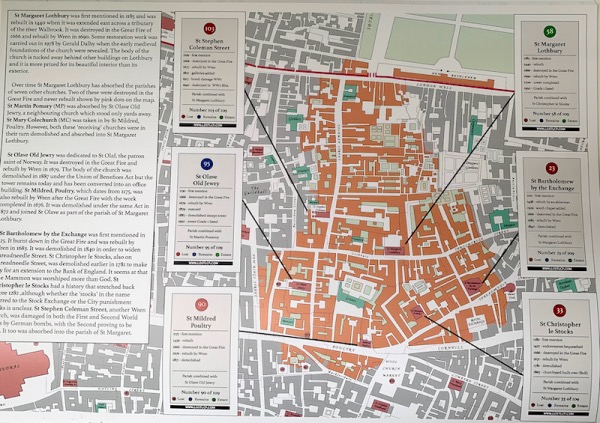
4. Does the project cover every “lost” church in the City of London? “It covers not just ‘lost’ churches but also the extant ones for two reasons. First, because those who are collecting the cards need a place to pick them up which they can do in the churches that still exist. Secondly, although the church buildings were lost, the parishes still remain to this day for administrative reasons. Every one of the 109 churches still has a parish clerk. The parishes have been amalgamated with the existing churches. So, for example, St Vedast in Foster Lane is a church of 13 united parishes having acquired them as the church buildings were lost over the centuries.”
5. Tell us how the Lost London Churches Project came about? “It all started when I was redrawing the Ogilby and Morgan map of 1676 in colour for my own pleasure. This large scale map (100 feet the inch) shows every single house in the City of 350 years ago. It was completed just after the Great Fire and so shows the location of all the lost churches clearly. The original covered 20 separate black and white sheets but I redrew them all joined together in colour on my computer. The end result was so huge it was impractical to print…So it made sense to break it up and publish in a book, and since the most interesting information in the map was the churches lost in the fire. it became the basis for the collectors book for the Lost London Churches project. At the same time, I was going through my late father’s papers and found a booklet of cigarette cards that he had collected in the 1940s. He also had a passion for painting watercolours of churches. That’s when I had the idea of producing a series of ‘cigarette cards’ showing the lost churches and the project was born.”
6. What’s the role of the cards? “The role of the cards is to give some tangible treasure to collect while exploring the lost churches. Like trading cards or Pokemon the challenge is – can you collect them all? In every participating church you will be able to pick up that church’s card along with a pack of five random cards for a small voluntary donation. Cards are also available from the project’s website lostlcp.com.”
7. You mentioned earlier that there were a number of ways the City of London’s churches become lost? “They were lost in three phases. Around 85 were destroyed or damaged in the Great Fire of 1666 of which 34 were never rebuilt. The others were rebuild by Christopher Wren, along with St Pauls Cathedral. Then 26 more churches were lost after the Union of Benefices Act of 1860 triggered a second wave of demolition. The purpose of the act was to combine parishes and free up space for the swelling capital of the British Empire. Lastly, the City suffered badly in the Blitz of World War II which took a further toll on these ancient buildings.”
8. How easy is it to spot remnants of the City’s lost churches? “Though the buildings are lost, the parishes remain and you can still see the old parish boundary markers even on modern buildings. The best place to see an example of these is to walk down Cheapside along the New Change shopping centre towards the church of Mary le Bow. In only 100 or so yards you will have crossed the boundaries of five different parishes; St Vedast Foster Lane, St Matthew Friday Street, St Peter Westcheap, All Hallows Bread Street and St Mary Magdalene Milk Street. As you walk down the street look up above the shops ( see picture below) and you will see little plaques marking these parish boundaries. These type of parish boundary markers are scattered throughout the City. Our downloadable explorers walks on Google Maps available (for free) on our website lostlcp.com will show you some routes to find them. There is also a A4 sized map of the ancient parishes we have published for you to use as a guide.”
Parish markers on a building on Cheapside and, inset, in detail.
9. Have you uncovered any particularly interesting stories in your research into London’s lost churches? “I think one the most interesting things is the unusual names and how they were derived: Benet Fink, Stephen Coleman, Mary Somerset, Martin Ludgate and Gabriel Fenchurch. Couldn’t these be the names in an Agatha Christie mystery where the key to the murder is church themed aliases? But seriously, every church has a rich history since most were established before 1200 so in visiting them you are trekking right back to medieval times.”
10. And lastly, do you have a favourite “lost” London church? “My favourite is St Mary Abchurch just off Cannon Street. It is not only the headquarters of the ‘Friends of the City Churches’ charity but also a perfect jewel of a Wren church with the most glorious painted ceiling – like a secret Sistine chapel!”
• The 25 metre high viewpoint in the grass and tree covered Marble Arch Mound opens to visitors on Monday. Created by Westminster City Council, the mound – which has been designed by Dutch architectural studio MVRDV, provides expansive views of Oxford Street, Hyde Park, Mayfair and Marylebone. Visitors can either climb the 130 stairs to the top or take a lift. The mound will be open to the public until January next year. Ticket holders are also invited to visit W1Curates art installation Lightfield, led by British/American artist, Anthony James, which is located inside the mound. For more information and to book tickets, see www.westminster.gov.uk/news/get-set-summit-marble-arch-mound-summer.
• The history, art and culture of the Native Americans who met the passengers of the Mayflower is explored in a new exhibition at the Guildhall Art Gallery. Opening on Friday, Wampum: Stories from the Shells of Native America centres on a newly-crafted wampum belt created by the Wampanoag people of Massachusetts alongside historic material from the British Museum. Wampum belts are the creative expression of the Wampanoag people, with each shell on the belt imbued with memory and meaning. The display is presented by The Box, Plymouth, and supported by Arts Council England as part of commemorations of the 400th anniversary of the sailing of the Mayflower from England to America. Runs until 5th September. Entry is free (booking required). For more, head here.
• On Now: Paula Rego. This exhibition at Tate Britain – the largest retrospective of Paula Rego’s work to date – features more than 100 works including collage, paintings, large-scale pastels, drawings and etchings as it showcases the career of the Portuguese-born artist. As well as early work from the 1950s, the display features her large pastels of single figures from the acclaimed Dog Women and Abortion series and richly layered, staged scenes from the 2000s. Runs until 24th October. Admission charge applies. For more, see www.tate.org.uk/whats-on/tate-britain/exhibition/paula-rego.
Send all items for inclusion to exploringlondon@gmail.com.







 Exploring London