10 of London’s greatest Victorian projects – 8. London’s railways…

London’s railway network stands out as one of the greatest achievements of the Victorian age for it was during the 19th century that much of the railway infrastructure still in use today was first established.
St-PancrasThe first railway line in London opened in February 1836 (six years after the UK’s first line opened) and ran between Spa Road in Bermondsey and Deptford on the south bank of the River Thames. The line was extended to London Bridge in December that same year and again to Greenwich, from cross-Channel steamers left – in April the following year.

That same year – 1837 – the station at Euston opened as the final stop for trains from Birmingham (an earlier terminus as Chalk Farm was deemed too far out). It was followed by Paddington in 1838, Fenchurch Street – the first permanent terminus in the City – in 1841, Waterloo in 1848 and King’s Cross in 1850.

Having seen a boom period during the 1840s, development of new lines took a back seat in the 1850s but resumed apace the following decade with the opening of Victoria Station, connecting the city to Brighton and Dover. Stations followed at Charing Cross, Ludgate Hill and Cannon Street and alongside the grand terminus’ around the outskirts of London where trains arriving from distant destinations arrived, numerous smaller railways began to be built, such as the West End of London and Crystal Palace Railway and the Victoria Station and Pimlico Railway, which took passengers on only short journeys across the city (these smaller railway companies all disappeared by 1923 when the 1921 Railways Act resulted in the creation of what are known as the “Big Four” British railway companies).

And, of course, the London Underground, has its first journey in 1863 but we’ll look at that in more detail next week.

Interesting to note that there were three classes of rail travel and while first and second class passengers had seats, this wasn’t always the case in third class where, writes Michael Paterson in Inside Dickens’ London, passengers, such as those on the Greenwich line, were initially forced to stand in open topped carriages known by some as ‘standipedes’.

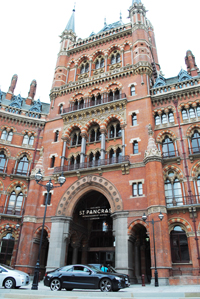
Naturally, with the building of the railways came some spectacular stations – among the most spectacular is the late Victorian building which stood at the front of St Pancras Railway Station and housed the Midland Grand Hotel (pictured above). An exemplar of the Gothic Victorian style, it was designed by Sir George Gilbert Scott and, following a massive recent refurbishment, is now home to the five star Renaissance London Hotel and apartments.

We can, of course, only touch on the history of the railways in such a brief article – but we will be looking in more detail at some more specific elements of the system in later posts.
London Pub Signs – Doggett’s Coat and Badge…

Perhaps not so much a sign as a pub name, the strangely monikered Doggett’s Coat and Badge in South Bank is named after a rowing race – said to be the oldest continuous sporting event in the country – in which apprentice waterman traditionally competed for a prize consisting of waterman’s coat and badge and named after Irish-born actor and theatre manager, Thomas Doggett.

The race – which is held in July and runs over a course of four miles and seven furlongs from London Bridge to Chelsea (the starting and finishing points were originally both marked by pubs called The Swan) – was first held in 1715 when it was first organised by Doggett who financed it up until his death in 1721 after which he left instructions in its will for it to be carried on by The Fishmongers’ Company (which it still is today).

While there’s a nice story that Doggett, who managed the Drury Lane Theatre and later the Haymarket Theatre and carving out a name for himself as a ‘wit’, started the race as thanks to Thames watermen for rescuing him when he fell off a watercraft while crossing the Thames, Doggett – a committed Whig – actually started the race to commemorate the ascension of King George I – the first ruler of the House of Hanover – on 1st August, 1714, following the death of Queen Anne.

This year’s race winner was Merlin Dwan (London Rowing Club) who beat four others to finish in 24 minutes, 28 seconds.

The pub, one of the Nicholson franchise, is located in a multiple storey modern building complex and sits along the course of the race in South Bank. It features a range of bars including Thomas Doggett’s Bar and the Riverside Bar as well as a dining room and other function rooms.

For more on the pub, see www.nicholsonspubs.co.uk/doggettscoatandbadgesouthbanklondon/. For more on the race (which we’ll be mentioning, along with more on Thomas Doggett, in more detail in upcoming posts), see www.DoggettsRace.org.uk.

10 Historic London Markets – 1. Borough Market…

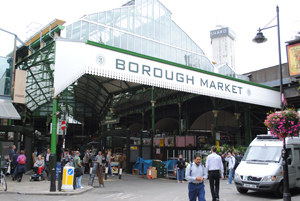
In the first of a new series looking at some of London’s most historic markets, we take a look at the history of Borough Market in Southwark, now the city’s most famous food market.

The origins of a food market in the area go back to at least to the reign of the Anglo-Saxon King Ethelred the Unready in early 11th century (some have suggested as far back as Roman times) with food vendors clustering around the southern end of London Bridge. The market was relocated to Borough High Street in the 1200s.

In 1755, traffic congestion saw Parliament close the market but Southwark residents raised £6,000 and bought a small area of land known as The Triangle – once part of the churchyard of the now long gone church of St Margaret’s – and reopened the market there.

The Triangle still remains at the heart of the market which sits partly under railway arches just to the south of the Southwark Cathedral churchyard. New market buildings were constructed in the mid 1800s but deemed “impractical”, they were replaced by new buildings in the late 1800s and 1930s (the latter was when the art deco entrance on Borough High Street was erected).

The market was refurbished in 2001 and the ornate Grade II-listed Floral Hall, which was originally the south portico on the Floral Hall at Covent Garden (taken down to make way for the Royal Opera House), was installed in 2003.

There are now more than 100 stalls in the wholesale and retail food market, making it one of the largest in London. It is owned by a charitable trust, The Borough Market (Southwark), with the volunteer trustees all local residents. Sections in the market include the Jubilee Market and the Green Market and a blue plaque, declaring the market London’s “oldest fruit and veg market”, was installed by Southwark Council earlier this year.

The amazing variety fine food on offer will tempt even the most jaded of palates but be warned that you have to queue as it can get a little packed with tourists at lunchtimes!

WHERE: 8 Southwark Street (nearest Tube Stations are London Bridge or Borough); WHEN: 10am to 3pm Monday to Wednesday, 11am to 5pm Thursday, 12pm to 6pm Friday, and, 8am to 5pm Saturday; COST: Free entry; WEBSITE: www.boroughmarket.org.uk

Around London – The Shard celebrates; Crossrail archaeology; new sheriffs named; and, Blackpool at Wellington Arch…

• Europe’s tallest building marks the completion of its exterior structure today with a spectacular light show. The Shard, a £450 million development located over London Bridge Station in Southwark, stands 310 metres tall and was designed by Italian architect Renzo Piano. The controversial glass clad structure, work on which commenced in 2009, features a jagged top with the design reportedly referencing the city’s many church spires. While the exterior of the building is now complete, work is expected to continue on the building’s interior – which will contain offices, luxury shops and restaurants, a five star hotel and 10 top-end apartments (the highest in the UK) – until next year. It is expected that the building’s viewing decks – which offer panoramic 360 degree views over the city – will become a major new tourist attraction in the city. The Shard will be formally opened today by Qatari Prime Minister Hamad bin Jassem al-Thani and Prince Andrew, Duke of York. The hour long light show, which features lasers and searchlights, kicks off at 10pm and those who can’t see it in person can watch it streamed live at the-shard.com.

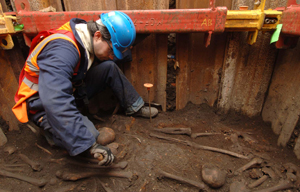
• A skeleton from the St Bethlehem Burial Ground and 55 million-year-old fragments of amber are among the artefacts which will go on display this Saturday at a special public exhibition of archaeological discoveries made during the construction of Crossrail. Almost 100 objects found at 10 different sites will be in the Bison to Bedlam – Crossrail’s archaeology story so far exhibition which marks the halfway point of the Crossrail archaeology program, first launched in 2009. Finds have dated from prehistoric times through to the Industrial Revolution and, as well as those aforementioned, also include some medieval ceramic wig curlers, 17th century gravestone markers and stakes made out of animal bone. All the items will be eventually donated to the Museum of London or Natural History Museum. The exhibition will be held from 10am to 5pm this Saturday at the Music Room, Grays Antiques, 26 South Molton Street (nearest Tube station is Bond Street). For more, see www.crossrail.co.uk.

• Alderman Jeffrey Evans (Ward of Cheap) and Nigel Pullman have been elected the new sheriffs of the City of London in a poll held late last month. The office of the sheriffs dates back to the Middle Ages – current duties include assisting the Lord Mayor of London in his official duties and attending sessions of the Central Criminal Court at the Old Bailey. The two new sheriffs take up their post in late September.

• On Now: Blackpool: Wonderland of the World. A new exhibition held in the Quadriga Gallery at the Wellington Arch, Hyde Park Corner, this looks at how Blackpool transformed in the 19th century from a small village to become became the first resort in the world to cater for the working classes. Focusing on two of the town’s key attractions – the Winter Gardens and the Blackpool Tower – the exhibition’s highlights include a silver model of Blackpool Tower dating from 1893, rare Victorian and vintage posters advertising performances by some of the stars who shone there, and early 20th century photographs of the interiors of the Winter Gardens. In addition, two crowns will illuminate the top of Wellington Arch in a taste of Blackpool’s famous light show. Organised by English Heritage in partnership with Blackpool Council, it runs until 27th August. Admission fee applies. See www.english-heritage.org.uk/daysout/properties/wellington-arch/exhibitions-at-the-arch/current-exhibition/ for more.

LondonLife – Sunset over The Shard…


Says the photographer, Ed Walker: “The picture was taken from my girlfriend’s roof garden in New Cross using a 50mm prime lens. I’ve been experimenting with increasing clarity in my pictures to bring out the textures and sharpness especially in landscapes. With the reds, yellows and purples in the sky the cityscape contrasts perfectly.” For more of Ed’s work, follow this link www.flickr.com/photos/spooke/7191263460/in/set-72157629741433536.

Taken an interesting photograph of somewhere in London? We’re always looking for interesting images of the city so if you’ve got one you reckon captures a snippet of life in London, please contact us at exploringlondon@gmail.com or via our new Flickr group at www.flickr.com/groups/exploringlondon/