This Week in London – Italian Cast Court reopens at V&A; Christmas Past at the Geffrye; and, last call for NYE celebrations…

Weston-Cast-CourtThe V&A’s spectacular Italian Cast Court will reopen on Saturday after the completion of the first phase in the museum’s programme of renovating its day-lit courts. The Italian court, which has been renamed the Weston Cast Court, features more than 60  19th century reproductions of Italian Renaissance monuments including a five metre high cast of Michelangelo’s David, a cast of the massive Gates of Paradise from Florence Cathedral, a plaster cast of a pulpit from Pisa Cathedral and a monumental cast of Jacopo della Quercia’s great arch from the Basilica of San Petronio in Bologna. The displays have been reconfigured with a new interpretation following extensive examination and preservation of the collection during the gallery’s renovation. The two cast courts at the South Kensington-based museum first opened in 1873. Entry is free. For more, see www.vam.ac.uk. PICTURE: © Victoria and Albert Museum.

The annual ‘Christmas Past’ exhibition – in which 11 period rooms have been decorated in period style for the Christmas season – opened at the Geffrye Museum in Shoreditch this week. Along with the chance to see how Christmas looked in bygone years, there’s a series of Christmas-themed events including “A Georgian Christmas” on 4th December, “festive food” in the cafe and Christmas gifts to stuff your stocking with.  Entry to the museum is free. Christmas Past runs until 4th January. For more, see www.geffrye-museum.org.uk.

We’ve mentioned it already but London’s public New Year’s Eve celebration – featuring its spectacular fireworks and lighting display – will this year be a ticketed event and the final tickets will be released during the first couple of weeks in December. A batch of new tickets will be released at noon each day from the 1st to 15th December. Those wishing to snag a ticket – and you can book up to four with a £10 administration fee payable for each – need to head to www.london.gov.uk/nye. Meanwhile the city is gearing up for Christmas and, in the wake of the Christmas lights getting turned on all across the metropolis, comes the annual lighting of the Christmas Tree in Trafalgar Square. The tree – a gift from the citizens of Oslo as a token of London’s support for them during World War II – takes place next Thursday (4th December) at 6pm (more on further Christmas events next week).

Send all items for inclusion to exploringlondon@gmail.com.

Apologies that the headline originally had a mis-spelling of the Geffrye Museum (auto-correct run amok!)
Famous Londoners – Sir Robert Geffrye…

He lends his name to one of London’s best small museums but who was the person behind the name the Geffrye Museum?

Sir-Robert-GeffryeDetails about his life are somewhat scant but it is generally believed Sir Robert Geffrye (among a number of variants of the spelling of his name) was born around 1613 in the village of Landrake near Saltash in Cornwall.

Moving to London while still just in his teens, he is believed to have undertaken a seven year apprenticeship, eventually admitted as a member of the Worshipful Company of Ironmongers and freeman of the City of London.

It’s been suggested he was an ironmonger in name only but it seems to be the case that his new status gave him the opportunity to launch his career as a merchant and he apparently made a fortune from investing in African and East Indian trade.

Geffrye – who married Priscilla Cropley, a lawyer’s daughter, at the chapel in the Mercer’s Hall in Cheapside in 1651 and lived in Lime Street – was twice Master of the Worshipful Company of Ironmongers (first in 1667 and then again in 1685).

He was knighted by King Charles II in 1673 (his coat-of-arms can still be seen in the Ironmonger’s Hall) and in 1674, he was appointed a sheriff of London before being elected Lord Mayor in 1685 (his wife Priscilla had died in 1676).

In 1688, Geffrye became president of Bridewell and Bethlehem Hospitals – a role which he held for two years and which apparently saw him attending Bridewell every Friday to judge and sentence prisoners.

He died in February 1704 and was buried in the now long-gone St Dionis Backchurch, where his wife had been buried earlier. Their remains were transferred to the almshouses grounds after the church was demolished in 1878.

Geffrye left behind a substantial fortune and, along with bequests to family, friends and charities, he made a sizeable bequest which funded the building of 14 almshouses in Shoreditch (now home to the Geffrye Museum which this year celebrates its tercentenary) (for more on the museum and alms houses, see our earlier posts here and here).

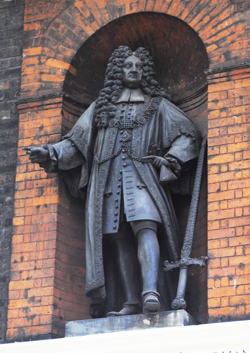
A replica of an original 1723 statue of Sir Robert still adorns the almshouses which bear his name (pictured above).

For more on the people that made London, see Boris Johnson’s Johnson’s Life of London: The People Who Made the City That Made the World.

Treasures of London – Geffrye almshouses…

GeffryeIt’s a big year for the Geffrye Museum in Shoreditch – not only 300 years since the almshouses were first opened to house the poor and elderly, it’s 100 years since the almshouses were converted into the museum which now occupies the site.

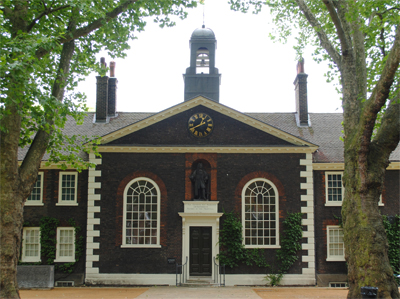
Geffrye2With that in mind, we thought we’d take a look at the almshouses themselves (we’ve looked at the museum – which features 11 period rooms from the 17th to 20th centuries – a couple of times previously). The Grade I-listed almshouses were built in 1714 by the Worshipful Company of Ironmongers, using funds that had been bequeathed to them by Sir Robert Geffrye, a Cornishman who became twice-master of the company and a Lord Mayor of London (there’s a fine statue of him adorning the front of the building).

They comprised 14 houses, each of which had four rooms, and provided accommodation for up to 56 pensioners. Arranged in a U-shape around a courtyard, the two storey almshouses came complete with a chapel which still stands at the centre of the the complex and where residents were expected to attend each week (a walkway which runs around the back of the chapel was added in 1914 offers some great views of the garden).

The almshouses, which had originally been built in what was a largely rural context, remained in use until the early 20th century by which time the area had become one of London’s most crowded with poor sanitation. In 1910, the Ironmongers’ decided to sell off the almshouses and move out to the safer, cleaner area of Mottingham in Kent.

In 1912, the houses and gardens were purchased by the London County Council – attracted by the public open space – and following representations from members of the Arts and Crafts movement, the museum opened its doors in 1914.

It’s still possible to visit a former almshouse – number 14 –  which was restored and opened in 2002 and has been furnished to show what life was like there for the pensioners (contrast the sparse furnished there with that with some of the more opulent rooms on display in the museum – and don’t forget to allow some time to visit the gardens; there is also a shop and cafe on site).

WHERE: 136 Kingsland Road, Shoreditch. Nearest tube is Liverpool Street or Old Street (a fair walk) or Hoxton Overground Station (next door); WHEN: The almshouses are open on select days only – check website. The museum is open Tuesdays to Sundays, 10am-5pm (gardens open until 31st October); COST: £3 for admission to  almshouses/admission to the museum and gardens is free; WEBSITE: www.geffrye-museum.org.uk

10 sites from Shakespearean London – 4. Shakespeare’s Shoreditch theatres…

While the association between the Bard and Bankside’s Globe Theatre is well known (see our earlier post here for more), the Bard and his plays were also performed in various other theatres around London. Here we take a quick look at a couple in Shoreditch, then a more rural suburb of London known for its associations with the (somewhat seedy) entertainment industry…

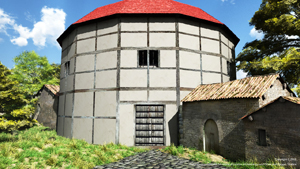
The-Theatre The Theatre, Shoreditch. Built in 1576 by James Burbage on property that had once been part of Holywell Priory, the Theatre was the home of a number of acting companies including The Lord Chamberlain’s Men of which Shakespeare was a member. The polygon-shaped theatre served as the home of the company between 1594 and 1598 when a dispute with a landlord over the lease led them to leave, temporarily settling at The Curtain Theatre, before rebuilding their theatre, now renamed The Globe, in Southwark. Between 2008 and 2010, archaeologists from Museum of London Archaeology (MOLA) carried out an investigation beneath a disused warehouse in New Inn Broadway, near the intersection of Curtain Road and Great Eastern Street, and found the remains of a 14 sided theatre about 22 metres across. Plans have been mooted to build a new theatre on the site. To find out more about The Theatre and see a terrific animated recreation by Cloak & Dagger Studios and MOLA (pictured), head to www.explorethetheatre.co.uk. PICTURE: Courtesy of MOLA (Museum of London Archaeology) and Cloak and Dagger Studios.

The Curtain Theatre, Shoreditch. The Lord Chamberlain’s Men only performed here temporarily, between 1598-1599, before relocating to Southwark. Henry V (the reference to “this wooden O” in the prologue of the play is taken to refer to this theatre) and Romeo and Juliet are believed to be among Shakespeare’s plays which premiered here. Located just a couple of hundred yards south of The Theatre and built the year after it, it also hosted Ben Jonson’s Every Man in his Humour, a play in which Shakespeare is known to have performed. The polygonal theatre’s name comes from the road on which it stood – Curtain Road, which, it has been suggested, was named after the Holywell Priory’s ‘curtain wall’. It continued as a theatre until the 1620s and was later converted into tenements. The remains of what is believed to have been the Curtain Theatre were found by MOLA archaeologists in 2012 and further excavations are expected with the hope that one day the site will be open to the public with plays performed here. There is a plaque commemorating the site at 18 Hewett Street which is only a short distance from where the excavations were carried out. For more on the Curtain Theatre, check out www.shakespearesshoreditch.com.

For more on Elizabethan theatres, see Julian Bowsher’s Shakespeare’s London Theatreland: Archaeology, History and Drama.

Famous Londoners – Christopher Marlowe…

Born the same year as Shakespeare, Christopher Marlowe was, like him, one of the foremost dramatists of the Elizabethan era.

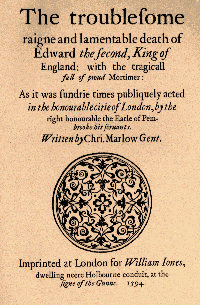
EdwardiiquartoBorn in Canterbury the son of shoemaker John Marlowe and his wife Catherine in 1564 (he was baptised on 26th February and likely to have been born a few days before), Marlowe attended the King’s School in the city and went on to study at Corpus College in Cambridge, receiving a Bachelor of Arts in 1584 and a Master of Arts in 1587. It is believed that at around this time, he was also working secretly for the government of Queen Elizabeth I, although what the nature of that work was remains unknown.

While Marlowe’s first play was Dido, Queen of Carthage, he first found theatrical success in 1587 with Tamburlaine the Great, later followed with a second part. His other four plays included The Jew of Malta, Edward the Second, The Massacre at Paris about the St Bartholomew’s Day Massacre in 1572, and Doctor Faustus.

The plays served as key works for the Admiral’s Men, the company of Edward Alleyn who performed many of the key roles in the plays, and who is strongly associated with the Rose Theatre  – indeed it was here that Tamburlaine the Great, The Jew of Malta, and Doctor Faustus premiered (you can see our earlier post on the theatre here).

Marlowe, who is known to have lived in Shoreditch, also completed other works included poetry and translations and while there is little evidence about his personal life, there is much speculation including that he was, as aforementioned, a spy as well as a carouser (he is known to have frequented taverns in London including Ye Olde Cock in Fleet Street), a homosexual and/or a heretic. It has also been suggested he was a tutor to noblewoman Arabella Stuart.

It is known that he was arrested in 1592 in Flushing in The Netherlands for counterfeiting coins and was sent back to England but no further action was taken.

His death is one of the big mysteries of his life. A warrant was issued for Marlowe’s arrest over some heretical tracts which were found in the lodgings of his colleague Thomas Kyd (who when questioned apparently implicated him) and he appeared to answer to the Privy Council on 20th May, 1593. They weren’t sitting and he was apparently instructed to appear daily until further notice. He was dead 10 days later.

The exact circumstances of his death remain a matter of speculation. It is often said he died in a drunken brawl with one early source suggesting this was over a homosexual love affair and another, more recent, theory suggesting he even faked his own death to avoid being executed for heresy (an extrapolation of this theory goes that after his fake death he continued writing plays under the name of William Shakespeare but this is generally deemed fairly far-fetched). The official account recorded at the time was that he was stabbed to death in a brawl over payment of a bill with men at a house in Deptford.

He was buried in an unmarked grave at St Nicholas’ Church in Deptford. There is a memorial window to him in Poet’s Corner in Westminster Abbey. A gift of the Marlowe Society, it was unveiled in 2002 and controversially included a question mark after the generally accepted date of his death. There is a portrait, dated 1585,  generally believed to be of Marlowe at Cambridge.

PICTURE: Title page of the earliest known edition of Edward II (1594)/Wikipedia

10 sites from Shakespearean London – 1. The Globe…

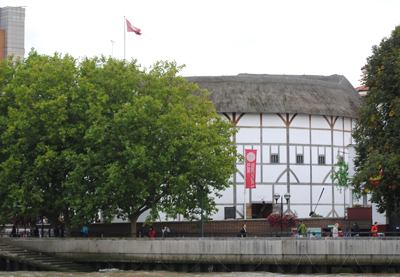
The-GlobeMention William Shakespeare and London in the same breath and everyone immediately thinks of one building – the reconstructed Globe on Bankside. So we thought that to kick off our new series – being run in honour of the 450th anniversary of the playwright’s birth – we’d take a look at history of the iconic structure.

The-Globe2The original Globe Theatre, located a few hundred metres to the south, opened in 1599 as a home for the actors’ company known as the Lord Chamberlain’s Men (later renamed the King’s Men on the accession of King James I in 1603), of which Shakespeare was a member. Founded by James Burbage, this merry band was originally was housed at London’s first purpose-built playhouse Shoreditch before lease disputes led them to establish a new theatre in Southwark, close to the then existing theatre, The Rose.

Up and running by 1599 (Shakespeare was among four actors who bought a share in the property to help fund the new building which used timbers from the former Shoreditch theatre), the new theatre was used for 14 years until, during a performance of Henry VIII in 1613, wadding from a stage cannon ignited and the theatre burned to the ground. Rebuilt with a tiled roof, it remained the home of the company until it was closed down by the Puritan government in 1642 and demolished two years later.

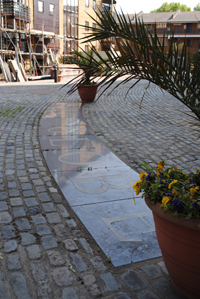
You can see the original site of The Globe just in nearby Park Street. The shape of the structure is marked by a dark line embedded in the pavement (pictured).

The reconstructed building which stands proudly by the water today was the vision of the late American actor, director and producer, Sam Wanamaker. He founded the Shakespeare Globe Trust which, with the on-site assistance of Queen Elizabeth II, opened the theatre at its current site in 1997 (sadly, Wanamaker had died three-and-a-half-years previously).

The building’s design was drawn from sifting through what little historical evidence could be found including the findings of an archaeological dig at the original site, descriptions contained in Shakespeare’s plays (including the line from Henry V – “Or may we cram within this wooden ‘O’), and printed panoramas from the time, although it should be noted that much – particularly the design of the stage – is speculative.

Meanwhile the techniques used in the construction of the theatre were the subject of years of research and were in accord with those of the early 17th century  and included using oak laths and staves to support lime plaster and then covering the walls in white lime wash while the roof was made of water reed thatch.

One of the best ways to see the theatre and make the most of the atmosphere is to see a play from a standing position in the pit!

WHERE: Globe Theatre Exhibition & Tour, Shakespeare’s Globe, 21 New Globe Walk (nearest Tube stations are Southwark and London Bridge); WHEN: Exhibition is open 9am to 5.30pm daily – tours run at various times, see website for details; COST: Exhibition and tour cost is £13.50 adults/£12 seniors/£11 students/£8 children (5-15 with children under five free)/£36 family of four; WEBSITE: www.shakespearesglobe.com.

This Week in London – New drawbridge for the Tower; Churchill War Rooms celebrate 30 years; and, the mid-Twentieth century home at the Geffrye…

There’s a working drawbridge at the Tower of London, something not seen at the fortress since the 1970s. The bridge, which would have originally spanned a water-filled moat, was created in 1834 to allow munitions to be brought into the basement level of the White Tower from the wharf (the moat was drained in 1843 on the orders of the then-Constable, the Duke of Wellington). The bridge has been altered many times but the last time it was completely replaced was in 1915 while the tradition of raising it was carried on until the 1970s before it was permanently fixed in 1978. The new bridge draws on historic designs from 1914 and has been constructed of steel and English oak. It will be raised and lowered on “high days” and holidays and for educational purposes. For more, see www.hrp.org.uk/TowerOfLondon/.

The Churchill War Rooms – a complex of underground rooms from where then PM Winston Churchill and others directed the course of Allied troops during World War II – is celebrating the 30th anniversary of its public opening with a new displaying showcasing never before seen objects related to its creation as a tourist attraction. The objects include a private admissions ticket from the days when the only way inside was via specially granted permission, correspondence about the fate of the War Rooms and a poster from 1984 advertising the opening of the Cabinet War Rooms to the public. Admission charge applies. For more, see www.iwm.org.uk/visits/churchill-war-rooms.

On Now: John Pantlin: photographing the mid-century home. This free exhibition at the Geffrye Museum in Shoreditch celebrates the work of Pantlin who is noted for his extensive work for the architectural press in the 1950s and 1960s. The small exhibition focuses on his shots of domestic interiors with shots of sun-filled living rooms and bedrooms filled with toys with all images drawn from the Robert Elwall Photographs Collection. Runs until 29th June. For more, see www.geffrye-museum.org.uk.

This Week In London: The London that might have been; the V&A’s Christmas tree; Christmas celebrations at the Geffrye; and, World War II recollections…

A new exhibition looking at the London that might have been opened at Wellington Arch near Hyde Park Corner yesterday. Almost Lost: London’s Buildings Loved and Loathed uses digital technology to look at how several redevelopment proposals – including a 1950s conceptual scheme for a giant conservatory supporting tower blocks over Soho and a 1960s plan to redevelop Whitehall which including demolishing most of the Victorian and Edwardian buildings around Parliament Square – would have changed the face of the city. The exhibition also looks at how the latest developments in digital mapping can be used in the future and features ‘Pigeon-Sim’ which provides a bird’s-eye view of the city’s buildings with an interactive flight through a 3D photorealistic model of the city. The exhibition runs until 2nd February. Admission charge applies. For more, see www.english-heritage.org.uk/daysout/properties/wellington-arch/.

A specially commissioned Christmas tree has been unveiled at the V&A in South Kensington. The 4.75 metre high ‘Red Velvet Tree of Love’ is the work of artists Helen and Colin David and will stand in the museum’s grand entrance until 6th January. The design of the tree – which is coated in red flocking and decorated with 79 sets of hand cast antlers and 67 white, heart shaped baubles – was inspired by an 1860 HFC Rampendahl chair in the V&A’s collection which features a real antler frame and velvet upholstery. For more, see www.vam.ac.uk.

The annual Christmas Past exhibition is once again open at the Geffrye Museum in Shoreditch. Festive decorations have transformed the museum’s rooms and give an insight into how the English middle classes celebrated in times gone past. The exhibition runs until 5th January. Admission is free. Accompanying the exhibition are a series of events including an open evening celebrating an Edwardian Christmas between 5pm-8pm tonight. For more, see www.geffrye-museum.org.uk/whatson/christmas-past-2013/.

The World War II experience of Chelsea Pensioners are being commemorated in a new display in the White Space Gallery at the National Army Museum in Chelsea. The Old and the Bold is the culmination of a year long collaboration between the museum and the Royal Hospital Chelsea and features nine interviews with 14 In-Pensioners. Their accounts span iconic moments in World War II history – from D-Day to North Africa and the Falklands and are supported by items from the museum’s collection. Runs until 3rd January. Admission is free. For more, see www.nam.ac.uk.

What’s in a name?…Shoreditch

The origins of the name Shoreditch – now a slowly gentrifying area to the north of the City of London within the Borough of Hackney – are lost to time but there are a few interesting theories around.

While the name probably comes to us as a derivation of Soersditch or Sewer Ditch – perhaps in reference to a drain that was once here – a more tragic version has it named after Jane Shore.

A mistress of King Edward IV in the mid to late fifteenth century, she, so the story goes, was buried in a ditch in the area after dying in a state of penury following a dramatic fall from favour during the subsequent reign of King Richard III (the king apparently had Jane arrested and made her perform a public penance for being a harlot).

There was an important priory here – the Augustinian Priory of Holywell – in medieval times and by Elizabethan times, some substantial houses. In 1576, James Burbage built England’s first theatre – known as The Theatre – on its site located near Curtain Road. Some of William Shakespeare’s plays were performed here and at the nearby rival, the Curtain Theatre, before a dispute with the landlord in the late 16th century saw the theatre relocated to Southwark in the dead of night (although the foundations must have remained – these were excavated a few years ago). Both Shakespeare and follow playwright Christopher Marlowe had associations with the area.

The area, which centred on St Leonard’s Church (while the current building dates from around 1740, there is believed to have been a church here  – at the intersection of Shoreditch High Street and Hackney Road – since Saxon times), become known for its textiles in the 17th century and later for its furniture industries.

It was still known as one of London’s premier entertainment districts in the late 19th and early 20th centuries with well known music halls and theatres but by then was also just as well known for its poverty.

Shoreditch suffered heavily during the Blitz and while the area continues to suffer from urban decay there is now some new life being breathed into it with the arrival of projects as the Boxpark Shoreditch which, made from shipping containers, is billed as “the world’s first pop-up mall”. There’s also an annual festival, the Shoreditch Festival, held in summer along Regent’s Canal.

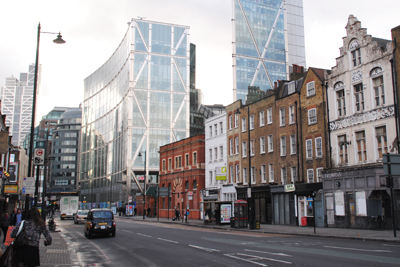
PICTURE: View down Shoreditch High Street to the City – © David Adams.

10 small (and fascinating) museums in London…8. The Geffrye Museum

We have mentioned this museum before, but it’s well worth doing so again (particularly for those who may have missed the first entry). Located in former almhouses in Shoreditch, the Geffrye Museum is a survey of house interiors from the 17th century through to modern times.

Featuring 11 reconstructed period interiors created using authentic furnishings, it tells the story of the city through its residents’ homes (albeit largely wealthy ones) and includes a look at a hall in 1630, a parlour in 1790, a drawing room in 1870 and a loft conversion dating from 1998. There’s an audio guide which provides details on each room and information panels as you go along (and if you can’t get there but want to have a look, the website gives a detailed look at each room with notes on select furnishings).

The almshouses in which the museum resides (it runs along the rear wing of a U-shaped courtyard and takes in the chapel) were built in the early 1700s by the Company of Ironmongers after it received a bequest from Sir Robert Geffrye, a former twice-master of the company and a former Lord Mayor of London (his statue adorns the front of the chapel and faces out into the courtyard, itself a quiet oasis in busy Shoreditch).

These were used until early in the 20th century when the company decided to relocate the remaining pensioners. But the buildings have been preserved and it is possible to visit a former almshouse which has been restored and opened as a museum with displays on what life was like for the pensioners. Meanwhile, at the rear of the museum is a walled herb garden filled with herbs and a series of ‘period garden rooms’ ranging from the 17th to 20th centuries.

There’s also a restaurant and shop onsite (housed in a new extension opened in 1998).

WHERE: 136 Kingsland Road, Shoreditch. Nearest tube is Liverpool Street or Old Street (a fair walk) or Hoxton Overground Station (next door); WHEN: Tuesdays to Saturdays, 10am-5pm or Sundays and Bank Holidays, 12-5pm (gardens open until 31st October); COST: Free (admission to almhouses £2.50 at set times on select days); WEBSITE: www.geffrye-museum.org.uk