LondonLife – The Big Chill 2…

Big-Chill2

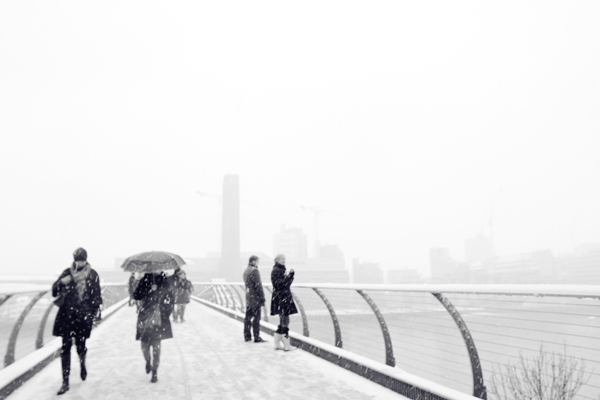
Says the photographer, Ben Bibriesca: “Instead of spending another lazy weekend in, my flatmate and I decided to plan a trip to the Tate Modern. Unfortunately due to the snow, all our friends dropped out. We decided to still go but spent more time outdoors taking photos in the snow then at the actual museum. This shot was taken right before we crossed the bridge to get to our destination. I just loved the way everything was snow covered and white.” For more of Ben’s work, see www.flickr.com/photos/benbibriesca/.

Taken an interesting photograph of somewhere in London? We’re always looking for interesting images of the city so if you’ve got one you reckon captures a snippet of life in London, please contact us at exploringlondon@gmail.com or via Flickr at www.flickr.com/groups/exploringlondon/.

London Pub Signs – Doggett’s Coat and Badge…

Perhaps not so much a sign as a pub name, the strangely monikered Doggett’s Coat and Badge in South Bank is named after a rowing race – said to be the oldest continuous sporting event in the country – in which apprentice waterman traditionally competed for a prize consisting of waterman’s coat and badge and named after Irish-born actor and theatre manager, Thomas Doggett.

The race – which is held in July and runs over a course of four miles and seven furlongs from London Bridge to Chelsea (the starting and finishing points were originally both marked by pubs called The Swan) – was first held in 1715 when it was first organised by Doggett who financed it up until his death in 1721 after which he left instructions in its will for it to be carried on by The Fishmongers’ Company (which it still is today).

While there’s a nice story that Doggett, who managed the Drury Lane Theatre and later the Haymarket Theatre and carving out a name for himself as a ‘wit’, started the race as thanks to Thames watermen for rescuing him when he fell off a watercraft while crossing the Thames, Doggett – a committed Whig – actually started the race to commemorate the ascension of King George I – the first ruler of the House of Hanover – on 1st August, 1714, following the death of Queen Anne.

This year’s race winner was Merlin Dwan (London Rowing Club) who beat four others to finish in 24 minutes, 28 seconds.

The pub, one of the Nicholson franchise, is located in a multiple storey modern building complex and sits along the course of the race in South Bank. It features a range of bars including Thomas Doggett’s Bar and the Riverside Bar as well as a dining room and other function rooms.

For more on the pub, see www.nicholsonspubs.co.uk/doggettscoatandbadgesouthbanklondon/. For more on the race (which we’ll be mentioning, along with more on Thomas Doggett, in more detail in upcoming posts), see www.DoggettsRace.org.uk.

Around London – Liberty Festival’s 10th; teddy bears at Royal Parks; Cosmati pavement on the web; and animal crackers at Cartoon Museum…

• This weekend London host’s the 10th Liberty Festival, a showcase of deaf and disabled artists. Free events – including live music, dance, street theatre, film and cabaret – are being held at several locations across the city over Saturday, Sunday and Monday, including in Trafalgar Square, the National Theatre, South Bank Centre, BFI Southbank and Picture, the Mayor of London’s Live Site at Potters Fields Park next to City Hall on the south bank of The Thames. Highlights of the event – a centrepiece of the Paralympic celebrations – include a “cabaret showcase of comedy, film and music” at Royal Festival Hall on Saturday, and a “jazz, blues and R&B spectacular” at BT London Live Trafalgar Square on Sunday. This year’s event, produced by the Mayor of London with Greenwich+Docklands Festivals, coincides with Unlimited, the London 2012 Festival’s showcase of disabled artists. For more details, see www.molpresents.com/liberty. For more on BT London Live Trafalgar Square, see www.btlondonlive.com.

• If you go down the woods (read Royal Parks) today…you will find a Teddy Bear’s picnic! Royal Parks is inviting children up to the age of 12 to attend three Teddy Bear’s picnics it’s holding in Richmond Park and Bushy Park this week. While one event has already gone (it was held yesterday), there’s still two to go – one at the Kingston Gate Playground in Richmond Park from 11.30am to 3.30pm today, and another at the Bushy Park Playground between 11.30am and 3.30pm tomorrow (Friday). Both afternoons feature free craft activities, games and a “best dressed ted” competition. For more, see www.royalparks.org.uk.

Tragedy on the Thames: Princess Alice Disaster. This talk at the London Metropolitan Archives looks at an event which took place on 3rd September, 1878 when a day trip to Rosherville Pleasure Gardens in Gravesend turned to tragedy with more than 650 people dead after a collision on the Thames. The talk will discuss the coroner’s inquests and witness accounts before looking at some original documents held at the LMA. The free event is held on Monday from 2pm to 3pm. Booking essential (020 7332 3851). For more on the LMA, follow this link.

Westminster Abbey has unveiled a new website showing how the spectacular Cosmati pavement was brought back to life in a two year restoration project. The 13th century floor mosaic, which covers the floor in front of the High Altar, was hidden under carpets for more than 100 years before the restoration work was carried out. The new website features more than 40 films showing all elements of the restoration and interviews with experts about the pavement as well as an interactive map of the pavement. For more, see www.westminster-abbey.org/conservation. You can also see our Treasures of London article on the pavement here.

• On Now: Animal Crackers – A Cartoon and Comic Bestiary. This exhibition at the Cartoon Museum in Bloomsbury features characters including Mickey Mouse, Wallace and Gromit, Fred Basset and Rupert Bear as well as icons like the American Eagle, Russian Bear and financial Fat Cat and joke cartoons from publications including Punch, Private Eye, The Spectator and many national newspapers. More than 140 cartoons, caricatures, comics and graphic novels, created by more than 60 artists, are included in the display. Runs until 21st October. Admission charge applies. For more, see www.cartoonmuseum.org.

Around London – Diamond Jubilee celebrations special…

UPDATED: Excitement has been building for months ahead of this weekend’s Diamond Jubilee celebrations which include a 1,000 boat flotilla which will sail down the Thames on Sunday, the Diamond Jubilee concert on Monday and National Service of Thanksgiving at St Paul’s Cathedral on Tuesday which will be followed by a ceremonial procession back to Buckingham Palace.
• First to the flotilla. The formal river procession will be held between 2pm and 6pm, starting upriver of Battersea Bridge and finishing downriver of Tower Bridge. The Queen and her family will be boarding the Royal barge, the Spirit of Chartwell, near Albert Bridge at 2.30pm and will travel upriver at the centre of the flotilla with the aim of pulling up alongside HMS President, near Tower Bridge, at 4.15pm.

The flotilla will be one of the largest ever assembled on the river and feature rowing, working and pleasure boats of all shapes and sizes decked out for the occasion. In addition as many as 30,000 people will be aboard passenger boats and there will also be music barges and boats spouting geysers as well as specially constructed craft like a floating belfry. It is estimated that it will take the flotilla around 75 minutes to pass any static point along the route.

Downriver of London Bridge, near the end of the pageant’s seven mile (11 kilometre) course, a gun salute will be fired and the procession will pass through an ‘Avenue of Sail’ formed by traditional sailing vessels, oyster smacks, square riggers, naval vessels and others. For more on the pageant (including the location of large viewing screens – these positions will be regulated from 8am onwards – and road closures as well as an interactive map of the route), head to www.thamesdiamondjubileepageant.org.

• Diamond Jubilee Concert and Beacons. To be held outside Buckingham Palace, close to the Victoria Memorial, on the evening of Monday, 4th June, the concert – which starts at around 7.30pm and features everyone from Elton John to Paul McCartney and Shirley Bassey – will be televised live by the BBC (unless you’re lucky enough to have one of the 10,000 balloted tickets meaning you get to have a picnic in the palace gardens and see the concert). For those who can’t go but would like to experience some of the atmosphere, Royal Parks are setting up screens along The Mall, in St James’s Park and in Hyde Park.

At 10.30pm that night, the Queen will light the National Beacon outside Buckingham Palace, the last in a network of beacons to be lit across the country. More than 4,000 beacons will be lit by communities across the UK and in Commonwealth countries around the world between 10-10.30pm that night (for more on the beacons, see www.diamondjubileebeacons.co.uk).

• National Service of Thanksgiving and Carriage Procession. On Tuesday, the Queen and the Duke of Edinburgh will leave Buckingham Palace at 10.15am and travel by car to St Paul’s Cathedral via the Mall, through Trafalgar Square, down the Strand and Fleet Street and up Ludgate Hill to St Paul’s. There they and the 2,000 invited guests will attend the National Service of Thanksgiving, conducted by the Dean of St Paul’s, the Very Rev Dr David Ison (the Archbishop of Canterbury will preach).

At 11.30am, the Queen and Duke will then head to Mansion House for a reception (via St Paul’s Churchyard and Queen Victoria Street), hosted by the Lord Mayor of London David Wootton, Court of Aldermen and Court of Common Council. Other members of the Royal family will attend a reception at Guildhall. At 12.30pm, the  Queen and members of the Royal Family will then head to Westminster Hall (via Queen Victoria Street, St Paul’s Churchyard, Ludgate Hill, Fleet Street, the Strand, Whitehall and Parliament Square), entering through the Sovereign’s Entrance of the Palace of Westminster (Houses of Parliament) at 12.40pm. There, they will attend the Diamond Jubilee Lunch.

At 2.20pm, the Queen and Prince Philip will lead a carriage procession from the Palace of Westminster to Buckingham Palace (via New Palace Yard, Whitehall, Trafalgar Square and The Mall), riding in a 1902 State Landau. They will be followed by the Prince of Wales and Duchess of Cornwall in a State Landau, and the Duke and Duchess of Cambridge (Prince William and Kate) and Prince Harry in another State Landau. If it’s raining, these will be replaced by the Australian State Coach, Queen Alexandra’s State Coach and the Glass Coach. Military personnel will line the route, a 60 gun salute will be fired and a Guard of Honor will await them in the Buckingham Palace forecourt.

At 3.30pm, the Queen and members of the Royal Family in the carriage procession will appear on the balcony at Buckingham Palace to wave to the crowds and witness an RAF flypast and a Feu de Joie – a celebratory volley of rifle fire – which will be given as a salute in the palace forecourt.

There’s plenty more happening over the weekend including many local street parties – far too much for us to record here. So for more, head to the official Diamond Jubilee site, www.thediamondjubilee.org (or The Big Lunch for local lunches – www.thebiglunch.com). You can purchase a copy of the official souvenir programme online at www.royalcollectionshop.co.uk/diamond-jubilee-1/diamond-jubilee-official-souvenir-programme.html or download it at www.itunes.co.uk.

Reckon you can take a good photo? We’re looking for great images of this weekend’s Diamond Jubilee celebrations (just email us at exploringlondon@gmail.com).

Want to read more about the Queen? Why not check out Sixty Glorious Years: Queen Elizabeth II, Diamond Jubilee, 1952-2012, Queen Elizabeth II: A Diamond Jubilee Souvenir Album, or Debrett’s: The Queen – The Diamond JubileeFor related music, check out Diamond Jubilee: A Classical CelebrationThe Diamond Jubilee Album or Gary Barlow & the Commonwealth Band’s Sing EP (featuring Prince Harry).

Celebrating the Diamond Jubilee with 10 royal London locations – 7. Silver Jubilee memorials…

For those who may not be aware, the current Diamond Jubilee is, of course, not the first jubilee Queen Elizabeth II has celebrated. In 1977, the Queen and the nation marked her Silver Jubilee, celebrating her 25th year on the throne.

Just as this year is designed as a year of celebration, so too was 1977 with the anniversary of the Queen’s accession culminating in a series events run over a week in early June. They included street parties, the lighting of a chain of beacons across the country (the Queen lit the first fire at Windsor), a national service of thanksgiving at St Paul’s Cathedral (which the Queen went to in the Gold State Coach) and a river progress from Greenwich to Lambeth.

To mark the Jubilee, the Queen and Prince Philip also travelled across the country, visiting as many as 36 counties during a Royal Tour, and went overseas where they visited nine countries as far afield as Australia and New Zealand, the West Indies and Canada.

In London, a number of memorials were installed which can still be visited today. They include:

The Silver Jubilee Walkway. Opened by the Queen on 9th junee 1977, this is made up of five circular sections which are themselves located in a 15 mile (24 kilometre) circle around the city and takes in many of the city’s greatest sites, including St Paul’s Cathedral, Buckingham Palace, Tower Bridge and Shakespeare’s Globe. For more on the walk, see www.walklondon.org.uk/route.asp?R=3

• South Bank Jubilee Gardens. Originally created to celebrate the Silver Jubilee in 1977, these gardens, located between Waterloo and Westminster Bridges, have recently been remade – including planting 70 new trees – for the Queen’s Diamond Jubilee and the Olympic Games.

Memorial Urn in Queen Square, Bloomsbury. This monument has inscriptions by poets Philip Larkin (“In times when nothing stood, But worsened or grew strange, There was one constant good, She did not change”) and Ted Hughes (A nation’s a soul, A soul is a wheel, With a crown for a hub, To keep it whole”) in front of and behind it.

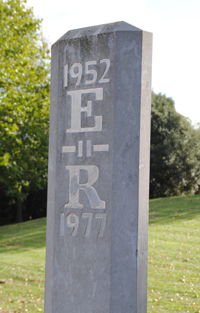
King’s Stairs Memorial Stone. This memorial stone (pictured) located on the edge of King’s Stairs Gardens by the Thames in Bermondsey was first installed to mark the Queen’s Silver Jubilee. The other side of the stone was inscribed during the Golden Jubilee in 2002.

• Plaque on Queen Elizabeth II’s birthplace. We’ve mentioned this plaque at 17 Bruton Street in Mayfair in an earlier entry but it’s interesting to note that it was erected in 1977.

Any others you can think of?

LondonLife – An upsized Royal Family…

Like your Royal Family large? The largest ever photograph of Queen Elizabeth II, her husband, the Duke of Edinburgh, and their four children has been displayed on South Bank building, Sea Containers, in celebration of the Queen’s Diamond Jubilee. The iconic picture of the family – which also includes Earl Mountbatten, uncle to Prince Philip, and Princess Anne’s then husband Mark Phillips – was taken during 1977’s Silver Jubilee by an unknown photographer. The 100 by 70 metre image, which weighs nearly two tons, took eight people more than 45 hours to put into place on the building’s facade overlooking the Thames. It was erected by the owner of Sea Containers as a tribute to be seen during this weekend’s Jubilee Flotilla (and also to hide development work taking place behind as the building is transformed into a Mondrian hotel – Europe’s first – and office space.

Around London – New Year’s Eve fireworks; a Resurrectionist diary; and, Russian architecture at the Royal Academy…

Plans for this year’s New Year’s Eve fireworks – marking the beginning of the year in which London hosts the Olympic and Paralympic Games – have been announced by the Mayor of London, Boris Johnson. The EDF London Eye on South Bank will once again form the focus of the fireworks display and those wishing to attend have been warned to take their places early with some areas filling up by 9pm or 10pm. Parents with young children are advised to consider attending fireworks displays closer to home (for more, see www.london.gov.uk/newyearseve). The display will be followed by a parade on New Year’s Day (for more, see www.londonparade.co.uk). Meanwhile, the annual Christmas Tree lighting ceremony will take place next Thursday. The tree is a gift from the people of Oslo, the Norwegian capital, given annually for more than 60 years in recognition of Britain’s support during World War II.

On Now – The Diary of a Resurrectionist. This month marks the 200th anniversary of an intriguing diary which offers insights into the work of a group of grave robbers and to mark the moment, the Hunterian Museum at the Royal College of Surgeons of England is hosting an exhibition featuring extracts from the diary and charting the rise and fall of grave robbing. The exhibition, which is being hosted in the Library Reading Room, runs until 22nd December. There is a special lecture by Kirsty Chilton at the museum from 7pm tonight (24th November, entry fee applies). For more, see www.rcseng.ac.uk/museums/exhibitions/index.html.

• On Now – Building the Revolution: Soviet Art and Architecture 1915-1935. The Royal Academy of Arts is hosting this exhibition which looks at the avant-garde architecture which appeared in Russia from 1922 to 1935, and its design origins in the earlier flowering of Constructivisit art which emerged around 1915. Large scale photographs, taken by Richard Pare, are juxtaposed with relevant Constructivisit drawings and paintings as well as vintage photographs. A reconstruction of Vladimir Tatlin’s Monument to the Third International (known as Tatlin’s Tower) has been built in the Annenberg Courtyard to coincide with the exhibition. Runs until 22nd January. Admission charge applies. For more, see www.royalacademy.org.uk.

Around London – London celebrates on the Thames; a fashionable night in London; and, heritage trains in Amersham…

London will this weekend celebrate the 15th annual Thames Festival, billed as the city’s “largest free festival”. The two day event includes a giant shipwreck sculpture outside City Hall (created with the aid of students from 100 London schools), barge races and a parade of more than 100 boats on the Thames, a wide array of musical and street performances (these include a mass choir of 700 school children and a performance in which the HMS Belfast is used as a percussion instrument) and an illuminated Night Carnival culminating in fireworks. More than 800,000 people are expected to attend the event which takes place at a range of venues stretching from the London Eye to Tower Bridge. Other highlights include the annual Feast on the Bridge on Saturday during which Southwark Bridge will be closed to traffic, Korean Taekwondo displays, a food market and an exclusive cruise on the Thames hosted by the likes of historian David Starkey and the creators of cult children’s character Rastamouse. River boat operators, meanwhile, are offering 2-for-1 tickets for the weekend to help people make the most of the festival. For more information on the festival, see www.thamesfestival.org. For more on the 2 for 1 tickets, see www.tfl.gov.uk/river.

Regent Street and surrounds will be buzzing tonight with more than 40 shops, bars and restaurants taking part in Vogue Fashion’s Night Out. The event, which is running for its third year in London, will see many stores remaining opening until 11pm and feature special events and promotions. The night is part of a series of nights being held in countries across the globe – from Russia to Brazil, Australia to Spain. For more information, see http://fashions-night-out.vogue.co.uk.

An art deco Tube train dating from 1938 and the Sarah Siddons, the last operational ex-Metropolitan Railway electric locomotive will be running between Harrow-on-the-Hill, Rickmansworth and Amersham this Sunday as part of the Amersham Old Town’s Heritage Day. Other activities include a best dressed competition showcasing retro fashions, a free heritage bus service, including rides on the Routemaster RM1, street performances including a Punch and Judy show and clowns, and “object handling sessions” at the Amersham Museum. For more information, see the London Transport Museum’s website here.

Lost London – The Skylon

A sleek, futuristic, cigar-like sculpture that resembled what early science-fiction writers thought space-craft would look like, the Skylon was the centrepiece of the 1951 Festival of Britain site in South Bank and remains the enduring icon of the post-war celebration.

Designed by young architects Hidalgo Moya and Philip Powell (with the assistance of engineer Felix Samuely), the 300 foot tall Skylon, which, supported by cables, seem to hang in the air over the Thames, some 40 foot above the ground.

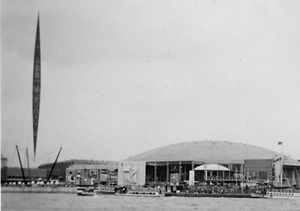
The structure (seen on the left of the picture of the Festival of Britain site) was dismantled in 1952 on the orders of the then-Prime Minister Winston Churchill who apparently saw it as an unwanted symbol of Clement Attlee’s Labour Government which had lost power earlier that year.

Strangely, the fate of the structure remains something of a mystery – Jude Kelly, artistic director at the Southbank Centre describes it as being “like the Loch Ness monster” in an interview with the Guardian newspaper earlier this year. “People have sightings of Skylon – they think – and bits of it, but nobody really knows what happened to it,” she said, adding that it was very hard to understand why it was thrown away.

While some fragments remain – including the base (and a model of it) which can be found at the Museum of London –  a common theory is that the rest of it was cut up and dropped into the Thames while other theories have it being buried under Jubilee Gardens or simply sold for scrap metal and “turned into ashtrays”.

There is an ongoing campaign to have the Skylon, which these days lends its name to a riverside restaurant at the Southbank Centre, rebuilt, although not necessarily in its original location.

The story of the Skylon, which sat on a site now occupied by the Southbank Centre, is told in the Museum of 1951 (see Southbank Centre website for details), open as part of the celebrations of the 60th anniversary of the 1951 Festival of Britain. On Tuesday, architect Nicholas Grimshaw and former president of the Royal Institute of British Architects Jack Pringle will lead a discussion at the Southbank Centre on the Skylon. For more information, follow this link.

PICTURE: John Ritchie Addison (via Wikipedia)

LondonLife – Reliving the Festival of Britain

Beach huts overlook the Thames at Queens Walk, Southbank, in celebration of the 60 year anniversary of the 1951 Festival of Britain. The huts have been individually designed by artists and reflect an element of life by the seaside – from an exhibition of vintage swimwear to a gallery of visual art which recalls when a storm surge flooded much of the North Sea coast in 1953. Nearby is an “urban beach” where you can pause to play in the sand. The huts will remain in position until 4th September. For more on the Festival of Britain 60th anniversary celebrations, see www.southbankcentre.co.uk.

Around London – South Bank marks 60 years since the Festival of Britain; Royal wedding cakes; and, a new cable car for London…

• South Bank is celebrating the 60th anniversary of the 1951 Festival of Britain with a four month series of events. The official celebrations kicked off yesterday and will run until early September. Highlights of the celebrations include the Museum of 1951 – a temporary museum located in Royal Festival Hall featuring exhibits relating to the 1951 festival, themed weekends including next weekend’s ‘London in Love’, featuring performances by Billy Bragg, and a Festival of Britain-inspired ‘Meltdown’ curated by Ray Davies of The Kinks (runs from 10th to 19th June). The original Festival of Britain was opened on 3rd May, 1951, with the intention of developing a sense of “recovery and progress” among the British in the aftermath of World War II and marked the centenary of the 1851 Great Exhibition. The South Bank Exhibition was at the heart of what were national celebrations and was attended by more than eight million people. For more information on what’s happening, see www.southbankcentre.co.uk.

• Historic royal wedding cakes have been recreated this Easter weekend  in an exhibition celebrating the lead-up to this Friday’s Royal Wedding. The English Heritage-event Let Them Eat Cake, which is being held at Wellington Arch near Hyde Park Corner, features a “four-and-20 blackbirds pie” of the sort King Henry VIII gave to his new wife Anne Boleyn as well as recreations of Prince Charles and Lady Diana’s wedding cake and that of Queen Elizabeth II. The event, which is sponsored by Tate & Lyle Sugars, involves some of Britain’s leading bakers. For more, see www.english-heritage.org.uk/daysout/events/765107/. See Exploring London this week for more on the upcoming Royal Wedding.

• The Mayor of London, Boris Johnson, confirmed this week that work will begin on a new cable car to cross the Thames River in East London this summer. The 34 gondola cable car will stretch for 1.1 kilometres, connecting Greenwich Peninsula and the O2 on the river’s south bank with Royal Victoria Docks and the ExCel centre on the north and carrying up to 2,500 people every hour. Construction will be carried out by a consortium of firms led by Mace – the company currently building the Shard Tower – and it is hoped it will be completed before next year’s Olympics.

The Tip – Free online guides to walking in South Bank

The first in a regular section of tips to make the most out of your time in London…

South Bank Walks. Five free online walking guides, each of which comes with maps and detailed descriptions of points of interest along the way, are available on the South Bank Walks website, created by the South Bank Employers’ Group . The walks take in more that just South Bank – one starts in Soho and finishes in South Bank; another starts at St Paul’s and ends up at Borough Market – and include a guide specifically designed for young people. The website also has a terrific building and street search feature. www.southbankwalks.com