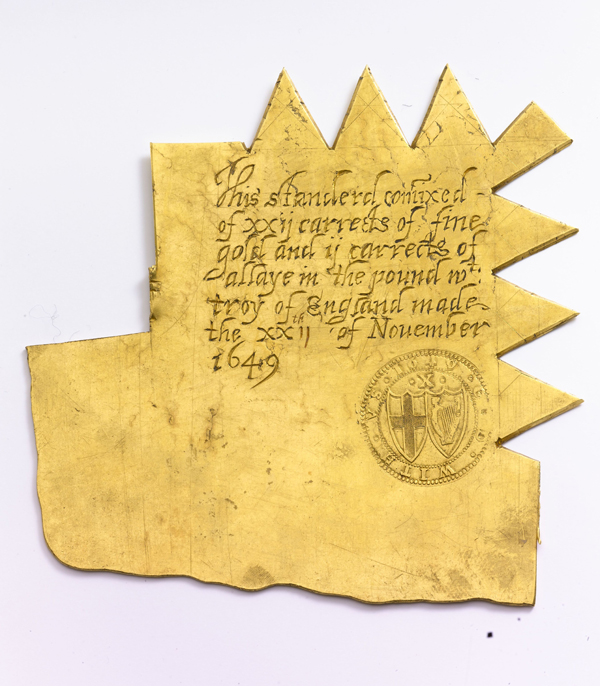
This is a section of the Cromwell Trial Plate used in the Trial of the Pyx in 1649. The Trial of the Pyx, still held every year in February, dates back to the 12th century; its purpose was to ensure, in a public demonstration, that coins produced at the Royal Mint were within set parameters surrounding weight, size and metallic composition. It is named after the box in which coins were transported, known as a pyx (from the Latin pyxis for box or chest – these were historically kept in the Chamber of the Pyx at Westminster Abbey), and involves melting down samples of coins and measuring the gold and silver content against a benchmark piece of metal known as a Trial Plate. This Trial Plate, created by the Goldsmith’s Company during the first year of the Commonwealth, is among 400 treasures on show as part of Gold: Power and Allure, a landmark exhibition celebrating the story of gold and Britain being held at the Goldsmiths’ Hall in association with the World Gold Council. Runs until 28th July. Admission is free. For more, head to www.thegoldsmiths.co.uk. PICTURE: © Royal Mint.
Churches
Celebrating the Diamond Jubilee with 10 royal London locations – 4. Westminster Abbey…
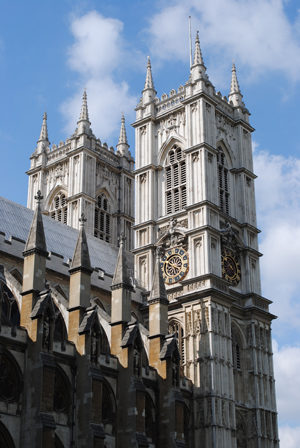
Westminster Abbey has played a key role in the life of Queen Elizabeth II – it was here on 20th November, 1947, that she was married to Prince Philip (then Lieutenant Philip Mountbatten) and it was here on 2nd June, 1953, that she was crowned Queen Elizabeth II.
First to the wedding. Princess Elizabeth was only the 10th royal to be married in the Abbey (her predecessors included her parents who married here on 26th April, 1923). The ceremony started at 11.30am and the princess, who wore a white dress designed by Norman Hartnell, entered to a specially composed fanfare accompanied by eight bridesmaids and two pages.
Due to post war austerity measures, only about 2,000 people attended the wedding (we’ve previously mentioned that the princess had to save coupons for her wedding dress like any other bride). On the day, the grave of the Unknown Warrior was the only stone that was not covered by the special carpet and the day after the wedding, the now married Princess Elizabeth followed a royal tradition started by her mother, Queen Elizabeth, which involved sending her wedding bouquet back to the Abbey to be laid on the grave.
It was about five-and-a-half years after her wedding that the princess returned to the Abbey to be crowned a queen.
Then Princess Elizabeth was in Kenya (on her way to Australia) when news reached her on 6th February that year of the death of her father, King George VI. After Prince Philip broke the news to her, the new queen chose Elizabeth as her “regnal name”, and the couple returned to England.
Queen Elizabeth II’s grandmother, Queen Mary, died on 24th March, but it was decided to proceed with the coronation anyway (Queen Mary had apparently asked that the coronation not be delayed by her death).
The coronation, the 38th to be conducted in the Abbey, was the first to be televised (with the exception of the anointing and communion) and was “instrumental” in helping to popularise it in the UK and elsewhere.
The building was closed for five months so preparations could be made for the more than 8,000 wedding guests. The Queen’s coronation dress, meanwhile, was made by Norman Hartnell (as had been her wedding dress) and was made of white satin embroidered with emblems of the United Kingdom and the Commonwealth.
Having arrived from Buckingham Palace in the Gold State Coach, the Queen entered the Abbey at 11.20am and, having been invested with the Regalia while seated in the Coronation Chair, was crowned with St Edward’s Crown at 12.34pm. She left the Abbey at 2.53pm and rode through the streets of London back to the palace.
Of course, the Queen has since attended many other events at the Abbey – including thanksgiving services for their golden and silver wedding anniversaries and last year’s Royal Wedding – since her coronation which we don’t have space to talk about here. But it is worth noting before signing off that the Abbey continues to have a special relationship to her – it is a “Royal Peculiar” meaning it is exempt from any ecclesiastical jurisdiction but that of the Sovereign.
WHERE: Westminster Abbey, Westminster (nearest Tube station is Westminster or St James’s Park); WHEN: Open to tourists everyday except Sunday (times vary so check the website); COST: £16 an adult/£13 concessions/£6 schoolchildren (11-18 years), free for children aged under 11/£38 for a family (two adults, two children); WEBSITE: www.westminster-abbey.org
LondonLife – Florence Nightingale remembered…
The life of Florence Nightingale, ‘The Lady with the Lamp’, depicted here on the Crimean War Memorial at Waterloo Place, is to be commemorated at the annual service in Westminster Abbey tomorrow. The Florence Nightingale commemoration service is held “to celebrate nursing and midwifery and all staff, both qualified and unqualified working in these services”. During the service a lamp, carried this year by Claire Gibbs, will be taken from the Abbey’s Florence Nightingale Chapel (formerly known as the Nurses’ chapel but rededicated in May 2010 – the centenary of Nightingale’s death) and escorted by a procession of nurses – this year it’s students from Liverpool John Moores University – to Reverend Professor Vernon White who will place it upon the High Altar. The address will be given by the former Archbishop of Canterbury, Lord Carey. Nightingale (1820-1910) rose to fame for her pioneering nursing work during the Crimean War and established the first secular nursing school in the world at St Thomas’ Hospital in London. The upcoming International Nurses Day is celebrated each year on her birthday – 12th May. Tickets for this year’s commemoration service are already allocated – to apply for tickets to next year’s, keep an eye on www.florence-nightingale-foundation.org.uk for details.
Famous Londoners – Jack Ketch
A 17th century public executioner famed for his botched executions, Jack Ketch looms as an infamous figure in British history and a byword for brutality and executioners in general.
Ketch’s origins are unknown (he’s also known as John Catch) but he is believed to have received his appointment as a public hangman sometime in the early to mid 1660s – the first recorded mention of him in that role, in a pamphlet celebrating his handiwork, dates from 1678. Such was his self-importance that he apparently adopted the title Esquire and apparently asked for his letters to be addressed to Dr John Ketch.
Among those who died at his hand were those accused of involvement in the Popish Plot against the Crown – a Catholic conspiracy to assassinate King Charles II which was all apparently fabricated by Titus Oates. These included William Staley and Edward Coleman both of whom were hung, drawn and quartered in 1678 (Ketch was also charged with whipping Oates following his perjury conviction).
But Ketch’s most infamous executions, the only two beheadings he is known to have performed, became notorious because of the botched manner in which they were carried out.
It was reported that it took Ketch three blows to strike off the head of William, Lord Russell, when he was executed for treason on 21st July, 1683 (he had opposed the succession of James II and was accused of involvement in the Rye House Plot), although Ketch apparently denied suggestions he had turned up drunk and blamed Lord Russell for flinching.
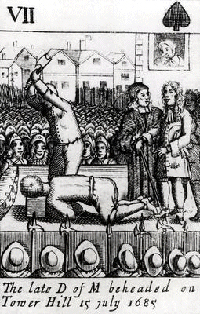
The beheading of James Scott, the Duke of Monmouth (and illegitimate son of King Charles II), on 15th July, 1685 (pictured above in a print from the time), was apparently even worse – it took Ketch five blows to take off his head and he apparently finished the job with a knife after having almost given up halfway through. Monmouth had been captured following the Battle of Sedgemoor in July 1685 in which he led an army having declared himself king (more on that another time).
Ketch fell out of favor with the authorities later that year and was briefly gaoled in Bridewell prison. He was reinstated but his return to the job of public executioner was only short-lived for he died in 1686 and is believed to have been buried in St James’ in Clerkenwell on 29th November, 1686.
He was survived by his wife Katherine, who apparently stood by her man despite the public feeling against him, and is it generally assumed a girl Susanna who was baptised at the church in Clerkenwell in 1668 – some 18 years before his death – was his daughter.
Following his death, Ketch’s name was adopted by subsequent public hangmen – he even appeared as an ongoing character in Punch and Judy shows.
For more on Ketch, see Tim Wales’ article Jack Ketch in the Oxford Dictionary of National Biography (a subscription is required for access).
PICTURE: Wikipedia.
What’s in a name?…St John’s Wood
This well-to-do area in London’s north-west, just outside Regent’s Park, takes its name from the historic ownership of land here by the Order of St John of Jerusalem (also known as the Knights Hospitaller).
The land had previously been part of the Great Forest of Middlesex. The Order of St John of Jerusalem, which since 1140s had its English headquarters in a Clerkenwell priory where St John’s Gate stands (this now houses the Museum of the Order of St John – see our previous entry here), took over ownership of land in the early 1300s after the previous owners, the Knights Templar, fell into disgrace.
Following the Dissolution, it became Crown land and remained so until 1688 after which it passed into the hands of private families, notably the Eyre family who owned much of the area.
It remained relatively undeveloped until the early 19th century when, following the introduction of semi-detached villas on planned estates, it was marketed as a residential alternative for London’s middle classes, away from the smog and congestion of central London.
It became favored by the bohemian set and residents included creative types like artists and authors as well as scientists and traditional craftsmen (apparently in the late 19th century it was also known for its upmarket brothels).
Rebuilt with swanky apartment complexes in the early twentieth century, these days it remains a leafy enclave for the wealthy. Many of the houses which have survived are heritage listed.
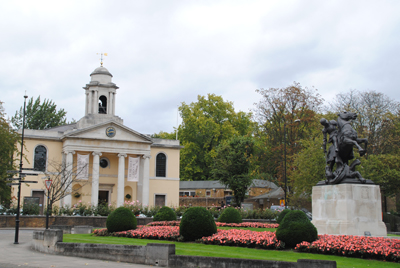
Landmarks include St John’s Church (pictured above, this was consecrated in 1814) and the St John’s Wood Barracks and a Riding School (this was completed in 1825 and is the oldest building still on the site) which is now home to the King’s Troop Royal Horse Artillery which carries out mounted ceremonial artillery duties such as firing royal salutes for the State Opening of Parliament, royal birthdays and state visits.
St John’s Wood is also home to Abbey Road Studios (home of the Beatles and that famous zebra crossing), Lord’s Cricket Ground (officially the home of the Marylebone Cricket Club which was moved here in 1814, the same year the church was consecrated) and the Central London Mosque located on the edge of Regent’s Park.
For more on St John’s Wood, take a look at the website of The St John’s Wood Society.
Around London – Your Roman influences; celebrating the City; and, of Journeys and kinship…
• The Museum of London is calling on Londoners to submit images showing “Roman influences in London today” as part of its forthcoming Our Londinium 2012 exhibition, a revamping of the museum’s Roman gallery. In what is the largest update made to the museum’s Roman gallery since it opened in 1994, the reworked gallery looks at parallels between Roman London and the city today and features important Roman artifacts such as a bust of the Emperor Hadrian found on the Thames foreshore (part of the British Museum’s collection, this will be displayed for six months before being replaced by a replica) alongside modern objects such as the V for Vendetta masks worn by protestors in the Occupy movement. The exhibition is being co-curated by young people from Junction, the Museum of London’s youth panel, and they’re calling on people to submit their images showing how the city’s Roman past still resonates even today (see example pictured). For details on how to submit images via email of Flickr, head to www.museumoflondon.org.uk/ol2012map.
• Secrets will be revealed, we’re promised, as part of the City of London’s Celebrate the City: four days in the Square Mile event to be held from 21st to 24th June. Events held in the City our the four days, many of which will be free, include a musical extravaganza to launch the event in Guildhall Yard as well as exhibitions, walks and talks, a chance to explore buildings like Livery Company Halls, the Bank of England and the Mansion House, family entertainment at the Cheapside Fayre and music and activities at sites across the Square Mile including the Barbican Centre, Museum of London and churches. We’ll have more to come on this. For now, head to www.visitthecity.co.uk/culture2012 for more information.
• Architectural historian and former director of the Sir John Soane Museum, Sir John Summerson, has been honored with an English Heritage blue plaque at his former home London’s north-west. Sir John (1904-1992) lived at the property at 1 Eton Villas in Chalk Farm for more than 40 years. He was the director of the Sir John Soane Museum from 1945 to 1984. For more, see www.english-heritage.org.uk/discover/blue-plaques/.
• Architecture students are being invited to submit designs for a new stone seating area on the City thoroughfare of Cheapside. The winning student will work with trainee masons from the Cathedral Works Organisation and The Mason’s Company with the new seating area unveiled in October. For an application pack and full brief, see For an application pack and full brief, please contact Melanie Charalambous, Department of the Built Environment, City of London Corporation, PO Box 270, Guildhall, London, EC2P 2EJ or call 020 7332 3155 or email stonebench@cityoflondon.gov.uk.
• Now On: Journeys and kinship. This display at the Museum of London Docklands showcases the creative output of a community collaboration project which involved a group of young Londoners working with visual artist Jean Joseph, Caribbean Calypso musician Alexander D Great and Yvonne Wilson from training organisation Equi-Vision. The centrepiece of the exhibition – which explores themes highlighted in the museum’s permanent gallery, London, Sugar and Slavery, on the city’s involvement in the trans-Atlantic slave trade – is an artwork by Joseph entitled Sales Over Centuries, 2010, which features plaster face casts of 42 people from the African diaspora who were born in or currently live in London. In response to it, the young Londoners have created their own works including face casts, music, film and photography. Runs until 4th November. Entry is free. For more, see www.museumoflondon.org.uk/Docklands/.
Where is it? #21
The latest in the series in which we ask you to identify where in London this picture was taken and what it’s of. If you think you can identify this picture, leave a comment below. We’ll reveal the answer early next week. Good luck!
Congrats to Jameson Tucker who correctly placed this in the gardens which now occupy the site of the former church of St John Zachary which lie, as Mike Paterson correctly pointed out, near the Goldsmiths’ Hall.
In fact, the gardens, located at the corner of Gresham and Noble Streets in the City (opposite the Goldsmith’s Hall), are also known as the Goldsmith’s Garden and were laid out following bomb damage during the Blitz (the church of St John Zachary had been destroyed in the Great Fire of London and not rebuilt).
The gardens were redesigned in 1957 by landscape architect Sir Peter Shepheard and have been added to and amended over the years since (including by landscape architect Anne Jennings in the mid-Nineties).
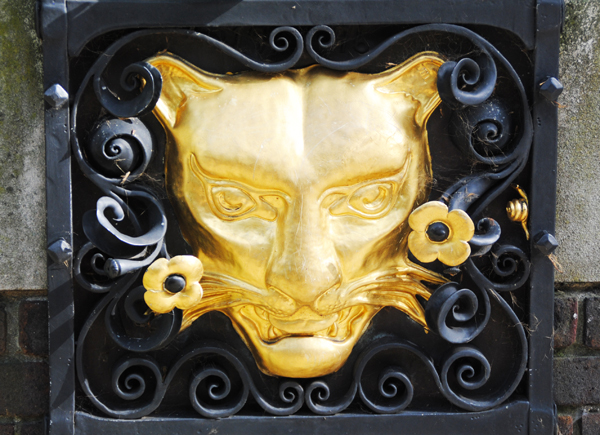
The iron arch, which was commissioned by the Blacksmith’s Company and put here in 1994, features the leopard’s head which is the hallmark of the Goldsmiths’ Company Assay Office, the premier hallmark in the UK (the term hallmark dates from the 15th century when London craftsmen were first required to bring their creations to the Goldsmiths’ Hall for verification and marking although the mark of the leopard’s head has been in use since the early 1300s).
For more on the Goldsmiths, see www.thegoldsmiths.co.uk.
Celebrating Charles Dickens – 6. Dickens the philanthropist
As the fame of author Charles Dickens grew, so too did his philanthropy and today we’re highlighting a couple of the London institutions he was known to support (and yes, we’ve changed the title for this series as most of the entries comprised more than one site!)…
1. Urania Cottage. A home for the redemption of “fallen women” or prostitutes, Urania Cottage was founded by an initially reluctant Dickens in Shepherd’s Bush in the city’s west in the late 1840s following an approach by Angela Burdett Coutts, heiress to the Coutts banking fortune. The home was founded as an alternative to existing institutions for such women – known for their “harsh and punishing” routines – and instead looked to provide an environment where they could learn skills, such as reading and writing, to help them successfully reintegrate into society (this would be overseas as all the women who spent time at the house were apparently required to emigrate following their time there). After founding the home in Lime Grove, Dickens became heavily involved in establishing the day-to-day running of the home – including interviewing prospective residents and personally searching prisons and workhouses for suitable candidates. It’s estimated that 100 women graduated from the home between 1847 and 1859. (For more, see Jenny Hartley’s Charles Dickens and the House of Fallen Women).
2. Great Ormond Street Hospital. Dickens played an important role in helping to publicise the work of this hospital – then known as the Hospital for Sick Children in Great Ormond Street, it opened in a converted 17th century townhouse in Great Ormond Street in 1852 and, initially with just 10 beds, was the first hospital in Britain to offer inpatient care only to children. The hospital was apparently initially regarded with suspicion by many and had few patients but Dickens, a close friend of Dr Charles West, the principal founder of the hospital, was able to write a powerful article about the hospital in his publication Household Words and so help to popularise its ground-breaking work. Dickens was a regular at the hospital’s annual fundraising dinner, was appointed an honorary governor and helped save the church from financial collapse in 1858 when he gave a public reading at St Martin-in-the-Fields’ church hall to raise funds. For more on the history of Great Ormond Street, see www.gosh.nhs.uk/about-us/our-history/.
3. Battersea Dogs & Cats Home. Clearly concerned with the well-being of all creatures great and small, Dickens was an influential supporter of the dogs home – then housed in a disused barn in Hollingsworth Street, Holloway – writing an article in the 1860s in his magazine All The Year Round about how dogs were cared for at the then fledgling organisation. In honor of the bicentenary of his birth, the home has been naming some of the animals in its care after some of the characters created by the Victorian author – these include a Staffordshire bull terrier called Copperfield and a bull mastiff cross called Dodger. For more on the home, see www.battersea.org.uk.
We’d be interested to hear from you if there are any other organisations you’re aware of which Dickens supported…
Lost London: Gates Special – Cripplegate
Originally the northern gate of the Roman fort constructed in about 120 AD, Cripplegate was rebuilt several times during the medieval period before finally being demolished in 1760 as part of road widening measures.
The origins of the gate’s name are shrouded by the mists of time but it has been suggested that it was named for the beggars or cripples that once begged there or that it could come from an Anglo-Saxon word crepel which means a covered walkway.
The name may even be associated with an event which took place there in 1100 when, fearful of marauding Danes, Bishop Alwyn ordered the body of Edmund the Martyr, a sainted former Anglo-Saxon king, to be tranferred from its usual home in Bury St Edmunds to St Gregory’s Church near St Paul’s in London so that it could be kept safe. It was said that when the body passed through the gate, many of the cripples there were miraculously healed.
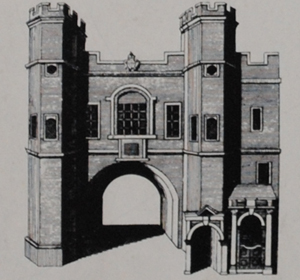
The gate (pictured here in an 18th century etching as it would have looked in 1663 in an image taken from a London Wall Walk plaque), which gave access in medieval times to what was then the village of Islington, was associated with the Brewer’s Company and was used for some time as a prison.
It was defensive works, known as a barbican, built on the northern side of the gate in the Middle Ages which are apparently responsible for the post World War II adoption of the name Barbican for that area of London which once stood outside the gate’s northern facade (the gates stood at what is now the intersection of Wood Street and St Alphage Garden).
The gate’s name now adorns the street known as Cripplegate as well as the name of the church St Giles Cripplegate, which originally stood outside the city walls. It is also the name of one of the 25 wards of the City of London. The original site of the gate is marked with a blue plaque.
10 curiously named churches of London – 10. St Olave Hart Street
One of a few London churches to have escaped the Great Fire of 1666 (the flames are said to have come within 100 metres before the wind changed direction), St Olave Hart Street is named after the patron saint of Norway, St Olaf – a figure more known for his ability as a warrior than as a saint.
King Olaf II was King of Norway in the early 11th century and an ally of the Saxon King, Ethelred the Unready. The Norwegian king won the thanks of the English after he fought alongside Ethelred against the Danes in 1014 in what some refer to as the Battle of London Bridge.
According to some, the church was built on the site of where the battle was fought – many also believe the battle was also the inspiration for the nursery rhyme, London Bridge Is Falling Down, for it was during that battle that Olaf, who was helping Ethelred retake London, is credited with using his longships to pull down London Bridge in a effort to thwart the Danish occupiers.
The church, meanwhile, was rebuilt a couple of times in the Middle Ages, when it was said to have been known as St Olave-towards-the-Tower. The church which now stands on the site was built in 1450 with the distinctive red brick on the tower added in the early 18th century.
Having survived the Great Fire in 1666, the church was not so fortunate during the Blitz when it was struck by German bombs. It was subsequently restored with King Haakon VII of Norway attending the re-opening in the mid-1950s (there is a stone laid in front of the sanctuary which he brought from Trondheim Cathedral).
Other features inside include a recently returned 17th century bust of a prominent physician Dr Peter Turner – part of a monument which went missing after World War II, it resurfaced at an auction in 2010.
The church’s most famous parishioner was the 17th century diarist Samuel Pepys who lived and worked in the nearby Naval Office (for more on Pepys see our earlier entry here). The door through which he would have entered the church is marked with a 19th century memorial.
Pepys and his wife Elizabeth are both buried in the church (the memorial Pepys commissioned for her is still there) as is his brother John. Samuel Pepys’ life is commemorated at a service held close to the day he died – 26th May – each year.
Others associated with the church include Sir William Penn, an admiral and father of the William Penn who founded Pennsylvania in what is now the United States, and Charles Dickens, who gave it the name “Ghastly Grim” thanks to the skulls above its Seething Lane entrance.
St Olave’s is also the chapel of the The Clothworker’s Company, The Worshipful Company of Environmental Cleaners and Trinity House, a charitable organisation dedicated to the safety, welfare and training of mariners established by Royal Charter from King Henry VIII in 1514.
WHERE: Corner of Hart Street and Seething Lane in the City (nearest Tube stations are Tower Hill and Monument). WHEN: See website for details; COST: Free; WEBSITE: www.sanctuaryinthecity.net/St-Olaves.html
10 curiously named churches of London – 9. St Michael Paternoster Royal
This triple-monikered church was first recorded in the 1200s. Far from unique in its dedication to the Archangel St Michael (there were apparently seven churches which were dedicated to him before the Great Fire), it was distinguished from the others by the name Paternoster Royal.
Surprisingly, the name has nothing to do with royalty or the clergy, at least not directly. The name Paternoster comes from the church’s location on what was Paternoster Lane (it’s now College Hill) – it was named for the number of paternoster or rosary seller that were based there.
The name Royal, meanwhile, is a little bit more obscure. First applied in the 1300s, it apparently comes from the close proximity of another street called Le Ryole which was itself a corruption of the French town of La Reole in the wine districts near Bordeaux. The street is believed to have been given the name thanks to the number of wine merchants who traded there.
Like other London churches, this one has been rebuilt several times – notably after the Great Fire of London (to the designs of Sir Christopher Wren) and again after World War II during which the church was all but destroyed by a V1 flying bomb. Since its reopening in 1968 it has served as the international headquarters of the Christian organisation, the Mission to Seafarers, which supports chaplains working in ports around the world.
The walls date from Wren’s time and the stone steeple, which wasn’t completed until 1717, is the work of Nicholas Hawksmoor. The interior features carved figures of Moses and Aaron which stand before the reredos – these apparently came from All-Hallows-the-Great (demolished in 1894) as did the chandelier which bears the words ‘Birmingham 1644’).
High profile parishioners over the years have included the four time Lord Mayor of London, Dick Whittington (see our earlier post on him) – he paid for a substantial extension of the church and founded a college of priests there (it’s from this college, which was dissolved in the mid-1500s and then re-established soon after, that College Hill is believed to have derived its name) as well as an almshouse next door.
Whittington and his wife were both buried inside but he was apparently exumed since several times and the location of his body is now unknown. There’s a stained glass window depicting Whittington and his famous cat inside and the gardens just outside also bear his name.
10 curiously named churches of London – 8. St Lawrence Jewry
The reason for the name of this church, founded in 1136, may seem obvious – it was associated with London’s Jewish community, thanks to its location on the edge of the area in which they lived (this area was centred on the street just to the south still known as Old Jewry).
What is perhaps more amazing may be the fact that the name stuck despite the expulsion of all Jews from London in 1291, the name was still used to distinguish it from other churches.
The church – named in honor of St Lawrence, a Roman era martyr who was slow grilled over a fire – was among those consumed in the Great Fire of London and rebuilt by Sir Christopher Wren afterwards. This new church had the honor of being reopened by King Charles II in 1677 – it was badly damaged in the Blitz before being rebuilt by Cecil Brown to Wren’s original design.
Located just off Guildhall Yard – home of the City’s authorities – St Lawrence Jewry is the official church of the Corporation of London and as such hosts a number of special services for the Lord Mayor and Aldermen during the year. Some 11 livery companies have links with the church – among them are those of tallow chandlers, loriners, girders, haberdashers and actuaries.
Worth noting on the inside is the painting of the martyrdom of St Lawrence – this survived the Blitz along with the tower and outer walls – and the many beautiful stained glass windows, painstakingly restored after World War II. There’s also a pond, complete with fish, outside the main entrance.
WHERE: Guildhall Yard (nearest Tube stations are St Paul’s, Bank and, a little further off, Moorgate and Mansion House). WHEN: 8am to 6pm Monday to Friday; COST: Free; WEBSITE: www.stlawrencejewry.org.uk.
10 curiously named churches of London – 7. St Margaret Pattens
It’s not often you’d come across a church named after a type of shoe, but that’s the case with the church of St Margaret Pattens.
Located in Eastcheap, a church dedicated to St Margaret – a saint who was martyred in Antioch in the Middle East – has stood on the current site for at least 900 years. The earliest reference dates from 1067 and the church was rebuilt at least once in the medieval period, with the costs of construction apparently partly funded out of gifts presented to a crucifix or rood which stood in Rood Lane close to the church.
It’s only since the 17th century, however, when the church was rebuilt to the design of Sir Christopher Wren after the Great Fire of London, that it took on the name ‘Pattens’ to distinguish itself from other churches dedicated to St Margaret.
Pattens were wooden undershoes which were trapped beneath normal footwear and raised the wearer above the street, allowing them to walk across muddy roads and still arrive at their destination cleanshod. This footwear was apparently made and sold near which the church was located.
The trade of pattenmaking, incidentially, died out as streets became paved – according to the church’s website, the last pattenmaker died in the 19th century. There’s still a sign in the church asking women to remove their pattens before entering.
It’s worth noting before we move on that there is an alternative theory as to the origins of the name – this is that it commemorates a benefactor, possibly a canon at St Paul’s named Ranulf Patin – but it’s the former interpretation which is more widely accepted.
St Margaret Pattens, which was united with that of St Gabriel Fen after the latter was destroyed in the Great Fire, was damaged by bombing in World War II but was restored in the mid 1950s.
While the church lost many of its valuables during the Reformation (with the exception of a silver gilt communion cup dating from 1545 – on loan to the Victoria & Albert Museum), notable features inside include a memorial to King Charles I (since 1890, the king has been remembered in a special service each year held on the nearest Thursday to the date of his execution – 30th January) and a Royal Stuart Coat-of-Arms believed to be those of King James II.
There’s also a reredos containing a painting by Italian Carlo Maratta (1625-1713), two unusual canopied pews reserved for churchwardens, an hourglass dating from 1750 used to time the sermons, and a bell which dates from before the Great Fire. It’s also possible to view a set of pattens.
Among those who have been associated with the church is famed medieval Lord Mayor of London, Dick Whittington, apparently at one time the church’s patron (you can see our earlier post on him here), as well as livery companies including, as one would expect, the Worshipful Company of Pattenmakers, and the Worshipful Company of Basketmakers.
WHERE: Corner of Eastcheap and Rood Lane (nearest Tube stations are Monument, Bank and Tower Hill). WHEN: Weekdays from 10.30am (check website for services); COST: Free; WEBSITE: www.stmargaretpattens.org.
10 curiously named churches of London – 6. St Katharine Cree
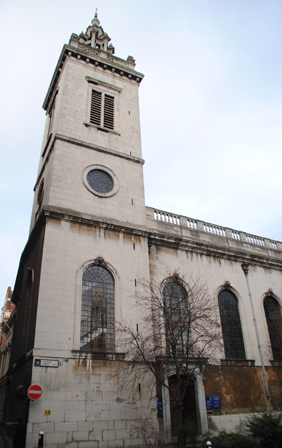
Contrary to what some may, St Katharine Cree is not named after a person of that name (or at least not entirely). St Katherine, certainly, but the addition of ‘Cree’ is simply a medieval corruption of ‘Christ Church’.
The name Christ Church, abbreviated to Cree, was applied to this church because it was the prior of the Augustinian Priory of the Holy Trinity in Aldgate, also known as Christ Church, who founded St Katharine Cree in 1280 for the use of the area’s parishioners (apparently their use of the priory church was causing problems).
The current building dates from 1630 (although the tower dates from 1504), making it the only surviving Jacobean church in London.
It was consecrated by William Laud, then Bishop of London (and later beheaded for, among other things, his support of King Charles I). He is commemorated in one of the church’s chapels.
Unlike so many other of London’s churches, St Katharine Cree was not destroyed in the Great Fire of London and only suffered minor damage in the Blitz. But structural problems meant it did need substantial restoration in the 1960s.
Inside, is a mid 17th century font and stained glass dating from the same era which depicts a Catherine wheel (St Katherine/Catherine is said to have died strapped to a spiked wheel when martyred during the time of the Roman Empire.).
There is also a rose window which was modelled on that of old St Paul’s Cathedral (before it was destroyed by the Great Fire). Parts of the organ, which was restored in the early Noughties, date from the 17th century and the original was played by none other than George Frideric Handel and Henry Purcell. The six bells were restored in 2009 following an appeal.
Among those buried at St Katharine Cree are Sir Nicholas Throckmorton, a 16th century diplomat (his monument is inside), and the artist Hans Holbein the Younger (his grave is also claimed by St Andrew Undershaft).
The church today has no parish but is the Guild Church to Finance, Commerce and Industry (its rector is that of St Olave Hart Street). Among its annual events is the Lion Sermon given in October, a tradition that dates back to 1643 and owes its origins to the former Lord Mayor of London, Sir John Gayer, who decided to finance the sermon after he survived an encounter with a lion in Syria.
WHERE: Leadenhall Street, London (nearest Tube stations are Aldgate and Tower Hill); WHEN: See website for service times; COST: Free; WEBSITE: www.sanctuaryinthecity.net/St-Katharine-Cree.html.
Exploring London’s 10 most popular posts for 2011 – Numbers 6 and 5…
The countdown of our 10 most popular posts for 2011 continues with numbers six and five…
6. The Royal Wedding – A view from The Mall: Another Royal Wedding entry, this post from April was all about the glamour and excitement of the day itself as we joined the crowds lining The Mall;
5. Treasures of London – The Whispering Gallery, St Paul’s Cathedral: One of London’s star sights, the Whispering Gallery at St Paul’s has long held a fascination for visitors and Londoners alike.
10 curiously named churches of London – 5. St Magnus the Martyr
St Magnus the Martyr has to be one of the most oddly dedicated churches in London. Indeed, for many years there was confusion over which St Magnus it was dedicated to – candidates including a second and a third century martyr and a Viking who was slain in the Orkney Isles around 900 years ago.
Revived interest in the latter St Magnus in the early 20th century thanks to the discovery of his remains hidden in a pillar in the Orkney ‘capital’ of Kirkwall , however, led to a confirmation of the church’s dedication in 1924.
There is believed to have been a church on the site since Roman times (a fact which has contributed to the confusion over it’s more recent dedication) but its first known mention as that of St Magnus is shortly after the Norman Conquest.
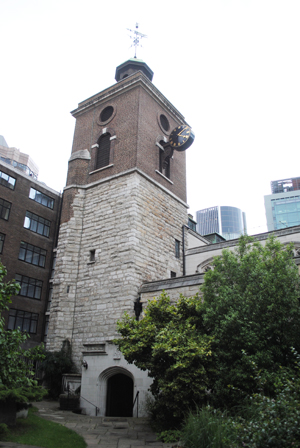
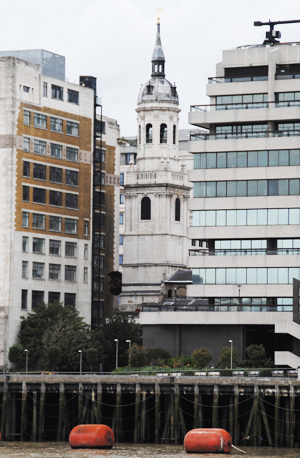
The church’s location, on the approach to London Bridge (see the picture, right, of the church tower overlooking the Thames), meant it occupied an important place in the life of medieval London. Following the Reformation, the patronage of the church was held alternately by the Abbey of Bermondsey and the Abbot and Convent of Westminster – this later passed into the hands of the Bishop of London, Edmund Grindall, and it was he who appointed the church’s most famous rector, Miles Coverdale, best remembered today as a Bible translator (there is a large monument to him in the church).
The church had been repaired in the early 17th century but was destroyed completely in the Great Fire of 1666. It was subsequently rebuilt to the designs of the ubiquitous Sir Christopher Wren.
A fire in 1760 did considerable damage to Wren’s building but it was restored and improvements continued to be made on a sporadic basis until 1831 when Sir John Rennie’s new London Bridge was opened and the old bridge demolished, meaning St Magnus no longer occupied the ‘gateway’ position it had for centuries prior.
The church only received relatively minor damage during World War II when a bomb struck London Bridge but was later restored. Features of the church now include the exterior clock, which dates from 1700, and a piece of wood believed to have one formed part of the Roman wharf which has been placed under the porch.
Among those buried at St Magnus’ during medieval times were Henry Yevele, master mason to King Edward III and King Richard II (his monument was destroyed in 1666). The church still has connections to the Fishmonger’s Company and the Plumber’s Company.
WHERE: Lower Thames Street, London (nearest Tube stations are Monument and London Bridge); WHEN: 10am to 4pm Tuesday to Friday; COST: Free; WEBSITE: www.stmagnusmartyr.org.uk.
10 curiously named churches of London – 4. St James Garlickhythe
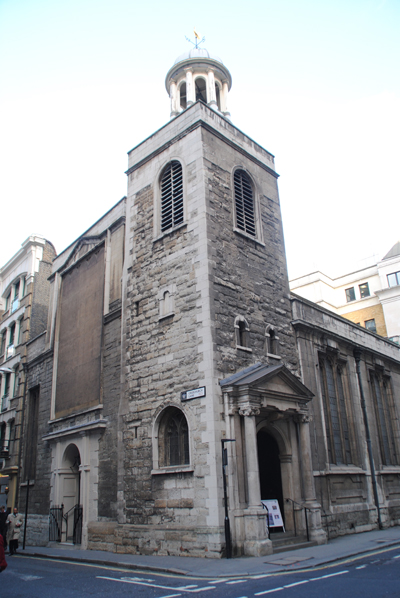
Situated close to London’s riverfront, there is believed to have been a church on this site since at least 1100, although it is believed to have been previously dedicated jointly to the apostles St James and St John.
The name of Garlickhythe can be explained by its location – the word ‘hythe’ is a Saxon word for a landing place or jetty and it is believed garlic, used as a preservative and medication, was unloaded nearby and even possibly traded on Garlick Hill where the church stands.
The church was rebuilt in the 1300s and again after the Great Fire (it was another of Sir Christopher Wren’s designs and thanks to the abundance of natural light inside was known as ‘Wren’s Lantern’) but it largely escaped damaged in World War II (the projecting tower clock was among the casualities but while a 500 lb bomb buried itself in the south-east corner of the church, it failed to explode).
What bombs failed to do, however, a death watch beetle did and when one was discovered in the roof timbers in the 1950s, the church was closed until 1963 while it was restored. The exterior clock was restored in 1988 and repairs to the south transept were required after a crane counterweight smashed into the church in 1991.
Inside, the church boasts the second highest ceiling – 40 foot – of any churches in London (St Paul’s being the highest) and much of the carved woodwork inside, including the font cover, altar table and churchwardens pews, is still original.
There is also original ironwork including a mayoral swordrest as well as a Stuart and Georgian coat-of-arms (the Stuart arms are among a number of features which come from St Michael Queenhithe – it was combined with this parish in the late 1800s; St Michael’s was pulled down in 1894 ).
The magnificent Bernhard Schmidt organ was installed in 1718. The church also houses two rare chalices dating from the time of Edward VI in the mid-16th century and some other rare plate as well as the oldest parish registers in England (these date from the 16th century with the first entry being that of the baptism of Edward Butler on 18th November, 1535).
St James Garlickhythe, which sits in the parish of St James Garlickhythe with St Michael Queenhithe and Holy Trinity-the-Less (the latter being another now demolished church), boasts connections to 12 livery companies including the Vintners (the church is located in Vintry Ward) and the Joiners. Among those buried there are six former mayors.
The church is currently appealing for funds for a new ring of eight bells to mark the Diamond Jubilee of Queen Elizabeth II next year.
And we couldn’t mention the church without referring to Jimmy Garlick, the church’s mummy. An embalmed body of an older man, this was discovered in the church vaults in 1855 and, identity unknown, was subsequently put on display so that curious onlookers could, for a small fee, look upon him or apparently even touch him. Jimmy, whose identity remains unknown, is no longer on public view.
WHERE: Garlick Hill (just off Upper Thames Street) (nearest Tube station is Mansion House). WHEN: See website for service times; COST: Free; WEBSITE: www.stjamesgarlickhythe.org.
LondonLife – Poet Ted Hughes commemorated in Poets’ Corner

The late Poet-Laureate Ted Hughes was honored in a ceremony in Westminster Abbey’s Poets’ Corner last week with the dedication of a hand-carved memorial slab. The memorial includes a quotation from his work That Morning: “So we found the end of our journey, So we stood alive in the river of light, Among the creatures of light, creatures of light…”. The memorial to Hughes, who died in 1998 at the age of 68, was placed at the foot of that of TS Eliot, who was a mentor to Hughes. Among those who attended the commemoration were Hughes’ widow Carol and his daughter Frieda as well as literary figures including Nobel Laureate Seamus Heaney, Sir Andrew Motion, Michael Morpurgo and Graham Swift. Other literary luminaries commemorated in Poets’ Corner (only some of whom are buried here) include Geoffrey Chaucer, Edmund Spenser, John Milton, Lord Byron and John Keats as well as Charles Dickens, William Shakespeare and Rudyard Kipling. For more on Poets’ Corner, see www.westminster-abbey.org.
PICTURE: Carol Hughes lays a bouquet of flowers and herbs from the garden of the Hughes’ Devon home at the memorial. (Copyright Dean and Chapter of Westminster).
10 curiously named churches of London – 3. St Mary-le-Bow
We’ve already touched on the history of St Mary-le-Bow in our earlier series on Sir Christopher Wren but thought it was worth revisiting in a bit more detail.
Another of Wren’s churches (after all, remember he designed more than 50 in the city), St Mary-le-Bow, on the corner of Cheapside and Bow Lane, has a history dating back at least to the Norman Conquest (although it is thought it may stand on the site of an earlier Saxon church) when it was constructed of Caen stone on the orders of Lanfranc, the new Archbishop of Canterbury, and was perhaps seen as a symbol of Norman oppression.
The name ‘le Bow’ is said to come from the Norman arches (it was apparently initially known as St Mary de Arcubus) which stand in what is now the crypt – this would have only been partially underground when built. From 1251, it hosted one of the church’s most important courts, which, thanks to its location, was known as the Court of the Arches. There is now a cafe in the crypt.
Like many other churches in the City, St Mary-le-Bow has been repeatedly repaired and rebuilt – following damage in a tornado in the late 11th century, the collapse of its tower in 1271, and, of course, the Great Fire of London in 1666 – Wren’s subsequent rebuilding included the construction of the fine great tower (pictured here against the backdrop of more modern City buildings, it was his second tallest structure after St Paul’s and was built to accommodate the Bow bells ). The church’s most recent remodelling was in 1964 after it was almost completely destroyed during bombing in May, 1941.
One of the church’s most important claims to fame is its bells. These included the city’s principal curfew bell, rung at 9pm each day since at least as far back as 1363. It is said that ‘true Londoners’ or ‘Cockneys’ must be born within hearing of the Bow bells and it was the pealing of the Bow bells (or what may have only been one bell at the time) which, of course, caused thrice-mayor Dick Whittington to turn back when leaving London. The church (in particular, its curfew bell) is also among a number of City churches mentioned in various versions of the rhyming song, Oranges and Lemons.
Features inside include a memorial to the first British Governor of New South Wales in Australia, Admiral Arthur Phillip, who was born nearby, and a bronze relief of St George and the Dragon given by Norway in commemoration of the work of the Norwegian Resistance during World War II. The churchyard outside contains a statue of Captain John Smith, founder of Virginia, and former parishioner.
For an indepth history of the church, you can’t go past the rather comprehensive St Mary-le-Bow: A History.
WHERE: Cheapside (nearest Tube station is St Paul’s). WHEN: 7.30am to 6pm Monday to Wednesday (closes 6.30pm Thursday and 4pm Friday and not usually open on weekends or bank holidays); COST: Free; WEBSITE: www.stmarylebow.co.uk.
Lost London: Gates Special – Ludgate
We’re launching a new ‘Lost London’ special looking at some of the now disappeared gates of London. First up is Ludgate which once stood on the western side of the city.
The gate is believed to have been constructed in Roman times and is known to have been rebuilt a several times – once in 1215 and another time after it was destroyed in the Great Fire – before being demolished in 1760 to allow for the road to be widened.
The origins of the name – which is today commemorated in street names like Ludgate Hill and Ludgate Circus – are sketchy but may have been named after the mythical pre-Roman King Lud, who was, so the legend goes, buried underneath this portal (this myth was popularised by the 12th century writer Geoffrey of Monmouth). Others have suggested ‘lud’ is a corruption of ‘flud’ or ‘flood’ and the gate was so named because it prevented the city being flooded by the River Fleet. Another possibility is that ‘lud’ is simply an old English word for a postern gate, a small secondary gate.
Whatever the origins of its name, it has been suggested it was through Ludgate that William the Conqueror passed when first entering the city. In 1377 it became a prison for petty criminals like debtors and trespassers – serious criminals were sent to Newgate – and this lasted until its final destruction.
There is a blue plaque on the wall of the church of St Martin-within-Ludgate in Ludgate Hill marking where Ludgate once stood (pictured above). It is believed that some badly corroded statues standing under a porch at the church of St Dunstan-in-the-West on Fleet Street are of Lud and his sons and were taken down from the gate before its demolition. William Kerwin’s statue of Queen Elizabeth I which dates from 1586 sits in a niche on the front of the church is also believed to have been removed from Ludgate.