10 Historic Sporting Events in London – 4. The 1966 FIFA World Cup at Wembley…

The home of English football, in 1966 Wembley Stadium in north-west London played host to the FIFA World Cup and witnessed England win the coveted cup.
Led out onto the ground by Bobby Moore, the English team, under manager Alf Ramsey, were locked in a 2-2 draw with West Germany when the game went into extra time. English player Geoff Hurst, who had already scored a goal, went on to score two more goals (one of which was particularly controversial with some still believing it didn’t cross the goal-line), giving him a hat-trick of goals and handing England the cup in a 4-2 win.

The team received the Jules Rimet trophy (named for former FIFA president Jules Rimet and replaced with the current FIFA World Cup Trophy in the 1970s) from Queen Elizabeth II.

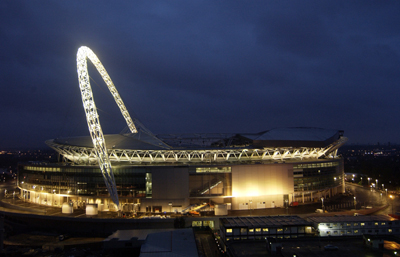
While the history of Wembley goes back to 1923 when the Empire Stadium, referred to as the “Twin Towers” thanks to its distinctive two domed towers, was built on the site, the current stadium was only officially opened in 2007. Capable of seating 90,000, it is the second largest stadium in Europe.

As the Empire Stadium, the ground – originally built for a British Empire Exhibition – had played host to events including the 1934 Empire Games, the 1948 Olympics, and numerous football finals including the so-called “White Horse final” when a mounted policeman went on the pitch to contain the estimated 200,000 fans who watched the Bolton Wanderers FC defeat West Ham United FC 2-0 in the 1923 FA Cup final.

The current stadium with its iconic arch now plays host to the FA Cup as well as other high-profile matches like the FA Community Shield and large events including rock concerts (a recent vote on the Wembley website found that the greatest event ever held there was a 2007 concert by Muse).

This Olympics, Wembley is hosting numerous football matches including the gold medal match for both men and women, on the 11th and 9th August respectively (the last time the men’s final was played here during an Olympics was in 1948 when England won the bronze). It’s hoped a new record will be set for the number of people attending a women’s Olympic football match (the current record of 76,489 was recorded at the 1996 Olympics in Georgia at the Stanford Stadium) during the Games.

With a one kilometre circumference, the stadium encloses some four million square metres (equivalent apparently to the space taken up by 25,000 London double-decker buses) and features a Royal Box in the middle of the north stand from where all trophies are presented. The roof is partly closable.

There are tours of the stadium (although it’s closed during the Olympics), details of which are below.

WHERE: Wembley National Stadium, Wembley (nearest Tube stations are Wembley Park and Wembley Central or the Wembley Stadium British Rail station); WHEN: Selected dates – see website for details; advance booking strongly recommended (the stadium is closed for events, including the Olympics and before and after); COST: £16 an adult/£9 a child (under 16, under five’s free)/£9 seniors/£41 family ticket (zip wire ride extra); WEBSITE: www.wembleystadium.com/Wembley-Tours.aspx.

PICTURE: Action Images/Paul Harding (courtesy of Wembley National Stadium).
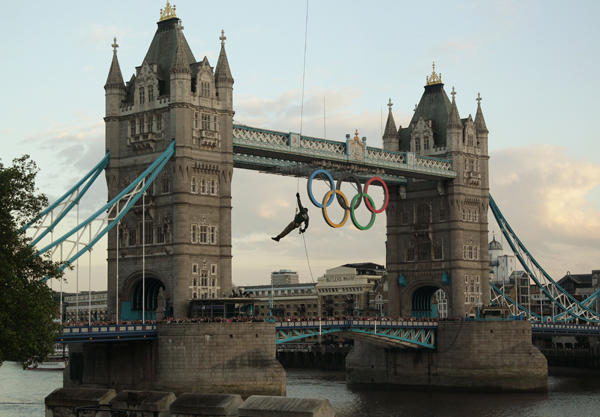
LondonLife – The Olympic Torch Relay (so far)…

The Olympic Torch Relay arrived in London last Friday night and has been moving around the capital ever since. Here are some of the highlights so far (all images are courtesy of LOCOG)…

Day 63 (20th July): A Royal Marine, believed to be Martin Williams, is carrying the Olympic Flame as he abseils from a helicopter into the grounds of the Tower of London.

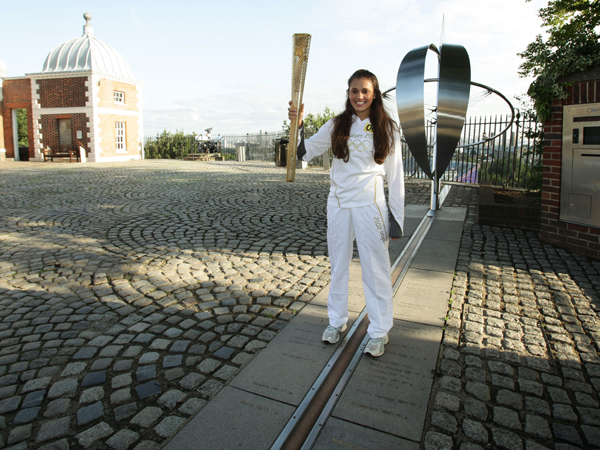
Day 64 (21st July): Swimmer Natasha Sinha holds the Olympic Flame on the Meridian Time Line outside the Royal Observatory in Greenwich.

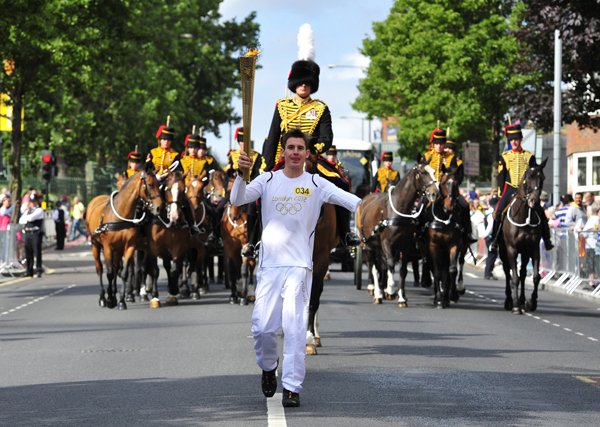
Jaco-Albert Van Gass carries the Olympic Flame through Greenwich.

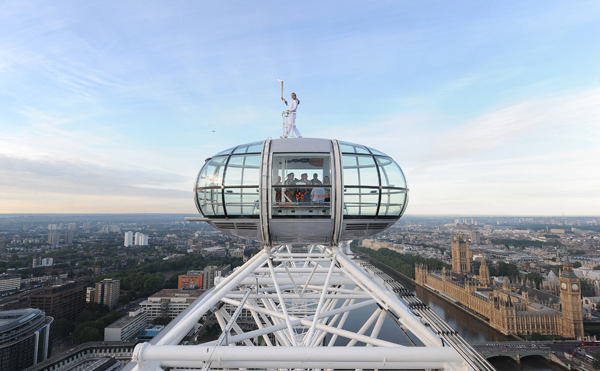
Day 65 (22nd July): Student explorer Amelia Hempleman-Adams poses with the Olympic Flame on top of a London Eye pod.

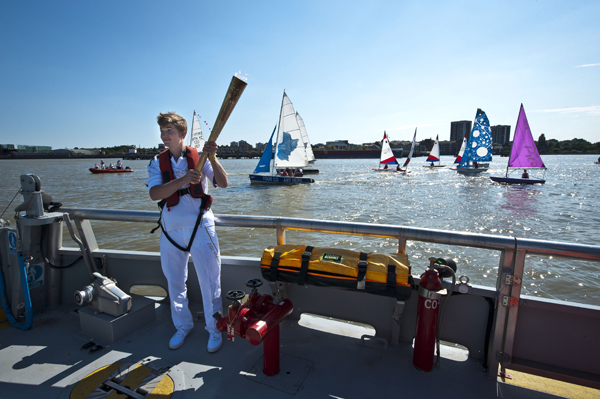
Sailor Aaron Reynolds carries the Olympic Flame on a London Fire Brigade Boat.

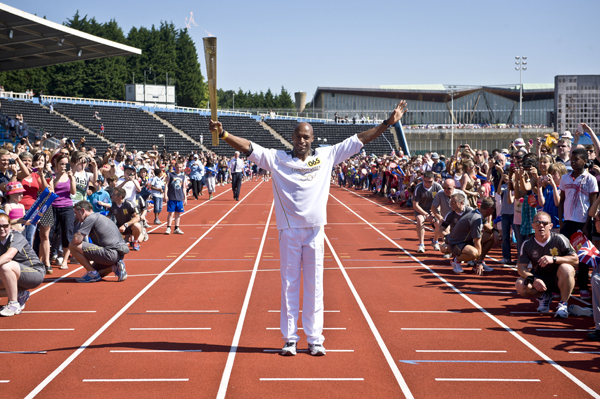
Day 66 (23rd July): Sprinter Marlon Devonish carries the Olympic Flame at Crystal Palace stadium in south London.

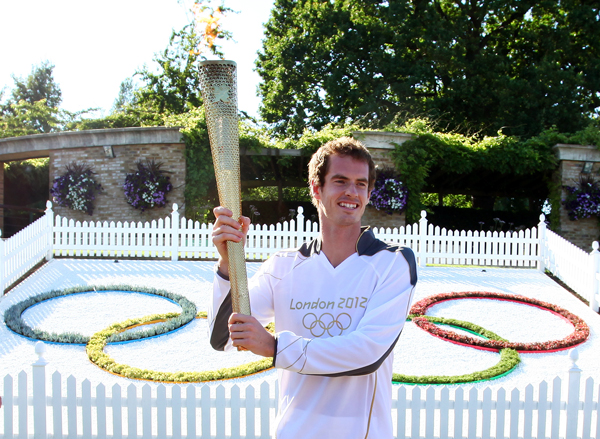
Tennis player Andy Murray carries the Olympic Flame at Wimbledon.

For more on the Torch Relay, see www.london2012.com/torch-relay/

ALL PICTURES: LOCOG.

Around London: Olympic Torch Relay hits London; mascots pop-up all over the city; and Shakespeare at the British Museum…

• The Olympic Torch Relay arrives in London tomorrow night before working its way around all of the city’s 33 boroughs and reaching the Olympic Stadium for the Opening Ceremony next Friday.  The torch will arrive in the city by helicopter from Guildford tomorrow night and then be abseiled into the Tower of London where it will spend the night ensconced with the Olympic medals. The relay will travel 200 miles over the next week, carried by more than 980 torchbearers. The route is as follows:

  • Saturday, 21st July – Greenwich via Newham, Tower Hamlets and Hackney to Waltham Forest (highlights include a visit to the Cutty Sark);
  • Sunday, 22nd July – Redbridge via Barking & Dagenham and Havering to Bexley (highlights include a ride on the London Eye and a crossing of the Thames);
  • Monday, 23rd July – Lewisham via Bromley, Croydon, Sutton and Merton to Wandsworth (highlights include a visit to a live filming of Eastenders);
  • Tuesday, 24th July – Kingston via Richmond, Hounslow, Hillingdon and Denham to Ealing (highlights include a visit to Kew Gardens);
  • Wednesday, 25th July – Harrow via Brent, Barnet and Enfield to Haringey (highlights include a visit to Wembley Arena);
  • Thursday, 26th July – Camden via Islington, the City of London, Southwark, Lambeth, Wandsworth, Kensington & Chelsea and Hammersmith & Fulham  to Westminster (the many landmarks to be visited include St Paul’s Cathedral, Shakespeare’s Globe, Trafalgar Square, Buckingham Palace and Hyde Park);
  • Friday, 27th July – From Hampton Court Palace (where it will be taken into the maze) on board Gloriana via the Thames to Olympic Park for the Opening Ceremony.

The 70 day torch relay, which kicked off on 19th May, will have travelled a total distance of about 8,000 miles and have involved 8,000 torchbearers by the time it reaches its end. LOCOG and Transport for London have advised people to see the relay at a location closest to their home given the expected crowds. For more detailed route information, see www.london2012.com/torch-relay/route/. PICTURE: LOCOG

Still talking all things Olympics and London’s largest ever ‘pop up’ shop – where you can buy Olympic merchandise – was officially opened by multiple gold medalist Sir Steve Redgrave in Hyde Park last week. The shop, located on Rotten Row, will be the site of special athlete visits during the Games and visitors can have their photo taken with the Olympic Torch.

• Meanwhile, life-sized versions of the Olympic mascot Wenlock and Paralympic mascot Mandeville are popping up at some of London’s key tourist locations. The 83 two metre tall sculptures capture various elements of life in London with incarnations including a Beefeater, a giant red phone box and a replica of Big Ben. The figures can be found on the routes of Stroll, six new discovery trails designed to help both tourists and Londoners get more out of the city. A QR code on the bottom of each of the sculptures directs smartphone users to further information about the discovery trails. The discovery trails are part of the Mayor of London Presents, a city-wide programme featuring free events, shows and activities. For more on what’s happening in your area, see www.molpresents.com. Some of these events are also being run as part of the Festival of London 2012. For more on this, see http://festival.london2012.com.

• On Now: Shakespeare: staging the world. Part of the World Shakespeare Festival taking place in London, this exhibition at the British Museum looks at the then emerging role of London as a “world city” as interpreted through Shakespeare’s plays and examines the role the playhouse performed in this. The museum has collaborated with the Royal Shakespeare Company to produce the exhibition which features more than 190 objects including paintings, jewels and rare manuscripts. These include the Ides of March coin, a Roman gold aureus commemorating the assassination of Julius Caesar (Julius Caesar), the Lyte Jewel, presented to Thomas Lyte in 1610 in thanks for his work in tracing King James I’s lineage back through Banquo (Macbeth), and a 1610 bird’s-eye view of Venice (Othello and The Merchant of Venice). Runs until 25th November. Admission charge applies. For more, see www.britishmuseum.org.

Around London – Richmond’s upsized Olympic rings; cart marking; ‘Sam’ Mussabini honored; and, Tudor twins at the NPG…

• The largest official Olympic Rings were unveiled at Richmond Park National Nature Reserve in London’s south-west this week, having been mown into the grass by the Royal Parks’ shire horses. The rings, which lie on Heathrow’s flight path and are 300 metres wide and more than 135 metres tall, will welcome athletes as they fly in to compete in the Games which kick off later this month. It took six shire horses to create the giant rings – which represent five continents – but they’ll be maintained by just two – Jim and Murdoch. Horses have worked in Richmond Park since as far back 1637 when King Charles I had the park enclosed as a royal hunting ground. Eleven Olympic events will be held on Royal Parks during the Games including road race cycling in Richmond Park. For more on Richmond Park, see www.royalparks.org.uk/parks/richmond-park. PICTURE: LOCOG.

• Almost 50 vehicles, ranging from handcarts to horse drawn carriages, steam powered vehicles to a new London bus, took part in the Worshipful Company of Carmen’s traditional ‘Cart Marking’ procession through the City of London yesterday. The ‘trade’ of carmen dates back to the 13th century when City authorities passed a bye-law controlling carters. At the ceremony, the carmen bring a variety of vehicles which are branded by placing a red hot iron on a wooden plate, with the year letter and the car number, in the continuation of an ancient tradition. The Worshipful Company of Carmen is said to be the oldest transportation organisation in the world. For more on the livery company, see www.thecarmen.co.uk.

• The late athletics coach Scipio Africanus “Sam” Mussabini (1867-1927) was honored this week with the unveiling of an English Heritage Blue Plaque at his former home in Herne Hill in London’s south. Mussabini, whose role in helping 100 metre sprinter Harold Abrahams win gold at the 1924 Olympics was depicted in the film Chariots of Fire (he was played by Ian Holm),  lived at the house at 84 Burbage Road from 1911 to about 1916. It backs onto the Herne Hill Stadium where he worked as a cycling and athletics coach from the 1890s, a period during which he trained several medal-winning Olympic athletes. All up, Mussabini’s runners won a total of 11 Olympic medals including five golds, between 1908 and 1928. For more, see www.english-heritage.org.uk.

On Now: Double Take: Versions and Copies of Tudor Portraits. This display at the National Portrait Gallery features five pairs of nearly identical Tudor portraits and explores how and why they were made. Among the portraits from the gallery’s collection on display are those of King Henry VIII, his wife Anne Boleyn, Archbishop William Warham, the merchant Thomas Gresham and Lord Treasurer Thomas Sackville – all of which are paired with paintings on loan from other collections. Admission is free. Runs until 9th September. For more information on the Making Art in Tudor Britain research project – of which this is a part – see www.npg.org.uk/research/programmes/making-art-in-tudor-britain.

LondonLife – Olympic flower power at Kew Gardens…

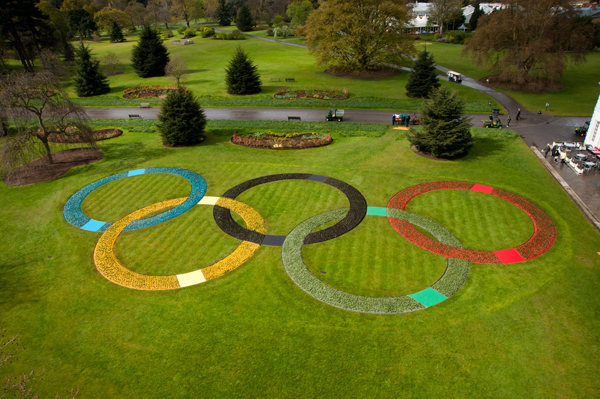
There’s less than a month to go to the Opening Ceremony of the Olympic Games so we thought it only appropriate to take a look at Kew Gardens’ floral Olympic Rings. Located next to The Orangery, the rings are 50 metres long and made of 20,000 plants including Viola ‘Light Blue’, Viola ‘Clear Yellow’, Viola ‘Black Delight’, apple mint (Mentha suaveolens) and Viola ‘Red Blotch’ plants. Able to be seen from planes on the Heathrow flight path, they were unveiled in April and will be at the gardens until September. For more information on visiting Kew Gardens, see www.kew.org. PICTURE: Courtesy Kew Gardens

Around London – Olympic Rings unveiled on Tower Bridge; London from above; Blake on Primrose; V&A illustrations; and, Munch at the Tate Modern…

• The Olympic Rings were unveiled on Tower Bridge yesterday to mark one month until the Opening Ceremony of the 2012 Games. Each of the rings weighs three tonnes and are 25 metres wide and 11.5 metres tall. A light show featuring thousands of LED lights brings them to life at night. The rings retract when the bridge is raised. Among those at the unveiling were Lord Sebastian Coe, chairman of LOCOG, London Mayor Boris Johnson and the Culture Secretary Jeremy Hunt.

• Several hundred images of London have been included in Britain from Above, a new website launched by English Heritage and the Royal Commissions on the Ancient and Historical Monuments of Scotland and Wales. The website, which boasts more than 15,000 images taken between 1919 and 1953 includes some of the oldest and most valuable images from the Aerofilms Collection, an archive of more than a million photographs taken between 1919 and 2006. A search for London brings up 283 results, among them stunning images of Tower Bridge, The Tower of London and St Paul’s Cathedral. Users are encouraged to download images, customise their own themed photo galleries and share information to add to the knowledge behind each of the images. For more, see www.britainfromabove.org.uk.

• A quote from William Blake has been inscribed on stone on the summit of Primrose Hill, famous for its views of the London skyline. The quote – “I have conversed with the spiritual sun. I saw him on Primrose Hill” – was selected, according to Nick Biddle, The Regent’s Park manager, “because it sums up so well the experience of standing on Primrose Hill in the early morning light”. “It is always a wonderful experience,” he says. The unveiling of the inscription signalled the end to a series of improvement works on the hill. For more, see http://www.royalparks.org.uk.

• On Now: V&A Illustration Awards display. Features works by the 14 artists short-listed for the V&A’s annual illustration awards. Drawn from more than 1,000 entries the panel – fashion designer Orla Kiely, broadcaster and cultural commentator Emma Freud and Moira Gemmill, V&A director of design – selected their favorite entries in three categories – book illustration, book cover and jacket illustration – while winners of last year’s award judged a fourth category for students’ work. Runs until 31st December. Admission is free. For more, see www.vam.ac.uk/illustrationawards.

• On Now: Edvard Munch: The Modern Eye. This major exhibition at the Tate Modern reassesses the work of this Norwegian painter and aims to show how he engaged with the 20th century world, in particular his interest in the rise of modern media including photography, film and stage production. Organised in conjunction with the Centre Pompidou in Paris and the Munch Museum in Oslo, the exhibition features more than 60 paintings and 50 photographs as well as Munch’s lesser-known work in film. They include different versions of celebrated works like The Sick Child and The Girls on a Bridge as well as his last work, a self protrait. Runs until 14th October. Admission charge applies. For more, see www.tate.org.uk.

10 Historic Sporting Events in London – 1. The 1908 Olympic Games…

The London Olympics are almost upon us and having completed our series on the Queen to mark her Diamond Jubilee, we’re launching a new special looking at historic sporting events which took place in London and where they were carried out.

To kick it off, however, we thought we’d take a look at Olympics past. London has previously hosted the Games twice – 1908 and 1948. So this week we’re taking a look at the 1908 Games.

The 1908 Summer Olympics – officially recognised as the fourth “modern” Games – were initially to be held in Rome. But the eruption of Mt Vesuvius in 1906 devastated the city of Naples and so the funds which were to be used for the Games had to be diverted to help the stricken community.

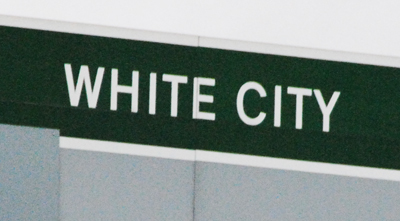
A number of candidates, including Milan and Berlin, were apparently considered before it was decided to hold the Games in White City in London’s west alongside the Franco-British Exhibition already being held in the area (the white marble clad buildings constructed for the exhibition buildings are what gave the area its name).

A new stadium – the White City Stadium – was constructed in just 10 months for the Games and was designed to accommodate 66,000 people. As well as the running track around the perimeter with which we are familiar today, there was also a cycle track located outside the running track while the infield hosted swimming and diving pools and a pitch where football, hockey, rugby and lacrosse could be played. Wrestling and gymnastics was also conducted in the middle of the stadium.

While many of the 110 events in 22 different sports – including athletics, archery, lacrosse, rugby union, swimming, water polo and  tug of war (the only time run at an Olympics, it was won by a City of London police team) – and were held at the stadium, a number were held elsewhere.

These included tennis (at the All England Lawn Tennis and Croquet Club in Wimbledon – see yesterday’s post), rowing (at Henley), fencing (at the neighbouring British-Franco Exhibition) and jeu de paume or ‘real tennis’ (at the Queen’s Club in West Kensington).

The Games, which ran for six months from April to October, were noted for being the first in which Winter events were included (four figure skating events were held at the Prince’s Skating Club in Knightsbridge), for being the first at which the Olympic creed – “The important thing in life is not the triumph, but the fight; the essential thing is not to have won, but to have fought well” – was publicly proclaimed.

They were also the Olympics at which length of the marathon was set at 26 miles, 385 yards (the distance from a window outside the nursery at Windsor Castle, where the event was started to give the Royal Family a good view, to the stadium) and were the first Games in which spectators marching into the arena behind their country’s flag during the opening ceremony.

The marathon, incidentally, was particularly controversial with Italian Dorando Pietri finishing first after being assisted across the finish line by officials when he collapsed (he was disqualified but awarded a special cup for his efforts by Queen Alexandra). There was also controversy when the US team refused to dip their flag before King Edward VII in the opening ceremony. Judging disputes also led to the creation of standard rules and the introduction of neutral judges in subsequent Games.

White City Stadium initially fell into disuse but was subsequently used for greyhound racing and athletics. The site is now occupied by the BBC. There is a ‘Roll of Honour’, unveiled on the site in 2005, which commemorates the 1908 Games.

Oh, and the most medals were won by Great Britain who won 56 gold, 51 silver and 38 bronze while the US came next with 23 gold, 12 silver and 12 bronze.

You can check out the Olympic website for more including images – www.olympic.org/london-1908-summer-olympics.

Around London – Open gardens; new gates mark St Paul’s tercentenary; a new Olympics trail; and, truces at the IWM…

• If you’re not too exhausted after last weekend’s Diamond Jubilee festivities (or if you’re looking for something a little more sedate), this Saturday and Sunday London plays host to Open Garden Squares Weekend. Among the 208 gardens to be opened this weekend is the communal garden at Number 10 Downing Street, home of Prime Minister David Cameron. Laid out in 1736, the L-shaped garden at 10 Downing Street is shared by residents of both Number 10 and Number 11, including Larry, the Downing Street cat (tickets for this garden have already been allocated via a ballot process). Among the more than 200 gardens open to the public as part of the weekend are 24 new gardens and, for the first time, the event is being supported by the National Trust (along with the usual organisers, the London Parks and Gardens Trust). Downing Street aside, other gardens open to the public include the Regent’s Park Allotment Garden, the Royal College of Physicians’ Medicinal Garden, the Kensington Roof Gardens, and the gardens at HMP Wormwood Scrubs. Tickets for the gardens are cheaper if bought online in advance of the weekend and picked up on Saturday or Sunday – it’s not too late to do so, so for tickets and more information, head to www.opensquares.org.

A new pair gates designed to mark St Paul’s Cathedral’s tercentenary were opened in Richmond Park for the first time last week. The gates, which now form part of the historic vista seen from King Henry’s Mound in Richmond Park when looking toward’s St Paul’s Cathedral, were designed by 21-year-old blacksmith Joshua De Lisle and funded through a donation from the family of family of the late environmentalist and The Ecologist magazine founder Edward Goldsmith. Called ‘The Way’, the gates stand on the fence of Sidmouth Woods, and depict oak branches. Sir Christopher Wren, designer of St Paul’s, is acknowledged through the inclusion of a wren on one of the lower branches. For more on the Royal Parks, see www.royalparks.org.uk.

• Now On: Winning at the ancient Games. The British Museum is celebrating the London Olympics with a victory trail bringing together 12 “star objects” in its collection, united by the theme of winning. The ‘stops’ on the trail include a classical Greek statue of a winning charioteer on special loan from Sicily, a previously never exhibited mosaic showing Hercules, the legendary founder of the ancient Games, and the 2012 Olympic Medals. The trail is free. For more information, see www.britishmuseum.org.

Now On: Build the TruceDrawing on the idea of truce that was implemented during the ancient Olympic Games to allow athletes from Greece’s warring cities to compete, this new display at the Imperial War Museum features films, interviews and insights collected during a project investigating the concepts of truce, conflict and resolution and their relevance in the 21st  century. Highlights include excerpts of interviews with former IRA prisoner Seanna Walsh and former UDA prisoner Jackie McDonald -both now involved in peace initiatives in Northern Ireland, Courtny Edwards, who worked with a health service in displaced persons’ camps following civil war in Sierra Leone; and Professor Tony Redmond, who led aid teams in Kosovo following NATO attacks in 1999. Family activities are being run in conjunction with the exhibition on selected weekends. Entry is free. Runs until 23rd September. For more, see www.iwm.org.uk.

Around London – Leicester Square reopens; RA and MOL exhibitions mark Diamond Jubilee; ‘Jed’ retires; and, the history of horses at the British Museums…

• Leicester Square officially reopened last night following a £15.3 million transformation which has seen every paving stone replaced, new plants, and 40 new water jets placed around the Grade II listed fountain and statue of William Shakespeare. The 17 month makeover also included new lighting, new seating and a refurb of the underground toilets. The square – which owes its name to Robert Sidney, the 2nd Earl of Leicester, who purchased this land in 1630 and, after building himself a mansion, kept aside part of the land for public use – now welcomes as many as 250,000 tourists a day and is known as one of the world’s premiere sites for the release of new films.

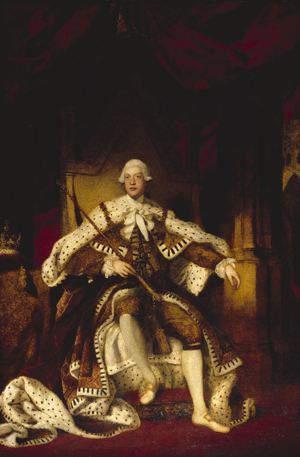
• The Royal Academy of Arts is marking the Queen’s Diamond Jubilee with a new exhibition opening tomorrow which features a selection of paintings by Royal Academicians elected during the early part of the Queen’s reign. The Queen’s Artists will include works by Jean Cooke, Frederick Gore and Ruskin Spear and will be displayed in the Reynolds and Council Rooms. Meanwhile The Saloon will house a collection of sculptures, paintings and drawings prepared by Royal Academicians for British coins and royal seals on loan from the Royal Mint Museum. The collection includes portraits of the Queen by Edward Bawden and Sir Charles Wheeler which have never before been shown in public, and Sir Anthony Caro’s new coin design of the London 2012 Olympic Games. Over in the Tennant Gallery, The King’s Artist’s George III’s Academy, will look at the king’s role in the foundation of the academy in 1768 and his influence in selecting the first artists. Highlights include portraits of King George III (pictured) and Queen Charlotte painted by the academy’s first president, Sir Joshua Reynolds. Admission charge applies. For more, see www.royalacademy.org.uk. PICTURE: Copyright Royal Academy of Arts, London/John Hammond.

• A new exhibition focusing on Londoners and their treasured souvenirs commemorating Queen Elizabeth II opens tomorrow at the Museum of London. At Home with the Queen features 12 photographic portraits of Londoners at home with their mementos as well as a selection of royal commemorative objects from the museum’s collection. The latter include trinkets produced for Queen Victoria’s Diamond Jubilee in 1897, official Coronation Day street decorations, Silver Jubilee paper tableware and souvenirs relating to the current Diamond Jubilee. Runs until 28th October. Admission is free. For more (including a series of events running on conjunction with the exhibition), see www.museumoflondon.org.uk.

The Royal Parks’ Shire horse, Jed, retired last week after a decade of service working in Richmond Park. The Queen presented a commemorative retirement rosette to Jed who was born in 1993 and joined the Royal Parks from Bass Brewery in Burton upon Trent almost 10 years ago. Horses have been used in Richmond Park since it was enclosed by King Charles I in 1637. The horses took a break in 1954 but the Shires were reintroduced in 1993 as a way to sustainably manage the parkland. For more on Richmond Park, see www.royalparks.org.uk/parks/richmond-park.

On Now: The horse: from Arabia to Royal Ascot. This major free exhibition at the British Museum is part of the august institution’s Diamond Jubilee celebrations and traces the history of the horse from domestication around 3,500 BC through to present day, with a particular focus on Britain’s equestrian tradition, from the introduction of the Arabian breed in the 18th century to events like Royal Ascot. Highlights include one of the earliest known depictions of horse and rider – a terracotta mould found in Mesopotamia dating from around 2000 to 1800 BC, a cylinder seal of Darius dating from 522 to 486 BC depicting the king hunting lions in a chariot, a 14th century Furusiyya manuscript, an Arabian manual of horsemanship, and the 19th century Abbas Pasha manuscript, the primary source of information about the lineage of purebred Arabian horses acquired by Abbas Pasha (mid-nineteenth century viceroy of Egypt). The exhibition is being held in Room 35. Runs until 30th September. For more, see www.britishmuseum.org.

Celebrating the Diamond Jubilee with 10 royal London locations – 6. The Mall…

For many Londoners, an opportunity to see the Queen means heading to Buckingham Palace to watch her wave from the balcony – or standing in the Mall to watch as her carriage goes by.

Given that, we thought we’d take the time to have a quick look at the history of The Mall, an important player in events like the annual Trooping the Colour.

This one kilometre long grand processional route which links Trafalgar Square to Buckingham Palace, was originally cut through St James’s Park in 1660 when King Charles II was looking for a new paille-maille pitch (see our earlier entry on Pall Mall for more on this). Two long avenues of trees were planted on either side, giving it a leafy feel that’s still in evidence today.

The Mall had become notorious by the 18th century and was spruced up in 1911 under the eye of Sir Aston Webb (who also designed other elements in the area including a new facade for Buckingham Palace, the Queen Victoria Memorial in front of the palace, and Admiralty Arch at the western end of the route) to become the grand avenue, complete with red-carpet like surface (this was done later), that it is today.

It is bordered by St James’s Park on the south side and on the north side is overlooked by various grand buildings – including Clarence House and the Institute of Contemporary Arts – as well as, toward the western end, Green Park.

These days the Queen publicly processes down The Mall for a number of events throughout the year – among them are the State Opening of Parliament (held earlier this month) as well as military ceremonies like Trooping the Colour and events like last year’s Royal Wedding when is it said that more than a million people were said to have filled the broad street.

The Mall is also the route along which Heads of State process in a horse drawn carriage during official visits (the road is then decorated with Union Jacks and flags of the visitor’s country). During the Olympics, it will be the start and end location of the marathons and cycling road races.

Apart from the Queen Victoria Memorial at the eastern end of The Mall, statues and monuments lining the road include the Queen Mother Memorial, a statue of explorer Captain James Cook, and a recently installed statue of cosmonaut, Yuri Gagarin.

There are apparently a series of tunnels underneath with link Buckingham Palace with Whitehall.

We should also briefly mention Horseguards, which is at The Mall’s eastern end and where Trooping the Colour and Beating Retreat takes place. This was formerly the site of a tiltyard of the Palace of Whitehall and jousting tournaments were held here during the time of King Henry VIII. It has been used for parades and ceremonies since the 17th century. While cars were parked here for much of the 20th century, this practice was stopped in the mid-1990s.

What’s in a name?…Earls Court

A residential district in inner west London, the origins of the name Earls Court apparently go back almost to the time of the Norman Conquest when the area was granted to the de Vere family as part of the Manor of Kensington. 

The de Veres, who held a court at the manor, were named the Earls of Oxford in 1141 and hence, according to Cyril M. Harris, author of What’s in a Name?: Origins of Station Names on the London Underground, came about the name Earl’s Court. The courthouse, which was demolished in the late 1800s, apparently stood on a site by Old Manor Lane now occupied by gardens.
Originally fertile farmland, Earl’s Court’s development took place in the mid to late 1800s after the arrival of the railway line (the station was built in 1869). The area officially became part of London in 1889 when the London County Council was formed and the city’s boundaries extended.

The area became famous for the Earls Court Exhibition Grounds – established by John Robinson Whitley in 1887 –  which featured rides and an arena which hosted Buffalo Bill’s Wild West Show. A giant wheel was added 10 years later.

After the Second World War, the area attracted large numbers of Polish immigrants leading to Earl’s Court Road being named ‘The Danzig Corridor’. The arrival of large numbers of Australian and New Zealander travellers in the late Sixties saw it earning a new nickname – this time ‘Kangaroo Valley’. The area is now undergoing gentrifcation.

Notable buildings include the art deco Earl’s Court Exhibition Centre, former home of the Royal Tournament and site of the volleyball competition during this year’s Olympic Games, while notable residents have included the Egyptian archaeologist Howard Carter, film director Alfred Hitchcock, and Queen frontman Freddie Mercury.

Around London – Europe’s oldest intact book at British Library; 100 days to the Games; world’s largest archaeological archive; the London Marathon; and, Turner at the National Gallery…

• The British Library has paid £9 million for a 7th century text, the St Cuthbert Gospel, which is also the oldest intact European book. The acquisition follows the library’s most successful fund-raising effort ever – it included a £4.5 million grant from the National Heritage Memorial Fund. The book – a Gospel of John bound in beautifully tooled red leather – was produced in north-east England in the late 7th century and was placed in the saint’s coffin after his death on the Isle of Lindisfarne in 698. It was retrieved when the coffin was opened at Durham Cathedral in 1104. The Gospel is on display in the Sir John Ritblat Treasures Gallery at the library in St Pancras and following a conservation review, it is anticipated it will soon be displayed with the pages open for the first time. There will be a public event celebrating the acquisition on 15th May. For more, see www.bl.uk/whatson/events/may12/index.html.

• London this week marked 100 days until the Opening Ceremony of the 2012 Olympic Games. This included unveiling the latest installation of the Olympic rings – made of 20,000 plants the 50 metre long rings are located in the Royal Botanic Gardens at Kew in the city’s west and can be seen from planes on the Heathrow flight path. The organising committee also announced the Red Arrows aerobatic display team will perform a nine-ship flypast in ‘big battle’ formation on the day of the Opening Ceremony (27th July) and stated that the games motto will be ‘Inspire a Generation’. For more, see www.london2012.com.

• The Museum of London’s archaeological archive – known as the London Archaeological Archive and Research Centre (LAARC) – is officially the largest in the world according to Guinness World Records. The archive contains more than five million artefacts and the records of almost 8,500 excavations dating back to 1830. Items in the archive include shoes dating back to Roman times, a 200-year-old set of false teeth, ‘witching bottles’ including one with human hair and toenails, and coffin plates from London’s cemeteries. The world record has been recorded as part of World Record London, a series of world record breaking events being held in the run-up to the Olympics. Others have included the Faberge Big Egg Hunt.

• Thousands of people are expected to take part in the Virgin London Marathon this Sunday. The 26.2 mile route starts in Blackheath, passes through Woolwich and Greenwich and crosses the Thames at Tower Bridge before looping around the east end of London, through Canary Wharf, and the west along The Highway (formerly known as The Ratcliffe Highway) and Embankment to Parliament Square, Birdcage Walk and finally to Buckingham Palace. The first London marathon was run in 1981. For more, see www.virginlondonmarathon.com.

• On Now: Turner Inspired – In the Light of Claude. The first major presentation of 17th century artist Claude Gellée’s influence on the English romantic artist J M W Turner, the exhibition focuses on Claude-inspired themes which run through Turner’s work including “the evocation of light and air in landscape, the effect of light upon water and his often radical reworking of contemporary scenes”. The display includes works from large scale oils on canvas through to leaves from Turner’s pocket sketchbooks. Interestingly, the exhibition also explores the story behind the so-called Turner Bequest – that on his death, Turner linked himself to Claude forever by leaving the National Gallery two pictures – Dido building Carthage (1815) and Sun rising through Vapour: Fishermen cleaning and selling Fish (before 1807) –  on condition that they were hung between two pictures by Claude, Seaport with the Embarkation of the Queen of Sheba (1648) and Landscape with the Marriage of Isaac and Rebecca (1648). Runs until 5th June. Admission charge applies. For more, see www.nationalgallery.org.uk.

Queen unveils final Jubilee Greenway plaque; a Barbican weekend; and, the Transit of Venus at Greenwich…

Queen Elizabeth II this week unveiled the final plaque marking the end of the 37 mile/60 kilometre Jubilee Greenway in front of Buckingham Palace. The circular Greenway – marked by 542 glass plaques – has been created to celebrate the Queen’s Diamond Jubilee. It can be walked or cycled and takes in key sites around London, including Kensington Palace, Regent’s Park, the Thames Barrier and Olympic sites including Greenwich Park (equestrian events), the O2 Arena (hosting gymnastics, trampoline and basketball events) as well as the main stadium at Olympic Park. The Greenway is divided into 10 sections and you can download either the entire walk or brochures for one of the sections only here.

This weekend sees the Barbican Centre play host to the event known as ‘Barbican Weekender’ – two days of free art, dance, music, theatre and film at the Barbican Foyers. Part of London 2012 Festival, the event’s ‘Freestage’ programme features Roxxxan,Dizralie and the Small Gods, young drummers from East London and performance poetry by the Barbican Young Poets. There’s also street dance classes with Boy Blue Entertainment, the chance to make an Opera in a Day with the Hip Hop Shakespeare Company, a Digital Graffiti wall, street food stalls, the Wah Nails Pop-Up boutique and free running by Streets United. For more, see www.barbican.org.uk/weekender.

• On Now – Measuring the Universefrom the Transit of Venus to the edge of the cosmos. Marking the 2012 transit of Venus, this exhibition at the Greenwich Observatory follows the story of man’s ongoing quest to understand the vastness of space, looking at the people and technologies involved in seeing farther than ever before – from the Astronomer Royal, Edmond Halley, to Captain James Cook and Edwin Hubble and through to the possibilities offered by the Cosmic Microwave Background Explorer. It’s accompanied by a series of talks, observing events – including this month’s Daytime Sky Watch sessions – and a planetarium show. Runs until 2nd September. Admission is free. For more information, see www.rmg.co.uk.

Around London – Family festival to celebrate Diamond Jubilee; British Library publishes world’s first detective novel; and, Closing Ceremony Celebration Concert tickets on sale Friday…

Sainsbury’s and Royal Parks have unveiled plans for a two day festival in Hyde Park – billed as the largest family festival London has ever seen – celebrating the Queen’s Diamond Jubilee over the June holiday weekend. The Jubilee Family Festival will feature live music and entertainment with one of the key highlights of each day being the finale – a 70 minute Disney concert specially created to celebrate the Jubilee. Other activities will include appearances by celebrity performers and dancer and children’s TV characters as well as equestrian events and motorcycle displays. There will also be a range of “Commonwealth-inspired” acts, food and drink supplied by Sainsbury’s and giant screens showing Jubilee-related events taking place elsewhere. There will be capacity for 50,000 ticket holders on each of the two days – Saturday, 2nd June, and Sunday, 3rd June. The event will run from 10.30am to 7pm on each day. Tickets – priced at £20 an adult/£12.50 for under 16s (children under three free) or £52 for a family of two adults and two children – go on sale at 9am tomorrow (Friday 24 February) from Ticketmaster – www.ticketmaster.co.uk or call 0844 847 1661 (+44 161 385 3211 from outside the UK) – or Seetickets –  www.seetickets.com  or call 0844 858 6760 (+44 1142 249 784 from outside the UK). In addition, from 28th March, Sainsbury’s customers who spend £60 in store will be able to enter a daily ballot for free family tickets. For more information on the festival, see www.sainsburys.co.uk/jubilee.

• The British Library has republished what many believe was the first detective novel ever published. The Notting Hill Mystery by Charles Felix was originally serialised between 1862 and 1863 in the magazine Once a Week (pictured right – image courtesy of the British Library). It was also published as a single volume in 1863, meaning it predates both Wilkie Collins’ The Moonstone (1868) and Emile Gaboriau’s first Monsieur Lecoq novel, L’Affaire Lerouge, but has not been available commercially since. The story is presented in the form of diary entries, family letters, chemical analysis reports, and interviews with witnesses as well as a crime scene map and follows an insurance investigator, Ralph Henderson, as he builds a case against the sinister Baron ‘R___’ whom he suspects of murdering his wife for life insurance. Available from the British Library bookshop – www.bl.uk/shop.

• Tickets for the BT London Live Closing Ceremony Celebration Concert go on sale tomorrow. The open air event will feature headline act Blur and will be held in Hyde Park on Sunday, 12th August, the day of the Olympic Games Closing Ceremony. Other artists performing at the concert will include The Specials and New Order, and giant screens in the park will show highlights of the Closing Ceremony. Another concert will be held in Hyde Park on Friday July 27, coinciding with the Games’ Opening Ceremony (headline acts and ticket prices will be announced shortly – BT customers will have 48 hour priority access for tickets for both concerts via www.bt.com/londonlive. Tickets for the August concert, priced at £55 (plus booking fee) go on sale at 9am on Friday via www.btlondonlive.com.

Around London – Butler’s Retreat reopens in Epping Forest; Designs of the Year; and, Lucian Freud’s last work…

• Epping Forest’s historic Butler’s Retreat has reopened its doors as a cafe following a refurbishment project to restore the building to its former glory. The building was constructed in the 19th century and is one of the last remaining Victorian-era ‘retreats’ within the forest. Named for its 1891 occupier, John Butler, it was one of a number of retreats built to serve refreshments as part of the Temperance movement – said to have been “extremely popular” with visitors from the East End. The building, which now forms part of the Epping Forest visitor hub, is expected to host a range of events this summer and will have its opening hours extended with the slated opening of a restaurant upstairs in the evenings. Owned by the City of London, Epping Forest is the largest public open space in the London area, stretching across 12 miles from Manor Park in East London to a spot past Epping in Essex. The cafe, the refurbishment of which was carried out with funding provided via the Heritage Lottery’s Branching Out project, will be open from 9am to 5pm weekdays and 8am to 5pm weekends. For more on the cafe, see www.worldslarder.co.uk. For more on Epping Forest, see www.cityoflondon.gov.uk/eppingforest

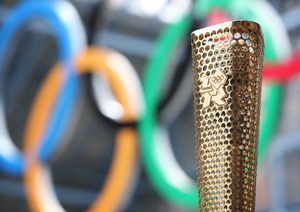
• On Now – Designs of the Year Exhibition: The London Olympic Torch and the Duchess of Cambridge’s wedding dress are among 90 objects nominated as one of the “best designs in the world” in this year’s Design of the Year competition. The objects, which go on display at the Design Museum today, have been entered in seven categories – architecture, digital, fashion, furniture, graphics, product and transport – with winners to be announced on 24th April. Among the other objects nominated are a wind-propelled landmine detector, a pop-up cinema in Hackney, the London 2012 velodrome and the first Tesco virtual store. An admission charge applies for the exhibition which runs until 15th July.  For more information, see designsoftheyear.com.

On Now – Lucian Freud Portraits. The last work of the late artist Lucian Freud is on show for the first time in this exhibition at the National Portrait Gallery. The unfinished painting, Portrait of the Hound 2011, which depicts Freud’s assistant assistant David Dawson and his dog Eli, is a highlight of the exhibition which also includes works dating back as far as the 1940s. The 130 paintings and works on paper – which feature sitters including artists Francis Bacon and David Hockney along with the likes of Andrew Parker Bowles and Baron Rothschild – have been loaned from museums and private collections around the world. Runs until 27th May, 2012. Admission charge applies. See www.npg.org.uk.

LondonLife – New Year’s Day Parade 2012

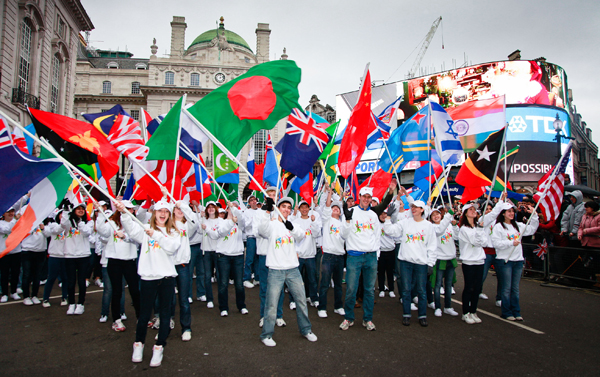
More than 8,500 performers – including those pictured celebrating the launch of London’s Olympic year – took part in this year’s New Year’s Day Parade in London, the wettest in the event’s 26 year history. But the wild weather didn’t put off the more than 500,000 people who turned out to watch the parade as it made its way from the starting point outside the Ritz Hotel in Piccadilly via Trafalgar Square to Parliament Square. As many as 19 London boroughs submitted entries in a competition based on the themes of the Olympics and the Queen’s Diamond Jubilee with Merton (its entry ‘From Horsepower To High Speed Rail’ featured animatronics) and the City of Westminster (its entry ‘Peter Pan’ involved a giant galleon and the The Sylvia Young Theatre School) announced as joint winners. For more on the parade, see www.londonparade.co.uk.

IMAGE: Courtesy of www.londonparade.co.uk

Around London: A new pleasure garden for London; music hall star Dame Gracie Fields honored; mystery portraits at the NPG; and, celebrating the Olympics (from a Peruvian perspective)…

A new pleasure garden will be built in the city’s east as part of celebrations for next year’s Diamond Jubilee. London Pleasure Gardens, announced back in March, will be built upon a 60,000 square metre site at Pontoon Dock, opposite the ExCeL Exhibition Centre, and consist of an “ever-evolving creative playground for both resident Londoners and tourists alike”. The gardens, which will feature landscaped walkways, a floating cinema, an ‘adult’s playground’ and a range of facilities such as a ‘glass cafe’ – are expected to be open for the Queen’s Jubilee Weekend on 1st June. It’s expected that more than 40,000 people a day will pass through the site during the Olympics. London has had a long association with the concept of pleasure gardens – places where people gathered to listen to music, see art, eat and drink and talk, the most famous of which was the Vauxhall Pleasure Gardens. But the Royal Docks also had its own pleasure gardens in the past – these existed between 1851 and 1884 and were named the Royal Victoria Gardens.  For more, see www.londonpleasuregardens.com.

• Music hall star Dame Gracie Fields has been honored by English Heritage with a blue plaque on the Islington house where she lived for three years in the 1920s. It was while living at 72a Upper Street with her parents and first husband Archie Pitt, that she consolidated her reputation as one of Britain’s most popular performers and it was also during this time that she recorded for the first time (she was to become a regular on the BBC and by 1933 had cut a massive four million discs) and appeared before King George V and Queen Mary at a Royal Variety Performance. Following her success, Fields and Pitt built a mansion in The Bishop’s Avenue, Hampstead, called ‘The Tower’ in honor of the show which had made her a star – Mr Tower of London. She later separated from Pitt and married an Italian born director Monty Banks. They moved to the US in 1940 amid fears her husband would be interned and, after the war, she settled on the Italian island of Capri where, following Banks’ death in 1950, she married again. She made her final appearance on the London stage in 1978 – closing a Royal Variety Performance – and died back in Capri the following year.

• And, briefly…..A new species of dinosaur – Spinops sternbergorum – has reportedly been discovered at the Natural History Museum, identified from bones previously gathering dust on a shelf at the museum.

On Now: Imagined Lives: Portraits of Unknown People. This exhibition at the National Portrait Gallery centres on a group of 14 portraits from the 16th and 17th centuries which depict unknown people. Originally thought to represent famous figures like Queen Elizabeth I, the identity of the sitters is now considered unknown. In response to the pictures, eight internationally renowned authors – from Alexander McCall Smith and Joanna Trollope to Julian Fellowes and Terry Pratchett – have written imaginative short stories about the portraits, bringing them to life. The exhibition was originally shown in Somerset but is now running at the NPG until 22nd July. Admission is free. For more information, see www.npg.org.uk.

On Now: London and the Olympics. The Museum of London is hosting a new display which looks at the 1908 and 1948 Olympic Games held in London but, in twist, looks at not only the experiences of Londoners but those of the 41 man team Peru sent to the 1948 games. Pictures included in the display come from an album made by one of the athletes, Enrique Mendizabal Raig, recording the team’s visit (you can find the images on Flickr here). Entry is free. Runs until September. For more, see www.museumoflondon.org.uk.

Around London – New Year’s Eve fireworks; a Resurrectionist diary; and, Russian architecture at the Royal Academy…

Plans for this year’s New Year’s Eve fireworks – marking the beginning of the year in which London hosts the Olympic and Paralympic Games – have been announced by the Mayor of London, Boris Johnson. The EDF London Eye on South Bank will once again form the focus of the fireworks display and those wishing to attend have been warned to take their places early with some areas filling up by 9pm or 10pm. Parents with young children are advised to consider attending fireworks displays closer to home (for more, see www.london.gov.uk/newyearseve). The display will be followed by a parade on New Year’s Day (for more, see www.londonparade.co.uk). Meanwhile, the annual Christmas Tree lighting ceremony will take place next Thursday. The tree is a gift from the people of Oslo, the Norwegian capital, given annually for more than 60 years in recognition of Britain’s support during World War II.

On Now – The Diary of a Resurrectionist. This month marks the 200th anniversary of an intriguing diary which offers insights into the work of a group of grave robbers and to mark the moment, the Hunterian Museum at the Royal College of Surgeons of England is hosting an exhibition featuring extracts from the diary and charting the rise and fall of grave robbing. The exhibition, which is being hosted in the Library Reading Room, runs until 22nd December. There is a special lecture by Kirsty Chilton at the museum from 7pm tonight (24th November, entry fee applies). For more, see www.rcseng.ac.uk/museums/exhibitions/index.html.

• On Now – Building the Revolution: Soviet Art and Architecture 1915-1935. The Royal Academy of Arts is hosting this exhibition which looks at the avant-garde architecture which appeared in Russia from 1922 to 1935, and its design origins in the earlier flowering of Constructivisit art which emerged around 1915. Large scale photographs, taken by Richard Pare, are juxtaposed with relevant Constructivisit drawings and paintings as well as vintage photographs. A reconstruction of Vladimir Tatlin’s Monument to the Third International (known as Tatlin’s Tower) has been built in the Annenberg Courtyard to coincide with the exhibition. Runs until 22nd January. Admission charge applies. For more, see www.royalacademy.org.uk.

Around London – The Lord Mayor’s Show goes on; London 2012 Festival launched; dowry tradition lives on; and, Leonardo da Vinci at the National Gallery…

On Saturday the annual Lord Mayor’s Show will crawl its way across London’s Square Mile in a three mile long procession that will involve 123 floats and 6,200 people. The show (a scene from last year’s procession is pictured) is held each year as the first public outing of the newly elected Lord Mayor – this year it’s David Wootton, the City of London’s 684th Lord Mayor, who officially takes up his new office tomorrow (11th November). Organisers have said the procession will follow its usual route despite the protestors currently encamped outside St Paul’s. Leaving Mansion House, the official residence of the Lord Mayor, at 11am, it will make its way down Cheapside to St Paul’s Cathedral, where the new Lord Mayor will be blessed, before heading onto the Royal Courts of Justice, where the Lord Mayor swears an oath of allegiance to Queen Elizabeth II, and then returning to Mansion House. The the procession, the origins of which date back to 1215, will feature representatives of livery companies, educational and youth organisations, military units and other London-associated organisations and charities like St Bart’s Hospital. There will be a fireworks display at 5pm on the Thames between Blackfriars and Waterloo. For more information, see www.lordmayorshow.org.

• Organisers have unveiled plans for the London 2012 Festival, a 12 week nationwide cultural celebration of music, theatre, dance, art, literature, film and fashion held around next year’s Games. We’ll be providing more details in upcoming weeks and months but among the highlights in London will be a British Museum exhibition on the importance of Shakespeare as well as “pop-up” performances by actor Mark Rylance – both held as part of the World Shakespeare Festival, a musical tribute to the history of jazz at the Barbican by the London Symphony Orchestra and Jazz at the Lincoln Center Orchestra, an exhibition of the work of artist Damien Hirst at the Tate Modern and another on Yoko Ono at the Serpentine Gallery, and ‘Poetry Parnassus’ at the Southbank Centre – the largest poetry festival ever staged in the UK. The festival is the finale of the “Cultural Olympiad” – launched in 2008, it has featured a program of events inspired by the 2012 Olympics – and will see more than 10 million free events being held across the country. For more details, see www.london2012.com.

In a tradition which dates back to the late 1800s, three “poor, honest (and) young” women have been awarded a dowry by the City of London Corporation. Susan Renner-Eggleston, Elizabeth Skilton, and Jenny Furber have each received around £100 under the terms of a bequest Italian-born Pasquale Favale made to the City in 1882. Inspired by the happiness he found is his marriage to his London-born wife Eliza, Favale bequeathed 18,000 Lira to the City in 1882 and stipulated that each year a portion of the money was to be given to “three poor, honest, young women, natives of the City of London, aged 16 to 25 who had recently been or were about to be married”. To be eligible the women must have been born in the City of London or currently reside there.

• On Now: Leonardo da Vinci: Painter at the Court of Milan. Billed as the year’s blockbuster art event in London, this exhibition at the National Gallery focuses on Da Vinci’s time as a court painter in Milan in the 1480s-90s and features 60 paintings and drawings. Thanks to a collaboration between the National Gallery and the Louvre, they include two versions of the Virgin of the Rocks (it is the first time the two versions are being shown together). Other paintings include Portrait of a Musician, Saint Jerome, The Lady with an Ermine (an image of Cecilia Gallerani, mistress of Milan’s ruler at the time – Ludovico Maria Sforza, ‘Il Moro’) and Belle Ferronniere as well as a copy of Da Vinci’s painting, The Last Supper, by his pupil Giamopietrino. Runs until 5th February and an admission charge applies. For more, see www.nationalgallery.org.uk.

The Royal Parks – 6. Greenwich Park

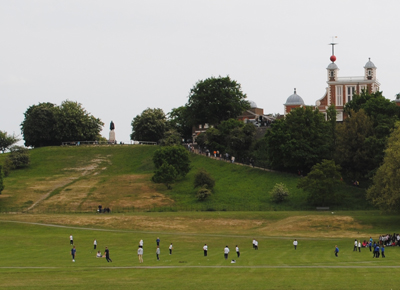
The oldest of the royal parks, the 74 hectare (183 acre) Greenwich Park has been associated with royalty since at least the 15th century.

The area covered by the park had been occupied by the Romans (there are some remains of a building, possibly a temple, near Maze Hill Gate) and later the Danes, who raised protective earthworks here in the 11th century. After the Norman Conquest, it became a manor.

Its enclosure only happened in 1433 after the land came into the possession of Humphrey of Lancaster, Duke of Gloucester and brother of King Henry V. At the time regent to the young King Henry VI, Duke Humphrey also built a tower on the heights above the park – where the Royal Observatory now stands.

Following the duke’s death in 1447, the land was seized by Margaret of Anjou – wife of King Henry VI – and subsequently became known as the Manor of Placentia. King Henry VII later rebuilt the manor house, creating what was known as Greenwich Palace or the Palace of Placentia.

Not surprisingly, it was King Henry VIII, who, having been born at Greenwich Palace, introduced deer to the park. Indeed the park was to have strong associations with others in his family – the king married Catherine of Aragorn and Anne of Cleeves at Greenwich Palace, and his daughters, later Queen Mary I and Queen Elizabeth I, were born there while his son, King Edward VI, died there in 1553 at the age of only 15. (There’s a tree in the park known as Queen Elizabeth’s Oak, which is said to be where she played as a child).

In 1613, King James I gave the palace and accompanying park – which he had enclosed with a high wall – to his wife, Queen Anne of Denmark, apparently as an apology after swearing at her in public when she accidentally shot one of his favorite dogs. Queen Anne subsequently commissioned Inigo Jones to design what is now known as the Queen’s House – for more on that, see our earlier post.

Following the Restoration, King Charles II ordered the palace rebuilt and while this work remained unfinished, the king did succeed in having the park remodelled – it is believed that Andre Le Notre, gardener to King Louis XIV of France, had a role in this.

The works included cutting a series of terraces into the slope – these were known as the Great Steps and lined with hawthorn hedges – as well as creating a formal avenue of chestnut trees (now known as Blackheath Avenue), and some woodlands. Work is currently taking place on restoring an orchard which dates from 1666 at the park.

King Charles II also commissioned Sir Christopher Wren to build the Royal Observatory that still stands on the hill overlooking the park – it stands on the site once occupied by the Duke Humphrey Tower (the Royal Observatory is home of the Prime Meridian – see our earlier post on the Royal Observatory for more).

King James II was the last monarch to use the palace and park – his daughter Queen Mary II donated the palace for use as a hospital for veteran sailors and the park was opened to the pensioners in the early 1700s. The hospital later become the Royal Naval College and the National Maritime Museum later moved onto the site (for more on this, see our earlier post).

As an aside, Royal Parks say the truncated shape of some of the trees in the park is apparently due to the fact that when anti-aircraft guns were positioned in the flower garden during World War II, the trees had to be trimmed to ensure a clear field of fire.

Facilities in the park today include a tea house, a children’s playground, sporting facilities such as tennis courts and, of course, the Wilderness Deer Park where you can see wildlife at large. Statues include that of Greenwich resident General James Wolfe, an instrumental figure in establishing British rule in Canada – it sits on the crest of the hill opposite the Royal Observatory looking down towards the Thames.

The park, which is part of the Greenwich World Heritage Site, is slated as a venue for next year’s Olympics – it will host equestrian events and the shooting and running events of the pentathlon.

WHERE: Greenwich Park (nearest DLR station is Cutty Sark – other nearby stations include Greenwich, Maze Hill and Blackheath); WHEN: 6am to at least 6pm (closing times vary depending on the month); COST: Free entry; WEBSITE: www.royalparks.gov.uk/Greenwich-Park.aspx