What is a name?…Spitalfields…

This curiously named area in London’s east – located outside the medieval walls – is named for a priory and hospital founded here in the late 12th century.

The Priory and Hospital of Blessed Mary without Bishopsgate (more commonly known as St Mary Spital), was founded by London citizen Walter Brunus and his wife Roisia (both later said to have been buried before the chapel’s high altar), possibly along with other Londoners, in 1197 (although the priory was apparently “refounded” in 1235 when the church was moved).

An Augustinian institution, it also housed what became one of the largest hospitals in England – as well as caring for pilgrims, widows and the infirm poor, it is said to have provided care for pregnant women and the young children of those who died in childbirth – and the site of a large cemetery.

The hospital survived until the reign of King Henry VIII (although apparently barely with the church said to have been in some disrepair by this time) when it fell prey to Thomas Cromwell and his agents in the Dissolution. It was closed in 1539.

The church and most of the buildings were subsequently demolished with part of the area subsequently used as an artillery ground under the jurisdiction of the Tower of London (the area of the inner priory, meanwhile, reverted to the Crown and retained its status outside the jurisdiction of local authorities, known as the Liberty of Norton Folgate).

But the name remained in use for the suburb which had started to appear around the priory and on its former lands (Spitalfields) and in the seventeenth century a market was established here which ensured its longevity. For more on Old (and New) Spitalfields Market and the area’s later history, see our previous post here.

Major excavations were carried out at the priory cemetery between 1991 and 2007 when more than 10,500 skeletons were unearthed. More than 5,000 of these were analysed providing archaeologists with considerable insight into medieval burials. The remains of a charnel house, dating from about 1320, which was once part of the cemetery still exist in Bishop’s Square.

For more, check out Christopher Thomas’ Life and Death in London’s East End: 2000 Years at Spitalfields.

LondonLife – The Tweed Run London…

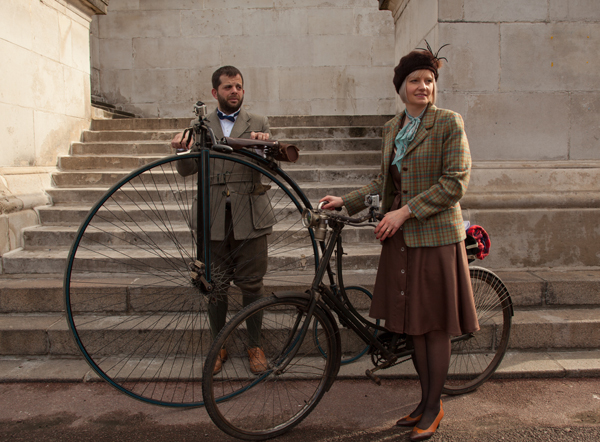
Tweed-RunThe Tweed Run London celebrated its fifth anniversary last Saturday with more than 500 taking part in the rather unusual annual event in which participants combine their passion for British fashion with their love for cycling. Among those taking part (entry was via a lottery system) on bikes of all shapes and sizes were people from as far afield as The Netherlands, Korea, Russia, Australia, Japan and even Afghanistan. The two hour ride took in Marylebone High Street, Savile Row, Regent Street, Piccadilly Circus and the Houses of Parliament before finishing at Trafalgar Square. The ride has been copied by other cities around the world including, Tokyo, Toronto and St Petersburg. For more on the Tweed Run, see www.tweedrun.comPICTURE: Selim Korycki, Tweed Run LLP.

Where’s London’s oldest…Catholic church?

Hidden away to the north-west of the City of a quiet cul-de-sac, the oldest still-in-use Roman Catholic church in London (indeed, in England) is St Etheldreda’s Church in Holborn.

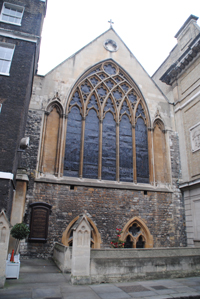
St-EtheldredaLocated in Ely Place, this atmospheric church – named for Etheldreda, seventh century female abbess of Ely – opened as a Roman Catholic Church in 1878, although the building in which it is lodged is much older, indeed a rare survivor from the 13th century. It was built in 1290 by John De Kirkeby, the Bishop of Ely and Treasurer of England during the reign of King Edward I, as a chapel to a residence he constructed on the site.

It and the adjoining palace remained in use by subsequent bishops and other nobles (including John of Gaunt who lived here after his own residence, Savoy Palace , was burnt down during the Peasant’s Revolt) up to and after the Reformation – the first reformer Bishop to use it was Thomas Goodrich, who built the nearby Mitre Tavern. (Worth noting is that the church also has some strong links to Shakespeare – there’s a great article on the church’s website exploring these).

In 1620, the Spanish Ambassador, the Count of Gondomar, moved into Ely Place and the chapel was used once again for Catholic masses (the residence was considered part of Spanish territory) – this was a relatively short-lived development for, thanks to deteriorating relations between England and Spain following a failed match between Prince Charles (later King Charles I) and the Infanta of Spain, the next ambassador was refused permission to live there.

Having escaped destruction in the Great Fire of London, the chapel was requisitioned by Parliament as a prison and hospital during the Civil War and subsequently fell into disuse before in 1772, the property – including the chapel – was sold to the Crown who in turn sold it to a surveyor and builder, Charles Cole.

Cole demolished the palace buildings with the exception of the chapel and had the current Ely Place built with neat rows of Georgian homes, modernising the chapel for the use of residents as an Anglican place of worship. The church attracted few worshippers, however, and in 1820 was taken over by the National Society for the Education of the Poor.

In 1873, the chapel was again to be sold and following a somewhat controversial auction was bought by the Catholic Institute of Charity (aka the Rosminians) and restored under the eye of Father William Lockhart (the Catholic Emancipation Act had been passed in 1829, allowing Catholics to have churches and say mass).

Interestingly, it was during this work that 18 bodies were discovered buried in the crypt – they had died in the ‘Fatal Vespers’ of 1623 when, during a secret meeting of Catholics at the French ambassador’s house in Blackfriars, the floor collapsed and more than 100 were killed. Not able to be buried publicly due to anti-Catholic feeling, they were buried in secret with some of them buried here.

A mass commemorated the completion of the restoration work on 23rd June, 1878, and the church has been in use as a Roman Catholic Church ever since (although years of repairs were needed following significant bomb damage in World War II). Further restoration work was carried out in the 1990s when Flemish tiles from the original cloister were discovered.

These days the church – which features a relic of St Etheldreda contained in a bejewelled cask sitting by the altar – is a quiet oasis in the midst of the bustling city – a great place to take some time out in the midst of a busy day. Also of note is the east window – the work of Joseph Edward Nuttgens, it was completed in 1952 and, like all the other windows, replaced a Victorian window destroyed in the Blitz (look for the image of St Etheldreda) – and the  west window – the work of Charles Blakeman, it is apparently the largest stained glass window in London and depicts a series of English Catholic martyrs.

WHERE: St Etheldreda’s Church, Ely Place (nearest Tube stations are Chancery Lane and Farringdon); WHEN: 8am to 5pm Monday to Saturday; 8am-12.30pm Sunday; COST: Free; WEBSITE: www.stetheldreda.com.

Around London – Olympics at the Museum of London; Oxford wins the Boat Race; restoration project at Kew; and, Phantom Ride at the Tate…

 Diver Tom Daley’s swimming trunks, cyclist Bradley Wiggins’ yellow jersey and a Mary Poppins outfit worn in last year’s Olympic Games’ opening ceremony are among the items on display as part of the Museum of London’s 2012 display. The free display, which opened last week, exactly 200 days after the Paralympics closing ceremony, features a selection of 70 items connected with the Games. Runs in the Galleries of Modern London until 31st October. For more, see www.museumoflondon.org.uk.

Oxford took line honours at the 159th Boat Race, held on the River Thames last weekend. The Dark Blues – whose crew included Olympic medalists Constantine Louloudis and Malcolm Howard – still trail Cambridge (the Light Blues) – whose crew included another Olympic medallist, George Nash, however, with 77 wins to 81 wins. For more, see www.theboatrace.org or our previous articles – here and here.

Kew Garden’s historic Temperate House has received a £14.7 million Lottery Fund grant for conservation of the Grade One listed building, the largest Victorian glasshouse in the world. The grant – which adds to £10.4 million from the government and £7.7 million from private donors – will also be used to create a “more inspiring” public display for visitors with the overall £34.3 million project completed by May, 2018. The building opened in 1863 and was last refurbished 35 years ago. It houses some of the world’s rarest plants, including a South African cycad (Encephalartos woodii). For more, see www.kew.org.

On Now: Phantom Ride. This “haunting” film installation by artist Simon Starling was commissioned by the Tate Britain in Millbank and is located in the neo-classical Duveen galleries. Referencing the late nineteenth century tradition of ‘phantom rides’ – films, often made by cameramen strapped to the front of a train, that gave a dramatic sense of motion as if one is aboard an invisible vehicle – the installation includes a “compelling flow of images” of artworks that once filled the Duveen galleries, creating a sense of movement as the works move up and down the walls. Admission is free. Runs until 20th October. For more, see www.tate.org.uk.

LondonLife – 14th century burial ground unearthed underneath Charterhouse Square…

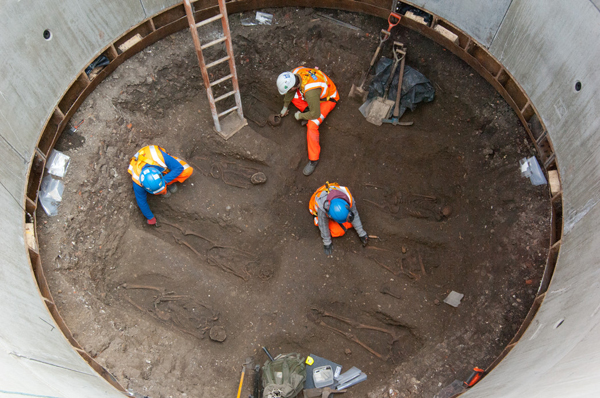
Crossrail---FarringdonA lost London burial ground has been unearthed in Farringdon by archaeologists working on the £14.8 million Crossrail project.

Thirteen adult skeletons, believed to be up to 660 years old, have been discovered lying in two rows 2.5 metres below the ground on the edge of Charterhouse Square.

It is likely based on the depth at which the bodies were buried and other evidence (including pottery found at the site and a similarity between the layout of the bones and those of 14th century plaque victims unearthed at the East Smithfield Burial Ground in the 1980s), that the skeletons were buried here in 1349 during the Black Death.

Historical records suggest that as many as 50,000 people may have been buried here in the three years from the burial ground’s opening in 1348. The burial ground remained in use until the 1500s but has never been located in modern times.

The skeletons are being excavated and taken to the Museum of London Archaeology for laboratory testing.

Crossrail Lead Archaeologist Jay Carver described the discovery as “highly significant”.

“We will be undertaking scientific tests on the skeletons over the coming months to establish their cause of death, whether they were Plague victims from the 14th Century or later London residents, how old they were and perhaps evidence of who they were,” he said.

“However, at this early stage, the depth of burials, the pottery found with the skeletons and the way the skeletons have been set out, all point towards this being part of the  14th century emergency burial ground.”

It is likely more remains will be found according to experts.

Archaeologists working on the Crossrail project have previously uncovered more than 300 burials at the New Cemetery near the site of the Bedlam Hospital at Liverpool Street from the 1500s to 1700s.

For more on Crossrail, see www.crossrail.co.uk.

London Pub Signs – The Lord Aberconway…

Located just off Liverpool Street in Old Broad Street in the City, The Lord Aberconway is named after the last chairman of the Metropolitan Railway Company, operator of the world’s first underground railway (keep an eye out for our extended piece on the history of the Underground later this week).

Lord-AberconwayCharles McLaren – Lord Aberconway – (1850-1934) was a landowner, industrialist and MP who was raised to the peerage in 1911, a year after he had left the House of Commons. He served as chairman of ‘The Met’ from 1904 to 1933.

While the current building – the interior of which features booths and an L-shaped bar – dates from the 19th century, there has been a pub on the site, close to Liverpool Street Station, for much longer and its previous names included the King and Keys and the Metropolitan Railway’s ‘Refreshment Room’ and ‘Railway Buffet’.

The pub, which stands not far from the Monument commemorating the Great Fire of London, is reputed to be haunted by victims of the fire (only four people are said to have officially died in the blaze but it’s believed the death toll would have actually been much higher). You’re more likely to see city traders there however.

The pub is now run by the Nicholson’s. For more on the Lord Aberconway, see www.nicholsonspubs.co.uk/thelordaberconwayliverpoolstreetlondon/.

Treasures of London – Siborne’s Large Model…

An amazing feat of model-making, Siborne’s Large Model is a painstakingly detailed model reconstruction of the Battle of Waterloo on display at the National Army Museum. Controversial even to this day, the story behind the model’s creation is an incredible tale of one man’s perseverance.

Siborne's-modelA career soldier, Captain William Siborne was commissioned in 1830 by Lord Rowland Hill, then Commander-in-Chief of the British Army, to construct a model of the Battle of Waterloo, fought between British and allied forces under the command of the Duke of Wellington and Prussian field marshal Gebhard von Blücher and French forces under the command of the Emperor Napoleon on 18th June, 1815.

Siborne, who hadn’t been present at the battle but had previously been involved in the construction of a model of the Battle of Borodino, extensively researched it before beginning work including spending eight months surveying the entire field where the battle took place and corresponding with hundreds of those who had fought there.

The model wasn’t completed until 1838, partly due to the fact that Siborne still had military duties to perform and also due to the fact that he ran out of funds and, when the authorities refused to pay up, ended up financing the project out of his own pocket (and then spent much time trying to recover the funds).

In his fascinating book, Wellington’s Smallest Victory: The Duke, the Model Maker and the Secret of Waterloo (well worth a read if you’re interested in learning more about the history of this amazing model), Peter Hofschroer writes in detail about the acrimonious relationship the Duke of Wellington developed with Siborne, thanks to a clash over the model’s depiction of the battle which shows the crisis point in the battle at 7pm – when the French Imperial Guard attacked Wellington’s centre – and has the Prussians helping to win the day.

The model was placed on public display in October 1838 at the Egyptian Hall in Piccadilly after which it went on tour around the UK. He went on to write up his research in a book on the battle, published in 1844, and it was while preparing this – in 1841 – that he announced he had changed his mind and would revise the model, eventually removing figures representing some 40,000 Prussians from the model and thus reducing the role they played at the decisive moment of the battle – a move which could only be seen as a win for Wellington.

It’s also worth mentioning that Siborne created a second, larger scale model of just part of the battlefield, exhibited in 1844 in London and later in Berlin (it’s now on display at the Royal Armouries Museum in Leeds). Siborne’s subsequent efforts to sell either model didn’t bear fruit before he died, said to have been a “broken man”, on 13th January, 1849.

After his death the large model was subsequently purchased by the United Service Museum and can now be found at the National Army Museum in Chelsea.

WHERE: National Army Museum, Royal Hospital Road, Chelsea (nearest Tube station is Sloane Square); WHEN: 10am to 5.30pm daily; COST: Free; WEBSITE: www.nam.ac.uk.

Lost London – The Cockpit at Whitehall…

Once part of the Palace of Whitehall, the Cockpit (also referred to as Cockpit-in-Court or the Royal Cockpit) was initially built as a pit in which to watch cockfighting as part of renovations carried out by King Henry VIII after he “acquired” Cardinal Wolsey’s former property of York Place and before transforming it into a royal palace.

It was one of a number of entertainment related buildings constructed by the king in the new palace precinct – others included a real tennis court, bowling alley and a tiltyard.

By Jacobean times, the use of the octagonal-shaped cockpit – located between today’s Downing Street and Horse Guards Parade – had changed into that of a private royal theatre and in 1629 Inigo Jones was given the task of redesigning it to accommodate King Charles I’s elaborate court masques (Jones had previously redesigned the Cockpit Theatre in Drury Lane).

Following the Restoration in 1660, the Cockpit again returned to its use as a theatre and King Charles II had new dressing rooms added and the decor given an overhaul (the ever-present diarist Samuel Pepys was among those who attended theatrical presentations during this period and Ben Jonson among those whose work was presented here).

The theatre building is believed to have been demolished around 1675 and the site subsequently used to house government officials including those of the Foreign Office (see our earlier post here) and Privy Council.

In the 1730s, William Kent designed the building (which although since expanded and modified) now stands on the site and is currently the home of the Cabinet Office.

While the Cockpit is long gone, its name lives on in ‘Cockpit Passage’ – a gallery inside the Cabinet Office from where one could once watch tennis being played.

Lost London – The King’s Wardrobe…

In the medieval period, the royal wardrobe – that is, the splendid robes and other clothes worn on state occasions – were kept at a range of different locations including the Tower of London and Westminster Abbey. In the 1360s, however, it moved to a more permanent location in what had been a house near Blackfriars priory.

King's-WardrobeSold to King Edward III by the executors of the will of Sir John Beauchamp, the house served as the key storage site for  royal clothes including not only those of the monarch but various people attached to the court such as the royal family, king’s ministers and Knights of the Garter.

The building, which was considerably extended over the years to include everything from a great hall and chapel to stables, was destroyed in the Great Fire of 1666 and the wardrobe was moved to another building in Buckingham Street although by this stage its importance had declined considerably (the last Master of the Wardrobe held office in the late 18th century).

Its name lived on in that of the church St Andrew-by-the Wardrobe and that of the well-hidden and intimate Wardrobe Place (it’s located between St Andrew’s Hill and Addle Hill). There is a blue plaque which marks the site of the former building (pictured above).

Around London – Chinese New Year; Orchids at Kew; Lucian Freud’s donation to the National Gallery; and, Man Ray at the NPG…

Chinese New Year celebrations will go off with a bang in Chinatown in the West End this Saturday. The festivities, which are the largest outside Asia, will include a lion dance, fireworks, and a variety of performers – all gathered to herald the start of the Year of the Snake. The celebrations will kick off with a parade which will leave Trafalgar Square at 10am and end at Rupert Street in Chinatown at 11am. At 12pm, dignitaries will gather in Trafalgar Square for the Dotting of the Eye ceremony which will bring the dragons and lions to life and performances will the take place until 5.30pm. At 5.55pm a fireworks display will mark the end of the day’s celebrations. For more, see www.chinatownlondon.org/page/chinese-new-year-2013/378.

Like orchids? Want to escape the gloom of winter? Kew Gardens are celebrating the exotic plant with a dazzling display in the Princess of Wales Conservatory. Thousands of orchids will be on show as part of ‘Orchids at Kew’ and the plants will be used to recreate the giant waterlily flower, Victoria amazonica, which can normally be seen in the conservatory in the summer months. There are special behind the scenes tours, food and an adult education course for the truly interested. Charges apply. Opening on Saturday, 9th February, the display can be seen until 3rd March. For more, see www.kew.org.

The late artist Lucian Freud has donated a treasured portrait – Jean-Baptiste Camille Corot’s L’Italienne ou La Femme à la Manche Jaune (The Italian Woman, or Woman with Yellow Sleeve) – to the nation in gratitude for the welcome his family received when they arrived as refugees from Berlin. The Corot has been allocated to the National Gallery by the Arts Council England and was done under the Acceptance in Lieu scheme, which allows people to transfer works of art into public ownership instead of paying inheritance tax.  The painting – which was last seen in a show at the Louvre, Paris, in 1962, and was previously owned by Hollywood Golden Age star Edward G. Robinson – is on display on Room 41 of the gallery. For more, see www.nationalgallery.org.uk.

On Now: Man Ray Portraits. The first museum exhibition to focus on the photographic portraiture of the 20th century artist Man Ray, this display at the National Portrait Gallery features more than 150 vintage prints taken between 1916 and 1968. Subjects include everyone from Catherine Deneuve and Ava Gardner to Salvador Dali and Aldous Huxley. The majority of works have never been exhibited in the UK before. Runs until 27th May. Admission charge applies. For more, see www.npg.org.uk.

Like to tell others about your upcoming event in London? If you’ve got an event coming up, please send any press releases or details to exploringlondon@gmail.com.

10 of London’s greatest Victorian projects – 4. The Palace of Westminster…

Commonly thought to be older than it actually is due to its Gothic stylings (although, to be fair, parts of it do date from medieval times), the Palace of Westminster – or, as it’s more commonly known, the Houses of Parliament – didn’t actually take on much of its current appearance until the latter half of the 19th century.

The need for a new building for parliament arose after 1834 when a fire, caused by the overheating of two underfloor stoves used to incinerate the Exchequer’s obsolete tally sticks, tore through the former complex, leaving only some structures from the old palace intact. They included the 11th century Westminster Hall (the largest in Europe when it was built), 14th century Jewel Tower and a chapterhouse, crypt and cloisters, all of which was once attached to the now gone St Stephen’s Chapel.

Houses-of-Parliament2While King William IV offered the use of Buckingham Palace for Parliament, the idea – along with a host of other options – was rejected as unsuitable. Instead, a competition was held for a new design and after almost 100 entries were considered, architect Charles Barry and his design for a new palace in the perpendicular Gothic style was chosen. Interestingly, while Barry was a classical architect, under the terms of the competition, designs were required to be in a Gothic style, thought to embody conservative values .

Incorporating some of the remains of the old palace – including Westminster Hall but not the Jewel Tower which to this day stands alone – the design was based around a series of internal courtyards with the House of Commons and House of Lords located on either side of a central lobby (first known as Octagonal Hall). The design involved reclaiming some land from the Thames so the building’s main river-facing facade could be completed.

Towers stand at either end of the complex – the Victoria Tower over the Sovereign’s Entrance at the southern end of the complex (for many years the tallest square stone tower in the world) and the narrower tower formerly known as the Clock Tower which houses the bell Big Ben, at the northern end – and there is a central Octagonal Tower which stands directly over the Central Lobby. The Clock Tower, incidentally, was renamed the Elizabeth Tower last year in honour of Queen Elizabeth II’s Diamond Jubilee (for more on it and Big Ben, see our earlier entries here and here).

Other towers include the Speaker’s Tower (located at the northern end of the building on the waterfront, this contains a residence for the Speaker), the Chancellor’s Tower (located at the southern end, it too contained a residence originally used by the Lord Chancellor) and St Stephen’s Tower – located in the middle of the building’s west front, it contains the public entrance to the building. Significant other rooms in the palace complex include the Robing Room – where the Queen puts on her ceremonial robes and crown before the State Opening of Parliament – and the Royal Gallery, used for state occasions.

The foundation stone (the building was constructed out of sand-coloured limestone from Yorkshire) was laid in 1840 and construction of the monumental building – which features more than 1,100 rooms and two miles of passageways – wasn’t completely finished until the 1870s although most of the work had been completed by 1860 (the year Barry died). The House of Lords first sat in their new chamber in 1847 and the House of Commons in 1852 (it was at this point that Barry was knighted for his work).

The cost, meanwhile, originally estimated at less than £750,000, ended up coming in at more than £2 million.

Much of the interior decoration owes its appearance to the Gothic revivalist Augustus Pugin who designed everything from wallpapers, to floor tiles and furnishings. Pugin also helped Barry with the external appearance but like Barry died before the project was completely finished (in 1852).

The palace was bombed numerous times in World War II – in one raid, the Commons Chamber was destroyed as firefighters opted to save the much older Westminster Hall instead. It was later rebuilt under the direction of Sir Giles Gilbert Scott and completed by 1950. Other aspects of the building have also been restored.

A Grade I-listed building classified as a World Heritage Site, Barry’s Houses of Parliament remain one of London’s most iconic structures. We’ll be looking in more detail at some of the building’s features in future posts.

WHERE: Houses of Parliament (nearest Tube stations are Westminster, St James’s Park and Embankment); WHEN: Tours (75 minutes) are run from 9.15am to 4.30pm on Saturdays (also six days a week during summer opening); COST: £15 adults/£10 concessions/£6 children five to 15 years (children under five are free). Prices go up after 1st April – check website for details and to purchase tickets (tours for UK residents, including climbing the Elizabeth Tower, can also be arranged through your MP); WEBSITE: www.parliament.uk.

For more, see Robert Wilson’s guide to the The Houses of Parliament or David Cannadine’s indepth,  The Houses of Parliament: History, Art, Architecture. For more on the story of the fire in 1834, see head parliamentary archivist Caroline Shenton’s recent book The Day Parliament Burned Down.

Lost London – The Crystal Palace…

Given our current series on great London projects of the Victorian age in honour of the Tube’s 150th birthday, it’s only fitting that we should take a look at the Crystal Palace, a wonder of the age which once adorned the grounds of Hyde Park.

The-Crystal-PalaceBuilt as the centrepiece to the Great Exhibition (more properly known as the Great Exhibition of the Works of Industry of All Nations) of 1851 – an event enthusiastically supported by Prince Albert, the Crystal Palace (pictured left in an image published in 1854) was a vast cast-iron and glass exhibition hall which took its nickname (apparently first mentioned in Punch magazine) from the enormous amount of glass used in its creation.

Designed by gardener and architect Sir Joseph Paxton (his designs were chosen after an international competition failed to come up with anything suitable), the enormous and innovative structure, located just south of the The Serpentine, owed its design inspiration to his previous work on glasshouses.

Measuring 1,848 foot (563 metres) long, it was completed in just five months. The building, which needed no artificial lighting during the day due to its massive expanses to the glass, was so large that full-sized elm trees already growing in the park could be enclosed within it.

More than six million people visited the building during the Great Exhibition, held from 1st May to the 15th October, 1851. As well as hosting 14,000 exhibitors, the building also housed the first major installation of public toilets in which George Jennings had installed his ‘monkey closet’ flushing lavatory. While the structure was only meant to be temporary, such was its appeal (Paxton was knighted for his design efforts) that following the closing of the exhibition, it was purchased by the Crystal Palace Company.

A massive feat of logistics saw it dismantled and relocated to a site on what was then Penge Common at Sydenham Hill in south London where it was rebuilt (albeit to a different, much larger, design). It reopened in 1854 and contained a series of courts, illustrating art from various periods of history as well as other exhibits and performance spaces.

The grounds, meanwhile, were decorated with gardens and fountains designed by Edward Milner which drew water from two water towers designed by Isambard Kingdom Brunel. There was also a maze (still there) and also featured some terrific life-sized statues of dinosaurs created by Benjamin Waterhouse Hawkins (these Grade I-listed specimens, the first of their kind in the world, are still located in Crystal Palace Park).

Interestingly, the fountains were later grassed over and one was used as a sports stadium, famous for hosting the first 20 FA Cup Finals. The site also became home to the Crystal Palace School of Art, Science, and Literature and later, the Crystal Palace School of Practical Engineering.

The Crystal Palace remained in use for various purposes – including as a TV studio for John Logie Baird – until late in 1936 when it was destroyed by fire, the origins of which apparently remain somewhat mysterious.

The name Crystal Palace has remained, however, as well as being given to Crystal Palace Park – the actual site where the building once stood – it also continues to lend itself to the area in which the structure once stood.

There’s also now a foundation – the aptly named Crystal Palace Foundation – which works to “keep alive the memory of the Crystal Palace and its major role in the story and social development of Victorian and Edwardian England” and a small museum, The Crystal Palace Museum, housed in a building constructed around 1880 as a classroom for the Crystal Palace Company’s School of Practical Engineering. Plans for building a replica of Crystal Palace have been mooted but there’s no sign of it rising once more at this stage.

PICTURE: Wikipedia.

For more on the Crystal Palace, see Patrick Beaver’s book, The Crystal Palace: A Portrait of Victorian Enterprise.

Around London – Of foundling tokens; a French field marshal’s grave marker; behind the scenes at Royal Albert Hall; Tom Daley’s swimming trunks; and, crime fiction at the British Library…

A new exhibition opens at the Foundling Museum tomorrow (25th January) which tells the often heart-breaking stories behind the tokens left by mothers with their babies at the Foundling Hospital between 1741-1760. While hundreds of tokens were removed from the hospital’s admission files in the 1860s, Fate, Hope & Charity reunites the tokens – which range from coins and jewellery to playing cards, poems and even a nut – with the foundlings to whom they were given. A moving exhibition. Museum admission charge applies. For more, see www.foundlingmuseum.org.uk.

The Duc and Duchesse de La Rochefoucauld-Doudeauville were among those who attended the dedication of a ledger stone marking the grave of their kinsman, Field Marshal Francois de La Rochefoucauld, the Marquis de Montendre, at Westminster Abbey last week. Born in 1672, de La Rochefoucauld served in the British Army during the reign of King William III and Queen Mary II after fleeing France as a Huguenot refugee (he had also succeeded his brother as marquis). He was promoted to field marshal in 1739 but died later that year and was buried in the abbey. The floor stone which was replaced by the new ledger stone will be sent to France for inscription and installation at Montendre. For more on the abbey, see www.westminster-abbey.org.

• One we should have mentioned with our piece on Royal Albert Hall last week. The Royal Albert Hall is running behind the scenes tours of the venue every Monday until 11th February as well as Tuesday 29th January (so you’ll have to be quick!). The tour – which runs as an extension of the front of house tour – takes in the loading bay located under the hall and one of the many dressing rooms (currently in use by Cirque de Soleil who are in residency with their new show KOOZA. The 90 minute Behind the Scenes tours cost £16. Booking in advance is strongly recommended. For more, see www.royalalberthall.com.

A pair of swimming trunks worn by diver Tom Daley during the 2012 Olympic Games has been donated to the Museum of London. The trunks join an ever increasing collection of Olympics and Paralympics-related outfits in the museum with others including a leotard worn by bronze-medal winning gymnast Beth Tweddle. A display featuring the Olympic kit is being planned for spring. Meanwhile, still aty the museum and an exhibition featuring a series of photographs exploring the city’s major arterial roadways opens on Saturday. The free exhibition, Highways: Photographs by John Davies, features six specially commissioned photographs taken by Davies in 2001-02 – just prior to the introduction of the Congestion Charge in 2003. Routes featured include the Elephant and Castle roundabout, the Hammersmith Flyover, Marble Arch and Hyde Park, St Pancras Station Midland Grand Hotel and the A501, the junction of Poultry and Queen Victoria Street and the Blackwall Tunnel entrance. Runs until 16th June. For more, see www.museumoflondon.org.

• On Now: Murder in the Library: An A-Z of Crime Fiction. This exhibition at the British Library looks at the history of crime fiction and features never-before-seen manuscripts, printed books, rare audio recordings, artworks and artefacts. Highlights include Arthur Conan Doyle’s manuscript of the Sherlock Holmes story, The Adventure of the Retired Colourman (1926); the first appearance in print of Miss Marple (in Royal Magazine in 1929); John Gielgud’s annotated script for the film Murder on the Orient Express, crime novels from unlikely authors including Pele and burlesque performer Gypsy Rose Lee and the 1933 book, the Jigsaw Puzzle Murders in which readers had to complete a jigsaw puzzle to solve the crime. A series of events will be taking place alongside the exhibition. Entry to the library’s Folio Society Gallery is free. Runs until 12th May. For more see www.bl.uk.

10 of London’s greatest Victorian projects – 2. Two South Kensington Museums…

Located in the South Kensington estate – known to some during the Victorian era as Albertopolis (see previous entry in this series) – each of the two museums mentioned here represents an architectural and cultural feat in its own right, for the sake of space (and to allow us to explore a wider range of buildings as part of this series) we’re grouping them together…

V&A2• Victoria and Albert Museum: Following on from the success of the Great Exhibition of 1851, the V&A as it’s popularly known, was established in 1852 and funded by the profits from the exhibition.

Initially known as the Museum of Manufactures, it was founded with the three aims of making art accessible, educating people and inspiring British designers and manufacturers.

Renamed the South Kensington Museum after moving to its current site in 1857, its collections – which now include everything from metalwork, furniture and textiles to fine art such as paintings, drawings and sculptures from a range of contemporary and historical periods – continued to expand.

Located in what were only meant to be temporary exhibition buildings – factory-like structures which become known as the ‘Brompton Boilers’, in 1899 Queen Victoria laid the foundation stone for the grand new facade and entrance that we see today (it was at this point that that the museum took on its current name).

The Science Museum – the third major museum of Albertopolis – initially formed part of this museum and only gained its independent status in 1909.

WHERE: Victoria and Albert Museum (nearest Tube stations are South Kensington and Knightsbridge); WHEN: 10am to 5.45pm daily (late opening Fridays); COST: Free (apart from special exhibitions); WEBSITE: www.vam.ac.uk.


NHM Natural History Museum: Created to house what was previously the natural history collection of the British Museum (itself founded out of the collections of Sir Hans Sloane), the museum was founded thanks largely to the efforts of Sir Richard Owen.

The superintendent of the natural history department at the British Museum and later the founder of the NHM, it was he led the campaign for a separate premises for the museum’s natural history collections which had outgrown the museum’s home in Bloomsbury.

It first opened its doors on Easter Monday, 1881, but the museum legally remained part of the British Museum until 1963 and continued to be known as British Museum (Natural History) until 1992.

Known as the Waterhouse Building (after Alfred Waterhouse, the young architect who designed it following the death of the original designer, engineer Captain Francis Fowke, who was also involved in the initial design of Royal Albert Hall), the museum’s main structure – faced in terracotta – is said to be one of the finest examples of a Romanesque structure in Britain.

The premises and collections of the Geological Museum – now the ‘red zone’ of the NHM –  merged with the Natural History Museum in 1985.

WHERE: Natural History Museum (nearest Tube stations are South Kensington and Knightsbridge); WHEN: 10am to 5.50pm daily; COST: Free (apart from special exhibitions); WEBSITE: www.nhm.ac.uk.

Lost London – Frost fairs…

 As London undergoes the big chill with much of the rest of the country, we thought we’d take a quick look at the frost fairs which were once held on top of the frozen River Thames.

While records reveal the Thames froze over as far back as the city’s Roman era, the first recorded ‘frost fair’ dates from the mid-16th century (Queen Elizabeth I is said to have attended one in 1564) while the last was held in 1814.

Frost_Fair_of_1683While the lower temperatures played a role in allowing the ice to get thick enough to hold frost fairs on top (the period between the 14th and 19th centuries is known as the ‘Little Ice Age’ in northern Europe), so too did the fact that the Thames was broader and shallower than it is now, not to mention the narrow arches of Old London Bridge (it was demolished in 1831 – for more on this, see our earlier entry) which slowed the waters of the Thames.

The fairs were set up in a range of locations along the river. Descriptions of them talk of a range of activities being carried out on the river’s frozen surface – yes, the use of sleds and skates but also things like bear-baiting, coach, horse racing, dancing and puppet plays as well as the setting up of booths or stalls from which traders sold food, souvenirs, and, importantly, drink.

One of the longest of the fairs – recorded by diarist John Evelyn – was held over the winter of 1683-84 and located between Temple and Southwark. It featured streets of stalls with different traders grouped in different areas. King Charles II himself was a visitor.

During the last and biggest frost fair, held on the river near Blackfriars Bridge, a street known as ‘City Road’ ran down the middle of the Thames and donkeys gave people rides.

There is a frieze depicting a ‘frost fair’ underneath the southern end of Southwark Bridge.

PICTURE: Detail of an image of the Frost Fair of 1684 with London Bridge in the background. Source: Wikipedia.

Around London – Duchess of Cambridge at the NPG; Imperial War Museum closed for now; and, Frozen London…

The controversial first official painted portrait of Kate Middleton, the Duchess of Cambridge, has gone on display at the National Portrait Gallery. Unveiled on 11th January, the portrait by Paul Emsley has already sparked considerable criticism. Emsley, the 2007 winner of the gallery’s BP Portrait Award competition, was chosen by the gallery’s director Sandy Nairne to paint the portrait which took three-and-a-half months to paint. It is now on permanent display in the gallery as part of Contemporary Collections in the Lerner Galleries in Room 36, on the ground floor. Admission is free. For more (including a film on the making of the portrait), see  www.npg.org.uk.

The Imperial War Museum has closed its doors until July this year as the museum undergoes an extensive refurbishment. In July, the museum will launch a new exhibition –  Horrible Histories®: Spies, and also reopen of The Lord Ashcroft Gallery: Extraordinary Heroes, The Holocaust Exhibition, Secret War, A Family in Wartime and the Explore History Centre. The redevelopment, meanwhile, will continue until summer 2014 when the brand new First World War Galleries will be opened, marking the 100-year anniversary of the start of the First World War. For more, see www.iwm.org.uk/visits/iwm-london.

On Now: Frozen London. This exhibition at the London Metropolitan Archives looks at the impact of some of the most severe winters the city has ever experienced which occurred between 1683 and 1895. A highlight is a look at the Frost Fairs which took place on the River Thames during that time. Runs until April 25th. Admission is free. For more, follow this link. Correction: Opened 21st January-25th April.

10 of London’s greatest Victorian projects – 1. Royal Albert Hall…

The London Underground’s first railway journey took place on 9th January, 1863, and to celebrate we’re taking a look at 10 great Victorian-era projects in London. First up is Royal Albert Hall in South Kensington.

Royal-Albert-HallOpened on 29th March, 1871 (and in continuous use ever since), Royal Albert Hall was built in fulfilment of Prince Albert’s dream of creating a hall that would stand in the heart of the South Kensington estate and provide a focal point for the promotion of the arts and sciences.

It was on the back of the success of the Great Exhibition held in Hyde Park in 1851, that Prince Albert, Prince Consort to Queen Victoria, proposed the creation of a permanent arts and sciences precinct in South Kensington and advised the purchase of land for that purpose (the hall is located on land once occupied by Gore House). But it wasn’t until after his death in 1861 that his vision was actually realised.

Construction of the hall – which was to serve as the centrepoint of the cultural precinct which became known, somewhat derisively, as Albertopolis – started in April 1867 (initially to be known as The Central Hall of Arts and Sciences, the hall apparently had its named changed to the Royal Albert Hall of Arts and Sciences by Queen Victoria while she was laying the foundation stone on 20th May that year – around 7,000 people attended the event). It was designed by engineers Captain Francis Fowke and, after his death, Lieutenant Colonel Harry Darracott Scott, based on concepts put forward by the man described as the “driving force” behind the project, Henry Cole (later the first director of what is now the Victoria and Albert Museum). He had been inspired by the Roman amphitheatres he had seen while touring in southern France.

While initial proposals had suggested the hall would accommodate as many as 30,000 people, this was later scaled back to about 7,000 (and today the figure is apparently about 5,500 thanks to fire regulations).

The central auditorium, measuring 185 feet by 219 feet, is covered by a glazed dome constructed of wrought iron girders and was the largest structure of its kind in the world at the time of its building. The hall’s exterior was built from about six million red bricks and features an 800 foot long terracotta frieze showing figures engaged in a range of cultural pursuits. Much of the interior decorative detail was added later.

So overcome was Queen Victoria at the building’s opening in 1871 that Edward, the Prince of Wales, had to speak in her place, declaring it open on her behalf before a crowd which included then Prime Minister Benjamin Disraeli. Her only reported comment on the hall was that it reminded her of the British constitution.

The Grade One listed hall – which thankfully only suffered minor damage during World War II bombing raids (the German pilots apparently used its bulk as a navigation aid) – has since undergone substantial modifications including works undertaken to improve the hall’s acoustics, the replacement of gas lighting (electricity was first demonstrated in the hall in 1873) and demolition in 1889 of an adjoining glass conservatory to its south. A massive programme of improvements was carried out between 1996 and 2004 at the cost of more than £69 million.

The list of those who have performed or spoken at the hall reads something like a who’s who – among them are classical composers Wagner, Verdi, Elgar and Rachmaninov, singers and musicians including Frank Sinatra, Jimi Hendrix, The Beatles, The Who, Eric Clapton, Elton John, Adele, and Jay Z as well as sports personalities including boxer Mohammed Ali and tennis player John McEnroe, explorers like Sir Ernest Shackleton, world figures such as Queen Elizabeth II, Sir Winston Churchill, former South African president Nelson Mandela, the Dalai Lama and former US president Bill Clinton and other high profile personalities such as Albert Einstein, Alan Ginsberg and Paul Robeson.

Among the other events held in the hall have been a marathon race, Greco-Roman wrestling and two Welsh National Eisteddfod’s (in 1887 and 1909). One of the most popular series of events now held there each year are the BBC Promenade Concerts, known as The Proms they include more than 70 events, which have been held in the hall since World War II.

A Victorian masterpiece. For more on the hall, see www.royalalberthall.com.

Exploring London’s 10 most popular posts for 2012 – 2 and 1…

And so we come to the final two entries in our countdown and both, not suprisingly, are part of our Diamond Jubilee related coverage…

2. LondonLife – A look back at Queen Elizabeth II’s reign. Concerning a V&A exhibition of portraits of the Queen.

1. Celebrating the Diamond Jubilee with 10 royal London locations – 5. Buckingham Palace. One of a series looking at London locations associated with the Queen, this examined some of the history of London’s most famous palace.

Wishing all our readers a very Happy New Year!

Exploring London’s 10 most popular posts for 2012 – 4 and 3…

4. Around London – Olympic Rings unveiled on Tower Bridge; London from above; Blake on Primrose; V&A illustrations; and, Munch at the Tate Modern. More on an Olympic theme.

3. LondonLife – Florence Nightingale remembered. A piece mentioning the annual service at Westminster Abbey commemorating the life of the ‘Lady with the Lamp’. Part of our LondonLife series.

Exploring London’s 10 most popular posts for 2012 – 6 and 5…

Both of the next two are from our Thursday updates – Around London…

6. Around London: Olympic Torch Relay hits London; mascots pop-up all over the city; and Shakespeare at the British Museum – not a surprising mention, given the Olympic theme;

5. Around London – Butler’s Retreat reopens in Epping Forest; Designs of the Year; and, Lucian Freud’s last work. The reason for this update’s inclusion remains a bit of a mystery – but it was a big year for the late Lucian Freud.