10 Historic Sporting Events in London – 2. The 1948 Olympic Games…

We took a break from our Wednesday special looking at 10 historic sporting events in London but today we resume with a look at the 1948 Olympics.
The first Games held in 12 years due to outbreak of World War II, the XIV Olympiad were known as the “Austerity Games” due to the post-war rationing and economic climate. Britain had been named as host of the 1944 Games in June 1939 but following its cancellation, it was suggested as a venue for the 1948 and in 1946 was duly awarded them over other cities including a Lausanne in Switzerland and a number of US cities such as Los Angeles.

In so doing, London became the second city to host the Games twice (Paris had already done so in 1900 and 1924). Interestingly, when it hosts this year’s Games, London will become the first city to do so.

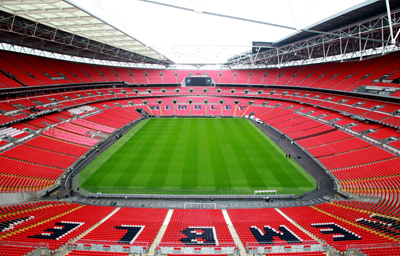
Due to the economic climate, no new venues were constructed for the Games and the athletes were accommodated in existing properties – RAF camps and London colleges – rather than a purpose-built Olympic village. The key venue was the Wembley Empire Exhibition Grounds – the opening ceremony (King George VI officially opened the Games), closing ceremony, athletics and football and hockey finals were all held in Wembley Stadium (pictured above as it is today – we’ll be looking at the “home of British football” in more detail in a later post) while fencing was held in the Palace of Engineering and swimming, diving and water polo at the Empire Pool.

Other London venues included Empress Hall at Earls Court for boxing, weightlifting and gymnastics, the Harringay Arena in north London for basketball and wrestling, the Herne Hill Velodrome for cycling and numerous football and hockey grounds including Arsenal Stadium in Highbury.

More than 4,000 athletes including 390 women took part in 136 events (Japan, Germany and the USSR were not represented while other countries such as Burma, Syria and Venezuela, were among the record-making 59 nations for the first time).

Memorable moments at the Games, which ran from late July into August, included 17-year-old Bob Mathias’ win in the decathlon only four months after taking up the sport (he remains the youngest man to win a men’s athletics event) and that of Dutch woman Fanny Blankers-Koen, the ‘flying housewife’, who won four gold medals in running events.

The Games were also notable for being the first to be shown on household televisions (although few people would have watched the Games this way), for introducing starting blocks for sprinters and for the use of the first covered pool – the Empire Pool at Wembley.

In a sign of things to come, the US won the most medals (84) followed by Sweden (44), and France (29). Great Britain came 12th with 23.

For more, check out the official Olympic website – www.olympic.org/london-1948-summer-olympics.

For more on Olympics history, check out London Olympics, 1908 and 1948.

PICTURE:  Courtesy of Wembley Stadium
LondonLife – Unveiling the Bomber Command Memorial…

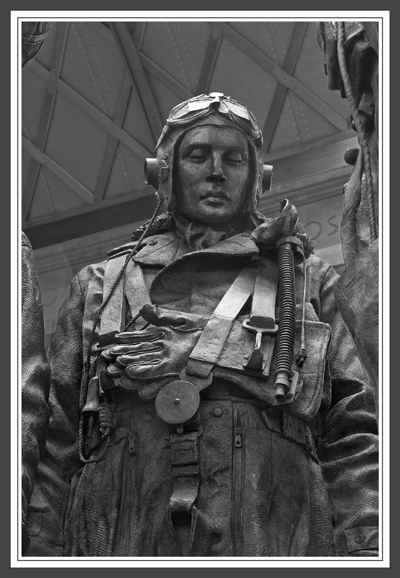
A new memorial honoring the 55,573 airmen who died while serving in Bomber Command during World War II was formally dedicated by Queen Elizabeth II in Green Park last week. At the centre of a new Portland stone pavilion, designed by architect Liam O’Connor (the architect behind the Commonwealth Memorial Gates near Buckingham Palace), is a nine foot high sculpture – the work of Philip Jackson – depicting seven aircrew from a Lancaster bomber having just returned from an operation (detail of which is pictured). The roof of the pavilion, the design of which was inspired by construction techniques used in the Vickers Wellington bomber, incorporates aluminium which was recovered from a Handley Page Halifax III bomber shot down over Belgium on the night of 12th May, 1944. The eight crew were killed during the incident and three of them were found still at their stations when the aircraft was excavated from a swamp in 1997 (they were subsequently buried with full military honors alongside the other five members of the crew). Hundreds of RAF veterans and Commonwealth airmen turned out to see the £6 million publicly funded memorial officially unveiled. The event was also marked with a flyover by five RAF Tornado bombers followed by the RAF’s last Lancaster Bomber which dropped thousands of poppies over Green Park in a message of remembrance. About 125,000 men served in Bomber Command from 1939-1945. The memorial, created following a five year campaign, commemorates people of all nations who lost their lives in the bombing campaigns of that period. For more on the memorial, see www.bombercommand.com.

PICTURE: Courtesy of Mike Legend at Flickr.

Where’s London’s oldest…manufacturing company?

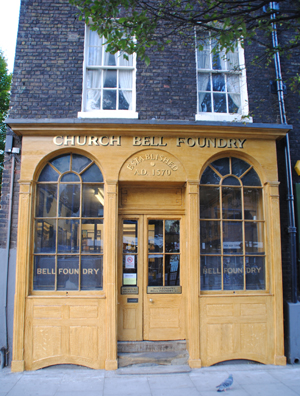
London’s oldest manufacturing company is the same as Britain’s oldest and is, according to the Guinness Book of Records, the Whitechapel Bell Foundry.

The company was established in 1570 (although founders have been discovered operating in the area as far back as 1420) and, according to its website, still concentrates solely on the manufacture of bells and their fittings with large church bells accounting for 80 per cent of the company’s business. The remainder of the business is involved in manufacturing handbells and other smaller bells.

The foundry’s current buildings, apparently originally used as a coaching inn named The Artichoke, date from 1670 and are presumed to have replaced structures consumed in the Great Fire of London. The foundry had earlier been located in smaller premises on the other side of Whitechapel Road.

The foundry has typically operated under the name of the master founder and owner but since 1968 has apparently operated under its current name.

The most famous bells cast at the foundry include the Liberty Bell (1752) – the symbol of American independence which cracked when first rung and was recast in Philadelphia, the Great Bell of Montreal Cathedral, ‘Great Tom’ of Lincoln Cathedral, and, of course, Big Ben (1858) – at 13,760 kilograms, the largest bell ever cast at the foundry.

Westminster Abbey and St Paul’s Cathedral also feature bells cast at the foundry and replacement bells for St Mary-le-Bow and St Clement Danes made here following their destruction in World War II and bells from the foundry have been sent as far afield as Australia and India.

Among the most recent bells to be cast at the foundry are the Royal Jubilee Bells, used in the Thames Diamond Jubilee Pageant and now housed at St James Garlickhythe in the City of London (each of the bells, which bear the Royal Arms, is named after a member of the Royal Family – Elizabeth being the largest with others named Philip, Charles, Anne, Andrew, Edward, William and Henry.)

There is a small exhibition on bell-making in the foundry shop looking at the history of the foundry and bell-making in general, and one-and-a-half-hour tours of the foundry run Saturdays (booking well in advance is usually required). Additional tours are being held every day during the Olympics.

WHERE: 32/34 Whitechapel Road; WHEN: Tours are usually held on Saturdays when no work is being undertaken – see website for dates – but special tours are being held daily from 10am to 5pm, 28th July to 12th August, 2012; COST: The exhibition/museum is free but tours are usually £12 a head for over 14s (Olympic period tours are £10 a head/£25 a family – children under 14 not admitted without adult supervision) – see website for more details on purchasing tickets; WEBSITE: www.whitechapelbellfoundry.co.uk.

Lost London – Vauxhall Pleasure Gardens

First laid out in the mid 17th century, Vauxhall Pleasure Gardens, on the east bank of the Thames just south of Lambeth, rose in fame to become one of London’s leading public entertainment venues.

The gardens, initially known as New Spring Gardens, are believed to have opened around the time of the Restoration of 1660 on a site which had been formerly an estate owned by vintners John and Jane Vaux (Jane was apparently widowed).

Initially apparently no more than an ale-house with a garden attached, the gardens grew to span several acres and featured a central hub and long avenues for strolling. Admission was initially free with money made from food and drink sold there. Among the earliest recorded visitors to the gardens was John Evelyn in 1661, describing it as a “pretty contrived plantation” and diarist Samuel Pepys, who wrote of a visit he made on 29th May, 1662 (he is known to have returned numerous times).

From 1729, the gardens came under ownership and management of John Tyers, entrepreneur, property developer and patron of the arts, and it was he who, until his death in 1767, oversaw the transformation of the area into an arts hotspot which included sculpture (in particular a fine statue of the composer Handel), music, painting and architecture. Thanks partly due to the patronage of Frederick, Prince of Wales, the gardens become the fashionable place to be seen.

The variety of entertainment on offer at the gardens – the name of which was only officially changed to Vauxhall Gardens in 1785 – grew substantially over the years: from concerts and fireworks displays to performances by tight rope walkers and lion tamers and even re-enactments of famous battles. The gardens became renowned as site for balloon ascents and, for its architecture – the number of buildings there grew over the years to include a rococo ‘Turkish tent’, Chinese pavilion, and, another rococo building, the Rotunda (where concerts could be held in wet weather). There was also a cascade and private ‘supper boxes’ for those who could afford them; those who couldn’t could dine at tables set under the trees.

From the outset, Vauxhall was known as a place where the sexes could mix freely and, therefore, for romantic assignations – in fact, one area of the gardens became known as the ‘Dark Walk’ for the fact it was, unlike other areas of the gardens, never illuminated by lamps and it was in this area, frequented by prostitutes, that many of the more illicit liaisons took place.

By the late 1700s and early 1800s, the gardens, one of a number of pleasure gardens in London, had reached the height of their popularity with reportedly more than 60,000 people said to have  attending a fancy dress party held one night in the late 1700s.

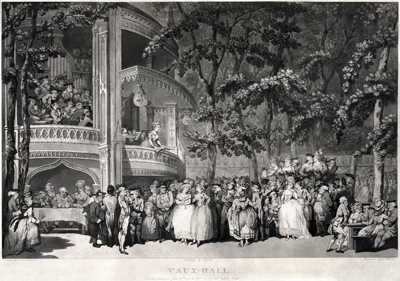
Those who attended events in the gardens included royalty as well as the likes of Samuel Johnson and James Boswell (see Thomas Rowlandson’s image above, Vauxhall Gardens, showing the likes of Johnson and Boswell, along with Georgina, Duchess of Devonshire, and the future King George IV, at the gardens in about 1779) as well as, much later, Charles Dickens (by the time Dickens visited, however, the heyday of the gardens was already well over).

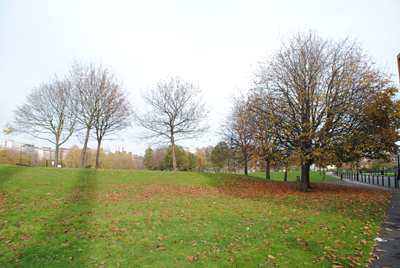
The gardens closed in 1859 due apparently to declining popularity and were eventually replaced with housing. After being badly bombed in World War II, however, the site once again returned to being a garden, known as Spring Gardens. The gardens (pictured) still occupy the site not far from Vauxhall tube station – part of them is used by the Vauxhall City Farm as paddocks for horses and livestock and they also contain a multi-use games court.

For an authoritative and comprehensive work on the Vauxhall Gardens, try David Coke and Dr Alan Borg’s Vauxhall Gardens: A History. There’s also much more information on David Coke’s website here. There’s also a detailed history here.

David Coke is curating an exhibition at The Foundling Museum, The Triumph of Pleasure, which looks at the way in which the gardens and the establishment of the Foundling Hospital in 1739 “changed the face of British art forever”. Runs from 11th May to 9th September. For more, see www.foundlingmuseum.org.uk.

PICTURES: Wikipedia and David Adams

Around London – At home in World War II; Hogwarts comes to London; Kew Steam Bridge Museum to be upgraded; and, V&A looks at British design…

• A new exhibition in which visitors can experience life during the Second World War through the eyes of a London family opens today at the Imperial War Museum in London. A Family in Wartime explores the lives of William and Alice Allpress and their 10 children at their South London home during the war as the face events such as the Blitz and the evacuation of the city. The display includes firsthand audio accounts from members of the family, photographs and a detailed model of the family home at 69 Priory Grove. Two of the family’s sons served in the military during the war while three of the daughters joined the Women’s Voluntary Service. Artefacts on display include many everyday household items such as cookery books which gave advice on cooking with limited rations and stirrup pumps which people were encouraged to wear in case of incendiary bombs as well as newspaper clippings, propaganda posters and film footage. There will also be artworks depicting wartime living by artists including Henry Moore, Wilfred Haines and Leila Faithful. Admission is free. For more, see www.iwm.org.uk/visits/iwm-london.

Hogwarts has come to London’s north with the opening of the new Warner Bros Studio Tour in Leavesden. The tour, which was launched this week, features sets, costumes and pros from the Harry Potter series of films and reveals how special effects and animatronics were used in the movies. Highlights include the chance to visit Hogwarts Great Hall, Dumbledore’s office and Diagon Alley as well as see Harry’s Nimbus 2000, the flying Ford Anglia owned by the Weasleys and Hagrid’s motorcycle. For more information, see www.wbstudiotour.co.uk.

The Kew Bridge Steam Museum in London’s west has been awarded a £1.84 million Heritage Lottery Fund grant for a restoration project that will see new visitor facilities and more modern displays as well as new outdoor water-based actvities. Project Aquarius will also see outstanding repairs to the Grade I and Grade II listed buildings – described as the most important historic site of the water supply industry in the UK – completed. The museum, which opened 37 years ago, features four giant working Cornish steam pumping engines as part of its displays telling the story of London’s water supply and attracts some 15,000 visitors a year. For more, see www.kbsm.org.

• On Now: British Design 1948-2012: Innovation in the Modern Age. The V&A’s major spring exhibition, this is a showcase of British design from the 1948 ‘Austerity Olympics’ to present day and features more than 300 objects – from the 1959 Morris Mini Minor to a model of the recently completed Zaha Hadid-designed London Aquatics Centre. Highlighting significant moments in British design, the exhibition looks not only at 60 years worth of fashion, furniture, fine art, graphic design, photography, ceramics, architecture and industrial design but also investigates how the UK continues to nuture artistic talent and the role British design and manufacturing plays around the world. Admission charge applies. Runs until 12th August. For more see www.vam.ac.uk.

We’re taking a break over Easter – posts will resume next Tuesday. In the meantime have a great Easter!

Where is it? #21

The latest in the series in which we ask you to identify where in London this picture was taken and what it’s of. If you think you can identify this picture, leave a comment below. We’ll reveal the answer early next week. Good luck!

Congrats to Jameson Tucker who correctly placed this in the gardens which now occupy the site of the former church of St John Zachary which lie, as Mike Paterson correctly pointed out, near the Goldsmiths’ Hall.

In fact, the gardens, located at the corner of Gresham and Noble Streets in the City (opposite the Goldsmith’s Hall), are also known as the Goldsmith’s Garden and were laid out following bomb damage during the Blitz (the church of St John Zachary had been destroyed in the Great Fire of London and not rebuilt).

The gardens were redesigned in 1957 by landscape architect Sir Peter Shepheard and have been added to and amended over the years since (including by landscape architect Anne Jennings in the mid-Nineties).

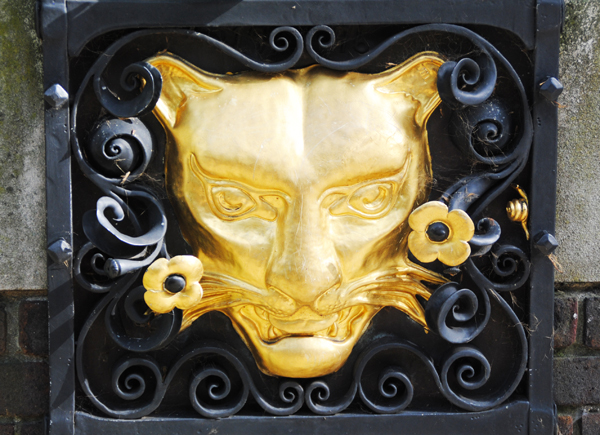
The iron arch, which was commissioned by the Blacksmith’s Company and put here in 1994, features the leopard’s head which is the hallmark of the Goldsmiths’ Company Assay Office, the premier hallmark in the UK (the term hallmark dates from the 15th century when London craftsmen were first required to bring their creations to the Goldsmiths’ Hall for verification and marking although the mark of the leopard’s head has been in use since the early 1300s).

For more on the Goldsmiths, see www.thegoldsmiths.co.uk.

Around London – John Carter at Ham House; John Hegley, Keats’ poet-in-residence; blue plaque writers; and, mapping the Blitz…

Ham House near Richmond in London’s south west is making a star appearance in the new Disney movie, John Carter. The 17th century mansion, located on the Thames, is doubling as a New York mansion on the Hudson River and the cast and crew spent six weeks filming there in January last year. The film is an adaptation of Edgar Rice Burroughs’ 1912 sci-fi comic-book John Carter of Mars, about a civil war veteran who is magically transported to a turbulent new life on the red planet. For more on Ham House, see www.nationaltrust.org.uk/ham-house/. PICTURE: ©2011 Disney.

• North London born poet John Hegley has been appointed poet-in-residence at Keats House in Hampstead for this summer. Hegley, whose poetry collections include Glad to Wear Glasses, The Sound of Paint Drying and My Dog is a Carrot, will host workshops and readings during his residency which takes place from 1st May to 31st October. He will also host the launch and closing event of the Keats House Festival, held at the house between 1st and 10th June, and present a series of meetings, entitled Sunday Tea with John (Keats), on the last Sunday of each month. These will include music and a 20 minute lecture about a particular aspect of Keats’ life. For more, see www.keatshouse.cityoflondon.gov.uk.

• Writers Jean Rhys and Elizabeth Bowen have been commemorated with English Heritage blue plaques. Caribbean-born Rhys (1890-1979) lived at Paultons House, Paultons Square, in Chelsea in the 1930s and it was while here that she developed her career as a novelist and penned Good Morning, Midnight (1939), now considered one of her finest works. Meanwhile the Anglo-Irish novelist Elizabeth Bowen (1899-1973) lived at 2 Clarence Terrace, Regents Park, for 17 years and during her time there wrote her two most celebrated works, The Death of the Heart (1938) and The Heat of the Day (1949). Last month blue plaques were unveiled commemorating the home of singer Elisabeth Welch (1904-2003) – described by her biographer as “Britain’s first black star” – at Ovington Court in Kensington and that of florist to royalty Constance Spry (1886 – 1960) on the site of her Mayfair shop at 64 South Audley Street. For more, see www.english-heritage.org.uk/discover/blue-plaques/.

Now on: Mapping the London Blitz. This exhibition at the London Metropolitan Archives in Clerkenwell centres on a series of bomb damage maps made during the dark days of World War II. Created by the London County Council, the 110 large maps used a color code to indicate the extent of damage in individual buildings and covered 117 square miles. Now in its last days – exhibition closes on 29th March. For more, see www.cityoflondon.gov.uk/lma.

Where’s London’s oldest…shop?

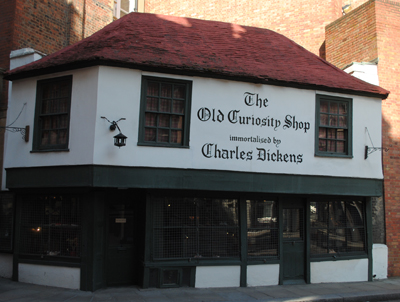
We’re celebrating the bicentenary of the birth of Charles Dickens this year so it’s only fitting that we look at a building which has been, rightly or wrongly, associated with one of his books.

Located at 13-14 Portsmouth Street in Westminster, The Old Curiosity Shop now operates as a shop selling handmade fashions and footwear but the building apparently dates back 1567, making it a strong contender for the title of London’s oldest shop.

The name – The Old Curiosity Shop – was apparently applied to the building some years after Dickens first published his story, The Old Curiosity Shop, in the weekly serial, Master Humphrey’s Clock, in 1840 and 1841. The belief subsequently arose that it was this building the author had in mind when writing the book which tells the tale of Little Nell and her grandfather, a shopkeeper, and their interactions with the evil moneylender Daniel Quilp.

The claim is disputed by some, author Ed Glinert among them. In his book Literary London: A Street by Street Exploration of the Capital’s Literary Heritage he says the model for Dickens’ building was located at either 24 Fetter Lane or 10 Orange Street near Leicester Square and notes that at the end of the novel, Dickens said the building had long since been pulled down.
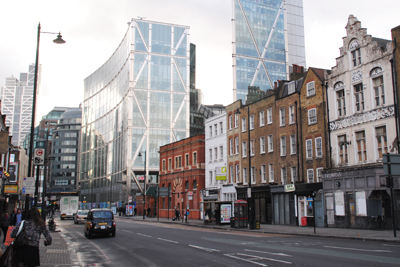
The Grade II* listed building, which survived the Great Fire of 1666 and the Blitz of World War II, is said to have been made from wood taken from old ships. Apparently at one stage it was a dairy which belonged to an estate awarded by King Charles II to one of his mistresses.

For more, see www.curiosityuk.com.

What’s in a name?…Shoreditch

The origins of the name Shoreditch – now a slowly gentrifying area to the north of the City of London within the Borough of Hackney – are lost to time but there are a few interesting theories around.

While the name probably comes to us as a derivation of Soersditch or Sewer Ditch – perhaps in reference to a drain that was once here – a more tragic version has it named after Jane Shore.

A mistress of King Edward IV in the mid to late fifteenth century, she, so the story goes, was buried in a ditch in the area after dying in a state of penury following a dramatic fall from favour during the subsequent reign of King Richard III (the king apparently had Jane arrested and made her perform a public penance for being a harlot).

There was an important priory here – the Augustinian Priory of Holywell – in medieval times and by Elizabethan times, some substantial houses. In 1576, James Burbage built England’s first theatre – known as The Theatre – on its site located near Curtain Road. Some of William Shakespeare’s plays were performed here and at the nearby rival, the Curtain Theatre, before a dispute with the landlord in the late 16th century saw the theatre relocated to Southwark in the dead of night (although the foundations must have remained – these were excavated a few years ago). Both Shakespeare and follow playwright Christopher Marlowe had associations with the area.

The area, which centred on St Leonard’s Church (while the current building dates from around 1740, there is believed to have been a church here  – at the intersection of Shoreditch High Street and Hackney Road – since Saxon times), become known for its textiles in the 17th century and later for its furniture industries.

It was still known as one of London’s premier entertainment districts in the late 19th and early 20th centuries with well known music halls and theatres but by then was also just as well known for its poverty.

Shoreditch suffered heavily during the Blitz and while the area continues to suffer from urban decay there is now some new life being breathed into it with the arrival of projects as the Boxpark Shoreditch which, made from shipping containers, is billed as “the world’s first pop-up mall”. There’s also an annual festival, the Shoreditch Festival, held in summer along Regent’s Canal.

PICTURE: View down Shoreditch High Street to the City – © David Adams.

10 curiously named churches of London – 10. St Olave Hart Street

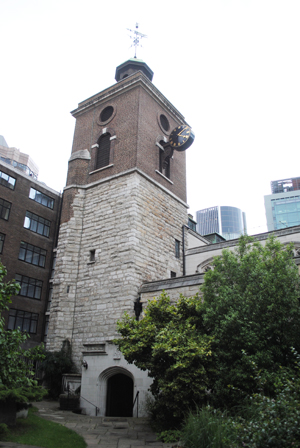
One of a few London churches to have escaped the Great Fire of 1666 (the flames are said to have come within 100 metres before the wind changed direction), St Olave Hart Street is named after the patron saint of Norway, St Olaf – a figure more known for his ability as a warrior than as a saint.

King Olaf II was King of Norway in the early 11th century and an ally of the Saxon King, Ethelred the Unready. The Norwegian king won the thanks of the English after he fought alongside Ethelred against the Danes in 1014 in what some refer to as the Battle of London Bridge.

According to some, the church was built on the site of where the battle was fought – many also believe the battle was also the inspiration for the nursery rhyme, London Bridge Is Falling Down, for it was during that battle that Olaf, who was helping Ethelred retake London, is credited with using his longships to pull down London Bridge in a effort to thwart the Danish occupiers.

The church, meanwhile, was rebuilt a couple of times in the Middle Ages, when it was said to have been known as St Olave-towards-the-Tower. The church which now stands on the site was built in 1450 with the distinctive red brick on the tower added in the early 18th century.

Having survived the Great Fire in 1666, the church was not so fortunate during the Blitz when it was struck by German bombs. It was subsequently restored with King Haakon VII of Norway attending the re-opening in the mid-1950s (there is a stone laid in front of the sanctuary which he brought from Trondheim Cathedral).

Other features inside include a recently returned 17th century bust of a prominent physician Dr Peter Turner – part of a monument which went missing after World War II, it resurfaced at an auction in 2010.

The church’s most famous parishioner was the 17th century diarist Samuel Pepys who lived and worked in the nearby Naval Office (for more on Pepys see our earlier entry here). The door through which he would have entered the church is marked with a 19th century memorial.

Pepys and his wife Elizabeth are both buried in the church (the memorial Pepys commissioned for her is still there) as is his brother John. Samuel Pepys’ life is commemorated at a service held close to the day he died – 26th May – each year.

Others associated with the church include Sir William Penn, an admiral and father of the William Penn who founded Pennsylvania in what is now the United States, and Charles Dickens, who gave it the name “Ghastly Grim” thanks to the skulls above its Seething Lane entrance.

St Olave’s is also the chapel of the The Clothworker’s Company, The Worshipful Company of Environmental Cleaners and Trinity House, a charitable organisation dedicated to the safety, welfare and training of mariners established by Royal Charter from King Henry VIII in 1514.

WHERE: Corner of Hart Street and Seething Lane in the City (nearest Tube stations are Tower Hill and Monument). WHEN: See website for detailsCOST: Free; WEBSITE: www.sanctuaryinthecity.net/St-Olaves.html

10 curiously named churches of London – 9. St Michael Paternoster Royal

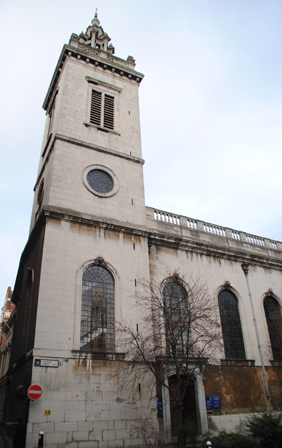
This triple-monikered church was first recorded in the 1200s. Far from unique in its dedication to the Archangel St Michael (there were apparently seven churches which were dedicated to him before the Great Fire), it was distinguished from the others by the name Paternoster Royal.

Surprisingly, the name has nothing to do with royalty or the clergy, at least not directly. The name Paternoster comes from the church’s location on what was Paternoster Lane (it’s now College Hill) – it was named for the number of paternoster or rosary seller that were based there.

The name Royal, meanwhile, is a little bit more obscure. First applied in the 1300s, it apparently comes from the close proximity of another street called Le Ryole which was itself a corruption of the French town of La Reole in the wine districts near Bordeaux. The street is believed to have been given the name thanks to the number of wine merchants who traded there.

Like other London churches, this one has been rebuilt several times – notably after the Great Fire of London (to the designs of Sir Christopher Wren) and again after World War II during which the church was all but destroyed by a V1 flying bomb. Since its reopening in 1968 it has served as the international headquarters of the Christian organisation, the Mission to Seafarers, which supports chaplains working in ports around the world.

The walls date from Wren’s time and the stone steeple, which wasn’t completed until 1717, is the work of Nicholas Hawksmoor. The interior features carved figures of Moses and Aaron which stand before the reredos – these apparently came from All-Hallows-the-Great (demolished in 1894) as did the chandelier which bears the words ‘Birmingham 1644’).

High profile parishioners over the years have included the four time Lord Mayor of London, Dick Whittington (see our earlier post on him) – he paid for a substantial extension of the church and founded a college of priests there (it’s from this college, which was dissolved in the mid-1500s and then re-established soon after, that College Hill is believed to have derived its name) as well as an almshouse next door.

Whittington and his wife were both buried inside but he was apparently exumed since several times and the location of his body is now unknown. There’s a stained glass window depicting Whittington and his famous cat inside and the gardens just outside also bear his name.

10 curiously named churches of London – 8. St Lawrence Jewry

The reason for the name of this church, founded in 1136, may seem obvious – it was associated with London’s Jewish community, thanks to its location on the edge of the area in which they lived (this area was centred on the street just to the south still known as Old Jewry).

What is perhaps more amazing may be the fact that the name stuck despite the expulsion of all Jews from London in 1291, the name was still used to distinguish it from other churches.

The church – named in honor of St Lawrence, a Roman era martyr who was slow grilled over a fire – was among those consumed in the Great Fire of London and rebuilt by Sir Christopher Wren afterwards. This new church had the honor of being reopened by King Charles II in 1677 – it was badly damaged in the Blitz before being rebuilt by Cecil Brown to Wren’s original design.

Located just off Guildhall Yard – home of the City’s authorities – St Lawrence Jewry is the official church of the Corporation of London and as such hosts a number of special services for the Lord Mayor and Aldermen during the year. Some 11 livery companies have links with the church – among them are those of tallow chandlers, loriners, girders, haberdashers and actuaries.

Worth noting on the inside is the painting of the martyrdom of St Lawrence – this survived the Blitz along with the tower and outer walls – and the many beautiful stained glass windows, painstakingly restored after World War II. There’s also a pond, complete with fish, outside the main entrance.

WHERE: Guildhall Yard (nearest Tube stations are St Paul’s, Bank and, a little further off, Moorgate and Mansion House). WHEN: 8am to 6pm Monday to FridayCOST: Free; WEBSITE: www.stlawrencejewry.org.uk.

Where’s London’s oldest…music hall?

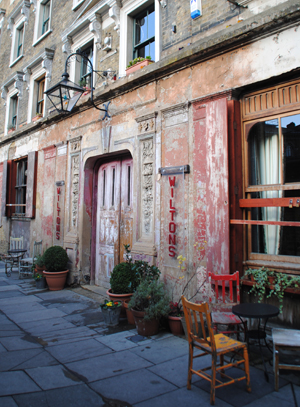
Wilton’s Music Hall  seems to be regularly making news these days so the revelation that it’s London’s oldest (in fact, according to the venue’s website, it’s the oldest surviving grand music hall in the world) probably comes as no surprise.

The hall, located in Graces Alley, Whitechapel, started out life as a pub which stood in the middle of a row of terrace houses. Named the Prince of Denmark, it is said to have had the first mahogany counters in London (hence the ‘Mahogany Bar’ at the front of the music hall today) and incorporated a concert room built at the rear of the ground floor.

The building was taken over by John Wilton in the 1850s. He also bought up the neighbouring terrace homes and subsequently built the grand music hall which still stands today – one of what were then a new generation of large music halls which appeared in London in the mid to latter part of the 19th century but had all but disappeared by 1900.

Wilton’s Music Hall opened on 27th March, 1859, and continued to operate under Wilton’s management for the next couple of decades. In 1877 it was badly damaged in a fire an rebuilt the following year.

Ten years later, however, the Wesleyan Mission took over the building and used it as a hall – dockers were served meals here during their first ever strike in 1889, it was used as a safe house during the so-called Battle of Cable Street of 1936 in which police clashed with protestors opposing a march by the British Union of Facists, and during World War II it was used as shelter for people bombed out of their homes.

The Methodists left in the 1950s and in 1964, the building was scheduled for demolition. Thanks to the intervention of poet John Betjeman, however (he led a campaign to prevent its destruction), the hall was saved. While it’s been undergoing restoration work ever since, more work is still required and the hall is still looking for donations to help fund it.

As well as operating once again as a music venue, it has since appeared in numerous films including Chaplin, The Krays, and the latest Sherlock Holmes film – Sherlock Holmes: A Game of Shadows.

There is a more detailed history of Wilton’s Music Hall at www.arthurlloyd.co.uk/Wiltons.htm, a music hall and theatre site. Wilton’s website can be found here.

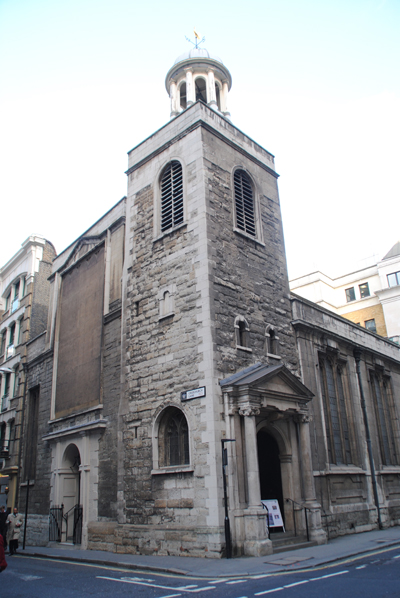
10 curiously named churches of London – 7. St Margaret Pattens

It’s not often you’d come across a church named after a type of shoe, but that’s the case with the church of St Margaret Pattens.

Located in Eastcheap, a church dedicated to St Margaret – a saint who was martyred in Antioch in the Middle East – has stood on the current site for at least 900 years. The earliest reference dates from 1067 and the church was rebuilt at least once in the medieval period, with the costs of construction apparently partly funded out of gifts presented to a crucifix or rood which stood in Rood Lane close to the church.

It’s only since the 17th century, however, when the church was rebuilt to the design of Sir Christopher Wren after the Great Fire of London, that it took on the name ‘Pattens’ to distinguish itself from other churches dedicated to St Margaret.

Pattens were wooden undershoes which were trapped beneath normal footwear and raised the wearer above the street, allowing them to walk across muddy roads and still arrive at their destination cleanshod. This footwear was apparently made and sold near which the church was located.

The trade of pattenmaking, incidentially, died out as streets became paved – according to the church’s website, the last pattenmaker died in the 19th century. There’s still a sign in the church asking women to remove their pattens before entering.

It’s worth noting before we move on that there is an alternative theory as to the origins of the name – this is that it commemorates a benefactor, possibly a canon at St Paul’s named Ranulf Patin – but it’s the former interpretation which is more widely accepted.

St Margaret Pattens, which was united with that of St Gabriel Fen after the latter was destroyed in the Great Fire, was damaged by bombing in World War II but was restored in the mid 1950s.

While the church lost many of its valuables during the Reformation (with the exception of a silver gilt communion cup dating from 1545 – on loan to the Victoria & Albert Museum), notable features inside include a memorial to King Charles I (since 1890, the king has been remembered in a special service each year held on the nearest Thursday to the date of his execution – 30th January) and a Royal Stuart Coat-of-Arms believed to be those of King James II.

There’s also a reredos containing a painting by Italian Carlo Maratta (1625-1713), two unusual canopied pews reserved for churchwardens, an hourglass dating from 1750 used to time the sermons, and a bell which dates from before the Great Fire. It’s also possible to view a set of pattens.

Among those who have been associated with the church is famed medieval Lord Mayor of London, Dick Whittington, apparently at one time the church’s patron (you can see our earlier post on him here), as well as livery companies including, as one would expect, the Worshipful Company of Pattenmakers, and the Worshipful Company of Basketmakers.

WHERE: Corner of Eastcheap and Rood Lane (nearest Tube stations are Monument, Bank and Tower Hill). WHEN: Weekdays from 10.30am (check website for services)COST: Free; WEBSITE: www.stmargaretpattens.org.

10 curiously named churches of London – 6. St Katharine Cree

Contrary to what some may, St Katharine Cree is not named after a person of that name (or at least not entirely). St Katherine, certainly, but the addition of ‘Cree’ is simply a medieval corruption of ‘Christ Church’.

The name Christ Church, abbreviated to Cree, was applied to this church because it was the prior of the Augustinian Priory of the Holy Trinity in Aldgate, also known as Christ Church, who founded St Katharine Cree in 1280 for the use of the area’s parishioners (apparently their use of the priory church was causing problems).

The current building dates from 1630 (although the tower dates from 1504), making it the only surviving Jacobean church in London.

It  was consecrated by William Laud, then Bishop of London (and later beheaded for, among other things, his support of King Charles I). He is commemorated in one of the church’s chapels.

Unlike so many other of London’s churches, St Katharine Cree was not destroyed in the Great Fire of London and only suffered minor damage in the Blitz. But structural problems meant it did need substantial restoration in the 1960s.

Inside, is a mid 17th century font and stained glass dating from the same era which depicts a Catherine wheel (St Katherine/Catherine is said to have died strapped to a spiked wheel when martyred during the time of the Roman Empire.).

There is also a rose window which was modelled on that of old St Paul’s Cathedral (before it was destroyed by the Great Fire). Parts of the organ, which was restored in the early Noughties, date from the 17th century and the original was played by none other than George Frideric Handel and Henry Purcell. The six bells were restored in 2009 following an appeal.

Among those buried at St Katharine Cree are Sir Nicholas Throckmorton, a 16th century diplomat (his monument is inside), and the artist Hans Holbein the Younger (his grave is also claimed by St Andrew Undershaft).

The church today has no parish but is the Guild Church to Finance, Commerce and Industry (its rector is that of St Olave Hart Street). Among its annual events is the Lion Sermon given in October, a tradition that dates back to 1643 and owes its origins to the former Lord Mayor of London, Sir John Gayer, who decided to finance the sermon after he survived an encounter with a lion in Syria.

WHERE: Leadenhall Street, London (nearest Tube stations are Aldgate and Tower Hill); WHEN: See website for service timesCOST: Free; WEBSITE: www.sanctuaryinthecity.net/St-Katharine-Cree.html.

10 curiously named churches of London – 5. St Magnus the Martyr

St Magnus the Martyr has to be one of the most oddly dedicated churches in London. Indeed, for many years there was confusion over which St Magnus it was dedicated to – candidates including  a second and a third century martyr and a Viking who was slain in the Orkney Isles around 900 years ago.

Revived interest in the latter St Magnus in the early 20th century thanks to the discovery of his remains hidden in a pillar in the Orkney ‘capital’ of Kirkwall , however, led to a confirmation of the church’s dedication in 1924.

There is believed to have been a church on the site since Roman times (a fact which has contributed to the confusion over it’s more recent dedication) but its first known mention as that of St Magnus is shortly after the Norman Conquest.

The church’s location, on the approach to London Bridge (see the picture, right, of the church tower overlooking the Thames), meant it occupied an important place in the life of medieval London. Following the Reformation, the patronage of the church was held alternately by the Abbey of Bermondsey and the Abbot and Convent of Westminster – this later passed into the hands of the Bishop of London, Edmund Grindall, and it was he who appointed the church’s most famous rector, Miles Coverdale, best remembered today as a Bible translator (there is a large monument to him in the church).

The church had been repaired in the early 17th century but was destroyed completely in the Great Fire of 1666. It was subsequently rebuilt to the designs of the ubiquitous Sir Christopher Wren.

A fire in 1760 did considerable damage to Wren’s building but it was restored and improvements continued to be made on a sporadic basis until 1831 when Sir John Rennie’s new London Bridge was opened and the old bridge demolished, meaning St Magnus no longer occupied the ‘gateway’ position it had for centuries prior.

The church only received relatively minor damage during World War II when a bomb struck London Bridge but was later restored. Features of the church now include the exterior clock, which dates from 1700, and a piece of wood believed to have one formed part of the Roman wharf which has been placed under the porch.

Among those buried at St Magnus’ during medieval times were Henry Yevele, master mason to King Edward III and King Richard II (his monument was destroyed in 1666). The church still has connections to the Fishmonger’s Company and the Plumber’s Company.

WHERE: Lower Thames Street, London (nearest Tube stations are Monument and London Bridge); WHEN: 10am to 4pm Tuesday to FridayCOST: Free; WEBSITE: www.stmagnusmartyr.org.uk.

LondonLife: Those Christmas Lights (part two)…

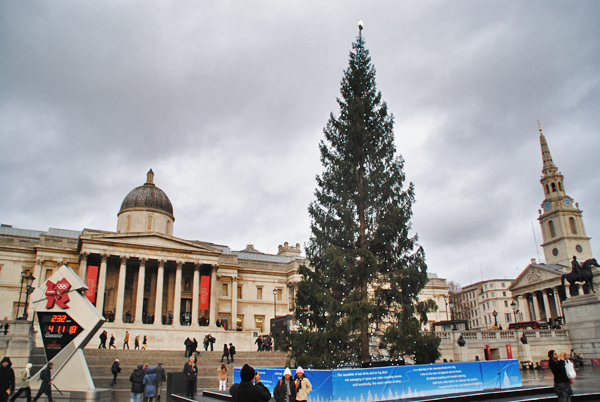
The Trafalgar Square Christmas Tree – donated  by the people of Oslo each year since 1947 as a thanks for the support Britain gave to Norway during World War II. On the left is the Olympic countdown clock.

A giant hedge-like reindeer outside Covent Garden, a market since at least the 1600s but once the site of a large kitchen garden for the monks of the Convent of St Peter, Westminster (see our earlier post for more).

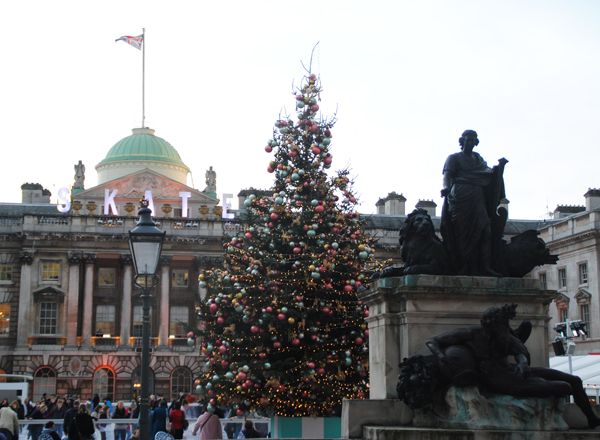
Christmas tree near the ice-skating rink at Somerset House, now an arts and cultural centre but originally built on the site of a Tudor palace in the late 1770s as a home for three “learned societies” – the Royal Academy of Arts, the Royal Society, and the Society of Antiquaries – as well as government offices (including the Navy Board).

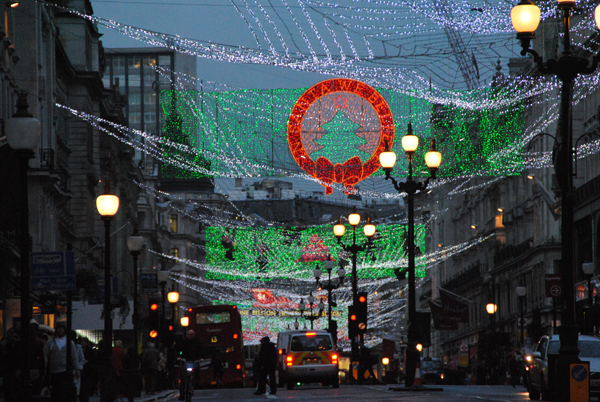
Christmas lights in Regent Street, one of the city’s premier shopping streets, in the West End. It’s current shape was designed by architect John Nash in the early 19th century.

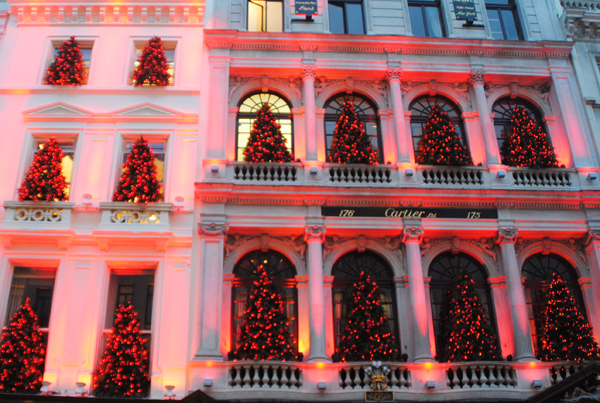
Christmas decorations on the exterior of Cartier in Old Bond Street, Mayfair. The area takes its name from the May Fair once held there and is now one of the most expensive areas within London (see our earlier post for more).

Looking for a book about London? See The Exploring London Little List of Books for Christmas…

10 curiously named churches of London – 4. St James Garlickhythe

Situated close to London’s riverfront, there is believed to have been a church on this site since at least 1100, although it is believed to have been previously dedicated jointly to the apostles St James and St John.

The name of Garlickhythe can be explained by its location – the word ‘hythe’ is a Saxon word for a landing place or jetty and it is believed garlic, used as a preservative and medication, was unloaded nearby and even possibly traded on Garlick Hill where the church stands.

The church was rebuilt in the 1300s and again after the Great Fire (it was another of Sir Christopher Wren’s designs and thanks to the abundance of natural light inside was known as ‘Wren’s Lantern’) but it largely escaped damaged in World War II (the projecting tower clock was among the casualities but while a 500 lb bomb buried itself in the south-east corner of the church, it failed to explode).

What bombs failed to do, however, a death watch beetle did and when one was discovered in the roof timbers in the 1950s, the church was closed until 1963 while it was restored. The exterior clock was restored in 1988 and repairs to the south transept were required after a crane counterweight smashed into the church in 1991.

Inside, the church boasts the second highest ceiling  – 40 foot – of any churches in London (St Paul’s being the highest) and much of the carved woodwork inside, including the font cover, altar table and churchwardens pews, is still original.

There is also original ironwork including a mayoral swordrest as well as a Stuart and Georgian coat-of-arms (the Stuart arms are among a number of features which come from St Michael Queenhithe – it was combined with this parish in the late 1800s; St Michael’s was pulled down in 1894 ).

The magnificent Bernhard Schmidt organ was installed in 1718. The church also houses two rare chalices dating from the time of Edward VI in the mid-16th century and some other rare plate as well as the oldest parish registers in England (these date from the 16th century with the first entry being that of the baptism of Edward Butler on 18th November, 1535).

St James Garlickhythe, which sits in the parish of St James Garlickhythe with St Michael Queenhithe and Holy Trinity-the-Less (the latter being another now demolished church), boasts connections to 12 livery companies including the Vintners (the church is located in Vintry Ward) and the Joiners. Among those buried there are six former mayors.

The church is currently appealing for funds for a new ring of eight bells to mark the Diamond Jubilee of Queen Elizabeth II next year.

And we couldn’t mention the church without referring to Jimmy Garlick, the church’s mummy. An embalmed body of an older man, this was discovered in the church vaults in 1855 and, identity unknown, was subsequently put on display so that curious onlookers could, for a small fee, look upon him or apparently even touch him. Jimmy, whose identity remains unknown, is no longer on public view.

WHERE: Garlick Hill (just off Upper Thames Street) (nearest Tube station is Mansion House). WHEN: See website for service timesCOST: Free; WEBSITE: www.stjamesgarlickhythe.org.

10 curiously named churches of London – 3. St Mary-le-Bow

We’ve already touched on the history of St Mary-le-Bow in our earlier series on Sir Christopher Wren but thought it was worth revisiting in a bit more detail. 

Another of Wren’s churches (after all, remember he designed more than 50 in the city), St Mary-le-Bow, on the corner of Cheapside and Bow Lane, has a history dating back at least to the Norman Conquest (although it is thought it may stand on the site of an earlier Saxon church) when it was constructed of Caen stone on the orders of Lanfranc, the new Archbishop of Canterbury, and was perhaps seen as a symbol of Norman oppression.

The name ‘le Bow’ is said to come from the Norman arches (it was apparently initially known as St Mary de Arcubus) which stand in what is now the crypt – this would have only been partially underground when built. From 1251, it hosted one of the church’s most important courts, which, thanks to its location, was known as the Court of the Arches. There is now a cafe in the crypt.

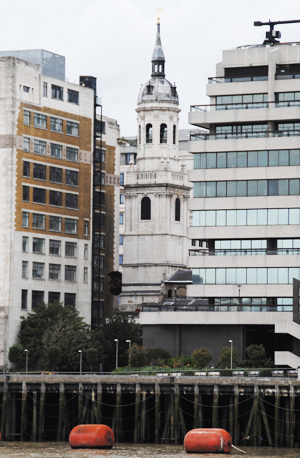
Like many other churches in the City, St Mary-le-Bow has been repeatedly repaired and rebuilt – following damage in a tornado in the late 11th century, the collapse of its tower in 1271, and, of course, the Great Fire of London in 1666 – Wren’s subsequent rebuilding included the construction of the fine great tower (pictured here against the backdrop of more modern City buildings, it was his second tallest structure after St Paul’s and was built to accommodate the Bow bells ). The church’s most recent remodelling was in 1964 after it was almost completely destroyed during bombing in May, 1941.

One of the church’s most important claims to fame is its bells. These included the city’s principal curfew bell, rung at 9pm each day since at least as far back as 1363. It is said that ‘true Londoners’ or ‘Cockneys’ must be born within hearing of the Bow bells and it was the pealing of the Bow bells (or what may have only been one bell at the time) which, of course, caused thrice-mayor Dick Whittington to turn back when leaving London. The church (in particular, its curfew bell) is also among a number of City churches mentioned in various versions of the rhyming song, Oranges and Lemons.

Features inside include a memorial to the first British Governor of New South Wales in Australia, Admiral Arthur Phillip, who was born nearby, and a bronze relief of St George and the Dragon given by Norway in commemoration of the work of the Norwegian Resistance during World War II. The churchyard outside contains a statue of Captain John Smith, founder of Virginia, and former parishioner.

For an indepth history of the church, you can’t go past the rather comprehensive St Mary-le-Bow: A History.

WHERE: Cheapside (nearest Tube station is St Paul’s). WHEN: 7.30am to 6pm Monday to Wednesday (closes 6.30pm Thursday and 4pm Friday and not usually open on weekends or bank holidays)COST: Free; WEBSITE: www.stmarylebow.co.uk.

What’s In a Name?…Elephant and Castle

A somewhat neglected area located in the Borough of Southwark, just south-east of Borough, Elephant and Castle takes its rather odd name from a coaching inn which once stood on the site – the Elephant and Castle.

The area is more correctly known as Newington but the name Elephant and Castle was apparently adopted informally in the mid 18th century as the area rose in prominence thanks in part to the opening of Westminster Bridge.

The inn, which stood on the site of a former playhouse, was apparently rebuilt several times but there is now no sign of it – the current, rather ugly, Elephant and Castle pub which is said to stand a short distance from where the tavern once stood, was built in the 1960s.

The origins of the sign of the Elephant and Castle, meanwhile, apparently comes from the mid-15th century when members of the Cutler’s Company adopted the sign of the elephant as their symbol (perhaps representing the ivory they used in their trade). The Worshipful Company of Cutlers still has an elephant carrying a castle on its back in its coat-of-arms.

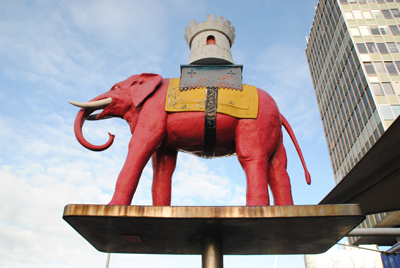
The area of Elephant and Castle, meanwhile, was known for its shopping and theatres before it was heavily bombed in the Blitz. It still features a rather grim shopping mall (pictured is the sign of the elephant and castle out front) which was said to have been the first covered shopping mall in Europe when it opened in the mid-1960s – it is apparently due for demolition as part of a larger regeneration project. The area has already seen some major new developments like the the residential tower known as Strata.

Other prominent buildings include the Metropolitan Tabernacle – standing opposite the shopping centre, this was founded by preacher Charles Hadden Spurgeon in the 19th century and rebuilt after World War II (interestingly, the site of the tabernacle is where three men, known as the Southwark Martyrs, were burnt at the stake for heresy in 1557 during a period of religious persecution in the reign of Queen Mary I).

Famous residents have included Charlie Chaplin – who lived in a workhouse in the area as a child – while other notable features include a large stainless box which stands at the centre of the area’s major road intersection, linking what is now New Kent Road and Kennington Park Road (via Newington Butts) with roads leading to Lambeth, Westminster, Waterloo and London Bridges among others (this is actually a memorial to scientist Michael Faraday, who was born in nearby Newington Butts). The area also boasts its own Tube station, Elephant & Castle.