Located just to the east of the Tower of London, St Katharine Docks were opened in 1828 following the demolition of more than 1,000 houses along with a brewery and what was left of the medieval St Katharine’s Hospital.
World War II
Treasures of London – The Anglo-Saxon archway, All Hallows by the Tower…
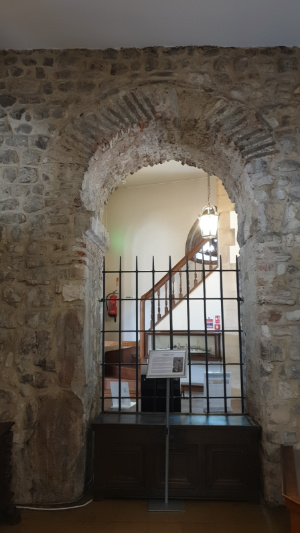
This rounded arch in the Church of All Hallows is believed to be oldest surviving arch of the Anglo-Saxon period surviving in the City of London.
The arch can be found at the west end of the nave and dates from an earlier church on the site, possibly built as early as the 7th century (the church was later rebuilt and expanded several times, survived the Great Fire in 1666, and was then largely destroyed during the Blitz before being rebuilt and reconsecrated in 1957).
Roman tiles have been reused in the arch’s construction as well as Kentish ragstone and it doesn’t include a keystone.
The arch was fully revealed after a bombing during the Blitz in 1940 brought down a medieval wall and revealed it.
The arch has given some weight to the idea that the Anglo-Saxon church was founded not long after Erkenwald founded Barking Abbey in the 7th century (he went on to become the Bishop of London in 675).
WHERE: All Hallows by the Tower, Byward Street (nearest Tube station is Tower Hill); WHEN: 8am to 5pm Monday to Friday; 10am to 5pm Saturday and Sunday; COST: Free; WEBSITE: https://www.ahbtt.org.uk/
This Week in London – The Charles Dickens Museum celebrates 100 years; activist Olive Morris commemorated; and, ‘The Story of Soldier Magazine’…
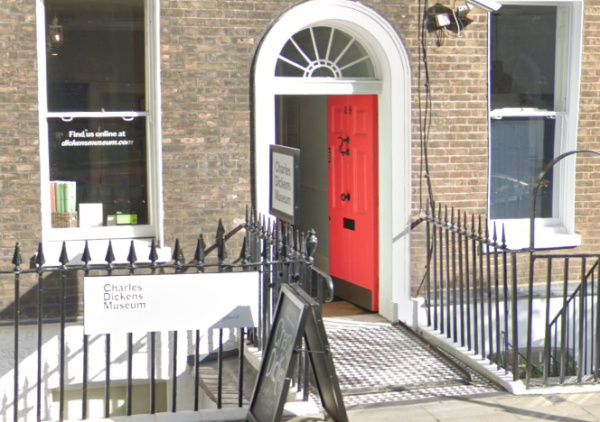
• The Charles Dickens Museum, located in the author’s former home at 48 Doughty Street in Bloomsbury, is marking its centenary this year, and to celebrate the occasion, it’s holding a special exhibition of highlights from its collection. The museum, which first opened its doors on 9th June, 1925, has brought together everything from Dickens’ hairbrush, walking stick and only surviving suit through to portraits and photographs made during his lifetime as well as original manuscripts, letters to his family and friends and rare first editions. The exhibition runs on 29th June. Admission charge applies. For more, see https://dickensmuseum.com/.
• Housing rights campaigner and activist Olive Morris has been commemorated with an English Heritage Blue Plaque in Brixton. Jamaican-born Morris (1952-1979), who dedicated her life to helping the oppressed and exploited, hosted Black women’s study groups and lived as a squatter at the three storey property at 121 Ralston Road in the 1970s. She was a significant figure in the British Black Panther movement, co-founded the Brixton Black Women’s Group and the Organization of Women of African and Asian Descent in 1978, and was one of the “Old Bailey three” who were acquitted after being prosecuted over a protest outside the Old Bailey, winning the right to a fair representation of Black people on the jury during the court proceedings. For more, see www.english-heritage.org.uk/visit/blue-plaques/.
• Soldier magazine, the official magazine of the British Army, is marking its 80th anniversary with an exhibition ay the National Army Museum. The Story of Soldier Magazine charts the publication’s history from March, 1945, when it was launched by Field Marshal Bernard Law Montgomery, through the role it’s played in covering every major conflict since as well as the issues shaping military life. Runs until 6th July. Admission is free. For more, see https://www.nam.ac.uk.
Send all items for inclusion to exploringlondon@gmail.com.
A Moment in London’s History…New Cross V2 attack…
One of the most devastating moments of World War II in Britain took place 80 years ago this month when, at 12:26pm on 25th November, 1944, a German V2 rocket bomb hit a Woolworths store in New Cross, south-east London.
There were some 30 staff and 100 customers in Woolworths when the rocket struck (a queue had formed at the store after word had spread that tin saucepans had arrived).
The massive blast flattened the shop and spread into nearby streets, bringing down neighbouring houses and shops, overturning an army lorry and causing cars to burst into flames.
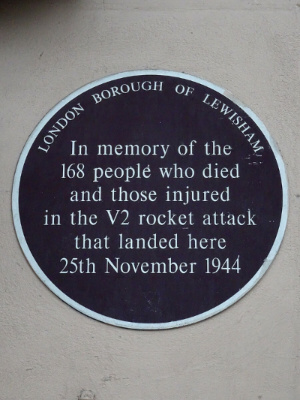
Some 168 people, including Woolworths customers and store workers as well as 33 children (some just babies in prams), were killed in the blast. Some of those who died were in the neighbouring Royal Arsenal Co-operative Socierty store, others were sitting at their desks in nearby offices and some were killed while sitting on a passing bus. Some 123 passersby were injured in the blast.
It took three days to clear the debris. Twenty four of those killed were never identified.
It is believed that the nearby New Cross Station was the intended target.
The V2, the world’s first long-range guided ballistic missile, travelled at some 3,000 mph and, as such, few too high and fast to be tracked by radar, put down by anti-aircraft fire or intercepted by fighter aircraft.
V2s had only started to be used in September, 1944, following an order from Adolf Hitler for their manufacture in December, 1942. The first V2 rocket had hit Chiswick on 8th September, 1944, and over the next few months about half of the 3,000 rockets fired at Allied targets were aimed at London.
Such was the fear over the rocket attacks that it had only been on 10th November 1944, that Winston Churchill had publicly admitted the country was facing rocket attacks.
The New Cross attack is commemorated by two memorial plaques at the site, one erected by the Deptford History Group in 1994 and the other by the London Borough of Lewisham in 2009.
This Week in London – Lord Mayor’s Show; ‘Poppy Fields at the Tower’; and, ‘The Great Mughals’ at the V&A…
• The Lord Mayor’s Show – featuring the 696th Lord Mayor of London, Alastair King – will be held this Saturday. The three-mile long procession – in which the Lord Mayor will ride in the Gold State Coach – features some 7,000 people, 250 horses, and 150 floats. It will set off from Mansion House at 11am and travel down Poultry and Cheapside to St Paul’s Cathedral before moving on down Ludgate Hill and Fleet Street to the Royal Courts of Justice. The return journey will set off again at 1:10pm from Temple Place and travel via Queen Victoria Street back to Mansion House where he will take the salute from the Pikemen and Musketeers at 2:40pm. For more information, including where to watch the show, head to https://lordmayorsshow.london.
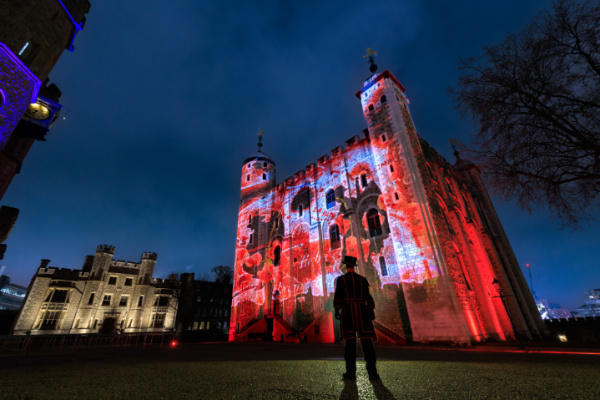
• An immersive sound and light show commemorating World War I and II opens at the Tower of London tomorrow ahead of Armistice Day and Remembrance Sunday. Historic Royal Palaces has partnered with Luxmuralis to present Poppy Fields at the Tower with visitors invited to go inside the Tower where – recalling the 2014 display Bloodswept Lands and Seas of Red in the Tower of London moat to mark the centenary of World War I – the walls will not only be illuminated with tumbling poppies but also historic photographs, documents and plans. The display is being accompanied by music composed by David Harper, and poetry recordings. Visitors will also be granted special access to see the Crown Jewels after-hours to learn more about their removal from the Tower during both World Wars. Runs until 16th November and should be pre-booked. Admission charges apply. For more, see https://www.hrp.org.uk/tower-of-london/whats-on/poppy-fields-at-the-tower/.
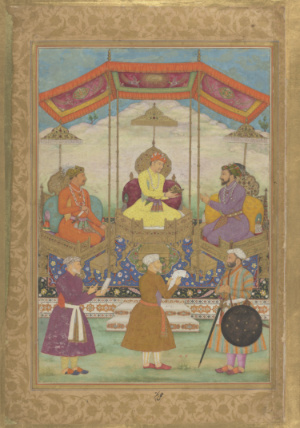
from the Minto Album. © CC BY – 4.0. Chester Beatty, Dublin
• An exhibition celebrating the golden age of the Mughal Court opens at the V&A in South Kensington on Saturday. The Great Mughals: Art, Architecture and Opulence examines the “creative output and internationalist culture” of Mughal Hindustan during the age of its greatest emperors, a period spanning c1560 to 1660. More than 200 objects are on display arranged in three sections corresponding to the reigns of the Emperor Akbar (1556-1605), Jahangir (1605 to 1627) and Shah Jahan (1628 to 1658). The objects include paintings, illustrated manuscripts, vessels made from mother of pearl, rock crystal, jade and precious metals. Highlights include four folios from the Book of Hamza, commissioned by Akbar in 1570, and the Ames carpet which was made in the imperial workshops between c1590 and 1600 and is on display for the first time in the UK. There’s also a unique wine cup made from white nephrite jade in the shape of a ram’s head for Shah Jahan in 1657, two paintings depicting a North American Turkey Cock and an African zebra created by Jahangir’s artists, and a gold dagger and scabbard set with over 2,000 rubies, emeralds and diamonds. Runs in Galleries 38 and 39 until 5th May. Admission charge applies. For more, see www.vam.ac.uk.
• Send all items for inclusion to exploringlondon@gmail.com.
10 towers with a history in London – 10. The ‘Lollard’s Tower’, Lambeth Palace…
This 15th century tower can be found at the north-west corner of Lambeth Palace, London residence of the Archbishop of Canterbury.
Subscribe for just £3 a month to gain access to all our stories – that’s less than the price of a cup of coffee!
10 significant (and historic) London trees…7. D-Day Tree…
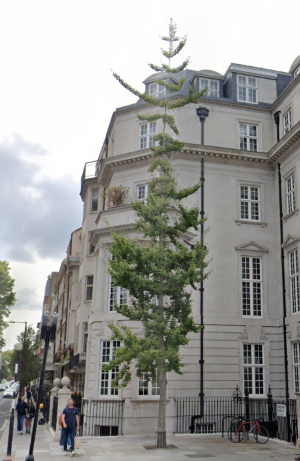
Nations, including the UK, have just marked the 80th anniversary of the D-Day landings in Normandy at a range of locations in France and England. But did you know London has its own “D-Day tree”?
The tree, a Ginkgo biloba or Maidenhair tree, is located outside number 22 in Grosvenor Square in Mayfair (on the corner with Upper Brooks Street). It was planted in 1994 to mark the 50th anniversary of the D-Day landings.
As well as the tree itself, the landings are commemorated with plaques around the base which provide the date of the landings and its code-name, Operation Overlord.
The location apparently relates to 20 Grosvenor Square being, for a time, the headquarters of Dwight D Eisenhower, Supreme Commander of the Allied Expeditionary Force launched on D-Day. There’s a plaque on the building commemorating his tenure.
In fact, the number of Americans working in the square – at locations including the US Embassy – led to it being known colloquially as ‘Eisenhower Platz’).
The tree was planted by the City of Westminster.
Note: There seems to be some conflicting information, not the least on a plaque in Bushy Park about Eisenhower’s connections with Grosvenor Square and Norfolk House in St James’s Square. We’ll be investigating further to clarify.
Treasures of London – Waterloo Station Victory Arch…
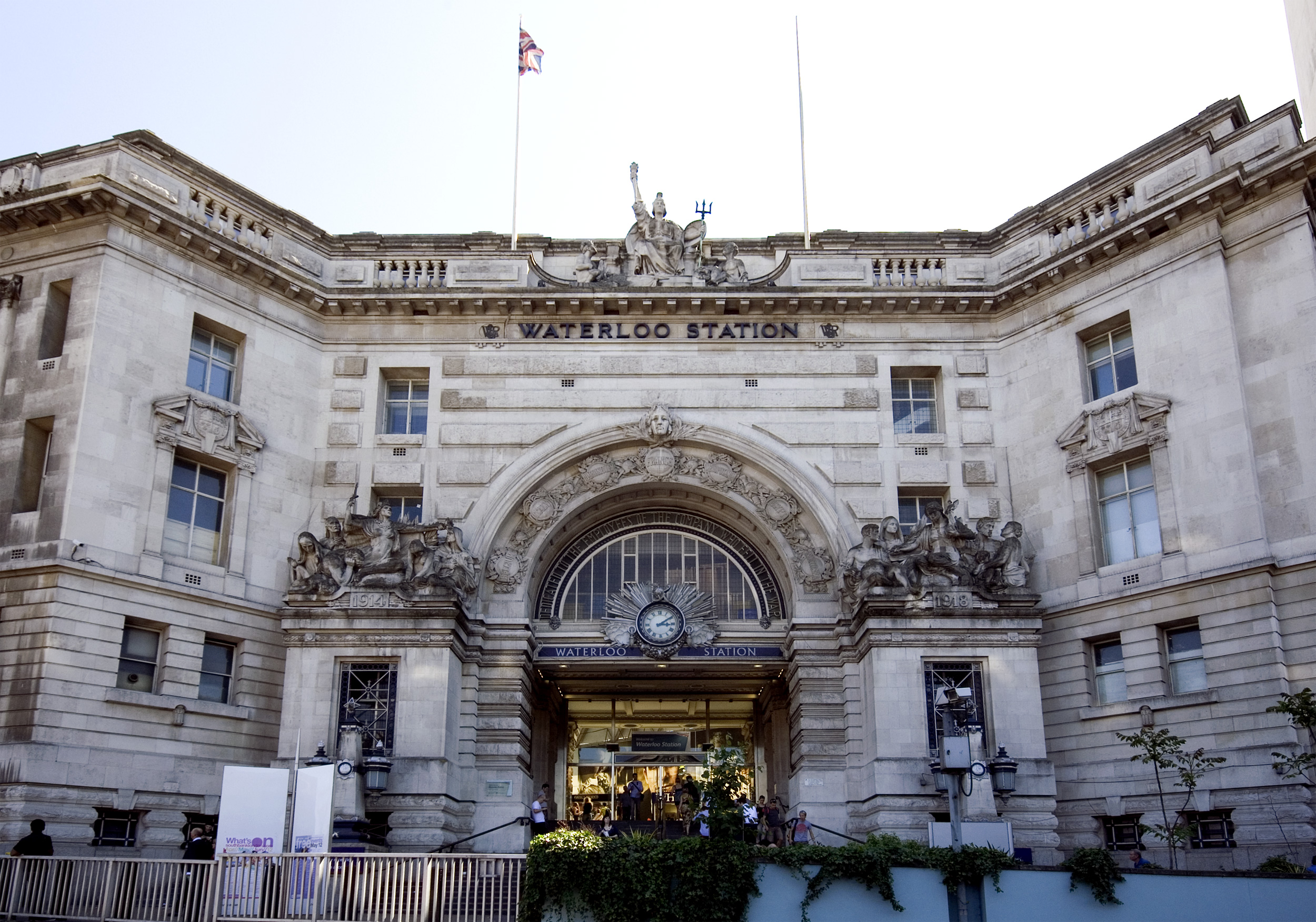
Sitting over the main entrance to Waterloo Station is a Victory Arch which commemorates railway personnel who died in World War I and II.
There are several plaques located at the top of the steps under the arch commemorating those who died in the conflicts and among them, particularly notable this week as the world marks the 80th anniversary of D-Day, is one commemorating those who died in the Normandy landings.
The plaque was installed on the 50th anniversary of the landings – 6th June, 1994.
The arch was built as part of a station rebuild in the first couple of decades of the 20th century and added to the design following World War I. The new station was completed in 1922.
The now Grade II-listed memorial, the work of sculptor Charles Whiffen, features two sculptural groups located on either side – one dedicated to Bellona and dated 1914 and the other dedicated to Peace and dated 1918.
Set around a glazed arch are the names of countries where key battles were fought in the conflict and at the centre is a clock set within in a sunburst. Sitting above the arch is a depiction of Britannia holding aloft the torch of liberty.
As well as the D-Day plaque under the arch, a Roll of Honour commemorates the 585 London and South Western Railway employees who lost their lives in World War I. There is also a plaque commemorating the 626 men of the Southern Railway who died in World War II.
What’s in a name?…Barons Court…

This district in west London doesn’t have anything to do with any particular baron but rather was named Barons Court by the late 19th century developer Sir William Palliser.
It apparently refers to the Court Baron, a form of manorial court which could be held in medieval times by any Lord of the Manor and is perhaps a nod to nearby Earl’s Court. It’s said by some that it may also be a reference to the Baronscourt estate in County Tyrone, Northern Ireland, where Sir William possibly had connections.
Many of the street names refer to members of the Palliser family or estates and the district, which lies between West Kensington and Hammersmith, features a Tube station which opened in 1905.
Barons Court did suffer bomb damage during World War II.
Landmarks include the London Academy of Music and Dramatic Art (LAMDA), housed in what was formerly a ballet school on Talgarth Road, the Queen’s Club tennis club, and the Margravine or Hammersmith Cemetery, which, laid out by architect George Saunders, opened in 1868.
10 atmospheric ruins in London – 8. Coldharbour Gate…
Located within the outer walls of the Tower of London are the remains of some early 13th century fortifications built by King Henry III.

These include the foundations of Coldharbour Gate which once adjoined the south-west corner of the White Tower as well as the western wall of the Inmost Ward which ran down to the Wakefiekd Tower.
The gate was defended by two cylindrical turrets while the Inmost Ward Wall has arrow loops installed, allowing archers to fire down on attackers who had breached the outer fortifications.
The gate was later used as a prison. Alice Tankerville, who was charged with piracy on the River Thames, became one of the most famous prisoners housed there when, despite having apparently been chained to the wall, she escaped with the help of two guards in 1533 (she was recaptured just outside the Tower).
The gateway was demolished in about 1675 and lead from the roof taken to Greenwich where it was redeployed at the Royal Observatory.
Much of the wall was hidden away behind later buildings but was re-exposed after being bomb damaged during World War II.
Not much remains to be seen today but the foundations do evoke a sense of the royal palace in times past and serve as a reminder that the buildings we see at the Tower today are not all that has existed here.
Other ruins at the Tower of London include the remains of the Wardrobe Tower, which lies at the south-east corner of the White Tower. It is thought to have dated from 1190 and incorporates the base of a Roman bastion.
WHERE: Tower of London (nearest Tube station Tower Hill); WHEN: 9am to 5.30pm (last admission 3.30pm), Tuesday to Saturday; 10am to 5.30pm (last admission 3.30pm) Sunday to Monday; COST: £34.80 adults; £17.40 children 5 to 15 (family tickets available; discounts for online purchases/memberships); WEBSITE: www.hrp.org.uk/toweroflondon/.
10 atmospheric ruins in London – 7. London Wall, Noble Street…
There’s many remnants of the Roman and later medieval wall which once surrounded the City of London – the towering section at Tower Hill near the Tower of London no doubt the most famous.
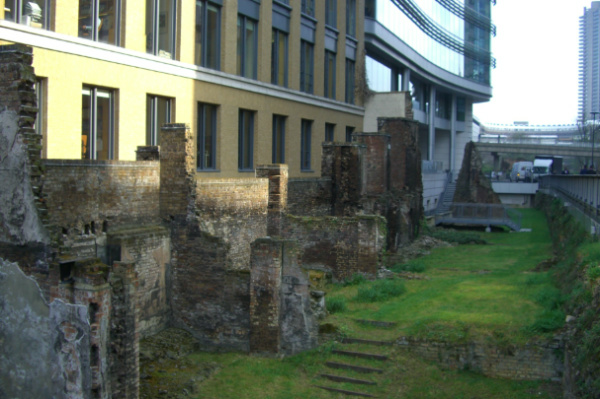
But there are several other stretches of the stone and brick wall left which evoke a sense of the structure it once was and the defensive role it played in protecting Londoners – among them is a substantial section of the wall located in Noble Street on the city’s western side.
The 80 metre long section of Roman and later medieval remains includes two internal turrets on what was the west side of the Roman Cripplegate fort (built between 120 and 150 AD) as well as a substantial bastion located at the southern end of the site.
The highest fragment of the Roman wall can be seen opposite Oat Lane, near the southern end of the site, while the highest section of the wall – which stands some 4.5 metres high and is mostly medieval – can be seen at the northern end of the site.
As well as reflecting the City’s Roman and medieval history, this section of wall also evokes a sense of the horrors of the Blitz.
Projecting eastward on the inside of the wall are party walls from World War II bomb-damaged and later demolished homes which once fronted onto Noble Street.
WHERE: Noble Street, London (nearest Tube stations are Barbican and Bank; WHEN: Anytime; COST: Free.
This Week in London – Underground shelters in wartime – then and now; new Ravenmaster at the Tower; and, ‘La Ghirlandata’ back at the Guildhall Art Gallery…
• A new photographic exhibition exploring how Underground stations and metro systems provide shelter to citizens during periods of war, both now and in the past, opened at the London Transport Museum in Covent Garden last week. Echoes of the Blitz: Underground shelters in Ukraine and London features 70 images, including historical pictures from the museum’s collection as well as 38 contemporary photographs shot by six renowned, mainly Ukrainian, documentary photographers. The latter include photography showing ordinary Ukrainian citizens sleeping, waiting, cooking, washing clothes, caring for their pets and creating temporary make-shift homes in metro stations of Kyiv and and Kharkiv show alongside black and white archive images of Londoners taking refuge in Tube stations during World War II. The exhibition, which is being run in partnership with Berlin-based journalistic network n-ost, can be seen until spring next year. Admission charge applies. For more, see www.ltmuseum.co.uk.
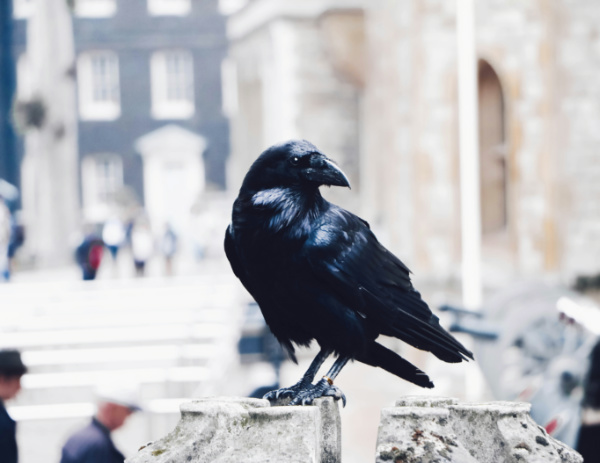
• A new Ravenmaster has been appointed at the Tower of London. Yeoman Warder Michael ‘Barney’ Chandler took up the role at the start of this month, 15 years after he first became a Yeoman Warder at the Tower. The Ravenmaster oversees a team of four responsible for the care of the Tower’s seven ravens which legend says must remain at the Tower to ensure its protection. The legend apparently goes back to at least the reign of King Charles II – when the King’s astronomer John Flamsteed complained that the resident ravens were impeding his work at the Tower and requested their removal, the King was told that if the ravens left the Tower then the Kingdom would fall (and so they remained). While the Yeoman Warders have longed cared for the ravens, the post of Ravenmaster was only created in the past 50 years and was first held by Yeoman Warder Jack Wilmington. Yeoman Warder Chandler, who became the 387th Yeoman Warder at the Tower when he was appointed in March, 2009, is only the sixth person to hold the office. For more, see www.hrp.org.uk/tower-of-london/.
• One of the most popular paintings at the Guildhall Art Gallery is being reinstalled to mark International Women’s Day on Friday. Dante Gabriel Rossetti’s La Ghirlandata has been on loan – first to the Tate Britain and then to the Delaware Art Museum in the US – but is now being returned. The painting dates from 1873 and depicts a ‘garlanded woman’ playing an arpanetta and looking directly at the viewer. The muse for the woman is said to have been the actor and model, Alexa Wilding, while the two ‘angels’ in the top corners were posed by William and Jane Morris’ youngest daughter, May Morris. The City of London Corporation acquired the oil on canvas work in 1927. On Saturday, free family activities will be held at the gallery to mark the work’s return. For more, see www.thecityofldn.com/la-ghirlandata.
Send items to exploringlondon@gmail.com.
What’s in a name?…Basinghall Street…

This City of London street, which sits on the eastern side of the Guildhall complex, is named for the wealthy Basing (or Bassing) family who had a hall here in the 13th century.
The street, which links Gresham Street in the south to Basinghall Avenue in the north, has been the site of numerous prominent buildings including the medieval hall of the Weaver’s Company (demolished in 1856, having replaced an earlier hall which burnt down in the Great Fire of London in 1666, the hall is now located in Gutter Lane), the Cooper’s Company (demolished in 1867, the hall is now located in Devonshire Square) and the Girdler’s Company (destroyed in the Blitz in 1940; the hall is now located in Basinghall Avenue).
It was also the location of the Sir Christopher Wren-designed Church of St Michael Bassishaw until 1899 after it was seriously damaged when the crypt was being cleared of human remains in line with the orders of City authorities. The parish with united with St Lawrence Jewry.
Famous denizens included the goldsmith, banker and civil engineer Sir Hugh Myddelton, most renowned for his design of the New River scheme to bring clean water to the City, who, according to The London Encyclopaedia, would sit in the doorway of his office and smoke his pipe while chatting with the likes of Sir Walter Raleigh.
The family also gave their name to the City of London’s Bassishaw Ward.
10 atmospheric ruins in London – 2. St George’s Garrison Church…
This mid-18th century church in Woolwich was constructed to serve the soldiers of the Royal Artillery but was badly damaged when hit by a bomb during World War II.

Designed by Thomas Henry Wyatt with the aid of his younger brother, Matthew Digby Wyatt, in the style of an Early Christian/Italian Romanesque basilica, the church was built between 1862 and 1863 on the orders of Lord Sidney Herbert, the Secretary of State for War.
It was among a number of buildings built to provide for the well-being of soldiers after a public outcry about their living conditions during the Crimean War.
The interior featured lavish decoration including mosaics said to have been based on those found in Roman and Byzantine monuments in Ravenna, Italy. Those that survive at the church’s east end – which include one of St George and the Dragon and others featuring a peacock and phoenix – are believed to have been made in Venice in the workshop of Antonio Salviati.
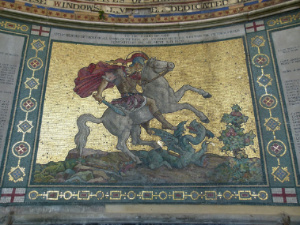
The mural of St George formed part of a memorial to the Royal Artillery’s Victoria Cross recipients located in the church and paid for through public subscription in 1915. The interior also featured five tall stained glass windows which served as memorials to fallen officers.
Plaques on the perimeter walls record the names of soldiers killed in military conflict or Royal Artillery servicemen who died of natural causes.
The church was visited by King George V and Queen Mary in 1928.
The church, which had survived a bombing in World War I, was largely destroyed on 13th July, 1944, when it was hit by a V1 flying bomb. Most of the interior was gutted in the fire that followed.
While plans to rebuild it after World War II were shelved, in 1970 it became a memorial garden with a roof placed over the church’s east end to protect the mosaics.
Services are still held in the Grade II-listed ruin, located opposite the Woolwich Barracks, and since 2018 it has been under the care of the Woolwich Garrison Church Trust.
WHERE: St George’s Garrison Church, A205 South Circular, Grand Depot Road, Woolwich (nearest DLR station is Woolwich Arsenal); WHEN: 10am to 1pm Sundays (October to March) and 10am to 4pm Sundays (April to September); COST: Free; WEBSITE: https://www.stgeorgeswoolwich.org.
Note that we’ve changed the title of this special series to allow us to explore a bit wider than the medieval period alone!
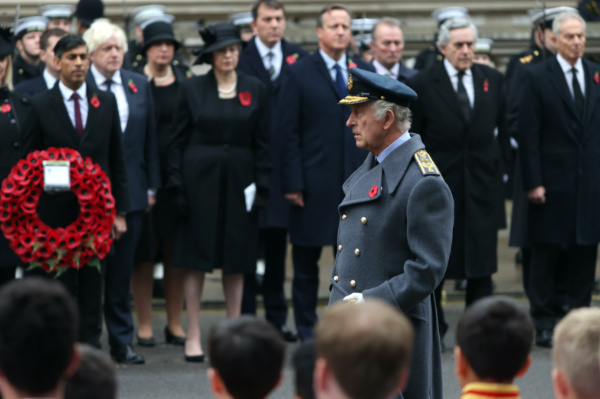
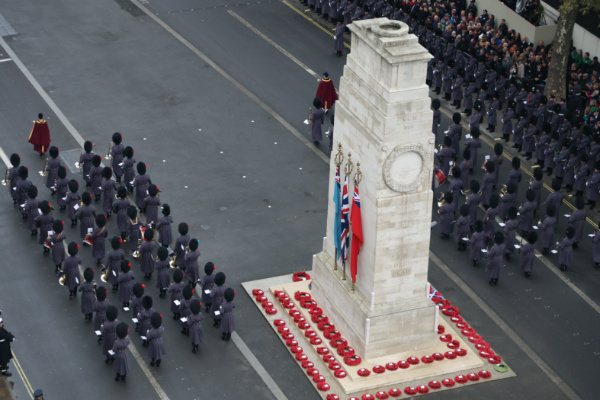
LondonLife – London remembers…
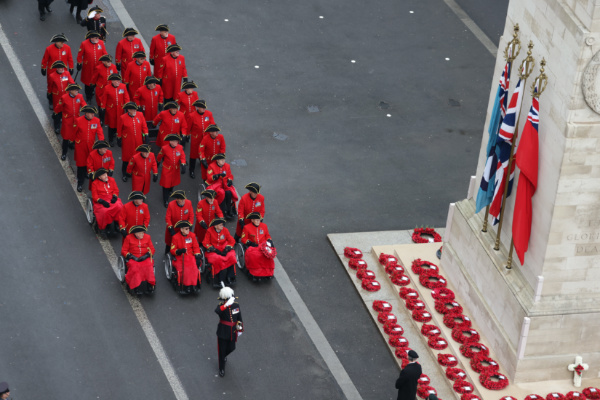
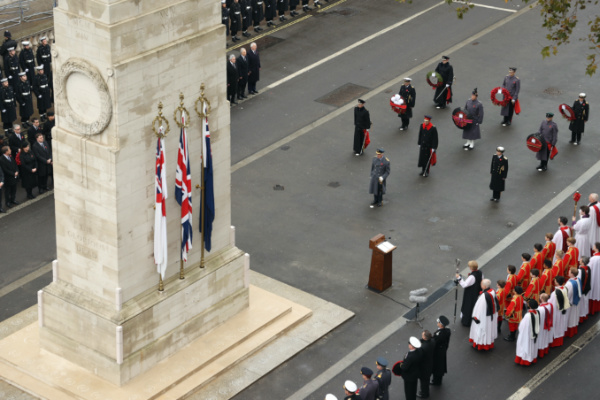
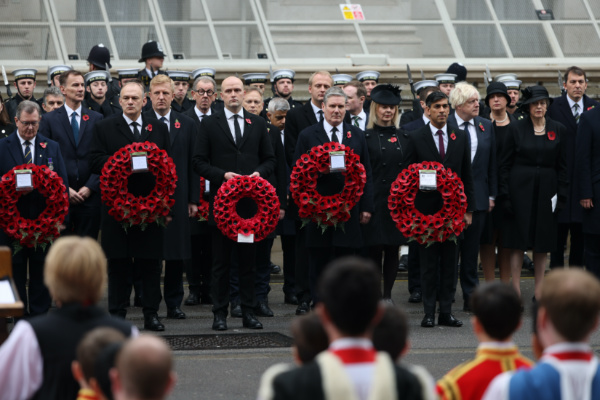
10 London locations related to Sir Christopher Wren…6. Westminster Abbey…

Think of Sir ChristopherWren and chances are it’s St Paul’s Cathedral – perhaps the most famous building he designed – which comes to mind. Certainly not Westminster Abbey, which he did not.
Yet, aside from his time at the Westminster School as a child, Wren did have a long relationship with the royal church at Westminster. In March, 1698, he was appointed the Surveyor of the Fabric at Westminster Abbey, a post he held until his death (when he was succeeded by Sir Nicholas Hawksmoor).
Wren did some work on the building. Prior to being appointed surveyor he had undertaken some work on schoolmaster Dr Richard Busby’s house (Wren had been one of his students) in the Little Cloister in 1683 (the house was destroyed during the Blitz in World War II).
Following his appointment, Wren did undertake a major restoration of the decayed stonework and roof of the church. He also approved designs by his deputy, William Dickinson, for the north front and an altarpiece which Wren had originally designed for the royal chapel at the Palace of Whitehall was given to the minster by Queen Anne (it was removed in the 19th century).
In 1713, Wren had also created designs for a series of works at the abbey which included the addition of a central tower and spire at the abbey and the completion of the west front which were never realised and which were shelved after his death (the wooden model for the tower and spire is located in Queen’s Diamond Jubilee Galleries, along with a pair of wooden obelisks he designed for the entrance to the Quire).
While there’s no memorial to him in the Abbey, Wren’s image can be seen in the lower right section of a memorial window in the north choir aisle dedicated to 19th century engineer Robert Stephenson while his coat of arms is shown along with numerous others in some post-war glass windows in the Chapter House.
WHERE: Westminster Abbey (nearest Tube stations are Westminster and St James’s Park); WHEN: Times vary – see the website for details; COST: £29 adults/£26 concession/£13 children (family rates available); WEBSITE: www.westminster-abbey.org.
This Week in London – ‘Spies, Lies and Deception’ at IWM London; the printing of Shakespeare’s plays; and, Georgian illuminations at the Sir John Soane’s Museum…
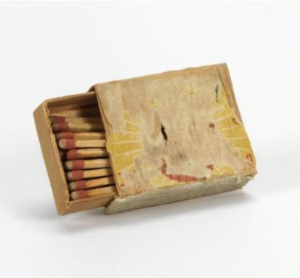
secret messages used during World War II. © IWM (EPH 178)
• A free exhibition exploring the “tricks, tools and elaborate plots that make up the secret world of spying and deception” has opened at IWM London. Spies, Lies and Deception features more than 150 objects including gadgets, official documents, art and newly digitised film and photography. Highlights include Operation Mincemeat mastermind Ewen Montagu’s private papers relating to the World War II plot – which fooled German High Command about the location of the next major Allied assault by planting a dead body with fake military documents off the Spanish coast – along with an oar from the submarine’s dinghy which deposited the body. There is also a box of matches with a match specially adapted for writing secret messages (pictured), footprint overshoes made by SOE (Special Operations Executive) in South-East Asia during World War II to disguise the wearer’s real footprints, and papier-mâché heads used to deceive snipers in World War I trenches. The exhibits also detail the work of the World War I Postal Censorships department – which examined letters sent to foreign locations including testing letters for invisible ink and tell the story of SOE operative Noor Inayat Khan – the first female wireless operator sent by SOE into Occupied France, she successfully transmitted messages to London for four months before being betrayed, captured and executed. There’s also a newly commissioned interview with Eliot Higgins, founder of Bellingcat, an international collective of researchers who used open source data to uncover the real identities of those responsible for the Salisbury Novichok poisonings in 2018, along with a photo album of double agent Kim Philby in Siberia after he escaped to the Soviet Union following his discovery in 1963. The free display can be seen until 14th April next year. For more, see iwm.org.uk/events/spies-lies-and-deception.
• A exhibition looking at the history of printing William Shakespeare’s plays has opened at the Guildhall Library. Folio 400: Shakespeare in Print covers everything from the printing of the small ‘Quartos’ of the late 16th century to the reworking of the text in the 18th century and the rediscovery of original texts in the 19th century. Running in parallel is a display at the City of London Heritage Gallery at Guildhall Art Gallery which features the library’s copy of the First Folio, widely regarded as one of the finest and most complete. Entry is free. Runs until 30th January. For more, see www.cityoflondon.gov.uk/things-to-do/history-and-heritage/guildhall-library.
• An exhibition centring on the spectacular light illuminations of the Georgian period has opened at Sir John Soane’s Museum. Georgian Illuminations celebrates the light shows of the period and the impressive and the elaborate temporary architectural structures created for them, often designed by leading architects and artists, including Sir John Soane. It features newly discovered linen transparencies, which were back-lit in Georgian windows as patriotic decoration during the Napoleonic Wars, as well as a contemporary work by light artist Nayan Kulkarni light artist which sees the facade of the museum at Lincoln’s Inn Fields illuminated each night from dusk until about 11pm. A series of events accompanies the exhibition. Runs until 7th January, 2024. Entry is free. For more, see www.soane.org/exhibitions/georgian-illuminations,
Send all items to exploringlondon@gmail.com for inclusion.
10 historic vessels in London’s Thames…6. ‘Portwey’…
One of only two twin screw, coal fired steam tugs still active in the UK, the steam tug Portwey can these days be found in London’s Docklands.
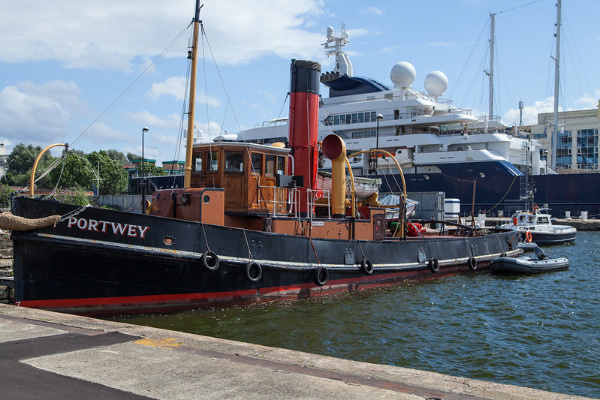
Ordered by the Portland & Weymouth Coaling Co Ltd, Portwey (the name comes from the company’s) was built by Harland & Wolff at Govan yard in Glasgow and launched on 10th August, 1927.
The 80 foot long vessel was based in Weymouth, Dorset, performed a range of tasks including carrying coal to steamers and being on call for any ship in distress requiring assistance or salvage. This included extinguishing a fire aboard the Danish timber-carrier Bodil in 1928, assisting ships like the cargo steamer Winslow (which had developed a list in heavy seas in 1932), and the Winchester Castle which had run aground in 1936, and even being involved in the search for a sunken submarine in 1932.
The Portwey was seconded by the Admiralty and moved to Dartmouth in Devon during World War II. Narrowly avoiding German bombs while in the harbour, during this time the tug was went to the assistance of ships attacked by the enemy. In 1944, she was assigned to US forces as they prepared for D-Day and her duties including clearing obstructions from the channel and supplying fresh water to naval vessels as well as, when a rehearsal for the landings went wrong at Slapton Sands, rescuing personnel and landing craft.
After the war, the Portwey resumed duties as a harbour tug including ferrying pilots and customs officers out into the Channel. In 1947, she helped put out a fire at the Queen’s Hotel in Dartmouth.
The Portwey was sold to the Falmouth Dock and Engineering Company in Cornwall in 1952. As well as rescuing the captain and first officer of the cargo ship Flying Enterprise, during this period she was involved in the construction of the Lizard Lifeboat Station in Cornwall, and a car ferry slipway at Holyhead in north Wales.
In 1967, with coal-fired steam tugs being replaced by diesel-engined ships, she was laid up to be scrapped. But it wasn’t the end for the Portwey, which was bought by Richard Dobson, the assistant harbour master at Dartmouth. Along with a group of friends, he returned her to working condition and during the 1960s and 1970s, she took part in many events on the River Dart and around Torbay.
In 1982, the Portwey joined the Maritime Trust’s Historic Ship Collection at St Katharine’s Dock where the newly formed Friends of Portwey continued with restoration and operation of the tug.
The Friends of Portwey became the Steam Tug Portwey Trust in 2000 and purchased the tug from the Maritime Trust, moving the vessel to West India Dock.
WHERE: Steam Tug Portwey, West India Dock (South Quay) (nearest DLR station is South Quay); WHEN: 2pm to 9pm Wednesdays; WEBSITE: www.stportwey.co.uk.
10 historic vessels in London’s Thames…4. ‘Massey Shaw’…
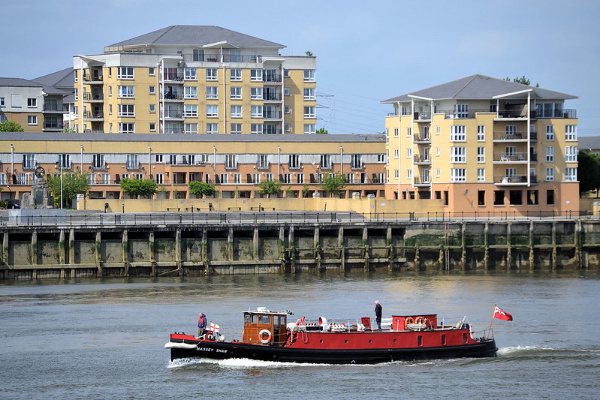
Moored at West India Dock, the Massey Shaw is a former London Fire Brigade fireboat.
The fireboat was constructed in 1935 for a cost of £18,000 by the J Samuel White company in Cowes on the Isle of Wight. Named for Sir Eyre Massey Shaw – the first Chief Officer of what was then named the Metropolitan Fire Brigade, the vessel was designed to London County Council specifications with a deliberately low profile so it could fit under the Thames bridges in all tides.
The vessel, which was was powered by two eight cylinder diesel engines and featured a main deck monitor as well as eight deck outlets (and a wheelhouse which was added later), soon proved its worth, playing an important role in saving what the press said was a million pounds worth of stock at a large warehouse fire on Colonial Wharf.
During World War II, the Massey Shaw took part in Operation Dynamo, forming part of the small boat flotilla which evacuated British troops from the beach at Dunkirk. She ferried more than 500 troops to a larger ship offshore and transported almost 100 back to England and it’s believed she was the last of the small boats to leave Dunkirk harbour (rescuing survivors from a French vessel which struck a mine along the way).
Back in London, Massey Shaw performed a critical role during the Blitz, pumping large quantities of Thames water to douse fires along the city’s waterfront.
It remained in service until the early 1970s, although it had operated as a reserve boat since 1960 with newer models taking over frontline duties.
Decommissioned in 1971, the Massey Shaw was found abandoned 10 years later at St Katharine Dock by a group who went on to found The Massey Shaw Fireboat Society with a view to preserving the vessel. They were granted a 50 year lease on the vessel.
In 1985, the Massey Shaw joined the Association of Dunkirk Little Ships on their return to Dunkirk for the first time since 1965 and two years later, she attended the centenary of Sir Eyre Massey Shaw’s review of 1000 firemen at Oxford.
In 1990 the Massey Shaw was sunk close to the London Fire Brigade headquarters at Lambeth but was subsequently salvaged and the following year, after restoration work, joined the 50th anniversary return trip to Dunkirk.
The society gained full ownership of Massey Shaw in 2002 and restoration work was carried out by the TV programme Salvage Squad (a second appearance on the show and more work followed two years later).
In 2008, a £500,000 Heritage Lottery Grant was used to fund the restoration of the vessel at Gloucester docks. She returned to London by road in 2013 where the restoration was completed and in 2015 was officially launched back on the River Thames with an event at the Westminster Boating Base.
Later that year she participated in another “little ships” armada to Dunkirk, this time commemorating the 75th anniversary of the evacuation. Massey Shaw has since taken part in other events including celebrations marking Queen Elizabeth II’s record as longest reigning monarch in 2015.
The vessel is now moored at the eastern end of West India Docks on the Isle of Dogs.
While Massey Shaw did appear in the 1958 film, Dunkirk, recapturing its role as one of the “little ships”, it did not appear in the 2017 film of the same name.
WHERE: Massey Shaw, West India Dock, Poplar (nearest DLR station is South Quay; nearest Tube station is Canary Wharf); WHEN: Between March and November, from 11am to 3pm daily (check website for details); WEBSITE: https://masseyshaw.org.
10 historic vessels in London’s Thames…2. HQS Wellington…
A former World War II convoy escort ship, the HQS Wellington, which is moored alongside Victoria Embankment in the River Thomas, is unusual in that for the past 75 years it has served as the headquarters of the Honourable Company of Master Mariners.

Constructed in the Devonport Dockyard, Plymouth, in 1934 for the Royal Navy as a two-masted Grimsby-class sloop, the HMS Wellington served in the Pacific in the lead-up to World War II, based mainly in New Zealand (she was named for the capital of New Zealand) and patrolling the South Pacific.
Following the outbreak of war, the HMS Wellington – which featured two 4.7-inch guns and one 3-inch gun as well as carrying other anti-aircraft guns and depth charges – served mainly as a convoy escort in the North Atlantic.
During this time, the vessel was involved in the sinking of an enemy U-boat, the evacuation of Allied forces from St Valery-en-Caux, north of Le Havre, and the Allied landings in North Africa in late 1942. In 1943, the HMS Wellington was one of the first escort ships to be fitted with Hedgehog, an anti-submarine weapon, which replaced the three inch gun.
The ship ended the war having travelled almost 250,000 miles and escorting 103 convoys.
Following the war, the 265 foot long ship was initially transferred to the Reserve Fleet in Milford Haven before, in 1947, the Admiralty made the ship available to the Honourable Company of Master Mariners to serve as a floating livery hall. She was converted for that purpose – and renamed the HQS Wellington – at Chatham Dockyard using funds raised through a public appeal.
The interior features a grand wooden staircase taken from the 1906 Isle of Man ferry SS Viper which was being broken up at the time.
The HQS Wellington arrived at Victoria Embankment in 1948 for service as the livery company HQ.
The ship had a major refit in 1991, during which it was fitted out with carpet and new displays showing off the Company’s collections, and in 2005, ownership of the ship was transferred to The Wellington Trust.
In April this year it was announced that due to safety concerns the Honourable Company of Master Mariners would have to leave the vessel. The company, which has relocated to a temporary on-shore headquarters in Greenwich, are now developing plans for a new floating headquarters.
 Exploring London