This Week in London – V&A celebrates new Exhibition Road Quarter; London’s Eid Festival; and, Colour and light at the Design Museum…

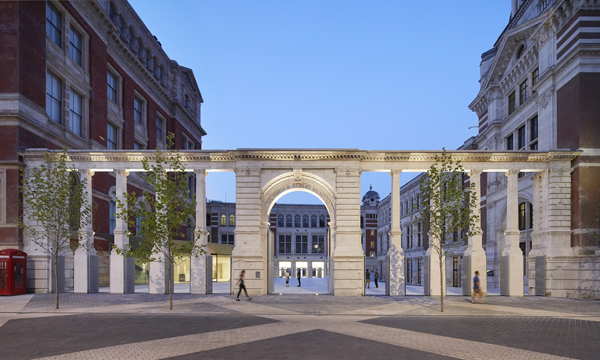
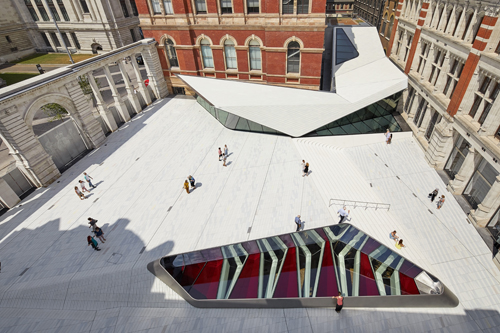
The Victoria and Albert Museum is celebrating the opening of its ‘Exhibition Road Quarter’ with a week long public festival featuring art, performances, fashion and family activities. Kicking off tomorrow (Friday), the REVEAL festival also coincides with the museum’s 165th anniversary. It opens with a music and digital-themed Friday Late, hosted in the Boiler Room, and culminates on 7th July with Fashion in Motion, four special catwalk shows in the new Sainsbury Gallery featuring Molly Goddard, British emerging talent winner at the 2016 Fashion Awards. Other events during the week include an immersive light experience by Simon Heijdens, a special performance by Julie Cunningham & Company responding to Yoko Ono’s ‘Dance Pieces’, a new hybrid opera by Anat Ben-David, and musical performances with the Royal College of Music and Albert’s Band from the Royal Albert Hall. The week also includes collaborations with partners from across Exhibition Road, including Discover South Kensington, Imperial College London, the Natural History Museum, Royal Albert Hall, the Royal College of Music and the Science Museum. The V&A’s Exhibition Road Quarter has been designed by Stirling Prize-winning architect Amanda Levete and her practice AL_A and, the museum’s largest architectural intervention in the past 100 years, it comes with new public areas and gallery spaces as well as revealing the historic facades of the existing Grade I buildings. The new spaces include the 1,100 square metre Sainsbury Gallery, the all-porcelain Sackler Courtyard and a new entrance from Exhibition Road, The Blavatnik Hall. A 1909 feature – the Astor Webb screen – has also been restored and incorporated into the design. Entry to the festival is free. For more, see vam.ac.uk/reveal. PICTURE: The Sackler Courtyard and Cafe, V&A Exhibition Road Quarter, designed by AL_A.

The Mayor of London, Sadiq Khan, has called on Londoners from all communities to join in this year’s Eid Festival celebrations in Trafalgar Square as a gesture of solidarity with those affected by the Finsbury Park attack and the Grenfell Tower fire, which, like Finsbury Park, affected many Muslim families. The event, held to mark the end of Ramadan, will feature live music and performances, arts and crafts, exhibitions, calligraphy, henna, face painting and food from across the world. Highlights include Rai musician Cheb Nacim, British Sudanese artist Rasha from the Shubbak festival, children’s writer Hajera Memon – who will be promoting her childrens’ book Hats of Faith, beat-boxer Omar Sammur, breakdancer Hakim, and a bazaar-style market area. The free event runs between noon and 6pm. For more, see www.london.gov.uk/eid.

A series of newly commissioned installations exploring perceptions and connections to colour have gone on show at the Design Museum. Breathing Colour, by designer Hella Jongerius is an installation-based exhibition that blurs the boundaries between art and design. The display is divided into separate spaces that simulate light conditions at morning, noon and evening and explore the impact of changing light on our perception of colour. Each of the three spaces includes a series of three dimensional objects as well as textiles, some of which have been hand-woven. Runs until 24th September at the Kensington High Street premises. Admission charge applies. For more, see www.designmuseum.org.

Send all items for inclusion to exploringlondon@gmail.com.
This Week in London – Remarkable Georgian princesses; John Singer Sargent’s watercolours; and the RA’s 249th Summer Exhibition…

The lives of three German princesses whose marriages into the British royal family during the Georgian era placed them right at the heart of progressive thinking in 18th century Britain are the subject of a new exhibition which opens at Kensington Palace today. Enlightened Princesses: Caroline, Augusta, Charlotte and the Shaping of the Modern World looks at how these three women – committed patrons of the arts and sciences – “broke the mould” in terms of their contributions to society, through everything from advocating for the latest scientific and medical advances to supporting the work of charities, changing forever the role women played in the British royal family. Caroline and Charlotte became queens consort to King George I and King George III respectively while Princess Augusta was at various times Princess of Wales, Regent and Princess Dowager (as mother to King George III) and between them, they had more than 30 children. But alongside their busy family lives, they also were at the centre of glittering courts where the likes of writers Alexander Pope and Jonathan Swift, scientist Isaac Newton and composer George Frideric Handel as well as successive Prime Ministers and international statesmen were welcomed. The display features almost 200 objects owned by the princesses, such as Charlotte’s hand-embroidered needlework pocketbook, pastels painted by their children and artworks and fine ceramics commissioned by some of the greatest artists and craftsmen of their day. The exhibition, which has previously been at the Yale Center for British Art, runs until 12th November. Admission charge applies. For more, see www.hrp.org.uk/kensington-palace/.

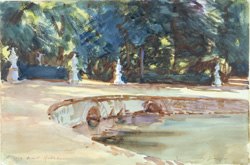
The UK’s first major exhibition featuring the watercolours of Anglo-American artist John Singer Sargent in almost 100 years has opened at the Dulwich Picture Gallery in south London. Sargent: The Watercolours features almost 80 works produced between 1900 and 1918, what was arguably his greatest period of watercolour production. Sargent mastered the art during expeditions in southern Europe and the Middle East and the show features landscapes, architecture and figurative scenes, drawing attention to the most radical aspects of his work – his use of close-up, his unusual use of perspective and the dynamic poses of his figures. The works include The Church of Santa Maria della Salute in Venice (c1904-1909), the mountain landscape Bed of a Torrent (1904), and figure study The lady with the umbrella (1911). The exhibition runs until 8th October. Admission charge applies. For more, see www.dulwichpicturegallery.org.uk. PICTURE: John Singer Sargent – Pool in the Garden of La Granja, c. 1903, Private Collection

The 249th Summer Exhibition has opened at the Royal Academy with Mark Wallinger, Yinka Shonibare and Antony Gormley among those with works on show. About 1,200 works are featured in the display with highlights including Shonibare’s Wind Sculpture VI, a new large scale work from Gilbert & George’s ‘Beard Speak’ series and, for the first time, a focus on construction coordination drawings, showing the full complexity of a building, in the Architecture Gallery. Runs until 20th August. Admission charge applies. For more, see www.royalacademy.org.uk.

Send all items for inclusion to exploringlondon@gmail.com.
This Week in London – Giovanni da Rimini on (rare) display; Dulwich ‘lates’; and, a history of City stationers…

We pause for a moment before our regular coverage to remember all those affected by the Grenfell Tower fire in north Kensington.

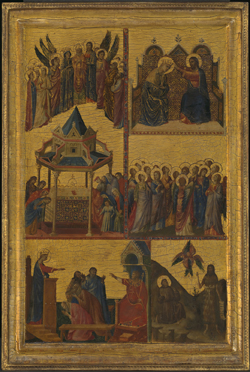
• Giovanni da Rimini’s 700-year-old work, Scenes from the Lives of the Virgin and Other Saints, has gone open show at The National Gallery. Acquired by the gallery in 2015 on the understanding that the panel will largely remain with New York collector and philanthropist Ronald S Lauder during his lifetime but for limited exceptions such as this, the panel forms the centrepiece of the exhibition Giovanni da Rimini: A 14th Century Masterpiece Unveiled. It brings together Giovanni da Rimini’s three easel works – also including Scenes from the Life of Christ (on loan from the Galleria Nazionale d’Arte Antica, Palazzo Barberini in Rome) and The Virgin and Child with Five Saints (on loan from the Pinacoteca Communal, Faenza, Italy) – for the first time in the UK. There are seven panel paintings in the display in total as well as two ivory panels and a fragment of an illuminated leaf. Alongside works by Giovanni da Rimini are those by Neri da Rimini, Francesco da Rimini/Master of Verruchio, Giovanni Baronzio and the great Florentine painter Giotto. The display can be seen in Room 1 until 8th October. Admission is free. For more, see www.nationalgallery.org.uk. PICTURE: Scenes from the Lives of the Virgin and other Saints (c 1300-1305), Giovanni da Rimini 1300-1305. © The National Gallery, London.

Dulwich Picture Gallery is celebrating the 200th anniversary of its public opening with a series of free late openings on Friday nights. Running until the end of July, the themed evenings feature performance, talks, and music with food and drink in the pavilion bar supplied by The Camberwell Arms. The nights include one of exploring how the memory of people, buildings, places and experiences influences and impacts architecture (16th June), tours of the gallery in which dancers are the guides (23rd June and 14th July), and a botanical themed evening with flower workshops, infused cocktails and other “green-fingered creativity” (28th July). For the full programme, see www.dulwichpicturegallery.org.uk/whats-on/.

An exhibition focusing on the 600 year history of the Worshipful Company of Stationers and Newspaper Makers has opened at the Guildhall Library in the City of London. The free exhibition joins the existing photographic display, Books and Publishing in the City, which features the work of artist-in-residence Simon Gregor and includes images of streets, buildings and documents with a particular focus on Stationers’ Hall. Both run until 31st August. For more, follow this link.

Send all items for inclusion to exploringlondon@gmail.com.
This Week in London – Beyond the ‘Great Wave’; Balenciaga’s fashions; British women cartoonists; and, The Royal Parks’ touring snail…

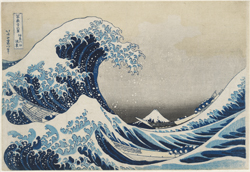
The later years of the life of Japan’s greatest artist, Katsushika Hokusai (1760-1849), is the subject of a new exhibition at the British Museum. Hokusai: beyond the Great Wave features his iconic print, The Great Wave (c1831), along with works he created during the last 30 years of his life until his death at the age of 90. Around 110 works – major paintings, drawings, woodblock prints and illustrated books depicting everything from iconic land and seascapes, to deities, mythological creatures, flora and fauna, and beautiful women – will be on display with about half the artworks changed over midway through the exhibition due to conservation reasons. Alongside The Great Wave, other key works, which come from the British Museum’s own collection as well as loans from Japan, Europe and the US, include Hokusai’s print series, Thirty-Six Views of Mt Fuji (published around 1831-33), a depiction of Red Shoki (the demon queller) – borrowed from the Metropolitan Museum in New York, and his brush drawing manual Hokusai manga. The exhibition, which opens today, runs until 13th August in Room 35. Admission charge applies. For more, see www.britishmuseum.org. PICTURE: British Museum

The fashions of Cristóbal Balenciaga are on show at the V&A in the first ever UK exhibition to explore his work and influence. Marking the centenary of the opening of Balenciaga’s first fashion house in San Sebastian and the 80th anniversary of the opening of his famous Paris house, Balenciaga: Shaping Fashion focuses on the latter part of his career in the 1950s and 1960s, a period during which he dressed some iconic figures and introduced revolutionary shapes such as the ‘baby doll’, the tunic and the sack. More than 100 garments and 20 hats are featured with highlights including ensembles made for Hollywood actress Ava Gardner, dresses and hats belonging to Sixties fashion icon Gloria Guinness and pieces worn by one of the world’s wealthiest women, Mona von Bismarck. Opens on Saturday and runs until 18th February. Admission charge applies. For more, see www.vam.ac.uk/balenciaga.

British female cartoonists and comic artists are celebrated in an exhibition on now at the Cartoon Museum in Bloomsbury. The Inking Woman features the work of more than 80 artists as it traces the evolution of British women in their role as satirists, humorists and story-tellers. Among them are Mary Darly, 18th century print seller, artist and the author of the first book on the art of caricature, Principles of Caricatura (1762), Marie Duval, an early artist for the 19th century magazine Judy, Sally Arts, Grizela and Kathryn Lamb – cartoonists for mainstream publications like Punch and Private Eye, political and joke cartoonists, strip cartoonists and caricaturists and comic artists and graphic novelists. Runs until 23rd July. Admission charge applies. See www.cartoonmuseum.org.

• An eight foot high snail will be touring The Royal Parks from the end of the month as part of The Royal Park’s Mission: Invertebrate. Funded with £600,000 from the People’s Postcode Lottery, the project aims to inspire people with the “amazing story of nature’s unsung workforce” and help park managers gain better insight into the 4,100 invertebrates species which live in The Royal Parks’ 5,000 acres. The snail, which will be visiting the parks during the half-term break and summer holidays, will bring with it interactive story-telling and a range of free, creative activities. For a full itinerary of the snail’s wanderings, head to www.royalparks.org.uk/be-involved/mission-invertebrate/family-programme.

Send all items for inclusion to exploringlondon@gmail.com.
This Week in London – New insights into Canaletto’s Venice; a rare Shakespearean opportunity; and, a Green Plaque for William Henry Hudson…

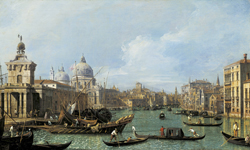
Methods employed by world renowned 18th century Venetian painter Canaletto in creating his evocative images of the city where he lived are the subject of a new exhibition which opens at The Queen’s Gallery in Buckingham Palace tomorrow. Canaletto & the Art of Venice showcases the findings of recent research in an exhibition which focuses on the Royal Collection’s remarkable group of paintings, drawings and prints by the artist – a collection obtained by King George III in 1762 from dealer (and the then-British Consult in Venice) Joseph Smith. Royal Collection Trust conservators used infrared technology to uncover previously hidden marks on drawings, providing new insights into Canaletto’s artistic techniques and casting doubt on a long held theory that he used a camera obscure to achieve topographical accuracy in his work. The exhibition, which features more than 200 paintings, drawings and prints, displays his work alongside that of contemporary artists Sebastiano, Marco Ricci, Rosalba Carriera, Francesco Zuccarelli, Giovanni Battista Piazzetta and Pietro Longhi. Runs until 12th November. Admission charge applies. For more, see www.royalcollection.org.uk. PICTURE: Canaletto, The Grand Canal looking East from Campo San Vio towards the Bacino, c.1727-8, from a set of 12 paintings of the Grand Canal. Royal Collection Trust/© Her Majesty Queen Elizabeth II 2017

• A rare ‘First Folio’ of William Shakespeare’s work – widely regarded as one of the most perfect copies in existence – will be available for viewing before an outdoor performance of Twelfth Night next month. Five actors from acting company The Three Inch Fools will perform the comedy in the St Mary Aldermanbury’s Garden on 1st June at 7pm, the same garden where Henry Condell and John Heminges, two of the Bard’s co-partners at the Globe Theatre and the men behind the production of the First Folio in 1623, were buried. Those attending the performance will be given the chance to view the folio in the nearby Guildhall Library before the performance. Tickets to this one night only opportunity can be purchased from Eventbrite.

Author and naturalist William Henry Hudson, whose work so inspired author Ernest Hemingway that his name was referenced in Hemingway’s first novel The Sun Also Rises, has been commemorated with a City of Westminster Green Plaque in Leinster Square, Bayswater. Born the son of British parents in Argentina, Hudson came to Westminster after leaving South America in 1874. An early support of the Royal Society for the Protection of Birds, his books on the English countryside became famous and helped foster the back to nature movement of the 1920s and 1930s.

Send all items for inclusion to exploringlondon@gmail.com.

This Week in London – Pink Floyd at V&A; examining the Syrian conflict; and, Giacometti’s works on show…

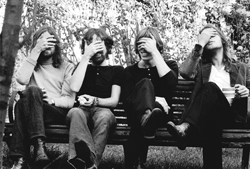
Marking 50 years since the release of their first album, The Piper At The Gates Of Dawn, a new exhibition opens at the V&A this Saturday celebrating the work of pioneering band Pink Floyd. The Pink Floyd Exhibition: Their Mortal Remains is an “immersive, multi-sensory and theatrical journey” through the “extraordinary world” of the band, encompassing their music as well as their iconic visuals and staging, which included ground-breaking use of special effects, sonic experimentation and imagery. The exhibition features more than 350 objects with highlights including set and construction pieces from some of the band’s most famous album covers and stage performances including the more than six metre tall metallic heads from 1994’s The Division Bell and a life-sized model of a British soldier seen in the artwork of 1988’s The Final Cut as well as instruments such as David Gilmour’s famous ‘Black Strat’, Roger Waters’ handwritten lyrics songs Wish You Were Here and Have a Cigar and psychedelic prints and posters. There is also never-seen-before classic Pink Floyd concert footage and a custom-designed laser light show as well as an accompanying sound experience – featuring past and present band members – provided by Sennheiser. Runs until 1st October. Admission charge applies. For more, see www.pinkfloydexhibition.com. PICTURE: © Pink Floyd Music Ltd photo by Storm Thorgerson/Aubrey ‘Po’ Powell 1971 Belsize Park

The ongoing conflict in Syria is the subject of a new exhibition at the Imperial War Museum which explores its origins, escalations and impacts. Syria: Story of a Conflict features a collection of objects – some of which have recently come from Syria – which point to the tragic and complex nature of the conflict as well as a film installation and a series of personal stories from Syrians affected by the fighting. It runs alongside a collection of more than 60 photographs by award-winning Russian documentary photographer Sergey Ponomarev taken around the conflict, a number of which are being displayed for the first time. Both the photography display – Sergey Ponomarev: A Lens on Syria – and the exhibition are part of the IWM’s Syria: A Conflict Explored ‘season’, with Syria the first contemporary conflict to be explored in the Imperial War Museum’s ‘Conflict Now’ ‘strand’, launched to coincide with the museum’s centenary. Both the exhibition and photographic display can be seen until 3rd September. Admission to both, which are accompanied by a programme of events including debates and tours, is free. For more, see www.iwm.org.uk/exhibitions/iwm-london/syria-a-conflict-explored

The work of sculptor, painter and draughtsman, Alberto Giacometti, is the subject of a new exhibition at the Tate Modern – the UK’s first major retrospective of his work for 20 years. More than 250 works are featured in the exhibition, which draws on the collection of Paris’ Fondation Alberto et Annette Giacometti, including rarely seen and never before exhibited plasters and drawings as well as works from across the span of Giacometti’s 50 year career – from Head of a Woman [Flora Mayo] (1926) to Walking Man 1 (1960). While Giacometti is best known for his bronze figures, Tate Modern is, in this exhibition, repositioning him as an artist with a far wider interest in materials and textures, especially plaster and clay, Runs until 10th September. Admission charge applies. See www.tate.org.uk.

Send all items to exploringlondon@gmail.com.

This Week in London – The Great Parchment Book; 20th century art at Guildhall Art Gallery; and, iconic music photography…

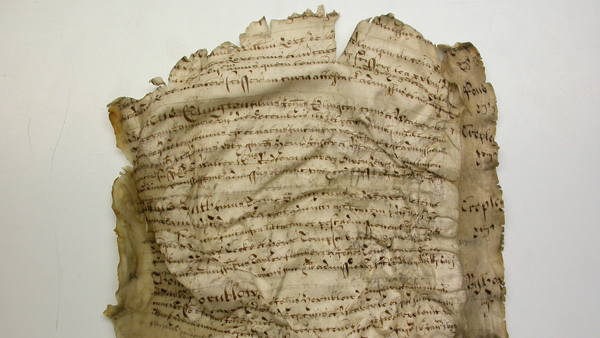
The Great Parchment Book, known as the ‘Domesday Book’ of the Ulster Plantation (now part of Northern Ireland), has gone on display at the City of London’s Heritage Gallery, located in the Guildhall Art Gallery. The book was compiled in 1639 and documents the period following King James I’s settlement of English and Scottish Protestants in Ulster. It came about after King Charles I seized estates around Derry which were managed by the Irish Society on behalf of the City of London and City livery companies and a survey was done to gather information about the lands. Stored at Guildhall, The Great Parchment Book was damaged in a fire in 1786 but following conservation is now on display. Runs until 10th August. Admission is free. For more, see www.greatparchmentbook.org. PICTURE: Courtesy City of London Corporation.

Works by Damien Hirst and David Hockney are among those on show in #LondonTrending which opens at the Guildhall Art Gallery today. A selection of limited edition prints on loan from British Land’s collection charts how collectives of London-based artists created some of the 20th century’s most innovative art. The display will also feature prints by pop artists Peter Blake, who created the sleeve design for The Beatles’ Sgt Pepper’s Lonely Hearts Club Band album, and Eduardo Paolozzi, who designed the mosaic patterned walls at Tottenham Court Road tube station as well as works by Richard Hamilton, Patrick Procktor, Jan Dibbets, Richard Long, Bruce McLean, Michael Lady, Simon Patterson, Gary Hume and Ian Davenport. Runs until 28th August in the Temple Room. Admission is free. A series of curator talks are scheduled. For more, see www.cityoflondon.gov.uk/londontrending.

Sheila Rock’s iconic portraits of musicians ranging from Sir Simon Rattle to Siouxsie Sioux are on show at the City of London’s Barbican Music Library. Picture This includes a wide range of her vintage prints including her work for album and vinyl 12” releases such as the shot of Debbie Harry used in 1978 for Blondie’s Denis’ 12. Other images included in the display feature Irish band U2 and conductor Daniel Barenboim. Rock, who has been based in London since 1970, was introduced to music photography by her ex-husband (and renowned rock photographer) Mick Rock and became known as a highly influential photographer during the punk and post-punk scene, later helping to shape the look of creative magazines such as The Face. Runs until 4th July. Entry is free. For more, follow this link.

Send all items for inclusion to exploringlondon@gmail.com.
This Week in London – Maritime Greenwich lights up; garden memorial to Diana; and, Ecce Homo at St Paul’s…

Wishing all our readers a very happy Easter!

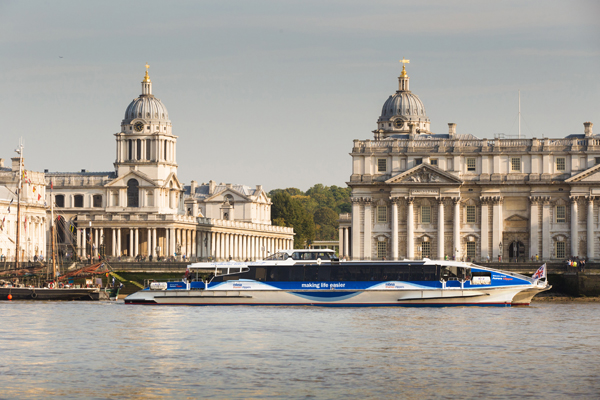
Maritime Greenwich will celebrate 20 years of UNESCO World Heritage Listing with a “spectacular” lighting event next Tuesday night. The lights will be switched on at 8.30pm on 18th April, illuminating landmarks including the Cutty Sark, the Queen’s House, National Maritime Museum and Royal Observatory as well as the Old Royal Naval College. The event, the first in a series to mark the 20 year anniversary this year, is the first time all the buildings have been lit up in unison and is a one night only event. Greenwich Park and the grounds of the National Maritime Museum and Old Royal Naval College will be kept open until 10pm to give visitors more time to witness the historic event. Maritime Greenwich was inscribed on the World Heritage List in 1997 due to its role in the progression of English artistic and scientific endeavour in the 17th and 18th centuries. The event takes place from 8.30pm to 11pm (Cutty Sark will be lit until 11pm) and is free to attend. For more, see www.rmg.co.uk. PICTURE: RMG

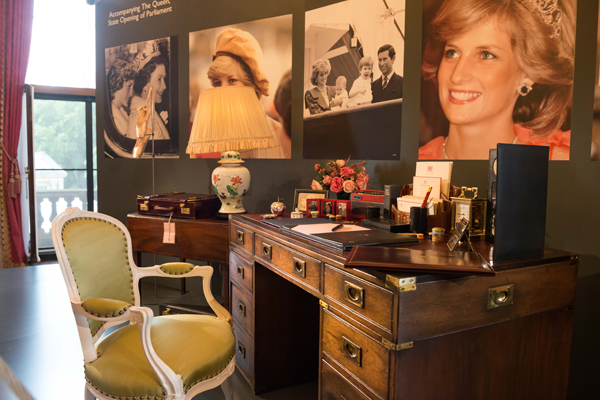
 A memorial garden to Princess Diana has opened at Kensington Palace, marking 20 years since her death. The temporary ‘White Garden’ – located in what was formerly the Sunken Garden which often featured floral displays admired by the Princess – features flowers and foliage inspired by memories of the Princess’s life, image and style. The garden, which can be seen from a public walkway, complements the exhibition, Diana: Her Fashion Story, currently on show in the palace. For more, see www.hrp.org.uk/kensington-palace/.

Mark Wallinger’s work, Ecce Homo – a life-sized sculpture of Jesus Christ with his hands bound behind his back and a crown of barbed wire on his head, has been placed at the top of St Paul’s Cathedral’s west steps for Easter. The sculpture, which will be at the cathedral for six weeks, represents Christ as he stands alone, waiting for judgement and a sentence of death. The sculpture is being presented by the cathedral in partnership with Amnesty International and the Turner Prize winning artist to highlight the plight of all those currently in prison, suffering torture or facing execution because of their political, religious or other conscientiously-held beliefs. The statue first appeared on the Trafalgar Square Fourth Plinth in 1999. For more, see www.stpauls.co.uk.

Send all items for inclusion to exploringlondon@gmail.com.
This Week in London – Hunting Easter bunnies at Hampton Court; Celebrating botanist Joseph Hooker; and, Dulwich marks its 200th…

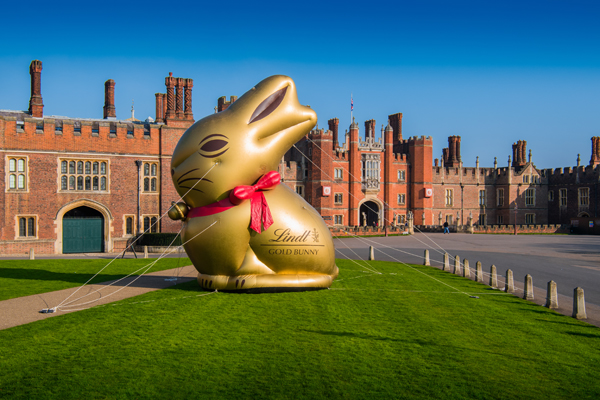
• Join in the hunt for Lindt gold bunnies at Hampton Court Palace this Easter. The bunny hunt is just one of the many chocolate-related activities taking place at the palace over the Easter period – visitors can also explore the history of chocolate and discover how it was made in the palace’s 18th century ‘chocolate kitchen’ by Thomas Tosier, King George I’s private chocolate chef while attractions outside also include the reopened ‘Magic Garden’. An imaginative play garden first opened in spring last year, it invites visitors to explore the world of Tudor tournaments on what was the site of King Henry VIII’s former tiltyard. The Palace Lindt Gold Bunny Hunt runs until 17th April (the Magic Garden is open until 27th October). Admission charges apply. For more, see www.hrp.org.uk/hampton-court-palace/. PICTURE: Lindt & Sprungli (UK) Ltd.

Joseph Dalton Hooker – dubbed the ‘king of Kew’ – is the subject of a new exhibition in The Shirley Sherwood Gallery of Botanical Art in Kew Gardens. Joseph Hooker: Putting plants in their place explores the life of the botanist, charting his travels to many parts of the world – including  Antarctica and Mt Everest – and how he helped to transform Kew Gardens from a “rather run-down royal pleasure garden” into a world class scientific establishment. The exhibition features an array of drawings, photographs, artefacts and journals including 80 paintings by British botanical artists and an illustration of Mt Everest by Hooker, the earliest such work by a Westerner. Runs until 17th September. Admission charge applies. For more, see www.kew.org.

On Now – The Private Made Public: The First Visitors. The first in a series of public events and exhibitions celebrating Dulwich Picture Gallery’s bicentenary year, this display features the first handbook to the gallery, a 1908 visitor book which includes the signatures of Vanessa and Clive Bell and Virginia Woolf, and James Stephanoff’s watercolour, The Viewing at Dulwich Picture Gallery, which depicts the gallery’s enfilade as it would have been in the 1830s. The exhibition also looks back at some of the gallery’s first visitors and features quotes from notable artists, writers and critics shown next to works in the permanent collection. Can be seen until 4th June. Admission charge applies. For more, see www.dulwichpicturegallery.org.uk.

Send all items for inclusion to exploringlondon@gmail.com.
This Week in London – Revamped National Army Museum opens; butterflies return to the NHM; and World War I reimagined…

• The National Army Museum opens today following a massive three year, almost £24 million redevelopment. Designed by architects BDP and exhibition design agency Event (with £11.5 million in funding from The National Lottery), the main site of the museum at Chelsea features five new permanent galleries and a temporary exhibition space. Laid out over four floors, the new galleries feature more than 2,500 objects arranged under the themes of ‘Soldier’, ‘Army’, ‘Battle’, ‘Society’ and ‘Insight’. Among the objects on display are Crimean Tom, a cat found during the Crimean War and brought back as a pet (‘Soldier’), a portrait of Khudadad Khan VC, the first Indian soldier to win the Victoria Cross (‘Army’), the famous ‘Siborne Model’ of the Battle of Waterloo (‘Battle’), the flak jacket, helmet, identity discs and press pass of journalist Kate Adie (‘Society’), and a cup from the 1745 Jacobite Rebellion (‘Insight’). The new 500 square metre temporary exhibition space, meanwhile, is initially hosting the exhibition War Paint: Brushes with Conflict which features more than 130 paintings and objects explores the complex relationship between war and the men and women who map, record, celebrate and document it. Other features at the museum include a new cafe, shop and play area for children known as Play Base. Entry to the museum is free. For more, see www.nam.ac.uk.

• Butterflies return to the Natural History Museum this week with the immersive exhibition, Sensational Butterflies. The experience, now in its ninth year, takes visitors on a trail through a tropical habitat as they encounter each aspect of the life-cycle of the butterfly with highlights including watching them hatch from delicate chrysalises and seeing them feed and engage with each other. The Butterfly House team will be on hand to answer questions and give advice and tips. Admission charge applies. Runs from Friday until 17th September. For more, see www.nhm.ac.uk/sensational-butterflies.

A new exhibition exploring the personal stories of those who fought in World War I as well as those back home opens at the Guildhall Art Gallery tomorrow. Echoes Across The Century, conceived and delivered by the Livery Schools Link in partnership with the gallery, takes visitors on a “multi-sensory journey” exploring craftsmanship, memory and separation. It features Jan Churchill’s installation, Degrees of Separation, and the work of 240 students who were guided and inspired by Jane as they explored the impact of the war and imagined what life was like for those 100 years ago. Admission is free. Runs until 16th July. For more follow this link.

Send all items for inclusion to exploringlondon@gmail.com

Famous Londoners – Sir Henry Wellcome…

Pharmacist, entrepreneur, philanthropist, and collector, American-born Sir Henry Solomon Wellcome’s name lives on in London’s Wellcome Collection and Wellcome Library as well as the world-renowned biomedical research charity known as the Wellcome Trust.

The son of a farmer turned itinerant preacher, Wellcome was born on 21st August, 1853 in a log cabin on the American frontier in northern Wisconsin and, working in his uncle’s drugstore in Garden City, Minnesota, developed an interest in medicine, particularly the marketing of medicine (his first marketing success was his own invisible ink).

Taking various positions at other pharmacies over the ensuing years, he studied at the Philadelphia College of Pharmacy and there meet Silas Burroughs. Graduating in 1874, he spent a few years as a pharmaceutical salesman (and an explorer, travelling to South America to search for rare native cinchona trees, a source of quinine) before, with the encourage of Burroughs, he moved to London in 1880.

There they founded a pharmaceutical company, Burroughs, Wellcome & Co. They introduced the selling of medicine in the form of compressed tablets – it had hitherto been sold largely in liquid or powder form – to England with their patented ‘tabloid’. They also pioneered direct marketing to doctors.

When Burroughs died in 1895 (they had already fallen out), Wellcome took over the flourishing company in its entirety and set up two research laboratories connected to his pharmaceutical company. In 1924, he consolidated all his commercial and non-commercial entities in one holding company, The Wellcome Foundation Ltd.

In 1901, Wellcome married Gwendoline Maud Syrie Barnardo, daughter of Dr Thomas John Barnardo, founder of children’s charity Barnardo’s (they had met in Khartoum).

They had one child, Henry Mounteney Wellcome, who was born in 1903 and sent to foster parents at about the age of three due to the travelling lifestyle of his parents. The couple, however, were not happy and Gwendoline, known as ‘Syrie’, reportedly had several affairs including one with department store identity Harry Gordon Selfridge and another with author William Somerset Maugham, whom she later married. Wellcome and Gwendoline divorced in 1916.

Wellcome, meanwhile, became a British subject in 1910 and was knighted in 1932, the same year he was made an honorary fellow of the Royal College of Surgeons of England. Something of a recluse in his later years, he died in pneumonia at The London Clinic on 26th July, 1936, following an operation.

Under the terms of his will, the Wellcome Trust was established for “the advancement of medical and scientific research to improve mankind’s wellbeing” which, initially funded by the income from the Wellcome Foundation and now a separate charity, continues to fund biomedical research and training.

Wellcome, meanwhile, had amassed an enormous collection of artefacts with the aim of creating a ‘Museum of Man’, which by the time of his death amounted to more than a million objects including at least 125,000 medically related ones and such oddities as Napoleon’s toothbrush and King George III’s hair. The first exhibition of selected objects from his collection opened at a temporary exhibition in Wigmore Street in 1913 next door to the Wellcome Burroughs showroom and since 1976 some of his collection have been on show at the Science Museum.

The Wellcome Collection, based in Euston Road, was established in 2007 to display some of Wellcome’s medical collection as well as artworks. The Wellcome Library, now part of the Wellcome Collection, is based on the book collection of Sir Henry which he started collecting seriously late in the 1890s. The books were housed in a series of locations around London before, in 1949, opening as the Wellcome Historical Medical Library in Euston Road.

An English Heritage Blue Plaque can be found at Sir Henry’s former home at 6 Gloucester Gate, Regent’s Park, which he leased from about 1920 until his death.

PICTURE: Henry Solomon Wellcome in 1930/Wikimedia/CC BY 4.0

This Week in London – Anti-war movement history at IWM; National Gallery’s new space; and a VR spaceflight at the Science Museum…

We pause briefly at the start of this week’s coverage to remember those killed and injured in yesterday’s terror attack outside the Houses of Parliament in Westminster as well as pay tribute to the emergency services and passersby who responded to aid the wounded.

The UK’s first major exhibition dedicated to the evolution of the anti-war movement has opened at the Imperial War Museum this week. People Power: Fighting for Peace features such rare items as a hand-written poem by Siegfried Sassoon, artist Gerald Holtom’s original sketches for the iconic ‘peace symbol’, artworks depicting the destructive nature of World War I like Paul Nash’s Wire (1918) and CRW Nevinson’s Paths of Glory (1917), a handwritten letter by Winnie the Pooh author AA Milne outlining his struggle to reconcile pacifism with the rise of Hitler, and Peter Kennard and Cat Philip’s iconic photomontage Photo Op (2007) which depicts former PM Tony Blair taking a selfie against the backdrop of an explosion. More than 300 items are displayed in the exhibition including paintings, literature, posters, banners, badges and music, dating from World War I to the present. Admission charge applies. Runs until 28th August. For more, see www.iwm.org.uk/exhibitions/iwm-london/fighting-for-peace. PICTURE: David Gentleman, Stop the War – No More Lies/© David Gentleman, reproduced with the kind permission of the Stop the War Coalition.

• The first new gallery space to open at The National Gallery in 26 years was launched this week. Gallery B, designed by architects Purcell, features some 200 square metres of display space and features nine works by Rubens and 11 by Rembrandt. There are also drawings by contemporary painter Frank Auerbach, inspired by Rembrandt and Rubens works, in the Gallery B lobby and espresso bar. The launch also marks the daily opening of Gallery A which has hitherto only be opened on selected days. Entry is free. For more, see www.nationalgallery.org.uk.

A virtual reality experience which enables people to experience what it feels like to sit inside the Russian Soyuz TMA-19M spacecraft used by Tim Peake – the UK’s first European Space Agency astronaut – in a mission to and from the International Space Station opens at the Science Museum tomorrow. The South Kensington museum acquired the spacecraft in December last year and, from Friday, visitors will be able to take part in Space Descent VR with Tim Peake – a 360 degree state-of-the-art virtual reality experience which allows visitors to experience what it is like in the Soyuz’s 1.5 tonne descent module during its dangerous 400 kilometre high speed journey back to Earth during which it has to slow from a speed in orbit of 25,000 kph. The experience was created by Alchemy VR and made possible with the support of Samsung, Tim Peake and the ESA. For more information and tickets, see sciencemuseum.org.uk/VR.

Send all items for inclusion to exploringlondon@gmail.com.
This Week in London – Michelangelo & Sebastiano; St Patrick’s Day festivities; the first woman in space; and, Moscow’s unrealised past…

The collaborative partnership between Renaissance Italian artists Michelangelo and Sebastiano del Piombo is the subject of a new exhibition which opened at The National Gallery this week. The Credit Suisse Exhibition: Michelangelo & Sebastiano features about 70 works – paintings, drawings, sculptures and letters – produced by the pair before, during, and after their collaboration. The two met when Michelangelo was working on the ceiling of the Sistine Chapel and spent 25 years in a friendship partly defined by their opposition prodigious artist Raphael. Key works on show include their first collaborative work, Lamentation over the Dead Christ (also known as Viterbo ‘Pietà’ it was painted in about 1512-16), The Raising of Lazarus (completed by Sebastiano in 1517-19 with Michelangelo’s input and one of the foundational paintings of the National Gallery’s collection – it bears the first inventory number, NG1 ), The Risen Christ (a larger-than-life-size marble statue carved by Michelangelo in 1514–15 which is shown juxtaposed, for the first time, with a 19th-century plaster cast after Michelangelo’s second version of the same subject (1519–21)), and, Michelangelo’s The Virgin and Child with the Infant Saint John the Baptist (also known as the ‘Taddei Tondo’, it was commissioned in 1504-05 and is on loan from the Royal Academy of Arts). The display features a 3D reproduction of the Borgherini Chapel in Rome to evoke the sense of seeing the works in situ. Runs until 25th June. Admission charge applies. For more, see www.nationalgallery.org.uk. PICTURE: Sebastiano del Piombo, Lamentation over the Dead Christ (1516), The State Hermitage Museum, St Petersburg/© The State Hermitage Museum /Vladimir Terebenin

St Patrick’s Day is tomorrow and to celebrate London is hosting three days of events showcasing Irish culture, food and music. Cinemas in the West End will be showing short Irish films, there will be comedy, drama and family workshops, an Irish Cultural Trail in the Camden Market and a world-renowned parade on Sunday ahead of a closing concert in Trafalgar Square. For the full programme, see www.london.gov.uk/stpatricks.

An exhibition dedicated to the life and career of Valentina Tereshkova, the first woman in space, has opened at the Science Museum. Attended by the woman herself in honour of her 80th birthday this week, Valentina Tereshkova: First Woman in Space tells how Tereshkova came to be the first woman in space when, on 16th June, 1963, at the age of just 26 she climbed aboard the USSR spacecraft Vostok 6. She orbited the Earth 48 times over the three days, logging more flight time than all the US astronauts combined as of that date. She never flew again but remains the only female cosmonaut to have flown a solo mission. Tereshkova, who had been a factory worker, went on to become a prominent politician and international women’s rights advocate. The exhibition, which is free, is part of the 2017 UK-Russia Year of Science and Education. Runs until 16th September. For more, see www.sciencemuseum.org.uk/valentina-tereshkova.

Six unbuilt architectural landmarks – proposed for Moscow during the 1920s and 1930s but never realised – are at the heart of a new exhibition which has opened at the new Design Museum in Kensington. Imagine Moscow: Architecture, Propaganda, Revolution looks at how the proposed schemes – including the Palace of the Soviets, planned to be the world’s tallest building, and Cloud Iron, a network of horizontal ‘skyscrapers’ – reflected the changes taking place in the USSR after the Russian Revolution. As well as the six case studies, the exhibition features a dedicated room to the “geographical and ideological centre” of this new Moscow – the Lenin Mausoleum. Runs until 4th June. Admission charge applies. For more, see www.designmuseum.org.

Send all items for consideration to exploringlondon@gmail.com

This Week in London – Rosalind Franklin’s grave; American printmaking; and Disabled Access Day at royal residences….

Acclaimed biologist Rosalind Franklin’s grave in Willesden United Synagogue Cemetery has been given listed status, Historic England announced in marking International Women’s Day this week. Franklin’s tomb commemorates her life and achievements – they include X-ray observations she made of DNA which contributed to the discovery of its helical structure by Crick and Watson in 1953. Meanwhile, Historic England has teamed with The Royal Society to highlight the achievements of 28 remarkable women noted for their achievements in the fields of chemistry, biology, physics and astronomy. The women’s stories have been explored and key historic locations mapped. They include the Marianne North Gallery in Kew Gardens (named for 19th century botanist Marianne North), the Elizabeth Garrett Anderson Hospital – founded in 1872 as the New Hospital for Women in London by Anderson, a suffragette and the first English woman to qualify as a doctor, and the Royal Academy of Arts where natural history illustrator and painter Sarah Stone was an honorary exhibitor in the 1780s.

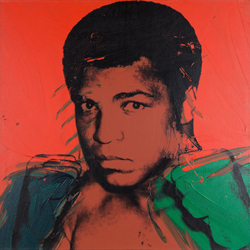
The first major exhibition focusing on contemporary American printmaking has opened in the Sainsbury Exhibitions Gallery of The British Museum. The American Dream: pop to the present features more than 200 works from 70 artists including Andy Warhol, Jasper Johns, Robert Rauschenberg, Ed Ruscha, Chuck Close, Louise Bourgeois and Kara Walker. Including loans from institutions such as The National Gallery of Art in Washington, DC, as well the museum’s own collection, the works span six decades – from the moment when pop art arrived in the New York and West Coast scene of the early 1960s, to the rise of minimalism, conceptual art and photorealism in the 1970s, and through to the practices of today’s artists. Among the works on show are Warhol’s Marilyn, Willie Cole’s Stowage and Claes Oldenburg’s sculpture of the Three-Way Plug. Admission charges apply. Runs until 18th June. For more, see www.americandreamexhibition.org. PICTURE: Andy Warhol (1928–1987), ‘Vote McGovern’, Colour screenprint/© 2016 The Andy Warhol Foundation for the Visual Arts, Inc./Artists Rights Society (ARS), New York and DACS, London.

Visitors with disabilities will be offered free admission to royal residences – including the Royal Mews and The Queen’s Gallery at Buckingham Palace – this weekend to mark Disabled Access Day. Visitors to the Queen’s Gallery can join verbal descriptive tours of the Portrait of the Artist exhibition on 12th March while the Royal Mews will offer free admission to disabled visitors on 10th and 11th March.  Standard access resources, including plain English tour scripts, induction loops, large-print and list access will be available across all venues. For more, see www.royalcollection.org.uk.

Send all items for inclusion to exploringlondon@gmail.com.
This Week in London – Diana’s fashion-sense explored; America after the crash; and, British landscapes…

diana-her-fashion-storyThe fashions of Diana, Princess of Wales, go on show at Kensington Palace tomorrow in a new exhibition, 20 years after her death. Diana: Her Fashion Story traces the evolution of her sense of style from the demure outfits of her first public appearances to the “glamour, elegance and confidence” of her later life and explores how she used her image to engage and inspire people as well as champion the causes she cared out. The display features everything from glamorous 1980s evening gowns to her “working wardrobe” of the 1990s and original fashion sketches created for her by her favourite designers. Highlights include a pale pink Emanuel blouse worn for Lord Snowdon’s 1981 engagement portrait, a ink blue velvet gown designed by Victor Edelstein and famously worn during a visit to the White House when the princess danced with John Travolta, and a blue tartan Emanuel suit worn for an official visit to Venice in the 1980s. The latter goes on public display for the first time, having recently been acquired at auction by Historic Royal Palaces. Complementing the exhibition, gardeners have created a temporary ‘White Garden’ in the palace’s Sunken Garden with flowers and foliage inspired by the princess’s life, style and image. Admission charge applies. For more, see www.hrp.org.uk/kensington-palace/. PICTURE: Courtesy Historic Royal Palaces.

Works chronicling life in the United States of America during the decade after the Wall Street crash of 1929 go on show at the Royal Academy of Arts on Saturday. America after the Fall: Painting in the 1930s features 45 works by some of the foremost artists of the era which have been sourced from collections across the US. They include Grant Wood’s American Gothic (1930) – the first time it’s being exhibited outside of the US, Georgia O’Keeffe’s Cow’s Skull with Calico Roses (1931), Edward Hopper’s Gas (1940) and works by Jackson Pollock, Philip Guston, Alice Nee and Thomas Hart Benton. Organised by the Art Institute of Chicago, in collaboration with the Royal Academy and Etablissement public du musée d’Orsay et du musée de l’Orangerie in Paris, the exhibition in The Sackler Wing of Galleries can be seen until 4th June. Admission charge applies. For more, see www.royalacademy.org.uk.

Landscape drawings created over the century spanning 1850 to 1950 are the subject of a new free exhibition which opens at the British Museum today. Places of the Mind: British watercolour landscapes 1850-1950 features more than 125 works from the museum’s department of prints and drawings, over half of which have never been published or exhibited before. Artists represented include George Price Boyce, Alfred William Hunt, John Ruskin, James McNeill Whistler, Philip Wilson Steer. Graham Sutherland and Henry Moore. The display can be seen in Room 90 until 27th August. For more, see www.britishmuseum.org.

Send all items for inclusion to exploringlondon@gmail.com.
This Week in London – The Repentant Magdalene; the first Dulwich Pavilion; and, a comic icon…

Apologies that we missed our Wednesday special series on fictional character homes in London this week – normal service will resume next week!

The Repentant Magdalene, regarded as Italian artist Guido Cagnacci’s greatest work, has gone on show at The National Gallery. On loan from the Norton Simon Museum in Pasadena, California, the work depicts Mary Magdalene in an unusual pose lying on the ground as Martha begs her to abandon her life of vice while in the background an angel chases out a devil representing vice. Cagnacci (1601-1663), described as one of the most unconventional artists of the Italian Baroque period, was in the Gonzaga collection in Mantua Italy by 1665 but entered the collection of the English Duke of Portland in 1711 where it remained until American collector Norton Simon purchased it in 1981. This is the first time it has been on show in England since. The painting can be seen in Room 1 until 21st May. Admission is free. For more, see www.nationalgallery.org.

Camberwell-based architectural practice IF_DO will design the first ‘Dulwich Pavilion’ to sit temporarily in the grounds of the Dulwich Picture Gallery, the gallery and London Festival of Architecture have announced. The pavilion will play host to a programme of events marking the gallery’s bicentenary, kicking off  in conjunction with the start of the London Festival of Architecture on 1st June. The design – called ‘After Image’ – features a series of translucent mirrored screens, some fixed, some moveable, which “reflect and disrupt” the context. It has a timber truss roof with a mesh veil, creating a canopy-like space. The winning design was chosen from among more than 70 entries by a panel of leading architectural and cultural figures. For more, see www.dulwichpicturegallery.org.uk.

On Now: Future Shock: 40 Years of 2000 AD. The British “publishing phenomenon” science fiction comic 2000 AD – which lives on through characters like Judge Dredd – is the subject of an exhibition at the Cartoon Museum in Bloomsbury. Launched in February, 1977, the comic was the brainchild of Pat Mills and John Wagner who were later joined by writers such as Neil Gaiman and Grant Morrison. Eighty pages of original artwork are featured in the display featuring the work of artists including Dave Gibbons, Brian Bolland, Mike McMahon, Ian Gibson, Henry Flint, David Roach, Simon Davis, and Carlos Ezquerra – the originator of Judge Dredd. Runs until 23rd April. Admission charge applies. For more, see www.cartoonmuseum.org.

Send all items for inclusion to exploringlondon@gmail.com.
This Week in London – Crossrail finds on show; Russian art; robot history; and, Vanessa Bell…

A Tudor-era bowling ball, Roman iron horse shoes and late 19th century ginger jars are among hundreds of historic objects unearthed during the Crossrail construction project to go on show at the Museum of London Docklands tomorrow. Tunnel: the archaeology of Crossrail presents highlights from among the more than 10,000 objects which have been discovered during the project, the largest infrastructure project currently underway in Europe, since it kicked off in 2009. The finds, which span 8,000 years of human history, also include prehistoric flints found at North Woolwich, medieval animal bone skates and human remains found in the former 17th century Bedlam cemetery. The objects, which can be seen until 3rd September, are displayed in accordance to where along the new Elizabeth line they were found. Entry is free. For more, see www.museumoflondon.org.uk.

bolshevik This year is centenary of the Russian Revolution and to mark the occasion, the Royal Academy of Arts in Piccadilly is hosting a landmark exhibition on Russian art which takes in the period between 1917 – the year of the October Revolution – and 1932 when Josef Stalin began his violent suppression of the avant-garde. Revolution: Russian Art 1917-1932 features the works of the likes of avant-garde artists Marc Chagall, Wassily Kandinsky, and Kazimir Malevich and social realists like Isaac Brodsky and Alexander Deineka. More than 200 works are on show including loans from the State Russian Museum of St Petersburg and the State Tretyakov Gallery in Moscow, many of which have never been seen in the UK before. Highlights include Chagall’s Promenade (1917-18), Kandinsky’s Blue Crest (1917) and Malevich’s Peasants (c. 1930). Alongside the paintings, the display features photography, sculpture, film, posters and porcelain. Admission charge applies. Runs until 17th April. For more, see www.royalacademy.org.uk. PICTURE: Boris Mikailovich Kustodiev, ‘Bolshevik’ (1920) © State Tretyakov Gallery.

More than 100 robots are on display at the Science Museum in South Kensington as part of a new exhibition spanning 500 years of robotic history. Robots, which explores how robots have been shaped by religious belief, the industrial revolution, 20th century popular culture and dreams of the future, features everything from a 16th century mechanical monk to a 2.4 metre tall robot named Cygan dating from the 1950s, and one of the first walking bipedal robots. Visitors will be able to interact with 12 working robots and go behind the scenes to see recent developments in robotic research as well as speculate on what robots of the future might be like. Admission charge applies. Runs until 3rd September. For more, see www.sciencemuseum.org.uk/robots.

A major exhibition celebrating the work of early 20th century UK modern artist Vanessa Bell – a central figure in the so-called ‘Bloomsbury Group’ – has opened at the Dulwich Picture Gallery in London’s south this week. About 100 oil paintings as well as ceramics, fabrics, works on paper, photographs and related archival material are featured in the exhibition with the works arranged thematically so as to reveal Bell’s “fluid movement” between the fine and applied arts and focusing particular attention on her most distinctive period of experimentation from 1910 onwards. Vanessa Bell, which runs until 4th June, is presented alongside a photography display which brings together Bell’s photographic work with that of American musician, writer and artist Patti Smith. Legacy: Photographs by Vanessa Bell and Patti Smith features 17 photographs by Smith – who has long found inspiration in the work and lives of the Bloomsbury Group – and a selection of Bell’s photo albums. Both can be seen until 4th June. For more, see www.dulwichpicturegallery.org.uk.

Send all items for inclusion to exploringlondon@gmail.com.
This Week in London – 500 years of Londoners; images of London under attack; reflections on Europe; and female ‘fighters’ fists…

sewage-workersRat catchers, trapeze artists and politicians are among the subjects depicted in photographs, prints and drawings which form the heart of a new exhibition spanning 500 years of London’s history. Opening at the London Metropolitan Archives, The Londoners: Portraits of a Working City, 1447 to 1980 includes portraits of unknown Londoners as well as some of such luminaries as author Charles Dickens, night-watchmanengineer Isambard Kingdom Brunel and Lord Protector Oliver Cromwell. Highlights include a rare photograph of Charles Rouse, reputedly the last night watchman (pre-cursors to the Metropolitan Police) still on duty in London in the mid-19th century, an 1830 lithograph of a crossing sweeper, the ‘Old Commodore of Tottenham Court Road’, and a number of photographs shot by George WF Ellis in the mid-1920s including a portrait of feminist and social campaigner Dora Russell. The exhibition, which is part of a series of events marking 950 years of London archives, opens on Monday and runs until 5th July at the LMA in Clerkenwell. For more, see www.cityoflondon.gov.uk/lma. PICTURES: Top – A team of sewermen, photographed outside the City Sewers department in 1875. Right – Jack Black of Battersea, noted rat catcher to Queen Victoria, pictured here from a daguerreotype photograph taken for Henry Mayhew’s ‘1851 London Labour and the London Poor’. Both images © London Met Archives.

The response of artists and photographers to London’s Blitz during World War II forms the subject of a new exhibition which has opened at the Museum of London. Perspectives of Destruction: Images of London, 1940-44 explores how artists and photographers responded to the devastation caused by the massive aerial bombings. Much of the artwork was commissioned by the government’s War Artists Advisory Committee and focused on damage to buildings rather than deaths and injuries to people due to the impact it may have had on public moral. At the heart of the display is nine recently acquired drawings from official war artist Graham Sutherland depicting damage in the City of London and East End between 1940 and 1941. Also on show is a 1941 oil painting of Christchurch on Newgate Street by John Piper and David Bomberg’s Evening in the City of London, dating from 1944, which depicts St Paul’s Cathedral dominating the horizon above a devastated Cheapside. There’s also a photograph of a V-1 flying bomb narrowly missing the iconic cathedral which, along with eight others, was taken by City of London police constables Arthur Cross and Fred Tibbs. Other artists with works featured include Henry Moore, Bill Brandt and Bert Hardy. Runs until 8th May. Admission is free. For more, see www.museumoflondon.org.uk.

• A series of installations commissioned from 12 artists – asked to imagine what Europe might look like 2,000 years from now and how our present might then be viewed – have gone on display in the V&A as part of the week long ‘Collecting Europe’ festival. The festival, which only runs until 7th February, includes a range of talks, discussions, live performances and workshops aimed at encouraging debate around Europe and European identity in the light of the Brexit vote. The installations, commissioned by the V&A and Goethe-Institut London, have been created by artists from across Europe. For more, see www.vam.ac.uk/collectingeurope.

• Bronze casts of black women’s movement activists’ fists go on display at the City of London’s Guildhall Art Gallery from Tuesday. A Fighters’ Archive, features the work of sculptor Wijnand de Jong and pays tribute to 15 women who were members of various activist groups. The sculpture takes the form of a boxing archive – casts of boxers’ fists collected by boxing academies to commemorate prize fighters – with the fists cast from life. Subjects include Professor Dame Elizabeth Anionwu, Emeritus Professor of Nursing at the University of West London and patron of The Sickle Cell Society, Mia Morris, creator of Black History Month, and Gerlin Bean, founder of Brixton Black Women’s Centre. The fists can be seen until 19th March. Admission if free. For more, see www.cityoflondon.gov.uk/things-to-do/visit-the-city/attractions/guildhall-galleries/Pages/guildhall-art-gallery.aspx.

Send all items for inclusion to exploringlondon@gmail.com.
This Week in London – Roman finds from Walbrook revealed; Pablo Picasso prints; and, Highgate Cemetery’s virtual directory…

roman-gardening-toolsRoman tools and other artefacts from the era including a stamp for metal ingots and pottery are among objects found in London’s ‘lost’ Walbrook Valley which have gone on display at the Museum of London. Working the Walbrook features objects excavated during the past 170 years of digs around the watercourse which once cut the city in half, running from Finsbury Circus to Cannon Street. Created as part of a PhD project being supervised by the Museum of London and the University of Reading, the objects on show include an iron stamp dating from the Roman period inscribed with the letters MPBR (understood to be an abbreviation for ‘Metal Provinciae Britanniae’ – “the mines of the province of Britannia”) which is believed to have been used by officials to stamp metal ingots passing through London on their way to the Continent. Other items include Roman farming and gardening tools, and a pot decorated with a smith’s hammer, anvil and tongs which was found at the bottom of a well in Southwark and which may have been linked to worship of the god Vulcan. The free display is on show until March. For more, see www.museumoflondon.org.uk. PICTURE: Gardening tools from Roman London. A pruning hook, bailing fork and shears © Museum of London

• A series of prints by Pablo Picasso spanning the period from the late 1940s to the late 1950s form the heart of a new exhibition at the British Museum in Bloomsbury. The prints, which include 16 lithograph prints and three aquatint prints, were recently acquired by the museum in what represents the final part of the museum’s effort to more fully represent the artist’s work as a printmaker. Six of the lithographs were inspired by the beauty of Picasso’s lover Francoise Gilot while others feature Bacchanalian scenes and portraits of German-born dealer Daniel-Henry Kahnweiler. On display from Friday in Gallery 90A, they can be seen in the free exhibition until 3rd March. For more, see www.britishmuseum.org.

The details of some 160,000 people buried at Highgate Cemetery in north London have been made available online. Deceased Online has announced that all records for the period from May, 1839, to August, 2010 – a total of 159,863 people, are now available, including digital scans of original registers, details of who is buried in each grave and location maps for most graves. Notable people buried at Highgate include author Douglas Adams, philosopher Karl Marx and chemist and physicist Michael Faraday. For more, see www.deceasedonline.com

Send all items for inclusion to exploringlondon@gmail.com.
This Week in London – The ‘William Charter’ on show; Donald Trump in London; and the Fourth Plinth shortlist…

A charter granted by King William the Conqueror to the City of London in 1067 is on display at the City of London Heritage Gallery. The 950-year-old charter, known as the William Charter, was given by the king soon after his coronation at Westminster Abbey but before he had entered the City and is seen as key in his winning the support of the City as well as in how the City came to have its special autonomy. Written in Old English, the charter measures only 2 x 16 centimetres and has one of the earliest seal impressions of King William I. The oldest item in the City of London Corporation’s 100 kilometres of archives, it’s on display at the gallery until 27th April. For more, follow this link.

Madame Tussauds in Marylebone has unveiled a wax figure of US President-elect Donald J Trump this week in the lead-up to his inauguration in Washington, DC, on Friday. The future president stands in the ‘Oval Office’ section of the display. The organisation’s team of sculptors, make-up artists and hair inserters have been working on the figure since his victory in the US election back in October. For more, see www.madametussauds.com/london/en/.

• A scoop of ice-cream with a visiting fly and micro-drone, a recreation of an ancient sculpture destroyed by the so-called Islamic State and a tower made of a VW, scaffolding, oil drums and a ladder among the possibilities to replace David Shrigley’s Really Good on Trafalgar Square’s Fourth Plinth next year. Maquettes of five short-listed sculptures are on show at the National Gallery from today until 26th March. Two of those displayed will be chosen to be featured on the plinth – one next year and the other in 2020. Admission is free. As well as Heather Phillipson’s The End, Michael Rakowitz’s The Invisible Enemy Should Not Exist, and Damián Ortega’s High Way, the short-listed works include Huma Bhabha’s Untitled (a massive figure like something from a sci-fi film) and Raqs Media Collective’s The Emperor’s Old Clothes (an empty robe).

Send all items for inclusion to exploringlondon@gmail.com.