Around London – Resurrection men at the MoL; Hollywood costumes at the V&A; Hanwell locks “at risk”; and, David Nash sculptures at Kew…

• A new exhibition at the Museum of London opens tomorrow (Friday) looking at the “murky world” of the early 19th century ‘resurrection men’ and the surgeon/anatomist whom they supplied with bodies. Doctors, Dissection and Resurrection Men will centre around the 2006 excavation of a until then forgotten burial ground at the Royal London Hospital in Whitechapel. The excavation of the area – which was used between 1825-41 – uncovered some 262 burials and while many contained just one person, others contained a mix of bones providing ample evidence of dissections, autopsies, amputations and the wiring together of bones for teaching as well as evidence animals had been dissected for comparative studies. The excavation revealed that rather than rely on body snatchers, the hospital had used its own ‘unclaimed’ patients for dissection practice. As well as human remains from the find (displayed for the first time), exhibition highlights include various instruments used in early 19th century surgery, a plaster cast of James Legg who was hanged for murder before his body was flayed and cast in plaster for study purposes and a wooden skeleton and other detailed anatomical models made by Joseph Browne. The exhibition runs until 14th April. An admission charge applies. For more details – including the programme of talks taking place alongside the exhibition – see www.museumoflondon.org.uk.

• The three piece white suit worn by John Travolta in Saturday Night Fever, the blue and white gingham pinafore dress worn by Judy Garland in The Wizard of Oz and costumes worn by Meryl Streep in the recent film, The Iron Lady,  are all making their public appearance in London this weekend with the V&A’s major autumn exhibition. Opening on Saturday, Hollywood Costume features more than 100 iconic costumes designed for some of the big screen’s most unforgettable characters. A three gallery (or three ‘act’) journey covering the silent film era of Charlie Chaplin through to a look at motion capture costume design in Avatar, the exhibition explores the role costume design plays in cinematic storytelling and examine the changing social and technological context in which designers worked over the past century. Sourced from major motion picture studios, costume houses, museums, archives and private collections, the costumes will be  displayed alongside interviews with costume designers, actors and directors. Runs until 27th January. Admission charge applies. For more, see www.vam.ac.uk/hollywoodcostume.

A flight of locks which raise the Grand Union Canal 53 feet over the course of a third of a mile at Hanwell in west London is among the top Grade II heritage sites at risk in England, according to English Heritage. The organisation released its Heritage At Risk Register 2012 this week and announced a new program to examine how Grade II listed buildings not already covered by the register can be assessed. Other “at risk” sites in London include Kensal Green (All Souls) Cemetery – one of London’s “magnificent seven” Victoria cemeteries, Abney Park Cemetery in Hackney, Gunnersbury Park in Houslow and 94 Piccadilly (Cambridge House) in Westminster. For more, see www.english-heritage.org.uk/caring/heritage-at-risk/.

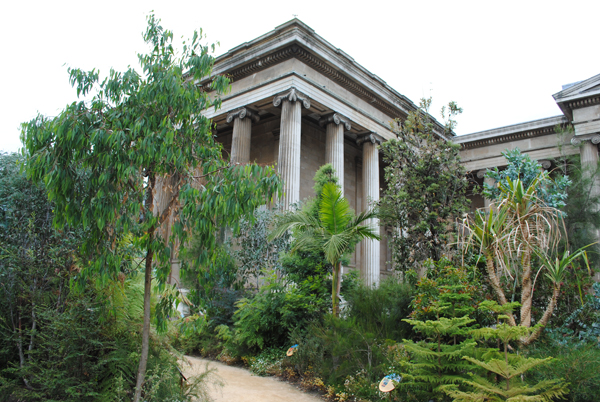
• On Now: David Nash at Kew: A Natural Gallery. New works by renowned sculptor David Nash were officially unveiled at Kew Gardens last weekend. Mostly created using Kew trees which have come to the end of their life whether through storms, lightning or disease, the series of sculptures – created on site since April in a ‘wood quarry’ in the arboretum – has been installed in gallery spaces across the gardens including The Nash Conservatory, the Temperate House and The Shirley Sherwood Gallery of Botanical Art. They are displayed along with a series of drawings and short films. Runs until 14th April. An admission charge applies. See www.kew.org.

Around London – Dickens and the foundlings; astronomy photographs at the Royal Observatory; Royal Parks allotments; and, Asian drinking vessels at the British Museum…

• A new exhibition exploring the relationship between author Charles Dickens, the Foundling Hospital and its secretary and former foundling, John Brownlow, opened at the Foundling Museum today. Received, a Blank Child: Dickens, Brownlow and the Foundling Hospital looks at how Dickens supported the institution in various ways including helping a young mother petition for a place for her child and publicising the work of the hospital through his writing – in particular the 1853 article Received, A Blank Child (the phrase comes from the wording used on the hospital’s entry forms). Among the items on display are never before displayed letters from Dickens relating to the hospital. The exhibition, which runs until 16th December, is free with the museum admission. And if you haven’t yet had a chance to see it, there’s still time to catch Dickens and the Foundling, in which six contributors including actor Gillian Anderson and journalist Jon Snow, have chosen objects to be displayed. This ends on 28th October. For more, see www.foundlingmuseum.org.uk.

Images from the Astronomy Photographer of the Year competition have gone on display at the Royal Observatory in Greenwich (which runs the competition in conjunction with Sky at Night Magazine). Among the winning images were The Whirlpool Galaxy taken by Martin Pugh of the UK/Australia, Star Icefall by Masahiro Miyasaka of Japan, and Venus-Jupiter Close Conjunction, by Laurent Laveder of France. The exhibition is free of charge and runs until February next year. For more (including an online gallery), see www.rmg.co.uk/visit/exhibitions/astronomy-photographer-of-the-year/2012-winners/.

It’s Harvest Festival time at London’s Royal Parks and this Sunday, between 11am and 4pm, people are invited to attend the Kensington Gardens’ allotment to see the fruits of the gardeners’ labour including the “big dig” of the potato crop as well as seasonal vegetables. There’s also the chance for families to see the allotment chickens being fed and children’s activities run by Ginger Cat. This week’s event follows one last weekend at Regent’s Park. For more, see www.royalparks.org.uk.

• On Now: Ritual and revelry: the art of drinking in Asia. This new free exhibition in room 91 of the British Museum features a display of objects which have been used in the consumption of liquids in various Asian contexts and the manner in which their use is intertwined with ritual, religious and otherwise. Among the vessels on display is a Tibetan skull-cap known as a kapala which is made from a human skull and used in religious rituals as well as a silver tea set from western India which features handles shaped like bamboo stems and a lacquered wooden sake bottle which was used as an altar piece. Runs until 6th January. For more, see www.britishmuseum.org.

Treasures of London – The Royal Kitchens, Kew…

Given this week’s release of English Heritage’s The London List 2011 – which lists all properties given a new or upgraded heritage listing last year, we thought it was only appropriate to look at one of the properties listed, in this case the Royal Kitchens in Kew Gardens.

Upgraded to a Grade I listing in 2011, the kitchens were opened to the public for the first time in May this year following a £1 million restoration. The origins of the kitchens go back to the 1730s when they were built to the designs of William Kent to serve the White House, the grand mansion of Frederick, Prince of Wales (eldest son and heir of King George II).

While the White House was demolished in 1802, the Georgian kitchens – built in a separate building to mitigate the risk of fire – were kept to serve the nearby premises of Kew Palace (formerly known as the “Dutch House”, it had been originally built in 1631 for a Flemish merchant).

But after the death of Queen Charlotte (wife of King George III) in 1818, members of the Royal family only stayed occasionally and so the kitchen fell into disuse. While the upper floors were given over to accommodation, the lower floor remained untouched, allowing it to survive in a considerable degree of intactness.

The kitchens centre on the double storey ‘Great Kitchen’ featuring three charcoal stoves as well as a rare cooking range with “smoke jack” and fan. Other rooms include a scullery, a bakery, larders and stores for silver and spices while among the surviving furnishings is a preparation table or dresser, cupboards, shelves and baking ovens. Upstairs, the office of the clerk who oversaw the feeding of the Royal Household has been restored.

Historic Royal Palaces, who look after the kitchens, have installed a new permanent exhibition at the site which focuses life on the 6th February, 1789, the date when King George III, having suffered his first bout of ‘madness’ (believed to be porphyria), was given back his knife and fork. William Wybrow was the Master Cook at this time and William Gorton the Clerk of the Kitchen.

WHERE: The Royal Kitchens, Kew Gardens, Kew (nearest Tube Station is Kew Gardens); WHEN: 11am to 5pm daily until 30th September, then Thursday to Sunday until 28th October, then daily again until 4th November; COST: Kew Gardens tickets must be purchased – £16 adults/£14 concessions/children under 16 free – and then tickets to Kew Palace – £6 adults/£4.50 concessions/children under 16 free (or free with annual Historic Royal Palaces membership); WEBSITE: www.hrp.org.uk/kewpalace/stories/palacehighlights/royalkewkitchens.

PICTURE: Forster/HRP

For more on Kew Palace, check out Kew Palace: The Official Illustrated History.

Around London – Bells…and more bells; Olympic memorabilia; free wifi in the West End; The Arch returns to Kensington Gardens; and, Impressionists at the RA…

• It’s all about the Olympics in London this week and many of the events – like the Opening Ceremony and Torch Relay (see last week’s post) – are well covered elsewhere, but we thought we’d mention a couple of things in relation to the Games: 

The first is the ‘All the Bells’ project which will see bells across London being rung at 8:12am on Friday to “ring in” the first day of the Olympic and Paralympic Games. Work No. 1197: All the bells in a country rung as quickly and as loudly as possible for three minutes, commissioned as part of the London 2012 Festival, is the brainchild of Turner Prize-winning artist and musician Martin Creed and will involve thousands of bells across the nation. Speaking of bells, the City of London has announced that some of the City’s churches will be ringing continuously during the three Olympic marathon events – the men’s, women’s, and Paralympic events. As many as 57 of the country’s most experienced bell ringers, co-ordinated by the Ancient Society of College Youths (a ringing society created in London in 1637) will be working for three to four hours continuously at churches including St Paul’s Cathedral, St Mary le Bow, St Lawrence Jewry, St Magnus the Martyr, St Vedast and St Katharine Cree. During the women’s marathon, an all-female band will be attempting a peal at St Paul’s, the first all-woman attempt on the bells. (Apologies, this article had originally had the time for the bell ringing at 8.12pm – it is in the morning, not the evening!)

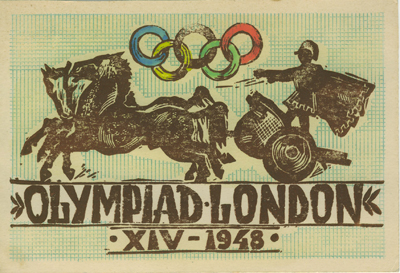
A new exhibition exploring London’s Olympic history has opened at the British Library. Olympex 2012: Collecting the Olympic Games features a range of memorabilia including a swimming costume and the finishing tape broken by – later disqualified – marathon runner Dorando Pietri  from the 1908 London Games (see our earlier post for more on him) as well as posters and artworks, stamps, letters and postcards. The exhibition also features audio interviews with Olympians including William (Bill) Roberts, a relay runner in the 1936 Berlin Olympics, and Dorothy Tyler, a medal-winning high jumper who competed in the 1936 and 1948 Olympics. Presented by the British Library and International Olympic Committee, the exhibition runs until 9th September at the library in St Pancras. Entry is free. For more, see www.bl.uk. PICTURE: Rare 1948 postcard by an unknown artist (c) Private collection/IOC

• A new free wifi network has been launched in London’s West End. Westminster City Council and telco O2 launched the network this week. It will initially cover Oxford and Regent Streets, Trafalgar Square, Leicester Square, Piccadilly Circus and Parliament Square with further areas in Westminster and Covent Garden the next to be included in the network. A once-only registration process is required to join.

• Henry Moore’s famous sculpture, The Arch, has been returned to its original home in Kensington Gardens. The six metre high work was presented to the nation by Moore in 1980 and was positioned on the north bank of the Long Water until 1996 when the structure became unstable and was placed in storage. In late 2010, the Royal Parks began a project with The Henry Moore Foundation to see if the work could be returned to the gardens. Work began to restore the piece – which consists of seven stones weighing 37 tonnes – to its original location earlier this year. For more on Kensington Gardens, see www.royalparks.org.uk/parks/kensington-gardens.

• On Now: From Paris: A Taste for Impressionism. This Royal Academy of Arts exhibition at Burlington House features 70 works from the Sterling and Francine Clark Art Institute in Williamstown, Massachusetts, and includes works by Manet, Monet, Pissarro, Degas, Sisley, Morisot and Renoir as well as those of post-Impressionist artists Corot, Théodore Rousseau and J-F. Millet, and ‘academic’ paintings by Gérôme, Alma-Tadema and Bouguereau. Runs until 23rd September. Admission charge applies. See www.royalacademy.org.uk for more.

Around London: Olympic Torch Relay hits London; mascots pop-up all over the city; and Shakespeare at the British Museum…

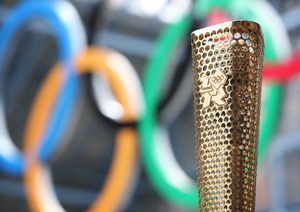
• The Olympic Torch Relay arrives in London tomorrow night before working its way around all of the city’s 33 boroughs and reaching the Olympic Stadium for the Opening Ceremony next Friday.  The torch will arrive in the city by helicopter from Guildford tomorrow night and then be abseiled into the Tower of London where it will spend the night ensconced with the Olympic medals. The relay will travel 200 miles over the next week, carried by more than 980 torchbearers. The route is as follows:

  • Saturday, 21st July – Greenwich via Newham, Tower Hamlets and Hackney to Waltham Forest (highlights include a visit to the Cutty Sark);
  • Sunday, 22nd July – Redbridge via Barking & Dagenham and Havering to Bexley (highlights include a ride on the London Eye and a crossing of the Thames);
  • Monday, 23rd July – Lewisham via Bromley, Croydon, Sutton and Merton to Wandsworth (highlights include a visit to a live filming of Eastenders);
  • Tuesday, 24th July – Kingston via Richmond, Hounslow, Hillingdon and Denham to Ealing (highlights include a visit to Kew Gardens);
  • Wednesday, 25th July – Harrow via Brent, Barnet and Enfield to Haringey (highlights include a visit to Wembley Arena);
  • Thursday, 26th July – Camden via Islington, the City of London, Southwark, Lambeth, Wandsworth, Kensington & Chelsea and Hammersmith & Fulham  to Westminster (the many landmarks to be visited include St Paul’s Cathedral, Shakespeare’s Globe, Trafalgar Square, Buckingham Palace and Hyde Park);
  • Friday, 27th July – From Hampton Court Palace (where it will be taken into the maze) on board Gloriana via the Thames to Olympic Park for the Opening Ceremony.

The 70 day torch relay, which kicked off on 19th May, will have travelled a total distance of about 8,000 miles and have involved 8,000 torchbearers by the time it reaches its end. LOCOG and Transport for London have advised people to see the relay at a location closest to their home given the expected crowds. For more detailed route information, see www.london2012.com/torch-relay/route/. PICTURE: LOCOG

Still talking all things Olympics and London’s largest ever ‘pop up’ shop – where you can buy Olympic merchandise – was officially opened by multiple gold medalist Sir Steve Redgrave in Hyde Park last week. The shop, located on Rotten Row, will be the site of special athlete visits during the Games and visitors can have their photo taken with the Olympic Torch.

• Meanwhile, life-sized versions of the Olympic mascot Wenlock and Paralympic mascot Mandeville are popping up at some of London’s key tourist locations. The 83 two metre tall sculptures capture various elements of life in London with incarnations including a Beefeater, a giant red phone box and a replica of Big Ben. The figures can be found on the routes of Stroll, six new discovery trails designed to help both tourists and Londoners get more out of the city. A QR code on the bottom of each of the sculptures directs smartphone users to further information about the discovery trails. The discovery trails are part of the Mayor of London Presents, a city-wide programme featuring free events, shows and activities. For more on what’s happening in your area, see www.molpresents.com. Some of these events are also being run as part of the Festival of London 2012. For more on this, see http://festival.london2012.com.

• On Now: Shakespeare: staging the world. Part of the World Shakespeare Festival taking place in London, this exhibition at the British Museum looks at the then emerging role of London as a “world city” as interpreted through Shakespeare’s plays and examines the role the playhouse performed in this. The museum has collaborated with the Royal Shakespeare Company to produce the exhibition which features more than 190 objects including paintings, jewels and rare manuscripts. These include the Ides of March coin, a Roman gold aureus commemorating the assassination of Julius Caesar (Julius Caesar), the Lyte Jewel, presented to Thomas Lyte in 1610 in thanks for his work in tracing King James I’s lineage back through Banquo (Macbeth), and a 1610 bird’s-eye view of Venice (Othello and The Merchant of Venice). Runs until 25th November. Admission charge applies. For more, see www.britishmuseum.org.

LondonLife – Olympic flower power at Kew Gardens…

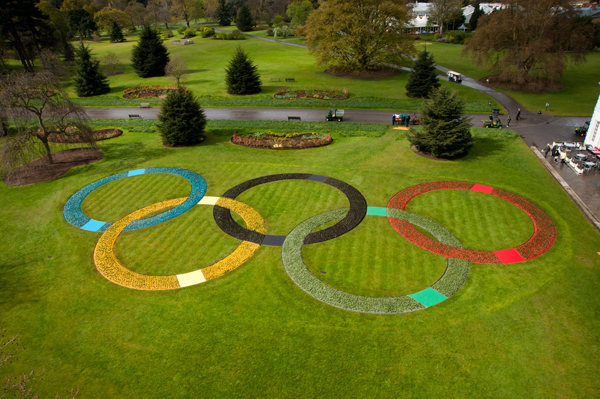
There’s less than a month to go to the Opening Ceremony of the Olympic Games so we thought it only appropriate to take a look at Kew Gardens’ floral Olympic Rings. Located next to The Orangery, the rings are 50 metres long and made of 20,000 plants including Viola ‘Light Blue’, Viola ‘Clear Yellow’, Viola ‘Black Delight’, apple mint (Mentha suaveolens) and Viola ‘Red Blotch’ plants. Able to be seen from planes on the Heathrow flight path, they were unveiled in April and will be at the gardens until September. For more information on visiting Kew Gardens, see www.kew.org. PICTURE: Courtesy Kew Gardens

Around London – Open gardens; new gates mark St Paul’s tercentenary; a new Olympics trail; and, truces at the IWM…

• If you’re not too exhausted after last weekend’s Diamond Jubilee festivities (or if you’re looking for something a little more sedate), this Saturday and Sunday London plays host to Open Garden Squares Weekend. Among the 208 gardens to be opened this weekend is the communal garden at Number 10 Downing Street, home of Prime Minister David Cameron. Laid out in 1736, the L-shaped garden at 10 Downing Street is shared by residents of both Number 10 and Number 11, including Larry, the Downing Street cat (tickets for this garden have already been allocated via a ballot process). Among the more than 200 gardens open to the public as part of the weekend are 24 new gardens and, for the first time, the event is being supported by the National Trust (along with the usual organisers, the London Parks and Gardens Trust). Downing Street aside, other gardens open to the public include the Regent’s Park Allotment Garden, the Royal College of Physicians’ Medicinal Garden, the Kensington Roof Gardens, and the gardens at HMP Wormwood Scrubs. Tickets for the gardens are cheaper if bought online in advance of the weekend and picked up on Saturday or Sunday – it’s not too late to do so, so for tickets and more information, head to www.opensquares.org.

A new pair gates designed to mark St Paul’s Cathedral’s tercentenary were opened in Richmond Park for the first time last week. The gates, which now form part of the historic vista seen from King Henry’s Mound in Richmond Park when looking toward’s St Paul’s Cathedral, were designed by 21-year-old blacksmith Joshua De Lisle and funded through a donation from the family of family of the late environmentalist and The Ecologist magazine founder Edward Goldsmith. Called ‘The Way’, the gates stand on the fence of Sidmouth Woods, and depict oak branches. Sir Christopher Wren, designer of St Paul’s, is acknowledged through the inclusion of a wren on one of the lower branches. For more on the Royal Parks, see www.royalparks.org.uk.

• Now On: Winning at the ancient Games. The British Museum is celebrating the London Olympics with a victory trail bringing together 12 “star objects” in its collection, united by the theme of winning. The ‘stops’ on the trail include a classical Greek statue of a winning charioteer on special loan from Sicily, a previously never exhibited mosaic showing Hercules, the legendary founder of the ancient Games, and the 2012 Olympic Medals. The trail is free. For more information, see www.britishmuseum.org.

Now On: Build the TruceDrawing on the idea of truce that was implemented during the ancient Olympic Games to allow athletes from Greece’s warring cities to compete, this new display at the Imperial War Museum features films, interviews and insights collected during a project investigating the concepts of truce, conflict and resolution and their relevance in the 21st  century. Highlights include excerpts of interviews with former IRA prisoner Seanna Walsh and former UDA prisoner Jackie McDonald -both now involved in peace initiatives in Northern Ireland, Courtny Edwards, who worked with a health service in displaced persons’ camps following civil war in Sierra Leone; and Professor Tony Redmond, who led aid teams in Kosovo following NATO attacks in 1999. Family activities are being run in conjunction with the exhibition on selected weekends. Entry is free. Runs until 23rd September. For more, see www.iwm.org.uk.

LondonLife – The RHS Chelsea Flower Show…

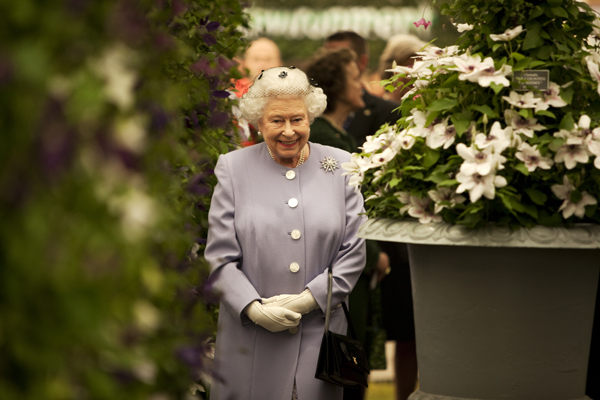
Yes, it’s that time of the year again when Chelsea is all abloom! This year the flower show is marking the Queen’s Diamond Jubilee with a specially designed flower bed designed by the Parish of St Helier in Jersey, the centrepiece of which is a rotating Jersey Accession Issue Postal stamp (pictured above). During a visit to the Flower Show on Monday (pictured below, this took place prior to the public opening today), Queen Elizabeth II, patron of the show, awarded the first ever Diamond Jubilee Award for the Best Exhibit in the Great Pavilion to HM Hyde & Son for their display of lilies. Among the other ways in which the show is marking the Diamond Jubilee is the opening of an exhibition of photographs of the Queen’s past visits to the show. The flower show runs until Saturday (while tickets are sold out, you can check in person daily at the ticket office for returned tickets). For more, see www.rhs.org.uk/Shows-Events/RHS-Chelsea-Flower-Show/2012. PICTURES: Andy Paradise (courtesy of RHS).

Lost London – Vauxhall Pleasure Gardens

First laid out in the mid 17th century, Vauxhall Pleasure Gardens, on the east bank of the Thames just south of Lambeth, rose in fame to become one of London’s leading public entertainment venues.

The gardens, initially known as New Spring Gardens, are believed to have opened around the time of the Restoration of 1660 on a site which had been formerly an estate owned by vintners John and Jane Vaux (Jane was apparently widowed).

Initially apparently no more than an ale-house with a garden attached, the gardens grew to span several acres and featured a central hub and long avenues for strolling. Admission was initially free with money made from food and drink sold there. Among the earliest recorded visitors to the gardens was John Evelyn in 1661, describing it as a “pretty contrived plantation” and diarist Samuel Pepys, who wrote of a visit he made on 29th May, 1662 (he is known to have returned numerous times).

From 1729, the gardens came under ownership and management of John Tyers, entrepreneur, property developer and patron of the arts, and it was he who, until his death in 1767, oversaw the transformation of the area into an arts hotspot which included sculpture (in particular a fine statue of the composer Handel), music, painting and architecture. Thanks partly due to the patronage of Frederick, Prince of Wales, the gardens become the fashionable place to be seen.

The variety of entertainment on offer at the gardens – the name of which was only officially changed to Vauxhall Gardens in 1785 – grew substantially over the years: from concerts and fireworks displays to performances by tight rope walkers and lion tamers and even re-enactments of famous battles. The gardens became renowned as site for balloon ascents and, for its architecture – the number of buildings there grew over the years to include a rococo ‘Turkish tent’, Chinese pavilion, and, another rococo building, the Rotunda (where concerts could be held in wet weather). There was also a cascade and private ‘supper boxes’ for those who could afford them; those who couldn’t could dine at tables set under the trees.

From the outset, Vauxhall was known as a place where the sexes could mix freely and, therefore, for romantic assignations – in fact, one area of the gardens became known as the ‘Dark Walk’ for the fact it was, unlike other areas of the gardens, never illuminated by lamps and it was in this area, frequented by prostitutes, that many of the more illicit liaisons took place.

By the late 1700s and early 1800s, the gardens, one of a number of pleasure gardens in London, had reached the height of their popularity with reportedly more than 60,000 people said to have  attending a fancy dress party held one night in the late 1700s.

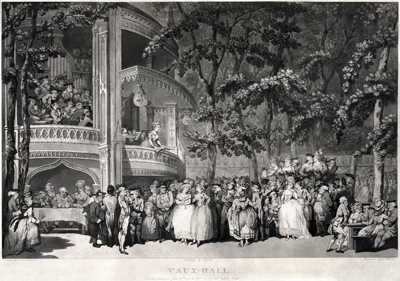
Those who attended events in the gardens included royalty as well as the likes of Samuel Johnson and James Boswell (see Thomas Rowlandson’s image above, Vauxhall Gardens, showing the likes of Johnson and Boswell, along with Georgina, Duchess of Devonshire, and the future King George IV, at the gardens in about 1779) as well as, much later, Charles Dickens (by the time Dickens visited, however, the heyday of the gardens was already well over).

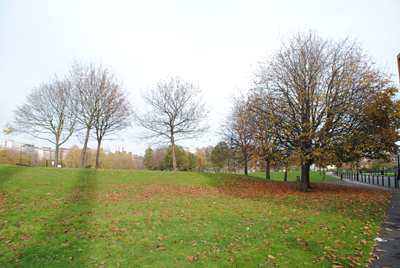
The gardens closed in 1859 due apparently to declining popularity and were eventually replaced with housing. After being badly bombed in World War II, however, the site once again returned to being a garden, known as Spring Gardens. The gardens (pictured) still occupy the site not far from Vauxhall tube station – part of them is used by the Vauxhall City Farm as paddocks for horses and livestock and they also contain a multi-use games court.

For an authoritative and comprehensive work on the Vauxhall Gardens, try David Coke and Dr Alan Borg’s Vauxhall Gardens: A History. There’s also much more information on David Coke’s website here. There’s also a detailed history here.

David Coke is curating an exhibition at The Foundling Museum, The Triumph of Pleasure, which looks at the way in which the gardens and the establishment of the Foundling Hospital in 1739 “changed the face of British art forever”. Runs from 11th May to 9th September. For more, see www.foundlingmuseum.org.uk.

PICTURES: Wikipedia and David Adams

Around London – Europe’s oldest intact book at British Library; 100 days to the Games; world’s largest archaeological archive; the London Marathon; and, Turner at the National Gallery…

• The British Library has paid £9 million for a 7th century text, the St Cuthbert Gospel, which is also the oldest intact European book. The acquisition follows the library’s most successful fund-raising effort ever – it included a £4.5 million grant from the National Heritage Memorial Fund. The book – a Gospel of John bound in beautifully tooled red leather – was produced in north-east England in the late 7th century and was placed in the saint’s coffin after his death on the Isle of Lindisfarne in 698. It was retrieved when the coffin was opened at Durham Cathedral in 1104. The Gospel is on display in the Sir John Ritblat Treasures Gallery at the library in St Pancras and following a conservation review, it is anticipated it will soon be displayed with the pages open for the first time. There will be a public event celebrating the acquisition on 15th May. For more, see www.bl.uk/whatson/events/may12/index.html.

• London this week marked 100 days until the Opening Ceremony of the 2012 Olympic Games. This included unveiling the latest installation of the Olympic rings – made of 20,000 plants the 50 metre long rings are located in the Royal Botanic Gardens at Kew in the city’s west and can be seen from planes on the Heathrow flight path. The organising committee also announced the Red Arrows aerobatic display team will perform a nine-ship flypast in ‘big battle’ formation on the day of the Opening Ceremony (27th July) and stated that the games motto will be ‘Inspire a Generation’. For more, see www.london2012.com.

• The Museum of London’s archaeological archive – known as the London Archaeological Archive and Research Centre (LAARC) – is officially the largest in the world according to Guinness World Records. The archive contains more than five million artefacts and the records of almost 8,500 excavations dating back to 1830. Items in the archive include shoes dating back to Roman times, a 200-year-old set of false teeth, ‘witching bottles’ including one with human hair and toenails, and coffin plates from London’s cemeteries. The world record has been recorded as part of World Record London, a series of world record breaking events being held in the run-up to the Olympics. Others have included the Faberge Big Egg Hunt.

• Thousands of people are expected to take part in the Virgin London Marathon this Sunday. The 26.2 mile route starts in Blackheath, passes through Woolwich and Greenwich and crosses the Thames at Tower Bridge before looping around the east end of London, through Canary Wharf, and the west along The Highway (formerly known as The Ratcliffe Highway) and Embankment to Parliament Square, Birdcage Walk and finally to Buckingham Palace. The first London marathon was run in 1981. For more, see www.virginlondonmarathon.com.

• On Now: Turner Inspired – In the Light of Claude. The first major presentation of 17th century artist Claude Gellée’s influence on the English romantic artist J M W Turner, the exhibition focuses on Claude-inspired themes which run through Turner’s work including “the evocation of light and air in landscape, the effect of light upon water and his often radical reworking of contemporary scenes”. The display includes works from large scale oils on canvas through to leaves from Turner’s pocket sketchbooks. Interestingly, the exhibition also explores the story behind the so-called Turner Bequest – that on his death, Turner linked himself to Claude forever by leaving the National Gallery two pictures – Dido building Carthage (1815) and Sun rising through Vapour: Fishermen cleaning and selling Fish (before 1807) –  on condition that they were hung between two pictures by Claude, Seaport with the Embarkation of the Queen of Sheba (1648) and Landscape with the Marriage of Isaac and Rebecca (1648). Runs until 5th June. Admission charge applies. For more, see www.nationalgallery.org.uk.

LondonLife – The Queen visits the newly transformed Kensington Palace…

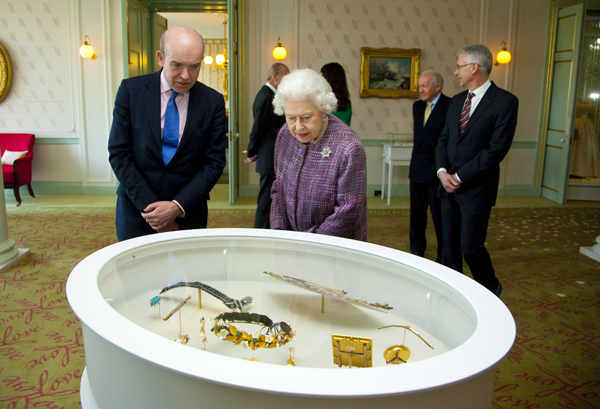
Queen Elizabeth II looks over gifts exchanged by Queen Victoria and Prince Albert in a display which forms part of the Victoria Revealed exhibition at Kensington Palace.

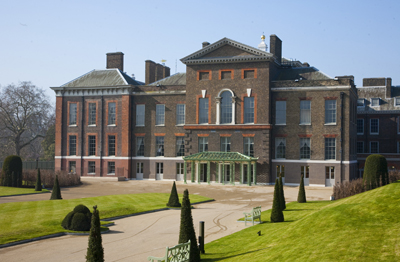
The Queen and Duke of Edinburgh visited palace last week to officially reopen the building following a £12 million, two year renovation project aimed at “transforming the visitor experience”.

The works have involved restoring the palace gardens – which will now be permanently open to the public free-of-charge – and reconnecting the palace with the surrounding parklands of Kensington Gardens partly through the provision of a new entrance. Landscape designer Todd Longstaffe-Gowan’s plan – which centres on a statue of Queen Victoria – features new lawns and avenues and a “maze-like path” inspired by 18th century “wilderness walks”.

There is also a new visitor reception area and “orientation hub” as well as a new courtyard terrace and cafe to complement The Orangery, shop and learning centre.

Victoria Revealed, a new permanent exhibition at the palace looks in intimate detail at the life of the Queen who once lived here and features everything from her black silk baby shoes to her wedding dress and the mourning clothing she wore following the death of Prince Albert as well as archive film footage showing the celebrations for the Diamond Jubilee of her reign in 1897.

The palace reopens on 26th March.

WHERE: The Broad Walk, Kensington Gardens, Kensington (nearest Tube stations are High Street Kensington or Queensway); WHEN: Daily 10am to 6pm (until 31st October); COST: £14.50 adult/£12 concession/children under 16 free (online booking discounts available, Historic Royal Palaces members free); WEBSITE: www.hrp.org.uk/KensingtonPalace.

PICTURES: Courtesy of Historic Royal Palaces/newsteam.co.uk

Around London – Chiswick House’s Camellia Festival; Picasso at the Tate; and, Mondrian at the Courtauld…

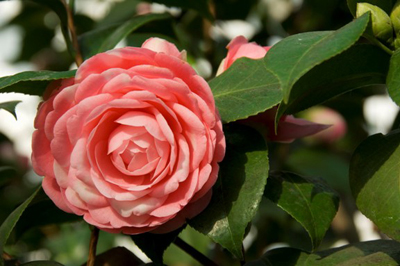
The second annual Camellia Festival kicks off in  gardens surrounding the neo-Palladian property, Chiswick House,  in west London this weekend. The month long festival, run by the Chiswick House & Gardens Trust, was kicked off in 2011 with the aim of showcasing Chiswick’s world renowned Camellia Collection, believed to be the largest in the Western world. Following the success of last year’s festival following a £12.1 million garden restoration project, the flowers will once again be on display in the Conservatory (designed by Samuel Ware in 1813). Complementing the display of camellias will be a showcase of early spring flowers planted in the newly restored Italian Garden (originally created for the 6th Duke of Devonshire in 1814, it was, at the time, at the forefront of horticultural fashion). The Camellia Collection, meanwhile, includes rare and historically significant plants featuring pink, red, white and striped blooms, many of which are descended from the original planting in 1828. Among them is the Middlemist’s Red which was originally brought to Britain from China in 1804 by John Middlemist, a nurseryman from Shepherds Bush. It is one of only two in the world known to exist (the other is in Waitangi in New Zealand). The festival runs from the 18th February to the 18th March.  Admission charge applies. For more information, see www.chgt.org.uk. PICTURE:  The Middlemist’s Red Camellia at Chiswick House © Clare Kendall.

• On Now: Picasso and Modern British Art. This exhibition at Tate Britain explores the influence of Spanish artist Pablo Picasso on British art and the role this played in the acceptance of modern art in Britain as well as celebrating the connections Picasso made with Britain following his first London visit in 1919. It features more than 150 works including 60 by Picasso, among them Weeping Woman and The Three Dancers, as well as works by the likes of Duncan Grant, Wyndham Lewis, Ben Nicholson, Henry Moore, Francis Bacon, Graham Sutherland and David Hockney. Runs until 15th July. Admission charge applies. For more information, see www.tate.org.uk

On Now: Mondrian || Nicholson in Parallel. This show at the Courtauld Gallery tells the story of the extraordinary relationship between celebrated 20th century painter Piet Mondrian and Ben Nicholson, one of the UK’s greatest modern artists. The exhibition will follow the parallel artistic paths taken by the two artists in the 1930s and their subsequent creative relationship. Each of the works selected for the exhibition have a particular historical significance and the presentation also includes archival material such as photographs and letters. Admission charge applies. For more information, see www.courtauld.ac.uk.

10 curiously named churches of London – 9. St Michael Paternoster Royal

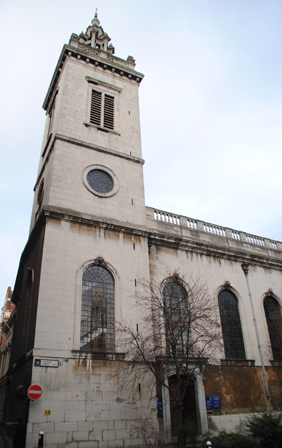
This triple-monikered church was first recorded in the 1200s. Far from unique in its dedication to the Archangel St Michael (there were apparently seven churches which were dedicated to him before the Great Fire), it was distinguished from the others by the name Paternoster Royal.

Surprisingly, the name has nothing to do with royalty or the clergy, at least not directly. The name Paternoster comes from the church’s location on what was Paternoster Lane (it’s now College Hill) – it was named for the number of paternoster or rosary seller that were based there.

The name Royal, meanwhile, is a little bit more obscure. First applied in the 1300s, it apparently comes from the close proximity of another street called Le Ryole which was itself a corruption of the French town of La Reole in the wine districts near Bordeaux. The street is believed to have been given the name thanks to the number of wine merchants who traded there.

Like other London churches, this one has been rebuilt several times – notably after the Great Fire of London (to the designs of Sir Christopher Wren) and again after World War II during which the church was all but destroyed by a V1 flying bomb. Since its reopening in 1968 it has served as the international headquarters of the Christian organisation, the Mission to Seafarers, which supports chaplains working in ports around the world.

The walls date from Wren’s time and the stone steeple, which wasn’t completed until 1717, is the work of Nicholas Hawksmoor. The interior features carved figures of Moses and Aaron which stand before the reredos – these apparently came from All-Hallows-the-Great (demolished in 1894) as did the chandelier which bears the words ‘Birmingham 1644’).

High profile parishioners over the years have included the four time Lord Mayor of London, Dick Whittington (see our earlier post on him) – he paid for a substantial extension of the church and founded a college of priests there (it’s from this college, which was dissolved in the mid-1500s and then re-established soon after, that College Hill is believed to have derived its name) as well as an almshouse next door.

Whittington and his wife were both buried inside but he was apparently exumed since several times and the location of his body is now unknown. There’s a stained glass window depicting Whittington and his famous cat inside and the gardens just outside also bear his name.

Around London – Illuminating manuscripts at the BL; Capability Brown and Richard Burton blue plaqued; and, Grayson Perry at the British Museum…

Opened to the public last week, Royal Manuscripts: The Genius of Illumination – a landmark exhibition at the British Library – features a “treasure trove” of illuminated manuscripts collected by the kings and queens of England between the 9th and 16th century. Highlights include 16 illuminated manuscripts of King Edward IV, what the library calls the first “coherent collection” of royal books; the Psalter of King Henry VIII, A History of England by Matthew Paris, a 13th century monk, scholar and advisor to King Henry III; Thomas Hoccleve’s Regement of Princes – a early 15th century instruction book on how to be an effective ruler; a 14th century Genealogical Chronicle of the English Kings; and, The Shrewsbury Book, created in Rouen in 1445 and presented to Margaret of Anjou on her marriage to King Henry VI by the renowned military commander John Talbot, 1st Earl of Shrewsbury. An impressive series of public events featuring well known writers and historians – including Eamon Duffy, Michael Wood, and Andrew Marr –  is taking place alongside the exhibition. Runs until 13th March. An admission charge applies. For more, see www.bl.uk.

PICTURE: The Coronation of Henry III, Images of English Kings, from Edward the Confessor to Edward I, England, c. 1280-1300, Cotton Vitellius, A. xiii, f. 6 © British Library Board

• Leading 18th century landscape gardener Lancelot ‘Capability’ Brown has been honored with a blue plaque at his former home in Hampton Court Palace. Brown, who designed more than 120 landscapes during his lifetime, lived at Wilderness House after King George III appointed him Chief Gardener at the palace – he lived there from 1764 until his death in 1783. Brown’s legacy can still be seen at country houses around England – including at Petworth House in West Sussex, Alnwick Castle in Northumberland, Chatsworth House in Derbyshire and Blenheim Palace in Oxfordshire. He had earned the name ‘Capability’ by the 1760s – apparently he often spoke of a property’s capabilities when speaking of it. English Heritage unveiled the plaque last week. For more, see www.english-heritage.org.uk.

A second blue plaque worth mentioning this week is that marking the former home of actor Richard Burton. Michael Sheen – currently playing Hamlet at the Young Vic – was among those who last week attended the unveiling on the plaque at the home Burton and his wife actress Sybil Williams lived in from 1949 to 1956, the period during which he rose to international fame. While living at the house 6 Lyndhurst Road in Hampstead, Burton was a member of the Old Vic theatre company – performing, to the acclaim of critics, roles including that of Hamlet, Othello, Coriolanus and Henry V – and in 1952 made his Hollywood debut with My Cousin Rachel. Other films he appeared in during the period include The Robe (1953), The Desert Rats (1953), and Alexander the Great (1956). Following the close of the Old Vic season in 1956, Burton moved to Switzerland and went on to even greater public fame following his role in the 1963 film Cleopatra alongside his then lover (and later wife) Elizabeth Taylor. For more, see www.english-heritage.org.uk.

• On Now: Grayson Perry – The Tomb of the Unknown Craftsman. This exhibition at the British Museum explores a range of themes connected with the ideas of craftsmanship and sacred journeys and includes 190 objects from the museum’s collection selected by the artist along with a works by Grayson himself, many of which will be on public view for the first time. They include everything from Polynesian fetishes to Buddhist votive offerings, a prehistoric hand axe to 20th century badges and a re-engraved coin from 1882 featuring a bust of Queen Victoria with a beard and boating hat. At the heart of the exhibition sits Grayson’s own work, The Tomb of the Unknown Craftsman, a richly decorated cast-iron “coffin-ship”. Runs until 19th February. An admission charge applies. For more, visit www.britishmuseum.org.

The Royal Parks – 8. Bushy Park

And so we come to the final entry in our special series on Royal Parks – Bushy Park (Royal Parks also look after Brompton Cemetery, but given it’s not strictly a park, we’ll deal with that in an upcoming post).

Lying off the beaten track near Hampton Court in south-west London, Bushy Park’s location means it’s perhaps the least glamourous of the Royal Parks we have looked at. Yet, like the other parks, its connection with royalty goes back a long way – in this case to the time of King Henry VIII.

The park was included as part of the Hampton Court estate given to the king by Cardinal Wolsey. Henry immediately transformed what had been farmland (complete with artifical medieval rabbit warrens, the remains of which can still be seen) into a deer chase and enclosed the park with a brick wall (a section of the original wall lies on the north side of Hampton Court Road).

The character of the park was altered again in 1610 when King Charles I ordered the creation of the Longford River, a 12 mile ornamental canal designed to bring water from the River Colne in Hertfordshire to the park’s water features.

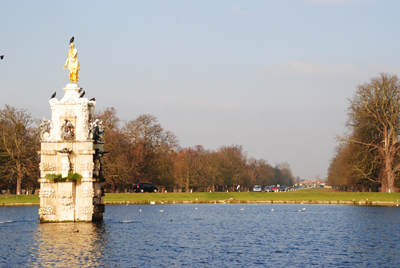
Christopher Wren had a hand in the park’s design in 1699 when he designed Chestnut Avenue – a mile long formal roadway which runs through the centre of the park. He also added the round pond at its end and placed a fountain topped with a statue in its midst.

Known as the Diana Fountain after the Roman goddess of hunting, the statue (pictured above with Chestnut Avenue behind) actually represents one of Diana’s nymphs Arethusa. It was commissioned by King Charles I for his wife, Queen Henrietta Maria, and originally stood at Somerset House before Oliver Cromwell moved it to the Privy Garden at Hampton Court and Wren then moved it to its current location.

The 17th and 18th century also saw the appearance of houses at the park to be used as hunting lodges (and the ranger’s home), and gardens were added.

Worth noting here is the story of shoemaker Timothy Bennet. A resident of nearby Hampton Wick, in 1752, when an old man, he successfully fought to ensure a public right-of-way through the park after the then ranger, Lord Halifax, ordered it closed to the public. There’s a monument to him outside Hampton Wick Gate and a walking path which runs across the park at perpendicular to Chestnut Avenue is still known as Cobbler’s Walk.

More gardens were added in the 20th century including the Waterhouse and Pheasantry Plantations. Other areas include the tranquil Woodland Gardens and the Water Gardens which are comprised of a Baroque-style collection of pools, cascades, basins and the canal. There are also a series of ponds – including a pond for model boats – to the east of Chestnut Avenue.

The park saw service in both World Wars. During the first, Canadian troops were stationed there (there’s a totem pole in the Woodland Garden marking this) and other areas within the park were used for growing produce as part of the “Dig for Victory” campaign.

During the second, it was used again for food production and in 1942 became a US base and later Supreme Headquarters Allied Expeditionary Forces – the location where General Dwight Eisenhower planned Operation Overland, the reinvasion of Europe which kicked off with the D-Day landings. There are memorials concerning this connection in the park’s north-east corner.

Facilities today include the Pheasantry Welcome Centre, which opened in 2009, and includes a cafe, toilets and information. There are also sporting facilities, a small cafe near the carpark and a children’s playground.

WHERE: The park lies north of Hampton Court Palace, just west of Kingston and Hampton Wick and south of Teddington (nearest train station is Hampton Wick or Hampton Court). WHEN: 24 hours except in September and November when it’s open between 8am and 10.30pm; COST: Free; WEBSITE: www.royalparks.gov.uk/Bushy-Park.aspx

The Royal Parks – 5. The Regent’s Park

A former hunting chase, The Regent’s Park in London’s north-west was extensively developed in the 19th century and remains a good – if not complete – example of a Regency landscape.

As with many of London’s Royal Parks, Regent’s Park (it’s formal name is actually The Regent’s Park but we’ll shorten it for our purposes here) once served as King Henry VIII’s hunting grounds – he seized the park, then known as Marylebone Park Fields after the nearby village and boasting thick woods as well as more open forests, from the Abbey of Barking in 1538.

Used by royalty for the next 50 years, it remained largely unaltered until after the Civil War when, between 1649 and 1660, the Commonwealth ordered many of the trees to be chopped down to pay debts. It was restored to royal ownership with the restoration of the monarchy but, with hunting falling out of fashion, was then leased out to tenant farmers.

It was John Nash who created the park that we know and love today. Friend of the Prince Regent (later King George IV), he was among a number of architects who responded to the Prince Regent’s calls for the creation of a new design featuring a palace for himself.

Nash’s original designs included a round park featuring a lake and canal and surrounded by as many as 56 villas and a palatial summer home for the Prince Regent which would be linked to his other home at St James’s by a processional road.

But only eight of the villas were ever built and only two of them – St John’s Lodge and The Holme – remain (both are private residences but part of the lodge’s gardens are open to the public) while the plans for the Prince Regent’s palace were put on hold when he turned his attention to developing Buckingham Palace instead. The canal, meanwhile, was moved to the park’s northern boundary where it still stands today (see our earlier entry on Regent’s Canal) while the processional route Nash had proposed became Regent Street.

While the park was initially only for the exclusive use of residents and what Royal Park’s call the ‘carriage set’, in 1835, the eastern part of the park was opened to the public for two days a week. Other sections of what is now included in the park, including Primrose Hill, were opened later.

Meanwhile, the fact most of the villas had never been built had left a large amount of free space and so both the Zoological Society and the Royal Botanic Society moved in – the latter laying out what is the Inner Circle with lawns and a lake of its own. Another society to operate in the park was the Royal Toxophilite Society which introduced archery there.

Not much has changed since but for the creation of Queen Mary’s Gardens in the 1930s – these were laid out on the space formally occupied by the Royal Botanic Society which had decided not to renew its lease. The Open Air Theatre performances, which are still held in the gardens today, started at about the same time. The park was damaged by bombing during World War II but has been fully restored.

Other facilities now in the 166 hectare (410 acre) park include a sports facility known as The Hub as well as several cafes, tennis courts and boat hire. The London Zoo, of course, also remains there.

WHERE: The Regent’s Park (nearest tube station is Regent’s Park); WHEN: 5am to at least 4pm (closing times vary depending on the month); COST: Free entry; WEBSITE: www.royalparks.gov.uk/The-Regents-Park.aspx

LondonLife – A last chance to experience Australia at the British Museum…

An Australian landscape constructed in the forecourt of the British Museum as part of the museum’s Australian Season. The landscape takes the intrepid on a journey across the vast Australian continent through the arid red desert of the red centre to the granite outcrops of the country’s west coast. The plants include iconic Australian flora such as the kangaroo paw, wattle, coast banksia, gums and ferns as well as a Wollemi pine. The landscape is the fourth created in the museum’s forecourt under a partnership with the Royal Botanic Gardens, Kew. But time is running out to see it – the garden will disappear on 16th October. Other events held at the museum as part of Australian Season have included an exhibition of Australian artworks and handcrafted baskets. Admission to the garden is free. For more, visit www.britishmuseum.org.

The Royal Parks – 1. Hyde Park

This year marks the 160th anniversary of the transfer of the care of the Royal Parks to the government (meaning the public was freely able to enjoy access for the first time). To celebrate, over the next weeks we’ll be taking a look at the history of each of them. First up is the 142 hectare Hyde Park, perhaps the most famous of all eight Royal Parks.

Formerly owned by Westminster Abbey, King Henry VIII seized the land in 1536 for use as a private hunting ground. He had it enclosed with fences and the Westbourne Stream, which ran through the park – it now runs underground – dammed.

It remained the king and queen’s private domain (Queen Elizabeth I is known to have reviewed troops there) until King James I appointed a ranger to look after the park and permitted limited access to certain members of the nobility in the early 17th century.

The park’s landscaping remained largely unaltered until the accession of King Charles I – he created what is known as the ‘ring’ – a circular track where members of the royal court could drive their carriages. In 1637, he also opened the park to the public (less than 30 years later, in 1665, it proved a popular place for campers fleeing the Great Plague in London).

During the ensuring Civil War, the Parliamentarians created forts in the park to help defend the city against the Royalists – some evidence of their work still remains in the raised bank next to Park Lane.

After King William III and Queen Mary II moved their court to Kensington Palace (formerly Nottingham House) in the late 1600s, they had 300 oil lamps installed along what we know as “Rotten Row’ – the first artificially lit road in the country – to enable them and their court to travel safely between the palace and Westminster.

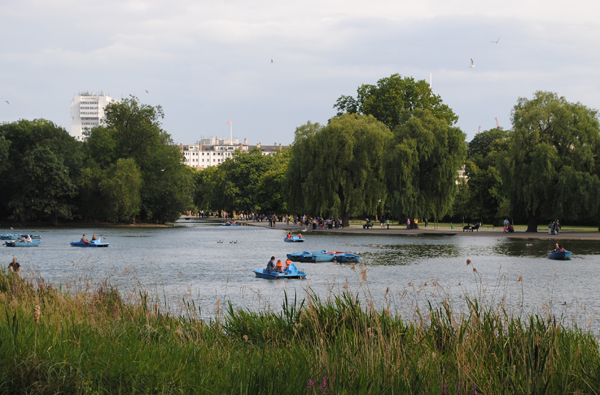
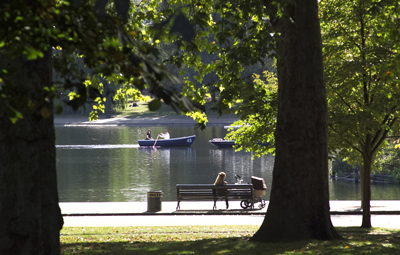
The natural looking Serpentine – the great, 11.34 hectare, lake in the middle of Hyde Park (pictured) – was created in the 1730s on the orders of Queen Caroline, wife of King George II, as part of extensive work she had carried out there. It was Queen Caroline who also divided off what we now know as Kensington Gardens from Hyde Park, separating the two with a ha-ha (a ditch).

The next major changes occurred in the 1820s when King George IV employed architect and garden designer Decimus Burton to create the monumental park entrance at Hyde Park Corner – the screen still remains in its original position while Wellington Arch was moved from a parallel position to where it now stands (see our previous posts for more on that). Burton also designed a new railing fence and several lodges and gates for the park. A bridge across the Serpentine, meanwhile, was built at about the same time along with a new road, West Carriage Drive, formally separating Hyde Park and Kensington Gardens.

While the basic layout of the park has been largely unchanged since, there have been some additions – among them, the establishment in 1872 of Speaker’s Corner as a place to speak your mind in the north-east corner of the park (near Marble Arch), the creation in 1930 of the Lido for bathing in warm weather, and, more recently, the building of the Diana, Princess of Wales’ Memorial Fountain (unveiled in 2004), and the 7 July Memorial (unveiled in July 2009).

Other sculptures in the park include Isis (designed by Simon Gudgeon, located on the south side of the Serpentine), the Boy and Dolphin Fountain (designed by Alexander Munro, it stands in the Rose Garden), and a monumental statue of Achilles, a memorial to the Duke of Wellington designed by Richard Westmacott, near Park Lane. There are also memorials to the Holocaust, Queen Caroline, and the Cavalry as well as a Norwegian War Memorial and a mosaic marking the site of the Reformer’s Tree (the tree was burnt down during the Reform League Riots of 1866).

The park has been integral part of any national celebrations for centuries – in 1814 a fireworks display there marked the end of the Napoleonic Wars, the Great Exhibition – with the vast Crystal Palace – was held there in 1851 and in 1977 a Silver Jubilee Exhibition was held marking Queen Elizabeth II’s 25 year reign. Cannons are fire there on June 2nd to mark the Queen Elizabeth II’s coronation and on 10th June for the Duke of Edinburgh’s birthday.

Facilities these days include rowing and pedal boats, tennis courts, deck chairs, a restaurant and cafe (the latter based in the Lido) and, of course, some Boris bikes. There is a heritage walk through the park which can be downloaded from the Royal Parks website.

WHERE: Hyde Park (nearest tube stations are that of Marble Arch, Hyde Park Corner, Lancaster Gate, Knightsbridge and South Kensington); WHEN: 5am to midnight; COST: Free; WEBSITE: www.royalparks.gov.uk/Hyde-Park.aspx?page=main

PICTURE: Courtesy of Royal Parks. © Indusfoto Ltd 

10 small (and fascinating) museums in London…8. The Geffrye Museum

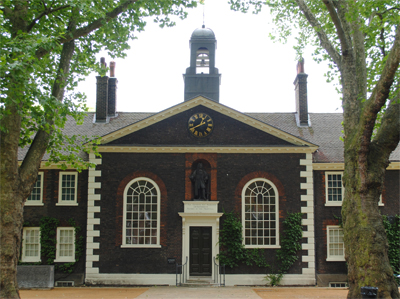
We have mentioned this museum before, but it’s well worth doing so again (particularly for those who may have missed the first entry). Located in former almhouses in Shoreditch, the Geffrye Museum is a survey of house interiors from the 17th century through to modern times.

Featuring 11 reconstructed period interiors created using authentic furnishings, it tells the story of the city through its residents’ homes (albeit largely wealthy ones) and includes a look at a hall in 1630, a parlour in 1790, a drawing room in 1870 and a loft conversion dating from 1998. There’s an audio guide which provides details on each room and information panels as you go along (and if you can’t get there but want to have a look, the website gives a detailed look at each room with notes on select furnishings).

The almshouses in which the museum resides (it runs along the rear wing of a U-shaped courtyard and takes in the chapel) were built in the early 1700s by the Company of Ironmongers after it received a bequest from Sir Robert Geffrye, a former twice-master of the company and a former Lord Mayor of London (his statue adorns the front of the chapel and faces out into the courtyard, itself a quiet oasis in busy Shoreditch).

These were used until early in the 20th century when the company decided to relocate the remaining pensioners. But the buildings have been preserved and it is possible to visit a former almshouse which has been restored and opened as a museum with displays on what life was like for the pensioners. Meanwhile, at the rear of the museum is a walled herb garden filled with herbs and a series of ‘period garden rooms’ ranging from the 17th to 20th centuries.

There’s also a restaurant and shop onsite (housed in a new extension opened in 1998).

WHERE: 136 Kingsland Road, Shoreditch. Nearest tube is Liverpool Street or Old Street (a fair walk) or Hoxton Overground Station (next door); WHEN: Tuesdays to Saturdays, 10am-5pm or Sundays and Bank Holidays, 12-5pm (gardens open until 31st October); COST: Free (admission to almhouses £2.50 at set times on select days); WEBSITE: www.geffrye-museum.org.uk


Treasures of London – Peter Pan statue, Kensington Gardens

It’s now one of the most popular statues in London – the diminuative “boy who wouldn’t grow up”. But few people today are aware of its somewhat unusual origins.

Located about half-way along the western shore of the Long Water in Kensington Gardens, the bronze statue first “appeared” in the park in 1912. The story goes that author JM Barrie, who published his first story about Peter Pan – The Little White Bird – in 1902, chose the location of the statue based on it being the place where, in the story, Peter Pan landed after flying out of the nursery window of his home.

Peter Pan first appeared on stage two years later in 1904 in the play Peter Pan, or The Boy Who Wouldn’t Grow Up, and this was later expanded into a novel by Barrie, Peter and Wendy. He’s since appeared in numerous film and stage adaptations – including sequels and prequels to the original tales.

Barrie had apparently been thinking about the statue for some time prior to its appearance – in 1906 he went so far as to take a series of photographs of six-year-old  Michael Llewelyn Davies wearing a Peter Pan costume (it was Barrie’s relationship with the Llewelyn Davies family which is said to have inspired Peter Pan’s creation).

Six years later Barrie commissioned Sir George Frampton to create the statue – interestingly, in what was a cause of some friction between the artist and patron, Sir George modelled his figure not on Llewelyn Davies but on another boy. Peter is seen playing on some pipes and is surrounded by small animals and fairies. There’s no sign of Captain Hook.

On the 1st of May, the statue simply appeared in its current position after being taken into the park under the cover of darkness. Barrie announced what he called his “May Day gift” to the children of London in The Times newspaper, describing it as “delightfully conceived”.

There was apparently some initially concerns raised among MPs about the appropriateness of an author erecting a statue to promote his own work but it has since become an iconic symbol of the gardens (and undergone some repairs – including after an incident in 1952 when Peter’s pipes were stolen).

So popular has the statue proved, that copies of the Peter Pan statue – created using Sir George’s mould – can now be found in Liverpool as well as in countries including Canada, Brussels, Australia and the US. There are others (not copies) in Kirriemuir, Scotland (Barrie’s birthplace) and another of him with Tinkerbell outside Great Ormond Street Hospital for Children (which holds the copyright to the character).

WHERE: Peter Pan statue (nearest Tube station is Lancaster Gate); WHEN: 6am to dusk daily; COST: Free; WEBSITE: www.royalparks.gov.uk/Kensington-Gardens.aspx