10 historic London hotels…8. The Dorchester…

This five star luxury Mayfair hotel opened in 1931 and quickly established a reputation for luxuriousness.

Located at 35 Park Lane on the site of what was formerly the London residence of the Earl of Dorchester (and later a mansion built for millionaire RS Holford), the hotel was the dream of Sir Robert McAlpine who bought the site in partnership with Gordon Hotels in 1929 for £500,000 and vowed to create a luxury hotel that would “rank as the finest in Europe”.

Engineer Sir Owen Williams initially oversaw the building’s design but a falling out saw architect William Curtis Green take over the project (meaning while the structural frame was Sir Owen’s work, the elevations are largely the work of Green). A quarter of the building was constructed underground.

When the 10 storey modernistic building was opened on 18th April, 1931, by Lady Violet Astor, it featured luxurious rooms and suites (with, apparently, the deepest baths of any hotel in London), a ballroom built to accommodate 1,000, an Oriental Restaurant and, of course, the Dorchester Bar (it was here the ‘Dorchester of London’ cocktail was invented).

The Dorchester survived World War II with only minor damage (its basement served as an air-raid shelter). In fact, during World War II, such was the reputation of its reinforced concrete structure, that UK Cabinet members including Lord Halifax stayed here while US General Dwight D Eisenhower planned the D-Day invasion from his suite – now the Eisenhower Suite – during World War II.

In the 1950s, stage set designer Oliver Messel revamped various aspects of the hotel including designing some suites in an extension in Deanery Street (the Oliver Messel Suite is named for him).

The hotel has hosted its share of the rich and famous – Prince Philip hosted his bachelor party in the hotel’s Park Suite on the eve of his wedding to Queen Elizabeth II in 1947 (the Queen, meanwhile, had dined there the day before the engagement was announced), and actors Richard Burton and Elizabeth Taylor used the hotel as something of a “second home”.

Other notable figures who have stayed at the hotel include writers Cecil Day-Lewis and Somerset Maugham, painter Sir Alfred Munnings, director Alfred Hitchcock and film stars Gloria Swanson, Marlene Dietrich, Danny Kaye and James Mason as well as Tom Cruise, Meg Ryan and Nicole Kidman.

The Dorchester was listed as a Grade II building in 1981 and, having been sold by the McAlpine family to a consortium headed by the Sultan of Brunei in the mid-1970s, it was purchased outright by the Sultan of Brunei in the Eighties (and later transferred ownership to the Brunei Investment Agency).

The hotel was completely renovated between 1988 and 1990 and was again refurbished in 2002.

Facilities today at the hotel – alongside the 250 rooms and suites – include numerous restaurants and bars such as the three Michelin star Alain Ducasse at The Dorchester, China Tang, The Spatisserie and The Grill at the Dorchester, as well as The Bar at the Dorchester and The Promenade where afternoon tea is served. There’s also a spa.

Today The Dorchester is the flagship of the Dorchester Collection of hotels which also includes 45 Park Lane, Cowarth Park in Ascot, The Beverly Hills Hotel and The Hotel Bel-Air in LA, the Hotel Eden in Rome, Le Meurice and Hotel Plaza Athenee in Paris and the Hotel Principe di Savoia in Milan.

Out the front of the hotel is a London Plane tree which was named one of the “great trees of London” in 1997.

For more, see https://www.dorchestercollection.com/en/london/the-dorchester/.

PICTURE: || UggBoy♥UggGirl || PHOTO || WORLD || TRAVEL || (licensed under CC BY 2.0/image cropped)

What’s in a name?…Abbey Road…

Famous for its Beatles connection (and a particular pedestrian crossing), Abbey Road in London’s north-west takes it name from, you guessed it, a former religious house.

Kilburn Priory was founded at what is now the road’s northern end under the auspices of Westminster Abbey in about 1130 AD. It was eventually dissolved on the orders of Henry VIII in 1537.

The religious house gave its name not only to Abbey Road but also the intersecting Priory Road and Priory Terrace, and nearby Abbot’s Place, to name a few.

Of course, Abbey Road is famous for being the location of EMI’s Recording Studios (later renamed the Abbey Road Studios, they are located at number three at the southern end in St John’s Wood) where the Beatles and many others, including Shirley Bassey, Yehudi Menuhin, Max Bygraves and Cliff Richard, recorded albums (it’s also been used for recording film scores including for Star WarsRaiders of the Lost Ark, The Lord of the Rings trilogy and the Harry Potter films).

The Beatles named their last studio LP after the street and the album’s cover shows the four of them walking across the aforementioned famous zebra crossing just outside the studio. The crossing, which attracts a steady stream of tourists year round, was given Grade II-listed status in December 2010. The studios are also Grade II-listed.

Abbey Road was also the site of the founding of the Abbey National Building Society, now Santander UK, which was founded in a church here in 1874.

PICTURE: Looking northward up Abbey Road across the famous crossing (the studios are just beyond the crossing on the left) (WillMcC/licenced under CC BY-SA 3.0/image cropped)
 

This Week in London – City of London’s biggest rooftop viewing platform opens; Rembrandt at the British Museum; and, Franz West at the Tate…

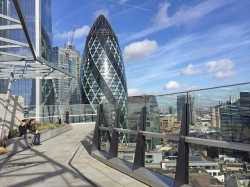
The City of London’s largest rooftop viewing space – The Garden at 120 – has opened atop the newly opened Fen Court office building in Fenchurch Street. The viewing platform – located 15 storeys above the street – offers 360 degree views of the City and features a pergola planted with fruit trees and Italian wisteria, a water feature and coffee hut. Entry is free and access is between 10am and 6.30pm weekdays until 31st March (5pm on weekends) and between 10am and 9pm from 1st April to 30th September. For more, see www.thegardenat120.com. PICTURE: diamond geezer (licensed under CC-BY-NC-ND 2.0)

Rembrandt’s drawing and prints are the subject of a new free exhibition at the British Museum. Marking 350 years since the death of Rembrandt van Rijn in 1669, Rembrandt: thinking on paper features more than 60 of the Dutch artist’s works ranging from quick sketches to fully realised compositions with subject matter including self-portraits, landscapes and Biblical scenes. Works include Young woman sleeping (Hendrickje Stoffels?) (c1654), his printing plate for Reclining female nude (1658), the pen-and-ink Sketches of an old man and child (c1639-40), Self-portrait, bareheaded, bust in frontal view (1629), Self-portrait drawing at a window (1648), the Raising of Lazarus (c1632) and his late, large drypoints the Three Crosses (1653) and Ecce Homo (1655). Runs until 4th August in Room 90. Entry is free. For more, see www.britishmuseum.org.

The first posthumous retrospective of the work of Franz West (1947-2012) ever staged in the UK has opened at the Tate Modern. Franz West spans the artist’s career over four decades and includes examples from his series of early abstract small sculptures like Passstücke (Adaptives), furniture work first displayed in the artist’s pivotal 1989 exhibition at the Haus Lange Museum, as well as later, large-scale installations such as Auditorium (1992) and Epiphany on Chairs (2011). The artist’s works in papier-mâché – Legitimate Sculptures – are also featured and there’s a room devoted to Redundanz (1986), a three-part ensemble accompanied by text that stresses “the difference between language and art as ways of understanding the world”. The display finishes with an array of West’s dramatic aluminum works and a collection of maquettes for the artist’s outdoor sculptures, five of which are installed in the South Landscape. Runs until 2nd June. Admission charge applies. For more, see www.tate.org.uk.

Send all items for inclusion to exploringlondon@gmail.com.

10 historic London hotels…7. The Grosvenor House Hotel (JW Marriott Grosvenor House London)…


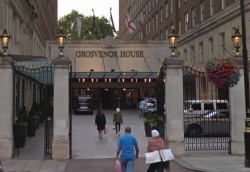
Built on the site of what was Grosvenor House in Park Lane – London residence of the Dukes of Westminster, the Grosvenor House Hotel opened in 1929 but wasn’t completed until the 1950s.

The Mayfair hotel was conceived and constructed on the orders of commercial speculator Albert Octavius Edwards and was designed by Wimperis, Simpson and Guthrie with luxury in mind (Sir Edwin Lutyens was responsible for the external elevations).

Originally designed as two apartment blocks, it was apparently only when the first block was completed that it was decided the second north block would be a hotel. It opened on 14th May, 1929, with an event described as “outstanding”.

Along with some 472 rooms – it was the first hotel in London to feature en suite bathrooms which came with running ice-cold water in each, its facilities included The Great Room, originally an ice-skating rink where then Princess Elizabeth (later Queen Elizabeth II) learned to ice skate which Edwards decided in the 1930s to convert into one of the largest banqueting spaces in Europe.

It was subsequently the scene of many awards evening and charity events including Queen Charlotte’s Ball as well as BBC broadcasts (the Beatles are among those who have performed there). The hotel was also the first in London to have a swimming pool.

The hotel, which only suffered minor damager during the Blitz, saw service during World War II. The Great Room was initially home to the Officers’ Sunday Club and later as one of the largest US officers’ mess. During the war, the premises hosted everyone from Charles de Gaulle and King Haakon of Norway as well as US generals Dwight D Eisenhower and George S Paton.

The hotel actually has strong American connections from the get go – American methods were used during construction to speed things along – and its restaurant was noted for swerving American-style food. Among other Americans who have stayed there include Douglas Fairbanks, Jr, Orson Welles, Jackie Onassis, Henry Kissinger, Sammy Davis, Jr, and Madeline Albright.

The actual construction of the hotel continued into the 1950s when permission was given to demolish a house at 35 Park Street (located next door to the hotel) following the death of its owner – Bruno, Baron Schroder, and a 92 bedroom extension to the hotel was built. It was officially opened by Peter Thorneycroft, Chancellor of the Exchequer, in 1957.

The hotel, which was acquired by Trust Houses in 1963, underwent several changes of ownership in more recent years and following an extensive renovation in the Noughties, it reopened in September, 2008 as a JW Marriott hotel.

It was reportedly announced late last year that Qatari-owned Katara Hospitality was buying the hotel from Indian conglomerate Sahara India Pariwar, which has owned the hotel since 2010, for an undisclosed sum.

For more, see www.LondonGrosvenorHouse.co.uk.

PICTURES: Park Lane facades and entrance in Park Street. Courtesy of Google Maps.

A Moment in London’s History – The first Anderson shelter is built…

A small air raid shelter designed for people to erect on their properties in preparation for the expected bombing campaigns of World War II, the first of London’s ‘Anderson’ shelters were rolled out 80 years ago in a backyard garden of a house in Islington on 25th February, 1939.

The shelter’s name comes from Sir John Anderson, Lord Privy Seal and the man tasked with the job of overseeing air-raid preparations across the country. As part of that job, he commissioned engineers to come up with an easy-to-construct, affordable shelter that could be used by the population at large.

The resulting arched-roofed structures, designed to be flexible and absorb the impact when bombs hit, were made from six curved sheets of corrugated steel or iron and, at six feet tall, 6.5 feet long and 4.5 feet wide, could house a family of six. They were designed to be buried under four feet of earth in backyards and the roof covered with a minimum of 15 inches of soil.

The shelters were given out for free to lower income families but those with the means had to buy them for £7. Some chose to incorporate them into their gardens and grew vegetables and plants on top and some decorated them – there were even competitions held for the best looking.

By the time bombs started hitting London in the Blitz, more than 1.5 million of the shelters had been built (and a further 2.1 million were erected as the war raged).

It was expected that families would use them every night but the shelters were found to be cold and damp and often flooded which meant many people only used them when air raid sirens sounded (and some not even then – one 1940 survey apparently found only 27 per cent of Londoners used them).

After the war, most were scrapped for the metal but some of the Anderson shelters were repurposed as garden sheds. A small number of them survive across London.

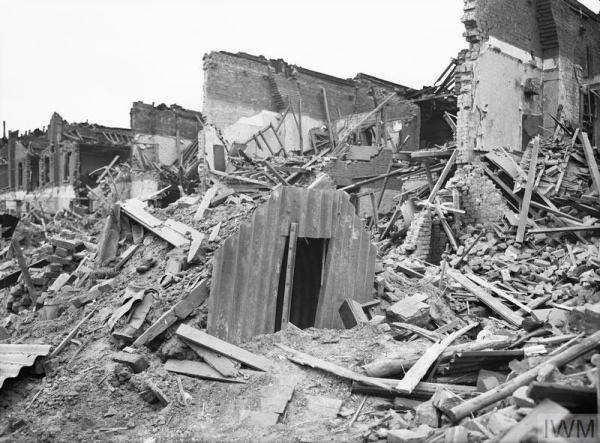
PICTURE: An intact Anderson shelter sits amid devastation in Poplar caused after a land mine fell a few yards away in in 1941. The three people inside were not hurt. Via Imperial War Museum (© IWM (D 5949))

10 historic London hotels…6. The Midland Grand Hotel (The St Pancras Renaissance London)

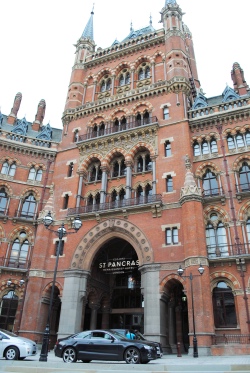
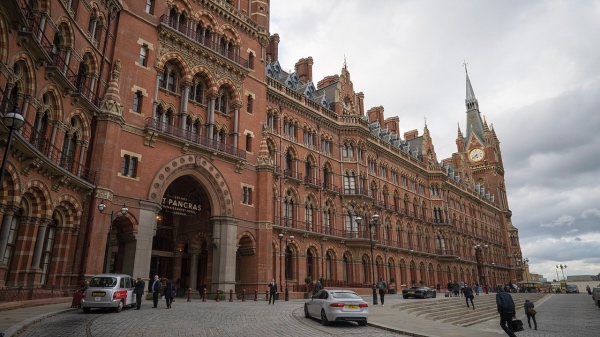
Another of the opulent Victorian hotels built at London’s railway termini, the Midland Grand Hotel was designed by Sir George Gilbert Scott in an ornate High Gothic style.

Scott’s design for the new hotel – which was to be built adjoining the railway station and would form its southern facade on Euston Road – was selected over 10 other submissions to win an 1865 competition run by the Midland Railway Company.

Scott was apparently reluctantly involved – he only entered the competition after pressure from one of the company’s directors despite apparently previously refusing to get involved with the project prior to that.

His expensive – and expansive – design (apparently resembling his rejected plans for government offices in Whitehall) included an 82 metre high clock tower at the east end of the more than 170 metre long facade and a 76 metre high tower at the west end (it also originally had an extra floor that wasn’t included in the final building).

The luxurious property – considered from the outset one of London’s best hotels, it cost whopping £438,000 – featured some 300 bedrooms, a grand double staircase, curved dining room and mod-cons like water-driven lifts (it was the first private building to boost these and one remained in place until 1958), an electric bell calling system and flushing toilets.

Staff communicated via a system of speaking tubes and wary of fires after the Palace of Westminster burned down, a “fireproof floor”. The property also boasted the first ladies’ smoking room in London in 1873 and, in 1899, the first revolving door in Britain was installed at the entrance.

Decorative details in the best guest rooms, meanwhile, included Axminster carpets, carved marble fireplaces, 18 foot high ceilings, and vast windows. En suite bathrooms, however, were not included.

The hotel’s east wing opened on 5th May, 1873, but it wasn’t completed until spring of 1876. One Herr Etzesberger, formerly of the Victorian Hotel in Venice, was apparently appointed general manager.

Guests included music hall singer and comedian Marie Lloyd, Jesse Boot (of Boots chemists fame), railroad and shipping entrepreneur Cornelius Vanderbilt and George Pullman (of the Pullman sleeping car fame).

The hotel was taken over by the London, Midland and Scottish Railway in 1922. It closed in 1935 thanks to its now outdated and expensive-to-maintain facilities and, despite innovations like a Moroccan coffee house and in-house orchestra.

Renamed St Pancras Chambers, the building was subsequently used as railway company offices. It survived the Blitz and attempts to have it demolished thanks to a high profile campaign led by poet Sir John Betjeman, architectural historian Nikolaus Pevsner and the Victorian Society and in 1967 the hotel and St Pancras station were given Grade I-listed status.

British Rail continued using it as offices but in the 1980s the building was deemed unsafe and closed. It was restored in the 1990s and in 2004, permission was given for it to be redeveloped into a new hotel – the same period during which the station was being redeveloped into one of the largest rail termini in Europe in order to accommodate cross-channel trains.

This project saw the main public rooms of the old Midland Grand Hotel kept and restored as well as some bedrooms while the former driveway for taxes was converted into the new lobby and a new bedroom wing constructed. The upper floors of the original building, meanwhile, were converted into 68 apartments.

The five star, 245 room St Pancras Renaissance Hotel opened on 14th March, 2011, to guests but the formal opening took place on 5th May that year – exactly 138 days after it first opened its doors.

Facilities at the property today, part of the Marriott group, include The Chambers Club, The Booking Office Bar & Restaurant, MI + ME, The Marcus Wareing-designed Gilbert Scott Restaurant, the Hansom Lounge – where afternoon tea is served, and George’s Bar. There’s also a spa and leisure club and pool and meeting facilities.

The premises has appeared in films including the The Secret GardenRichard III, Batman Begins, Bridget Jones’ Diary and Harry Potter and the Chamber of Secrets. It also served as the backdrop for the Spice Girls video clip, Wannabee.

For more, see www.stpancraslondon.com.

PICTURE: Top – LepoRello (licenced under CC BY-SA 3.0);  Right – David Adams; Below – Jwslubbock (licenced under CC BY-SA 3.0).

London Pub Signs – The Wenlock Arms…

Located just to the north of the City, The Wenlock Arms takes its name from the former Wenlock Brewery (the name was also given to the nearby Wenlock Basin which runs off Regent’s Canal).

Located at 26 Wenlock Road in Hoxton, the pub is said to have opened in 1836 as a tap for the nearby brewery and went on to become a rare survivor of the Blitz (for the area in which it’s located).

The pub has an interesting recent history – it was successfully saved from demolition several years ago following a campaign from locals and is now a protected building. Having undergone a bit of a spruce up since, it is highly regarded for both its ales and its live music.

It also featured as a location in the 2013 film, The World’s End, starring Simon Pegg.

For more, see http://wenlockarms.com.

PICTURE: Marcuswenlock (licensed under CC BY-SA 4.0)

Treasures of London – The Southwark Needle…

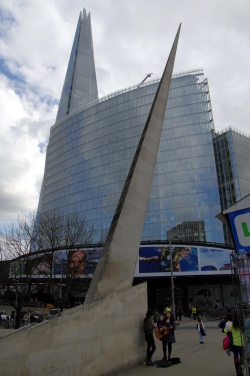
A 16 metre long splinter of stone sticking up in the air at the southern end of London Bridge, the Southwark Needle (its official name is actually the Southwark Gateway Needle) was erected in 1999.

Made of Portland stone and sitting on an angle of 19.5 degrees, it was designed by Eric Parry Architects as part of the Southwark Gateway Project which also included the creation of a new tourist information centre.

There’s been much speculation about what the pointed obelisk actually represents with some believing that the sharp spike is a kind of memorial to those whose heads were placed on spikes above the gateway which once stood at the southern end of London Bridge.

It seems, however, that the subject remembered in the monument is rather more mundane – it’s a marker and apparently points across the Thames the Magnus the Martyr church which marked the start of where London Bridge was formerly located (several metres to the east of the current bridge’s location). And for those trying to figure out how the needle points to that, word is that is the line of the base of the marker which points to the start of the old bridge – not the sharp end of the obelisk.

The needle is now commonly used as a meeting point.

PICTURE: Donald Judge (licensed under CC BY 2.0)

This Week in London – Dior at the V&A, and, Don McCullin at the Tate…

The UK’s largest ever exhibition focusing on fashion designer Christian Dior and his work opens at the V&A on Saturday. Christian Dior: Designer of Dreams spans his career and legacy from 1947 – the year he hosted his first UK fashion show at the Savoy Hotel in London, to the present day. Based on an exhibition shown at the Musée des Arts Décoratifs in Paris, it will also include a section on the world renowned designer’s fascination with British culture. The more than 500 objects on show – revealed in 11 sections – include more than 200 rare haute couture garments as well as accessories, photography, film, perfume and make-up, illustrations, magazines and personal possessions. Alongside gowns worn by the likes of Princess Margaret, Margot Fonteyn and Jennifer Lawrence, highlights include the iconic Bar Suit, given to the V&A by the House of Dior in 1960. Runs until 14th July in The Sainsbury Gallery. Admission charge applies. For more, see www.vam.ac.uk. PICTURE: © Adrien Dirand (V&A).

The work of Sir Don McCullin – regarded as one of Britain’s greatest living photographers and perhaps best known as a photojournalist and war correspondent – is the subject of a new show opening at Tate Britain next Tuesday. Don McCullin features more than 250 photographs dating from the 1950s – when he started documenting the community in his native Finsbury Park – to 2017, when he visited Syria to document the destruction undertaken by the so-called Islamic State. Among the iconic photographs on show are The Guvnors, a portrait of a notorious local gang in Finsbury Park which launched his career as a photojournalist in 1958, Shell-shocked US Marine, The Battle of Hue (1968), Starving Twenty Four Year Old Mother with Child, Biafra (1968), Northern Ireland, The Bogside, Londonderry (1971), and The theatre on the Roman city of Palmyra, partly destroyed by Islamic State fighters (2017). Also on show are photographs depicting the changing social conditions in the UK, landscapes and still lifes as well as the photographer’s magazine spreads, contact sheets, McCullin’s helmet and the Nikon camera which took a bullet for him in Cambodia. Runs until 6th May. Admission charge applies. For more, see www.tate.org.uk.

Send all items for inclusion to exploringlondon@gmail.com.

LondonLife – A look inside The India Club…

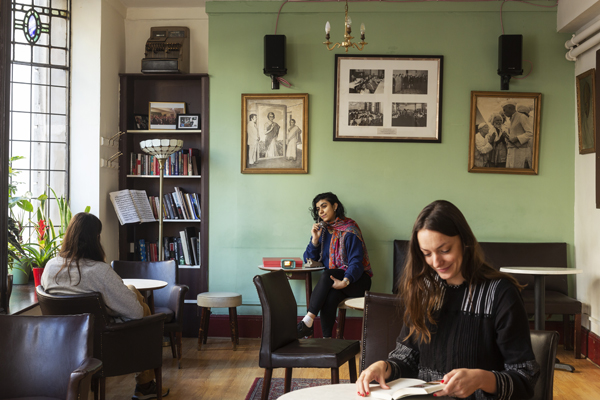
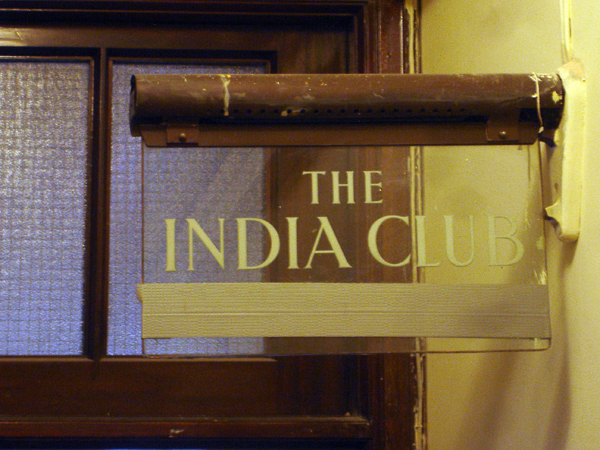
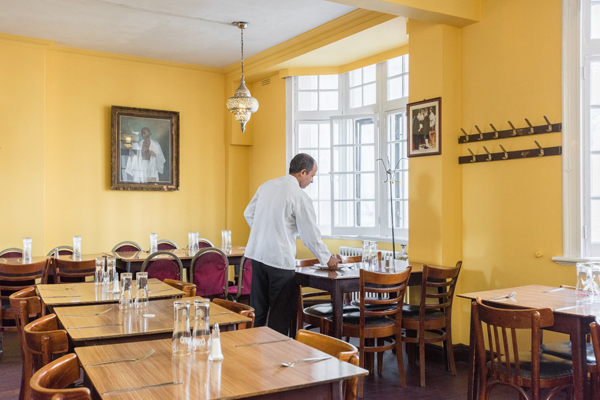
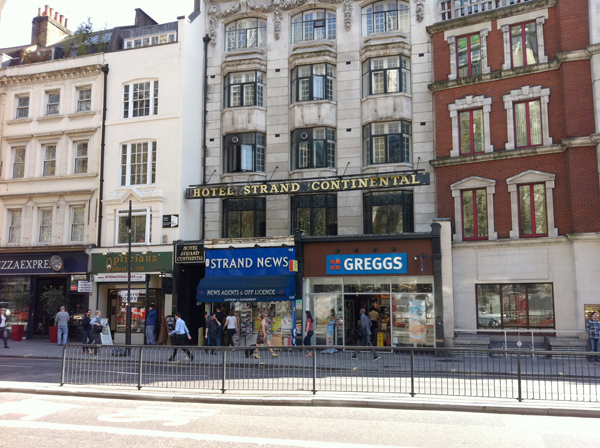
The rich and tapestried history of The India Club forms the heart of a new exhibition by the National Trust which opens at the Strand-based club this week. A Home Away from Home: The India Club is an audio-based exhibition – featuring interviews with everyone from former staff, freedom fighters, BBC reporters, artists and writers – and highlights the club’s history and its ongoing significance among the British South-Asian community. Borne out of the Indian League which had campaigned for India’s independence, the club was founded in 1951 under the leadership of Krishna Menon, the first High Commissioner to India, with founding members including Jawaharlal Nehru, India’s first Prime Minister, and Lady Mountbatten. Originally located at 41 Craven Street, it moved to 143 Strand, the premises of the Hotel Strand Continental, in 1964. The club, site of what was one of the UK’s first Indian restaurants, remains an important hub for a range of Anglo-Indian organisations and the community of journalists, writers, artists, academics and students who regularly meet in the premises. The exhibition comes as more than 26,000 people have signed a petition to prevent the club’s redevelopment as part of plans to refurbish the building in which its located. Opening tomorrow and running until 1st March, the display is being accompanied by a programme of supper clubs, artist talks, screenings and conversations. The exhibition is free but ticketed. For more, see
www.nationaltrust.org.uk/features/a-home-away-from-home-the-india-club.

PICTURES: Top – Enjoying the new exhibition in The India Club (courtesy of National Trust); Below – The India Club sign (courtesy of Jake Tilson); the restaurant in The India Club (courtesy of The India Club); the Strand Continental Hotel in which the club is located (courtesy of Jake Tilson).

Where’s London’s oldest…public building with electric lighting?

The Savoy Theatre, located next to the Savoy Hotel just off the Strand in the West End, was the first public building in London to feature electric lighting.

Built to the designs of CJ Phipps and decorated by Collinson and Locke, its construction was instigated and financed by Richard D’Oyly Carte with the specific intention of hosting WS Gilbert and Arthur Sullivan‘s operas.

Opening on 10th October, 1881, the first show at the new premises was Gilbert and Sullivan’s Patience, which had been previously playing at the Opera Comique. It continued to solely show Gilbert and Sullivan’s works until 1886 when a falling out led to the end of the partnership between Gilbert and Sullivan.

The theatre subsequently hosted comedic operas by other composers as well as productions of Shakespeare (Henry Irving was among those who trod the boards here in the early 20th century).

It was rebuilt in just 135 days in 1929 and the new premises featured an exterior designed by Frank Tugwell and interior designed by Art Deco expert Basil Ionides.

A fire caused considerable damage in 1990 after which the theatre was again renovated, this time under the guidance of the theatre’s then chairman Sir Hugh Wontner and architect Sir William Whitfield, with the public areas returned to how they had looked under Tugwell and Ionides’ scheme from the 1920s. It reopened in July, 1993, with a Royal Gala performance by the English National Ballet (Diana, Princess of Wales, was among those in attendance).

Now owned by the The Ambassador Theatre Group, the Savoy these days it shows a range of different productions. It’s currently hosting Dolly Parton’s 9 to 5: The Musical. For more, see www.thesavoytheatre.com.

PICTURES: Above – Neon sign for The Savoy Theatre advertising a previous production with the hotel and theatre entrance (Loren Javier/image cropped/licensed under CC BY-ND 2.0); The Savoy Theatre with a Westminster City Council Green Plaque commemorating it being the first public building with electric lighting in London (David Adams).

This Week in London – Recalling Sir Joseph Bazalgette; Pierre Bonnard retrospective; and Bill Viola meets Michelangelo…

A plan of the Deptford Pumping Station signed by Sir Joseph Bazalgette is going on display at the City of London Heritage Gallery on Saturday to mark 200 years since the Victorian engineer’s birth. Other items in the new display include the Shakespeare Deed – only one of six documents to bear the signature of William Shakespeare, and one of the City of London’s earliest charters – granted by King Richard I in 1197. Admission to the gallery, located in the Guildhall Art Gallery, is free. Runs until 16th May. For more, follow this link.

The first major retrospective of French painter Pierre Bonnard in 20 years has kicked off at the Tate Modern on South Bank. The CC Land Exhibition, Pierre Bonnard: The Colour of Memory, features about 100 of his most celebrated works from public and private collections spanning the period from 1912 to his death in 1947. Bonnard, like his friend Henri Matisse, had a profound impact on modern painting and went on to influence the likes of Mark Rothko and Patrick Heron. Works on show include Dining Room in the Country (1913), The Lane at Vernonnet (1912-14), Coffee (1915), Summer (1917), Piazza del Popolo, Rome (1922), Nude in an interior (c1935), and Studio with Mimosa (1939-46). Runs to 6th May; admission charge applies. For more, see http://www.tate.org.uk. PICTURE: Pierre Bonnard (1867–1947), Coffee (Le Café), 1915,  Oil paint on canvas (via Tate Modern)

The work of pioneering video artist Bill Viola has been brought together with drawings buy Michelangelo in a new exhibition opening at the Royal Academy on Saturday. Bill Viola/Michelangelo features 12 major video installations by Viola, an honorary Royal Academician, which span the period 1977 to 2013 as well as 15 works by Michelangelo including 14 highly finished drawings as well as the Academy’s Taddei Tondo. It proposes a “dialogue” between the two artists with Viola, who first encountered Michelangelo’s works in the 1970s in Florence, considered an heir to the long tradition of spiritual and affective art which uses emotion to connect viewers with the subject depicted. Runs until 31st March. Admission charge applies. For more, see www.royalacademy.org.uk.

Send all items for inclusion to exploringlondon@gmail.com.

10 historic London hotels…4. The Langham Hotel…

This sprawling London hotel in Portland Place – just past the top end of Regent Street – has spent much of its life as a hotel but was also once part of the BBC.

Built in 1863-65 to the plans of John Giles and James Murray, the £300,000 Langham Hotel – claimed as Europe’s first “grand hotel” – was deliberately designed to be on a scale and with a level of magnificence the city had not yet seen.

Spread over 10 floors – including those below ground – and designed in the style of an Italian palace, it boasted 600 rooms including numerous suites and featured mod-cons including the city’s first hydraulic lifts (electric lighting and air-conditioning would follow).

Features included its celebrated Palm Court, said to be the birthplace of the traditional afternoon tea.

It opened in a rather spectacular celebration on 10th June, 1865, with more than 2,000 guests including the Prince of Wales (later King Edward VII).

It soon gained a reputation among the rich and influential. Along with exiled members of European royal families including the Emperor Napoleon III of France and exiled Ethiopian Emperor Haile Selassie, those who stayed here included the likes of American writer Mark Twain, Italian conductor Arturo Toscanini, Czech composer Antonin Dvorak, explorer Henry Morton Stanley and romantic novelist Ouida.

Charles Dickens believed there was no better place for dinner parties and Sir Arthur Conan Doyle, another guest, used it as a setting in his Sherlock Holmes novels.

Its proximity to All Soul’s in Langham Place – the scene of many a fashionable wedding – saw it host many wedding receptions and the servants at Langham were led in prayers each morning by a clergyman from the church.

It was also popular with international musicians and artists thanks to the location of Queen’s Hall nearby.

The Langham declined in popularity during the two World Wars as the social centre of London moved west. Having served as a first aid and military post during World War II, it was badly damaged during the Blitz with much destruction caused when its massive water tank ruptured.

After the war, the BBC bought the hotel and used it for offices, studios and the BBC Club.

The BBC sold the building in the mid-Eighties and in 1991 after a £100 million renovation, it reopened as the Langham Hilton Hotel with Diana, Princess of Wales, a regular visitor.

It was sold again in 1995 and extended and refurbished. It again underwent a five year, £80 million, refurbishment in the mid 2000s, reopening in 2009.

The five star Langham – now the flagship of a group of hotels, celebrated its 150th anniversary in 2015 with the opening of the Regent Wing as well as The Sterling Suite, a luxurious six bedroom suite, and a new Langham Club Lounge.

Now a Grade II-listed building, it contains some 380 suites and rooms as well as The Grand Ballroom, the aforementioned Palm Court, restaurants including Roux at The Landau and Artesian, a British tavern, The Wigmore, and a spa.

It has appeared in numerous films, including the 1995 James Bond film, GoldenEye, in which it doubled for a hotel in St Petersburg. It also features a City of Westminster Green Plaque commemorating a meeting there between Oscar Wilde, Conan Doyle and Joseph Marshall Stoddart who commissioned the two writers to write stories for his magazine.

For more, see www.langhamhotels.com/en/the-langham/london.

PICTURE: Top – Sheep”R”Us (licensed under CC BY-NC-ND 2.0); Right – David Adams

Correction – this is actually number four in our special series, not three!

A Moment in London’s History – The Beatles play a final rooftop concert…

This month marks 50 years since The Beatles’ final public performance – a seemingly impromptu concert which took place on a Savile Row rooftop on a freezing day in 1969 (but was actually held to record the final scenes of a film they were making).

The unannounced concert on 30th January was only 42 minutes long and featured five songs – including Get Back, I’ve Got A Feeling, One After 909, Dig A Pony and Don’t Let Me Down, some of which were played more than once (as well as various other song snippets).

As well as band members John Lennon, Paul McCartney, George Harrison and Ringo Starr, Billy Preston had been brought in as a keyboardist.

The event, described in RollingStone as the band’s first “truly live” performance in more than two years, took place on the roof of the headquarters Apple Corps, then located at 3 Savile Road, which was the corporation the group had founded as an umbrella organisation for its various business ventures including Apple Records.

The performance, which famously ended with John Lennon saying “I’d like to say thank you on behalf of the group and ourselves, and I hope we passed the audition”, was filmed and recorded and 21 minutes of the footage featured in the 1970 documentary, Let It Be.

The Fab Four’s concert was eventually shut down by the Metropolitan Police – located just up the street at number 27 – over noise and traffic issues but no arrests were made (Ringo later wrote about his regret at not being dragged off by them).


10 historic London hotels…3. Claridge’s…

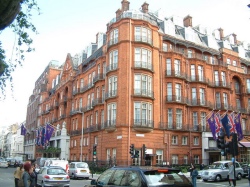
This five star Mayfair establishment owes its origins and name to William Claridge, possibly a former butler, and his wife Marianne, who took over management of a small hotel at 51 Brook Street in 1853.

In 1854, they purchased the adjoining Mivart’s Hotel, first established in 1812, and substantially expanded the premises. It apparently combined the two names – Mivart’s and Claridge’s – for a short time before the reference to Mivart’s was dropped.

The hotel, which stands on the corner with Davies Street, was bought by Richard D’Oyly Carte (owner of The Savoy) in 1893 and subsequently rebuilt in red brick to the designs of CW Stephens (of Harrods fame) with interiors by Sir Ernest George and the inclusion of modern amenities including en suite bathrooms and lifts. The hotel, which is now Grade II-listed, reopened in 1898, with some 203 rooms and suites.

It was extended in the late 1920s with the addition of 80 new rooms and a ballroom while the lobby was redesigned by art deco pioneer Oswald Milne (much of that decoration, including work by Basil Ionides, remains).

The hotel’s reputation as a place to stay among the well-to-do was given a significant boost when Empress Eugenie, wife of French Emperor Napoleon III stayed in 1860 and entertained Queen Victoria and Prince Albert.

It was also favoured by exiled royals during World War II including King Peter II and Queen Alexandria of Yugoslavia all staying here. In fact, their son, Crown Prince Alexander II, was born in suite 212 in 1945 (now named the Prince Alexander Suite).

The story goes that Prime Minister Winston Churchill declared the suite Yugoslav territory for a day (although evidence supporting the story about Churchill’s involvement is apparently scarce). It’s also said that a spadeful of dirt from Yugoslavia was placed under the bed so the Crown Prince could literally be born on Yugoslav soil (but there’s no mention of this aspect of the story on Crown Prince Alexander II’s official website).

Churchill and Clementine stayed in a suite here on the sixth floor after the wartime PM’s unexpected defeat in the general election of 1945.

Other luminaries to have stayed here include American actors Cary Grant, Katharine (and Audrey) Hepburn, Yul Brynner and Bing Crosby (Spencer Tracey famously said he didn’t want to go to heaven when he died but to Claridge’s) as well as director Alfred Hitchcock, Aristotle and Jackie Onassis, and, more recently, everyone from Mick Jagger and Madonna to Brad Pitt and Tom Cruise. Kate Moss celebrated her 30th birthday here.

And, of course, royals including the late Queen Mother, Queen Elizabeth II and Prince Phillip have all been regular diners.

The hotel, which underwent a major restoration from 1996 and saw 25 new suites designed by David Linley opened in 2012, is now part of the Maybourne Hotel Group, having parted ways with the Savoy Hotel in the mid-noughties.

Current facilities include the restaurant Fera at Claridge’s (this opened in 2014 after the closure of Gordon Ramsay at Claridge’s in 2013) as well as The Foyer & Reading Room (where afternoon tea is served), The Fumoir cocktail bar, Claridge’s Bar and a health club and spa.

The Claridge’s Christmas Tree is a much anticipated part of London’s festive season, with recent years seeing a different world-renowned designer taking on the task of decorating it, including the likes of John Galliano, Domenico Dolce and Stefano Gabbana, and Christopher Bailey of Burberry.

The hotel was the subject of a three part documentary, Inside Claridges, in December, 2012.

For more, see www.claridges.co.uk.

PICTURE: Tim Westcott (licensed under CC BY-SA 2.0)


This Week in London – Good grief, Charlie Brown!; Captain Cook and the Pacific; and the Kindertransport remembered…

Eighty original comic strips hand-drawn by Charles M Schulz, of Peanuts fame, are on show at Somerset House on the Strand along with many of his personal effects and interactive installations in an exhibition marking the 70th anniversary of the creation of iconic character Charlie Brown. Good Grief, Charlie Brown! Celebrating Snoopy and the Enduring Power of Peanuts looks at the impact of the comics on the cultural landscape, from 1950 to now, and, alongside works by Schultz, features responses to them by 20 figures from the worlds of art, fashion and music. The comic strips are showcased in their original state and size – complete with inky thumbprints and correction marks – and sit alongside vintage Peanuts products and publications as well as correspondence between Schultz and people such as Billie Jean King and Hillary Rodham (now Clinton). Along with interactive displays including a real-life re-imagination of Lucy’s Psychiatric Help booth, light boxes where people can learn to draw the Peanuts characters and a Snoopy Cinema, here are also three large-scale lights installations illuminating the entrance to the exhibition. This landmark exhibition can be seen until 3rd March. Admission charge applies. For more, see www.somerset.org.uk.

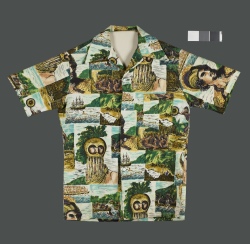
Newly acquired contemporary artworks by Pacific Island artists are at the centre of an exhibition re-examining the relationship between Captain James Cook and the peoples of the Pacific Ocean which is running at the British Museum. Reimagining Captain Cook: Pacific Perspectives also features historic artefacts including Cook’s personal possessions and the British Museum’s oldest example of a Hawaiian shirt (pictured). Among the 14 contemporary artworks are eight specially acquired for the exhibition and all are in some way a response to Cook’s voyages to places including Australia, New Zealand, New Caledonia, Hawaii, Vanuatu and Tahiti. They include Maori artist Steve Gibbs’ Name Changer – an attempt to restore awareness of the traditional Maori names for the region around Gisborne in New Zealand, and a work by the Aboriginal photographer and artist Michael Cook, Civilised #12, which reflects on the legacy of William Dampier, the first Briton to visit Australia (before Cook). The display can be seen in Room 91 until 4th August. Admission is free. For more, see www.britishmuseum.org. PICTURE: ‘Hawaiian’ style vintage cotton shirt, decorated with designs from drawings done on Captain Cook’s voyages, Hawaii, 1970-1980. © Image The Trustees of the British Museum.

An exhibition marking the 80th anniversary of the Kindertransport is running at the Jewish Museum London in Camden. Remembering the Kindertransport: 80 Years On tells the story of how in 1938-39, the British Government allowed 10,000 Jewish and other ‘non-Aryan’ children from Nazi-occupied Europe to come to Britain in a rescue operation which became known as the ‘Kindertransport’. It features the children, now in their 80s and 90s, telling their stories on film as well as personal objects and artefacts they brought with them from their homelands. Also on show is a photographic exhibition – Still in Our Hands: Kinder Life Portraits – featuring archival photographs and portraits of former Kindertransportees and another – My Home and Me – which, held in partnership with the British Red Cross, explores the journey of young refugees arriving in Britain today. The exhibition, which is being accompanied by a series of events, runs until 10th February. Admission is free. For more, see www.jewishmuseum.org.uk/kindertransport.

Send all items for inclusion to exploringlondon@gmail.com.

10 historic London hotels…2. The Savoy…


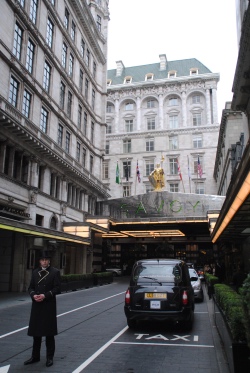
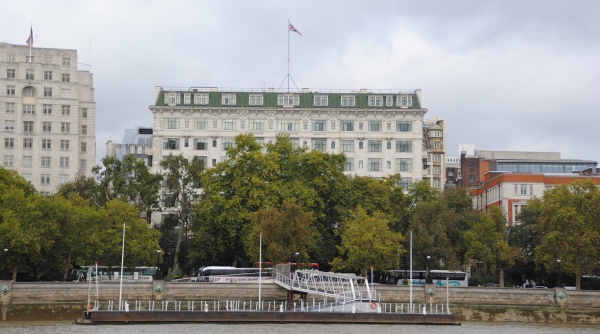
The first purpose-built luxury hotel built in Britain (and often referred to as London’s “most famous” hotel), The Savoy opened its doors on 6th August, 1889.

Located on the river side of the Strand on the site of what had been the medieval Savoy Palace (its most famous resident was John of Gaunt), the hotel was built by theatre impresario Richard D’Oyly Carte using profits made from his staging of Gilbert and Sullivan operas, some of which were performed in the neighbouring Savoy Theatre.

The now Grade II-listed building, which apparently had no overall architect in its initial design process, exuded opulence and its interiors included the latest in modern amenities such as electric lighting and lifts, en suite bathrooms in most of the guest rooms and constant cold and hot running water.

César Ritz, who would later rise to fame as the owner of The Ritz Hotel in Paris and then London (see our recent post), was hired as the manager and Auguste Escoffier as the chef. Together they oversaw the introduction of a new, unprecedented level of hotel service which would set the standard for future enterprises. This included keeping a comprehensive index of guest’s tastes and preferences and saw Escoffier revolutionise the restaurant industry in the country with the creation of various “stations” in the kitchen (his pots and pans are apparently still at the hotel).

The hotel was expanded in 1903-04 under the eye of architect Thomas Edward Collcutt (the designer of Wigmore Hall) with new east and west wings and the main entrance was moved from the river side of the building to Savoy Court running off The Strand. The Front Hall is a survivor of this period while the Lancaster Ballroom dates from 1910.

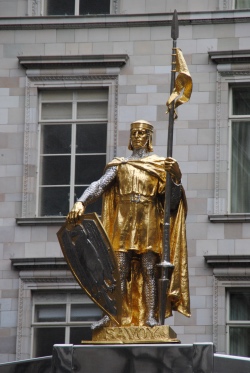
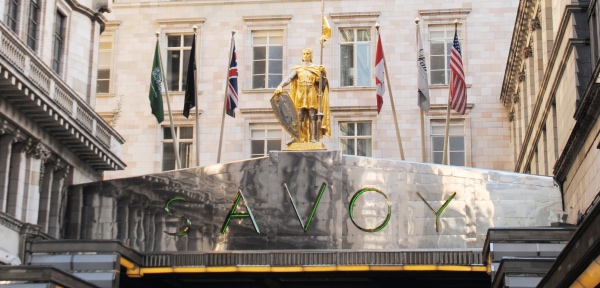
The hotel underwent further remodelling in the 1920s – it was during this period that the famous stainless steel sign over the Savoy Court entrance, designed by art deco architect Howard Robertson (later Sir Howard), was created (Savoy Court incidentally is the only street in the UK where traffic must keep to the right – more on that another time). The sign is topped with a gilt statue of Peter of Savoy, the uncle to King Henry III’s wife, Eleanor of Provence (pictured below). It was Peter who first built the Savoy Palace on the land where the hotel now stands. The sign, meanwhile, was created for the 1904 extension but placed here during the 1920s works.

Further modifications – including the introduction of air conditioning – followed in later decades. The hotel now boasts some 267 rooms and suites (the latter include the Royal Suite which spans the entire riverside of the fifth floor), many of which feature panoramic views of the River Thames.

Famous guests over the years have included royalty such as King Edward VII (when Prince of Wales) as well as more recent royals, French actress Sarah Bernhardt, Oscar Wilde, Charlie Chaplin, Sir Henry Irving and Sir Laurence Olivier. It’s also hosted a who’s who of Hollywood – everyone from Marilyn Monroe and Judy Garland to Frank Sinatra, Humphrey Bogart and John Wayne – and US President Harry S Truman.

Others associated with the hotel include opera singer Dame Nellie Melba – the dessert known as a Peach Melba was created here in her honour, and artist Claude Monet, who painted Waterloo Bridge from a position on one of the balconies.

Among other significant events to take place within its walls was a 1905 “Gondola Party” hosted by American millionaire George A Kessler which saw the central courtyard flooded as part of a recreation of Venice with guests dining on an enormous gondola and entertainment featuring singer Enrico Caruso.

In 1953, to mark the coronation of Queen Elizabeth II, the hotel hosted a ball attended by 1,400 of the rich and famous with special touches including 16 Yeoman Warders from the Tower of London who lined the entrance staircase.

Films shot here include Kipps (1921), based on a HG Wells novel (Wells was in attendance during the filming), The French Lieutenant’s Woman (1981) and Notting Hill (1999).

The Savoy remained in the Carte family until it was bought by an American private equity house in 1998 and eventually sold, in the mid-2000s, to become part of Fairmont Hotels and Resorts of Canada.

Closed in late 2007 for a complete renovation (the cost of which has been put at £220 million), it reopened in October, 2010. Among restaurants and bars now in the premises are the Thames Foyer restaurant – hosted in a glass atrium, it’s where afternoon tea is taken, the American Bar – described as the oldest cocktail bar in Britain, the Beaufort Bar, and the restaurant Kaspar’s.

The latter is named after the hotel’s oldest “employee” – Kaspar the Cat. Carved in 1927 by Basil Ionides, the cat was created to act as a 14th guest in the private dining rooms when 13 guests were present, a figure which was considered unlucky and which, tradition held, meant the first person to leave the table would one the first to die.

Its origins go back to 1898 when a wealthy South African by the name of Woolf Joel apparently scoffed at the idea of 13 being an unlucky number at the table and volunteered to leave it first. He was shot dead back in South Africa just a few week’s later. In the wake of his death, management at the hotel decreed that any table of 13 would be joined by a staff member.

But this was only a short-term solution – not only there was there the privacy of diners to consider, the fact staff would be a person down when this was required was a problem. So when Ionides redecorated the private dining room ‘Pinafore’ in the 1920s, he created the cat, complete with napkin, to fulfil the role of the 14th diner. And so he has ever since. Kaspar, the subject of a children’s book written by Michael Morpugo in 2008, can these days be found in Kaspar’s or, when not working, in the Front Hall.

For more, see www.thesavoylondon.com

10 historic London hotels…1. The Ritz Hotel…

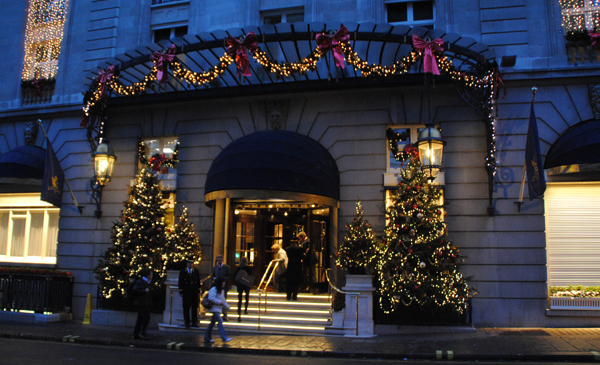
This Piccadilly institution was constructed from 1904 to 1906 and takes its name from Swiss hotelier César Ritz.

It was constructed on the site of a former coaching inn for the Blackpool Building and Vendor Company – it was the first steel-framed building in London – and designed by Mewés and Davis, the architects of the Paris Ritz. And even though Ritz himself was apparently actually retired at the time, it was built according to his specifications.

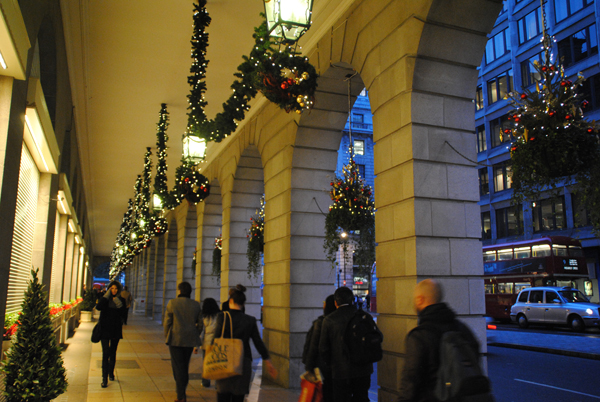
The exterior facade features Norwegian granite and Portland stone and boasts an arcade on Piccadilly which deliberately evokes the Rue de Rivoli in Paris. The interior, the work of Waring and Gillow, is designed in the style of Louis XVI and was designed to be opulent with all rooms featuring a working fireplace.

Public spaces include the Palm Court – famous for its traditional afternoon teas –  and a Michelin-starred restaurant with floor to ceiling windows overlooking Green Park. Other features include the Rivoli Bar, designed in 2001 by Tessa Kennedy to resemble the bar in the Orient Express, and the basement Ritz Club, a private casino.

The now Grade II*-listed hotel was officially opened by Ritz himself on 24th May, 1906, and was soon adopted by the rich and famous – the patronage of the Prince of Wales (future King Edward VIII) after the death of King Edward VII was one key reason for its success.

Actor Charlie Chaplin, who apparently had to have 40 police hold back the crowd to enter the hotel, is also a name famously associated with it as is that of Russian prima ballerina Anna Pavlova who performed here.

The Aga Khan and Paul Getty both had suites, and playwright Noel Coward and Queen Elizabeth, The Queen Mother, regularly dined here while Tallulah Bankhead famously sipped champagne from a slipper in the bar. The Marie Antoinette Suite was also famously the location of a conference between Winston Churchill, Dwight Eisenhower and Charles de Gaulle during World War II.

The hotel also featured in 1999 film Notting Hill, starring Hugh Grant and Julia Roberts, and in the more recent TV drama Downton Abbey.

The five star hotel underwent a major 10 year refurbishment after it was acquired by the Barclay brothers in 1995. The complex these days includes the adjoining 18th century property William Kent House (designed, of course, by William Kent).

In 2001, the hotel was awarded the first Royal Warrant for Banqueting and Catering Services. Other boasts these days include being the only UK hotel to have a certified tea sommelier (among teas served is the hotel’s own Ritz Royal Blend).

For more, see www.theritzlondon.com.

Famous Londoners – Mary Shelley…

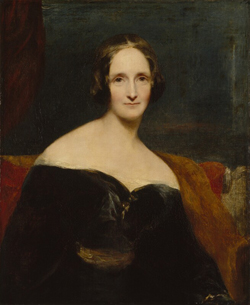
This year marks 200 years since the publication of Mary Shelley’s book, Frankenstein: or, The Modern Prometheus, so it’s timely to have a look at the life of this famous Londoner.

Shelley was born on 30th August, 1797, in Somers Town, London, to feminist philosopher Mary Wollstonecraft and political philosopher, novelist and journalist William Godwin. Her mother died soon after her birth, leaving her upbringing to Godwin (and his second wife Mary Jane Clairmont who apparently didn’t get on with Mary).

While she received little formal education, she was tutored in a range of subjects – everything from literature to art, French and Latin – by her father and visiting tutors. Godwin described her as having a great desire for knowledge.

She first met her future husband, the Romantic poet Percy Bysshe Shelley, while still a teenager. Shelley, who was estranged from his wife, had struck up a friendship with her father and was subsequently a regular visitor to their house.

Mary and Percy began secretly meeting each other at Mary Wollstonecraft’s grave in St Pancras Churchyard and then on 28th June, 1814, the couple eloped to France, taking Mary’s step-sister Claire Clairmont with them but leaving Shelley’s pregnant wife behind.

They went on to Paris and then, through war-ravaged France, to Switzerland. At Lucerne, however, a lack of money forced them to turn back and they returned to London where Mary’s father refused to have anything to do with her.

Now pregnant, Mary and Shelley moved into lodgings with Claire in Somers Town and later in Nelson Square where they were known for entertaining his friends. Shelley’s wife, meanwhile, gave birth to his son – something that must have been hard for Mary – and it is believed that he was also a lover of Mary’s step-sister Claire.

Mary gave birth to her first child, a daughter, on 22nd February, 1815, but she died just 12 days later. That same year, the death of Shelley’s grandfather brought himself considerable wealth and with their financial situation now relieved, in August, 1815, they moved to Bishopgate, in Windsor Great Park. In January, 1816, Mary gave birth to her second child, a son, William.

In May, 1816, the couple travelled with their son William and Mary’s step-sister Claire to Geneva in Switzerland where they hoped to improve Percy’s health. It was during the time they spent there that a ghost-writing contest in June, 1818, led her to write what would be the basis of the novel Frankenstein – credited with introducing genre of science fiction into English literature.

Returning to England, the Shelley’s took up residence in Bath (Clairmont was pregnant by Lord Byron and they wanted to keep this from the Godwins). Harriet Shelley, Percy’s estranged wife, drowned herself in the Thames on 9th November and it was following that, that on 30th December, Mary and Percy married at St Mildred’s Church in London with Mary’s father and step-mother as witnesses.

In March, 1817, the Shelley’s took up residence in Marlow where Mary gave birth to second daughter, Clara Everina Shelley, on 2nd September. Then in March, 1818, the family – along with Claire Clairmont and her daughter – travelled to Italy where it was hoped the warmer climate would help Shelley, who had been diagnosed with pulmonary disease.

There they lived at various addresses and were in Venice when Clara died of dysentery on 24th September, 1818. They traveled to Rome in April the following year and there, on 7th June, William died of malaria, leaving the couple devastated.

Their fourth child and only surviving child, Percy Florence Shelley, was born in Florence on 12th November. Their Italian sojourn continued for the next couple of years until, on 8th July, 1822, Percy Shelley and his friend Edward Williams were drowned in a squall in the Gulf of Spezia.

Determined to show she could write and look after her son, Mary Shelley returned to England in mid-1823 and lived in The Strand with her father and stepmother until in the summer of 1824 she moved to Kentish Town. Her novel, The Last Man, was published in 1826 followed by The Fortunes of Perkin Warbeck (1830), Lodore (1835), and Falkner (1837) as well as working on numerous other writing projects.

Shelley never remarried although she was linked to various men romantically including American actor John Howard Payne whose offer of marriage she rejected.

After her son Percy left university in 1841, he came to live with her and between 1840 and 1842 Shelley travelled to various locations in Europe with her son. Sir Timothy Shelley, Percy Bysshe Shelley’s father, died in 1844 with the result that Shelley and her son were now financially independent.

Percy married Jane Gibson St John in 1848 and Mary lived her son and daughter-in-law, splitting their times between the ancestral Shelley home – Field Place in Sussex – and Chester Square in London as well as accompanying them on their travels overseas.

Shelley suffered considerable illness in the last years of her life – including debilitating headaches and bouts of paralysis in her body – before on 1st February, 1851, she died at the age of 53 from a suspected brain tumour at the Chester Square property.

She had asked to be buried with her mother and father, but Percy and Jane instead buried her at St Peter’s Church in Bournemouth closer to their home. In order to fulfill her wishes, they had the bodies of her parents exhumed from St Pancras graveyard and reburied with her.

Despite gaining respect as a writer in her own lifetime, Shelley’s reputation in the literary arts was overshadowed by that of Percy’s after her death. But in more recent decades her overall writing career has come to be more closely examined and applauded.

If you missed it, for more on Mary Shelley’s links with London, see our special series 10 sites from Mary Shelley’s London.

PICTURE: Mary Shelley by Richard Rothwell (oil on canvas, exhibited 1840/NPG 1235). © National Portrait Gallery, London (licensed under CC BY-NC-ND 3.0)

This Week in London – Hampton Court kicks off Christmas festivities; ‘The Monarch of the Glen’ returns to National Gallery; and Alfred Munnings’ World War I art…

Visitors to Hampton Court Palace will be transported back to 1906 from Saturday as the palace community prepares for Christmas. Christmas Present, Christmas Past features a range of activities from carol singing around the tree to telling ghost stories (and looking at the traditions behind them) as well as live culinary demonstrations in the kitchens showing the evolution of Christmas dinner as we know it today. Meanwhile, the Hampton Court Palace Festive Fayre returns next weekend (7th to 9th December) with more than 90 stalls set up in the palace courtyards selling mince pies, mulled wine and a host of other festive treats. And the palace’s ice-skating rink has returned to the Tudor West Front (and will be there until 6th January). Admission charges apply. For more, see www.hrpfoodfestivals.com.

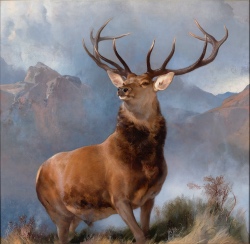
Sir Edwin Landseer’s dramatic work – The Monarch of the Glen – is at the centre of a new exhibition celebrating the connections between the 19th century artist and the National Gallery. “Coming home” to the Trafalgar Square-based institution for the first time in more than 160 years, the painting – arguably the most famous animal painting in the world – is one of 14 works included in a new free show opening today. Among paintings created to decorate the Palace of Westminster after fire devastated the building in 1834, Landseer’s (1802-1873) work was first exhibited at the Royal Academy in 1851, then housed in what is now the National Gallery building. It’s now on loan from the National Galleries of Scotland, which acquired the work in 2017. This is the first London showing since 1983. Other works in the display include Landseer’s Ecorche drawing of a dog’s leg (1821), as well as paintings and drawings connected with the famous lions Landseer designed for Trafalgar Square including a John Ballantyne portrait of the artist modelling the lions in his studio and a work by Queen Victoria, whom Landseer tutored in etching, entitled A pencil drawing of a stag after Landseer’s mural on the Dining Room wall at Ardverikie Shooting-lodge (1847). Can be seen in Room 1 until 3rd February. For more, see www.nationalgallery.org.uk. PICTURE: Edwin Landseer, ‘The Monarch of the Glen’ (about 1851), © National Galleries of Scotland

More than 40 paintings created during the final year of World War I by artist Alfred Munnings (1878-1959) go on show at the National Army Museum in Chelsea tomorrow. Alfred Munnings: War Artist, 1918 shows his mastery of equine subjects as well as portraiture and landscapes. Munnings was commissioned by the Canadian War Memorials Fund as an official war artist to capture the fighting front and logistics behind the scenes and in early 1918 was embedded with the Canadian Expeditionary Force. The exhibition has been developed by the Canadian War Museum in partnership with The Munnings Art Museum and is supported but The Beaverbrook Canadian Foundation. Can be seen until 3rd March. Admission charge applies. For more, see www.nam.ac.uk.

Send all items for inclusion to exploringlondon@gmail.com.