This Week in London – Revamped National Army Museum opens; butterflies return to the NHM; and World War I reimagined…

• The National Army Museum opens today following a massive three year, almost £24 million redevelopment. Designed by architects BDP and exhibition design agency Event (with £11.5 million in funding from The National Lottery), the main site of the museum at Chelsea features five new permanent galleries and a temporary exhibition space. Laid out over four floors, the new galleries feature more than 2,500 objects arranged under the themes of ‘Soldier’, ‘Army’, ‘Battle’, ‘Society’ and ‘Insight’. Among the objects on display are Crimean Tom, a cat found during the Crimean War and brought back as a pet (‘Soldier’), a portrait of Khudadad Khan VC, the first Indian soldier to win the Victoria Cross (‘Army’), the famous ‘Siborne Model’ of the Battle of Waterloo (‘Battle’), the flak jacket, helmet, identity discs and press pass of journalist Kate Adie (‘Society’), and a cup from the 1745 Jacobite Rebellion (‘Insight’). The new 500 square metre temporary exhibition space, meanwhile, is initially hosting the exhibition War Paint: Brushes with Conflict which features more than 130 paintings and objects explores the complex relationship between war and the men and women who map, record, celebrate and document it. Other features at the museum include a new cafe, shop and play area for children known as Play Base. Entry to the museum is free. For more, see www.nam.ac.uk.

• Butterflies return to the Natural History Museum this week with the immersive exhibition, Sensational Butterflies. The experience, now in its ninth year, takes visitors on a trail through a tropical habitat as they encounter each aspect of the life-cycle of the butterfly with highlights including watching them hatch from delicate chrysalises and seeing them feed and engage with each other. The Butterfly House team will be on hand to answer questions and give advice and tips. Admission charge applies. Runs from Friday until 17th September. For more, see www.nhm.ac.uk/sensational-butterflies.

A new exhibition exploring the personal stories of those who fought in World War I as well as those back home opens at the Guildhall Art Gallery tomorrow. Echoes Across The Century, conceived and delivered by the Livery Schools Link in partnership with the gallery, takes visitors on a “multi-sensory journey” exploring craftsmanship, memory and separation. It features Jan Churchill’s installation, Degrees of Separation, and the work of 240 students who were guided and inspired by Jane as they explored the impact of the war and imagined what life was like for those 100 years ago. Admission is free. Runs until 16th July. For more follow this link.

Send all items for inclusion to exploringlondon@gmail.com

Famous Londoners – Sir Henry Wellcome…

Pharmacist, entrepreneur, philanthropist, and collector, American-born Sir Henry Solomon Wellcome’s name lives on in London’s Wellcome Collection and Wellcome Library as well as the world-renowned biomedical research charity known as the Wellcome Trust.

The son of a farmer turned itinerant preacher, Wellcome was born on 21st August, 1853 in a log cabin on the American frontier in northern Wisconsin and, working in his uncle’s drugstore in Garden City, Minnesota, developed an interest in medicine, particularly the marketing of medicine (his first marketing success was his own invisible ink).

Taking various positions at other pharmacies over the ensuing years, he studied at the Philadelphia College of Pharmacy and there meet Silas Burroughs. Graduating in 1874, he spent a few years as a pharmaceutical salesman (and an explorer, travelling to South America to search for rare native cinchona trees, a source of quinine) before, with the encourage of Burroughs, he moved to London in 1880.

There they founded a pharmaceutical company, Burroughs, Wellcome & Co. They introduced the selling of medicine in the form of compressed tablets – it had hitherto been sold largely in liquid or powder form – to England with their patented ‘tabloid’. They also pioneered direct marketing to doctors.

When Burroughs died in 1895 (they had already fallen out), Wellcome took over the flourishing company in its entirety and set up two research laboratories connected to his pharmaceutical company. In 1924, he consolidated all his commercial and non-commercial entities in one holding company, The Wellcome Foundation Ltd.

In 1901, Wellcome married Gwendoline Maud Syrie Barnardo, daughter of Dr Thomas John Barnardo, founder of children’s charity Barnardo’s (they had met in Khartoum).

They had one child, Henry Mounteney Wellcome, who was born in 1903 and sent to foster parents at about the age of three due to the travelling lifestyle of his parents. The couple, however, were not happy and Gwendoline, known as ‘Syrie’, reportedly had several affairs including one with department store identity Harry Gordon Selfridge and another with author William Somerset Maugham, whom she later married. Wellcome and Gwendoline divorced in 1916.

Wellcome, meanwhile, became a British subject in 1910 and was knighted in 1932, the same year he was made an honorary fellow of the Royal College of Surgeons of England. Something of a recluse in his later years, he died in pneumonia at The London Clinic on 26th July, 1936, following an operation.

Under the terms of his will, the Wellcome Trust was established for “the advancement of medical and scientific research to improve mankind’s wellbeing” which, initially funded by the income from the Wellcome Foundation and now a separate charity, continues to fund biomedical research and training.

Wellcome, meanwhile, had amassed an enormous collection of artefacts with the aim of creating a ‘Museum of Man’, which by the time of his death amounted to more than a million objects including at least 125,000 medically related ones and such oddities as Napoleon’s toothbrush and King George III’s hair. The first exhibition of selected objects from his collection opened at a temporary exhibition in Wigmore Street in 1913 next door to the Wellcome Burroughs showroom and since 1976 some of his collection have been on show at the Science Museum.

The Wellcome Collection, based in Euston Road, was established in 2007 to display some of Wellcome’s medical collection as well as artworks. The Wellcome Library, now part of the Wellcome Collection, is based on the book collection of Sir Henry which he started collecting seriously late in the 1890s. The books were housed in a series of locations around London before, in 1949, opening as the Wellcome Historical Medical Library in Euston Road.

An English Heritage Blue Plaque can be found at Sir Henry’s former home at 6 Gloucester Gate, Regent’s Park, which he leased from about 1920 until his death.

PICTURE: Henry Solomon Wellcome in 1930/Wikimedia/CC BY 4.0

This Week in London – Anti-war movement history at IWM; National Gallery’s new space; and a VR spaceflight at the Science Museum…

We pause briefly at the start of this week’s coverage to remember those killed and injured in yesterday’s terror attack outside the Houses of Parliament in Westminster as well as pay tribute to the emergency services and passersby who responded to aid the wounded.

The UK’s first major exhibition dedicated to the evolution of the anti-war movement has opened at the Imperial War Museum this week. People Power: Fighting for Peace features such rare items as a hand-written poem by Siegfried Sassoon, artist Gerald Holtom’s original sketches for the iconic ‘peace symbol’, artworks depicting the destructive nature of World War I like Paul Nash’s Wire (1918) and CRW Nevinson’s Paths of Glory (1917), a handwritten letter by Winnie the Pooh author AA Milne outlining his struggle to reconcile pacifism with the rise of Hitler, and Peter Kennard and Cat Philip’s iconic photomontage Photo Op (2007) which depicts former PM Tony Blair taking a selfie against the backdrop of an explosion. More than 300 items are displayed in the exhibition including paintings, literature, posters, banners, badges and music, dating from World War I to the present. Admission charge applies. Runs until 28th August. For more, see www.iwm.org.uk/exhibitions/iwm-london/fighting-for-peace. PICTURE: David Gentleman, Stop the War – No More Lies/© David Gentleman, reproduced with the kind permission of the Stop the War Coalition.

• The first new gallery space to open at The National Gallery in 26 years was launched this week. Gallery B, designed by architects Purcell, features some 200 square metres of display space and features nine works by Rubens and 11 by Rembrandt. There are also drawings by contemporary painter Frank Auerbach, inspired by Rembrandt and Rubens works, in the Gallery B lobby and espresso bar. The launch also marks the daily opening of Gallery A which has hitherto only be opened on selected days. Entry is free. For more, see www.nationalgallery.org.uk.

A virtual reality experience which enables people to experience what it feels like to sit inside the Russian Soyuz TMA-19M spacecraft used by Tim Peake – the UK’s first European Space Agency astronaut – in a mission to and from the International Space Station opens at the Science Museum tomorrow. The South Kensington museum acquired the spacecraft in December last year and, from Friday, visitors will be able to take part in Space Descent VR with Tim Peake – a 360 degree state-of-the-art virtual reality experience which allows visitors to experience what it is like in the Soyuz’s 1.5 tonne descent module during its dangerous 400 kilometre high speed journey back to Earth during which it has to slow from a speed in orbit of 25,000 kph. The experience was created by Alchemy VR and made possible with the support of Samsung, Tim Peake and the ESA. For more information and tickets, see sciencemuseum.org.uk/VR.

Send all items for inclusion to exploringlondon@gmail.com.

This Week in London – Michelangelo & Sebastiano; St Patrick’s Day festivities; the first woman in space; and, Moscow’s unrealised past…

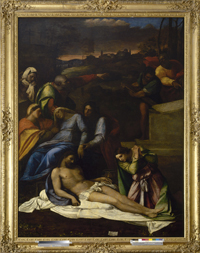
The collaborative partnership between Renaissance Italian artists Michelangelo and Sebastiano del Piombo is the subject of a new exhibition which opened at The National Gallery this week. The Credit Suisse Exhibition: Michelangelo & Sebastiano features about 70 works – paintings, drawings, sculptures and letters – produced by the pair before, during, and after their collaboration. The two met when Michelangelo was working on the ceiling of the Sistine Chapel and spent 25 years in a friendship partly defined by their opposition prodigious artist Raphael. Key works on show include their first collaborative work, Lamentation over the Dead Christ (also known as Viterbo ‘Pietà’ it was painted in about 1512-16), The Raising of Lazarus (completed by Sebastiano in 1517-19 with Michelangelo’s input and one of the foundational paintings of the National Gallery’s collection – it bears the first inventory number, NG1 ), The Risen Christ (a larger-than-life-size marble statue carved by Michelangelo in 1514–15 which is shown juxtaposed, for the first time, with a 19th-century plaster cast after Michelangelo’s second version of the same subject (1519–21)), and, Michelangelo’s The Virgin and Child with the Infant Saint John the Baptist (also known as the ‘Taddei Tondo’, it was commissioned in 1504-05 and is on loan from the Royal Academy of Arts). The display features a 3D reproduction of the Borgherini Chapel in Rome to evoke the sense of seeing the works in situ. Runs until 25th June. Admission charge applies. For more, see www.nationalgallery.org.uk. PICTURE: Sebastiano del Piombo, Lamentation over the Dead Christ (1516), The State Hermitage Museum, St Petersburg/© The State Hermitage Museum /Vladimir Terebenin

St Patrick’s Day is tomorrow and to celebrate London is hosting three days of events showcasing Irish culture, food and music. Cinemas in the West End will be showing short Irish films, there will be comedy, drama and family workshops, an Irish Cultural Trail in the Camden Market and a world-renowned parade on Sunday ahead of a closing concert in Trafalgar Square. For the full programme, see www.london.gov.uk/stpatricks.

An exhibition dedicated to the life and career of Valentina Tereshkova, the first woman in space, has opened at the Science Museum. Attended by the woman herself in honour of her 80th birthday this week, Valentina Tereshkova: First Woman in Space tells how Tereshkova came to be the first woman in space when, on 16th June, 1963, at the age of just 26 she climbed aboard the USSR spacecraft Vostok 6. She orbited the Earth 48 times over the three days, logging more flight time than all the US astronauts combined as of that date. She never flew again but remains the only female cosmonaut to have flown a solo mission. Tereshkova, who had been a factory worker, went on to become a prominent politician and international women’s rights advocate. The exhibition, which is free, is part of the 2017 UK-Russia Year of Science and Education. Runs until 16th September. For more, see www.sciencemuseum.org.uk/valentina-tereshkova.

Six unbuilt architectural landmarks – proposed for Moscow during the 1920s and 1930s but never realised – are at the heart of a new exhibition which has opened at the new Design Museum in Kensington. Imagine Moscow: Architecture, Propaganda, Revolution looks at how the proposed schemes – including the Palace of the Soviets, planned to be the world’s tallest building, and Cloud Iron, a network of horizontal ‘skyscrapers’ – reflected the changes taking place in the USSR after the Russian Revolution. As well as the six case studies, the exhibition features a dedicated room to the “geographical and ideological centre” of this new Moscow – the Lenin Mausoleum. Runs until 4th June. Admission charge applies. For more, see www.designmuseum.org.

Send all items for consideration to exploringlondon@gmail.com
Treasures of London – ‘Out of Order’…

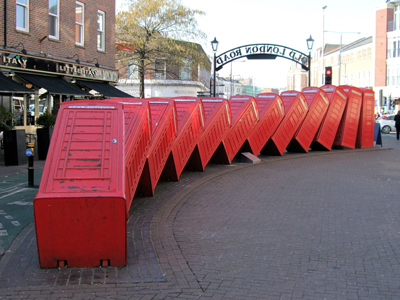
This sculpture by London-based Scottish artist David Mach can be found in Kingston upon Thames in south-west London. It depicts 12 K6 red phone boxes falling onto one another like a row of dominoes and was commissioned from the Royal Academician by the Royal Borough of Kingston upon Thames in 1988. Unveiled the following year, it was renovated in 2001. There’s been talk in the past of it being removed (and of the end phone being connected, so it works) but the iconic sculpture remains in situ near the Old London Road gateway (and unconnected). PICTURE: Jim Linwood/CC BY-SA 2.0 (image cropped)

This Week in London – Rosalind Franklin’s grave; American printmaking; and Disabled Access Day at royal residences….

Acclaimed biologist Rosalind Franklin’s grave in Willesden United Synagogue Cemetery has been given listed status, Historic England announced in marking International Women’s Day this week. Franklin’s tomb commemorates her life and achievements – they include X-ray observations she made of DNA which contributed to the discovery of its helical structure by Crick and Watson in 1953. Meanwhile, Historic England has teamed with The Royal Society to highlight the achievements of 28 remarkable women noted for their achievements in the fields of chemistry, biology, physics and astronomy. The women’s stories have been explored and key historic locations mapped. They include the Marianne North Gallery in Kew Gardens (named for 19th century botanist Marianne North), the Elizabeth Garrett Anderson Hospital – founded in 1872 as the New Hospital for Women in London by Anderson, a suffragette and the first English woman to qualify as a doctor, and the Royal Academy of Arts where natural history illustrator and painter Sarah Stone was an honorary exhibitor in the 1780s.

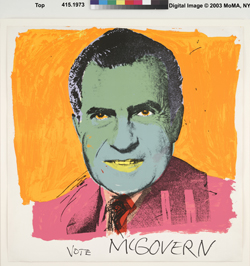
The first major exhibition focusing on contemporary American printmaking has opened in the Sainsbury Exhibitions Gallery of The British Museum. The American Dream: pop to the present features more than 200 works from 70 artists including Andy Warhol, Jasper Johns, Robert Rauschenberg, Ed Ruscha, Chuck Close, Louise Bourgeois and Kara Walker. Including loans from institutions such as The National Gallery of Art in Washington, DC, as well the museum’s own collection, the works span six decades – from the moment when pop art arrived in the New York and West Coast scene of the early 1960s, to the rise of minimalism, conceptual art and photorealism in the 1970s, and through to the practices of today’s artists. Among the works on show are Warhol’s Marilyn, Willie Cole’s Stowage and Claes Oldenburg’s sculpture of the Three-Way Plug. Admission charges apply. Runs until 18th June. For more, see www.americandreamexhibition.org. PICTURE: Andy Warhol (1928–1987), ‘Vote McGovern’, Colour screenprint/© 2016 The Andy Warhol Foundation for the Visual Arts, Inc./Artists Rights Society (ARS), New York and DACS, London.

Visitors with disabilities will be offered free admission to royal residences – including the Royal Mews and The Queen’s Gallery at Buckingham Palace – this weekend to mark Disabled Access Day. Visitors to the Queen’s Gallery can join verbal descriptive tours of the Portrait of the Artist exhibition on 12th March while the Royal Mews will offer free admission to disabled visitors on 10th and 11th March.  Standard access resources, including plain English tour scripts, induction loops, large-print and list access will be available across all venues. For more, see www.royalcollection.org.uk.

Send all items for inclusion to exploringlondon@gmail.com.

10 (more) fictional character addresses in London – 6. 9 Bywater Street, Chelsea…

Fictional British spy George Smiley featured in some eight books written by acclaimed author John Le Carré (sometimes as the main protagonist, sometimes as a side character) and is about to appear in a ninth, A Legacy of Spies, which comes out in September.

And that’s not to mention his appearance on small screens and large where he’s been portrayed by everyone from James Mason and Sir Alec Guinness to Denholm Elliott and Gary Oldman.

In the books, Smiley and his wife, Lady Ann, lived at a number 9 Bywater Street in Chelsea – which is an actual address, just off King’s Road (pictured with the red door). The Georgian townhouse was appropriately used to depict his home in the 1979 BBC series of Tinker Tailor Soldier Spy although, interestingly, while number nine’s exterior was used, it was apparently number 10, next door – pictured here with the blue door – which provided the interiors.

Le Carré, who was living just over the Thames in Battersea at the time of Smiley’s creation, has reportedly said he chose the location because his literary agent lived nearby (although there is apparently a little fuzziness on whether this is the case) and the mother of one his pupils from Eton (Le Carré – actually David John Moore Cornwell – taught at Eton for two years before he joined MI5 in 1958) lived in the street.

But perhaps the best literary reason is the fact that Bywater Street, despite the name, is actually a cul-de-sac which adds to the difficulty of anyone trying to spy on Smiley. A wise choice for a spy’s residence, in other words.

Other locations associated with George Smiley in London include The Circus, the secret London intelligence HQ where Smiley and his fellow intelligence operatives worked, which was located in an office block in Cambridge Circus, on the corner of Charing Cross Road and Shaftesbury Avenue.

PICTURE: Google Maps

LondonLife – Lovat Lane…

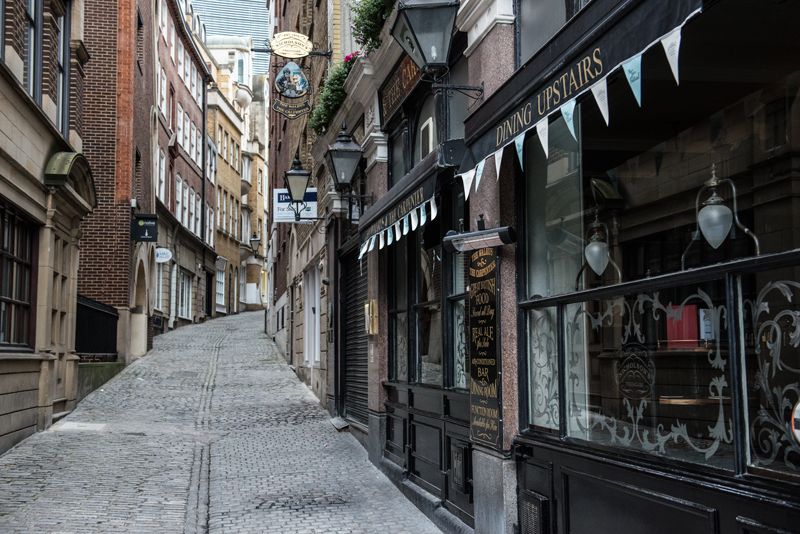
Originally known as Love Lane (the origins of which are somewhat obvious – a place where you could find ‘love’ although  whether this meant illicit love or has a more innocent explanation remains a matter of discussion),  the name of this charming alleyway – which runs south from Eastcheap to Lower Thames Street, was changed in the mid-20th century to avoid confusion with another Love Lane to the north. The new name apparently related to Lord Lovat, whose fisheries supplied the nearby former Billingsgate Market. PICTURE: Simon Mumenthaler/Unsplash.

10 (more) fictional character addresses in London – 5. 27b Canonbury Square…

canonbury_squareOK, I know the plaque on the front says this was the actual home of author George Orwell – who moved here in 1944 with his family. But the property was also apparently partly the inspiration for Victory Mansions, the home of  Winston Smith, the protagonist of his novel, Nineteen Eighty-Four.

Orwell (real name Eric Arthur Blair) moved to the property at 27b Canonbury Square with his wife Eileen and their young adopted son Richard in 1944 after their flat in Mortimer Crescent, Kilburn, was hit by a V-1 flying bomb.

But Eileen sadly died unexpectedly during surgery only a few months later in early 1945 while Orwell was off working as a war correspondent.

Despite this, Orwell retained the property until 1947 – the same year his allegorical story Animal Farm was published – but had left the property when Nineteen Eighty Four, which he had largely written while on the Scottish island of Jura in 1947 and 1948, was published in June, 1949 – only a few months before he died in January, 1950.

His was apparently the basement flat – rather unlike Smith’s home which Orwell wrote was located “seven flights up” in a rather large block. The architectural differences aside, however, Orwell’s flat apparently served as something of a model for Smith’s “bleak tenement in a down-at-heel area” which was, like the rest of the flats Victory Mansions, was “falling to pieces” and filled with the smell of boiled cabbage.

A plaque erected by the London Borough of Islington has long adorned the building although last year Orwell’s son Richard attended the unveiling of a new plaque which amended the dates Orwell lived here, changing  it from 1945 to 1944-47.

Of course, London is replete with other locations mentioned in Orwell’s book – Trafalgar Square becomes Victory Square (Big Brother stands atop the column in place of Admiral Lord Nelson), the Ministry of Truth where Smith works is modelled on the University of London’s Senate House in Bloomsbury, and the cells in the Ministry of Love are apparently based on those at Bethnel Green Police Station where Orwell has been incarcerated (although only for a few hours) after being arrest for drunk and disorderly behaviour in 1931.

Orwell, meanwhile, is commemorated with numerous plaques located around London, including an English Heritage Blue Plaque at a property in Lawford Road, Kentish Town.

Canonbury Square – Orwell’s former residence is in the foreground (with the old plaque). PICTURE: 14wesley/Wikipedia/CC BY-SA 3.0

London Pub Signs – The Marquis of Granby…

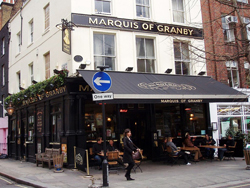
This Fitzrovia pub, famous for its literary connections (more about those in a moment), takes its name from a popular 18th century military hero.

marquis-of-granbyJohn Manners, the Marquis of Granby, played a key role for Britain during the Seven Years War – between Britain and her allies and France and hers – and, thanks to his popularity among the soldiers who served under his command, had numerous pubs named for him (he apparently also had a hand in setting up many old soldiers as publicans).

In his most famous battlefield exploit, while leading a series of cavalry charges at the Battle of Warburg in 1760 (in actions which saved the day), he apparently lost his hat and wig and was forced to salute his commander, Prince Ferdinand of Brunswick, without them.

All of which explains why the pub sign doesn’t show him wearing a hat and why soldiers from his former regiment, the Blues and Royals, have the unique privilege in being able to salute while not wearing headwear. The fact Manners was bald also apparently led to the coining of the phrase, “going at it bald-headed” – a reference to his fearlessness.

The pub, located at 2 Rathbone Street (on the corner with Percy Street – the address was formerly known as 38 Percy Street), is famous for its literary clientele during the years between the two World Wars – among those who drank here were writers Dylan Thomas and TS Eliot. They apparently shared the space with some low-level gangland figures.

For more, see www.nicholsonspubs.co.uk/restaurants/london/themarquisofgranbyrathbonestreetlondon.

PICTURE: Ewan Munro/Flickr/CC BY-SA 2.0/

This Week in London – Diana’s fashion-sense explored; America after the crash; and, British landscapes…

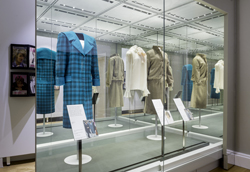
diana-her-fashion-storyThe fashions of Diana, Princess of Wales, go on show at Kensington Palace tomorrow in a new exhibition, 20 years after her death. Diana: Her Fashion Story traces the evolution of her sense of style from the demure outfits of her first public appearances to the “glamour, elegance and confidence” of her later life and explores how she used her image to engage and inspire people as well as champion the causes she cared out. The display features everything from glamorous 1980s evening gowns to her “working wardrobe” of the 1990s and original fashion sketches created for her by her favourite designers. Highlights include a pale pink Emanuel blouse worn for Lord Snowdon’s 1981 engagement portrait, a ink blue velvet gown designed by Victor Edelstein and famously worn during a visit to the White House when the princess danced with John Travolta, and a blue tartan Emanuel suit worn for an official visit to Venice in the 1980s. The latter goes on public display for the first time, having recently been acquired at auction by Historic Royal Palaces. Complementing the exhibition, gardeners have created a temporary ‘White Garden’ in the palace’s Sunken Garden with flowers and foliage inspired by the princess’s life, style and image. Admission charge applies. For more, see www.hrp.org.uk/kensington-palace/. PICTURE: Courtesy Historic Royal Palaces.

Works chronicling life in the United States of America during the decade after the Wall Street crash of 1929 go on show at the Royal Academy of Arts on Saturday. America after the Fall: Painting in the 1930s features 45 works by some of the foremost artists of the era which have been sourced from collections across the US. They include Grant Wood’s American Gothic (1930) – the first time it’s being exhibited outside of the US, Georgia O’Keeffe’s Cow’s Skull with Calico Roses (1931), Edward Hopper’s Gas (1940) and works by Jackson Pollock, Philip Guston, Alice Nee and Thomas Hart Benton. Organised by the Art Institute of Chicago, in collaboration with the Royal Academy and Etablissement public du musée d’Orsay et du musée de l’Orangerie in Paris, the exhibition in The Sackler Wing of Galleries can be seen until 4th June. Admission charge applies. For more, see www.royalacademy.org.uk.

Landscape drawings created over the century spanning 1850 to 1950 are the subject of a new free exhibition which opens at the British Museum today. Places of the Mind: British watercolour landscapes 1850-1950 features more than 125 works from the museum’s department of prints and drawings, over half of which have never been published or exhibited before. Artists represented include George Price Boyce, Alfred William Hunt, John Ruskin, James McNeill Whistler, Philip Wilson Steer. Graham Sutherland and Henry Moore. The display can be seen in Room 90 until 27th August. For more, see www.britishmuseum.org.

Send all items for inclusion to exploringlondon@gmail.com.

This Week in London – Crossrail finds on show; Russian art; robot history; and, Vanessa Bell…

A Tudor-era bowling ball, Roman iron horse shoes and late 19th century ginger jars are among hundreds of historic objects unearthed during the Crossrail construction project to go on show at the Museum of London Docklands tomorrow. Tunnel: the archaeology of Crossrail presents highlights from among the more than 10,000 objects which have been discovered during the project, the largest infrastructure project currently underway in Europe, since it kicked off in 2009. The finds, which span 8,000 years of human history, also include prehistoric flints found at North Woolwich, medieval animal bone skates and human remains found in the former 17th century Bedlam cemetery. The objects, which can be seen until 3rd September, are displayed in accordance to where along the new Elizabeth line they were found. Entry is free. For more, see www.museumoflondon.org.uk.

bolshevik This year is centenary of the Russian Revolution and to mark the occasion, the Royal Academy of Arts in Piccadilly is hosting a landmark exhibition on Russian art which takes in the period between 1917 – the year of the October Revolution – and 1932 when Josef Stalin began his violent suppression of the avant-garde. Revolution: Russian Art 1917-1932 features the works of the likes of avant-garde artists Marc Chagall, Wassily Kandinsky, and Kazimir Malevich and social realists like Isaac Brodsky and Alexander Deineka. More than 200 works are on show including loans from the State Russian Museum of St Petersburg and the State Tretyakov Gallery in Moscow, many of which have never been seen in the UK before. Highlights include Chagall’s Promenade (1917-18), Kandinsky’s Blue Crest (1917) and Malevich’s Peasants (c. 1930). Alongside the paintings, the display features photography, sculpture, film, posters and porcelain. Admission charge applies. Runs until 17th April. For more, see www.royalacademy.org.uk. PICTURE: Boris Mikailovich Kustodiev, ‘Bolshevik’ (1920) © State Tretyakov Gallery.

More than 100 robots are on display at the Science Museum in South Kensington as part of a new exhibition spanning 500 years of robotic history. Robots, which explores how robots have been shaped by religious belief, the industrial revolution, 20th century popular culture and dreams of the future, features everything from a 16th century mechanical monk to a 2.4 metre tall robot named Cygan dating from the 1950s, and one of the first walking bipedal robots. Visitors will be able to interact with 12 working robots and go behind the scenes to see recent developments in robotic research as well as speculate on what robots of the future might be like. Admission charge applies. Runs until 3rd September. For more, see www.sciencemuseum.org.uk/robots.

A major exhibition celebrating the work of early 20th century UK modern artist Vanessa Bell – a central figure in the so-called ‘Bloomsbury Group’ – has opened at the Dulwich Picture Gallery in London’s south this week. About 100 oil paintings as well as ceramics, fabrics, works on paper, photographs and related archival material are featured in the exhibition with the works arranged thematically so as to reveal Bell’s “fluid movement” between the fine and applied arts and focusing particular attention on her most distinctive period of experimentation from 1910 onwards. Vanessa Bell, which runs until 4th June, is presented alongside a photography display which brings together Bell’s photographic work with that of American musician, writer and artist Patti Smith. Legacy: Photographs by Vanessa Bell and Patti Smith features 17 photographs by Smith – who has long found inspiration in the work and lives of the Bloomsbury Group – and a selection of Bell’s photo albums. Both can be seen until 4th June. For more, see www.dulwichpicturegallery.org.uk.

Send all items for inclusion to exploringlondon@gmail.com.

10 (more) fictional character addresses in London – 3. 32 Brett Street, Soho…

irving-street

The rather grim Adolf Verloc, the smut purveyor-come-spy and main protagonist of Joseph Conrad’s The Secret Agent (recently made into a BBC series starring Toby Jones), lives in a residence attached to a small shop in Soho.

sir-henry-irvingThe residence, where he lived with his wife Winnie, her mother and young, mentally affected brother Stevie, and shop, where he sold scandalous publications, photographs and other bric-a-brac, was located at 32 Brett Street in Soho.

Except there is no Brett Street in Soho.

While it has been suggested Conrad may have taken the name Brett Street from Brett Road in Hackney – near where Conrad had lodgings at one stage, it’s also been put forward that Conrad based the streetscape on Irving Street (previously apparently known as Green Street) which runs between Leicester Square and Charing Cross Road (pictured above).

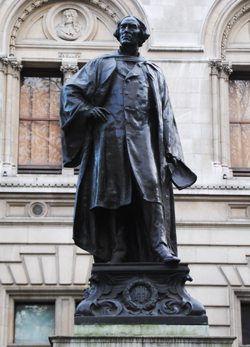
The street itself was named after actor Sir Henry Irving, whose statue stands at the junction with Charing Cross Road (pictured, it’s located at the rear of The National Gallery), and is these days filled with eateries and cheap theatre ticket box offices aimed at tourists.

Conrad’s book, which was set in 1886 but published in 1907, was loosely based around a bombing which took place in Greenwich in 1894.

Special – Queen Elizabeth II reaches ‘Sapphire Jubilee’…

royal-standard

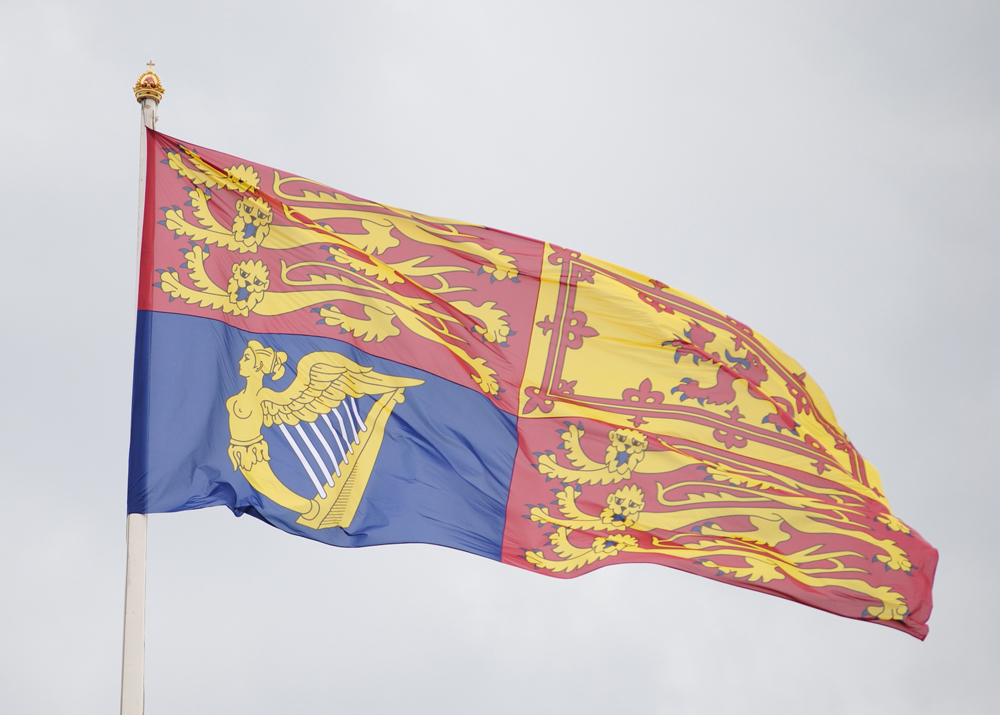
The Queen today reaches 65 years on the throne – an unprecedented ‘Sapphire Jubilee’ for a British monarch. While there will be gun salutes in Green Park and at the Tower of London, the Queen herself will reportedly spend the day indoors at Sandringham thinking about her late father, King George VI, who died on this day in 1952.

10 (more) fictional character addresses in London – 2. 27a Wimpole Street…

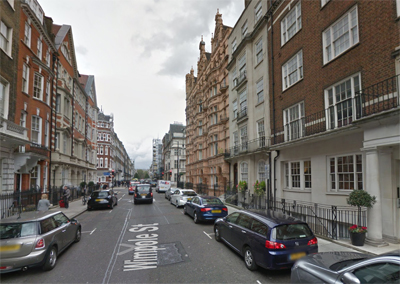
wimpole-streetThis notable Marylebone Street contains the home of Henry Higgins, the professor of phonetics who attempts to help Cockney flower girl Eliza Doolittle pass for a duchess as part of a bet in George Bernard Shaw’s play Pygmalion.

Written in 1912, the play which gives Professor Higgins’ address as 27A Wimpole Street was in 1964 adapted into the film, My Fair Lady, starring Audrey Hepburn and Rex Harrison.

The choice of Wimpole Street as the address of Professor Higgins – both for his home and “laboratory” – was apparently not co-incidental. Articles in The Telegraph and Daily Mail last year talk about the fact that 27a lies not far from a grand Georgian (Grade II-listed) townhouse (then on the market for £15 million) in Upper Wimpole Street which was formerly the home of a Professor Horace Hayman Wilson, a professor of Sanskrit at Oxford University in the early 19th century.

The articles say that while the “real-life academic ‘model'” for Higgins was Henry Sweet – an early 20th century Oxford professor of phonetics who is named in the preface to the play, the basis for Professor Higgins’ rather grand lifestyle was that of Professor Wilson.

They also suggest that the connection between Professor Higgins and Professor Wilson makes sense considering one of the mysteries of Pygmalion – how a humble phonetics professor could afford consulting rooms on a street known for wealthy private medical practices.

The answer lies in the Professor Wilson’s history – his father, a doctor, bought a house in the street in 1806 and subsequently bought a neighbouring property for his son who initially pursued a medical career before moving into academia where he specialised in languages. Splitting his time between Wimpole Street, Oxford and Calcutta in India, Professor Wilson’s lifestyle, straddling high society and academia, formed a prototype for that of Professor Higgins. Or so the story goes.

PICTURE: Looking down Wimpole Street; number 27 is second on the left. PICTURE: Google Maps.

This Week in London – Roman finds from Walbrook revealed; Pablo Picasso prints; and, Highgate Cemetery’s virtual directory…

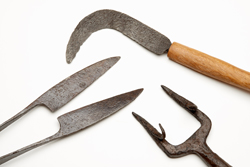
roman-gardening-toolsRoman tools and other artefacts from the era including a stamp for metal ingots and pottery are among objects found in London’s ‘lost’ Walbrook Valley which have gone on display at the Museum of London. Working the Walbrook features objects excavated during the past 170 years of digs around the watercourse which once cut the city in half, running from Finsbury Circus to Cannon Street. Created as part of a PhD project being supervised by the Museum of London and the University of Reading, the objects on show include an iron stamp dating from the Roman period inscribed with the letters MPBR (understood to be an abbreviation for ‘Metal Provinciae Britanniae’ – “the mines of the province of Britannia”) which is believed to have been used by officials to stamp metal ingots passing through London on their way to the Continent. Other items include Roman farming and gardening tools, and a pot decorated with a smith’s hammer, anvil and tongs which was found at the bottom of a well in Southwark and which may have been linked to worship of the god Vulcan. The free display is on show until March. For more, see www.museumoflondon.org.uk. PICTURE: Gardening tools from Roman London. A pruning hook, bailing fork and shears © Museum of London

• A series of prints by Pablo Picasso spanning the period from the late 1940s to the late 1950s form the heart of a new exhibition at the British Museum in Bloomsbury. The prints, which include 16 lithograph prints and three aquatint prints, were recently acquired by the museum in what represents the final part of the museum’s effort to more fully represent the artist’s work as a printmaker. Six of the lithographs were inspired by the beauty of Picasso’s lover Francoise Gilot while others feature Bacchanalian scenes and portraits of German-born dealer Daniel-Henry Kahnweiler. On display from Friday in Gallery 90A, they can be seen in the free exhibition until 3rd March. For more, see www.britishmuseum.org.

The details of some 160,000 people buried at Highgate Cemetery in north London have been made available online. Deceased Online has announced that all records for the period from May, 1839, to August, 2010 – a total of 159,863 people, are now available, including digital scans of original registers, details of who is buried in each grave and location maps for most graves. Notable people buried at Highgate include author Douglas Adams, philosopher Karl Marx and chemist and physicist Michael Faraday. For more, see www.deceasedonline.com

Send all items for inclusion to exploringlondon@gmail.com.

Eight historic department stores in London…8. John Lewis

john-lewis-oxford-street

The upmarket department store chain John Lewis traces its origins back to 1864 when the man himself opened a drapers at 132 Oxford Street (later renumbered, it’s the site of the current store).

Originally from Somerset and brought up by an aunt after he was orphaned at a young age, Lewis served as an apprentice to a linen draper in Wells as a teenager before he moved to London to work as salesman for an Oxford Street draper, eventually becoming a silk buyer. He apparently turned down offer of partnership in that business, deciding instead to put out his own shingle.

Lewis slowly expanded his business into neighbouring properties and diversified into a growing range of goods – everything from clothing to furniture to kitchen china. By 1895 he had rebuilt his original shop, which now had fronts on Oxford and Holles Streets, into a multi storey department store with retail showrooms as well as a warehouse and a restaurant for customers.

More than 40 years after he opened his first shop in London, in 1905 Lewis acquired Peter Jones in Sloane Square. His sons, John Spedan Lewis and Oswald, became partners in the business in 1907. Oswald was later bought out but John, particularly while convalescing following a riding accident, began to think about how he could improve staff wages and working conditions.

However, his new ideas led to conflict with his father (known to be a tough employer) and so, in 1914, Spedan Lewis took over total control of the Peter Jones business in exchange for no longer taking any part in the Oxford Street store. Instead, turning his attention to the Sloane Square business, he introduced a profit-sharing scheme for employees as well as a representative staff council and other initiatives including the introduction of the weekly in-house magazine, The Gazette.

In 1924, Spedan Lewis was reconciled with his father and so it was that following his father’s death in 1928, he became sole owner of both businesses, bringing them together into a single entity. The famous motto – “Never Knowingly Undersold” – has apparently been in use in the Peter Jones store since it was introduced by Spedan Lewis in 1925.

In 1929, he created the John Lewis Partnership Ltd and while he continued to have practical control of the business, his reforms meant profits were distributed among employees. Twenty-one years later, in 1950, he signed settlement which saw the partnership become the property of the employees.

In 1933, the partnership purchased its first store outside London in Nottingham and it is now regarded as the largest department store retailer in the UK with 46 John Lewis shops including 32 department stores. It also owns the Waitrose supermarket chain.

The flagship Oxford Street store was almost completely destroyed during World War II. The present premises, which features a roof garden, opened in 1961. It features a famous (now Grade II*-listed) artwork – Barbara Hepworth’s Winged Figure – on the Holles Street facade near the corner with Oxford Street.

In 2008 this store was awarded a Royal Warrant from Queen Elizabeth II as “suppliers of haberdashery and household goods”.

This is the final in our current Wednesday series. We’ll be starting a new series shortly.

PICTURE: James Petts/Wikipedia/CC BY-SA 2.0

What’s in a name?…St Katharine Docks…

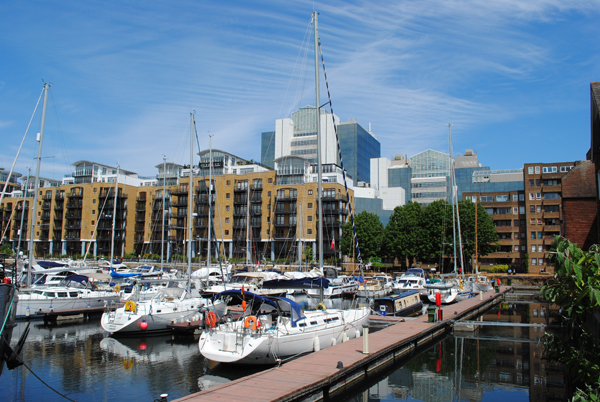
st-katharine-docksThe name for this dock, located just to the east of Tower Bridge, comes from a 12th century established to help the poor known as St Katharine’s Hospital which was once located in the vicinity.

The hospital, which was named at St Katharine – whom tradition holds was martyred in the 4th century by the Roman Emperor Maxentius – was founded by Matilda, the wife of King Stephen, in 1147, for the maintenance of 13 poor people.

It was supported by various English queens over the ensuing centuries, including Eleanor, beloved wife of King Edward I, who granted it a new charter in 1273, and Queen Philippa, wife of King Edward III, who drew up new regulations for the running of the hospital in 1351.

Having survived an attempt to have the hospital abolished by Puritans in the 17th century and an attempt to burn it down during the late 18th century Gordon Riots, in the early 19th century demand for new docks brought about the old hospital’s final demolition.

In 1825, the hospital relocated to Regent’s Park. Now known as the Royal Foundation of St Katharine, it is currently located in Limehouse, having moved there in 1948 (we’ll take a more in depth look at the history of St Katharine’s Hospital in an upcoming post).

The docks, meanwhile, was opened in 1828 following the removal of more than 1,200 homes and a brewery as well as the old hospital – works carried out despite a public outcry and, apparently, no compensation. Designed by Thomas Telford (of the Iron Bridge fame – this was apparently his only London project), the docks occupy a 23 acre site and featured a central basin opening to two docks lined with brick warehouses.

The docks were closed in 1968 and in the years since, the warehouses have been converted into shops, eateries, offices and residences while the waters are now used as a marina for luxury yachts.

This Week in London – Skating on Ice; Christmas trees worth seeing; and, Westminster Abbey’s new galleries…

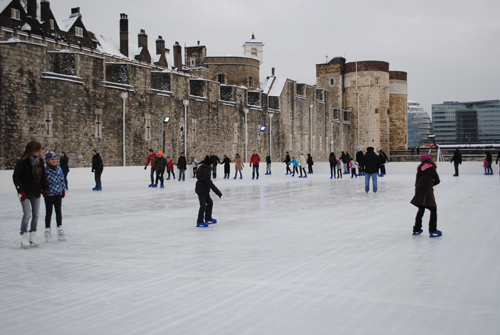
ice-skating-in-the-tower-moatLondon’s obsession with ice-skating is the subject of an exhibition which opened at the Museum of London earlier this month. Skating on Ice looks at the history of the popular pastime, from the 12th century – when locals are described strapping animals bones to their feet to skate on ice at Moorfields – across the centuries (and the developments that went with them) to today. Among the artefacts on show is an 1839 oil painting by J Baber depicting skaters on the Serpentine in Hyde Park, sketches from the London Illustrated News showing a rescue operation to recover the 40 of some 40 skaters who plunged beneath the ice in Regent’s Park on 15th January, 1867, a navy blue gabardine skirt suit from Fortnum & Mason dating from the 1930s and a series of skates, ranging from some made of animal bones through to a pair of Victorian racing skates known as Fen Runners and a pair of ice skates used from the late 1930s by Londoner Christina Greenberry at Streatham Ice Arena. Runs until 8th February. Entry is free. See www.museumoflondon.org.uk for more. (Pictured – ice-skating in the Tower of London moat).

• Christmas is looming and so, if you haven’t been out and about already, here’s five Christmas trees worth seeing over the coming few days (excluding the obvious one in Trafalgar Square):

  • Covent Garden. Always a glittering treat (this year complete with virtual prizes!).
  • St Pancras International. A rather odd design this year, this 100 foot tall tree is inspired by the Cirque du Soleil show Amaluna and lights up every time a donation is made to Oxfam.
  • Granary Square, Kings Cross. Looking like a Christmas tree frozen inside an ice-cube, this seven metre high installation – Fighting fire with ice cream – by British artist Alex Chinneck features some 1,200 lights.
  • Tate Britain, Millbank. An upside down tree, designed by Iranian artist Shirazeh Houshiary.
  • Connaught Hotel, Mount Street, Mayfair. Designed by British sculptor Antony Gormley, this 57 foot tall tree features a trunk transformed into a pillar of light.

Prince Charles last week unveiled the foundation stone for a tower that will take visitors to Westminster Abbey into the institution’s new museum and galleries. The tower is being built outside Poet’s Corner – between the 13th century Chapter House and 16th-century Henry VII’s Lady Chapel – and will be the principal entrance to the medieval triforium, which has never before been opened to the public and which house the proposed The Queen’s Diamond Jubilee Galleries. The tower and galleries, costing almost £23 million, will be the most significant addition to the abbey since Nicholas Hawksmoor’s west towers were completed in 1745. The galleries, which will be located 70 feet above the abbey’s floor, are due to open in summer 2018, and will display treasures from the abbey’s history as well as offering magnificent views of Parliament Square and the Palace of Westminster. To help meet the cost of the new galleries, the abbey has launched a #makehistory campaign asking for public donations to the project. For more, see www.westminster-abbey-galleries.org/Content/Filler.

Send all items for inclusion to exploringlondon@gmail.com.

Eight historic department stores in London…7. Hamleys…

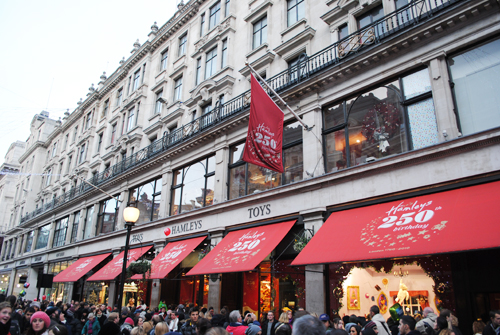
hamleysThis Regent Street establishment – the oldest and largest toy store in the world – dates back to 1760 when Cornishman William Hamley came to London and founded his toy store – then called ‘Noah’s Ark’ – on High Holborn.

Selling everything from wooden hoops to tin soldiers and rag dolls, the business aimed to capture the trade of affluent Bloomsbury families and proved rather successful, attracting a clientele in the early 19th century which included not only wealthy families but royalty.

Such was its success that in 1881, Hamley’s descendants opened a new branch of the shop at 200 Regent Street. The Holborn store, meanwhile, burned down in 1901 and was subsequently relocated to a larger premises at numbers 86-87 in the same street.

Faced with the Depression in the 1920s, the shop closed briefly in 1931 but was soon reopened by Walter Lines, chairman of Tri-ang Toys, and in 1938 was given a Royal Warrant by Queen Mary, consort of King George V.

The premises at 188-196 Regent Street was bombed five times during the Blitz but the shop (and its tin hat-wearing staff survived). In 1955, having presented a Grand Doll’s Salon and sizeable model railway at the 1951 Festival of Britain, the shop was given a second Royal Warrant – this time by Queen Elizabeth II, who has been given Hamleys toys as a child – as a ‘toys and sports merchant’.

The business, which has passed through several owners since the early 2000s, is now owned by Chinese-based footwear retailer C.banner.  The flagship store is spread over seven floors and tens of thousands of toys on sale, located in various departments.

As well as the Regent Street premises (it moved into the current premises at number 188-196 Regent Street in 1981), Hamlets has some 89 branches located in 23 countries, from India to South Africa. A City of Westminster Green Plaque was placed on the store in February 2010, in honour of the business’s 250th anniversary.

The toy store holds an annual Christmas parade in Regent Street which this year featured a cast of 400 and attracted an estimated 750,000 spectators.

www.hamleys.com

PICTURED: Hamleys during its 250th birthday celebrations.