This Week in London – Oceanic art and British watercolours at the RA; a celebration of immigrant nurses from Barbados; and NYE tickets on sale…

The first ever major survey of Oceanic art to be held in the UK opens at the Royal Academy in Piccadilly on Saturday. The exhibition – Oceania – brings together around 200 works created in Melanesia, Micronesia and Polynesia and includes pieces from public and private collections spanning a period of more than 500 years. It’s being held to mark the 250th anniversary of the RA which was founded in 1768, the same year Captain James Cook set sail on the Endeavour on his first expedition to the Pacific. Highlights of the display, which is organised around three major themes – ‘Voyaging’, ‘Place-making’ and ‘Encounter’, include a 14th century wooden Kaitata carving, excavated in 1920, which is one of the oldest known objects to have been found in New Zealand as well as two Maori hoe (canoe paddles) collected during Cook’s first voyage, and a 19th century feather god image from the Hawaiian Islands likely to be have been collected on Cook’s third voyage. There’s also an 18th century mourning costume known as a Heva tupapau which was obtained in Tahiti in 1791, a rare Fijian late 18th or 19th century double-headed whale ivory hook, and Maori sculptor Tene Waitere’s Ta Moko panel (1896-99 – pictured) depicting male and female tattoos as well as a 19th century Nguzunguzu (prow ornament for a war canoe) featuring a pigeon and a never-before-exhibited ceremonial feast bowl measuring almost seven metres in length, both from the Solomon Islands. Runs in the Main Galleries until 10th December. Admission charge applies. For more, see www.royalacademy.org.uk. PICTURE: Tene Waitere, Ta Moko panel, 1896-99. Te Papa (ME004211) © Image courtesy of The Museum of New Zealand Te Papa Tongarewa.

• Meanwhile, in another exhibition at the Royal Academy, 25 British watercolours and drawings – including works from BNY Mellon’s corporate art collection – have gone on show in the Tennant Gallery. British Watercolours: From the Collection of BNY Mellon features the work of prominent Royal Academicians including Thomas Gainsborough, JMW Turner, John Constable and Sir David Wilkie. Highlights include an 1833 view of Hampstead Heath by Constable, Italian landscapes painted in the 1770s by Thomas Jones and John Robert Cozens, John Frederick Lewis’ unfinished Study of a Bedouin Arab (1840s) and an expressive depiction of Venice by John Ruskin in 1876. The British drawings and watercolours in the BNY Mellon collection were largely acquired in the 1980s. The exhibition is being held as part of the Royal Academy’s 250th anniversary. Admission is free. For more, see www.royalacademy.org.uk.

A free exhibition focusing on one of pioneering groups of people migrating to Britain – the Bajan nurses from Barbados, is opening in Guildhall Yard on Friday as part of Black History Month. Celebrating 70 years of the NHS, the display reveals individual stories of achievements, struggles and leadership with the focus moving from world famous figures to the unsung midwives who helped deliver Britain’s post-war baby boom. The British-Barbadian Nursing Revolution can be seen anytime until 31st October. There’s a series of talks accompanying the display. For more, head to the City of London website.

New Year’s Eve is coming up fast – yes, it’s that time already! – and the first tickets for the world famous London event go on sale at midday on Friday. Tickets for the event, which features more than 12,000 fireworks, are still priced at £10 (a further batch will be sold in late November). Those without a ticket will not be able to enter the viewing area in central London (although it will, of course, be broadcast on TV). There are a maximum of four tickets per transaction. Head to www.london.gov.uk/nye.

Send all items for inclusion to exploringlondon@gmail.com.

Lost London – The Royal Aquarium and Winter Garden…

Opened on 22nd January, 1876, this short-lived building at the junction of Tothill and Victoria Streets in Westminster – across the road from Westminster Abbey, was designed as an entertainment venue offering a space for art exhibitions, concerts and plays in similar fashion to that of the famous Crystal Palace then located in Sydenham.

The classically styled and highly ornamented two storey building was designed by Alfred Bedborough and built of Portland stone and red brick. Its initial board of directors included composer Arthur Sullivan (he of Gilbert and Sullivan fame), retailer William Whiteley, and financier Henry Labouchére, covered an area of almost three acres.

It featured a central hall which stood 340 feet in length and 160 feet wide and was covered with a barrel-shaped iron and glass roof. The interior featured palm trees and other exotic plants, fountains, sculptures, space for a 400 member orchestra, and, 13 large tanks for sea creatures which were fed with fresh and sea water from four cisterns

These tanks, which gave the premises its name as well as its nickname, ‘The Tank’, didn’t prove all that successful. They were initially left empty, prompting author Charles Dickens to note that they become something of a “standing joke”, and even as late as 1896 were described as providing a “beggarly show of fish”.

As well as the main hall, the premises also boasted multiple smaller rooms including eating and drinking establishments, an art gallery, ice-skating rink, reading room, telegraph office, and, at its west end, the Aquarium Theatre, which in 1879 was renamed the Imperial Theatre. There was even apparently a division bell installed for MPs visiting from the nearby Houses of Parliament.

By the 1890s, the entertainments had become more low-brow and the building had become associated with illicit sexual liaisons. Its popularity declined.

In 1903, it was sold to the Methodist Church and Methodist Central Hall was built on the site in 1911. The theatre, however, wasn’t demolished until 1907 – the interior, however, was saved and apparently re-erected as the Imperial Palace of Varieties in Canning Town in 1909 (which itself was destroyed by fire in 1931).

PICTURE: A from 1896 book, The Queen’s London: a Pictorial and Descriptive Record of the Streets, Buildings, Parks and Scenery of the Great Metropolis, showing the Royal Aquarium in c1876.

A Moment in London’s History – The opening of “new” London Bridge…

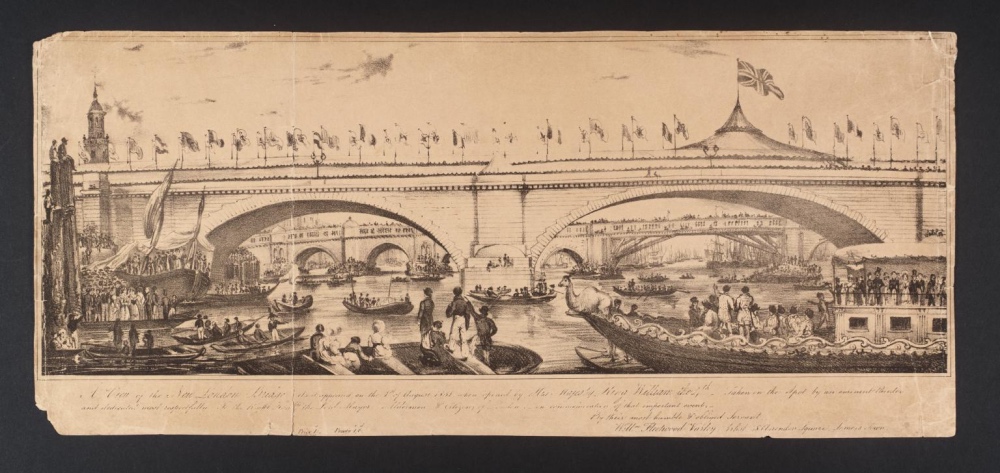
This month marks the 187 years since the opening of “new” London Bridge – the first bridge built over the Thames in London for more than 600 years.

Designed by John Rennie (who had won a competition, beating the likes of Thomas Telford for the honour), work on the new granite bridge had began in 1825 and was completed in 1831.

It was constructed alongside the medieval bridge which had been first completed in the 13th century and added to over the years since (and was eventually completely demolished after the opening of the ‘new’ bridge).

The ‘new’ bridge, said to have cost £506,000 to construct, was formally opened by King William IV on 1st August, 1831, in an event described by The Times as “the most splendid spectacle that has been witnessed on the Thames for many years”.

The royal party – which included Queen Adelaide – had approached the bridge, lined with flags for the occasion, after setting off from Somerset House amid cheering described as “almost deafening” (to add to cacophony of sound, church bells were rung and cannon fired throughout the day).

Watched by thousands of onlookers (who were entertained by bands at various locations), the royal party had processed their way downstream on the river to the bridge with the royal bargemen wearing new livery specially designed for the occasion. Two parallel lines of rivercraft – including barges and steamers – had gathered along the river to provide a sort of honour guard and ensure they had clear passage.

The royals arrived at the bridge at 4pm and the royal party made their way up red carpeted stairs to the bridge’s City end. Following a short ceremony in which the King was presented by the Lord Mayor of London with the sword and keys to the City of London as well as a specially made gold medal to mark the occasion, their Majesties then walked across from the across the bridge to the Southwark end where entertainments had included the ascension of a hot air balloon.

The King and the royal party then returned to the City end of the bridge to attend a banquet – guests were said to number 1,500 people – held under a pavilion erected atop the new structure.

The Gentleman’s Magazine reported that food was provided by a coffee house proprietor, a Mr Leech, and was said to include 150 hams and tongues, 370 “dishes of chickens”, and 300 turtles as well as 200 fruit tarts and 300 “ice-creams”.

The King and royal party then returned up the river.

Rennie’s bridge was replaced in the mid-20th century with another bridge which was officially opened by Queen Elizabeth II in 1973 and rather than being demolished, was sold to US oil magnate Robert P McCulloch who had it dismantled and shipped to Arizona where it was reconstructed at Lake Havasu City where it can now be seen.

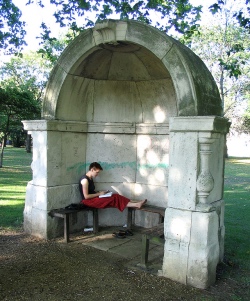
A couple of sections of the bridge survive in London – two of its pedestrian alcoves, one of which can be found in Victoria Park in London’s east and the other at King’s College London.

There is a famous painting – Clarkson Stanfield’s, The Opening of New London Bridge, 1 August 1831 – which captures the moment of the bridge’s opening and is part of the Royal Collection.

PICTURES: Top – ‘A View of the New London Bridge as It Appeared on the 1st August 1831, When Opened by His Majesty, King William the 4th’, Unknown artist, Lithograph on paper, Photo © Tate (licensed under CC-BY-NC-ND 3.0 (Unported)); Right – The alcove in Victoria Park (Public Domain).

10 (lesser known) memorials to women in London – 7. Catherine Booth…

Located at Denmark Hill in south London, this statue of Catherine Booth (1829-1890), co-founder of the Salvation Army, was apparently dedicated twice.

The first dedication took place in 1929, the centenary of her birth, and the second the following year when an accompanying statue of her husband William Booth – they stand on either side of the entrance to the Salvation Army’s William Booth Memorial Training College, designed by Sir Giles Gilbert Scott (he also designed the statue plinths), on Champion Park  – was also being dedicated.

The work of George Edward Wade, the bronze statue depicts Booth in her Salvation Army uniform – complete with bonnet – and has her holding a Bible pressed to her heart and reaching out with an open hand. Her husband William is also shown in his uniform, preaching from an open the Bible.

An inscription on the granite plinth below describes her “The Army Mother”. The larger than life statue was cast at the Morris Art Bronze Foundry.

There are, incidentally, exact replicas of both statues in Mile End Road in London’s east. Donated by the women of the Salvation Army in the US, that of William was unveiled in 1979 and that of Catherine a later addition, unveiled in 2015 on the 150th anniversary of the creation of the Salvation Army.

The statues are located close to the site where the Booths commenced the work of the Salvation Army in July, 1865.

PICTURE: R Sones (licensed under CC BY-SA 2.0/Image cropped)

LondonLife – Victorian London in photographs…

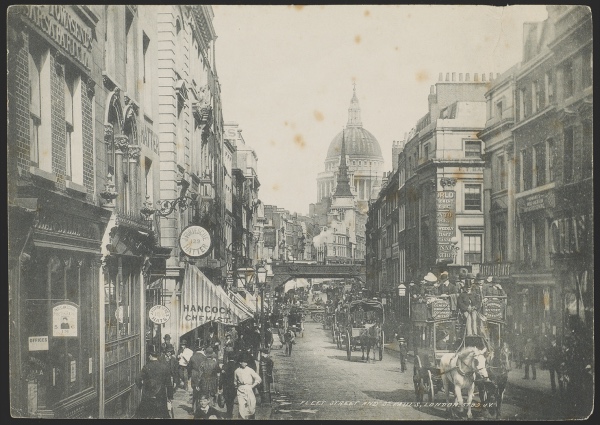
Above is a view along Fleet Street in the City of London in 1890, looking east towards Ludgate Hill and St Paul’s Cathedral. It’s one of many early photographic views of London on show in a free exhibition which can be seen in Aldgate Square until Sunday (12th August). Presented by the City of London Corporation’s London Metropolitan Archives, Victorian London in Photographs includes the earliest photograph in the LMA collection (see last Thursday’s entry for that). If you miss it at Aldgate Square, the display will be in Paternoster Square next to St Paul’s Cathedral from 14th to 23rd August. For more on the London Metropolitan Archives, follow this link. ALL PICTURES: London Metropolitan Archives, City of London Corporation

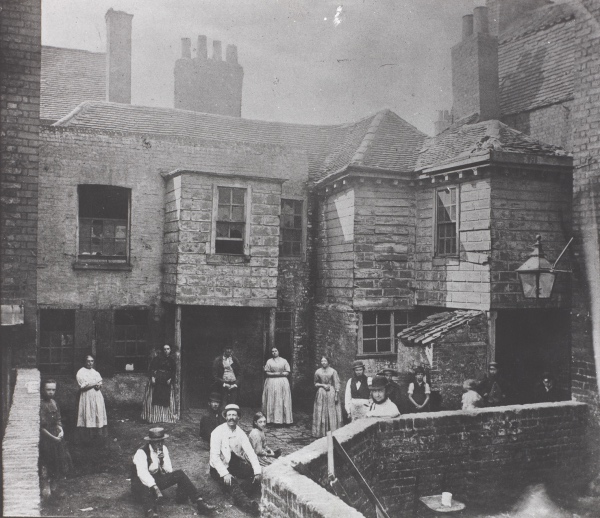
Above – Residents pose for the camera in Market Court, Kensington in 1868.

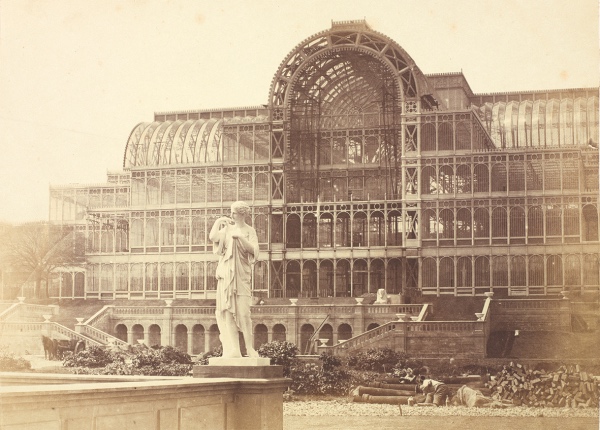
Above – Following the success of the Great Exhibition in Hyde Park in 1851, the Crystal Palace was relocated to Sydenham Hill. This photograph by Philip Henry Delamotte taken between 1852 and 1854 shows the South Transept during construction.

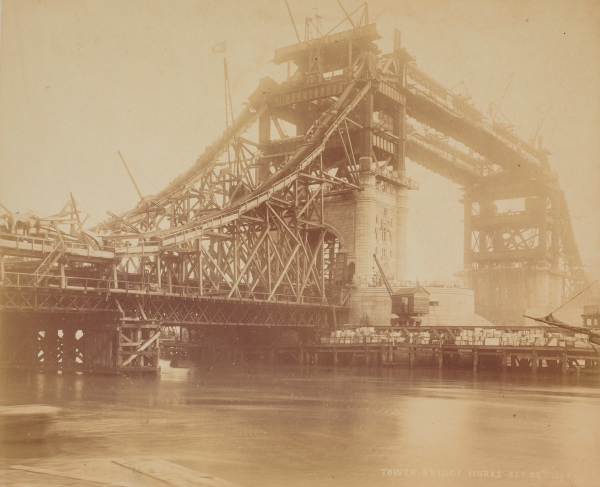
Above – Work progresses on the masonry and suspension chains during the construction of Tower Bridge in 1892. 

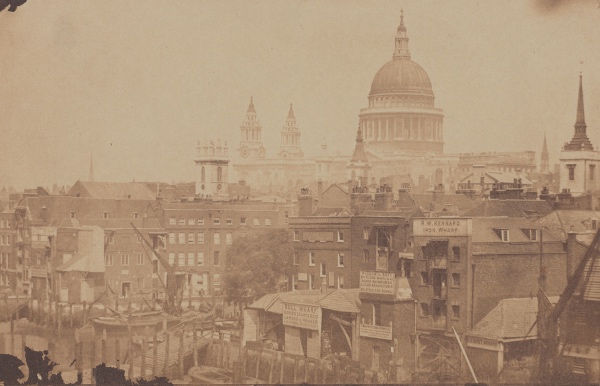
View of Iron Wharf and Bull Wharf, with St Paul’s Cathedral in the background. The photograph was taken from Southwark Bridge. Anonymous photographer, c. 1855.

London Pub Signs – Woodin’s Shades…

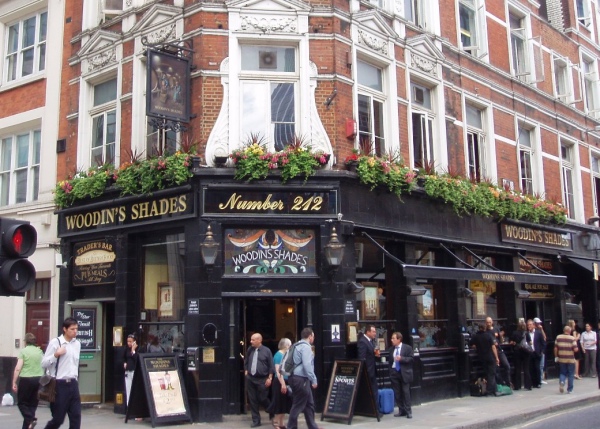
Located on Bishopsgate, Woodin’s Shades takes its name from wine merchant, William Woodin, while the ‘shades’ part apparently comes from an old word for a wine vault with a drinking bar.

Woodin acquired the site in 1863 – only 10 years later, in 1874, Liverpool Street Station opened opposite which was no doubt a boon for business.

The current red brick building dates from 1893.

The pub at 212 Bishopsgate, now part of the Nicholson’s chain, is popular with traders from the nearby Petticoat Lane and Spitalfields markets.

For more, see www.nicholsonspubs.co.uk/restaurants/london/thewoodinsshadesbishopsgatelondon.

PICTURE: Ewan Munro (licensed under CC BY-SA 2.0)


This Week in London – Early London photographs; CRW Nevinson at the British Museum; and, the Worshipful Company of Tylers and Bricklayers…

Some of the first photographic images of London and Londoners – depicting everything from Victorian families living in slums and the construction of the capital’s first underground railway to well-known icons like Tower Bridge and the Crystal Palace – have gone on show in Aldgate Square. Presented by the City of London Corporation’s London Metropolitan Archives, Victorian London in Photographs also features a daguerreotype (the earliest form of photograph) dating from the 1840s which depicts a view of The Monument (pictured) and is the earliest photograph of the City of London in LMA’s collections. The free exhibition can be seen until 12th August at Aldgate Square after which it moves to Paternoster Square next to St Paul’s Cathedral, where it can be seen from 14th to 23rd August. For more on the London Metropolitan Archives, follow this linkPICTURE: London Metropolitan Archives, City of London Corporation

A selection of works documenting CRW Nevinson’s experiences during World War I feature in a free exhibition at the British Museum. CRW Nevinson: Prints of War and Peace commemorates the centenary of the artist’s gift of 25 of his prints to the British Museum in 1918 and a number of the works featured on show for the first time. They include a self-portrait while Nevinson was a student at the Slade School of Art, A Dawn and Column on the March, both of which show massed ranks of French soldiers marching to their doom, The Doctor and Twilight which show the conditions wounded soldiers had to endure, and dynamic cityscapes such as Looking down into Wall Street, Looking through Brooklyn Bridge, Wet Evening (depicting Oxford Street in London) and Paris Window and Place Blanche (both dating from 1922 and depicting Paris). The display can be seen in Room 90a, Prints and Drawings Gallery, until 13th September. For more, see www.britishmuseum.org.

On Now – Worshipful Company of Tylers and Bricklayers. This exhibition at the Guildhall Library marks the 450th anniversary of the granting of the Tylers and Bricklayers’ Company’s charter by Elizabeth I in 1568. As well as tracing the company’s history from its first master in 1416 through to the company today, it also looks at the life of the company’s most famous son, playwright Ben Jonson, and how the company was instrumental in the rebuilding of the City of London after the Great Fire in 1666. Runs until 31st August. Admission is free. For more, follow this link.

Send all items for inclusion to exploringlondon@gmail.com.
10 (lesser known) memorials to women in London – 6. Sarah Siddons…

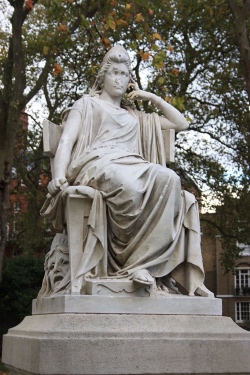
Located on Paddington Green, this statue of 18th century theatrical luminary Sarah Siddons (1755-1831) was unveiled by fellow thespian Sir Henry Irving on 14th June, 1897, who apparently noted that, Shakespeare aside, Siddons was the first actor to be immortalised with a statue in London.

It is also said to be the first outdoor statue erected in London of a non-royal woman.

Seated in a pose apparently inspired by Joshua Reynolds’ 1784 painting, Mrs Siddons as the Tragic Muse (now in California), the marble statue, which sits on a Portland stone plinth, is the work of French sculptor Leon-Joseph Chavailliaud.

The location was apparently selected due to the fact Siddons lived at Westbourne Green from 1805 to 1817 and is buried in St Mary’s Churchyard next to Paddington Green.

The Grade II-listed statue, which was paid for by public subscription, is sadly now need of a makeover – Mrs Siddons is missing a nose.

There is, incidentally, another, earlier, statue of Mrs Siddons in London – this larger-than-life work, is located in the chapel of St Andrew in Westminster Abbey’s north transept.

The work of sculptor Thomas Campbell, it features a standing Mrs Siddons, and dates from 1845.

PICTURE: Stephencdickson (licensed under CC BY-SA 4.0)

Where’s London’s oldest…swimming club?

The Serpentine Swimming Club, located on Hyde Park‘s Serpentine, dates its founding from 1864, the year it held the first of its famous Christmas Day Races.

The club, actually the oldest in Britain, was created in response to Londoners’ growing need for recreation – Hyde Park then being at the centre of a heavily built-up area – and came as the mass transit system – London’s Underground – was making it more accessible.

Initial facilities included a shady elm tree and a wooden seat. They’ve since improved somewhat to include changing rooms (although they’re still described as spartan).

These days members are permitted by The Royal Parks to swim in the lake between 6am and 9.30am daily.

While the Christmas Day Race – in which swimmers compete for the Peter Pan Cup (since the first cup was awarded by JM Barrie in 1904) – is the most famous race, the club also hosts numerous other races throughout the year which range in length and include a “bridge to bridge” race from one end of the Serpentine to the other (just held on 14th July).

While members use the Lido – which opened in 1930 – for swimming, it remains a separate entity to the SSC.

For more about the club, see www.serpentineswimmingclub.com.

The Lido on the Serpentine. PICTURE: Phil Russell/The Royal Parks.

What’s in a name?…Mincing Lane

The origins of this short and narrow City of London laneway, which runs between Fenchurch Street and Great Tower Street, have nothing to do with minced meat of any kind.

Rather it comes from the fact – according to 16th century historian John Stow – that houses along here were once the property of the nuns of St Helen’s Bishopsgate. The medieval word for a nun was ‘mynchen’ – ‘mincing’ is merely a corruption of that word.

Historically, Mincing Lane was known for spice and tea trading and was also apparently the centre of the opium trade in London as well as hosting businesses connected to the slave trade.

The Clothworkers Company is located in Dunster Court, just off Mincing Lane – the current building, which opened in 1958, is the sixth on the site.

Among more modern buildings hosted in the one-way lane today is the Minster Court complex, dating from the early Nineties, which features in the forecourt facing out to the lane, Althea Wynne’s sculpture of three larger than life-size bronze horses, apparently nicknamed “Dollar”, “Yen” and “Stirling” (pictured). The building featured in the 1996 film, 101 Dalmatians.

PICTURE: Mike Quinn / Wild horses wouldn’t drag me in here / CC BY-SA 2.0.

Lost London – St Luke’s Hospital for Lunatics, Old Street…

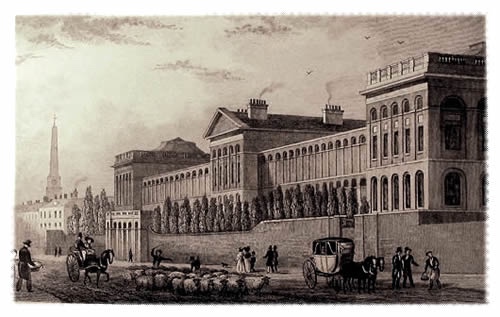
A monumental-sized building on Old Street in the City of London, St Luke’s Hospital for Lunatics was founded in 1751 to treat the poor who suffered from mental illnesses.

The new hospital – which was built partly through concerns about abuses patients suffered at the more famous Royal Bethlehem Hospital (Bedlam) – was initially located on a site in Moorfields which had been formerly occupied by a foundry. But in 1786 it moved to the purpose-built palatial premises in Old Street where it remained until 1916.

The new building, which was designed by George Dance after an competition for its design apparently failed to find a suitable candidate, had a 150 metre long street frontage with a central entrance and male wards on one side and female wards on the other.

The building contained some 300 individual cells – each had a small window, but no heating. There were gardens located behind it and in the basement were cold water baths used to treat patients.

The hospital building was enlarged in the 1840s when infirmaries and a chapel were added.

By the 1860s, the hospital appears to have abandoned its target market of the poor – the 150 or so patients were then described as being of “middle class”.

In 1916, the patients were transferred to other institutions – the charity running the hospital set up a ward in Middlesex Hospital – or sent home and the buildings were acquired by the Bank of England.

The premises was used to print banknotes until the 1950s and the building, which had been damaged during World War I, was eventually demolished in 1963.

The archive of St Luke’s have been digitised and are held by the Wellcome Library.

This Week in London – Queen’s Diamond Jubilee Galleries to open at Westminster Abbey; Royal Collection’s Indian treasures on show; and, Thomas Cole…

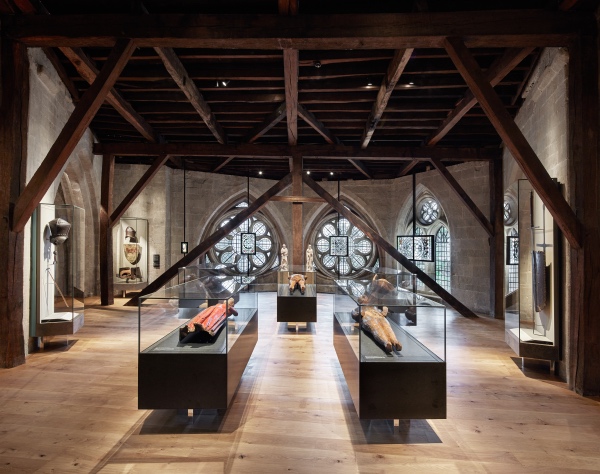
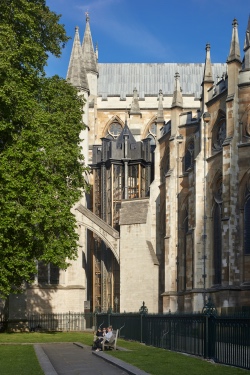
The new Queen’s Diamond Jubilee Galleries at Westminster Abbey open to the public on Monday. The museum galleries, located more than 50 feet above the abbey’s floor in the medieval Triforium, tell the 1,000 year history of the abbey through some of its greatest treasures. Entry to the Triforium – never before open to the public – is via the new Weston Tower, the first major addition to the abbey since 1745 which comes with previously unseen views of the neighbouring Palace of Westminster. The exhibition in the galleries, meanwhile, features some 300 objects and tells the abbey’s story around four major themes – building the abbey, worship and daily life, the abbey’s relationship to the monarchy and its role as a national place of commemoration and remembrance. Among the items on show are a column capital from the cloister of St Edward the Confessor’s Church (built around 1100), a scale model of the abbey commissioned by Sir Christopher Wren which features a never built massive central spire, The Westminster Retable (1259-69) – the oldest surviving altarpiece in England, the Litlyngton Missal – an illuminated 14th century service book, Queen Mary II’s Coronation Chair dating from 1689, the 2011 marriage licence of the Duke and Duchess of Cambridge, and early abbey guidebooks for visitors. The new galleries and tower were completed in a £22.9 million project funded through private donors and trusts. Admission charge applies. For more, see www.westminster-abbey.org/visit-us/plan-your-visit/the-queens-diamond-jubilee-galleries/.  PICTURES: Top – The Queen’s Diamond Jubilee Galleries; Right – The Weston Tower (Images courtesy of Westminster Abbey/Alan Williams).

The Royal Collection’s South Asian art goes on show at the Queen’s Gallery in Buckingham Palace from tomorrow. Splendours of the Subcontinent: A Prince’s Tour of India 1875-6 centres on the historic four month visit made by Albert Edward, Prince of Wales (later King Edward VIII) to the subcontinent prior to his mother, Queen Victoria, being formally declared Empress of India. It brings together some of the finest examples of Indian design and craftsmanship in the Royal Collection including some of the 2,000 gifts presented to the Prince on his tour. Highlights include an enamelled gold and diamond perfume holder given by Ram Singh II, Maharajah of Jaipur, a 10 piece gold service given by the Maharaja of Mysore, and a jewelled walking stick featuring a concealed gun, thought to have been the gift of Maharao Ram Singh of Bundi. There are also enamelled peacock feather fans, a gold and emerald turban ornament, and a brooch and necklace featuring a depiction of the Prince and Princess of Wales. The display can be seen until 14th October. Admission charge applies. The exhibition is being shown alongside Splendours of the Subcontinent: Four Centuries of South Asian Paintings and Manuscripts, which features highlights from the Royal Collection’s world-class holding of paintings and manuscripts from the region. For more, see www.royalcollection.org.uk.

British-born artist Thomas Cole’s depictions of the unspoiled American wilderness form the centre of a new exhibition at The National Gallery. Thomas Cole: Eden to Empire includes 58 works, mostly on loan from North American collections, including his iconic painting cycle The Course of Empire (1834-6), and the masterpiece that secured his reputation (and which has never been seen in the UK before), View from Mount Holyoke, Northampton, Massachusetts, after a Thunderstorm – The Oxbow (1836). Cole’s paintings will be shown alongside those of artists who had the greatest influence on him including JMW Turner and John Constable. Opens on 11th June and runs until 7th October. Admission charge applies. As a bonus, The National Gallery is also hosting a free exhibition of a series of 10 works created by Ed Ruscha in response to Cole’s The Course of Empire. These can be seen in Room 1. Admission is free. For more, see www.nationalgallery.org.uk.

Send all items for inclusion to exploringlondon@gmail.com.
10 islands in the Thames – 7. Eel Pie Island…

And so we come to one of the most curiously named, yet perhaps most famous, of all the Thames islands in London.

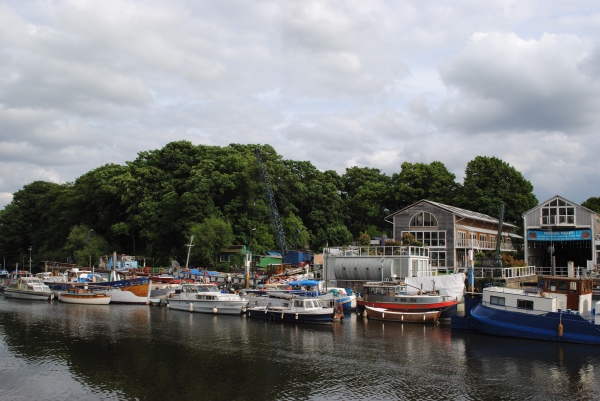
First, to the name. The almost nine acre island, which was previously divided into two and perhaps even three, was previously known by other names including Twickenham Ait and Parish Ait. A place of recreation since perhaps as early as the start of the 17th century – there’s an early reference to a bowling alley being located there, since at least the mid-18th century it was also home to an inn, known variously as The Ship and The White Cross.

During the 19th century, the island became a popular destination for steamer excursions and the inn was rebuilt on a grander scale in about 1830. It became famous for the eel pies that could be bought there – so popular were they that the island’s name was apparently changed in tribute (although there’s a very dubious story that it was King Henry VIII who first made the island’s eel pies famous by stopping to sample one from a stall there – that, however, seems unlikely).

Second, to the fame. Now known as the Eel Pie Hotel, in the first half of the 20th century the inn began an association with music which would see it one day make an important contribution to the development of British pop music.

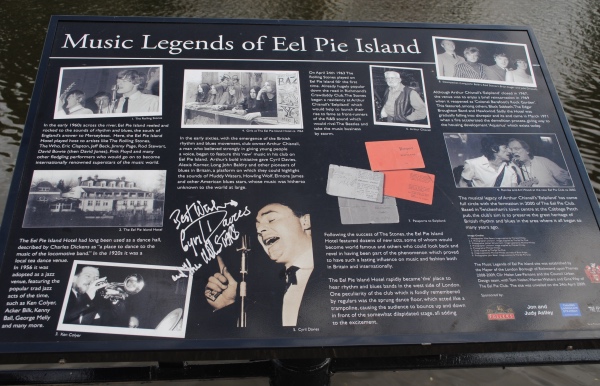
Dances were held there in the 1920s and 30s and in the mid-1950s, jazz sessions were held there. By the Sixties, the venue – under the stewardship of Arthur Chisnall – had started to attract R&B bands and among those who played here in the following years were everyone from Eric Clapton (as part of John Mayall’s Bluesbreakers) and The Rolling Stones to The Who, The Moody Blues, David Bowie and Rod Stewart. In 1967, the venue was forced to close due to the cost of repairs but reopened briefly in 1969 as ‘Colonel Barefoot’s Rock Garden’, attracting bands including Black Sabbath, Hawkwind and the Edgar Broughton Band.

The new venture didn’t last. Squatters moved in and in 1971, the hotel burned down in a “mysterious” fire while it was being demolished.

The island, the centre of which was again damaged by fire in 1996, now hosts about 50 homes and a few boatyards as well as other businesses and artist’s studios. It’s also home to the Twickenham Rowing Club, which was first established in 1860 and moved to the island in 1880.

While for many years it could only be accessed by ferry, the island can these days be accessed via a footbridge (the first bridge was installed in 1957 and replaced in 1998).

Notable residents on the island have included William Hartnell, the original Dr Who, and inventor Trevor Baylis (best known for the wind-up radio). The island has appeared in several books and TV shows including the 2005 series How To Start Your Own Country in which TV personality Danny Wallace attempted to “invade” the island. He was unsuccessful.

PICTURES: Above – Eel Pie Island from Twickenham. Below – A signboard tribute to the island’s musical heritage. (David Adams).

A Moment in London’s History – The last public hanging…

This month marks 150 years since the last public hanging in London (and, indeed, in Britain). It took place outside Newgate Prison and involved a Fenian (Irish nationalist) bomber named Michael Barrett.

Barrett had been arrested following the bombing of the Clerkenwell House of Detention in 1867 which, in a botched effort to free another Fenian, Richard O’Sullivan Burke, a number of bystanders were killed. Barrett’s case was a controversial one (he was the only one of six people to stand trial for the crime who was convicted) and his execution apparently postponed twice because of questions over his guilt.

The crowd at the hanging on the morning of 26th May, 1868, was said to be large – a “great surging mass” (indeed, such was the interest that seats in nearby houses were said to have sold for £10) – but described in The Times as “unusually orderly”.

“With the first sound of the bells came a great hungry roar from the crowd outside, and a loud, continued shout of ‘Hats off’, till the whole dense, bareheaded mass stood white and ghastly-looking in the morning sun, and the pressure on the barriers increased so that the girls and women in the front ranks began to scream and struggle to get free,” the newspaper reported.

“Amid such a scene as this, and before such a dense crowd of white faces, Barrett was executed…To neither cheers nor hisses did the culprit make the slightest recognition. He seemed only attentive to what the priest was saying to him, and to be engaged in fervent prayer. The hangman instantly put the cap over his face and the rope round his neck. Then Barrett turning spoke through his cap and asked for the rope to be altered, which the hangman did. In another moment Barrett was a dead man…He died without a struggle. It is worthy of remark that a great cry rose from the crowd as the culprit fell – a cry which was neither an exclamation nor a scream, but it partook in its sound of both.”

The hanging was carried out by William Calcraft, the orphaned son of an Essex farmer who many years earlier had found what was to be an almost life-long calling when, apparently while selling pies at a hanging he was noticed by his predecessor in the job and became his apprentice before taking in the job himself in 1829.

Calcraft, who was known for his use of controversial ‘short drops’ which meant the condemned would slowly strangle to death rather than have their necks broken, was to preside over the last public hanging – of Barrett – as well as the first private hanging inside Newgate – of 18-year-old murderer Alexander Mackay in September, 1868 – before eventually retiring in 1874 and dying shortly after.

Barrett, meanwhile, was buried under the ‘Birdcage Walk’ (also known as ‘Dead Man’s Walk’), the stone corridor which linked the prison with the Old Bailey. His body was transferred to the City of London Cemetery in 1903 as Newgate was demolished. The grave is marked with a plaque commemorating his place in history.

Public hangings were banned just three days after Barrett died when Parliament passed the Capital Punishment Amendment Act of 1868.

PICTURE: Image from an “execution broadside” of Barrett’s hanging in 1868. These were commonly sold at public executions in the 18th and 19th centuries. 

Treasures of London Special – The “new” Royal Academy of Arts…

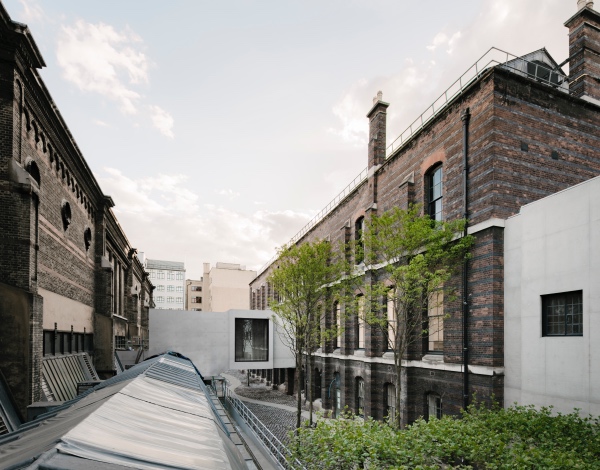
Celebrating its 250th anniversary this year, The Royal Academy of Arts opens its “new” expanded £56 million campus on Saturday.

Designed by Sir David Chipperfield, the new two acre Royal Academy campus features 70 per cent more public space than the RA’s original Burlington House blueprint which will enable the institution to expand its programs of exhibitions and events and create new free displays of art and architecture.

One of the key features of the redevelopment is the new Weston Bridge between the institution’s landmark property, Burlington House, and the RA’s formerly “unloved” building at 6 Burlington Gardens which unites the two-acre campus and creates a new route between Piccadilly and Mayfair.

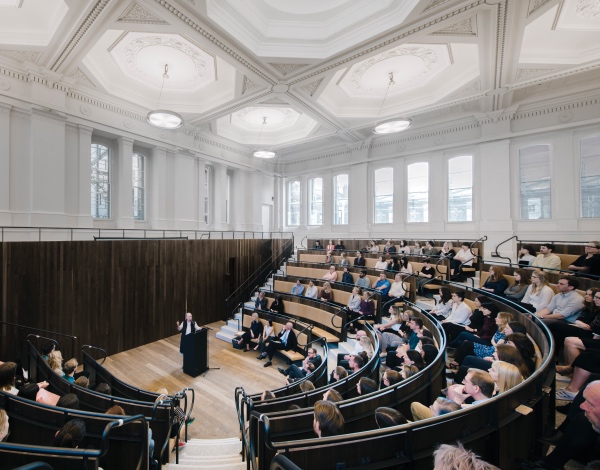
The Grade II-listed building on Burlington Gardens, which the RA bought in 1991 and which was previously home to, among other things, the Museum of Mankind, has been refurbished and a 250 seat lecture theatre, the Benjamin West Lecture Theatre, inserted along with a new architecture studio within The Dorfman Senate Rooms – restored by architect Julian Harrap – for free architectural displays.

A new public route through the campus has integrated the Royal Academy Schools into the visitor experience with the new Weston Studio, a public project space for students and alumni, and provides views of the Schools’ Corridor and the newly landscaped Lovelace Courtyard, providing visitors with a “greater insight into Britain’s longest established art school”.

It also takes visitors through the Gabrielle Jungels-Winkler Galleries, a suite of three day-lit galleries for temporary exhibitions (Tacita Dean’s LANDSCAPE, the inaugural display, opens Saturday) and past the new Royal Academy Collection Gallery where works by the likes of Michelangelo, Reynolds, Kauffman, Thornhill, Constable, Gainsborough and Turner can be seen. There’s also a new Clore Learning Centre.

New places to eat and drink within the complex include the Senate Room bar and restaurant, and cafes and shops located on either side of the Burlington Gardens entrance.

The Royal Academy was founded by King George III in 1768 after he was presented with a petition by architect Sir William Chambers which had been signed by 36 artists and architects seeking to “establish a society for promoting the Arts of Design”. Initially based in Pall Mall, the institution’s first official home was in the new Somerset House. In the 1830s, it moved to Trafalgar Square where it shared premises with the newly created National Gallery and in 1867, the institution has moved to Burlington House where it’s been located ever since.

To celebrate the opening of the “new” Royal Academy, there will be a weekend-long “art party” this weekend with free workshops, tours, displays, late-night performances and DJs. Highlights will include performances by The Uncollective and Rachael Plays Disco; collaborative mural drawing, party hat making, architectural model making, RA Collection gallery tours, and a family printmaking workshop in the new Clore Learning Centre. The Annenberg Courtyard will host street food and cocktail bars.

For more, see www.royalacademy.org.uk/plan-your-visit.

PICTURES: Top – The Weston Bridge and The Lovelace Courtyard/Below – The Benjamin West Lecture Theatre. (Both images by Simon Menges).

This Week in London – Hampton Court Palace breathes new life into Tudor kitchens; Kew’s Temperate House to reopen; and, World War I commemorated in Guildhall Yard…

Hampton Court Palace will on Saturday launch a major representation of its Tudor kitchens with a new display designed to give visitors a ringside seat to preparations for a royal feast. Visitors will be immersed in the sights, sounds and smells of King Henry VIII’s kitchens as they explore the stories of everyone from cooks to liveried pages who made the great court feasts possible and meet the likes of Thomas Cromwell, right-hand man to the king, master cook John Dale and Michael Wentworth, clerk of the kitchen. A specially commissioned play will be launched for the summer and during holiday periods there will be workshops, games and competitions. Admission to the kitchens is included in the palace admission. For more information, head to www.hrp.org.uk/hampton-court-palace/.

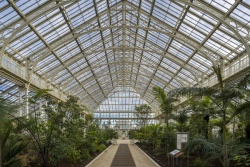
Kew’s iconic Temperate House – the world’s largest Victorian glasshouse – will reopen on Saturday after the biggest renovation project in its history. The five year restoration project has seen its entire framework repaired and thousands of panes of glass replaced. Some 500 plants were taken out and housed in a temporary nursery and some 10,000 plants, consisting of 1,500 species, have gone back in. A programme of events will take place involving the Temperate House, which dates from 1863, over the summer and there are special preview openings on Friday and Saturday night. For more, see www.kew.org. PICTURE: Gareth Gardner/Kew.

The City of London Corporation is marking the centenary of the end of World War I with a new open-air exhibition highlighting the global nature of conflict. Fields of Battle, Lands of Peace: 1918-2018, which opened on Monday, is the third and final display by photographer Michael St Maur Sheil to go on show in Guildhall Yard. The display can be seen until 28th May. Accompanying the exhibition is a free guided walk – The City’s Great War Heroes – which enables people to walk in the footsteps of City men and women who went off to the Great War. It departs from Bishopsgate every Monday and Saturday at 11am and 2pm until 28th May with an extra walk at 1.30pm on the final day. For more, follow this link.

Send all items for inclusion to exploringlondon@gmail.com.

This Week in London – James Cook’s voyages; Diana’s landmine moment remembered; and, the influence of the Greeks on Rodin…

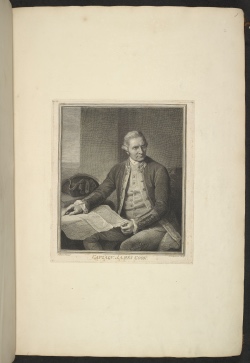
Marking 250 years since Captain James Cook set sail from Plymouth aboard the Endeavour in 1768 comes a new exhibition at the British Library focusing on the explorer’s three world-changing voyages aboard the Endeavour, the Resolution and the Discovery. Maps, artworks and journals from the voyages will be on show in James Cook: The Voyages alongside recently commissioned films bringing contemporary perspectives. The display features a collection of drawings by Polynesian high priest and navigator Tupaia – on display for the first time, as well as Sydney Parkinson’s natural history drawings including the first European depiction of a kangaroo, John Webber’s watercolour landscapes including the first European illustrations of Hawaii and works by William Hodges including the first artworks depicting the Antarctic. There’s also the first chart of New Zealand, specimens including the mouth parts of a squid from the first voyage, and, jewellery and musical instruments including a necklace from Tierra del Fuego, a ceremonial rate from Nootka Sound (Vancouver Island) and a bamboo flute from Tahiti. The display, which runs until 28th August, is being accompanied by a programme of public events. Admission charge applies. For more, see www.bl.ukPICTURE: Portrait of Captain James Cook (1728-79) © British Library Board.

A HALO Trust branded flak vest as well as a denim shirt and Armani chinos all worn by Diana, Princess of Wales, during a high profile visit to Angolan landmine fields in 1997 is among new items on show at Kensington Palace. Running since February last year, Diana: Her Fashion Story – which traces the evolution of the Princess’ style and her impact on British and global fashion – has been spruced up with the addition of new items including the landmine visit outfit as well as a pink Bellville Sassoon suit worn to board the train for her honeymoon, a Victor Edelstein evening gown worn for an official portrait by Terence Donovan (on public display for the first time), a floor length Yuki gown designed for the Prince and Princess of Wales’ visit to Japan, and a tartan dress by Caroline Charles worn to the 1982 Braemar Games in the Scottish Highlands. Admission charge applies. For more, see www.hrp.org.uk/Diana.

The influence of ancient Greek art on 19th century sculptor Rodin is the subject of a new exhibition opening at the British Museum today. Rodin and the art of ancient Greece displays his work alongside the Parthenon sculptures that inspired him. Thanks to a collaboration with the Musée Rodin in Paris, the exhibition features more than 80 of Rodin’s works in marble, bronze and plaster along with sketches. Key works on show include The Kiss (1882), which, like two female goddesses originally on the East Pediment of the Parthenon, was carved from a single block of stone. Runs until 29th July. Admission charge applies. For more, see www.britishmuseum.org.

Send all items to exploringlondon@gmail.com for inclusion.

Treasures of London – Gilbert and Sullivan memorials…

 Located on the west bank of the Thames between Waterloo and Hungerford Bridges are two separate memorials to the dramatist Sir WS Gilbert (1836-1911) and composer Sir Arthur Sullivan (1842-1900) – a partnership better known simply as Gilbert and Sullivan.

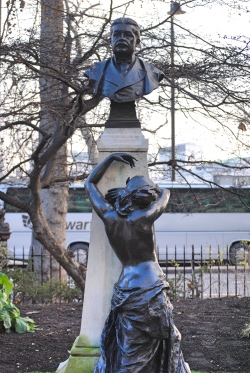
The first to be unveiled was a now Grade II-listed bronze bust of Sullivan in 1903. Located at the northern end of Victoria Embankment Gardens, it is the work of Sir William Goscombe John and, along with the bust which sits atop a pedestal, the monument features a scantily clad female muse leaning against the pillar in apparent grief.

Sheet music, a mandolin and a Pan mask all lie in a heap beside her – the discarded props of Sullivan’s profession – and on the side of the plinth are inscribed some lines from his work, The Yeoman of the Guard: “Is life a boon? If so, it must befall that Death, whene’er he call, must call too soon” (the same lines are inscribed on the sheet music).

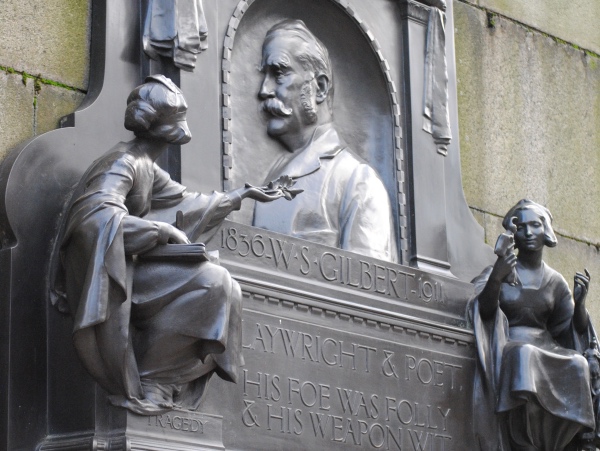
The bronze memorial plaque to Gilbert, meanwhile, was unveiled in 1915, four years after his death. It’s attached to Charing Cross Pier on the downstream side of Hungerford Bridge and, the work of Sir George Frampton, shows Gilbert in profile relief flanked by figures of Comedy and Tragedy.

Gilbert is accompanied by an inscription which reads: “His foe was folly & his weapon wit”. A shield underneath bears a Latin inscription which translates as “I would rather die than change”.

The location of the memorials is not coincidental – the career of Gilbert and Sullivan was closely associated with the nearby Savoy Theatre, where many of their works were premiered thanks to its owner Richard D’Oyly Carte – he’s also commemorated in a memorial opposite the entrance to the Savoy nearby.


Lost London – The Church of St Peter-le-Poer…

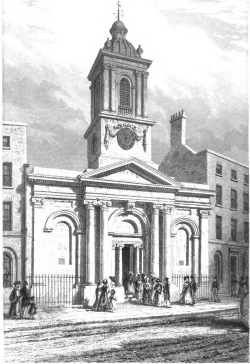
This medieval-era church, located on Broad Street in the City of London, survived the Great Fire of 1666 but was demolished in the early 20th century when, due to the lack of residents in the City, it was no longer needed as a church.

The church, also sometimes referred to as St Peter-le-Poor, was in existence by the end of the 12th century but it’s thought the name ‘le poer’ (generally said to refer to either the poverty of the surrounding area or its proximity to an Augustinian monastery) didn’t come to be added until the 16th century.

The church was rebuilt in 1540 and then enlarged and repaired – including the addition of a new steeple – in the first half of the 17th century.

By 1788, the church had, however, fallen into such disrepair that it had to be rebuilt and the new building, designed by Jesse Gibson and located further back from Broad Street (into which it had previously projected), was consecrated in November, 1792.

The layout of the new church was somewhat unusual – the altar was located on the north-west side of the church, opposite the entrance (altars were traditionally located in the east), and the nave was circular with a wooden gallery running around the interior.

There was a large lantern in the centre with glass walls. The entrance on the eastern side of the church, featured a facade which gave no hint of the circular nature of the building behind – it featured a square tower and columned entrance.

With the declining population living in the City of London, the church was no longer needed as a place of worship by the early 20th century and so it was demolished in 1907.

The parish was united with St Michael Cornhill and the proceeds from the sale of the site were used to build the church of St Peter-le-Poer in Friern Barnet. This church was also given the City property’s font, pulpit and panelling.


This Week in London – Monet and architecture; Abbey Road Studios on show; and, Maqdala recalled…

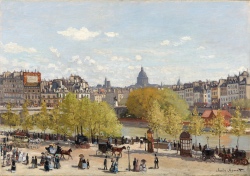
An exhibition showcasing the works of Impressionist artist Claude Monet with a focus on his depictions of architecture opens at the National Gallery on Monday. The Credit Suisse Exhibition: Monet & Architecture is the first exhibition concentrating solely on Monet’s works in London in more than 20 years. It spans his entire career from the mid-1860s to early 20th century and features more than 75 paintings depicting everything from villages to cities like Venice and London as well as individual structures and monuments. The display includes a rare gathering of some of Monet’s great ‘series’ paintings including five pictures from trips to Holland made in the early 1870s, 10 paintings of Argenteuil and the Parisian suburbs from the mid-1870s, seven pictures depicting the cathedral at Rouen from 1892–5, eight paintings of London from 1899–1904, and nine canvases showing Venice from 1908. Highlights include the Quai du Louvre (1867) (pictured), the Boulevard des Capucines (1873), and the flag-filled Rue Montorgeuil, 30 June 1878. Can be seen in the Sainsbury Wing until 29th July. Admission charge applies. For more, see www.nationalgallery.org.uk. PICTURE: The Quai du Louvre (Le Quai du Louvre), 1867, Claude Monet, Oil on canvas © Collection Gemeentemuseum Den Haag.

London’s Abbey Road Studios are celebrated in an exhibition of the work of rock photographer Jill Furmanovsky which opens at the Barbican Music Library on Monday. Inside Abbey Road Studios – Through the lens of Jill Furmanovsky is a showcase of her work since 1976 when she photographed Pink Floyd during the Wish You Were Here recording sessions and, as well as those images, includes more recent images of the likes of Nile Rodgers, Royal Blood, Novelist, and Mura Masa, as well as emerging musical talent. The display is a collaboration between Abbey Road Studios, Furmanovsky – who became artist-in-residence at the studios last year – and the Barbican Music Library. The exhibition, which is free to enter, can be seen until 27th June. For more, see www.barbican.org.uk/whats-on/2018/event/inside-abbey-road-studios.

Some 20 objects from Ethiopia are featured in new exhibition at the V&A marking the 150th anniversary of the siege and battle at Maqdala, culmination of the British Expedition to Abyssinia. Maqdala 1868, which focuses on the battle and its aftermath, features some of the earliest examples of military photography in Britain as well as a portrait of Emperor Tewodros II’s son Prince Alemayehu taken by Julia Margaret Cameron soon after the prince was brought to England by the British military. There’s also examples of metalwork and textiles including a gold crown with filigree designs and embossed images of the Evangelists and Apostles, a solid gold chalice, jewellery and a wedding dress believed to have belonged to the Emperor’s wife, Queen Terunesh. All of the objects were taken during Sir Robert Napier’s military expedition of 1867-68 which was aimed at securing the release of British hostages held by the Emperor and which culminated in the Emperor’s suicide and the destruction of his fortress. The exhibition, which is free to see, has been organised in consultation with the Ethiopian Embassy in London and an advisory group including members of the Orthodox Tewahedo Church, members of the Anglo-Ethiopian society and representatives from the Rastafarian community. Runs until July, 2019, in Room 66 of the Silver Galleries. There is a program of related events. For more, see www.vam.ac.uk.

Send all items for inclusion to exploringlondon@gmail.com.