10 London hills – 10. Richmond Hill…

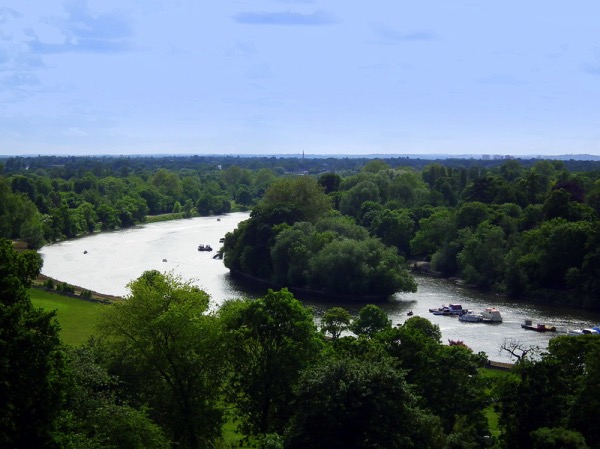
The famous and protected view looking south-west from Richmond Hill across The Thames and Glover’s Island. PICTURE: flicksmores (licensed under CC BY-NC-ND 2.0)

For the final in this series we head out west to Richmond Hill which takes its name from the palace which once stood nearby.

At the summit of the hill, which stands about 50 metres (165 feet) high, stands the gate to Richmond Park while the steeper western slopes drop down to Petersham Meadows by the River Thames.

What was the village of Richmond – now incorporated into greater London – sits partly on the slopes of the hill. It and the hill take their names from a palace, established here in the early 16th century by King Henry VII as a replacement for Sheen (Shene) Palace which had been destroyed in a fire in 1499. The King named the new building Richmond Palace, in honour of the earldom of Richmond in Yorkshire, one of his titles.

Richmond Hill is famed for its views – they include the only view in England protected by an Act of Parliament (passed in 1902). It looks to the south-west over Petersham to the Thames, taking in Glover’s Island, and reaching as far as Windsor and has been immortalised in works by the likes of artists JMW Turner and Sir Joshua Reynolds as well as by author Sir Walter Scott.

Richmond Hill features many fine 18th century homes including Wick House (built for Joshua Reynolds in 1771) and the westward slopes boast the Terrace Walk and Terrace Gardens, both of which are Grade II* listed, while the massive bulk of the former Royal Star and Garter Home for disabled ex-servicemen (now apartments) can be seen close to the summit.

Other famous residents on the hill have included Rolling Stones’ guitarist Ronnie Wood and actress Celia Johnson while scenes for the film, The Hours, were shot on The Terrace.

Looking at Richmond Hill from the Petersham meadows; to the left is the Petersham Hotel, to the right, the former Star and Garter Home. PICTURE: Maxwell Hamilton (licensed under CC BY 2.0)

Treasures of London – Southwark Bridge…

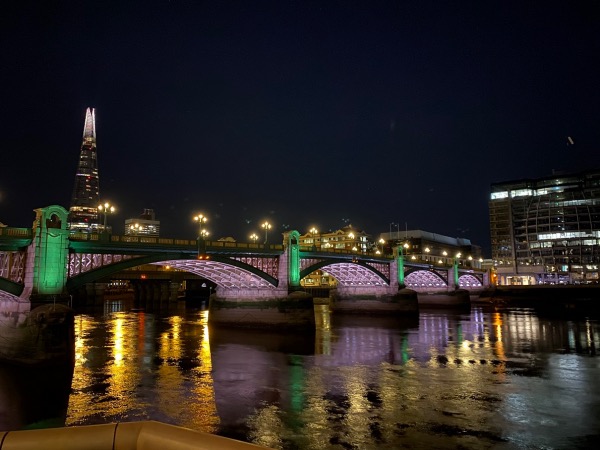
Southwark Bridge lit up to mark its 100th birthday. PICTURE: Courtesy of the City of London Corporation.

Southwark Bridge celebrated its 100th birthday earlier this month so we thought it a good time to have a quick look at the bridge’s history.

The bridge was a replacement for an earlier three-arch iron bridge built by John Rennie which had opened in 1819.

Known by the nickname, the “Iron Bridge”, it was mentioned in Charles Dickens’ Our Mutual Friend and Little Dorrit. But the bridge had problems – its narrow approaches and steep gradient led it to become labelled “the curse of the carman [cart drivers] and the ruin of his horses”.

Increasing traffic meant a replacement became necessary and a new bridge, which featured five arches and was made of steel, was designed by architect Sir Ernest George and engineer Sir Basil Mott.

Work on the new bridge – which was to cost £375,000 and was paid for by the City of London Corporation’s Bridge House Estates which was originally founded in 1097 to maintain London Bridge and expanded to care for others – began in 1913 but its completion was delayed thanks to the outbreak of World War I.

The 800 foot long bridge was finally officially opened on 6th June, 1921, by King George V who used a golden key to open its gates. He and Queen Mary then rode over the bridge in a carriage.

The bridge, now Grade II-listed, was significantly damaged in a 1941 air raid and was temporarily repaired before it was properly restored in 1955. More recently, the bridge was given a facelift in 2011 when £2.5 million was spent cleaning and repainting the metalwork in its original colours – yellow and ‘Southwark Green’.

The current bridge has appeared in numerous films including 1964’s Mary Poppins and, in more recent times, 2007’s Harry Potter and the Order of the Phoenix.

A Moment in London’s History – The coronation of King Edward IV…

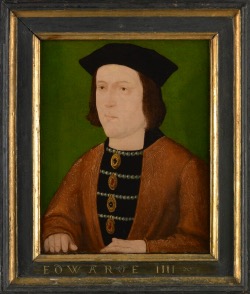
It’s 560 years ago this month that the Yorkist King Edward IV was crowned at Westminster Abbey.

This image has an empty alt attribute; its file name is king-edward-iv.jpg
King Edward IV by Unknown English artist, oil on panel, circa 1540 (NPG 3542). PICTURE: Courtesy of National Portrait Gallery

Only three months earlier, on 4th March, 1461, the 19-year-old Edward had been declared King at Westminster in London. He had then gone on to defeat the Lancastrian forces at the Battle of Towton in North Yorkshire during a snowstorm on 29th March, said to have been the bloodiest single day battle ever fought on English soil with an estimated 28,000 men dying.

While his coronation was first set for July, ongoing trouble from the Lancastrians saw him bring the date forward (his predecessor, Henry VI, was in exile at the time).

Edward arrived at the Tower of London on Friday, 26th June, and then retired to Lambeth for the night. The following day – Saturday, 27th June – he crossed London Bridge and made his state entrance into the City.

Accompanied by the Lord Mayor and Aldermen and some 400 of the elite citizens of the City, Edward, said to be an impressive figure at six foot, four inches tall, then processed through the City streets to the Tower of London.

Once at the Tower, he created some 28 new Knights of the Bath, including his younger brothers George and Richard. They then rode ahead of him as he rode through the streets to Westminster.

The following morning, Sunday, 28th June, Edward went to Westminster Abbey where he was crowned King. Thomas Bourchier, the Archbishop of Canterbury, presided over the ceremony, assisted by William Booth, the Archbishop of York.

After the coronation, a banquet was held in Westminster Hall with the King sitting under a cloth of gold. One of the highlights was apparently the moment when Sir Thomas Dymoke, the King’s champion, rode into the hall in full armour. Flinging down his mail gauntlet, he is said to have challenged anyone who disputed Edward’s right to be king to do battle with him. No-one took up the offer.

A further banquet was held the following day at the Bishop of London’s Palace – in honour of his brother George who was created Duke of Clarence, and on the Tuesday, King Edward, wearing his crown, attended St Paul’s Cathedral.

Edward’s first reign ended in 1470 when on 30th October, he was forced into exile and King Henry VI. But it was only to be for a brief period – Edward IV reclaimed the throne on 11th April, 1471, defeating the Lancastrians in a decisive battle at Barnet on 14th April (April marked the 550th anniversary of that battle).

10 London hills – 8. Harrow Hill…

The Harrow School (left) and St Mary’s Church on top of Harrow Hill. PICTURE: Google Maps

This hill in outer north-west London, which rises 124 metres (408 feet) above sea level, is the location of the village Harrow-on-the-Hill.

The hill’s name is said to refer to a Saxon place of worship and was later taken to mean the Christian church that stood upon it.

That church – the historic St Mary’s, the latest incarnation of a Christian church which has stood on the hill since the Norman Conquest – dominates the hill to this day. Nearby is a spot called King Charles’ Well where King Charles I is said to have stopped and taken one last look at London as he made his way from Oxford to surrender to the Scottish army in Nottinghamshire.

The other famous landmark atop the hill, opposite the church, is the world renowned Harrow School, founded under a Royal Charter by John Lyon in 1572, during the reign of Queen Elizabeth I.

The hill is also host to a Grade II-listed war memorial and a fine array of historic homes dating from the Georgian period to the early 20th century. Among this who have lived on the hill are 19th. century critic and writer Matthew Arnold and 19th century Scottish author RM Ballantyne.

Panoramic views of Central London can be seen from the top of the hill and there is a famous viewpoint in the churchyard known as Lord Byron’s View, which looks away to the north-west. It’s so-called because Byron, while a schoolboy at Harrow, was a frequent visitor to the spot by a tombstone – called the “Peachy Tomb”- where he would apparently spend time “dreaming”.

Byron’s View atop Harrow on the Hill. PICTURE: Google Maps

Famous Londoners – Thomas Crapper…

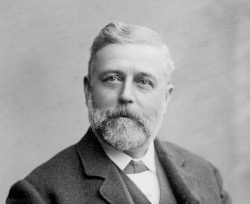
One of the most famous plumbers in the world, Thomas Crapper was the founder of London-based sanitary equipment company, Thomas Crapper & Co, and a man whose name has become synonymous with toilets (although he was not, contrary to popular belief, the inventor of the flushing toilet).

A portrait of Thomas Crapper. PICTURE: Via Wikipedia.

Crapper was born in the town of Thorne in Yorkshire in 1836, the son of Charles Crapper, a sailor (his exact birthday is unknown but he was baptised on 28th September, so it’s thought to have been around that time).

In 1853, he was apprenticed to his brother George, a master plumber based in Chelsea, and, having subsequently gained his own credentials, established himself as a sanitary engineer in Marlborough Road in 1861 (he had married his cousin, Maria Green, the previous year).

Sometime in the late 1860s, in a move some saw as scandalous, his company became the first to open public showrooms displaying sanitary-related products. He was also a strong advocate for the installation of flushing toilets in private homes.

While not the inventor of the modern flushing toilet (that is often credited to Sir John Harington, godson of Queen Elizabeth I, in 1595, although there are even earlier examples), he was responsible for a number of advances in the field including making design improvements to the floating ballcock, a tank-filling mechanism, and the U-bend, an improvement on the S-bend.

Crapper’s company did have some high profile clients – in the 1880s it supplied the plumbing at Sandringham House in Norfolk for then Prince Albert (later King Edward VII). This resulted in Crapper’s first Royal Warrant and the company would go on to receive others from both Albert, when king, and King George V.

Crapper’s branded manhole covers, meanwhile, can still be seen in various parts of London, including around Westminster Abbey where he laid drains. His name can also be found on what are said to be London’s oldest public toilets.

Thomas Crapper & Company logo. PICTURE: Oxyman (licensed under CC-BY-SA 3.0).

Crapper retired in 1904 (his wife had died two years earlier) and the firm passed to his nephew George (son of his plumber brother George) and his business partner Robert Marr Wharam (the firm, Thomas Crapper & Company, continues to this day – now based in Huddersfield, it still sells a range of vintage bathroom products).

Having spent some time commuting from Brighton, Thomas lived the last six years of his life at 12 Thornsett Road, Anerley, in south-east London (the house now bears a plaque). He died on 27th January, 1910, of colon cancer and was buried at Elmer’s End Cemetery nearby.

While it is often claimed that it’s thanks to Thomas Crapper and his toilets that the word ‘crap’ came to mean excrement, the word is actually of Middle English origin and was already recorded as being associated with human waste when Crapper was just a young boy.

But there is apparently more truth to the claim that toilets became known as ‘crappers’ thanks to Thomas Crapper’s firm. It was apparently American servicemen who, when stationed overseas during World War I, encountered Crapper’s seemingly ubiquitous branding on toilets in England and France and, as a result, started referring to toilets as such.

10 London hills – 5. Primrose Hill…

View from the top of Primrose Hill. PICTURE: Steve Cadman (licensed under CC BY-SA 2.0)

Standing in a park located just to the north of Regent’s Park in the city’s inner north-west, Primrose Hill stands 63 metres above sea level and, like Parliament Hill, provides panoramic views of the city skyline.

The hill, which features one of six protected views in London, was once part of a chase (unenclosed hunting land) owned by King Henry VIII and was Crown property until 1842 when it became part of a public park through an Act of Parliament.

The name has been in use for at least 500 years and is thought to refer to the flowers that grew here profusely (which it means it can’t have been named for Archibald Primrose, Prime Minister between 1894 and 1895).

The hill forms part of one of Mother Shipton’s “prophecies” – she apparently proclaimed that when London surrounded the hill, its streets would run with blood.

It was for a time known as Greenberry Hill after three labourers – Robert Green, Henry Berry and Lawrence Hill – were found guilty of the murder of magistrate Sir Edmund Berry Godfrey (he had heard Titus Oates’ evidence in the so-called Popish Plot). Sir Edmund was found impaled on his own sword on the hill in October, 1678 – convicted of his murder the three men were hanged on its summit in 1679 (they were later exonerated and the death of Sir Edmund remains something of a mystery).

The hill, which has also apparently been known as Battle Hill, was also the location where the poet and antiquarian Iolo Morganwg (Edward Williams) founded the Gorsedd, a community of Welsh bards, on 21st June in 1792.

In 1838, a railway tunnel under the hill was completed by the North Western Railway – it was the first in London and connected Chalk Farm and Swiss Cottage. In the 1840s, a proposal to create a cemetery here was put to Parliament but never went ahead. There were also plans to develop the entire hill as a housing estate but nothing came of it.

On top of the hill is York stone edging with an inscription by William Blake: “I have conversed with the spiritual sun. I saw him on Primrose Hill.” There’s also the remains of an anti-aircraft battery from World War II.

On the hill’s slope, meanwhile, is a tree planted in 1964 to mark the 400th anniversary of Shakespeare’s birth (it replaced once planted 100 years earlier in honour of the Bard’s 300th).

Primrose Hill gives its name to part of the surrounding area, which remains a sought-after residential district.

For details on when to visit, head to www.royalparks.org.uk/parks/the-regents-park/things-to-see-and-do/primrose-hill.

A Moment in London’s History – Sir Robert Walpole becomes first ‘Prime Minister’…

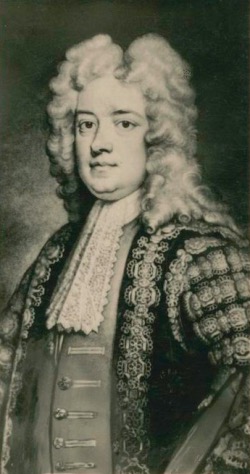
Portrait of Robert Walpole (1676-1745); probably a work of Godfrey Kneller (via Wikipedia).

This month – over the Easter weekend, in fact – marked the 300th anniversary of the date on which Sir Robert Walpole effectively became the first Prime Minister of the United Kingdom.

Walpole, who had entered Parliament as a Whig at the age of 25 in 1701, had had a tumultuous political career which had included rising quickly to the positions of Secretary at War and Treasury of the Navy before, having been targeted by his Tory opponents, spending six months in the Tower of London after he was found guilty of corruption.

The accession of King George I in 1714 was good news for the Whigs and the following year Walpole was appointed First Lord of the Treasury and Chancellor of the Exchequer in 1715. He resigned a couple of years later due to a party split but by 1720 he was once again man of influence, appointed to the Privy Council and made Paymaster General as well as Paymaster of the Forces.

The following year, on 3rd April, 1721, he was effectively elevated to the position of Prime Minister after being appointed First Lord of the Treasury, Chancellor of the Exchequer, and leader of the House of Commons.

Walpole remained at the head of the government until 1742 when he resigned after a motion of no confidence was moved against him. But it wasn’t all bad news, King George II subsequently elevated him to the House of Lords as the Earl of Orford.

Interesting, it was also King George II who offered Walpole the residence in Downing Street (Walpole only accepted on condition that it be a gift to the office of the First Lord of the Admiralty so he wasn’t liable for the cost of upkeep).

Walpole was the first of what has since been an unbroken line of 77 Prime Ministers (although only 55 people have held the office due to the multiple occasions on which individuals have served).

While the term was used informally to describe Walpole as far back as the 1730s (although in 1741 he denied he was the “sole and prime minister” in the House of Commons, thanks to the association of the term with foreign tyrannies), it wasn’t until the following century that it was used in Parliament (Benjamin Disraeli, was the first to sign an act using the title in 1878) and not until 1905 was the post of prime minister officially given recognition in the order of precedence.

10 London sites related to St Thomas Becket – A recap…

We’ve finished our series on London sites related to the story of Thomas Becket. Before we move on to our next special series, here’s a recap…

1. Cheapside…

2. Merton Priory…

3. Guildhall…

4. London churches…

5. The Tower of London…

6. Westminster Abbey…

7. Southwark…

8. St Thomas Becket memorial…

9. St Thomas’ Hospital…

10. The Pilgrim’s Way…

We’ll launch our new series next Wednesday.

Famous Londoners – Old Martin…

A grizzly bear (not Old Martin). PICTURE: Joshua J Cotten/Unsplash

A large, fully grown, grizzly bear presented to King George III by the Hudson’s Bay Company in 1811, Old Martin was one of the scarier residents of the Tower of London’s menagerie.

The bear, who was apparently named after a famous bear in Europe (the “old” was added because he spent so long in resident at the Tower), is said to have been the first grizzly in London.

He was not, however, the first bear to live there – King Henry III had been given a polar bear by King Haakon IV Haakonsson of Norway in 1251 (George, however, was apparently unimpressed with his gift, said to have commented in private that he would have preferred a tie or pair of socks).

Despite his many years in the menagerie, Old Martin apparently refused to be tamed and remained fierce towards both strangers and his keepers alike.

When the Duke of Wellington closed the menagerie in the early 1830s (King William IV apparently had little interest in the animals), Old Martin was moved to the London Zoo in Regent’s Park. He died there in 1838.

His skin and skull were subsequently sent to the Natural History Museum and rediscovered there in 1999 for an exhibition at the Tower.

There’s a rather odd story associated with Old Martin. It’s said that in 1816 – when Old Martin was living in the Tower’s menagerie – a Yeoman Warder saw a ghostly bear while on night duty near the Martin Tower. He apparently attempted to run it through with a bayonet but the blade went straight through and struck the door frame behind it. The somewhat dubious story goes that the poor Yeoman Warder died of shock just a few hours later.

10 London sites related to St Thomas Becket – 10. The Pilgrim’s Way…

The final in our series on St Thomas Becket’s London is not about a static site but a pathway, one that people have been walking since the Middle Ages as pilgrims to the shrine of St Thomas Becket in Canterbury.

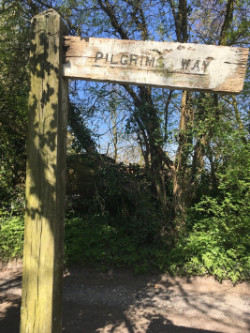
A Pilgrim’s Way signpost near Chaldon in Surrey. PICTURE: G Travels (licensed under CC BY-NC 2.0)

Famous today through its association with Geoffrey Chaucer’s The Canterbury Tales, the Pilgrim’s Way actually refers to not one path but a series of routes taken by pilgrims as they made their way from London to Canterbury, linking up along the way with another route originating in Winchester.

The pilgrimage from London typically started at the now long lost St Thomas Becket Chapel in the middle of Old London Bridge and then headed south through Southwark where the Tabard Inn – where Chaucer has his pilgrims staying at the start of his journey – was located.

These days, there’s several routes – the official Pilgrim’s Way website has a couple of different routes through London. Both start at Southwark Cathedral and one then follows the line of A2 south before heading east to the Thames through Deptford where it joins up with a second route. This route, on leaving Southwark Cathedral, follows the south bank of the Thames east.

On becoming one route at Deptford, the Pilgrim’s Way then follows the Thames through Greenwich and Woolwich before turning southward to Dartford and eventually linking up with the Pilgrim’s Way from Winchester in the village of Otford in Kent (and then on to Canterbury).

Other versions of the pilgrimage route start at Westminster Abbey and take in St Paul’s Cathedral before crossing over the Thames and heading east to Gravesend and on to the Medway towns and eventually Canterbury.

Interestingly, some believe that King Henry II took the route from London to Canterbury when performing his very public act of atonement for his role in the saint’s death (although others believe he made the pilgrimage from Winchester).

Treasures of London – St Thomas Becket pilgrim badges…

The Museum of London is currently closed due to the coronavirus pandemic but we run this story in the hope you’ll be able to visit soon.

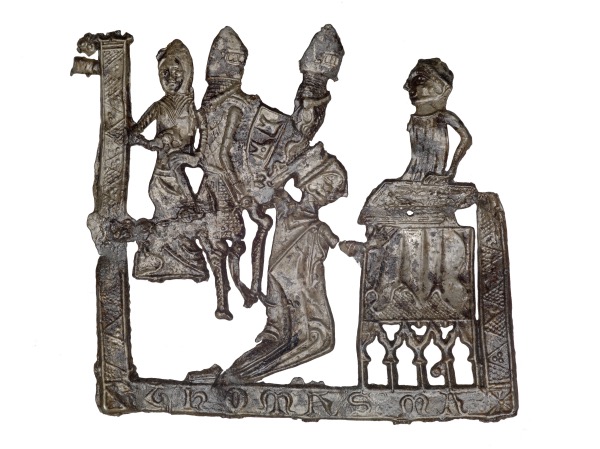
This pilgrim badge depicts the scene of Becket’s martyrdom. An inscription at the base of the badge reads ‘THOMAS MA’ (meaning ‘Thomas Martyr’). Becket is on his knees in front of an altar with a number of knights attacking him. Behind the altar stands the figure of Edward Grim, a clerk who tried to stop Becket’s murder. One of the knights carries a shield with two bears’ heads on it, identifying him as Reginald Fitzurse (through the visual pun on the Latin ‘ursus’, meaning ‘bear’). Fitzurse was the knight popularly believed to have struck final blow that killed Becket. PICTURE: © Museum of London.
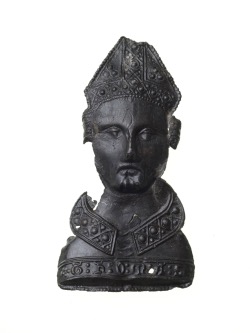
Pilgrim badge in the shape of a bust of St Thomas Becket wearing a mitre and inscribed ‘T:H:O:M:A:S’. PICTURE: © Museum of London.

The Museum of London contains a large collection – in fact, it’s said to be the largest in the UK – of pilgrim badges relating to the commemoration of the Archbishop of Canterbury, St Thomas Becket, who was brutally murdered in 1170.

Produced largely in Canterbury (possibly some in London), the lead-alloy badges were worn, typically on a hat or staff, by pilgrims as a means of commemorating their pilgrimage to the Shrine of St Thomas Becket in Canterbury.

They came in various shapes and sizes. Many simply depict a bust of Becket’s head wearing the Archbishop of Canterbury’s mitre (see picture right).

But others are more elaborate and depict the full-length figure of the archbishop, scenes of his martyrdom at the hands of King Henry II’s knights (see picture above) and even the elaborate bejewelled shrine housing St Thomas’ remains that was erected in about 1220 in Canterbury Cathedral (the endpoint of the pilgrimage).

The museum also has small tin ampullae which were created to hold “Canterbury Water” or “St Thomas’ Water” – water into which drops of the martyred archbishop’s blood were dripped before it was blessed – which was given to pilgrims to take home as a kind of “cure all”.

The collection of badges can be seen when the museum reopens. Keep an eye out for the reopening at www.museumoflondon.org.uk.

10 London sites related to St Thomas Becket – 9. St Thomas’ Hospital…

Following Thomas Becket’s brutal murder in Canterbury Cathedral in 1170, King Henry II is ordered by Pope Alexander III to perform acts of penance for his death, going on a public pilgrimage to Canterbury where he spent a night in prayer at Becket’s tomb and was whipped by monks.

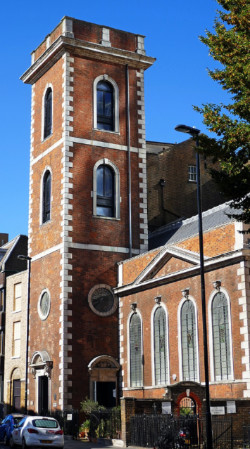
The Old Operating Theatre & Herb Garrett Museum now resides in the former St Thomas’ Church which probably started life (in a previous version) as the chapel for the medieval hospital. PICTURE: Calstanhope (licensed under CC BY-SA 4.0).

Becket’s renown, meanwhile, quickly grew in the aftermath of his death and miracles soon began to be attributed to him. And then, little over two years after he was killed, the Pope declared him a saint. It’s believed that soon after that, in 1173, St Thomas’ Hospital in Southwark- which had been founded a couple of years earlier – was named in commemoration of him.

The hospital was run by a mixed-gendered order of Augustinian canons and canonesses, believed to be of the Priory of St Mary Overie, and provided shelter and treatment for the poor, sick, and homeless. Following a fire in the early 13th century, the hospital was relocated to a site on what is now St Thomas Street.

In the 15th century, Dick Whittington endowed a ward for expectant unmarried mothers at the hospital and in 1537, it was the location for the printing of one of the first English Bibles – which is commemorated in a plaque at the former site of the hospital.

When the monastery at Southwark, which oversaw the hospital – also referred to as the Hospital of St Thomas the Martyr, was closed in 1539 during the Dissolution, the hospital too was closed. It did reopen a decade later but was dedicated to St Thomas the Apostle instead of St Thomas Becket (and has remained so since). The name change was political – King Henry VIII had ‘decanonised” St Thomas Becket as part of his reform of the church in England.

The hospital was rebuilt from the end of the 17th century (the long-deconsecrated Church of St Thomas in St Thomas Street, home to the Old Operating Theatre & Herb Garrett, is the oldest surviving part of this rebuild) but it left Southwark in 1862 when the site was compulsorily acquired to make way for the construction of the Charing Cross railway viaduct from London Bridge Station.

Following a temporary relocation to Royal Surrey Gardens in Newington, it moved into new premises at Lambeth – across the river from the Houses of Parliament – in 1871. It has since been rebuilt and merged with Guy’s Hospital.

Correction: Apologies – we had typo in the copy – the date Becket was made a saint was, of course, 1173!

10 London sites related to St Thomas Becket – 8. St Thomas Becket memorial…

PICTURE: Morgaine (licensed under CC BY-SA 2.0)

High profile and influential though he was during his lifetime – serving as Chancellor and Archbishop of Canterbury, it was the brutal and shocking nature of Thomas Becket’s death that ensured he would be remembered down through the ages.

Already strained, relations between King Henry II and Becket took a further downturn after the Archbishop excommunicated Roger de Pont L’Évêque, the Archbishop of York, Gilbert Foliot, the Bishop of London, and Josceline de Bohon, the Bishop of Salisbury, thanks to their role in crowning Henry, the Young King, in York, without the Archbishop’s permission.

On hearing the news of the excommunication, King Henry II is said to have uttered those immortal words, “Will no one rid me of this turbulent priest?” (although there is considerable dispute over exactly what he said – contemporary biographer (and Canterbury monk) Edward Grim, for example, has the quote as: “What miserable drones and traitors have I nourished and brought up in my household, who let their lord be treated with such shameful contempt by a low-born cleric?”).

Whatever the exact words, the King’s utterance – made while he was at Bur-le-Roi near Bayeaux in modern France – was interpreted as a command by four knights who were present – Reginald FitzUrse, Hugh de Morville, William de Tracy and Richard le Breton. Leaving the castle, they set out for England to confront the Archbishop.

The knights arrived at Canterbury Cathedral on 29th December, 1170, and informed Becket that he was commanded to go to Winchester to answer for his actions. Becket refused and the knights, retrieving weapons and armour they had stashed outside the cathedral, returned to the cathedral and hunted down Becket (who had apparently ordered the doors to remain open) with swords in their hands.

They found him at a door to the cloister near the stairs leading up to the cathedral quire where monks were chanting vespers. Becket is reported to have said “I am no traitor and I am ready to die” before one of the knights tried to pull him inside. Grabbing a pillar, he refused to go. The knights then struck him with a series of blows on the head which proved fatal.

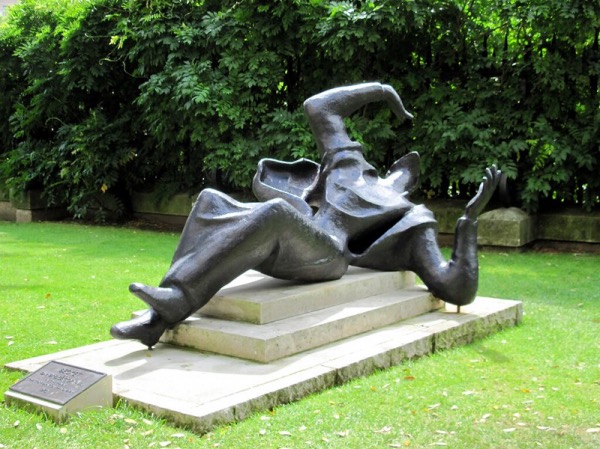
A modern memorial to Becket which features a statue depicting him lying back with his hand raised as though to ward off blows as he is attacked, is located in St Paul’s Churchyard. The statue, which is made from resin coloured to appear as bronze, is the work of Bainbridge Copnall and was created in 1970 as part of commemorations marking 800 years since his death. It was acquired by the City of London Corporation in 1973.

It was damaged by a falling cherry tree in 1987 but was restored by a student of Copnall.

Where’s London’s oldest…livery company?

There are 110 livery companies in London, representing various “ancient” and modern trades. But the oldest is said to be the Worshipful Company of Weavers.

What was then known as the Weavers’ Guild was granted a charter by King Henry II in 1155 (although the organisation has an even older origins – there is an entry in the Pipe Rolls as far back as 1130 recording a payment of £16 made on the weaver’s behalf to the Exchequer).

Saddler’s Hall in Gutter Lane where the Worshipful Company of Weavers is based out of.

In 1490, the Weaver’s Guild obtained a Grant of Arms, in the early 16th century it claimed the status of an incorporated craft, and, in 1577 it obtained ratification of its ordinances from the City of London.

By the late 16th century, the company – its numbers swollen by foreign weavers including Protestants fleeing persecution in Europe – built a hall on land it owned in Basinghall Street. A casualty of the Great Fire of London, the hall was rebuilt by 1669 but by the mid-1850s had fallen into disrepair and was pulled down and replaced by an office block.

After the office building was destroyed during World War II (fortunately some of the company’s treasures which had been stored there had already been moved), the company considered rebuilding the hall but decided its money could be better used, including on charitable works.

For many years, the company’s business was run from various clerk’s offices outside the City of London but since 1994 it has been run from Saddlers’ House.

The company, which ranks 42nd in the order of precedence for livery companies, has the motto ‘Weave Truth With Trust’.

For more, see www.weavers.org.uk.

10 London sites related to St Thomas Becket – 7. Southwark…

Thomas Becket spent eight years in role of Archbishop of Canterbury, including almost two based at a Cistercian abbey in Pontigny, France, while in exile following his dispute with King Henry II over the Constitutions of Clarendon.

Thomas returned to England in 1170 but his relationship with King Henry remained acrimonious, particularly after the Archbishop excommunicated Roger de Pont L’Évêque, the Archbishop of York, Gilbert Foliot, the Bishop of London, and Josceline de Bohon, the Bishop of Salisbury, who had crowned King Henry’s heir, Henry, the Young King, at York in June of that year without his approval.

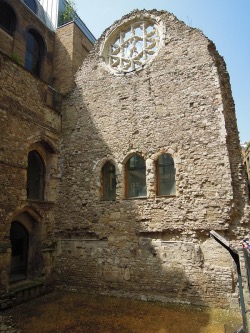
Ruins of Winchester Palace in Southwark. PICTURE: Aaron Bradley (licensed under CC BY-SA 2.0)

It’s that event that led to Becket’s infamous death at the hands of four knights in late December (more about that next week). But a few weeks before that Becket was in Southwark and there he met representatives of the Priory of St Mary Overie (of which what is now Southwark Cathedral was part) and visited Winchester Palace, London residence of the Bishop of Winchester (which now stands in ruins – see picture).

In what was to be Becket’s last visit to London before his death, he paused overnight at at the palace as he travelled to seek an audience with Henry, the Young King, in Winchester, in a bid to reconcile with the 15-year-old.

It was apparently quite an occasion – crowds estimated by one probable eyewitness to number some 3,000 came out to meet him as did a procession of singing monks from St Mary’s. Becket is said to have distributed alms to the poor and it’s said that a woman named Matilda, who apparently was known for making a spectacle of herself at public occasions, kept telling the Archbishop to “Beware of the knife” (which appears a little too conveniently prescient perhaps to ring true).

While at the palace, messengers arrived to inform Becket that the Young King did not wish to see him and instead ordered him back to Canterbury. Becket didn’t immediately obey – first headed further wet to Croydon and his manor at Harrow before eventually arriving back in Canterbury on about 18th December.

A Moment in London’s History – The “execution” of Oliver Cromwell…

It was 360 years ago late last month that the body of Oliver Cromwell, one time Lord Protector of the Commonwealth, was, having previously been exhumed from his grave in Westminster Abbey, hanged from a gallows at Tyburn before being beheaded.

Cromwell had died two years previously on 3rd September, 1658, at the age of 59. It’s thought he died of septicaemia brought on by a urinary infection (although the death of his favourite daughter Elizabeth a month before is also believed to have been a significant factor in his own demise).

He (and his daughter) were buried in an elaborate funeral ceremony in a newly created vault in King Henry VII’s chapel at Westminster Abbey.

Cromwell’s son Richard had succeeded him as Lord Protector but he was forced to resign in May, 1659, and divisions among the Commonwealth’s leadership soon saw Parliament restored and the monarchy restored under King Charles II in 1660.

In late January, 1661, on Parliament’s order, Cromwell’s body as well as those of John Bradshaw, President of the High Court of Justice for the trial of King Charles I, and Henry Ireton, Cromwell’s son-in-law and a general in the Parliamentary army during the English Civil War, were all exhumed from their graves.

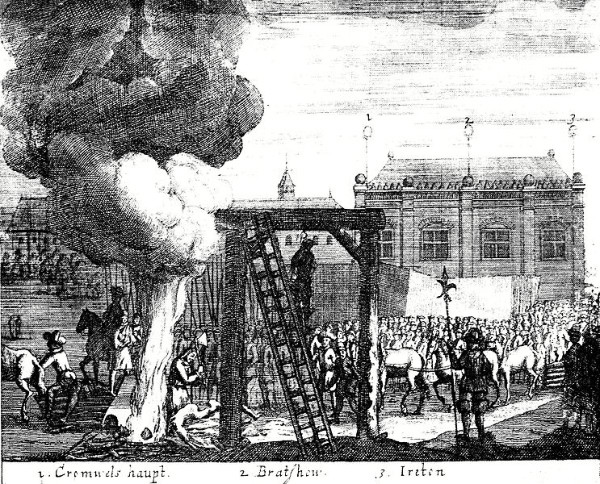
A contemporary engraving of the execution of Cromwell, Ireton and Bradshaw. PICTURE: Via Wikipedia.

The bodies of Cromwell and Ireton were taken to the Red Lion Inn in Holborn where they lay under guard overnight and were joined by that of Bradshaw the following day.

That morning – the 30th January, a date which coincided with the 12th anniversary of the execution of King Charles I in 1649 – the shrouded bodies in various states of decomposition and laying in open coffins were dragged on a sledge to gallows at Tyburn were they were publicly hanged.

The bodies remained on the gallows until sunset when they were removed and beheaded (Cromwell’s beheading apparently took eight blows). The bodies were believed to have been subsequently thrown into a common grave at Tyburn (although there’s all sorts of speculation surrounding the fate of Cromwell’s – indeed some believe his body had already been removed from Westminster Abbey before the exhumation took place and that it was the body of someone else which was hanged and beheaded).

The decapitated heads, however, were kept. They were placed on 20 foot long spikes at Westminster Hall for public display (Samuel Pepys was among those who saw them).

In 1685, however, the spike holding Cromwell’s head broke in a storm. Cromwell’s head is said to have ended up in the possession of a soldier who took it and hid it in his chimney (a reward was offered but searches were unsuccessful). The fate of the head then remains somewhat clouded but in 1710 it was being displayed in the London museum of Swiss-French collector Claudius Du Puy.

It subsequently passed through various hands until it was eventually bought by Dr Josiah Henry Wilkinson in the early 19th century. It remained in the possession of his family until, following tests which concluded it was indeed Cromwell’s head, it was offered to Sydney Sussex College, Cromwell alma mater, where, in 1960, it was buried in a secret location.

10 London sites related to St Thomas Becket – 6. Westminster Abbey…

Theobold of Bec, the Archbishop of Canterbury, in whose household Becket had previously served before becoming Lord Chancellor, died on 18th April, 1161. King Henry II, apparently hoping to install a friendly face in the post, ensured Becket was nominated to replace him several months later.

In keeping with tradition, the monks of Christ Church, Canterbury, apparently somewhat reluctantly, were persuaded to elect Becket, who was merely an archdeacon, to the post.

And it was at Westminster Abbey, on 23rd May, 1162, that a council of clergy and noblemen was convened to ratify the decision.

Sitting under the chairmanship of Bishop Henry of Winchester, who had only recently returned from exile, the council was told by the Prior of Christ Church that Thomas had been “unanimously and canonically” elected as Archbishop. The council, despite a lonely objection from Gilbert Foliot, the Bishop of Hereford, had then confirmed the decision and Bishop Henry read out the formal election result in the refectory or monk’s dining hall.

Becket, who was present, was then presented to the seven-year-old Prince Henry (later known as Henry, the Young King), the ill-fated eldest son of King Henry II who had been empowered by his father to give royal consent to the decision.

Becket headed for Canterbury soon after and there was ordained a priest on 2nd June and consecrated as Archbishop the following day. The stage was set for one of English history’s most infamous clashes of church and state.

Westminster Abbey, meanwhile, was also to play a key role in the antipathy that developed between King Henry II and Archbishop Thomas over the coming years. It was here that King Henry II had his aforementioned son Henry crowned as King of England in 1170 – against the wishes of Archbishop Thomas. It was that coronation which brought the simmering tension which had grown between them to a head.

And, in an footnote, in May, 2016, a relic of St Thomas, said to be a bone fragment from his elbow, stayed overnight in the Abbey’s Shrine of St Edward the Confessor. Usually kept at the Basilica of Esztergom in Hungary, the relic’s visit was part of a week-long tour of locations in London and Canterbury – the first time it had visited the UK in more than 800 years.

This Week in London – Exploring the ‘Raphael Cartoons’; using art to bridge Brexit divide; a 21st century police box; and, COVID’s viral tweets…

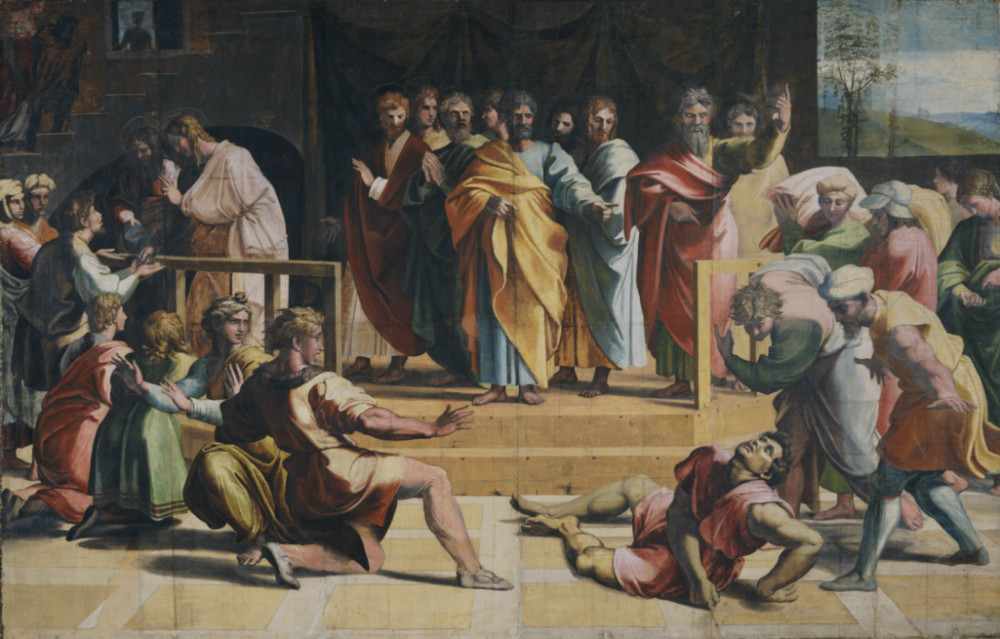
One of the Raphael Cartoons depicting ‘The Death of Ananias (Acts 5: 1-5)’, by Raphael, 1515 –16, Italy. Photo: © Victoria and Albert Museum, London. Courtesy Royal Collection Trust / Her Majesty Queen Elizabeth II 2021as.

An in-depth exploration of the so-called ‘Raphael Cartoons’ has gone online at the V&A ahead of the reopening of the newly transformed Raphael Court later this year. Among the greatest Renaissance treasures in the UK, the cartoons were commissioned by Pope Leo X for the Sistine Chapel in the Vatican shortly after his election in 1513. The Pope asked artist Raphael to create a series of 10 designs illustrating the lives of St Peter and St Paul which could then be turned into tapestries to grace the walls of the chapel. Created in the workshop of merchant-weaver Pieter van Aelst in Brussels, the 10 tapestries were each five metres wide and 3.5 metres high. Seven of Raphael’s original cartoons survive – they were brought to Britain in the early 17th century by the Prince of Wales (later King Charles I) and remained behind closed doors in the Royal Collection until they were lent to the South Kensington Museum – now the V&A – by Queen Victoria in 1865 in memory of Prince Albert. The cartoons have been on public display in the museum ever since. The new online offering traces the story of the cartoons and using ultra- high-resolution photography, infrared imagery, and 3D scans, and is the first time people have been able to explore the cartoons in such detail. It was produced as part of the V&A’s ‘Raphael Project’, marking the 500th anniversary of Raphael’s death in 2020, which includes a landmark renovation of the Raphael Court – home to the cartoons. The refurbished gallery will be unveiled when the museum reopens. To see the new online display, head to vam.ac.uk/raphael-cartoons.

A participatory art project exploring the relationship between the UK and France in a post-Brexit world has commenced this week. I Love You, Moi Non Plus – presented in partnership by Somerset House, Dover Street Market London, The Adonyeva Foundation, Collectif Coulanges, Eurostar and coordinated by Sabir, invites artists to share their interpretation of what the British-French relationship means to them with works to be displayed in a new online gallery alongside bespoke pieces from “project ambassadors” including Chinese artist Ai Weiwei, fashion designer Stella McCartney, English electronic musician Brian Eno, English National Ballet artistic director Tamara Rojo,and British artist Bob and Roberta Smith. The project seeks to highlight how art and creativity can “maintain connections between communities across the channels, unifying voices from across Britain and the EU”. Participants are asked to contribute either by sharing their creations on social media with hashtags #ILoveYouMoiNonPlus, #ILYMNP and #LifeAfterBrexit or submit them directly to the website here

Does this mean a new Tardis for Dr Who? The City of London Corporation is calling on architects, landscape architects, designers and artists to submit ideas for the design of a “21st century police box”. The competition, which is being run by the City in conjunction with the City of London Police, New London Architecture (NLA) and Bloomberg Associates, aims to provide “a modern and engaging way to provide information and safety” to the Square Mile’s residents, workers and visitors. Up to six shortlisted teams will be awarded funding to develop their idea into a design proposal and the winning design will be unveiled in the summer. For more, head to nla.london/submissions/digital-service-point-open-call-competition.

The Museum of London has acquired 13 tweets shared by Londoners during the initial coronavirus-related lockdown as part of its ongoing ‘Collecting COVID’ project. The tweets, which were collected under the ‘Going Viral’ strand of the Collecting COVID project, now form part of the museum’s permanent collection and lay bare what people were experiencing during 2020. The Going Viral project focused on collecting text, memes, videos and images that were ‘shared’ or ‘liked’ on Twitter more than 30,000 times. Additional tweets will be considered for acquisition this year.

Send all items for inclusion to exploringlondon@gmail.com.

Lost London – ‘Canute’s Canal’…

A waterway said to have been cut by the Viking Canute (also spelled Cnut) in the 11th century, the canal, according to the story, was constructed so his fleet of ships – blocked by London Bridge – could get upstream.

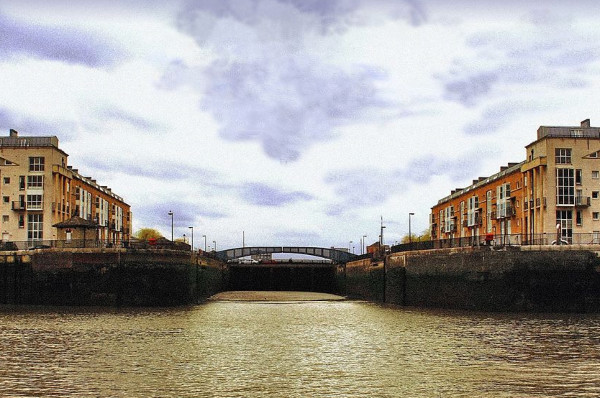
The entrance to Greenland Dock from The Thames in 2012 – one of the many places posited as the location where Canute’s Canal started. PICTURE: Public Domain

The story goes that in May, 1016, the Dane Canute (and future King of England), led an army of invasion into England to reclaim the throne his father, Sweyn Forkbeard, had first won three years earlier.

Canute needed to get his ships upriver of London Bridge to besiege the city which was held by the Saxons under Edmund Ironside (made king in April after his father Athelred’s death) but was blocked by the fortified, although then wooden, London Bridge.

So Canute gave orders for the digging of a trench or canal across some part of Southwark so his ships could pass into the river to the west of the bridge and he could encircle the city.

The canal – also known as ‘Canute’s Trench’ – was duly dug and the city was besieged – although the Vikings lifted the siege without taking the city (which does seems like a lot of work for not much result in the end) and the war was eventually decided elsewhere.

Various routes of the canal have been posited as possibilities – including the suggestion that there was an entry at Rotherhithe (Greenland Dock has been sited as one location) and exit somewhere near Lambeth or further south at Vauxhall (and one possibility is that Canute, rather than digging a long canal, simply cut through the bank holding back the Thames on either side of London Bridge and flooded the lands behind).

Various waterways have also been identified with it including the River Neckinger, parts of which survive, and the now lost stream known as the Tigris.

Whether the canal actually existed – and what form it took – remains a matter of some debate (although the low-lying, marshy land of Southwark at the time surely would have helped with any such project). But whether lost or simply mythical, the truth of ‘Canute’s Canal’ remains something of a mystery. For the moment at least.

Lost London – The Carlton Hotel…

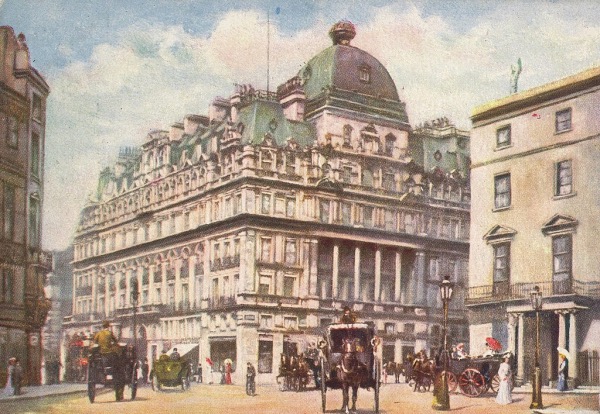
The Carlton Hotel (via Wikimedia Commons)

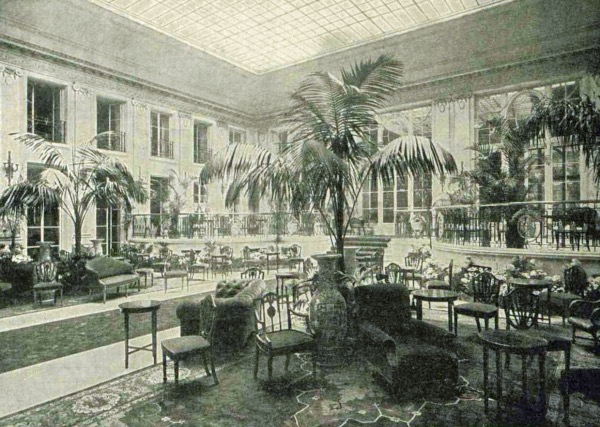
A luxury hotel built at the turn of the 20th century in the West End, the massive Carlton Hotel was part of an even larger redevelopment that included the (still standing) fourth version of Her Majesty’s Theatre (which provides a good idea of what the overall building looked like).

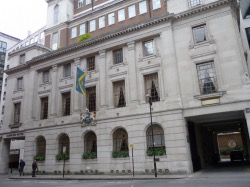
Located on the Crown estate on the corner of Pall Mall and Haymarket, the hotel was designed by CJ Phipps (who died before it was completed). Building started in 1896 and was completed by 1899.

Swiss hotelier César Ritz – who had been dismissed from his position as the manager of the Savoy Hotel in 1897 and subsequently successful opened his own establishment, the Hôtel Ritz, in Paris the following year – agreed to take a 72-year lease of the new hotel and a new company, The Carlton Hotel, Limited, was formed.

The building, which had interiors designed in the French Renaissance style, contained more than 300 guest rooms, all with telephones, including 72 suites which came with en suite bathrooms. There were also private dining and reception rooms for guests as well as reading and smoking rooms and a highly regarded Palm Court. And, of course, a restaurant in which Auguste Escoffier, who had left the Savoy under a cloud with Ritz, was employed as a head chef.

The Palm Court at The Carlton Hotel as featured in the Illustrated London News on 5th August, 1899.

The hotel, the upper floors of which contained private residences, was a hit and quickly threatened the status of the Savoy as the city’s most fashionable hotel. But in 1902, as the hotel was preparing to mark the coronation of King Edward VII, the king fell ill and the festivities were postponed indefinitely. Ritz suffered a nervous breakdown – apparently from the shock – and Escoffier was left in charge.

While its reputation was never again as high as it had been in the years immediately after opening, the Carlton Hotel remained profitable until World War II when it was heavily damaged during German bombing in 1940. Residential parts of the building were closed and in 1942 the remainder of the building was requisitioned by the British Government (with the exception of the American Bar and Grill Room which remained open).

The hotel never fully reopened, however, and, in 1949, the lease was sold to the New Zealand Government. The Carlton Hotel was demolished in 1957-58 and the New Zealand High Commission subsequently built on the site.

Among the hotel’s most famous clientele was Winston Churchill who was apparently dining in the restaurant with Lloyd George when World War I was declared.

Another famous association is commemorated by an English Heritage Blue Plaque which records the fact that Ho Chi Minh, founder of modern Vietnam, worked there as a cook in 1913 (when he was then known as Nguyen That Tanh).

There’s a story that Tanh, seeing how much food was being thrown away, asked Escoffier if he could give it to the poor, to which Escoffier told him to put aside his revolutionary ideas so he could teach him “the art of cooking, which will make you a great deal of money”. Tanh clearly choose another path.