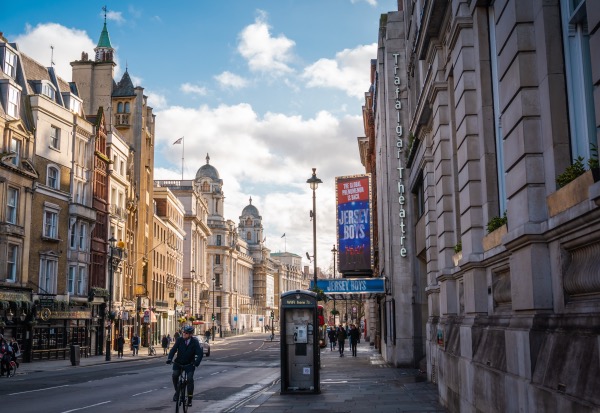
From the Trafalgar Square end. PICTURE: Johen Redman/Unsplash

From the Trafalgar Square end. PICTURE: Johen Redman/Unsplash
A waterway said to have been cut by the Viking Canute (also spelled Cnut) in the 11th century, the canal, according to the story, was constructed so his fleet of ships – blocked by London Bridge – could get upstream.

The story goes that in May, 1016, the Dane Canute (and future King of England), led an army of invasion into England to reclaim the throne his father, Sweyn Forkbeard, had first won three years earlier.
Canute needed to get his ships upriver of London Bridge to besiege the city which was held by the Saxons under Edmund Ironside (made king in April after his father Athelred’s death) but was blocked by the fortified, although then wooden, London Bridge.
So Canute gave orders for the digging of a trench or canal across some part of Southwark so his ships could pass into the river to the west of the bridge and he could encircle the city.
The canal – also known as ‘Canute’s Trench’ – was duly dug and the city was besieged – although the Vikings lifted the siege without taking the city (which does seems like a lot of work for not much result in the end) and the war was eventually decided elsewhere.
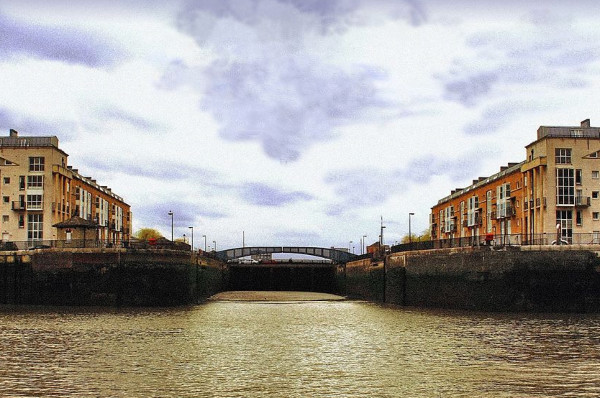
Various routes of the canal have been posited as possibilities – including the suggestion that there was an entry at Rotherhithe (Greenland Dock has been sited as one location) and exit somewhere near Lambeth or further south at Vauxhall (and one possibility is that Canute, rather than digging a long canal, simply cut through the bank holding back the Thames on either side of London Bridge and flooded the lands behind).
Various waterways have also been identified with it including the River Neckinger, parts of which survive, and the now lost stream known as the Tigris.
Whether the canal actually existed – and what form it took – remains a matter of some debate (although the low-lying, marshy land of Southwark at the time surely would have helped with any such project). But whether lost or simply mythical, the truth of ‘Canute’s Canal’ remains something of a mystery. For the moment at least.

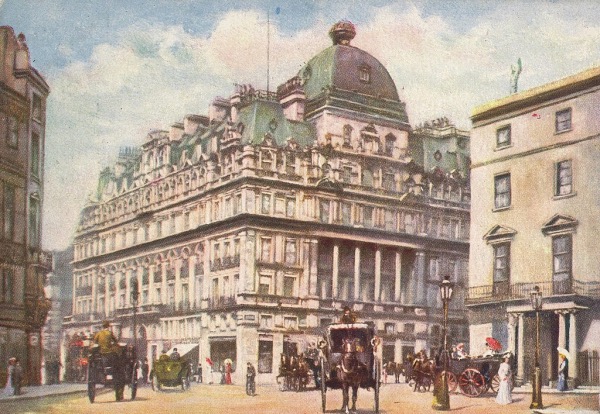
A luxury hotel built at the turn of the 20th century in the West End, the massive Carlton Hotel was part of an even larger redevelopment that included the (still standing) fourth version of Her Majesty’s Theatre (which provides a good idea of what the overall building looked like).
Located on the Crown estate on the corner of Pall Mall and Haymarket, the hotel was designed by CJ Phipps (who died before it was completed). Building started in 1896 and was completed by 1899.
Swiss hotelier César Ritz – who had been dismissed from his position as the manager of the Savoy Hotel in 1897 and subsequently successful opened his own establishment, the Hôtel Ritz, in Paris the following year – agreed to take a 72-year lease of the new hotel and a new company, The Carlton Hotel, Limited, was formed.
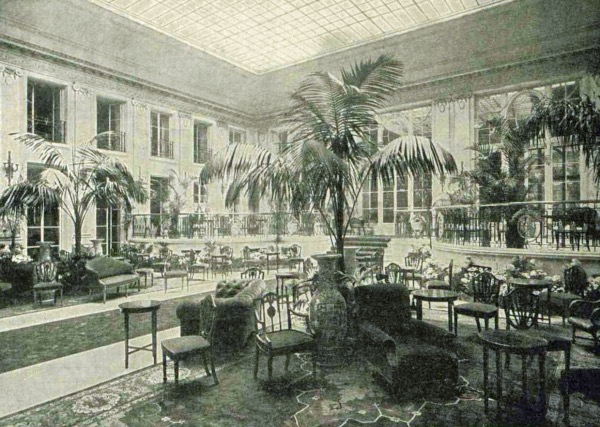
The building, which had interiors designed in the French Renaissance style, contained more than 300 guest rooms, all with telephones, including 72 suites which came with en suite bathrooms. There were also private dining and reception rooms for guests as well as reading and smoking rooms and a highly regarded Palm Court. And, of course, a restaurant in which Auguste Escoffier, who had left the Savoy under a cloud with Ritz, was employed as a head chef.

The hotel, the upper floors of which contained private residences, was a hit and quickly threatened the status of the Savoy as the city’s most fashionable hotel. But in 1902, as the hotel was preparing to mark the coronation of King Edward VII, the king fell ill and the festivities were postponed indefinitely. Ritz suffered a nervous breakdown – apparently from the shock – and Escoffier was left in charge.
While its reputation was never again as high as it had been in the years immediately after opening, the Carlton Hotel remained profitable until World War II when it was heavily damaged during German bombing in 1940. Residential parts of the building were closed and in 1942 the remainder of the building was requisitioned by the British Government (with the exception of the American Bar and Grill Room which remained open).
The hotel never fully reopened, however, and, in 1949, the lease was sold to the New Zealand Government. The Carlton Hotel was demolished in 1957-58 and the New Zealand High Commission subsequently built on the site.
Among the hotel’s most famous clientele was Winston Churchill who was apparently dining in the restaurant with Lloyd George when World War I was declared.
Another famous association is commemorated by an English Heritage Blue Plaque which records the fact that Ho Chi Minh, founder of modern Vietnam, worked there as a cook in 1913 (when he was then known as Nguyen That Tanh).
There’s a story that Tanh, seeing how much food was being thrown away, asked Escoffier if he could give it to the poor, to which Escoffier told him to put aside his revolutionary ideas so he could teach him “the art of cooking, which will make you a great deal of money”. Tanh clearly choose another path.

This tradition is actually one which is no longer observed – but we thought it worth a mention to finish this short series.
The creation of temporary of ‘boy bishops’ was relatively widespread at greater churches in Middle Ages (and several other churches in London also observed the tradition apparently including Westminster Abbey).
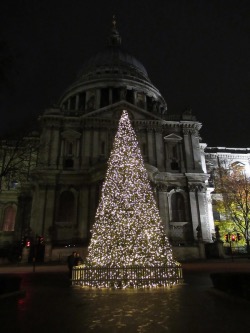
At St Paul’s, it involved one of the choir boys being elected to be the ‘boy bishop’, usually on 6th December, for a role that would run through until Holy Innocents Day on 28th December.
Dressed in child-sized bishop’s robes, the ‘boy bishop’ performed various ceremonial duties throughout the season, culminating with them delivering a sermon and leading a procession through the city.
The tradition apparently became more raucous as time went on, so much so that eventually it was abolished during the Reformation by King Henry VIII, revived by his successor Queen Mary I, and then abolished again by Queen Elizabeth I.
Since then, the idea of a ‘boy bishop’ or ‘youth bishop’ has been revived in a somewhat updated form in certain cathedrals including those in Salisbury and Hereford.
We’ll start a new Wednesday series next week.
And, just before we get to the top 10, here’s the next four in our countdown…
14. Treasures of London – The Cheapside Hoard
13. Lost London – The Devil Tavern…
12. 10 fictional character addresses in London – 1. 221b Baker Street…

In what has been, and continues to be, such a hard year for so many, we at Exploring London hope you’re still able to celebrate Christmas in some form this year…
Meantime, here’s the next four in our countdown of the 100 most popular posts of all time…
22. Lost London – The Savoy Palace…
21. What’s in a name?…St Mary Overie…
20. Treasures of London – The Whispering Gallery, St Paul’s Cathedral
The next two in our countdown…
28. 10 (more) fictional character addresses in London – 4. 138 Piccadilly…
London’s back under restrictions meaning doors to many of the city’s institutions are once again closed. So, for the moment, here’s the next two in our countdown…
30. 10 small, ‘secret’ and historic gardens in central London…5. Seething Lane Garden…
The next two in our countdown…
38. Treasures of London – Winston Churchill statue, Parliament Square…
The next two in our 10th bithday countdown…

Of medieval origins,the Church of St Antholin, which stood on the corner of Sise Lane and Budge Row, had been a fixture in the City of London for hundreds of years before it was destroyed in the Great Fire of 1666.
Rebuilt to the designs of Sir Christopher Wren, it survived until 1874 when it was finally demolished to make way for Queen Victoria Street.
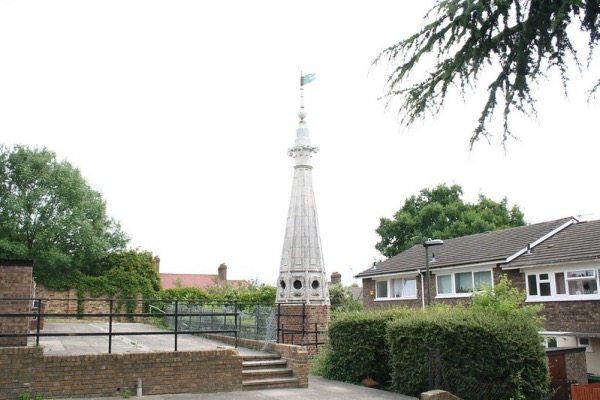
But, while the building itself was destroyed (and we’ll take a more in-depth look at its history in an upcoming article), a section of Wren’s church does still survive – the upper part of his octagonal spire (apparently the only one he had built of stone).
This was replaced at some stage in the 19th century – it has been suggested this took place in 1829 after the spire was damaged by lightning although other dates prior to the church’s demolition have also been named as possibilities.
Whenever its removal took place, the spire was subsequently sold to one of the churchwardens, an innovative printing works proprietor named Robert Harrild, for just £5. He had it re-erected on his property, Round Hill House, in Sydenham.
Now Grade II-listed, the spire, features a distinctive weathervane (variously described as a wolf’s head or a dragon’s head). Mounted on a brick plinth, it still stands at the location, now part of a more modern housing estate, just off Round Hill in Sydenham.

Dating possibly from as far back as the early medieval period, this royal lodging once stood in the City of London.
The building, which has been described variously as a palace as well as a strongly defended tower house, was located in the parish of St Michael Paternoster and gave its name – Tower Royall – to the street in which it was located (now long gone).
It has been suggested the property could date from as far back as the reign of King Henry I in the early 12th century and it has also been said that King Stephen is said to have lodged there later that same century (although some put the origins a bit later, possibly in the reign of King Edward I, who ruled from 1272 to 1307).
It was apparently in the possession of King Edward III in 1320 – he is said to have granted it to his wife, Queen Phillippa, who enlarged it and established her wardrobe there (hence it was sometimes referred to as the ‘Queen’s Wardrobe’).
On Queen Phillippa’s death, the king is said to have granted it to the Dean and Canons of Westminster but by 1371 it was apparently back in royal hands – Joan of Kent, the mother of the future King Richard II was living there at that time (Richard when king, apparently rode there to tell her of the suppression of the Peasant’s Revolt in 1381).
It is said to have been given to the Duke of Norfolk by his friend, King Richard III, in the 15th century, but, according to 16th century historian John Stow, by 1598 it had fallen into disrepair and was used for stabling the king’s horses.
The premises – believed to be located close to what is now Cannon Street, not far from Mansion House Tube Station – was among the buildings destroyed in the Great Fire of 1666. It was not rebuilt.
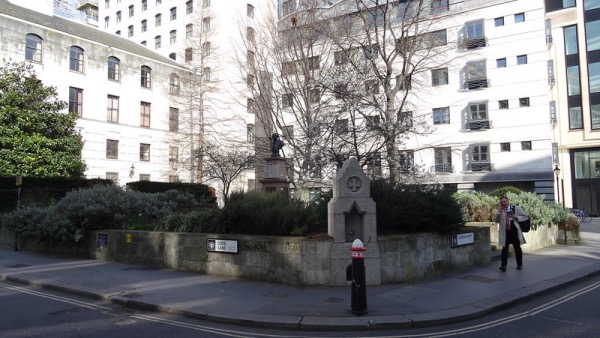
This church – not to be confused with the similarly named but still existing St Mary Aldermary – once stood at the corner of Love Lane and Aldermanbury in the City of London.

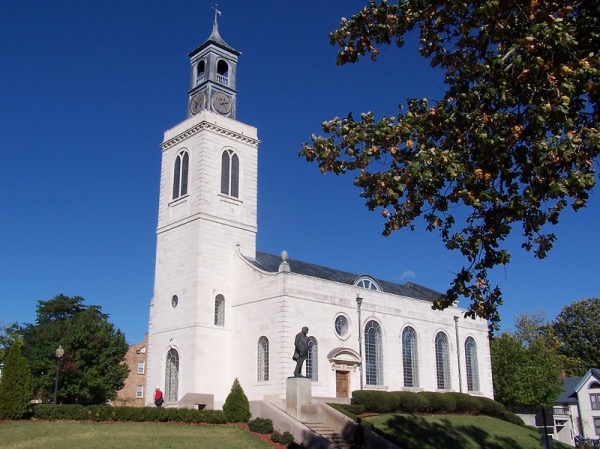
Founded in the 11th or early 12th century, the church – the name of which apparently relates to an endowment it received from an Alderman Bury, was destroyed in the Great Fire of London in 1666 and rebuilt by Sir Christopher Wren in a simple form with no spire.
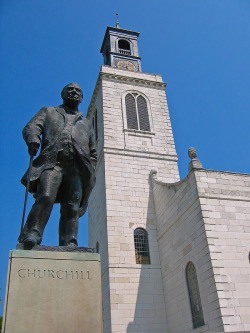
It was gutted during the Blitz – one of 13 Wren churches hit on the night of 13th December, 1940 – and the ruins were not rebuilt. Instead, in the 1960s (and this is where we get to the relocation part) a plan was put into action to relocate the church so it could form part of a memorial to Winston Churchill in the grounds of Westminster College in Fulton, Missouri.
It was only after four years of planning and fundraising (the project apparently cost some $US1.5 million with the money raised from donors including actor Richard Burton) that the relocation process finally began in 1965.

It started with workers in London cleaning, removing and labelling each of the church’s 7,000 stones so they could be reconstructed correctly on the other side of the Atlantic.
They were shipped free-of-charge – the US Shipping Board moved them as ship’s ballast – and then taken by rail to Fulton.
By the time the stones reached Fulton they had been jumbled. And so began the painstaking process of reassembling what was described as the “biggest jigsaw puzzle in the history of architecture” (with the stones spread over an acre, it apparently took a day just to find the first two stones).
While the first shovel on the project had been turned by former US President Harry S Truman on 19th April, 1964 (his connection to the project will become clear), the foundation stone was laid in October, 1966, 300 years after the Great Fire of London.
The shell of the church was completed by May, 1967. Two more years of work saw the church’s interior recreated with English woodcarvers, working from pre-war photographs, to make the pulpit, baptismal font, and balcony (new glass was also manufactured and five new bronze bells cast for the tower). The finished church, which was rededicated in May, 1969, was almost an exact replica of the original but apparently for a new organ gallery and a tower window.
Why Fulton for a tribute to Churchill? The connection between Churchill and Westminster College went back to the post war period – it was in the college’s historic gymnasium building that, thanks to a connection the institution had with President Truman, Churchill was to give one of his most famous speeches – the 1946 speech known as ‘Sinews of Peace’ in which he first put forward the concept of an “Iron Curtain” descending between Eastern and Western Europe.
The church is now one part of the National Churchill Museum, which also includes a museum building and the ‘Breakthrough’ sculpture made from eight sections of the Berlin Wall. It was selected for the memorial – planned to mark the 20th anniversary of Churchill’s speech – thanks to its destruction in the Blitz, commemorating in particular the inspiring role Churchill had played in ensuring the British people remained stalwart despite the air raids.

Meanwhile, back in London the site of the church has been turned into a garden. It contains a memorial to John Heminges and Henry Condell, two Shakespearean actors who published the first folio of the Bard’s works and were buried in the former church. The footings upon which the church once stood can still be seen in the garden and have been Grade II-listed since 1972.
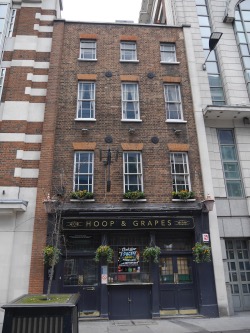
This historic pub in Farringdon bears a common enough name (and it’s not to be confused with the Hoop and Grapes located in Aldgate which we’ll look at in an upcoming post).

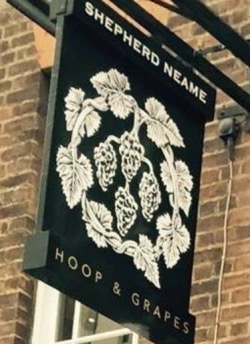
The hoop in the name refers to the metal bands binding together barrels staves and the grapes are obviously a reference to wine. But the ‘hoop’ could be a corruption of hops with the sign possibly once featuring a garland of hops and a bunch of grapes.
The pub, the current sign of which depicts grapes wrapped around a hoop (pictured below), is located in a four storey building first constructed for a vintner in about 1720 as a terraced house and converted to a pub more than a century later in the early 1830s.
Located on ground which one formed part of the St Bride’s Burial Ground, the brick vaults underneath are said to pre-date the rest of the building, having been built as warehouse vaults in the 17th century.
Its location on 80 Farringdon Street means it stood near the Fleet River (now covered) and close by to the former Fleet Prison (largely used as a debtor’s prison before its demolition in 1864).

As a result, it has been claimed that it was one of a number of pubs which hosted so-called ‘Fleet Marriages’, secret ceremonies performed by dodgy clergymen – for a fee – and without an official marriage license. But, as has been pointed out to us, the timing of the passing of the Marriage Act in 1753 outlawing such activities – and this only becoming a pub, according to its Historic England listing, much later – does make this seem unlikely (we’d welcome any further information on this claim).
The location also meant it was popular with printers who worked in nearby Fleet Street (in fact, it was apparently given a special licence to serve such customers at night or in the early morning).
The pub was scheduled for demolition in the early 1990s but saved with a Grade II-listing in 1991.
A rare survivor from an earlier time among the street’s more modern buildings, it is now part of the Shepherd Neame chain and it’s during renovations held after this purchase that burials were uncovered (the remains were moved into the British Museum). This has apparently led to rumours that the pub is haunted.
For more, see www.hoopandgrapes.co.uk.
Sorry for the confusion – We’ve corrected references to grapes in the second paragraph (and amended our comments on the current sign). And we’ve also clarified comments that the pub was used for Fleet Marriages given the timing discrepancy.
The next two entries in Exploring London’s 100 most popular posts countdown…
This delightfully named establishment – one of the most well-known chocolate houses in London – was apparently opened on the back of the opening of myriad coffee houses in London.
With a sign depicting the cocoa tree, this premises occupied several different locations in Pall Mall including number 46, occupied by an annexe of the Army and Navy Club, and number 89, the site where the Royal Automobile Club now stands.
It is said to have been first mentioned in 1698 – chocolate was first brought to England in the 1650s and the first “chocolate houses” opened soon after.
It was popular among Tories in the early 1700s serving as something as a defacto headquarters and later, apparently, a hotbed for those with Jacobite sympathies. Around the middle of the 18th century, it was converted into a private club and become notorious for the gambling conducted therein.
Among those said to have dined there during this later period was 18th century historian Edward Gibbon.
The Cocoa Tree later relocated to 64 St James’s Street, where it stood between 1799 and 1835. The property apparently finally closed in 1932.
PICTURE: Maddi Bazzocco/Unsplash
Partly located on a site now occupied by the church of St Giles-in-the-Fields in central London was a leprosy hospital founded by Queen Matilda, wife of King Henry I, in 1101.
The site was located outside the City walls making it ideal for such an establishment (given lepers had to isolate from the rest of the population) and the hospital, one of the first such establishments in England, was dedicated to St Giles, the patron saint of outcasts.
As well as an oratory or chapel, the hospital, initially founded on eight acres of farmland, is believed to have included houses for lepers, a master’s house, and quarters for a chaplain, clerk and servant. A chapter house was added in the early 14th century.
The hospital was under the care of the crown and in 1299, King Edward I ordered that the hospital be run by and its revenues given to the military Order of St Lazarus of Jerusalem (also known as the Leper Brothers of Jerusalem or Lazarists).
By the 15th century leprosy (now known as Hansen’s disease) was on the decline in England but this hospital continued to be used for lepers until at least 1500 after which it is recorded that it had opened it doors to the poor who needed care.
In 1539, the hospital was closed under King Henry VIII’s Dissolution of the monasteries. While the chapel remained in use as a parish church (it was at this time that “in-the-fields” was added to the church’s name), the hospital’s other buildings were given by King Henry VIII to John Dudley, Lord Lisle (and later Duke of Northumberland and Protector of Edward VI, the king’s eventual heir).
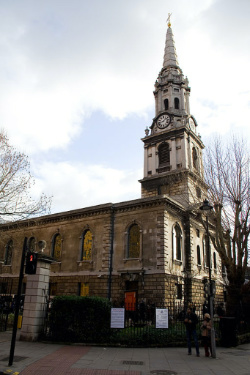
The church, meanwhile, had fallen into a poor state of repair by the early 1600s and was demolished. Construction of a Gothic replacement started in 1623 in a project largely funded by Alice, Duchess Dudley, daughter-in-law of Queen Elizabeth I’s favourite Robert Dudley. The new church was consecrated by William Laud, Bishop of London in 1631. The current building dates from 1733 (but more about that at another time).
PICTURE: The church of St Giles-in-the-Fields as it appears now. (Prioryman/licensed under CC BY-SA 2.0)
The next two entries in Exploring London’s 100 most popular posts countdown…
Among the buildings destroyed in the Blitz, St Stephen Coleman Street was one of the more than 50 City of London churches designed by the office of Sir Christopher Wren in the wake of the Great Fire of London of 1666.
The church was located on the corner of Coleman and Gresham Streets and replaced an earlier medieval building, the origins of which date back to at least the 13th century (the earliest mention occurs during the reign of King John) and which had also been known as St Stephen in the Jewry due to the number of Jewish people living in the vicinity.
St Stephen’s had apparently become a Puritan stronghold by the early 17th century when the vicars included John Davenport, who later went on to found a colony in Connecticut.
Five members of Parliament whom King Charles I attempted to arrest on 4th January, 1642, hid here as his troops searched for them. During the Commonwealth, the church instituted rules under which only those who were approved by a committee including the vicar and 13 parishioners – two of whom had apparently signed King Charles I’s death warrant, could receive Communion.
Following its destruction in the Great Fire of 1666, the church was rebuilt its former foundations – the new building incorporating some of the ruins of the former and featuring a bell lantern with a gilded weathervane on top – and was largely completed by 1677. In the early 1690s, additional funds gained through a coal tax provided for the construction of a burial vault and a gallery.
Notable vicars after the rebuild included Rev Josiah Pratt (1768-1844) who served for 21 years as secretary of the Church Missionary Society.
While the church suffered some minor damage during an air-raid in World War I, it was repaired. But it was finally destroyed during an air raid on 29th December, 1940, after which the church was not rebuilt but its parish joined with that of St Margaret Lothbury.
A City of London Corporation plaque at the intersection of Coleman Street and Kings Arms Yard marks the site of the former church.
PICTURE: An etching of St Stephen’s Coleman Street published in 1819.