Around London – Diamond Jubilee celebrations special…

UPDATED: Excitement has been building for months ahead of this weekend’s Diamond Jubilee celebrations which include a 1,000 boat flotilla which will sail down the Thames on Sunday, the Diamond Jubilee concert on Monday and National Service of Thanksgiving at St Paul’s Cathedral on Tuesday which will be followed by a ceremonial procession back to Buckingham Palace.
• First to the flotilla. The formal river procession will be held between 2pm and 6pm, starting upriver of Battersea Bridge and finishing downriver of Tower Bridge. The Queen and her family will be boarding the Royal barge, the Spirit of Chartwell, near Albert Bridge at 2.30pm and will travel upriver at the centre of the flotilla with the aim of pulling up alongside HMS President, near Tower Bridge, at 4.15pm.

The flotilla will be one of the largest ever assembled on the river and feature rowing, working and pleasure boats of all shapes and sizes decked out for the occasion. In addition as many as 30,000 people will be aboard passenger boats and there will also be music barges and boats spouting geysers as well as specially constructed craft like a floating belfry. It is estimated that it will take the flotilla around 75 minutes to pass any static point along the route.

Downriver of London Bridge, near the end of the pageant’s seven mile (11 kilometre) course, a gun salute will be fired and the procession will pass through an ‘Avenue of Sail’ formed by traditional sailing vessels, oyster smacks, square riggers, naval vessels and others. For more on the pageant (including the location of large viewing screens – these positions will be regulated from 8am onwards – and road closures as well as an interactive map of the route), head to www.thamesdiamondjubileepageant.org.

• Diamond Jubilee Concert and Beacons. To be held outside Buckingham Palace, close to the Victoria Memorial, on the evening of Monday, 4th June, the concert – which starts at around 7.30pm and features everyone from Elton John to Paul McCartney and Shirley Bassey – will be televised live by the BBC (unless you’re lucky enough to have one of the 10,000 balloted tickets meaning you get to have a picnic in the palace gardens and see the concert). For those who can’t go but would like to experience some of the atmosphere, Royal Parks are setting up screens along The Mall, in St James’s Park and in Hyde Park.

At 10.30pm that night, the Queen will light the National Beacon outside Buckingham Palace, the last in a network of beacons to be lit across the country. More than 4,000 beacons will be lit by communities across the UK and in Commonwealth countries around the world between 10-10.30pm that night (for more on the beacons, see www.diamondjubileebeacons.co.uk).

• National Service of Thanksgiving and Carriage Procession. On Tuesday, the Queen and the Duke of Edinburgh will leave Buckingham Palace at 10.15am and travel by car to St Paul’s Cathedral via the Mall, through Trafalgar Square, down the Strand and Fleet Street and up Ludgate Hill to St Paul’s. There they and the 2,000 invited guests will attend the National Service of Thanksgiving, conducted by the Dean of St Paul’s, the Very Rev Dr David Ison (the Archbishop of Canterbury will preach).

At 11.30am, the Queen and Duke will then head to Mansion House for a reception (via St Paul’s Churchyard and Queen Victoria Street), hosted by the Lord Mayor of London David Wootton, Court of Aldermen and Court of Common Council. Other members of the Royal family will attend a reception at Guildhall. At 12.30pm, the  Queen and members of the Royal Family will then head to Westminster Hall (via Queen Victoria Street, St Paul’s Churchyard, Ludgate Hill, Fleet Street, the Strand, Whitehall and Parliament Square), entering through the Sovereign’s Entrance of the Palace of Westminster (Houses of Parliament) at 12.40pm. There, they will attend the Diamond Jubilee Lunch.

At 2.20pm, the Queen and Prince Philip will lead a carriage procession from the Palace of Westminster to Buckingham Palace (via New Palace Yard, Whitehall, Trafalgar Square and The Mall), riding in a 1902 State Landau. They will be followed by the Prince of Wales and Duchess of Cornwall in a State Landau, and the Duke and Duchess of Cambridge (Prince William and Kate) and Prince Harry in another State Landau. If it’s raining, these will be replaced by the Australian State Coach, Queen Alexandra’s State Coach and the Glass Coach. Military personnel will line the route, a 60 gun salute will be fired and a Guard of Honor will await them in the Buckingham Palace forecourt.

At 3.30pm, the Queen and members of the Royal Family in the carriage procession will appear on the balcony at Buckingham Palace to wave to the crowds and witness an RAF flypast and a Feu de Joie – a celebratory volley of rifle fire – which will be given as a salute in the palace forecourt.

There’s plenty more happening over the weekend including many local street parties – far too much for us to record here. So for more, head to the official Diamond Jubilee site, www.thediamondjubilee.org (or The Big Lunch for local lunches – www.thebiglunch.com). You can purchase a copy of the official souvenir programme online at www.royalcollectionshop.co.uk/diamond-jubilee-1/diamond-jubilee-official-souvenir-programme.html or download it at www.itunes.co.uk.

Reckon you can take a good photo? We’re looking for great images of this weekend’s Diamond Jubilee celebrations (just email us at exploringlondon@gmail.com).

Want to read more about the Queen? Why not check out Sixty Glorious Years: Queen Elizabeth II, Diamond Jubilee, 1952-2012, Queen Elizabeth II: A Diamond Jubilee Souvenir Album, or Debrett’s: The Queen – The Diamond JubileeFor related music, check out Diamond Jubilee: A Classical CelebrationThe Diamond Jubilee Album or Gary Barlow & the Commonwealth Band’s Sing EP (featuring Prince Harry).

Celebrating the Diamond Jubilee with 10 royal London locations – 7. Silver Jubilee memorials…

For those who may not be aware, the current Diamond Jubilee is, of course, not the first jubilee Queen Elizabeth II has celebrated. In 1977, the Queen and the nation marked her Silver Jubilee, celebrating her 25th year on the throne.

Just as this year is designed as a year of celebration, so too was 1977 with the anniversary of the Queen’s accession culminating in a series events run over a week in early June. They included street parties, the lighting of a chain of beacons across the country (the Queen lit the first fire at Windsor), a national service of thanksgiving at St Paul’s Cathedral (which the Queen went to in the Gold State Coach) and a river progress from Greenwich to Lambeth.

To mark the Jubilee, the Queen and Prince Philip also travelled across the country, visiting as many as 36 counties during a Royal Tour, and went overseas where they visited nine countries as far afield as Australia and New Zealand, the West Indies and Canada.

In London, a number of memorials were installed which can still be visited today. They include:

The Silver Jubilee Walkway. Opened by the Queen on 9th junee 1977, this is made up of five circular sections which are themselves located in a 15 mile (24 kilometre) circle around the city and takes in many of the city’s greatest sites, including St Paul’s Cathedral, Buckingham Palace, Tower Bridge and Shakespeare’s Globe. For more on the walk, see www.walklondon.org.uk/route.asp?R=3

• South Bank Jubilee Gardens. Originally created to celebrate the Silver Jubilee in 1977, these gardens, located between Waterloo and Westminster Bridges, have recently been remade – including planting 70 new trees – for the Queen’s Diamond Jubilee and the Olympic Games.

Memorial Urn in Queen Square, Bloomsbury. This monument has inscriptions by poets Philip Larkin (“In times when nothing stood, But worsened or grew strange, There was one constant good, She did not change”) and Ted Hughes (A nation’s a soul, A soul is a wheel, With a crown for a hub, To keep it whole”) in front of and behind it.

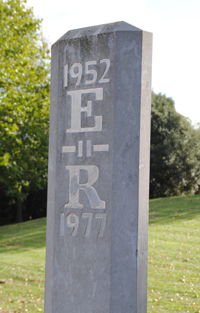
King’s Stairs Memorial Stone. This memorial stone (pictured) located on the edge of King’s Stairs Gardens by the Thames in Bermondsey was first installed to mark the Queen’s Silver Jubilee. The other side of the stone was inscribed during the Golden Jubilee in 2002.

• Plaque on Queen Elizabeth II’s birthplace. We’ve mentioned this plaque at 17 Bruton Street in Mayfair in an earlier entry but it’s interesting to note that it was erected in 1977.

Any others you can think of?

Celebrating the Diamond Jubilee with 10 royal London locations – 6. The Mall…

For many Londoners, an opportunity to see the Queen means heading to Buckingham Palace to watch her wave from the balcony – or standing in the Mall to watch as her carriage goes by.

Given that, we thought we’d take the time to have a quick look at the history of The Mall, an important player in events like the annual Trooping the Colour.

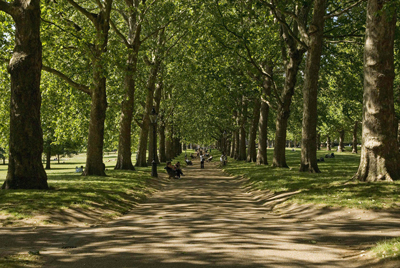
This one kilometre long grand processional route which links Trafalgar Square to Buckingham Palace, was originally cut through St James’s Park in 1660 when King Charles II was looking for a new paille-maille pitch (see our earlier entry on Pall Mall for more on this). Two long avenues of trees were planted on either side, giving it a leafy feel that’s still in evidence today.

The Mall had become notorious by the 18th century and was spruced up in 1911 under the eye of Sir Aston Webb (who also designed other elements in the area including a new facade for Buckingham Palace, the Queen Victoria Memorial in front of the palace, and Admiralty Arch at the western end of the route) to become the grand avenue, complete with red-carpet like surface (this was done later), that it is today.

It is bordered by St James’s Park on the south side and on the north side is overlooked by various grand buildings – including Clarence House and the Institute of Contemporary Arts – as well as, toward the western end, Green Park.

These days the Queen publicly processes down The Mall for a number of events throughout the year – among them are the State Opening of Parliament (held earlier this month) as well as military ceremonies like Trooping the Colour and events like last year’s Royal Wedding when is it said that more than a million people were said to have filled the broad street.

The Mall is also the route along which Heads of State process in a horse drawn carriage during official visits (the road is then decorated with Union Jacks and flags of the visitor’s country). During the Olympics, it will be the start and end location of the marathons and cycling road races.

Apart from the Queen Victoria Memorial at the eastern end of The Mall, statues and monuments lining the road include the Queen Mother Memorial, a statue of explorer Captain James Cook, and a recently installed statue of cosmonaut, Yuri Gagarin.

There are apparently a series of tunnels underneath with link Buckingham Palace with Whitehall.

We should also briefly mention Horseguards, which is at The Mall’s eastern end and where Trooping the Colour and Beating Retreat takes place. This was formerly the site of a tiltyard of the Palace of Whitehall and jousting tournaments were held here during the time of King Henry VIII. It has been used for parades and ceremonies since the 17th century. While cars were parked here for much of the 20th century, this practice was stopped in the mid-1990s.

Celebrating the Diamond Jubilee with 10 royal London locations – 5. Buckingham Palace…

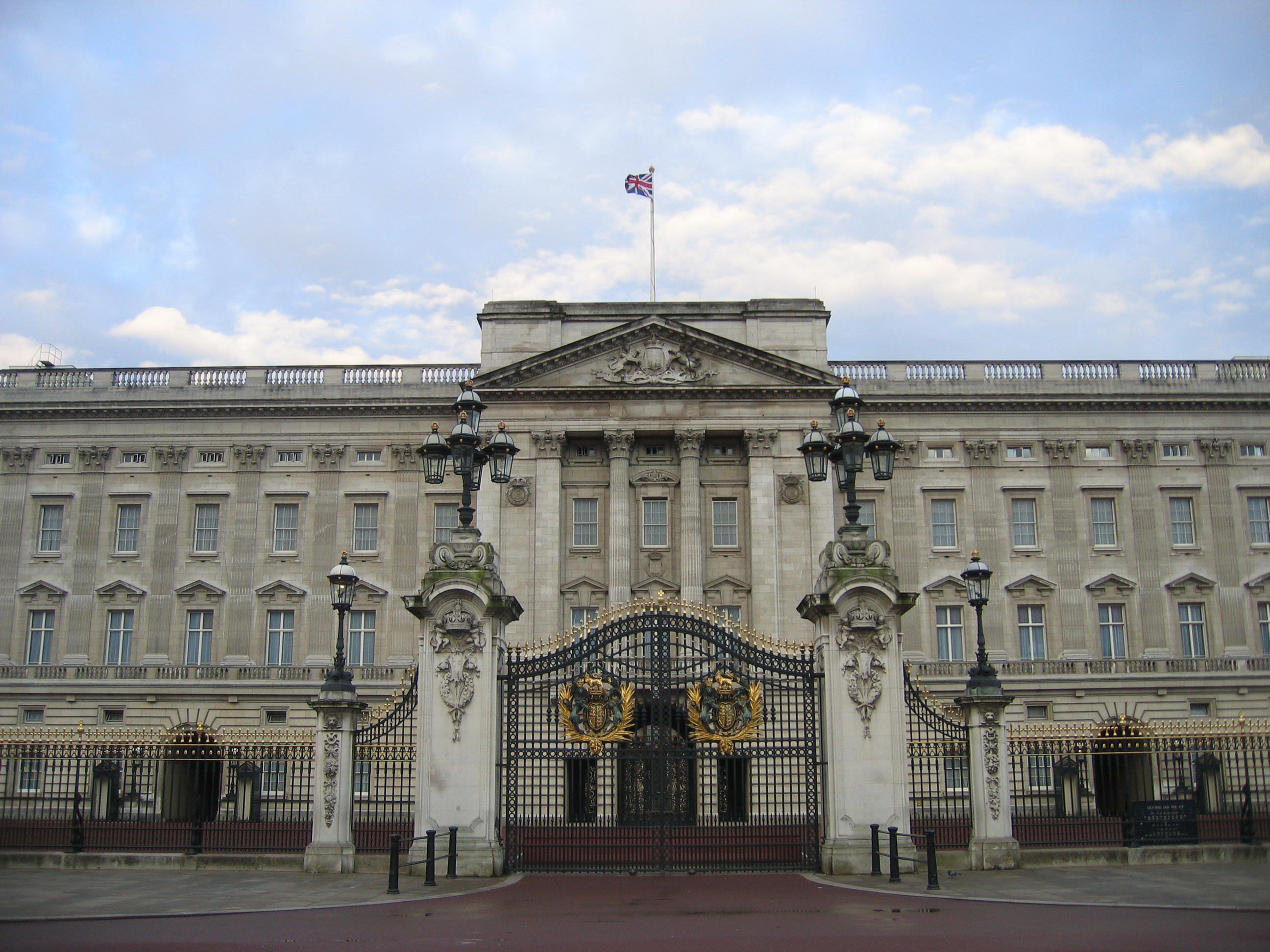
Following her coronation, Queen Elizabeth II and Prince Philip, the Duke of Edinburgh, took up residence in Buckingham Palace and have resided there ever since.

The Queen and her family’s appearance on the palace’s balcony to wave to crowds at events like Trooping the Colour and last year’s Royal Wedding have become symbols of her reign.

We’ve already written about some of the history of the 775 room palace (see our earlier post here), so today we’re looking specifically at the palace as the residence of Queen Elizabeth II.

While the focus for visitors to the palace is on the grand state rooms (of which there are 19 located in the west block facing the palace gardens – they include the Throne Room and State Dining Room), the Queen and the Duke of Edinburgh live in private apartments on the north side of the palace while rooms on the upper floors of the palace’s north and east sides are occupied by other members of the Royal Family. A large part of the ground floor and palace’s south wing are occupied by service quarters and members of the Royal Household.

As well as weekly meetings at the palace – including audiences with the Prime Minister, foreign and British ambassadors, clergy and senior members of the civil service, the Queen also hosts a variety of grand events at the palace throughout the year. These include the Diplomatic Reception given for members of the diplomatic corps in the autumn (more than 1,500 people attend from more than 130 countries), three large garden parties in the summer and grand State Banquets which are held in the Ballroom on the first evening of a visit from a foreign head of state. The Queen is also noted for the small private lunch parties she holds to which community leaders are invited.

The head of the 1,200 strong Royal Household is the Lord Chamberlain (since 2006 The Earl Peel), a non-political office responsible for the organisation of ceremonial activities at court as well as the palace’s upkeep. Under him are the various departments heads – these include the Comptroller, who heads the Lord Chamberlain’s Office (this oversees everything from State Visits to the Royal Mews), the Keeper of the Privy Purse (responsible for the management of the sovereign’s financial affairs) and the Master of the Household (responsible for domestic and staff arrangements as well as catering and official entertainment, this position dates back to 1539).

A typical day in the life of the Queen when at the palace involves her spending the morning at her desk where she reviews a sample of incoming letters (an estimated 200 to 300 arrive each day almost all of which are answered by her staff) and meets with her Private Secretaries to deal with official papers which arrive in the famous ‘red boxes’.

The Queen will then often hold a series of audiences during which she’ll meet with a range of people – from retiring senior members of the armed forces to newly appointed ambassadors and judges and people who have won awards for excellence in a particular field. She may then participate in an investiture at which honors and decorations are presented (about 25 of these are held every year, usually in the palace Ballroom).

Lunch is often private although as previously mentioned, the Queen and Duke of Edinburgh are known for hosting small lunch gatherings for a range of people. In the afternoon, the Queen will often attend engagements outside the palace (she attends about 430 engagements and audiences a year) before possibly meeting with the Privy Council.

Evenings are spent reviewing a report of the day’s parliamentary proceedings, meeting with the Prime Minister (something she does every Wednesday when both are in London), attending further engagements or hosting events at the palace.

And, of course, when the Queen is in residence, Buckingham Palace is also home to the Queen’s corgis – Monty, Willow and Holly – and dorgis (a cross between a corgi and a dachshund) – Cider, Candy and Vulcan.

For more on Buckingham Palace and the life of the Queen, go www.royal.gov.uk.

WHERE: State Rooms, Buckingham Palace (includes special exhibition Diamonds: A Jubilee Celebration) (nearest Tube stations are Victoria, Green Park and Hyde Park Corner); WHEN: 9.45am to 6.30pm, 30th June to 8th July and 31st July to 7th October; COST: £18 an adult/£10.50 a child (under 17s/under fives free)/£16.50 concession/£47 family; WEBSITE: www.royalcollection.org.uk/visit/buckinghampalace.

PICTURE: Christa Richert/sxc.hu

Celebrating the Diamond Jubilee with 10 royal London locations – 4. Westminster Abbey…

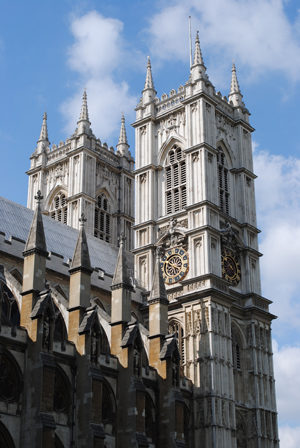
Westminster Abbey has played a key role in the life of Queen Elizabeth II – it was here on 20th November, 1947, that she was married to Prince Philip (then Lieutenant Philip Mountbatten) and it was here on 2nd June, 1953, that she was crowned Queen Elizabeth II.

First to the wedding. Princess Elizabeth was only the 10th royal to be married in the Abbey (her predecessors included her parents who married here on 26th April, 1923). The ceremony started at 11.30am and the princess, who wore a white dress designed by Norman Hartnell, entered to a specially composed fanfare accompanied by eight bridesmaids and two pages.

Due to post war austerity measures, only about 2,000 people attended the wedding (we’ve previously mentioned that the princess had to save coupons for her wedding dress like any other bride). On the day, the grave of the Unknown Warrior was the only stone that was not covered by the special carpet and the day after the wedding, the now married Princess Elizabeth followed a royal tradition started by her mother, Queen Elizabeth, which involved sending her wedding bouquet back to the Abbey to be laid on the grave.

It was about five-and-a-half years after her wedding that the princess returned to the Abbey to be crowned a queen.

Then Princess Elizabeth was in Kenya (on her way to Australia) when news reached her on 6th February that year of the death of her father, King George VI. After Prince Philip broke the news to her, the new queen chose Elizabeth as her “regnal name”, and the couple returned to England.

Queen Elizabeth II’s grandmother, Queen Mary, died on 24th March, but it was decided to proceed with the coronation anyway (Queen Mary had apparently asked that the coronation not be delayed by her death).

The coronation, the 38th to be conducted in the Abbey, was the first to be televised (with the exception of the anointing and communion) and was “instrumental” in helping to popularise it in the UK and elsewhere.

The building was closed for five months so preparations could be made for the more than 8,000 wedding guests. The Queen’s coronation dress, meanwhile, was made by Norman Hartnell (as had been her wedding dress) and was made of white satin embroidered with emblems of the United Kingdom and the Commonwealth.

Having arrived from Buckingham Palace in the Gold State Coach, the Queen entered the Abbey at 11.20am and, having been invested with the Regalia while seated in the Coronation Chair, was crowned with St Edward’s Crown at 12.34pm. She left the Abbey at 2.53pm and rode through the streets of London back to the palace.

Of course, the Queen has since attended many other events at the Abbey – including thanksgiving services for their golden and silver wedding anniversaries and last year’s Royal Wedding – since her coronation which we don’t have space to talk about here. But it is worth noting before signing off that the Abbey continues to have a special relationship to her – it is a “Royal Peculiar” meaning it is exempt from any ecclesiastical jurisdiction but that of the Sovereign.

WHERE: Westminster Abbey, Westminster (nearest Tube station is Westminster or St James’s Park); WHEN: Open to tourists everyday except Sunday  (times vary so check the website); COST: £16 an adult/£13 concessions/£6 schoolchildren (11-18 years), free for children aged under 11/£38 for a family (two adults, two children); WEBSITE: www.westminster-abbey.org

Celebrating the Diamond Jubilee with 10 royal London locations – 3. Married life at Clarence House…

Princess Elizabeth and Prince Philip were married at Westminster Abbey, a highly significant property in the Queen’s story which we’ll be looking at in more depth shortly, on 20th November, 1947 (and, as did other brides in post-war Britain, the princess had to collect coupons for her wedding dress).

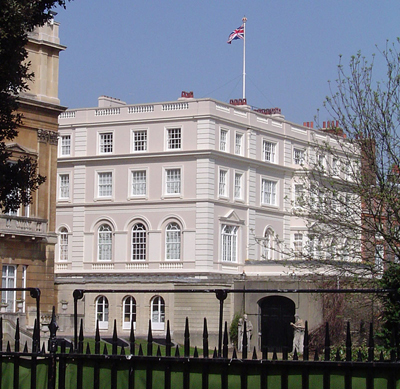
Following their honeymoon at Broadland – the home of Lord Mountbatten in Hampshire and at Birkhall, Balmoral, in Scotland, in 1949, they and their baby son, Charles, moved into Clarence House, their home for the next three years.

The house, which still featured Victorian decor, was refurbished although post-war austerity ensured the decor and furnishings – many of which were wedding presents – remained simple. The house still contains a Georgian dining table and 20 ladder-back chairs which were the gift of the Royal Warrant Holders Association and a mahogany sideboard and four side tables which were a present from Queen Mary, the Queen’s grandmother.

Princess Anne, second child of the Queen and Prince Philip, was born in the house in 1950.

Clarence House was originally built between 1825 and 1827 to the designs of John Nash (he also designed Buckingham Palace) and was designed as the home of George III’s third son, Prince William Henry, Duke of Clarence and his wife Adelaide, and incorporated some of the Tudor buildings of St James’ Palace.

Indeed, Prince William Henry liked the house so much that on succeeding to the throne as King William IV in 1830, he decided not to move to Buckingham Palace and instead remained at Clarence House.

Later occupants have included Queen Victoria’s mother, the Duchess of Kent, and two of her sons, Prince Alfred, Duke of Edinburgh, and Prince Arthur, Duke of Connaught as well as Queen Elizabeth, the Queen Mother, who moved in after the property was vacated by Queen Elizabeth II and remained living at the house until her death in 2002.

Today Clarence House is the official London residence of Prince Charles, Prince of Wales, and his wife Camilla, the Duchess of Cornwall, as well as Prince Harry.

Clarence House is usually open for tours during summer but will not be opening this summer due to the Paralympic and Olympic Games blocking the entrance from The Mall. For details on the 2013 opening, see www.royalcollection.org.uk/visit/clarencehouse.

PICTURE: ChrisO, Wikipedia

Treasures of London – Marble Arch…

Originally installed as a grand entrance to Buckingham Palace, John Nash’s arch was moved to its current location, what is now effectively a traffic island not far from Speaker’s Corner in nearby Hyde Park, in 1851.

The story goes that this took place after it was discovered that the arch was too narrow for the widest of the new-fangled coaches but there are some doubts over this, particularly as the gold state coach passed under it during Queen Elizabeth II’s coronation in 1952. Another story says that it was moved after extensions to Buckingham Palace left insufficient space for it.

Work on the arch had started at Buckingham Palace in the mid 1820s and it was completed by 1833. It was originally moved to replace Cumberland Gate as the new entrance to Hyde Park and to complement Decimus Burton’s arch at Hyde Park Corner. Successive roadworks in the 20th century, however, left it in its current position.

Clad in Carrara marble, the design of the arch was inspired by Rome’s Arch of Constantine and the Arc do Carrousel in Paris. The sculptural ornamentation, which includes works by Sir Richard Westmacott and Edward Hodges Baily, however, was apparently never completed and an equestrian statue of King George IV, originally destined for the top of the arch, instead now stands in Trafalgar Square. The bronze gates – which bear the lion of England, cypher of King George IV and image of St George and the Dragon – were designed by Samuel Parker.

Only senior members of the Royal family and the King’s Troop Royal Horse Artillery are permitted to pass under the central arch of the monumental structure.

The arch stands close to where the Tyburn Tree once stood (for more on this, see our earlier post). It contains three small rooms which, up until the 1950s housed what has been described as “one of the smallest police stations in the world”.

There was some talk in 2005 that the arch would be moved to Speaker’s Corner but this obviously hasn’t eventuated.

Celebrating the Diamond Jubilee with 10 royal London locations – 2. The Queen’s childhood homes

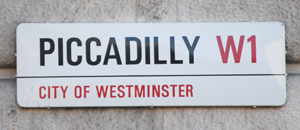
Having spent the first few months of her life at 17 Bruton Street, the future Queen Elizabeth II moved into her parents’ new property at 145 Piccadilly.

The property, located close to Hyde Park Corner, was previously the townhouse of the Marquesses of Northampton (interestingly, it was while living here that her father the Duke of York first started visiting the Harley Street-based Australian speech therapist Lionel Logue, as depicted in The King’s Speech). The 25 bedroom house was later destroyed by a bomb during the war, long after the Yorks had moved out.

As well as the house at 145 Piccadilly, the young Princess Elizabeth (and from 1930 her younger sister and only sibling Princess Margaret) also lived at White Lodge in the centre of Richmond Park in the city’s south-west. The Lodge, a Georgian property built as a hunting lodge for King George II, now houses part of the Royal Ballet School.

She also considerable time outside the city, staying in places including Scotland with her grandparents at either Balmoral Castle (owned by the Royal Family) or at Glamis Castle (owned by the parents of her mother, the Earl and Countess of Strathmore) as well as, from the age of six, at Royal Lodge in Windsor Great Park, the country home of the Yorks. The princess apparently had her own small house, known as Y Bwthyn Bach (the Little Cottage), in the grounds  – a gift from the people of Wales in 1932.

Following the death of King George V and subsequent abdication of King Edward VIII in 1936, new King George VI and his family moved from 145 Piccadilly to Buckingham Palace. Following the outbreak of World War II in 1939, the princesses lived in Balmoral, Scotland, and Sandringham but spent most of the war at Windsor Castle.

Princess Elizabeth, meanwhile, had met Prince Philip of Greece during the 1930s and in 1947, he asked for permission to marry her.

Around London – Europe’s oldest intact book at British Library; 100 days to the Games; world’s largest archaeological archive; the London Marathon; and, Turner at the National Gallery…

• The British Library has paid £9 million for a 7th century text, the St Cuthbert Gospel, which is also the oldest intact European book. The acquisition follows the library’s most successful fund-raising effort ever – it included a £4.5 million grant from the National Heritage Memorial Fund. The book – a Gospel of John bound in beautifully tooled red leather – was produced in north-east England in the late 7th century and was placed in the saint’s coffin after his death on the Isle of Lindisfarne in 698. It was retrieved when the coffin was opened at Durham Cathedral in 1104. The Gospel is on display in the Sir John Ritblat Treasures Gallery at the library in St Pancras and following a conservation review, it is anticipated it will soon be displayed with the pages open for the first time. There will be a public event celebrating the acquisition on 15th May. For more, see www.bl.uk/whatson/events/may12/index.html.

• London this week marked 100 days until the Opening Ceremony of the 2012 Olympic Games. This included unveiling the latest installation of the Olympic rings – made of 20,000 plants the 50 metre long rings are located in the Royal Botanic Gardens at Kew in the city’s west and can be seen from planes on the Heathrow flight path. The organising committee also announced the Red Arrows aerobatic display team will perform a nine-ship flypast in ‘big battle’ formation on the day of the Opening Ceremony (27th July) and stated that the games motto will be ‘Inspire a Generation’. For more, see www.london2012.com.

• The Museum of London’s archaeological archive – known as the London Archaeological Archive and Research Centre (LAARC) – is officially the largest in the world according to Guinness World Records. The archive contains more than five million artefacts and the records of almost 8,500 excavations dating back to 1830. Items in the archive include shoes dating back to Roman times, a 200-year-old set of false teeth, ‘witching bottles’ including one with human hair and toenails, and coffin plates from London’s cemeteries. The world record has been recorded as part of World Record London, a series of world record breaking events being held in the run-up to the Olympics. Others have included the Faberge Big Egg Hunt.

• Thousands of people are expected to take part in the Virgin London Marathon this Sunday. The 26.2 mile route starts in Blackheath, passes through Woolwich and Greenwich and crosses the Thames at Tower Bridge before looping around the east end of London, through Canary Wharf, and the west along The Highway (formerly known as The Ratcliffe Highway) and Embankment to Parliament Square, Birdcage Walk and finally to Buckingham Palace. The first London marathon was run in 1981. For more, see www.virginlondonmarathon.com.

• On Now: Turner Inspired – In the Light of Claude. The first major presentation of 17th century artist Claude Gellée’s influence on the English romantic artist J M W Turner, the exhibition focuses on Claude-inspired themes which run through Turner’s work including “the evocation of light and air in landscape, the effect of light upon water and his often radical reworking of contemporary scenes”. The display includes works from large scale oils on canvas through to leaves from Turner’s pocket sketchbooks. Interestingly, the exhibition also explores the story behind the so-called Turner Bequest – that on his death, Turner linked himself to Claude forever by leaving the National Gallery two pictures – Dido building Carthage (1815) and Sun rising through Vapour: Fishermen cleaning and selling Fish (before 1807) –  on condition that they were hung between two pictures by Claude, Seaport with the Embarkation of the Queen of Sheba (1648) and Landscape with the Marriage of Isaac and Rebecca (1648). Runs until 5th June. Admission charge applies. For more, see www.nationalgallery.org.uk.

Celebrating the Diamond Jubilee with 10 royal London locations – 1. The Queen’s birthplace

This week we start a new series in honour of this year being the Diamond Jubilee of Queen Elizabeth II. We’ll be looking at locations across the city which have played an important role in the story of the Queen. First up, it’s the Queen’s birthplace – a now non existent townhouse in Mayfair.

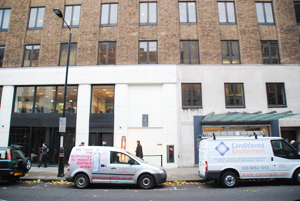
The property at 17 Bruton Street, which is marked by a small plaque installed in 1977 – the Queen’s Silver Jubilee (it’s in the middle of the image to the right), was actually the home of the Queen Mother’s parents, the Earl and Countess of Strathmore. It and the neighbouring townhouse at 18 Bruton Street have both been demolished and replaced with a rather bland office building.

Born here at 2.40am on 21st April, 1926, the Queen, named Elizabeth Alexandra Mary, was the first child of the then Duke and Duchess of York (later King George VI and Queen Elizabeth). At her birth, Queen Elizabeth II was only third in line to the throne after her uncle, the Prince of Wales (later, briefly, King Edward VIII), and her father.

The Queen’s grandparents, King George V and Queen Mary, both visited the newborn child at the property (along with an apparently large crowd outside). Elizabeth was christened five weeks later at the Chapel Royal in Buckingham Palace. She spent the first few months of her life living in a room at 17 Bruton Street which had been previously used by her mother before her marriage.

Recent books on the Queen include Andrew Marr’s  The Diamond Queen: Elizabeth II and Her People, the souvenir album Queen Elizabeth II: A Diamond Jubilee Souvenir Album, and Sarah Bradford’s Queen Elizabeth II: Her Life in Our Times.

• Correction: Bruton Street was mistakenly copied here as Brunton Street. It has been corrected. Apologies for the error!

Celebrating Charles Dickens – 7. Five other London sites of significance…

We’ve looked at Charles’ Dickens childhood in London and some of his residences, workplaces and the pubs he attended. Before we take a look at some of the sites relevant to his writings, Exploring London takes a look at just a handful of the many other London sites associated with the famous Victorian author…

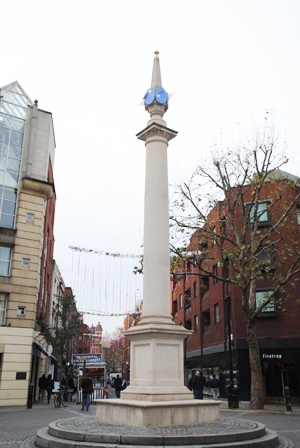
• Seven Dials and the former St Giles slum, Soho. An notorious slum of the 19th century, this area was among a number of “rookeries” or slums toured by Dickens in 1850 in the company of Inspector Field and police from Scotland Yard, and later helped to inform much of his writing. Seven Dials itself – located at the junction of Mercer and Earlham Streets and Upper St Martin’s Lane (pictured right is the monument at the junction’s centre) – has just undergone a renovation but much of the St Giles area is now irrevocably modernised. We’ll be mentioning another notorious slum located in Saffron Hill, Clerkenwell, in an upcoming week.

• Holland House, Kensington. Dickens became a friend of Lady Holland’s after attending one of her exclusive soirees at the age of 26. He was a guest at the house, now a youth hostel, in Holland Park on numerous occasions.

• Royalty House, Dean Street, Soho. The former site of the Royalty Theatre, known in Dickens’ day as Miss Kelly’s Theatre, it was here on 21st September, 1845, that Dickens and a group of friends performed Ben Jonson’s play, Every Man in his Humour (1598). Dickens acted as stage manager and director as well as playing the part of Captain Bobadil.

• Buckingham Palace. It was here in March 1870 – not long before his death – that Dickens had his only face-to-face meeting with Queen Victoria. She apparently found him to have a  “large, loving mind and the strongest sympathy with the poorer classes”.

• Westminster Abbey. Our final stop for it was here that Dickens was buried on 14th June, 1870, following his death at his home near Rochester in Kent. Dickens had apparently wanted to be buried in Rochester but given his public profile, Westminster Abbey was seen as the only fitting place of rest for him (his wishes for a small, private funeral were, however, respected but thousands did visit the site in the days following). His grave sits in Poet’s Corner.

Queen unveils final Jubilee Greenway plaque; a Barbican weekend; and, the Transit of Venus at Greenwich…

Queen Elizabeth II this week unveiled the final plaque marking the end of the 37 mile/60 kilometre Jubilee Greenway in front of Buckingham Palace. The circular Greenway – marked by 542 glass plaques – has been created to celebrate the Queen’s Diamond Jubilee. It can be walked or cycled and takes in key sites around London, including Kensington Palace, Regent’s Park, the Thames Barrier and Olympic sites including Greenwich Park (equestrian events), the O2 Arena (hosting gymnastics, trampoline and basketball events) as well as the main stadium at Olympic Park. The Greenway is divided into 10 sections and you can download either the entire walk or brochures for one of the sections only here.

This weekend sees the Barbican Centre play host to the event known as ‘Barbican Weekender’ – two days of free art, dance, music, theatre and film at the Barbican Foyers. Part of London 2012 Festival, the event’s ‘Freestage’ programme features Roxxxan,Dizralie and the Small Gods, young drummers from East London and performance poetry by the Barbican Young Poets. There’s also street dance classes with Boy Blue Entertainment, the chance to make an Opera in a Day with the Hip Hop Shakespeare Company, a Digital Graffiti wall, street food stalls, the Wah Nails Pop-Up boutique and free running by Streets United. For more, see www.barbican.org.uk/weekender.

• On Now – Measuring the Universefrom the Transit of Venus to the edge of the cosmos. Marking the 2012 transit of Venus, this exhibition at the Greenwich Observatory follows the story of man’s ongoing quest to understand the vastness of space, looking at the people and technologies involved in seeing farther than ever before – from the Astronomer Royal, Edmond Halley, to Captain James Cook and Edwin Hubble and through to the possibilities offered by the Cosmic Microwave Background Explorer. It’s accompanied by a series of talks, observing events – including this month’s Daytime Sky Watch sessions – and a planetarium show. Runs until 2nd September. Admission is free. For more information, see www.rmg.co.uk.

Exploring London’s 10 most popular posts for 2011 – Numbers 4 and 3…

We’re getting down to the pointy end of the countdown now. Here’s numbers four and three in Exploring London’s list of our most popular posts for 2011…

4. Curious London Memorials – 4. The Suffragette MemorialOne of our series on curious London memorials, this looked at a memorial in St James, erected in the 1970s to mark the contribution of those who fought for women’s right to vote;

3. The Royal Wedding – London’s royal reception venue: Another of our Royal Wedding themed posts, this looked at the history of Buckingham Palace, location of the reception which took place after the wedding of Prince William and Kate Middleton, now the Duchess of Cambridge.

Around London – Leading ladies of the 18th century at NPG; “at risk” in London; and, Antarctic images at the Queen’s Gallery…

• A new exhibition featuring some of London’s leading ladies of the eighteenth century opens at the National Portrait Gallery today. The First Actresses: Nell Gwyn to Sarah Siddons is the first exhibition devoted to eighteenth century actresses and features 53 portraits depicting the likes of Gwyn and Siddons as well as Lavinia Fenton, Mary Robinson and Dorothy Jordan. Highlights of the exhibition include a little known version of Joshua Reynolds’ portrait of Sarah Siddons as the “tragic muse”, William Hogarth’s The Beggar’s Opera and Thomas Gainsborough’s portraits of Giovanna Bacelli and Elizabeth Linley. The exhibition reveals the key role these women played in the celebrity culture found in London (and elsewhere) during the period. As a counterpoint, an accompanying exhibition displays photographs and paintings of some of today’s actresses. Runs until 8th January (an admission charge applies). For more information on the exhibition or the programme of accompanying events, see www.npg.org.uk.

Cemetery in Hackney and Kensal Green, a park in Hounslow and a Piccadilly property formerly used as the Naval and Military Club are among the “priority sites” listed on English Heritage’s annual Heritage At Risk Register. Released earlier this week, the register’s 10 London”risk priority sites” include London’s first metropolitan cemetery – Kensal Green (All Souls) – which dates from 1833, Gunnersbury Park in West London – featuring a large country home known as Gunnersbury Park House, it was built in 1801-28 and later remodelled, and a mansion at 94 Piccadilly – built in 1756-60 for Lord Egremont, it was later used at the Military and Naval Club and is now for sale. Others on the list include Abney Park Cemetery in Hackney – laid out in 1840, it is described as London’s most important Nonconformist cemetery, a medieval manor farm barn in Harmondsworth in London’s outer west, Tide Mill in Newham, East London, and the entire Whitechapel High Street and Stepney Green conservation areas. For more information, see www.english-heritage.org.uk/caring/heritage-at-risk/.

On Now: The Heart of the Great Alone: Scott, Shackleton and Antarctic Photography. Opening at the Queen’s Gallery, Buckingham Palace, tomorrow, the exhibition marks the centenary of Captain Robert Scott’s ill-fated expedition to the South Pole and features a collection of photographs presented to King George V by the official photographers on Scott’s expedition of 1910-13 and Ernest Shackleton’s expedition of 1914-16 as well as unique artifacts including the flag given to Scott by Queen Alexandra (the widow of King Edward VII) which was taken to the Pole. Highlights include Herbert Ponting’s images The ramparts of Mount Erebus and The freezing of the sea and Frank Hurley’s stunning images of Shackleton’s ship Endurance as it was crushed by ice. Runs until 15th April, 2012 (admission charge applied). For more, see www.royalcollection.org.uk.

The Royal Parks – 5. The Regent’s Park

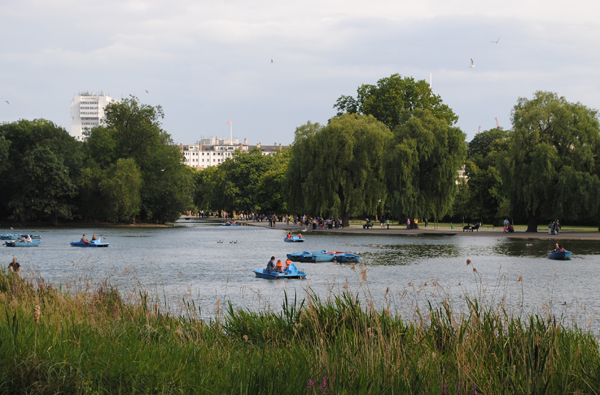
A former hunting chase, The Regent’s Park in London’s north-west was extensively developed in the 19th century and remains a good – if not complete – example of a Regency landscape.

As with many of London’s Royal Parks, Regent’s Park (it’s formal name is actually The Regent’s Park but we’ll shorten it for our purposes here) once served as King Henry VIII’s hunting grounds – he seized the park, then known as Marylebone Park Fields after the nearby village and boasting thick woods as well as more open forests, from the Abbey of Barking in 1538.

Used by royalty for the next 50 years, it remained largely unaltered until after the Civil War when, between 1649 and 1660, the Commonwealth ordered many of the trees to be chopped down to pay debts. It was restored to royal ownership with the restoration of the monarchy but, with hunting falling out of fashion, was then leased out to tenant farmers.

It was John Nash who created the park that we know and love today. Friend of the Prince Regent (later King George IV), he was among a number of architects who responded to the Prince Regent’s calls for the creation of a new design featuring a palace for himself.

Nash’s original designs included a round park featuring a lake and canal and surrounded by as many as 56 villas and a palatial summer home for the Prince Regent which would be linked to his other home at St James’s by a processional road.

But only eight of the villas were ever built and only two of them – St John’s Lodge and The Holme – remain (both are private residences but part of the lodge’s gardens are open to the public) while the plans for the Prince Regent’s palace were put on hold when he turned his attention to developing Buckingham Palace instead. The canal, meanwhile, was moved to the park’s northern boundary where it still stands today (see our earlier entry on Regent’s Canal) while the processional route Nash had proposed became Regent Street.

While the park was initially only for the exclusive use of residents and what Royal Park’s call the ‘carriage set’, in 1835, the eastern part of the park was opened to the public for two days a week. Other sections of what is now included in the park, including Primrose Hill, were opened later.

Meanwhile, the fact most of the villas had never been built had left a large amount of free space and so both the Zoological Society and the Royal Botanic Society moved in – the latter laying out what is the Inner Circle with lawns and a lake of its own. Another society to operate in the park was the Royal Toxophilite Society which introduced archery there.

Not much has changed since but for the creation of Queen Mary’s Gardens in the 1930s – these were laid out on the space formally occupied by the Royal Botanic Society which had decided not to renew its lease. The Open Air Theatre performances, which are still held in the gardens today, started at about the same time. The park was damaged by bombing during World War II but has been fully restored.

Other facilities now in the 166 hectare (410 acre) park include a sports facility known as The Hub as well as several cafes, tennis courts and boat hire. The London Zoo, of course, also remains there.

WHERE: The Regent’s Park (nearest tube station is Regent’s Park); WHEN: 5am to at least 4pm (closing times vary depending on the month); COST: Free entry; WEBSITE: www.royalparks.gov.uk/The-Regents-Park.aspx

The Royal Parks – 4. St James’s Park

The fourth in a line of parks stretching from Kensington Palace to Westminster, St James’s Park largely owes its foundation to King James I. 

Given its early history is covered in our earlier post, we’ll skip forward to the time of King Charles II when, under to instruction of Frenchman Andre Mollet, the park was redesigned with new landscaping including wide lawns, avenues of trees and a wide, centrally positioned canal. It was King Charles II who also opened the park up to the public (he even mingled with them there along with his mistress Nell Gwynn). Interestingly the first pelicans were also introduced to the park around this time when the Russian ambassador presented a pair of pelicans to the king.

In the 18th century, Horse Guards Parade was added to the park by filling in one end of the park’s canal and was later used for parades. The ceremonies of Beating Retreat and Trooping the Colour are still held there today.

The next major changes came in the 19th century when in 1827-28, architect John Nash oversaw a more romantically inspired renovation, including the transformation of the canal into a natural looking lake and the addition of winding paths, as part of his grand scheme which still shapes much of London today.

It was also at this time that The Mall (which like Pall Mall takes it name from the game of Pelle Melle – see our earlier post) was transformed into a grand processional route (it was opened to traffic later, in 1887). The park, bounded to the west by Buckingham Palace, also takes in the Queen Victoria Memorial – completed in 1914 to replace the Marble Arch which was moved to its current location at the corner of Oxford Street and Park Lane in 1851 – and flower beds which are planted annually with 12,000 geraniums, the color of which is chosen to match the guardsmen’s tunics.

Meanwhile, in 1837, the Ornothological Society of London erected a cottage for the birdkeeper (the thatched cottage can still be seen there today and the post of birdkeeper still exists). The first bridge was placed across the lake in 1851 (and replaced in 1951 with the one that now stands there).

Little has changed in the 23 hectare (58 acre) park since Nash’s day. Newer facilities include a restaurant and a playground at the western end.

WHERE: St James’s Park (nearest tube station is St James’s Park); WHEN: 5am to midnight daily; COST: Free entry; WEBSITE: www.royalparks.gov.uk/St-Jamess-Park.aspx 

PICTURE: © Anne Marie Briscombe  (courtesy Royal Parks)

The Royal Parks – 3. Green Park

Perhaps the most overlooked and least celebrated of central London’s Royal Parks, Green Park (officially The Green Park) is a peaceful oasis of leafy trees between the bustle of Piccadilly and traffic of Constitution Hill and part of an unending swathe of green which connects Kensington Gardens with, eventually, St James’ Park.

Originally meadowland used for hunting, the earliest known mention of the area where the park now stands was apparently in 1554 when it was believed to be a staging point for Thomas Wyatt (the younger) who led a group of rebels protesting against the marriage of Queen Mary I to King Philip II of Spain. The unfortunate – and unsuccessful (in terms of his rebellion at least) – Wyatt was later beheaded for treason.

In 1668, King Charles II had the park enclosed with a brick wall and stocked with deer, as well as having a ranger’s lodge and icehouse built (to keep his drinks cool when entertaining in summer). While it was initially known as Upper St James’s Park, by 1746 Green Park had its own name. It’s not really known what prompted the name change but the unofficial story is that Queen Catherine of Braganza, wife of King Charles II, found out that her philandering husband had picked some flowers there for another woman – a milkmaid. In revenge, she had every flower in the park pulled up with orders they were not to be replanted. To this day, while some 250,000 daffodils bloom here in spring, there remain no formal flowerbeds in the park.

The 47 acre (19 hectare) park, which was also used on occasion as a duelling ground, underwent further development at the beginning of the following century with the creation of the ornamental Tyburn Pool near the centre of the park.

Queen Caroline, the wife of King George II, meanwhile, had a reservoir built to supply water to St James’s Palace and Buckingham Palace (it was known as the Queen’s Basin) as well as a library and the Queen’s Walk. Planted in 1730, this runs along the eastern side of the park and helped to turn it into a fashionable place in which to be seen (and led to the building of many a mansion in nearby Piccadilly).

Other buildings in the park have included two temporary ‘temples’ – the Temple of Peace (erected in 1749 to mark the end of the War of Austrian Succession) and the Temple of Concord (erected in 1814 to mark 100 years of the rule of the Hanoverian dynasty). Both of these, believe it or not, burnt down during the celebrations they were built for.

The park, which underwent a redesign in which the first trees were planted in the 1820s as part of architect John Nash’s grand plans for St James’s Park, was opened to the general public in 1826 but by then many of its earlier features – including the ranger’s house, Tyburn Pool and the Queen’s Basin – were already gone.

In more recent times, war memorials have been added to the park – the maple-leaf daubed, Pierre Granche-designed memorial to Canadian soldiers in 1994 (Canada is also remembered in Canada Gate on the park’s south side, installed in 1908 to mark the nation’s contribution to the Empire), and a set of memorial gates on Constitutional Hill at the park’s western end which is dedicated to the five million people from the Indian Sub-Continent, Africa and the Caribbean who served in World War II in 2004. The park also features the ‘Diana fountain’, installed in 1952 by the Constance Fund (and currently undergoing restoration).

On 14th June, a 41 royal gun salute is fired here to mark the Queen’s birthday. Salutes are also fired here for the State Opening of Parliament in November or December, Remembrance Sunday, and for State Visits.

WHERE: Green Park (nearest tube station is Green Park and Hyde Park Corner); WHEN: daily; COST: free; WEBSITE: http://www.royalparks.gov.uk/Green-Park.aspx

PICTURE: Courtesy of Royal Parks. © Anne Marie Briscombe 

Around London – 16 Underground stations listed; life in a gun turret at HMS Belfast; and that dress on display at Buckingham Palace

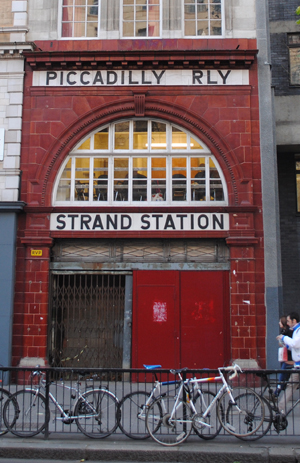
Sixteen London Underground stations were this week listed as Grade II heritage buildings. The Tube stations – several of which were designed by Leslie Green, known for his pioneering use of ‘ox-blood’ red tiles on the exterior of stations to create a consistent brand for the stations – include the now-closed Aldwych (pictured) along with Oxford Circus (originally two stations), Covent Garden and Russell Square as well as Belsize Park, Brent Cross, Caledonian Road, Chalk Farm, Chesham, Perivale, Redbridge, St John’s Wood, West Acton and Wood Green. Three other stations – Arnos Grove, Oakwood and Sudbury Town – have had their status upgraded from Grade II to Grade II*. These three were all designed by modernist architect Charles Holden for the extension of the Piccadilly Line in the 1930s. The new listings were made by Tourism and Heritage Minister John Penrose on the advice of English Heritage.

A new permanent exhibition showing would-be sailors what it is like to fight at sea opens at the HMS Belfast this weekend. Gun Turret Experience: A Sailor’s Story, 1943, is an immersive experience using lights, imagery, sound, smoke effects, movement and smell to recreate the atmosphere and conditions of a gun turret tower when a crew was at battle stations. Visitors are encouraged to follow the story of a young sailor on Boxing Day, 1943 when the German battle cruiser Scharnhorst is sighted leading to the Battle of the North Cape. The Gun Turret Experience, housed within the original triple gun turrets overlooking the quarterdeck, was developed with the help of Royal Navy veterans and eye-witness accounts from the Imperial War Museum (of which the HMS Belfast is part). Entry is included in normal admission price. For more information, see www.hmsbelfast.iwm.org.uk.

• Now On: See the dress the Duchess of Cambridge wore when she was married to Prince William in April at this year’s summer opening at Buckingham Palace. The gown, which features a nine foot long train, will be displayed along with the Halo Tiara until 3rd October in the palace ballroom (the same room used for the newly married couple’s reception). The exhibition features video footage of designer Sarah Burton, explaining how the dress was made. This year’s summer opening also features a display of the work of Carl Faberge – including his magnificent jewel-encrusted Imperial Easter Eggs as well as bejewelled boxes and miniature carvings of favorite pets of the royal family. More than half a million people are expected to visit the exhibition. For more information, see www.royalcollection.org.uk/default.asp?action=article&ID=30

LondonLife – Trooping the Colour…

A ceremony first believed to have been performed during the reign of King Charles II, since 1748 the parade has been used to mark the Official Birthday of the Sovereign.

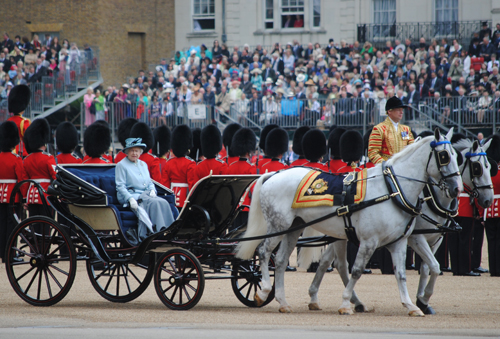
 Queen Elizabeth II inspects the Guards in her phaeton.

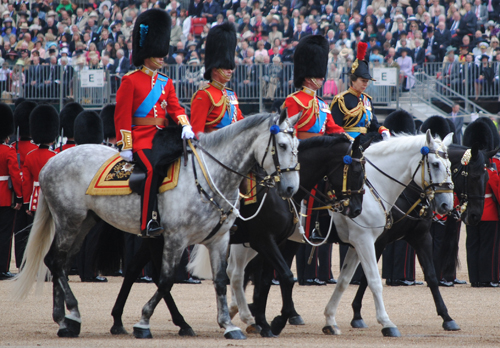
Prince William, Prince Charles, the Duke of Kent and Princess Anne riding Queen’s Escort behind the Queen.

The parade includes six Guards groups. This year it was the turn of the Scots Guards, raised in 1642 at the behest of King Charles I, to parade their colours.

Part of the Household Mounted Cavalry, the Blues and Royals.

At 1pm, back at Buckingham Palace following the firing of a 41 gun salute, the Queen and the Royal Family watch Royal Air Force aircraft performing a fly past overhead.

The RAF’s Red Arrows aerobatic display team perform a colorful flypast over Buckingham Palace.
All images and text are © David S. Adams

The Royal Wedding – A view from The Mall…

Along with tens of thousands of others, Exploring London took up a post in The Mall to watch festivities surrounding the London wedding of Prince William and Kate Middleton. Here’s some of what we saw…

Kate Middleton, newly titled Her Royal Highness the Duchess of Cambridge, rides in a 1977 Rolls Royce Phantom IV from the Goring Hotel in Belgravia to Westminster Abbey via The Mall, greeting crowds along the way. Others, including Prince William, had already passed by.

The crowds cheered along The Mall throughout the morning, including after Rowan Williams, the Archbishop of Canterbury, was heard over loudspeakers announcing that the couple were now man and wife. The Bishop of London, Dr Richard Chartres, delivered the address while James Middleton read the lesson.

After the ceremony, the newly married couple processed in the 1902 State Landau down Whitehall and The Mall through a sea of flag-waving well-wishers towards Buckingham Palace after the wedding ceremony. The Landau was the same used by Prince Charles and Princess Diana after their 1981 wedding.

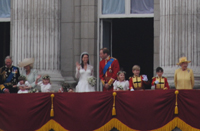
The couple, along with other members of the royal family and Kate Middleton’s parents, appear on the balcony of Buckingham Palace at around 1.30pm, waving to the crowd and exchanging kisses. Here they are flanked by Queen Elizabeth II (right) and the Duke and Duchess of Cornwall (left) along with bridesmaids and pageboys.

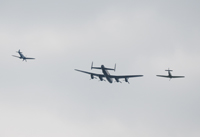
A Lancaster bomber and two Spitfires flew over the top of Buckingham Palace as part of an RAF flypast. They were followed by two tornados and two typhoons. The flypast brought official celebrations to an end after which the royal rejoined the champagne and canape reception already underway.

Crowds fill The Mall in the wedding’s aftermath. The newly weds later left Buckingham Palace driving a vintage convertible Aston Martin owned by Prince Charles. Overhead hovered a Sea King helicopter manned by some of Prince William’s colleagues.