LondonLife – The Queen’s 90th birthday marked at Trooping the Colour…

Queen-in-The-Mall

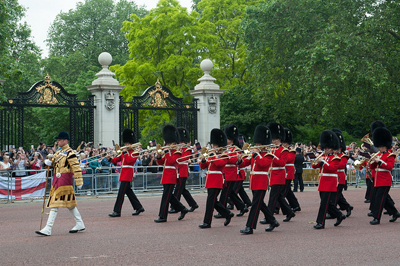
Photographer John Pannell was among the crowds who gathered in The Mall to witness Trooping the Colour on Saturday. Traditionally held to mark the Queen’s birthday, this year’s event – in honour of the fact that the Queen has turned 90 (her actual birthday being 21st April) – was followed on Sunday by a lunch for 10,000, known as the Patron’s Lunch, in The Mall. Trooping the Colour has marked the official birthday of the sovereign since the reign of King George II. Above are the Queen and Prince Philip while below are part of the Massed Bands of the Household Division, among those who marched, and, RAF planes fly-past Buckingham Palace while watched from the palace’s famed balcony by the Queen and the royal family.

Trooping-the-Colour
PlanesPICTURES: John Pannell/Flickr

LondonLife – A view down Constitutional Hill…

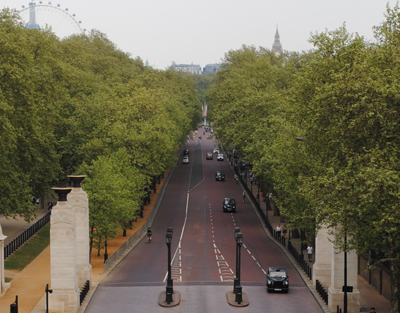
The-Mall

A view down Constitution Hill looking toward Whitehall, taken from the top of Wellington Arch at Hyde Park corner. To the left is Green Park and to the right, the grounds of Buckingham Palace. Constitutional Hill apparently has nothing to do with a document of any sort but takes its name from the fact that, considered to be a fine “constitutional” walk from St James’s Park to Hyde Park (King Charles II is rumoured to have been among those said to have taken their “constitutional” along this route while Queen Victoria survived a couple of assassination attempts on the road). The pillars at the near end are symbolic gates commemorating those who served Britain in World War I and II from the Indian subcontinent, Africa and the Caribbean (more on them in an upcoming post).

This Week in London – Seminal moments in Shakespearean performance; Maria Merian’s Butterflies; and, British conceptual art…

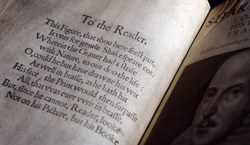
ShakespearesFirstFolio1623BritishLibraryPhotobyClareKendall• It’s the 400th anniversary of Shakespeare’s death (in case you missed that), and among the many events marking the occasion comes a major exhibition at the British Library focusing on 10 key performances that it says have made the Bard the “cultural icon” he is today. Shakespeare in Ten Acts, which opens on Friday, focuses on performances which may not be the most famous but which represent key moments in shaping his legacy. They span the period the first performance of Hamlet at the Globe theatre in around 1600 to a radical interpretation of the same play from US theatre company The Wooster Group in 2013. Among the exhibition highlights are a human skull which was given to the actress Sarah Bernhardt by writer Victor Hugo (and which she used as Yorik’s skull when she played Hamlet in 1899), a dress worn by Vivien Leigh playing Lady Macbeth in the 1955 production of Macbeth at the Royal Shakespeare Company, the only surviving play script written in the Bard’s own hand and rare printed editions including Shakespeare’s First Folio and the earliest printed edition of Hamlet from 1603 (one of only two copies in the world). The exhibition, which runs until 6th September, is accompanied by a season of events. Admission charge applies. For more, see www.bl.uk. PICTURE: Shakespeare’s First Folio 1623 British Library Photo by Clare Kendall.

• Still talking exhibitions commemorating Shakespeare’s death and a manuscript of William Boyce’s Ode to the Memory of Shakespeare will be on display at The Foundling Museum’s Handel Gallery from tomorrow. The work, which was composed in 1756, was performed annually at the Theatre Royal in Drury Lane. The manuscript, the first page of which was thought to be lost until it was acquired in 2006, formerly belonged to Samuel Arnold, who compiled the first complete edition of Handel’s works. Runs at the Bloomsbury-based museum until 30th May. Admission charge applies. For more, see www.foundlingmuseum.org.uk.

• Exquisite watercolours depicting the natural world go on show in The Queen’s Gallery at Buckingham Palace from tomorrow. Maria Merian’s Butterflies features 50 works produced by the eighteenth century German artist and entomologist Maria Sibylla Merian. The works – many of which record the flora and fauna of the then Dutch colony of Suriname in South America, were published in the 1706 work Metamorphosis Insectorum Surinamensium (The Metamorphosis of the Insects of Suriname) and partially printed, partially hand-painted versions of the plates were purchased by King George III for his library at Buckingham House (later Buckingham Palace). As well as insects, the works – which were based on a visit Merian made to the colony in 1699, depict lizards, crocodiles and snakes as well as tropical plants such as the pineapple. The exhibition runs until 9th October. Admission charge applies. For more, see www.royalcollection.org.uk/visit/the-queens-gallery-buckingham-palace.

• The evolution of conceptual art in Britain is the subject of a new exhibition at Tate Britain in Milbank  Conceptual Art in Britain 1964-1979 features 70 works by 21 artists and positions conceptual art “not as a style but rather a game-changing shift in the way we think about art, how it is made and what it is for”. Highlights include Michael Craig-Martin’s An Oak Tree (1973) and Roelof Louw’s Soul City (Pyramid of Oranges) (1987) as well as Victor Burgin’s Possession (1976), Mary Kelly’s Post-Partum Document (1974-78) and Conrad Atkinson’s Northern Ireland 1968 – May Day 1975 (1975-76). Admission charge applies. Runs until 29th August. For more, see www.tate.org.uk.

Send all items for inclusion to exploringlondon@gmail.com.

A Moment in London’s History – Birth of a future queen…

17-Bruton-StreetQueen Elizabeth II, the oldest British monarch, celebrates her 90th birthday later this month and, although we’ve run a piece on the Queen’s birth before, we thought it only fitting to take a second look at what proved to be a momentous birth.

The then Princess Elizabeth (Elizabeth Alexandra Mary) was born at 17 Bruton Street in Mayfair – the London home of her maternal grandparents, the Earl and Countess of Strathmore (they also owned Glamis Castle in Scotland) – at 2.40am on 21st April, 1926.

She was apparently delivered by Caesarian section and the Home Secretary, Sir William Joynson-Hicks, was in attendance to ensure everything was above board (the custom, which has since been dropped, was apparently adopted after what was known as the ‘Warming Pan Scandal’ when, following the birth of Prince James Francis Edward, son of King James II and Queen Mary of Modena, in June, 1688, rumours spread that the baby had been stillborn and replaced by an imposter brought into the chamber inside a warming pan).

The first child of the Prince Albert, the Duke of York (Bertie) and Elizabeth Bowes-Lyon, the Duchess of York (later King George VI and Queen Elizabeth), she was third in line to the throne at her birth but thanks to the abdication of King Edward VIII, became her father’s heir.

The event apparently drew a crowd to the property (although none could yet suspect how important this princess was to become) and among the well-wishers who visited the newborn that afternoon were her paternal grandparents, King George V and Queen Mary, who had apparently been woken at 4am to be informed of the birth of their second grandchild.

The property was to be Princess Elizabeth’s home for the first few months of her life (named after her mother, paternal great-grandmother, Queen Alexandra, and paternal grandmother, Queen Mary, she was christened in the private chapel at Buckingham Palace five weeks after her birth).

The home of her birth and a neighbouring townhouse have both since been demolished and replaced by an office building. A plaque commemorating it as the Queen’s birthplace was installed in the Queen’s Silver Jubilee Year of 1977 and another to mark the Diamond Jubilee in 2012.

The Queen’s birthday will be officially commemorated in June.

PICTURE: Via London Remembers


Lost London – The King’s Mews at Charing Cross…

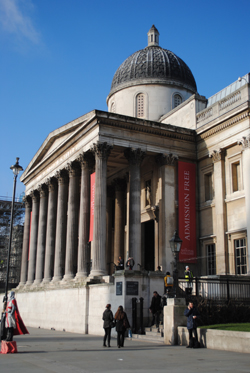
National-Gallery2The Royal Mews – a stables and carriage house – is these days located at Buckingham Palace but prior to being moved there, the Royal Mews, previously usually referred to as the King’s and Queen’s Mews depending who was on the throne, was located on the site where the National Gallery (pictured) and Trafalgar Square now stand.

The name ‘mews’ actually refers to the fact that, from at least the reign of King Richard II in the late 14th century (although official records suggest there may have been a mews on the site as far back as the reign of King Edward I), the royal hawks were initially housed on the site – then in the village of Charing Cross – (the word ‘mew’ refers to the moulting of the birds and originally referred to when they were confined here for that purpose but later come to simply mean the place were the birds were caged).

The title of Keeper of the King’s Mews became a sought-after honour during the 15th century (although largely honorary with the actual work done by deputies) but among those who held the honour were Richard Neville, Earl of Warwick, known, during the Wars of the Roses as the ‘Kingmaker’.

In 1534, the King’s Mews was destroyed by fire and when it was rebuilt a few years later, it took the form of a stable but kept the original name of mews (although it has been suggested the change of use took place before the fire).

During the Civil War, the Mews were apparently used as a prison by the Parliamentarians for captured Royalists and during the Commonwealth, soldiers were apparently quartered here. Diarist Samuel Pepys also apparently visited several times.

In 1732 the building was again rebuilt, but this time it was to the grand designs of William Kent – images show a grand building with turrets and a great open square before it. In the 1760s, King George III had some of his horses and carriages moved to facilities on the grounds of Buckingham Palace (he had purchased this from the Duke of Buckingham for his wife’s use) but the bulk remained on the Charing Cross site.

In the early 19th century they were opened to the public but in the 1820s, King George IV – making Buckingham Palace his main residence – had the entire stables moved (the Royal Mews which now stand at Buckingham Palace were designed by John Nash and completed in 1825).

The old mews were subsequently demolished and Trafalgar Square – another Nash design – built on the site between 1827 and 1835 while the National Gallery opened in 1838.

This Week in London – Lord Mayor’s Show marks 800 years; Dutch masters and Thomas Rowlandson at Queen’s Gallery; and, Alexander Calder on show at Tate…

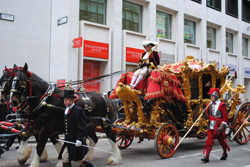
Lord-Mayor's-Show• The Lord Mayor’s Show will mark its 800th anniversary on Saturday as the newly elected Jeffrey Mountevans – the 688th Lord Mayor of the City of London – makes his way through the City to Westminster to swear loyalty to the Crown. The procession of 7,000 people, some 180 horses and 140 vehicles will set off on its way along a three-and-a-half mile route at 11am, starting at Mansion House and traveling down Cheapside to pause at St Paul’s Cathedral (which is open for free all day) before heading on via Ludgate Hill and Fleet Street to the Royal Courts of Justice before returning the City via Queen Victoria Street from 1.10pm. In a special nod to the 800th anniversary, the famous bells of St Mary-le-Bow will ring out a special 800-change at noon. The day will conclude with fireworks over the River Thames kicking off at 5.15pm (for the best view head down to the riverside between Waterloo and Blackfriars Bridges, either on Victoria Embankment or on the South Bank). The show’s origins go back to 1215 when, in exchange for a Royal Charter granting the City of London the right to elect its own mayor, King John insisted the newly elected mayor travelled to Westminster each year to swear loyalty to the Crown. For more (including a map to print out), see https://lordmayorsshow.london. PICTURE: From a previous show.

• Vermeer’s The Music Lesson is among 27 of the finest 17th and 18th century Dutch paintings in the Royal Collection which will go on display in a new exhibition at the Queen’s Gallery at Buckingham Palace from tomorrow. Masters of the Everyday: Dutch Artists in the Age of Vermeer also features works by the likes of Gerrit Dou, Pieter de Hooch and Jan Steen, all produced during what is known as the Dutch ‘Golden Age’. The exhibition is being shown alongside another display – High Spirits: The Comic Art of Thomas Rowlandson – which will focus on the work of 18th and early 19th century caricaturist Thomas Rowlandson. Around 100 of Rowlandson’s works feature in the display with highlights including The Two Kings of Terror featuring Napoleon and Death sitting face-to-face after Napoleon’s defeat at Leipzig in 1813, The Devonshire, or Most Approved Method of Securing Votes depicting Georgiana, Duchess of Devonshire, kissing a butcher (it was claimed she had claimed kisses for votes in the Westminster election of 1784), and A York Address to the Whale. Caught lately off Gravesend in which the Duke of York thanks a whale for distracting attention from accusations that his mistress was paid by army officers to secure promotions from the Duke. Admission charge applies. Both exhibitions run until 14th February, 2015. For more, see www.royalcollection.org.uk.

• The first major UK exhibition of the works of kinetic sculpture pioneer Alexander Calder opened at the Tate Modern this week. Alexander Calder: Performing Sculpture features more than 100 of the ground-breaking 20th century artist’s works which trace how Calder turned sculpture from the idea of a static object to a continually changing work to be experienced in real time. Works on show include figurative wire portraits of artists – Joan Miró and Fernand Léger (both 1930), works exploring the idea of forms in space – Red Panel, White Panel and Snake and the Cross (1936), motorised mobiles such as Black Frame and A Universe (1934), and chiming mobiles such as Red Gongs (1950) and Streetcar (1951). It closes with the large scale Black Widow (c.1948), shown for the first time ever outside Brazil. Runs until 3rd April. Admission charge applies. For more, see www.tate.org.uk.

Send all items for inclusion to exploringlondon@gmail.com.


This Week in London – Buckingham Palace offers a “Royal Welcome”; exploring London’s outdoor spaces; and contemporary portraiture at the V&A…

Buckingham-Palace• Buckingham Palace opened its 19 State Rooms to the public last weekend under the theme of ‘A Royal Welcome’. As well as the chance to see the State Rooms themselves, a series of displays and films are located throughout the palace which show how Royal Household staff are involved in welcoming the tens of thousands of guests who come to the palace each year for receptions, State Banquets, garden parties and investitures. And, for the first time, the public can enter the palace through the Grand Entrance where the Australian State Coach will be displayed. Other highlights include the Palace Ballroom – set up for a State Banquet with silver gilt candelabra and centrepieces from King George IV’s grand service, displays recreating part of the dresser’s workroom and the palace kitchens, pantries and wine cellars in the throes of preparing for a State Banquet, and some of the gifts received during State Visits to the palace. Items of Queen Elizabeth II’s personal jewellery are also on display including the Kokoshnik Tiara, worn at a State Banquet in honour of the President of Mexico this year, Queen Mary’s Dorset bow brooch and the diamond Coronation necklace and earrings. The palace is open until 27th September. Admission charge applies. For more, see www.royalcollection.org.uk.

• A new interactive map of public outdoor areas in London has been created to help encourage the city’s residents and tourists to make the most of the great outdoors this summer. The map details more than 200 public spaces including squares, green spaces and public street amenities, many of which have been improved as part of the Mayor of London, Boris Johnson’s Great Outdoors initiative which has seen more than £400 million invested in 242 projects since 2009. To check out the map, follow this link.

• A new exhibition examining contemporary portraiture – and its inspiration from traditional modes of portraiture such as miniatures, medals and death masks – opened at the V&A in South Kensington this week. Facing History: Contemporary Portraiture features more than 80 prints and photographs drawn from the V&A’s collection and created by artists including Julian Opie, Grayson Perry, Thomas Ruff, Maud Sulter and Gavin Turk. Works featured include self-referential pieces like Grayson Perry’s pair of prints, Mr and Mrs Perry and Gavin Turk’s Portrait of Something that I’ll Never Really See, portraits of real and fictional characters like Brian D Cohen’s Man with Eyes Closed (Walter White) whose subject is both a character from US TV series Breaking Bad and Bryan Cranston, the actor who played him, Cecilia Mandrile’s identity-card inspired ID-Intensively Displaced series, and 11 pieces from Ellen Heck’s Forty Fridas. Exhibition runs until 24th April. Admission is free. For more, see www.vam.ac.uk.

Send all items for inclusion to exploringlondon@gmail.com

LondonLife – Royal gun salute in Hyde Park marks birth of Princess Charlotte Elizabeth Diana…

Gun-salute

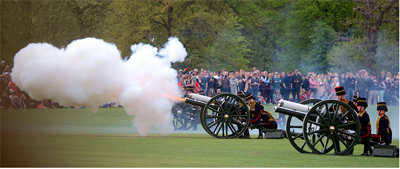
Guns fired a royal salute in Hyde Park on Monday to mark the birth of the Duke and Duchess of Cambridge’s new daughter (and Prince George’s new sister), named Princess Charlotte Elizabeth Diana (or more formally, Her Royal Highness Princess Charlotte of Cambridge). Seventy-one horses pulling six World War I-era 13-pounder field guns from the King’s Troop Royal Horse Artillery rode out in procession with the Royal Artillery Band from Wellington Barracks, past Buckingham Palace, up Constitution Hill to Wellington Arch, and into Hyde Park to fire the salute. The 41 gun salute was fired at the same time as a 62 gun salute at the Tower of London. By custom, gun salutes are fired for the birth of every prince or princess, regardless of where they sit in the order of succession. A basic salute is 21 rounds with an additional 20 rounds fired because Hyde Park is a Royal Park while at the Tower of London an extra 20 rounds are fired because it is a royal palace along with a further 21 because of its City of London location. The princess, fourth in line to the throne, was born at 8:34am on Saturday at St Mary’s Hospital in Paddington, and weighed 8lbs, 3oz (3.7kg). PICTURE: © Courtesy of Ian Wylie Photo.

What’s in a name?…Downing Street…

Downing-Street

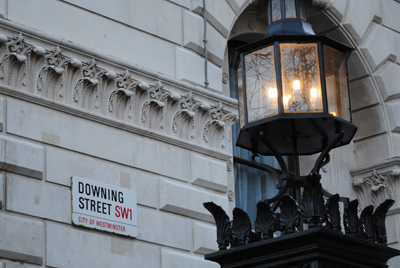
One of the most famous streets (and photographed) in London (though sadly not open to the public), Downing Street in Whitehall is these days most well-known for being the location, at Number 10, of the official residence of the British Prime Minister.

But Downing Street’s history dates back to a time before the first British PM moved in (this was Sir Robert Walpole in the 1735 and even after that, it didn’t become a regular thing for Prime Ministers to live here until the Twentieth century). And its name bears testimony to its creator, Sir George Downing, a soldier and diplomat described as “a miserly and at times brutal” man who served first under both Oliver Cromwell and, following the Restoration, King Charles II (and was, coincidentally, one of the first graduates of Harvard University).

In the 1650s, Sir George took over the Crown’s interest in land here, just east of St James’s Park, and intended to build a row of townhouses upon it. His ambitions were delayed, however, due to an existing lease with the descendants of Elizabethan courtier Sir Thomas Knyvet who had once lived in a large home on the site of what is now Number 10 Downing Street.

By the 1680s, however, the lease had expired and between 1682-84, Downing was able to construct a cul-de-sac, closed at the St James’s Park end, featuring either 15 or 20 two storey terraced townhouses with stables and coach-houses, designed by no less than Sir Christopher Wren.

While the homes were apparently of shoddy craftsmanship and stood upon poor foundations (Churchill famously wrote that Number 10 was “shaky and lightly built by the profiteering contractor whose name they bear”), the street apparently attracted some notable residents from the start.

These included the Countess of Yarmouth, who briefly lived at Number 10 in the late 1680s, Lord Lansdowne and the Earl of Grantham, and even, briefly, apparently the diarist James Boswell in the mid 1700s. Downing himself isn’t thought to have ever lived here – he retired to Cambridge a few months after the houses were completed.

The houses between Number 10 and Whitehall – on the north side of the street – were taken over by the government and eventually demolished in the 1820s to allow for the construction of offices for the Privy Council, Board of Trade and Treasury while the houses on the south side remained until they were demolished in the early 1860s to make way for the Foreign, India, Colonial and Home Offices.

The numbers in the street have changed since Downing’s houses were first built. Of the original homes in the street only Number 10 (home of the PM) and Number 11 (home of the Chancellor of the Exchequer) survive.

Access to the street has been restricted since the 1980s with the current black steel gates put in place in 1989.

An underground tunnel apparently runs under the street connecting number 10 with Buckingham Palace and the underground bunker, Q-Whitehall, built in the 1950s in the event of nuclear war.

Treasures of London – The Australian State Coach…

Australian-State-Coach
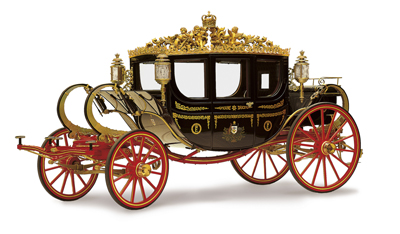
Among the treasures on show at this year’s summer opening of Buckingham Palace, the Australian State Coach was a gift to Queen Elizabeth II by Australia on 8th May, 1988, to mark the Australian Bicentennial.

The coach – the first to be built for the Royal Family since the Coronation of King Edward VII in 1902 – was built by Australian WJ “Jim” Frecklington who also designed the Diamond Jubilee State Coach.

The coach, which is usually kept in the Royal Mews where it can be viewed by the public, has been used at the State Opening of Parliament and other occasions involving foreign royal families and visiting heads of state. It was also used to carry Prince Charles, the Duchess of Cornwall and Michael and Carole Middleton back to Buckingham Palace after the wedding of Prince William and Catherine Middleton.

It was last used to carry the Duke of Edinburgh and Señora Rivera, wife of the president of Mexico, on a State Visit in March this year.

The summer opening of the palace runs from 25th July to 27th September. The coach will be on display in the Grand Entrance portico.

WHERE: Summer Opening of Buckingham Palace (nearest Tube stations are Victoria, Green Park and Hyde Park Corner); WHEN: 25th July to 31st August – 9.30am to 7.30pm daily (last admission 5.15pm)/1st to 27th September – 9.30am to 6.30pm (last admission 4.15pm); COST: £35.60 adults/£20 under 17 and disabled/£32.50 concessions/£91.20 family (2 adults and three under 17s); WEBSITE: www.royalcollection.org.uk/visit/the-state-rooms-buckingham-palace/plan-your-visit.

PICTURE: Royal Collection Trust © Her Majesty Queen Elizabeth II, 2015 

This Week in London – Garden art from the Royal Collection; A Royal Welcome at Buckingham Palace; photographic history; and, Joshua Reynolds reconsidered…

Gardens• King Henry VIII’s well-thumbed gardening manual, a late 15th century copy of the Ruralia Commoda, and a 16th century portrait of Jacopo Cennini, factor and estate manager to the House of Medici – believed to be the earliest surviving portrait of a gardener – are among more than 150 objects on display at a new exhibition celebrating the art of gardens. Opening at The Queen’s Gallery in Buckingham Palace tomorrow, Painting Paradise: The Art of the Gardens features some of the earliest surviving records of gardens and plants in the Royal Collection including Jan Brueghel the Elder’s Adam and Eve in the Garden of Eden (1615), The Family of Henry VIII (c. 1545) featuring King Henry VIII’s Great Garden at Whitehall Palace – the first real garden recorded in British art, and A View of Hampton Court by Leonard Knyff (c. 1702-14) – described as the “greatest surviving Baroque painting of an English garden”. There are also works by Frenchman Jean-Baptiste Martin, Swiss artist Johan Jacob Schalch and Sir Edwin Landseer. The exhibition runs until 11th October. Admission charge applies. For more, see www.royalcollection.org.uk. PICTURE: Illustration from Henry VIII’s copy of the gardening manual, c. 1490-95. Royal Collection Trust/© Her Majesty Queen Elizabeth II 2015. 

• Buckingham Palace, meanwhile, has announced its summer opening under the theme of A Royal Welcome. From 25th July to 27th September, displays in the State Rooms will recreate the settings for some of the many occasions in which the palace welcomes guests – from State Visits and garden parties to investitures and private audiences. The displays will show the behind-the-scenes preparations that go into a state visit and show the ballroom set up for a State Banquet. There will also be a display featuring the knighting stool and a knighting sword and, for the first time ever, visitors will enter the State Rooms through the Grand Entrance, used by those who come to the palace at the invitation of the Queen, including heads of state and prime ministers. The Australian State Coach, most recently used to carry the Duke of Edinburgh and the wife of the Mexican President, Señora Rivera, in March this year, will be displayed in the Grand Entrance portico. Admission charge applies. For more, see www.royalcollection.org.uk.

• About 100 of the “most stunning photographs ever created” go on show in the Science Museum’s Media Space in South Kensington from tomorrow. Revelations explores the role of early scientific photography in inspiring later art photographers and will feature rare shots from the National Photography Collection including an original negative of X-Ray, 19th century photographs capturing electrical charge and William Henry Fox Talbot’s experiments with photomicrography. Displayed alongside are images by some of the 20th century’s pre-eminent art photographers such as Trevor Paglen, Idris Khan and Clare Strand. Runs until 13th September. Admission charge applies. For more, see www.sciencemuseum.org.uk/revelations.

• On Now: Joshua Reynolds: Experiments in Paint. This exhibition at the Wallace Collection in Marylebone provides a new perspective on the portraits of Reynolds, one of the greatest artists of his day. Works on show including Nelly O’Brien, Mrs Abington as Miss Prue and Self Portrait Shading the Eyes as well as lesser known pictures and a rare history painting. The exhibition reveals discoveries made recently during a four year research project into the works of Reynolds now in the care of the collection. Runs until 7th June. Admission is free. For more, see www.wallacecollection.org.

Send items for inclusion to exploringlondon@gmail.com.

This Week in London – Hampton Court Palace lights up; doll house histories; more on Christmas; and, memories of a royal progress at The Queen’s Gallery…

• Hampton Court Palace’s world famous gardens have been transformed into an “illuminated wonderland” which can be explored using a specially created trail. From tomorrow, visitors can use a glow-in-the-dark map to follow the trail which starts at the palace’s hedge maze – the UK’s oldest – and meanders through various locations around the grounds – including the formal gardens – before ending up at the palace’s East Front where, through the use of interactive technology, visitors can ‘paint’ the building’s facade just by moving around. Allow about an hour. Entry is timed between 5pm and 8pm. Runs until 23rd December. Admission charge applies. For more, see www.hrp.org.uk/HamptonCourtPalace/.

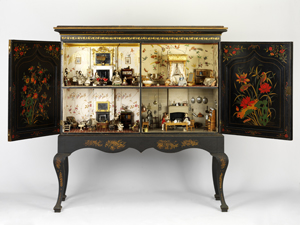
Killer_Cabinet_1840s• The stories behind some of the UK’s best-known dolls’ houses are the focus of a new exhibition which opens at the V&A Museum of Childhood in Bethnal Green on Saturday. Small Stories: At home in a dolls’ house tells the story of 12 dolls’ houses dating as far back as 300 years. Each of the houses – which are displayed chronologically – has been set up to represent a particular time of day and, using interactive technology, tells the story of those who live and work in the building in a series of stories featuring marriages, parties, politics and even crimes. Highlights include: the Tate Baby House – dating from 1760, it features original wallpapers and painted panelling in the style of Robert Adam; the Killer House (pictured) – a gift from surgeon John Egerton Killer to his wife and daughters in the 1830s, this Chinese-style cabinet has gilded wallpapers, a four poster bed and liveried servants; Whiteladies House – a Modernist country villa designed by artist Moray Thomas and built in the 1930s; the Hopkinson House – based on the homes built in the 1930s in the London County Council suburb, the St Helier Estate; and, the Kaleidoscope House – designed by Laurie Simmons to suit a “design conscious step-family living in the new millennium”. There’s a further 20 dolls’ houses, dating from 1673 to 2014, on display in the museum’s permanent galleries (just some of the more than 100 in the museum’s collection). Admission is free. Runs until 6th September, 2015. For more, see www.museumofchildhood.org.uk. PICTURE: Victoria and Albert Museum, London.

• The V&A has unveiled its 2014 Christmas Tree at the grand entrance to its South Kensington building. Designed by Gareth Pugh, Ceremony stands at more than four metres in height and, along with a shape not unlike a traditional Christmas tree, features nine tiered gold pyramids located around a central beacon of light to represent the nativity. For more, see www.vam.ac.uk/content/articles/c/christmas-tree-installation-by-gareth-pugh/. Meanwhile Winter Wonderland continues to entertain in Hyde Park with rides, markets, ice-skating and all the usual attractions. Open 10am to 10pm every day until 4th January (closed on Christmas Day). For more, see www.hydeparkwinterwonderland.com.

• On Now: Cairo to Constantinople: Early Photographs of the Middle East. This exhibition at The Queen’s Gallery, Buckingham Palace, features objects collected by the 20-year-old Prince of Wales, Albert Edward (later King Edward VII), during an educational tour of the Middle East in 1862. The display, which also features photographs taken by Francis Bedford – the first photographer to join a royal tour, follows the prince as he progresses through Egypt, Palestine and the Holy Land, Syria, Lebanon, Turkey and Greece. The exhibition is being show alongside Gold, a display of 50 gold items drawn from the Royal Collection. They include the Rillaton Cup, found in a Bronze Age burial dating from between 1700 and 1500 BC, a gold crown from Ecuador that predates the Incas, and an 18th century tiger’s head made from gold and rock crystal and taken from the throne of the Tipu Sultan of Mysore in India. Both run until 22nd February. Admission charge applies. For more, see www.royalcollection.org.uk.

Send all items for inclusion to exploringlondon@gmail.com.

A Moment in London’s History – Peace Day Parade, 1919…

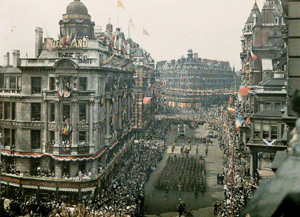
With Remembrance Sunday having been observed earlier this month, we thought it was an appropriate time to take a quick look at the Peace Day Parade of 19th July, 1919, at which the Cenotaph – the National War Memorial – was first unveiled.

London-Victory-ParadeThe parade, organised by a Peace Celebrations Committee appointed by the War Cabinet, was seen as the high point of a series of celebrations to mark the end of the war which had only officially ended on 28th June with the signing of the Treaty of Versailles.

Prime Minister David Lloyd George, on hearing French troops were to salute a ‘great catafalque’ (a raised structure upon which sits a coffin) built beside the Arc de Triomphe in honour of their war dead as part of their victory march, commissioned architect Edwin Lutyens to create a similar monument for the occasion.

Lutyens had apparently already started sketching, having been sounded out earlier about the possibility of such a structure, and eventually opted for a cenotaph, an empty tomb erected in honour of people buried elsewhere, in place of the catafalque.

The Cenotaph, one of a number of temporary structures built for the day, was unveiled in Whitehall early on the morning of Saturday, 19th July. Made of plaster and wood, it had been constructed in just two weeks (and, of course, it was replaced the following year with the stone Cenotaph which now stands there). Wreaths were soon piled high around its base.

As many as five million people reportedly turned out for the parade along a seven mile route from Knightsbridge (depicted above) through to Westminster and onto Buckingham Palace on Saturday – many of them had arrived from other parts of the country the previous night – and, eager not to miss out, had secured their space by sleeping in parks or streets overnight.

Also known as the London Victory Parade, the procession included some 15,000 Allied forces representing 12 victorious nations including, of course, Britain as well as France, the US, various European and Asian nations and small contingents from Australia, New Zealand and South Africa.

Also marching were military commanders such as Field Marshall Sir Douglas Haig – the British Commander-in-Chief, French Marshal Ferdinand Foch – Supreme Allied Commander during the last year of the war, and General John J Pershing, head of the American Expeditionary Force.

Some veterans apparently refused to take part, seeing the parade as “militaristic celebrations”.

After splitting into two columns and filing past the Cenotaph – inscribed with the words ‘The Glorious Dead”, those in the parade then marched down the Mall, which was lined with stands set aside for widows and orphans before King George V took their salute standing beneath a golden cupola erected at the base of the Victoria Memorial outside Buckingham Palace.

LondonLife – London in a snow globe at Covent Garden…


Covent-Garden-LEGO-snow-globe

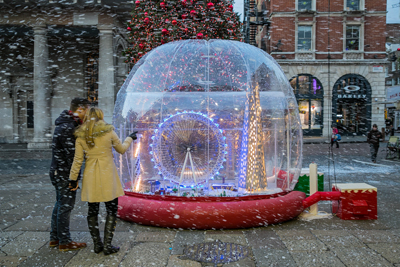
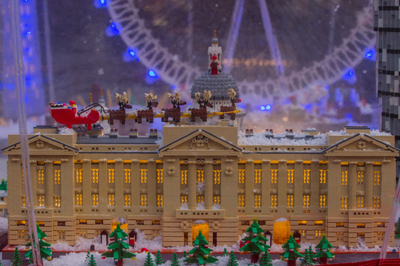
Following on from its LEGO advent calendar and Christmas tree, Covent Garden is home to a giant LEGO snow globe this Christmas. Made of 120,000 bricks, it features 14 of London’s most iconic landmarks – from Nelson’s Column, Buckingham Palace (see below) and the London Eye to The Shard, Shakespeare’s Globe and, of course, Covent Garden. The models took Duncan Titmarsh, the UK’s only certified LEGO professional, around 75 days to build. Hidden among the models are a number of LEGO Santas – count them to win prizes and press a button to make snow fall inside the globe. For more, see www.coventgardenlondonuk.com.

Covent-Garden-LEGO-snow-globe2

Around London – Reclaiming Castiglione; transport open weekend; and, Australia at the RA…

Oriental• The UK’s first major exhibition on the work of the innovative but violent 17th century artist Giovanni Benedetto Castiglione opens tomorrow at the Queen’s Gallery next to Buckingham Palace. The exhibition, which features 90 drawings and prints from the Royal Collection, is aimed at re-establishing Castiglione as one of the greatest artists of the Baroque period, thanks to his being credited with creating huge drawings in oil directly on paper, producing about 60 etchings and inventing the technique of monotype. Works include his monotype prints Head of an oriental (late 1640s) and The Nativity with angels (about 1655), a translation of Titian’s Sacred and Profane Love and drawings like Circe with the companions of Odysseus transformed into animals. Castiglione’s “nomadic” career was marred by his violent temperament – he was repeatedly before the courts for assaulting people, apparently tried to throw his sister off a roof and was forced to leave Rome because, it is believed, he had committed murder. Castiglione: Lost Genius runs with Gifted: From the Royal Academy to The Queen, an exhibition of prints and drawings given to the Queen by Royal Academicians to mark her Diamond Jubilee, until 16th March. Admission charge applies. For more, see www.royalcollection.org.uk. PICTURE: Giovanni Benedetto Castiglione, The head of an oriental, late 1640s. Royal Collection Trust/©Her Majesty Queen Elizabeth II 2013.

• The restored Met Locomotive 1 and the Victorian Jubilee Carriage 353 will be on show this weekend as part of the London Transport Museum’s Open Weekend at its Acton Depot. Visitors will be able to explore the depot’s vast collection of more than 400,000 objects along with a range of other activities including miniature tram and railway rides, heritage bus rides, talks and film screenings, and costumed interpreters as well as the chance to watch artist Ross Ashmore paint the locomotive and Jubilee Carriage. The weekend kicks off tomorrow. For more information and bookings, see www.ltmuseum.co.uk/whats-on/museum-depot/events.

• On Now: Australia. This landmark exhibition at the Royal Academy of Arts at Burlington House in Piccadilly features more than 200 works including paintings, drawings, photography, watercolours and multimedia pieces by 146 Australian artists. Spanning the period from 1800 until today, the display includes works by Aboriginal artists such as Albert Namatjira, nineteenth century immigrants such as John Glover and Eugene von Guerard, impressionists like Arthur Streeton and Tom Roberts, early modernists like Margaret Preston and Roy de Maistre, 20th century painters including Arthur Boyd, Albert Tucker and Brett Whiteley and contemporary artists including Gordon Bennett, Fiona Hall and Shaun Gladwell. Highlights include Frederick McCubbin’s The Pioneer (1904), four paintings from Sidney Nolan’s Ned Kelly series (1946), Rover Thomas’ Cyclone Tracy (1991) and Emily Kame Kngwarreye’s Big Yam Dreaming (1995). Organised with the National Gallery of Australia, the exhibition runs until 8th December. Admission charge applies. For more, see www.royalacademy.org.uk.

LondonLife – Recalling the Queen’s Coronation…

Coronation

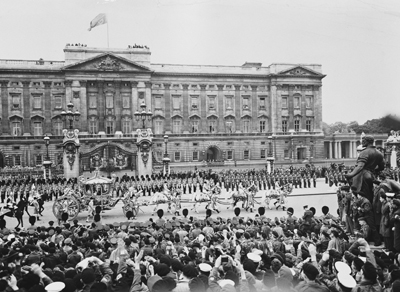
The Gold State Coach passes in front of Buckingham Palace on 2nd June, 1953. The image is among the displays at the special exhibition marking the 60th anniversary of the coronation of Queen Elizabeth II which forms part of the summer opening of Buckingham Palace’s State Rooms. The exhibition, which runs until 29th September, features dresses, uniforms and robes worn by the principal royal party on the day along with works of art, paintings and other objects related to it. Admission charge applies. For more, check out www.royalcollection.org.uk. PICTURE: Royal Collection Trust/All Rights Reserved.

Around London – Celebrating the coronation at Buckingham Palace; Royal births at the MoL; the Fourth Plinth unveiled; Menon remembered; and, manufacturing at the Design Museum…

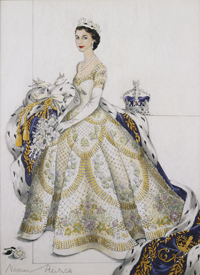
Norman-Hartnell-sketch• The Queen’s Coronation in 1953 is the subject of a special exhibition opening at Buckingham Palace as part of the palace’s summer opening. Celebrating the 60th anniversary of the coronation, the display features an array of outfits including uniforms and robes worn on the historic event on 2nd June, 1953, as well as a series of paintings recording the event, works of art and objects used on the day and film footage and sound recordings. Among the highlights of the exhibition will be sketches made by Norman Hartnell, the principal designer of the outfits worn at the coronation by the Queen, principal ladies of the immediate Royal Family and the Maids of Honour. The State Rooms of Buckingham Palace open on Saturday and remain open until 29th September. An admission charge applies. For more, see www.royalcollection.org.uk. PICTURE: Her Majesty The Queen in her Coronation Dress, 1953, Norman Hartnell. Royal Collection Trust/All Rights Reserved.

• Meanwhile in this, the week of the birth of Prince George, it’s only fitting that we mention a small display at the Museum of London showcasing memorabilia relating to royal babies of years past. A Royal Arrival features baby clothes and other items worn by future monarchs. They include a embroidered skullcap worn by the future King Charles I, a tiny linen vest and mitten which once was worn by the future King George III and a dress emblazoned with the three feather insignia which belonged to the future King Edward VII, eldest son of Queen Victoria. The free display will be on show until October. For more, see www.museumoflondon.org.uk.

• The new commission for Trafalgar Square’s Fourth Plinth will be unveiled today. The 4.7 metre high sculpture, Hahn/Cock, is the work of contemporary artist Katharina Fritsch. It will sit on the plinth for the next 18 months.  For more details, see www.fourthplinth.co.uk.

• Indian statesman VK Krishna Menon has been commemorated by English Heritage with a blue plaque on his former residence in Highgate. A key campaigner for Indian independence, Menon lived at 30 Langdon Road from 1929 to 1931, having moved to England from Madras in 1924. In 1947, Menon was appointed India’s First High Commissioner in London and among his greatest achievements was his work in keeping the country in the British Commonwealth after independence. Having been a local councillor in St Pancras, he later returned to India and embarked upon a political career there. For more, see www.english-heritage.org.uk/discover/blueplaques/.

The-Future-Was-Here• On Now: The Future is Here. A major new exhibition examining the changes taking place in manufacturing around the world, opened this week at the Design Museum. The Future is Here looks at how everything from “cars to shoes” is manufactured, funded, distributed and bought. Among highlights is a ‘Factory’ where visitors can discover how 3D printing works and see production in process. There will also be the chance to make your own ‘action doll’ and see a sofa designed through a crowd-sourcing process which involved members of the public. Runs until 3rd November. Admission charge applies. For more, see www.designmuseum.org.

Special – 10 facts about royal births of years past…

Buckingham-Palace

As we all know by now, Prince William and Kate, Duchess of Cambridge, are proud parents of a new born son with news of the new arrival provoking celebrations across Britain and, indeed, the world.

To celebrate the royal birth, here are 10 interesting facts about some previous royal births in London…

• The last time a Home Secretary attended a royal birth was in 1936 for the birth of Princess Alexandria, cousin of the Queen. The practice was officially stopped before the birth of Prince Charles in 1948.

• Such was the doubt over whether Mary of Modena, wife of King James II, was really pregnant that more than 40 eminent people were invited to witness the birth of their son Prince James in 1688 (and even then the rumours of that the stillborn baby had been swapped for another were rife).

• Queen Anne, who ruled from 1702-1714, went through 17 pregnancies but, tragically, outlived all of her children, her last surviving child – the Duke of Gloucester – dying in 1700.

• The tradition of firing a 41 gun salute on the news of the birth of a future monarch dates from the birth of the future King Edward VII. Twenty-one shots are fired in honour of the birth with an additional 21 fired because the guns are located in Green Park, a Royal Park.

• Queen Elizabeth II was born by caesarean section at 2.40am on April 21, 1926, at the home of her mother’s parents – 17 Bruton Street in Mayfair. (See our previous post on this here).

• Such was the animosity between Frederick, Prince of Wales, and his father, King George II, that when Frederick’s wife Augusta went into labour at the king’s home of Hampton Court Palace, he bundled her into a coach and had her taken to his home of St James’s Palace. With no preparations made there, his newly born daughter had to be wrapped in a tablecloth (the story is retold in detail in Lucy Worsley’s terrific book, Courtiers: The Secret History of the Georgian Court)

• Queen Victoria, who had nine children, used chloroform for pain relief during later births, despite the concept being frowned upon by some officials.

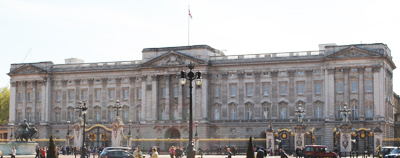
• Buckingham Palace (pictured above) has been the birthplace of numerous Royal Family members. Of course, Prince Charles was born here in 1948 as was his brother Prince Andrew (1960) and Prince Edward (1964) but so too – somewhat earlier – were 14 of King George III and Queen Charlotte’s 15 children when the property was known as Buckingham House and, later, the Queen’s House. King Edward VII was the only monarch who both was born and died in the building.

• Such was the desperation of King Henry VIII for a son, that a document announcing the birth were drawn up to that effect prior to Anne Boleyn giving birth to a daughter, the future Queen Elizabeth I. The document was still issued – the only concession being an ‘s’ added to the end of the word prince.

• The oldest English king to father a child was King Edward I – he was 66-years-old when his last child, Princess Eleanor, was born in 1306. Queen Eleanor of Aquitaine, wife of King Henry II, was the oldest queen to father a child when she gave birth to the future King John at 44-years-of-age in 1166.

Around London – Tudor and Stuart fashion; Wellington Arch treasures; Hunterian celebrates 200 years; Regent Street and the world; and, Kaffe Fassett at the FTM…

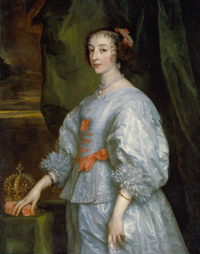
Queen-Henrietta-Maria-(Royal-Collection)• A landmark exhibition looking at fashion in the Tudor and Stuart eras opens at The Queen’s Gallery, Buckingham Palace, tomorrow. In Fine Style: The Art of Tudor and Stuart Fashion features everything from a diamond ring given by King Charles I to his then 19-year-old wife Henrietta Maria, an ornate set of armour which belonged to 13-year-old Henry, Prince of Wales (the older brother of King Charles I – he died of typhoid fever at the age of 19), and a diamond-encrusted box in which Queen Mary II kept black fabric patches worn to conceal blemishes or highlight the creaminess of skin. A 58.5 carat pearl, named ‘La Peregrina’ (‘The Wanderer’) and given to Queen Mary I as an engagement gift from Philip II of Spain (and later presented to Elizabeth Taylor by Richard Burton on Valentine’s Day, 1969), is also among the objects on show along with a pendant featuring a miniature of Queen Elizabeth I. The exhibition also features more than 60 portraits from the Royal Collection showing the fashions of the time, including a portrait by Sir Peter Lely of court beauty Frances Stuart, Duchess of Richmond, who famously refused to become King Charles II’s mistress. Admission charge applies. Runs until 6th October. For more, see www.royalcollection.co.uk. PICTURE: Sir Anthony van Dyck, Queen Henrietta Maria, 1609-69. Royal Collection Trust/© 2013, Her Majesty Queen Elizabeth II.

• A medieval crozier and bejewelled ring discovered in Cumbria in 2010 are on public display for the first time in a new exhibition at Wellington Arch. The artefacts, which were discovered at Furness Abbey, are featured in an English Heritage exhibition, A Monumental Act: How Britain Saved Its Heritage, which explores how the Ancient Monuments Act of 1913 helped protect Britain’s historical fabric. Other objects in display include some of the historic artefacts found in the 20 years following the act – a Roman bronze weight from Richborough Roman Fort in Kent and a 13th century sculpture of Christ found at Rievaulx Abbey in Yorkshire. Admission charge applies. The exhibition runs until 7th July. For more, see www.english-heritage.org.uk/daysout/properties/wellington-arch/.

• The Hunterian Museum at the Royal College of Surgeons is celebrating its bicentenary this year and to mark the occasion, they’re holding a free exhibition focusing on the museum’s collections of human anatomy and pathology; natural history and artworks. The display will consider how the objects in the collection have informed the medical world and fallen under the gaze of visitors who have included surgeons as well as monarchs. The exhibition in the Qvist Gallery at the museum in Lincoln’s Inn Fields opens on Tuesday, 14th May, and runs until 9th November. For more, see www.rcseng.ac.uk/museums/hunterian.

• The world comes to Regent Street this Sunday with the ‘InsureandGo The World on Regent Street’ festival. Representatives from countries including Argentina, Egypt, Trinidad and Tobago, Turkey and China as well as the UK will showcasing the best of each country’s culture, music and dance, art, food and fashion. Activities will include tango lessons from Argentina, professional henna drawing from Egypt, a steel band from Trinidad and Tobago, and a Chinese drumming performance and lion dancing. The street will be closed for the day. For more, see www.regentstreetonline.com.

• On Now: Kaffe Fassett – A Life in Colour. This exhibition at the Fashion and Textile Museum in Bermondsey Street celebrates the work of American-born artist Kaffe Fassett and features more than 100 works including nine foot wide knitted shawls, coats and throws, patchwork quilts and a ‘feeling wall’ where visitors can touch the textiles on display. Admission charge applies. Runs until 29th June. For more, see www.ftmlondon.org.

LondonLife – ‘Hans of Antwerp’ at The Queen’s Gallery…

Hans-of-AntwerpRecently conserved, Hans Holbein the Younger’s portrait Hans of Antwerp is one of 27 works by the painter on display in the exhibition, The Northern Renaissance: Durer to Holbein, at The Queen’s Gallery, Buckingham Palace. The portrait was first recorded in the Royal Collection in 1639 when it was said to have been hung in King Charles I’s Chair Room at Whitehall (it was painted in the 1530s by Holbein, best known as King’s Painter to King Henry VIII). While it has been previously thought the sitter was a goldsmith (a close friend of Holbein and witness to his will in 1543), Royal Collection Trust conservators have now definitively ruled it to be that of a merchant, possibly a German of the Hanseatic League based at the London Steelyard. You’ll have to be quick to see the exhibition – it winds up on 14th April. Admission charge applies. For more, see www.royalcollection.co.uk.

PICTURE: Royal Collection Trust/ © 2012, Her Majesty Queen Elizabeth II.