This Week in London – Hampton Court Palace’s Tulip Festival, National Gallery acquires ‘Portrait of a Girl’, and, art at Canary Wharf…

• Hampton Court Palace is hosting its first ever Tulip Festival. Featuring more than 100,000 bulbs placed throughout the formal gardens, the festival pays homage to the estate’s long history of tulip cultivation and, thanks to partnership with the Hortus Bulborum in the Netherlands, involves some types of tulip that have not been on show at the palace since the 17th century. First introduced to the British Isles in the 1630s, tulip planting at Hampton Court dates back to the reign of Queen Mary II. Ten different heritage and modern types have been planted across the gardens for the festival including Parrot, Triumph, Rembrandt and Darwin tulips. Visitors can undertake a self-guided trail which takes in both the palace’s courtyards – filled with ornate planters and flowers specially-selected to match the historic brickwork – and the gardens. Admission charge applies (tickets must be pre-booked). Runs until 3rd May. For more, see www.hrp.org.uk/hampton-court-palace/whats-on/tulip-festival-2021.

Isaack Luttichuys (1616–1673), Portrait of a Girl, about 1650 © The National Gallery, London

• The National Gallery has acquired Portrait of a Girl (about 1650) by Isaack Luttichuys, the first work by the artist to enter a British public collection. Luttichuys, who name is pronounced ‘Lootickhouse’, was born in London to Dutch parents and spent his early life in England (where the family was known as Littlehouse, the literal English translation of the name). The artist later moved to Amsterdam where he enjoyed a highly successful career as a portrait painter until his death in 1673. The work was acquired from the estate of banker and philanthropist George Pinto under the Acceptance in Lieu scheme, administered by the Arts Council. 

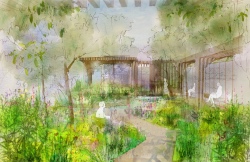
• Escape to faraway lands with a new art installation at Crossrail Place Roof Garden at Canary Wharf. Crossorelle is the work of artists Baker & Borowski, and features a design inspired by the Jardin Majorelle in Marrakech which fuses the Moroccan garden’s rich palette and art deco shapes with exotic flora. Free to visit, the display can be seen until 19th June. For more, see https://canarywharf.com/whats-on/crossorelle-roof-garden-mar-jun-2021/.

Send all items for inclusion to exploringlondon@gmail.com.
10 London hills – 3. Tower Hill…

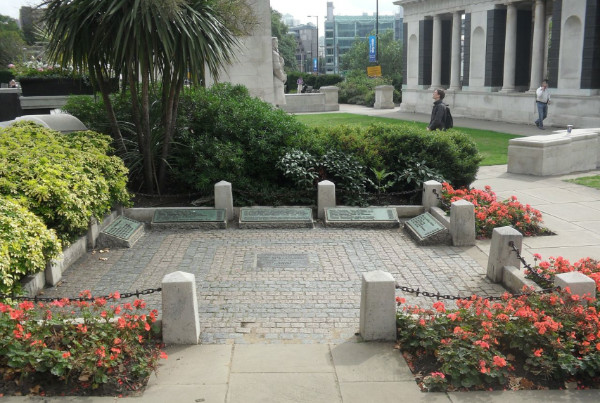
The site of scaffold on Tower Hill. PICTURE: Bryan MacKinnon (licensed under CC BY-SA 3.0)

The last of the three hills at least partly within the walls of the old City of London is Tower Hill, located at the City’s eastern end.

Famed as a site of public execution, Tower Hill – which rises to almost 14 metres above sea level – was traditionally where traitors who had been imprisoned in the nearby Tower of London met their final moments.

More than 120 people have been executed on the site, everyone from Sir Simon de Burley, tutor to King Richard II, in 1388, through to Thomas Cromwell in in 1540 and a soldier arrested during the Gordon Riots of 1780.

These days the gallows and scaffold – and the crowds which accompanied them – are long gone, marked by a stone set in the pavement at the western end of Trinity Square.

The hill, which is just to the north of the Tower of London and takes its name from it, was historically part of the tower liberties – meaning authorities could ensure nothing was developed on it which would affect the defences of the fortress.

It is the site of one of the remaining sections of the Roman and medieval wall which once surrounded the City of London (the hill is located on both sides of the wall).

A Tube station, Tower Hill, which opened in 1884 (it was originally named Mark Lane and the name changed to Tower Hill in 1946; it relocated to the current site in 1967).

The hill is also home to the Tower Hill Memorial – a pair of memorials dedicated to the mercantile marines who died in World War I and World War II – set inside the public park known as Trinity Square Gardens.

This Week in London – Women commemorated in new Blue Plaques, and, Buckingham Palace gardens explored…

• A social reformer, a former slave turned campaigner and the “people’s princess” are among six women who will be commemorated with new English Heritage Blue Plaques this year. The first of the new plaques – dedicated to crystallographer and peace campaigner Kathleen Lonsdale – was unveiled last week at the home in Seven Kings, Redbridge, where she lived from 1911 to 1927 during her early days at UCL and the Royal Institute. Lonsdale went on to carry out ground-breaking work on crystal structures and played what’s described as a “fundamental role” in progressing x-ray crystallography. Other plaques will commemorate social reformer Caroline Norton, designer Jean Muir, former slave and campaigner Ellen Craft, barrister Helena Normanton, and, Diana, Princess of Wales. For more on English Heritage’s Blue Plaques, see www.english-heritage.org.uk/visit/blue-plaques/.

The lake in the grounds of Buckingham Palace. PICTURE: Bob Jones (licensed under CC BY-SA 2.0)

• The garden at Buckingham Palace will open to the public this summer, allowing visitors to explore the 39 acre grounds on a self-guided tour for the first time. The route will encompass the 156-metre herbaceous border, plane trees planted by Queen Victoria and Prince Albert, and take in views of the garden’s 3.5 acre lake and island with its beehives. Visitors will also have the chance to enjoy a picnic on the lawns and explore the south-west of the garden – which includes the Rose Garden, summer house and wildflower meadow – on guided tours. Meantime, during April and May enthusiasts are able to enjoy the garden in springtime on guided tours. And for those unable to make it in person, a series of digital talks, A Warden’s Welcome, which explore Buckingham Palace, Windsor Castle and the Palace of Holyroodhouse kick off online next Wednesday. Charges apply for all – for more information and tickets, see www.rct.uk.

Send all items for inclusion to exploringlondon@gmail.com.

This Week in London – Gold bunnies at Hampton Court; ‘The Adoration of the Kings’ on a phone; and last two trees for London Blossom Garden…

Despite the ongoing impacts of the coronavirus pandemic, we hope you have a happy Easter break!

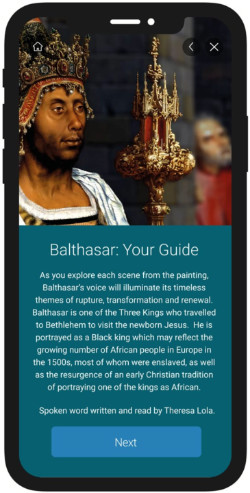
A screenshot from ‘Sensing the Unseen: Step into Gossaert’s ‘Adoration’, mobile edition’

• The National Gallery’s first exhibition aimed at mobile phone users – exploring Jan Gossaert’s masterpiece, The Adoration of the Kings – goes live from Friday. Sensing the Unseen: Step into Gossaert’s ‘Adoration’, mobile edition features six poems in the voice of King Balthasar, a character depicted in the painting, who interprets six scenes shown in the work while interactive sound brings them to life, all in an effort to guide people to details they may have missed in the work. Users can use their zoom function to explore the masterpiece’s minutiae and share their favourite finds on Instagram. The mobile phone offering is a pre-cursor to the planned reopening of the physical exhibition Sensing the Unseen: Step into Gossaert’s ‘Adoration’ – forced to close just a week after opening last December – on 17th May. To see the mobile display, head to nationalgallery.org.uk/visiting/virtual-tours.

• Hampton Court Palace is once again holding its Lindt Gold Bunny hunt for Easter. Families are invited to join in the search for the famous Lindt Gold Bunnies which have been hidden around the palace, enjoying the gardens along the way. Using a trail map, children will be able to learn about various lesser known Hampton Court residents including John Dale, Henry VIII’s master cook, and John Blanke, the King’s royal trumpeter. Successful treasure hunters can then claim a chocolate reward and a pair of gold bunny ears. Included in admission, the trail is designed for children aged three to 12-years-old and takes about one-and-a-half hours to complete. Runs until 18th April. For more, see www.hrp.org.uk/hampton-court-palace/whats-on/easter-lindt-gold-bunny-hunt/.

• The final two blossom trees have been planted in the new London Blossom Garden. The public garden, which is being created as a lasting, living memorial to Londoners who have lost their lives to COVID-19 and the city’s shared experience of the pandemic, is located in the northern part of Queen Elizabeth Olympic Park in Newham. Scheduled to open later this spring, it has been created in partnership with the National Trust and with the support of Bloomberg, and features 33 blossoming trees representing London’s boroughs and the City of London.

Send all items for inclusion to exploring-london@gmail.com

10 London sites related to St Thomas Becket – A recap…

We’ve finished our series on London sites related to the story of Thomas Becket. Before we move on to our next special series, here’s a recap…

1. Cheapside…

2. Merton Priory…

3. Guildhall…

4. London churches…

5. The Tower of London…

6. Westminster Abbey…

7. Southwark…

8. St Thomas Becket memorial…

9. St Thomas’ Hospital…

10. The Pilgrim’s Way…

We’ll launch our new series next Wednesday.

Famous Londoners – Old Martin…

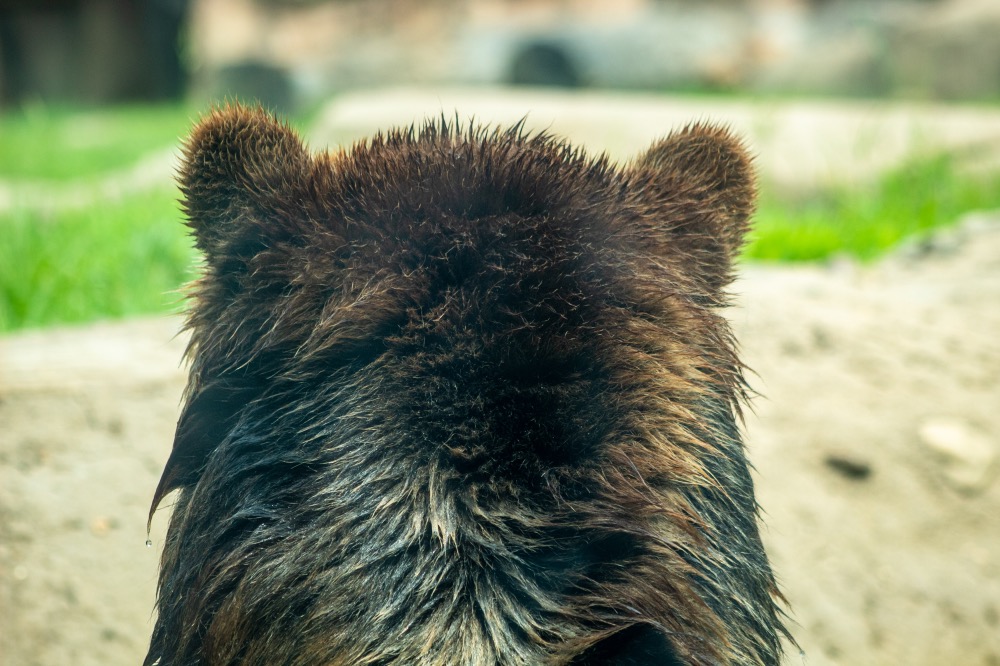
A grizzly bear (not Old Martin). PICTURE: Joshua J Cotten/Unsplash

A large, fully grown, grizzly bear presented to King George III by the Hudson’s Bay Company in 1811, Old Martin was one of the scarier residents of the Tower of London’s menagerie.

The bear, who was apparently named after a famous bear in Europe (the “old” was added because he spent so long in resident at the Tower), is said to have been the first grizzly in London.

He was not, however, the first bear to live there – King Henry III had been given a polar bear by King Haakon IV Haakonsson of Norway in 1251 (George, however, was apparently unimpressed with his gift, said to have commented in private that he would have preferred a tie or pair of socks).

Despite his many years in the menagerie, Old Martin apparently refused to be tamed and remained fierce towards both strangers and his keepers alike.

When the Duke of Wellington closed the menagerie in the early 1830s (King William IV apparently had little interest in the animals), Old Martin was moved to the London Zoo in Regent’s Park. He died there in 1838.

His skin and skull were subsequently sent to the Natural History Museum and rediscovered there in 1999 for an exhibition at the Tower.

There’s a rather odd story associated with Old Martin. It’s said that in 1816 – when Old Martin was living in the Tower’s menagerie – a Yeoman Warder saw a ghostly bear while on night duty near the Martin Tower. He apparently attempted to run it through with a bayonet but the blade went straight through and struck the door frame behind it. The somewhat dubious story goes that the poor Yeoman Warder died of shock just a few hours later.

This Week in London – Famous faces take in history, and, the Tudor world brought to life…

• Famous faces from TV and radio including Strictly Come Dancing champion Oti Mabuse and her partner Marius Iepure, Radio 2’s Reverend Kate Bottley and TV presenter Monty Halls, are visiting dramatic historic locations that are special to them in a new series of videos launched by Historic England. In each film in the #UncoverMore campaign, the personalities “discover a thread through time that brings to life the stories of people, places and spaces that have survived through the decades”. In their film, Oti and Marius dance at two of England’s oldest ballrooms (at Powderham Castle and Hampton Court Place), while Rev Bottley visits Loughborough Bellfoundry, and Monty Halls takes in ‘The Lost Gardens of Heligan’. To watch the videos, head to https://historicengland.org.uk/coronavirus/culturerecoveryfund/uncover-more/.

• The magnificence of the Tudor world will be bought to life in an online talk featuring Historic Royal Palace’s Chief Curator Dr Lucy Worsley next Wednesday. Worsley will be joined by Professor Glenn Richardson from St Mary’s University and fellow Historic Royal Palaces curators Dr Alden Gregory and Brett Dolman in an hour long talk that will focus one of “the most spectacular examples of royal showmanship”, the Field of Cloth of Gold, the 1520 event when Henry VIII met near Calais with his great rival François I of France. The talk will also feature a sneak preview of Hampton Court Palace’s upcoming exhibition Gold and Glory: Henry VIII and the French King. The event is free (although donations of £10 are encouraged). To register, head here.

Send all items for inclusion to exploringlondon@gmail.com.
10 London sites related to St Thomas Becket – 5. The Tower of London…

Thomas left the employ of Theobold, Archbishop of Canterbury, in 1154 when he took up the role of Chancellor for the newly crowned King Henry II (on Theobold’s recommendation).

The new role meant he wasn’t much in London over the next eight years – King Henry II spent less than two-and-a-half years in England during that period and Becket’s new role meant he was expected to be with the King.

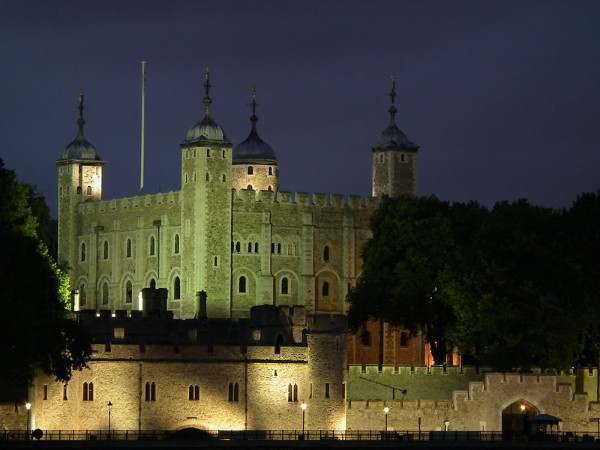
The Tower of London (the expansive St Thomas’s Tower is on the front left). PICTURE: flicksmores (licensed under CC BY-NC-ND 2.0)

One London connection during this period came about, however, when King Henry II awarded him the custody of the Tower of London (the role which is now known as Constable of the Tower and was apparently then referred to as Keeper of the Tower).

Interestingly, Becket is just one of four Archbishops of Canterbury who held the post (although he was Archbishop later) but is the only saint to have done so.

During his time as Constable of the Tower, Becket did carry our substantial repairs on the complex (while Chancellor he also oversaw repairs to other buildings including the Palace of Westminster).

There is a further connection between Becket and the Tower – King Edward I, during his rather dramatic renovations and expansion of the fortress, included a chapel dedicated to the martyred St Thomas in the royal quarters. To this day, the tower which fronts the Thames is known as St Thomas’s Tower (the naming of Traitor’s Gate, formerly known as Water Gate, under it occurred much later and had nothing to do with him).

This Week in London – The ‘Queen’ is missing from the Tower; and, ‘Unreal City’ online…

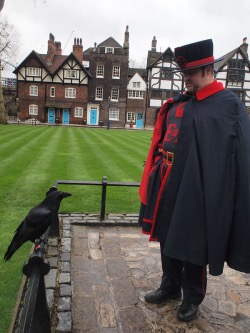
Merlina and Christopher Skaife in 2014. PICTURE: Megan Rosenbloom (licensed under CC BY-NC 2.0)

• The ‘Queen’ is missing from the Tower of London. ‘Merlina’, who is one of seven ravens in residence at the Tower under the care of raven master Christopher Skaife, reportedly hasn’t been seen at the fortress for several weeks. A spokesman for the Tower said it was feared Merlina, who joined the flock in 2007, had died. “Merlina was our undisputed ruler of the roost, Queen of the Tower Ravens,” he told the Evening Standard. “She will be greatly missed by her fellow ravens, the ravenmaster, and all of us in the Tower community.” Legend states that there must be six ravens at the Tower or the Kingdom will fall.

• An exhibition of augmented reality art (often known as AR art) is available to be viewed online. Unreal City, described as London’s biggest public festival of AR art, was launched back in December and involved 36 digital sculptures by the likes of Olafur Eliasson, Cao Fei, Alicja Kwade, Koo Jeong A, and Marco Brambilla, arranged in a walking tour along the Thames. The festival, which is  a partnership between Acute Art and Dazed Media, has now made the works available to be seen online via the via the Acute Art app. Also to be seen are works by artists KAWS, Bjarne Melgaard, and Tomás Saraceno.  The works can be seen for free via the Acute Art app until 9th February.

Send all items for inclusion to exploringlondon@gmail.com.
This Week in London – Buckingham Palace masterpieces; the Museum of London wants your dreams; theoretical physicist honoured; and, Khadija Saye’s self-portraits…

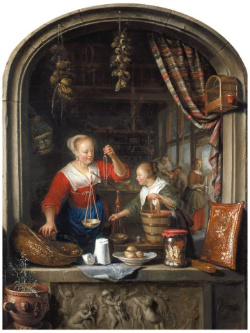
Gerrit Dou The Grocer’s Shop (1672) Royal Collection Trust/© Her Majesty Queen Elizabeth II

• World renowned artworks from Buckingham Palace’s Picture Gallery go on show at the Queen’s Gallery from tomorrow. Masterpieces from Buckingham Palace features 65 works by the likes of Titian, Rembrandt, Rubens, Vermeer, Van Dyck and Canaletto and, unlike in the tours of the State Rooms, visitors to the Queen’s Gallery will face the chance to enjoy the works close-up. The paintings on show include Johannes Vermeer’s The Music Lesson (early 1660s), Sir Peter Paul Rubens Milkmaids with Cattle in a Landscape, (c1617–18), Rembrandt’s The Shipbuilder and his Wife (1633), Canaletto’s The Bacino di San Marco on Ascension Day (c1733–4), Titian’s Madonna and Child in a Landscape with Tobias and the Angel (c1537) and Gerrit Dou’s The Grocer’s Shop (1672). The exhibition runs until January 2022. Advance booking is essential and admission charge applies. For more, see www.rct.uk.

• The Museum of London is seeking to record the dreams of Londoners during the coronavirus pandemic in a new project with the Museum of Dreams at Western University in Canada. Guardians of Sleep represents the first time dreams as raw encounters and personal testimonies will be collected by a museum. Londoners are being asked to register their interest to take part by 15th January with conversations with members of the Dreams network – an international team of trained scholars from the psychosocial community, slated to be held over Zoom in February. Contributions will be considered for acquisition by the Museum of London as part of its ‘Collecting COVID’ project. To volunteer to participate in the study, or to find out more details, members of the public should contact info@museumofdreams.org.

• Abdus Salam, a Nobel Prize-winning theoretical physicist, has been honoured with a Blue Plaque at his former property in Putney. The red brick Edwardian house was the Pakistani scientist’s London base from 1957 until his death in 1996. It features a study where Salam would write while listening to long-playing records of Quranic verses and music by composers ranging from Strauss to Gilbert and Sullivan. Salam’s work on electroweak theory contributed to the discovery of the Higgs boson particle – the ‘God particle’ which gives everything mass, and he was also involved in improving the status of science in developing countries.The unveiling comes as English Heritage issues a call for the public to nominate more notable scientists from history for its Blue Plaque scheme in London with only around 15 per cent of the 950 plus blue plaques across the capital dedicated to scientists. For more, see www.english-heritage.org.uk/visit/blue-plaques/.

• A self-portrait series by late Gambian-British artist Khadija Saye can be seen at the British Library’s entrance hall from today.  Khadija Saye: in this space we breathe features nine silk-screen prints and demonstrates Saye’s deep concern with “how trauma is embodied in the black experience” as well as her Gambian heritage and mixed-faith background. Saye, who died in 2017, photographed herself with cultural, religious and spiritual objects of significance both to her Christian mother and Muslim father and in African traditions of spirituality. The free display is on show until 2nd May. For more, see www.bl.uk.

Send all items for inclusion to exploringlondon@gmail.com.
LondonLife – Buckingham Palace’s Picture Gallery empties out…

Old Masters have been removed from the Picture Gallery at Buckingham Palace for the first time in almost 45 years to allow for essential maintenance works. The works, which include paintings by Titian, Rembrandt, Vermeer, Van Dyck and Canaletto, will be featured in a landmark new exhibition – Masterpieces from Buckingham Palace – which, featuring some 65 artworks in total, opens in the palace’s Queen’s Gallery on 4th December. They have been removed from the Picture Gallery – one of the palace’s State Room where Old Master paintings have hung since the reign of King George IV in the 1820s – over a period of four weeks to allow for building improvements which will include the replacement of electrics and pipework – some of which has not been updated since the 1940s – as well as the gallery’s roof. The refurbishment is part of a £370 million, 10 year refit programme being carried out at the palace due for completion in 2027.

This Week in London – The ‘Fight for Women’s Rights’ at the British Library; ghosts at Hampton Court Palace; and, Arctic culture at the British Museum…

Banners loaned from Southall Black Sisters, Bishopsgate Institute, People’s History Museum, Sisters Uncut, Feminist Archive South (Courtesy of the British Library)

• The history of the women’s rights movement and the work of contemporary feminist activists is the subject of a new exhibition opening at the British Library tomorrow. Unfinished Business: The Fight for Women’s Rights, the opening of which was delayed due to the coronavirus pandemic, features everything from personal diaries and banners to subversive literature, film, music and art. Highlights include protest poems written by Sylvia Pankhurst on toilet paper in Holloway Prison following her imprisonment for seditious activity in January 1921, a first edition of Jane Austen’s debut novel, Sense and Sensibility, published anonymously ‘By a Lady’ in 1811, and, football boots belonging to Hope Powell, a veteran player who became the first woman to manage England Women in 1998. There’s also records of surveillance carried out on Sophia Duleep Singh, one of Queen Victoria’s god-daughters and a supporter of campaigns for women’s suffrage, and a piece of fence wire cut by writer Angela Carter’s friends and sent to her as a present from RAF Greenham Common in Berkshire where they were protesting against nuclear missiles. Runs until 21st February next year. Admission charge applies. For more, see www.bl.uk.

• Like a good ghost story? Hampton Court Palace is launched a new self-guided ‘Creepy Stories and Ghostly Encounters’ trail on Saturday. The trail takes in sites including those where the ‘Grey Lady’ – said to be the ghost of Tudor nursemaid – has appeared since Victorian times, the locations said to be haunted by two of King Henry VIII’s queens – Jane Seymour and Catherine Howard, and the site where a spectral figure was captured on film slamming shut a door in 2003. The palace is also unveiling a new display of carved pumpkins in the Royal Kitchen Garden. Entry charge applies. For more, see www.hrp.org.uk/hampton-court-palace/.

• The first major exhibition on the history of the Arctic and its Indigenous people, through the lens of climate change and weather, has opened at the British Museum. The Citi exhibition, Arctic: culture and climate, reveals how Arctic people have adapted to climate variability in the past and are facing today’s weather challenges. It features everything from rare archaeological finds, unique tools and clothing as well as artworks and contemporary photography with highlights including an eight-piece Igloolik winter costume made of caribou fur and an Inughuit (Greenlandic) sled made from narwhal and caribou bone and pieces of driftwood which was traded to Sir John Ross on his 1818 expedition as well as artworks commissioned specifically for the exhibition. These include an Arctic monument of stacked stones, known as an Inuksuk – used to mark productive harvesting locations or to assist in navigation – which was built by Piita Irniq, from the Kivalliq Region of Nunavut, Canada. Can be seen in the Sainsbury Exhibitions Gallery until 21st February. Admission charge applies. For more, see www.britishmuseum.org.

Send all items for inclusion to exploringlondon@gmail.com.
Treasures of London – The Diana Fountain…

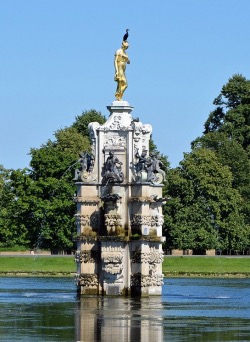
No, it’s not a memorial to that Diana, but a bronze statue depicting a mythological figure which forms the centrepiece of the Great Basin in Bushy Park.

Commissioned by King Charles I for his wife Queen Henrietta Maria, the statue (and other statuary on the monument) was the work of sculptor Hubert Le Sueur (he was also the sculptor of the famous equestrian statue of King Charles I which sits at the top of Whitehall).

While the 2.38 metre tall bronze statue, which weighs some 924 kilograms, is commonly referred to as Diana – the Roman goddess of hunting, she has none of the usual attributes of Diana, such as a bow, and is believed by some to actually represent Arethusa, a nereid or sea nymph from Greek mythology.

The statue is set on a marble and stone fountain carved with depictions of shells and sea life, and is surrounded, at a lower level, by groups of bronze statues -depicting boys holding fish or dolphins and water nymphs or mermaids astride sea monsters – through which water is discharged into four bronze basins.

The bronze figures were originally commissioned for a fountain, designed by Inigo Jones and built in the 1630s, in the Queen’s garden at Somerset House. Oliver Cromwell had the statues moved to the Hampton Court Palace’s Privy Garden in 1656 where they were incorporated into a fountain designed by Edward Pearce the Younger in 1689-90.

In 1713 the ensemble was moved again, this time to onto a new purpose-built podium in the middle of the Great Basin, located at the end of Bushy Park’s Chestnut Avenue, a grand avenue of trees designed by Sir Christopher Wren. While most of the statuary is believed to be from the original fountain designed by Inigo Jones, it’s thought some of the statues of the boys were recast for the new fountain.

The Grade I-listed monument was restored in 2009 and and during this process a stone which uncovered on its base which had a crown and the date AR 1712 (AR for ‘Anne Regis’) which would have been added when the statue and fountain were installed in the basin.

WHERE: The park lies north of Hampton Court Palace, just west of Kingston and Hampton Wick and south of Teddington (nearest train station is Hampton Wick or Hampton Court). WHEN: 24 hours except in September and November when it’s open between 8am and dusk; COST: Free; WEBSITE: www.royalparks.org.uk/parks/bushy-park

PICTURE: The Diana Fountain. PICTURE: It’s No Game (licensed under CC BY 2.0)

10 London buildings that were relocated…1. Marble Arch…

It’s well known that John Rennie’s London Bridge was purchased from the City of London by American entrepreneur Robert P McCulloch and in 1967 relocated to Lake Havasu City in Arizona. But what other London buildings have been relocated from their original site, either to elsewhere in the city or further afield?

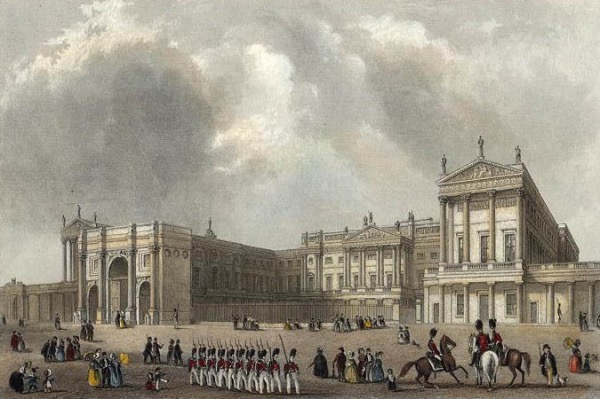
First up is Marble Arch, originally built as a grand entrance to Buckingham Palace. Designed by John Nash, the arch was constructed from 1827 and completed in 1833 (there was a break in construction as Nash was replaced by Edward Blore) on the east side of Buckingham Palace for a cost of some £10,000.

Inspired by the Arch of Constantine in Rome (and, it has to be said, some envy over the Arc de Triomphe du Carrousel in Paris, built to commemorate Napoleon’s military victories), the 45 foot high structure is clad in white Carrara marble and decorated with sculptural reliefs by Sir Richard Westmacott and Edward Hodges Baily.

An equestrian statue of King George IV was designed for the top by Francis Leggatt Chantrey but it was never put there (instead, it ended up in Trafalgar Square). The bronze gates which bear the lion of England, cypher of King George IV and image of St George and the Dragon – were designed by Samuel Parker.

The arch, said to be on the initiative of Nash’s former pupil, Decimus Burton, was dismantled and rebuilt, apparently by Thomas Cubitt, in its present location on the north-east corner of Hyde Park, close to Speaker’s Corner, in 1851.

There’s a popular story that the arch was relocated after it was found to be too narrow for the wide new coaches – this seems highly unlikely as the Gold State Coach passed under it during Queen Elizabeth II’s coronation in 1952. Actually, it was moved to create room for Buckingham Palace’s new east facade (meaning the palace’s famous balcony, where the Royal Family gather to wave, now stands where the arch once did).

Whatever the reasons, it replaced Cumberland Gate as the new ornamental entrance to Hyde Park, complementing the arch Decimus Burton had designed for Hyde Park Corner in the park’s south-east.

Subsequent roadworks left the arch in its current position on a traffic island. It stands close to where the notorious gallows known as the “Tyburn Tree” once stood.

The rebuilt, now Grade I-listed, arch contains three small rooms which, until the middle of the 20th century, housed what has been described as “one of the smallest police stations in the world”. Only senior members of the Royal family and the King’s Troop Royal Horse Artillery are permitted to pass through the central gates.

PICTURES: Top – Marble Arch in its current location and; Middle – and an 1837 engraving showing the arch outside Buckingham Palace.

Exploring London’s 100 most popular posts of all time! – Numbers 56 and 55…

The next two entries in Exploring London’s 100 most popular posts countdown…

56. Treasures of London – The Great Vine at Hampton Court Palace

55. 10 sites from Mary Shelley’s London…A recap…

Our new special Wednesday series will launch next week!

This Week in London – Kensington Palace reopens with Diana’s ‘Travolta dress’; institution reopenings; the Luna Cinema at Greenwich; and, ‘British Surrealism’ online…

• Kensington Palace has reopened its doors today after four months of lockdown and, to celebrate, the famous “Travolta dress” worn by Princess Diana is going on show for the first time. Designed by Victor Edelstein, the midnight blue velvet gown became the focus of world attention in 1985 when the Princess wore it to a White House Gala during which she danced with actor John Travolta. Historic Royal Palaces acquired the dress at auction in 2019. The palace will feature a new one-way route as part of coronavirus social distancing measures. For more, see www.hrp.org.uk/kensington-palace/.

• Other reopenings this week include: the Imperial War Museum, Churchill War Rooms, Wellington Arch, the Ranger’s House in Greenwich and the Jewel Tower in Westminster (Saturday, 1st July); the Royal Observatory in Greenwich (Monday, 3rd August); and, the Natural History Museum in South Kensington (Wednesday, 5th August).

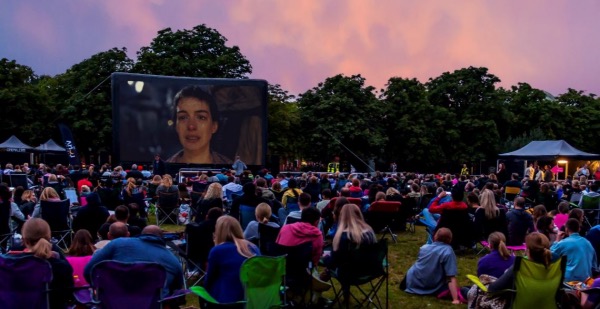
• The Old Royal Naval College at Greenwich will host Luna Cinema’s open-air cinema from Tuesday 4th to Thursday, 6th August. Audiences will be able to sing and dance along to blockbuster hits Rocketman, Judy and Dirty Dancing with the college as the backdrop. Meanwhile the Old Royal Naval College is launching new smartphone tours with the first, available for free on any smartphone using the Smartify app, a family tour aimed at those visiting with children aged five to 12 years. For more, see www.ornc.org.

• The Dulwich Picture Gallery’s British Surrealism exhibition will be available for anyone to view online from Friday. The exhibition, which celebrates the British artists that contributed to the iconic surrealist movement, features more than 70 artworks from 42 artists, including Leonora Carrington, Francis Bacon, Henry Moore, Paul Nash, Ithell Colquhoun, and Conroy Maddox. For more, see www.dulwichpicturegallery.org.uk.

Send all items for inclusion to exploringlondon@gmail.com.
LondonLife – Marking 72 years of the NHS…

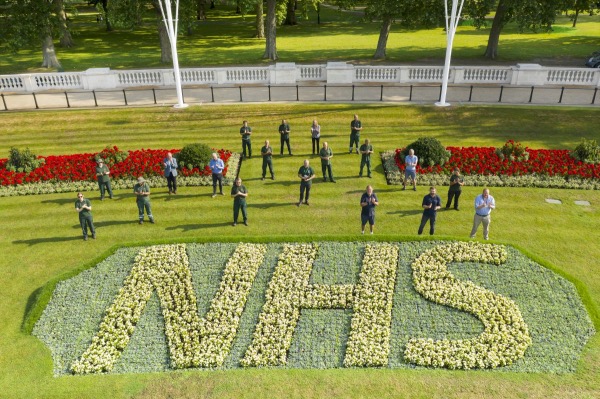
The Royal Parks have created two flowerbeds outside Buckingham Palace which spell out the letters ‘NHS’ in honour of the service’s 72nd birthday. The two 12 metre long flowerbeds, located in the Memorial Gardens – officially part of St James’s Park – contain some 45,000 flowers including scarlet geraniums, especially selected to match The Queen’s Guard at Buckingham Palace, as well as white begonias on a blue background of drought resistant succulents which, together replicate the colours of the NHS. The floral display – an appropriate tribute in this year of pandemic – can be seen until mid-September. PICTURES: Courtesy of The Royal Parks.

This Week in London – Tower of London lowers drawbridge; other openings include Westminster Abbey and The Queen’s Gallery…

• The Tower of London will officially lower the drawbridge in a symbolic ceremony this Friday morning to announce its reopening after a 16 week closure, the longest since World War II. A new one-way route has been introduced to allow for social distancing and while the Yeoman Warders, known as Beefeaters, won’t be restarting their tour immediately, they will be able to answer visitor questions. The Crown Jewels exhibition will also be reopening. Online bookings are essential. For more, see www.hrp.org.uk/tower-of-london/.

• Westminster Abbey reopens its doors to visitors on Saturday after the longest closure since it did so to prepare for the coronation of Queen Elizabeth II in 1953. The abbey will initially be open to visitors on Saturdays and on Wednesday evenings, with a limited number of timed entry tickets available solely through advance booking online.

• The Queen’s Gallery and the Royal Mews at Buckingham Palace as well as Royal Collection Trust shops reopened to the public this week. The Queen’s Gallery exhibition George IV: Art & Spectacle has been extended until 1st November while Japan: Courts and Culture, which had been originally due to open in June this year, is now expected to open in spring 2022. Tickets must be booked in advance at www.rct.uk/tickets.

• Other reopenings include Kew Gardens’ famous glasshouses (from last weekend) and the Painted Hall, King William Undercroft and interpretation gallery at Greenwich (from Monday 13th July).

Send all items for inclusion to exploringlondon@gmail.com.

PICTURE: Nick Fewings/Unsplash.


This Week in London – National Gallery – and other landmarks – to reopen while National Portrait Gallery remains closed to 2023…

• Plans are afoot for the reopening of London’s iconic historic and cultural institutions with The National Gallery becoming the first national museum in the UK the first to do so when it reopens its doors on 8th July. Special exhibitions include Titian: Love, Desire, Death which had to close after just three days and has now been extended to 17th January, 2021, and Nicolaes Maes: Dutch Master of the Golden Age which has been extended until 20 September. Meanwhile, Room 32 – one of the gallery’s largest rooms displaying 17th-century Italian paintings by artists including Caravaggio, Artemisia and Orazio Gentileschi, Guido Reni and Guercino – will reopen as the Julia and Hans Rausing Room after a 21 month refurbishment project while the Equestrian Portrait of Charles I by Van Dyck (about 1637/8) will be back on show in Room 21 after a more than two year restoration. There are also number of newly-acquired paintings on show including Liotard’s The Lavergne Family Breakfast (1754), Gainsborough’s Portrait of Margaret Gainsborough holding a Theorbo (about 1777) and Sorolla’s The Drunkard, Zaraúz, (1910). All visits must be booked online in advance and, of course, social distancing measures will be in place. For more, see www.nationalgallery.org.uk.

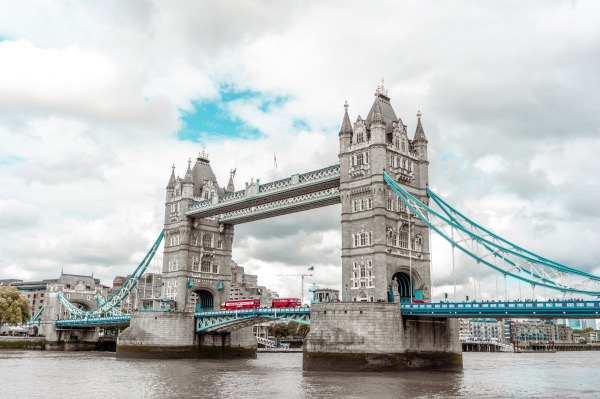
Tower Bridge is among landmarks reopening its doors in London. PICTURE: Javier Martinez/Unsplash 

• Other landmarks opening include Tower Bridge (with a new one way route from 4th July), Eltham Palace (from 4th July) and the Tower of London (from 10th July). Openings later this month include interiors at Hampton Court Palace (from 17th July) the British Library Reading Rooms (from 22nd July), and Kensington Palace (30th July). We’ll keep you informed as more sites open.

• And amid the openings, comes a closure with the National Portrait Gallery shutting its doors until spring 2023 to allow for a massive redevelopment project known as ‘Inspiring People’. The redevelopment project – the gallery’s biggest since the building in St Martin’s Place opened in 1896 – includes a comprehensive re-presentation of the gallery’s collection, spanning a period stretching from the Tudors to now, across 40 refurbished galleries along with a complete refurbishment of the building including the restoration of historic features, a new and more welcoming visitor entrance and public forecourt on the building’s north facade. For more, see www.npg.org.uk.

Send all items to exploringlondon@gmail.com

This Week in London – RHS Chelsea Flower Show goes virtual; National Gallery art on the streets; and, no summer opening at Buckingham Palace…

• The RHS Chelsea Flower Show is on this week but, due to the coronavirus pandemic, this year it’s a virtual affair. That’s good news for those who might not have been able to attend in person thanks to the stream of video content that’s being posted on the RHS website including garden design tips and planting ideas, virtual garden tours, ‘how to’ demonstrations and meet the growers sessions. Among highlights are a video featuring Sarah Eberle, the most decorated female designer in Chelsea history showing you around her woodland garden, a “lockdown tour” of some of London’s public parks, BBC presenter and multi-gold medal winning designer Adam Frost showing you around his Lincolnshire garden, florist Nikki Tibbles showing you how to create a seasonal bouquet and an update on what the Chelsea Pensioners have been up to on their allotment. The show runs until 23rd May. To see what’s on offer, head to www.rhs.org.uk/shows-events/virtual-chelsea. PICTURE: The Florence Nightingale Garden – A Celebration of Modern Day Nursing/© Robert Myers.

• The National Gallery has taken some of its most famous works out onto the streets thanks to a partnership with digital outdoor screen provider, Ocean Outdoor. Seven of the gallery’s most well-known images – Van Gogh’s Sunflowers (1888) and A Wheatfield, with Cypresses (1889), Monet’s The Water-Lily Pond (1899), van Eyck’s The Arnolfini Portrait (1434), Seurat’s Bathers at Asnières (1884), Vigée Le Brun’s Self Portrait in a Straw Hat (1782) and Rousseau’s Surprised! (1891) – are being shown on Ocean Outdoor’s giant screens for two weeks in cities around the UK including London. Head to www.nationalgallery.org.uk for more free art, films, stories and activities.

• The Royal Collection Trust has announced it will not open the State Rooms at Buckingham Palace to the public this summer due to the coronavirus pandemic. But the collection and palaces can be explored online at www.rct.uk.

Send all items to exploringlondon@gmail.com.